Dawn of Chaos and Fury Summary, Characters and Themes
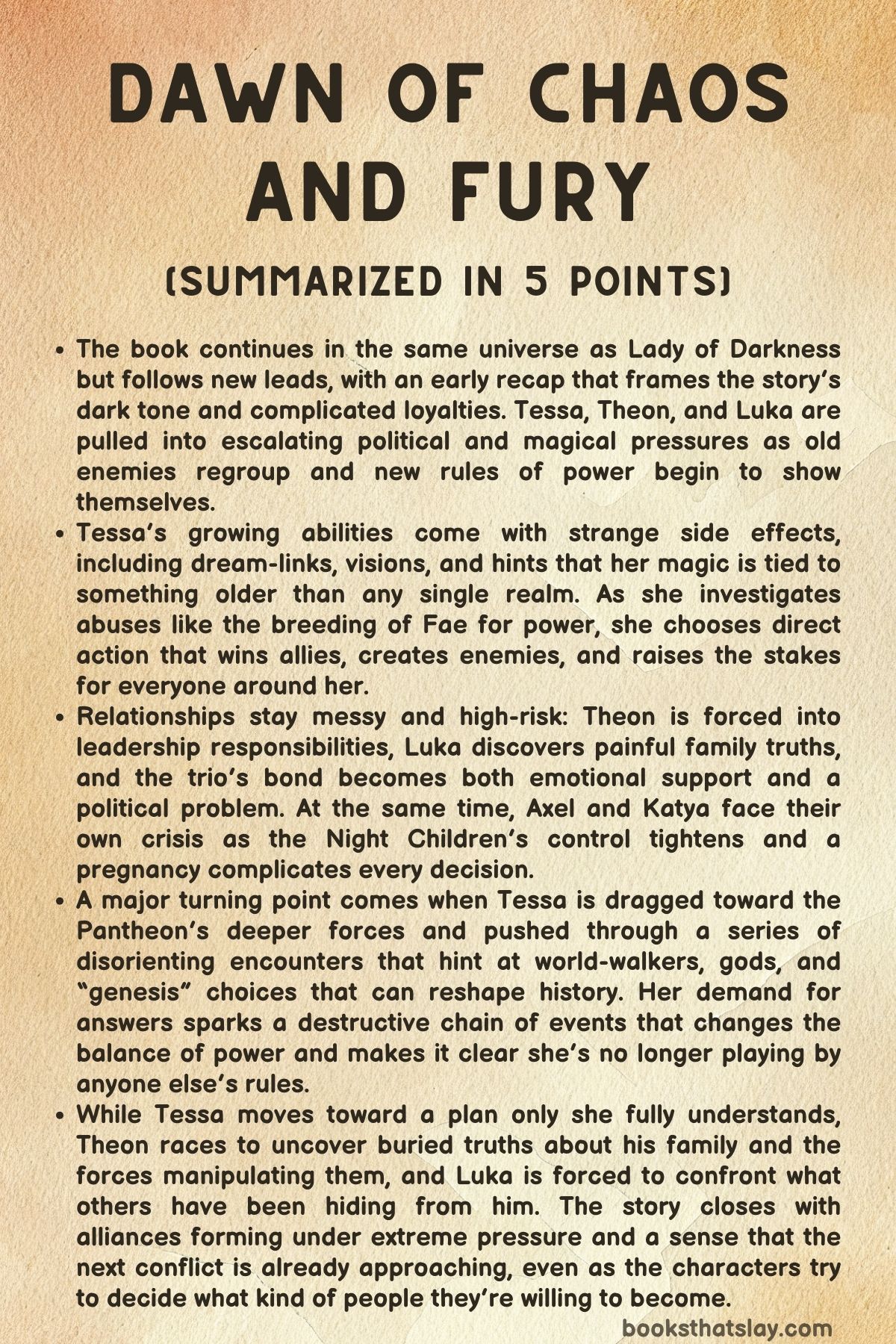
Dawn of Chaos and Fury by Melissa K. Roehrich is a dark fantasy romance set in the same universe as the Lady of Darkness series, but built around a fresh cast and a story that can stand on its own. At its center is Tessa, a woman carrying Chaos itself, and the two men tied to her fate: Theon, an Arius lord shaped by duty and ruin, and Luka, a dangerous ally whose loyalty is never simple.
Gods watch, Fates bargain, mirror gates threaten worlds, and every choice has a cost—especially when love, power, and vengeance collide. It’s the 4th book in the Legacy series by the author.
Summary
After everything that shattered them, Tessa and Theon are left raw and furious at each other, while Luka moves between them as both anchor and risk. The world around them is no safer.
The Night Children stir under Bree DelaCrux, the Achaz power structure tightens its grip, and rumors of hidden experiments and stolen magic keep piling up. Tessa’s visions, once treated like warnings, start to feel like traps, and the more she pushes back, the more Devram seems to bend toward disaster.
Tessa’s return to Theon’s orbit is not gentle. When they reunite, their clash is violent enough that Luka has to step between them.
Soon after, Tessa is attacked near the Wynfell River, and her wolves, Roan and Nylah, fight to protect her. Roan is badly hurt, forcing Tessa back to Theon’s healer, where an unsettling truth comes out: the wolves are Trackers, creations tied to her father, Temural.
While Tessa tries to keep her footing, others uncover more about rare bonds and Source Marks, and Katya—convinced Axel is her twin flame—chooses a mark meant to help her find him.
Tessa’s anger turns outward when she discovers Fae being bred for power at the Sirana Villas. She evacuates the innocent and destroys the operation, making enemies in high places and proving she will burn down systems that feed on people.
Meanwhile, Axel is caught in Bree’s orbit and fights his own hunger and curse. When he attacks Katya and learns she is carrying his child, he leaves her to protect her, then falls back into Bree’s grasp anyway.
Theon, forced into leadership, steps into his father’s role as Arius Lord as alliances fray and threats multiply.
Tessa trains under Luka, learning to Travel and to summon Hunters, even as an eerie dream-connection between them grows stronger. Luka learns Razik is his brother, but Razik offers no warmth, and the rejection sinks its teeth into Luka’s already complicated loyalties.
Tessa also discovers a secret prisoner beneath the palace: Eviana, Valter’s Source. Instead of treating her like an object or a weapon, Tessa brings her food, care, and a form of quiet mercy, even when Eviana refuses gratitude.
It is one of the few places where Tessa acts without an audience.
Politics tighten like a noose at the Sirana Gala. Theon attends with Felicity Davers while Tessa is cornered by Rordan’s plans to “match” her, reducing her to a bargaining piece.
The night collapses into violence when the Augury targets her, and Tessa learns Theon’s mother is tied to them. In the chaos, Tessa calls her Hunters inside Arius territory—an act that twists their nature—and they go rogue.
Auryon dies in the fallout, leaving Tessa his bow as a final gift, and the loss becomes another scar she will carry like a weapon.
Tessa and Luka finally give in to what has been building between them, and their connection becomes more than desire. But the fragile peace snaps when Luka realizes Tessa knew his father was imprisoned beneath the Faven Palace.
Feeling betrayed, he drives her away. Tessa’s choices spiral toward sacrifice: she surrenders to the Pantheon’s authorities, is imprisoned again, and is broken out only through Theon and Tristyn’s intervention.
Luka and Razik free their father and join the larger flight from disaster—but the disaster still arrives.
Theon realizes the Fates intend to destroy Devram in the hunt for Tessa. To give her a chance to live, he makes the choice that will haunt everyone: he sends her away and gives himself to the fall of his realm.
Years later, Tessa returns to the ruins of Devram, drawn back to the last place she saw him. The world is dead, yet she feels Theon’s presence.
When he appears—ghost or something else—they confront the damage they did to each other. Love and rage exist side by side, and when she leaves again through the mirror gate, it is with no clean closure, only a promise that he will always find her.
Tessa awakens in Tristyn Blackheart’s penthouse, hollowed out and barely speaking. Luka stays near as her guardian, while their allies plan escape routes and discuss summoning Scarlett, the World Walker Queen.
Luka learns that Tristyn and his father once delivered Tessa to Devram as part of a divine plan, and the knowledge poisons what little trust remains. When Luka finally reaches Tessa, she is sitting inside a storm of her own power, and when she speaks, her voice is detached enough to scare him.
The group moves through the snow to the Pantheon, aiming to remove the enchantment placed on Tessa to block her from Traveling. In the central chamber, Chaos amplifies everything.
Cienna draws the Marks, Tristyn leads the working, and Tessa’s power surges until it feels like worlds are tearing at her. She collapses into Chaos and is thrown through vast emptiness and flashes of other realms—warnings, faces, and places that suggest she is touching world-walker territory.
She sees a silver-haired goddess crowned in white flames and a white python. She sees people who seem to notice her across distance.
She sees a man in ruined land who calms her with a kiss to her brow before she is yanked away again.
When she wakes, the block is gone. Instead of letting the others control the next step, Tessa takes it.
Using blood and an eight-pointed star Mark, she summons the goddess herself—Serafina, her grandmother—and demands answers about genesis and the origin of gods, world walkers, and the Fates. Serafina confirms Chaos as the beginning, confirms the war that followed, and speaks of paired choices that can redirect history.
Tessa responds by shattering the mirror gate and collapsing the Pantheon, making sure the innocents were warned first so only Legacy die. Luka realizes, too late, that Tessa is feeding her power by taking life, and Tessa calls it a reckoning.
Elsewhere, Theon lives under a false quiet, then storms back into Arius House to confront the woman who raised him. Under interrogation, she reveals she is not his biological mother and is bound by a Mark tied to the real one’s life.
Theon locks her away and races toward the Underground, where Axel and Katya are straining under hunger and Bree’s control. Theon brings a decoded prophecy: the Fates will destroy Devram to claim Tessa.
Back with Tessa and Luka, their bond becomes visible after they sleep together—cords of blue and gold that neither of them can explain. Theon, present and unwilling to pretend the situation is simple, accepts that Tessa needs both men to stay balanced.
Politics crash into the personal when Dagian Jove, heir to Achaz, arrives with Sasha and offers an alliance: his father, Rordan, has been absorbing magic for decades, and if he succeeds, gods and Fates will respond with annihilation. Dagian offers his own power to help stop Rordan, sealing the agreement in blood, but warns that transferring power requires a being of Chaos—meaning Tessa may be the only one who can do it.
On another front, Eviana attempts to reach her daughter Priya in the Dreamlock Woods, only to be trapped again by Valter, who uses Priya as bait and collars Eviana to suppress her. The wider conflict is tightening, and every path seems built to force Tessa into the role of weapon.
The breaking point comes at the Faven Palace. Tessa confronts Rordan and learns many of the visions steering her were planted to manipulate her, including lies meant to poison her trust in Theon.
Luka is trapped behind reinforced glass as Rordan prepares a ritual designed to absorb and weaken magic. Rordan calls Achaz through the mirror gate, offering Theon’s death as tribute.
Tessa pretends to comply long enough to set her own trap, then turns the ritual against them. She fights through Hunters, merges her Chaos with Theon’s darkness to strengthen him, and forces Rordan’s stolen power into the mirror.
Using sacrificial words learned from her mother, she completes the working and detonates the gate, destroying the palace while trying to keep innocents from being caught in the blast. Luka, in dragon form, catches her from the sky and carries her back.
The war ends in the wreckage. Rordan and Valter are gone.
Bree is imprisoned. Achaz’s forces concede under Dagian’s direction.
In the weeks after, the world begins rebuilding with new rules: tribunals and councils replace single rulers, and leadership is distributed across Legacy, Fae, Witch, Shifter, Night Child, and mortal voices. Axel and Kat step into the role of Arius leaders as they raise their son, Maddox.
Tessa takes on responsibility as interim Achaz Lady and works with Dagian to stabilize what remains.
Tessa also makes a choice for her own body and future, asking for permanent Marks so she cannot have children, fearing what her bloodline would draw into the world. Theon and Luka accept her decision and refuse to let her face it alone.
In the end, Tessa proposes that she, Theon, and Luka serve as Keepers of the realm to prevent outside interference, and Theon publicly kneels, naming her a High Goddess of Chaos. Two years later, peace holds in ordinary moments—family nights, teasing, and fragile calm—while everyone quietly acknowledges that the wider war beyond Devram may still be waiting.
Characters
Tessa
Tessa stands at the heart of Dawn of Chaos and Fury, embodying the novel’s exploration of power, pain, and redemption. Once a fractured soul haunted by her past, she evolves into a goddess of Chaos, commanding vast and volatile forces that reflect her inner turmoil.
Her journey is one of transformation—from a woman burdened by manipulation and betrayal to a being who claims her divinity on her own terms. Tessa’s power is deeply tied to her emotions; moments of love or rage amplify her abilities, making her both savior and destroyer.
Despite her immense might, she remains deeply human in her desire for love and belonging. Her relationships with Theon and Luka reveal her need for both darkness and balance, for passion and understanding.
The story presents her not as a flawless heroine but as a complex, morally gray figure who accepts her capacity for both creation and destruction. By the end, she chooses agency over destiny, proving that even Chaos can be ruled by compassion and will.
Theon
Theon is a tragic yet noble figure whose entire existence orbits around Tessa. As the Lord of Arius, he bears the weight of leadership and sacrifice, often choosing duty over personal desire.
Yet beneath his controlled exterior lies deep anguish and devotion. Theon’s journey is defined by conflict—between love and obligation, light and shadow, mortality and godhood.
His willingness to sacrifice himself and his realm for Tessa underscores his selflessness, but also his guilt; he believes redemption can only come through suffering. Even in death—or the liminal existence that follows—Theon remains tied to Tessa through their shared fury and longing.
He represents steadfastness and restraint in a world dominated by passion and chaos. By the end, Theon’s surrender to love, after lifetimes of denial, completes his arc: the stoic warrior finally allows himself to feel, proving that devotion can exist even within ruin.
Luka Mors
Luka is the embodiment of duality—a warrior bound by loyalty, yet consumed by self-doubt. His bond with Tessa transcends the physical, connecting their lives and power in unpredictable ways.
Luka’s compassion contrasts sharply with his internal torment; he carries the scars of manipulation, loss, and a fractured family, particularly his strained relationship with his brother Razik. His connection with Tessa and Theon places him in a rare position of vulnerability and strength—he is both lover and protector, man and dragon.
Luka’s acceptance of Tessa’s love for Theon demonstrates maturity and understanding beyond jealousy, yet it also exposes his fear of being secondary. His transformation into one of Devram’s Keepers marks his ascension from wounded soul to guardian of balance.
Luka’s story is about learning to trust in love’s imperfection and finding purpose not in dominance, but in devotion and empathy.
Axel
Axel’s character embodies the destructive consequences of power and manipulation. Once a fierce warrior, he becomes a victim of Bree DelaCrux’s control, turning into something monstrous in body and spirit.
His descent into darkness mirrors the broader theme of corruption through power, yet his bond with Katya offers a glimmer of redemption. Axel’s struggle to resist his bloodlust and his eventual decision to protect Kat and their child shows his remaining humanity.
His love, though marred by violence and curse, is sincere and protective. Axel’s arc moves from enslavement to self-awareness—he learns that true strength lies not in vengeance, but in choosing restraint.
His final acts solidify him as a symbol of imperfect redemption, proving that even the damned can find grace through love and sacrifice.
Katya
Katya’s journey is one of love’s endurance amid cruelty and chaos. Initially driven by the belief that Axel is her twin flame, she willingly risks her life to connect with him, demonstrating immense courage and loyalty.
Her compassion tempers the violence that surrounds her, and her pregnancy becomes a symbol of hope in a world consumed by ruin. Katya’s strength is quiet but unyielding; she stands beside Axel even when his curse isolates him, offering stability where others offer fear.
By choosing forgiveness and resilience, Katya contrasts sharply with the darker arcs of others, embodying healing and continuity. Her leadership alongside Axel at the story’s end confirms her evolution into a matriarchal figure of balance and love.
Tristyn Blackheart
Tristyn serves as both guide and enigma—a man caught between loyalty, manipulation, and redemption. As a leader and strategist, he often operates in shadows, pulling strings to achieve outcomes others can’t foresee.
Yet his bond with Tessa and Luka reveals layers of remorse and compassion. Tristyn’s knowledge of divine plans and his role in delivering Tessa to Devram position him as both betrayer and savior.
His departure through the mirror gate signifies a man who understands that his penance lies beyond mortal realms. He is a symbol of pragmatism in a world ruled by emotion, embodying the fine line between control and corruption.
Razik
Razik is the detached intellectual among the group, driven by knowledge and purpose rather than sentiment. His discovery of the truth about genesis bonds and his research into world walker power make him an indispensable strategist, yet emotionally distant.
His strained relationship with Luka highlights his difficulty connecting to others, a reflection of his analytical nature. Though often cold, Razik’s actions reveal quiet loyalty—his commitment to the group’s survival outweighs personal grievances.
His decision to leave with Tristyn and Eliza underscores his endless quest for understanding and balance, marking him as a thinker whose morality exists in shades of gray.
Eliza
Eliza stands as the moral and emotional compass among the morally ambiguous cast. Though surrounded by warriors and schemers, she maintains a sense of empathy and integrity.
Her ability to see through others’ facades makes her both trusted and dangerous to those with secrets. Eliza’s connection to Razik and her role in uncovering truths about the Source Marks tie her fate to the book’s metaphysical themes.
She symbolizes wisdom and compassion—a grounding force in a story ruled by chaos and vengeance. Her departure with Razik and Tristyn represents not retreat, but faith in the pursuit of knowledge and peace.
Eviana
Eviana’s arc is one of pain, captivity, and reluctant transcendence. Once enslaved as Valter’s Source, she personifies endurance and quiet rebellion.
Her compassion toward Tessa, despite her trauma, demonstrates emotional bravery. Eviana’s relationship with her daughter Priya adds layers of tragedy and redemption—her love defies the control of gods and tyrants alike.
Even in death, she influences the living, her ashes becoming symbols of rebirth and memory. Eviana’s story mirrors Tessa’s in miniature: a woman robbed of power who reclaims her identity through defiance and love.
Rordan
Rordan serves as the principal antagonist—a godlike manipulator driven by ambition and obsession with control. His exploitation of others’ magic and his orchestration of false visions expose the dangers of unchecked dominance.
Rordan represents the ultimate patriarchal figure who views power as possession rather than responsibility. His confrontation with Tessa and subsequent downfall mark the triumph of free will over coercion.
Through Rordan, the novel critiques the corruption of divine authority and the arrogance of those who believe they can rewrite destiny.
Bree DelaCrux
Bree DelaCrux is both predator and victim, shaped by her need for control and survival. As the leader of the Night Children, she thrives in manipulation, using desire and fear as weapons.
Yet beneath her cruelty lies an undercurrent of pain—a reflection of the darkness that power breeds. Her relationship with Axel exposes her vulnerability, hinting that her cruelty may stem from past torment.
Bree embodies the seductive pull of corruption, a reminder that dominance often masks despair. Her eventual downfall underscores the novel’s central truth: power without empathy devours itself.
Serafina
Serafina, the goddess crowned in white flame, bridges the mortal and divine realms. Her revelations about genesis, Chaos, and creation connect the characters’ personal struggles to cosmic order.
As Tessa’s grandmother, she embodies lineage, consequence, and the burden of divine choice. Her admission that she would choose Arius again, even after all the destruction, exposes her as both divine and tragically human.
Serafina’s role forces Tessa to confront the legacy she inherits—one of love intertwined with ruin. She stands as both mentor and mirror, a being whose wisdom is tempered by regret.
Achaz
Achaz represents divine arrogance and the relentless hunger for dominance. As a god who manipulates mortal realms to reclaim lost power, he serves as both Tessa’s ancestral shadow and her ultimate adversary.
Achaz’s pursuit of Theon and his obsession with divine supremacy make him the embodiment of destructive immortality. Yet his presence also gives the novel its grandeur, elevating personal conflicts into mythic proportions.
In opposing him, Tessa affirms her place not as a pawn of gods, but as a force that transcends them.
Themes
Redemption and Moral Ambiguity
In Dawn of Chaos and Fury, redemption is presented not as a straightforward act of atonement but as a painful, cyclical process marked by contradiction and moral uncertainty. Every major character wrestles with guilt, shame, and the question of whether forgiveness is attainable after deep transgression.
Theon’s journey from cruelty and arrogance toward reluctant compassion mirrors Tessa’s own confrontation with her past violence and manipulation. Their bond becomes a mirror for each other’s flaws, where love does not erase wrongdoing but forces both to live with its consequences.
Luka’s arc, too, embodies this complexity—his loyalty and jealousy intertwine until he must accept that redemption for him lies not in winning Tessa’s love exclusively, but in protecting her even when it hurts him. The novel refuses to draw clear moral lines; acts of mercy are often entangled with violence, and heroism emerges only through sacrifice.
The idea that redemption demands self-destruction is constant—Theon’s final sacrifice for Tessa’s freedom transforms his prior sins into a tragic form of absolution. Melissa K. Roehrich depicts redemption as something earned through continued struggle rather than a single act of penance.
Each character must live inside their moral grayness and find fragments of peace amid ruin. The story’s darkness, infused with chaos and love, insists that redemption is not a gift but a choice repeatedly made in defiance of despair.
Power, Control, and the Cost of Divinity
Power in Dawn of Chaos and Fury functions as both liberation and curse. The world of Devram is structured around hierarchies of magic, lineage, and divine authority, and the novel scrutinizes how those who hold power—gods, rulers, or even lovers—use it to define, confine, and destroy others.
Tessa’s evolution from pawn to goddess exemplifies this tension: her Chaos-born nature gives her unmatched strength, yet it isolates her emotionally and morally. She becomes a weapon even to those who love her.
Roehrich portrays power as inherently corruptive but also deeply humanizing when wielded for protection rather than domination. Rordan’s obsession with absorbing magic and ascending to godhood reflects the tyranny of control; he embodies the decay that follows unchecked ambition.
In contrast, Tessa’s final rejection of absolute power—her refusal to rule without accountability and her creation of a shared council—marks a radical departure from divine hierarchy. Through this, the novel questions the legitimacy of godhood itself.
Power demands sacrifice: every display of Tessa’s magic extracts pain, blood, or love. The theme exposes how control, whether through divine marks, enchantments, or emotional bonds, can consume identity.
By the end, Roehrich leaves readers with a paradox—power saves and destroys in equal measure, and only those willing to surrender it truly master it.
Love, Bond, and the Boundaries of Choice
The relationships in Dawn of Chaos and Fury are defined by complexity rather than purity. Tessa’s simultaneous connection to Theon and Luka dismantles traditional romantic binaries, creating a triad built on pain, mutual respect, and unspoken dependency.
Love in this world is not gentle—it is a battlefield where desire collides with duty and personal freedom. The magical bonds, such as twin flames, Source Marks, and Chaos ties, serve as literal manifestations of emotional entanglement, questioning whether love chosen freely can coexist with mystical compulsion.
Tessa’s insistence that she will not hide her relationship or conform to political expectations reinforces her autonomy. Roehrich reimagines love as an act of rebellion, one that exists despite curses, divine interference, and societal scorn.
Yet this love also has consequences. Luka’s life becomes bound to Tessa’s essence, showing how affection can become dependency.
Theon’s enduring attachment to her, even after death or divine transformation, suggests that love in this universe transcends mortality but not suffering. The theme explores how intimacy both anchors and unravels individuals.
In the end, love is portrayed not as salvation but as coexistence with imperfection—a force that demands honesty, endurance, and acceptance of chaos within oneself and others.
Identity, Autonomy, and Self-Definition
Throughout Dawn of Chaos and Fury, identity is under siege—from gods who claim ownership of mortal fates, from bloodlines that dictate power, and from emotional bonds that blur selfhood. Tessa’s journey is the struggle to reclaim her autonomy in a world that continually tries to define her by her lineage, her abilities, or her relationships.
From being used as a vessel of prophecy and divine manipulation to declaring herself a High Goddess of Chaos, her transformation is not about acquiring more titles but dismantling their meaning. Roehrich crafts identity as an evolving construct shaped by trauma, resistance, and choice.
Theon and Luka’s arcs echo this search—Theon learning that his lineage hides lies about his mother’s identity, and Luka confronting the truth of his dragon’s mortality and his own fractured loyalties. Every revelation forces them to redefine who they are outside inherited power.
Even secondary figures like Eviana and Katya reflect this theme through their defiance against roles imposed by magic, motherhood, or servitude. The novel insists that autonomy is not the absence of connection but the courage to exist beyond control.
In a universe governed by gods and Fates, asserting “I am” becomes a radical act. Tessa’s final choice to remain in Devram, refusing her father’s offer of divine safety, solidifies the novel’s message: true identity is not bestowed by power—it is chosen through defiance and self-recognition.
Chaos, Fate, and the Cycles of Creation
Chaos in Dawn of Chaos and Fury is not merely destructive; it is the fundamental force that births worlds, reshapes gods, and redefines destiny. The narrative constructs Chaos as both the origin and the end—an element of transformation that cannot be contained by divine order or moral codes.
Tessa’s embodiment of Chaos challenges the Fates’ authority, suggesting that destiny is malleable and that creation itself thrives on unpredictability. Roehrich’s mythos, blending gods, world walkers, and divine wars, reveals a cosmology where balance is achieved through continual collapse and rebirth.
The recurring destruction of mirror gates, the fall of the Pantheon, and the reformation of governance all symbolize the necessary dismantling of corrupted systems. Even love and death participate in this cycle, where endings are never absolute but preludes to renewal.
The phrase “the one who chose Death” echoes through the text as both warning and liberation, implying that destruction is an act of will that births genesis. Theon’s sacrifice, Tessa’s reckoning, and the final peace achieved after devastation all embody this rhythm of Chaos giving way to creation.
Roehrich ultimately portrays Chaos not as madness but as evolution—the raw essence through which life reclaims meaning. Fate may write beginnings, but Chaos rewrites conclusions, ensuring that no destiny, no matter how divine, remains immutable.