The Things Gods Break Summary, Characters and Themes
The Things Gods Break by Abigail Owen is a mythic fantasy romance built around Greek gods, Titans, time fractures, curses, and impossible choices. The book follows Lyra, newly tied to the Underworld and to Hades, after she is trapped inside Tartarus with Boone.
What begins as a fight for survival becomes a larger battle against false history, manipulated memory, and a hidden enemy who has turned gods against Titans. At its center, the story is about love, sacrifice, self-creation, and the terrible price of saving a world built on lies.
Summary
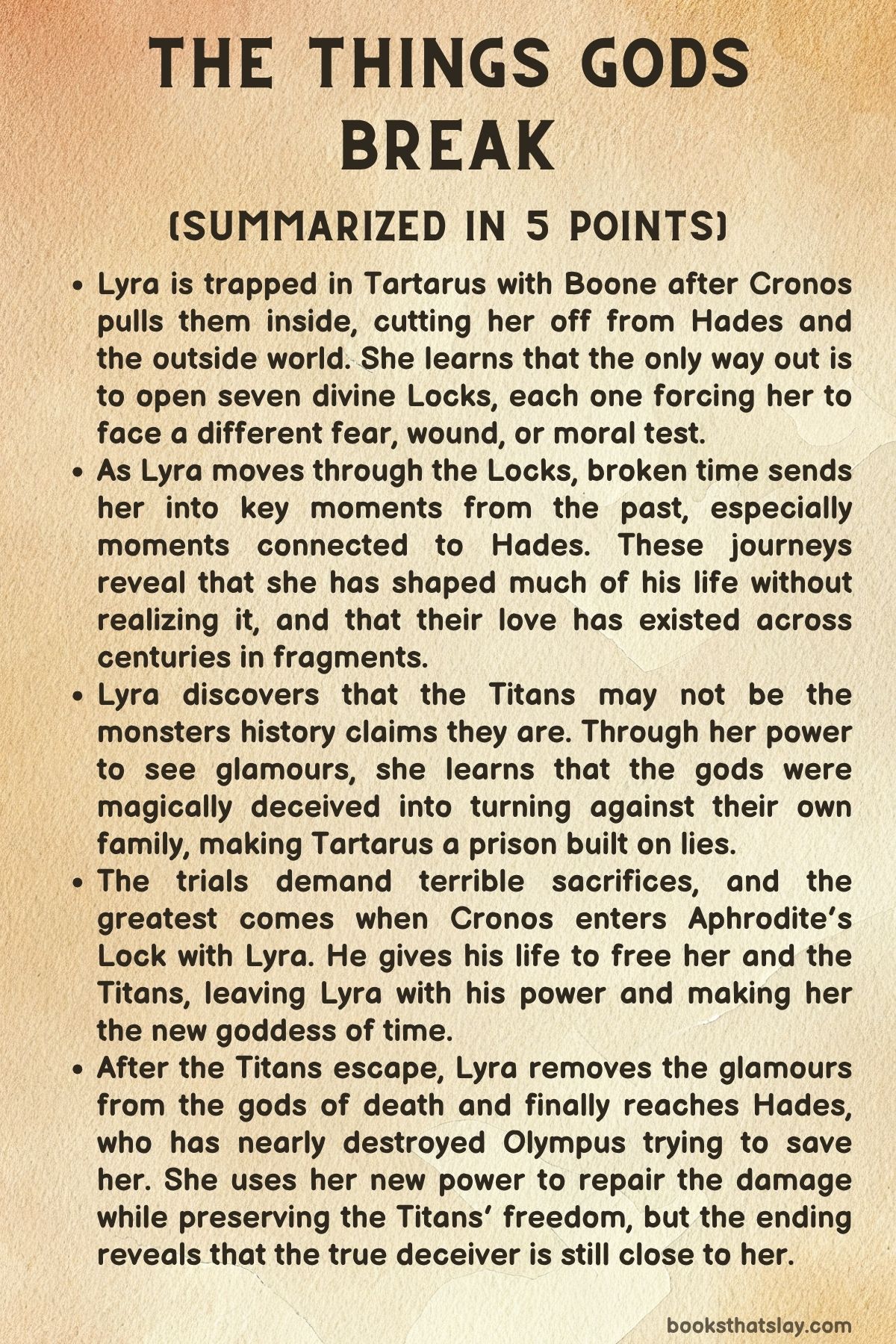
Lyra is trapped in Tartarus with Boone after being pulled through the gates by Cronos, the king of the Titans. She hears Hades raging outside, desperate to reach her, but the prison blocks all contact with the world beyond.
Cronos reveals that Tartarus has stripped Lyra of her weapons, her tattooed animal guardians, and much of what makes her powerful. He also hints that he has known her before, calling her the Titans’ savior, before dropping her into the abyss.
Instead of dying, Lyra falls through broken time. She briefly lands in Hades’s Underworld water garden during an earlier point in his life.
The past Hades recognizes her as a future version of the woman he knows, but the moment ends quickly, and Lyra is pulled away again. She lands inside the Labyrinth, where a projection of Hestia explains the purpose of the Locks.
Each Lock is a trial created by an Olympian, and opening them is the only way out of Tartarus. Hestia’s Lock tests innocence by granting Lyra her deepest unfulfilled desire: the love of the parents who abandoned her and the secure home she never had.
The illusion nearly claims Lyra. She accepts the false life, forgetting Tartarus and Hades, until flashes of her real love for Hades return.
She realizes that the future she wants with him is stronger than the childhood dream of being loved by her parents. She rejects the fantasy, exposes the false parents as monsters, and rescues Boone from the same illusion.
Together they defeat the Nightmares inside the Lock, and Lyra unexpectedly gains their loyalty. The first Lock opens, but the Titans remain guarded, desperate, and divided over whether Lyra can truly save them.
Lyra and Boone learn that Tartarus contains seven Locks, each tied to a god: Hestia, Hades, Demeter, Poseidon, Hera, Zeus, and Aphrodite. The Titans believe only Lyra can unseal them because she was once human.
Rhea, Hades’s mother, protects Lyra and begins to earn her trust. She explains that Cronos broke time long ago, creating red cracks that drag Lyra into crucial moments of the past.
These trips reveal that Lyra has appeared throughout Hades’s life, long before she remembers meeting him.
In one journey, Lyra meets teenage Hades, who fears his own deathly power and believes himself monstrous. Her touch does not kill him, and she helps him understand that he can control what he is.
In another, she sees him during later centuries, lonely and suspicious but already shaped by his mysterious meetings with her. These fragments complicate Lyra’s understanding of their relationship.
Hades did not simply fall for her in the present; his love has been formed across time, often by versions of Lyra who knew more than she currently does.
The second Lock belongs to Hades and takes the form of a deadly chariot race. Lyra and Boone must defeat a guardian copy of Hades, a piece of the real god’s soul bound to the Lock.
They win by using powers borrowed from different gods, but the victory brings disturbing truths. There are five more Locks, past versions of Lyra have failed many times, and death in the trials can cause time to reset.
The guardian warns her that the Titans may be using her and that freeing them could be dangerous.
As Lyra trains for the remaining Locks, she learns that the history she was taught may be false. During a journey to the Titanomachy, she sees the Olympian gods attacking the Titans while under glamour veils.
The Titans refuse to fight their children, even as they are imprisoned. Lyra discovers her own divine nature is tied to glamours: she can see and eventually remove magical falsehoods placed over the mind.
This changes everything. The Titans were not the monsters of legend; someone made the gods believe they were.
Lyra’s trust in Cronos grows as she sees his past. She witnesses him protecting young Hades from Uranus, killing the Primordial not out of cruelty but to save his son.
She also sees the birth of Aphrodite from the sea after Uranus’s death. The old stories of Cronos eating his children and the Titans being evil begin to collapse.
Lyra understands that the prison of Tartarus was built on manipulation, grief, and stolen memory.
Meanwhile, outside Tartarus, Hades tries to reach Lyra. His rage threatens the world, and the gods of death gather to stop him.
Zeus and other forces seem to be moving against him, but Hades refuses to abandon Lyra. His destructive love becomes both a danger and a sign of the depth of their bond.
Lyra’s time journeys make clear that she herself has guided many of the events that led to the present. She instructed Hades to choose her for the Crucible, to give her Persephone’s pearls, to break her heart at the necessary moment, and to trust the future they have not yet reached.
Lyra continues opening the Locks. Demeter’s Lock tests kindness by forcing her to save people who caused her pain: her mother, her childhood tormentor Chance, and finally a past version of herself.
Poseidon’s Lock demands coordination between Lyra and Boone. Hera’s Lock forces them through a storm, monsters, and misdirection until Lyra realizes the answer lies not in the stars but in a recurring horned creature.
Each success brings them closer to escape, but each Lock also costs them emotionally and physically.
Boone’s role becomes uncertain when Phoebe reveals a fated line between him and Lyra. Later, this prophecy is exposed as another glamour.
Boone is not Lyra’s fated partner, but he remains crucial. Persephone’s past with him adds emotional tension, revealing that broken time brought her to him before, leaving him hurt and distrustful.
Lyra also discovers Medusa hidden behind a glamoured door, another victim of altered memory and divine cruelty.
The final major obstacle is Aphrodite’s Lock. Lyra expects to enter with Boone, but Cronos prevents him from following and enters instead.
Aphrodite’s trial demands a sacrifice: one heart must enter the fire so another can be freed by pure love. Cronos accepts the role without hesitation.
He tells Lyra he has always thought of her as a daughter, gives final messages for his family, and steps into the flames. Lyra calls him father as he dies.
His sacrifice opens the final Lock, frees the Titans, and transfers his power to Lyra. She becomes the goddess of time.
The escape does not bring peace. Hades has nearly destroyed Olympus trying to reach Lyra, and the gods of death, still glamoured, confront the freed Titans.
In the battle, Lyra allows herself to be mortally wounded so she can get close enough to remove glamours from Hel and Anubis. Once they understand the truth, they heal her and help stop the fight.
Lyra uses the Nightmares, now loyal to her, to freeze the combatants and remove the glamours from the remaining gods.
Lyra finally reaches Hades, who has chained himself inside his own destructive power. He believes she is another future version who will vanish again, but she proves she is truly present.
Their reunion is intense and painful. She removes the glamour from him, restoring his real memories of the Titans, his mother, and the lies that drove him.
Hades breaks down as he understands what was done to his family and what he helped enforce.
The damage Hades caused must be repaired. Lyra seeks guidance from Cronos in the past, learning how to use her new time power.
She discovers the cruelest truth yet: she herself helped create the conditions of her own life. To preserve the timeline that frees the Titans, she directs a glamoured Zeus to curse her as a child, but builds limits into the curse.
Boone also appears in the past, ensuring her parents deliver her to the Order of Thieves. Both of them have been shaping events in painful ways to make survival possible.
Lyra then uses her power to rewind the destruction while protecting those freed from Tartarus inside a stopped-time bubble. She resets the world to a point just after the gates open, preserving the Titans’ freedom.
To explain events, the group claims Cronos caused the reversal as a final act. The gods of death judge Hades for the destruction he caused and strip him of his powers and immortality.
Lyra and Persephone are named joint Queens of the Underworld in his absence.
The book ends with one last threat. An unnamed narrator reveals that they were responsible for glamouring the immortal world into believing the Titans were monsters.
With Hades weakened, this hidden enemy plans to stay close to Lyra and gain control by becoming her closest friend. The victory is real, but incomplete.
The Titans are free, Lyra has become time’s new goddess, and Hades lives, yet the true deceiver remains near her.
Characters
Lyra Keres
Lyra is the emotional and moral center of The Things Gods Break, a character shaped by abandonment, survival, defiance, and an increasingly painful understanding of responsibility. At the start, she is still carrying the wounds of her childhood: parents who gave her away, a curse that made her believe she was unlovable, and a life in the Order of Thieves that taught her to distrust comfort.
Tartarus forces her to face every one of these wounds. Hestia’s Lock shows how badly she once wanted a family, while Demeter’s Lock forces her to save people who hurt her, including her mother and a younger version of herself.
Lyra’s growth lies in her refusal to remain defined by pain. She becomes not only a survivor but also an active maker of fate, even when that means accepting that she helped cause her own suffering to free the Titans.
Her power over glamours reflects her deeper role in the story: she sees through lies, even when the truth breaks her heart. By becoming goddess of time, she inherits both Cronos’s power and his burden.
Her heroism is not clean or easy; it is built from repeated losses, impossible decisions, and the courage to keep choosing love without surrendering judgment.
Hades
Hades is presented as a god of death whose fearsome power hides deep loneliness, guilt, and longing. His relationship with Lyra is unusual because it does not grow in a straight line.
He meets her out of order, across centuries, sometimes as a frightened youth, sometimes as a hardened ruler, and sometimes as a man trying to obey instructions from a woman he loves but cannot fully understand. This makes him both powerful and vulnerable.
He is capable of destroying Olympus to reach Lyra, but he is also the child who once believed he was a monster because his touch brought death. His tragedy comes from being manipulated into believing his parents were cruel and monstrous, when in truth they loved him and were victims of glamour.
In The Things Gods Break, Hades’s love is both his greatest strength and his greatest danger. He would burn the world for Lyra, yet he also learns that loving her means trusting her choices, even when they hurt him.
When his memories return, his grief is overwhelming because he must face not only what was done to him, but what he did while deceived. His loss of power at the end strips away the godly image, leaving a man who must rebuild himself, his family bonds, and his role in the Underworld.
Boone
Boone is Lyra’s loyal friend, fellow survivor, and one of the story’s clearest examples of chosen family. His connection to Lyra begins in the Order of Thieves, where both of them learned to live by quick thinking, secrecy, and instinct.
In Tartarus, Boone provides balance when Lyra is overwhelmed by grief, anger, or doubt. He is practical, observant, and often more willing than Lyra to question what they are being told.
His invisibility power also fits his personality; he is used to moving unseen, protecting from the side, and carrying pain without making it the center of the room. The false prophecy tying him to Lyra creates confusion and pressure, but its exposure does not lessen his importance.
It proves that love and loyalty do not need fate to validate them. Boone’s complicated relationship with Persephone adds depth to him, showing that he can be wounded by betrayal, secrecy, and misunderstanding.
His anger after Lyra disappears during the Locks is not selfish; it comes from fear, helplessness, and the burden of waiting while others make decisions around him. Boone’s value in the book lies in his steadfastness.
He is not Lyra’s destined romantic partner, but he is one of the people who helps her survive long enough to become who she must be.
Cronos
Cronos begins as an intimidating figure, introduced through violence, mystery, and the weight of myth. At first, Lyra and the reader have every reason to suspect him.
He is the Titan king, the supposed devourer of his children, and the one who drops Lyra into the abyss. Gradually, the story rebuilds him into one of its most moving figures.
Cronos is not innocent of harsh choices, but the monstrous version of him is revealed to be a lie created by manipulated history. His love for his children is central to his character.
He kills Uranus to protect young Hades, suffers imprisonment rather than harm his own family, and spends countless timelines trying to free the Titans. His bond with Lyra becomes one of the book’s strongest emotional arcs.
He trains her, challenges her, comforts her, and slowly lets himself feel like a father again. The mental visit to Pier 39 shows his tenderness and his sadness; he gives Lyra the childhood outing she always wanted, not because he is trying to trick her, but because he understands what it means to miss family.
His final sacrifice in Aphrodite’s Lock completes his arc. He gives his life so Lyra can live, calls her his daughter in all but formal blood, and passes time itself to her.
Rhea
Rhea is a figure of maternal strength, grief, and endurance. As Hades’s mother and Cronos’s partner, she carries the pain of being separated from her children while falsely remembered as part of a monstrous family.
She is protective without being soft, wise without being passive, and willing to make difficult choices when survival requires them. Her early protection of Lyra establishes her as one of the first Titans willing to treat Lyra as more than a tool.
She hides Lyra and Boone, explains the rules of Tartarus, and gradually becomes a source of emotional steadiness. Rhea’s most powerful moments often involve memory and recognition.
In the past, she protects Hades by transferring her animal tattoos to him, even though he has been glamoured against her. In the present, she recognizes Lyra’s value but also cares for her as a person.
Her grief over Cronos’s death is immense, yet she still urges Lyra to honor his sacrifice by standing strong. Rhea represents the kind of motherhood Lyra was denied in childhood: protective, honest, demanding, and loving.
When she calls Lyra daughter, the word carries the force of earned belonging.
Persephone
Persephone is bright, sharp, wounded, and far more complex than the simplified myths about her suggest. Her presence in Tartarus is one of the major signs that the official version of events cannot be trusted.
She was trapped, glamoured, and used as part of a larger scheme, yet she retains a strong sense of self. Her relationship with Lyra is built on contrast.
Persephone brings lightness, warmth, and emotional openness, while Lyra brings grounding, suspicion, and hard-earned realism. Their friendship recurs across timelines, suggesting that some bonds form not because fate commands them, but because two people repeatedly recognize something necessary in each other.
Persephone’s history with Boone reveals a more vulnerable side. She cared for him during time-displaced meetings, but secrecy and stolen time left him feeling used.
Her mistakes do not make her cruel; they show the damage caused when time, fear, and half-truths interfere with real feeling. She also refuses to remain only Hades’s lost friend or Demeter’s daughter.
By the end, when she becomes joint Queen of the Underworld with Lyra, she steps into authority through survival, loyalty, and her own claim to the life she wanted.
Iapetus
Iapetus is blunt, combative, often infuriating, and deeply loyal beneath his rough behavior. His first major actions toward Lyra are difficult to forgive: he pushes her into danger and treats her survival as a necessary risk.
Yet the longer the story stays with him, the clearer it becomes that Tartarus has worn him down. He has lived through repeated attempts, repeated failures, and the knowledge that freedom always seems close before another reset steals it away.
His harshness is partly fear disguised as impatience. He trains Lyra with little gentleness because he believes softness could get her killed.
His later transformation after being touched by the Pandemonium shows the horror of Tartarus in bodily form. He becomes a creature of lava and destruction, not by choice, but because the prison’s invisible horrors can break even ancient beings.
Iapetus also brings moments of humor and family friction among the Titans. His arguments with Cronos and others make the Titans feel like a damaged but living family, not distant legendary figures.
He is not easy to like at every moment, but he is easy to understand once the scale of his imprisonment becomes clear.
Phoebe
Phoebe is the Titaness of prophecy, and her role is shaped by the burden of seeing without always being able to prevent. She carries knowledge in fragments, visions, and warnings, many of which are dangerous to reveal too soon because the wrong truth can reset time.
This makes her both powerful and limited. She knows Lyra matters, but she cannot always explain how or why.
Her prophecies guide the Titans’ hope, but they also expose how vulnerable prophecy is to manipulation. The false fated bond between Lyra and Boone shows that even sacred vision can be altered by glamour.
Phoebe’s importance grows when Lyra sees her in the past during the Titanomachy. She recognizes Lyra’s emerging power and helps name what Lyra is becoming: someone who can see glamours.
Phoebe’s near-death after Iapetus turns monstrous is one of the book’s painful reminders that knowledge does not protect someone from violence. Her character represents the ache of foresight: she can point toward possibility, but others must still suffer, choose, and act.
Mnemosyne
Mnemosyne, Titaness of memory, carries one of the story’s heaviest symbolic roles. In a book full of altered histories, stolen truths, and repeated timelines, memory becomes both a weapon and a wound.
Mnemosyne can show Lyra the past lives and deaths she has endured, but doing so causes terrible pain. Her power exposes the cost of the Titans’ hope.
Lyra has not failed once; she has failed and died again and again, while the Titans remember enough to continue pushing toward escape. Mnemosyne’s weary manner suggests that remembering is not a simple gift.
It means carrying every loss with no clean release. She also helps reveal the moral ambiguity of the Titans’ plan.
They need Lyra, but their use of repeated resets has trapped her in cycles of suffering. Mnemosyne does not erase that discomfort.
Instead, she embodies it. Her character asks whether truth is always better than ignorance and answers with a difficult yes: truth hurts, but without it, Lyra can never choose freely.
Koios
Koios is one of the quieter Titans, but his presence matters in the training and survival structure of Tartarus. He offers a calmer form of instruction, especially when Lyra struggles to control her glamour-sight.
Where Cronos can be forceful and Iapetus impatient, Koios gives Lyra a practical mental image: an on-off switch. This helps her manage her ability, even if she cannot yet remove the glamour from the hidden door.
His teaching style shows patience and adaptability, qualities that are essential in a place where brute force has failed for thousands of years. Koios also appears as part of the Titan family’s emotional network.
His bond with Phoebe and the mention of their daughter Asteria add history and tenderness to the imprisoned Titans. When he steps out to face the feral Iapetus and protect Phoebe, he reveals courage grounded in love rather than glory.
Koios does not dominate the story, but he strengthens the sense that the Titans are not a faceless group. They are parents, partners, teachers, and survivors.
Hestia
Hestia’s role is unusual because she appears largely through the Lock she created, and her soul-piece is damaged by her death in the Overworld. Even in this fractured form, she establishes the rules that shape Lyra’s path.
Her Lock is not physically brutal at first; it is emotionally dangerous. It offers Lyra the home, parents, and belonging she always wanted, making the test a challenge of self-knowledge rather than strength.
Hestia’s association with home becomes painful because the home she offers is false. To pass, Lyra must admit that the life she once wanted is no longer the deepest truth of her heart.
Hestia’s damaged projection also shows the consequences of the Locks being tied to pieces of divine souls. These guardians are not simple illusions; they are fragments of gods, bound to old purposes and affected by what happens outside Tartarus.
Hestia therefore functions as both gatekeeper and warning. The Locks are not only tests for Lyra; they are remains of a broken divine order.
Demeter
Demeter’s Lock reveals the hard edge beneath kindness. Her test asks Lyra to save those who do not deserve her compassion, making kindness an action rather than a feeling.
The trial is cruel because it forces Lyra to revisit abandonment, bullying, and self-hatred. Yet it also clarifies what makes Lyra heroic.
She does not save her mother because she has forgiven everything. She saves her because choosing not to become cruel matters more than satisfying anger.
Demeter’s guardian is stern and rule-bound, becoming furious when Hades’s soul-piece interferes in the test. This reaction shows how seriously the Locks guard their purposes, even when those purposes create suffering.
Demeter is also important through her daughter Persephone. The old myth of Persephone’s pomegranate seeds is recast as a lie Demeter told, suggesting a controlling desire to define her daughter’s choices.
Demeter’s character is therefore tied to care that can become possession, protection that can become control, and kindness that must be tested beyond comfort.
Poseidon
Poseidon is most important through his Lock and through the larger family history of the gods. His trial demands coordination, timing, and trust between Lyra and Boone.
Unlike Hestia’s emotional illusion or Demeter’s moral test, Poseidon’s challenge is more physical, filled with danger, water, glass, and the need for precise teamwork. It shows that Lyra cannot succeed alone, no matter how powerful she becomes.
Poseidon also appears indirectly through the past, as one of the divine children caught in a manipulated war against the Titans. Like his siblings, he is part victim and part participant.
His actions are shaped by glamour, but the consequences of those actions remain real. The oceanic imagery surrounding him also connects to Oceanus and Uranus, expanding the story’s concern with inherited power.
Poseidon’s role reminds readers that divine strength without clear perception can be disastrous. Power must be guided by truth, or it becomes another tool in someone else’s hand.
Hera
Hera’s Lock is one of the most revealing trials because it punishes assumption. Lyra and Boone initially read the stars as the solution, only to realize that the recurring horned monster is the true key.
Hera’s challenge therefore tests pattern recognition, adaptability, and the willingness to abandon an answer that seems obvious. The presence of a childlike Zeus near the end of the Lock adds emotional unease, pointing toward the gods’ family history and the way childhood, power, and violence are repeatedly linked.
Hera herself is part of the generation of Olympians who were turned against their parents by glamour. Her mythology, authority, and anger are all reframed through the possibility that her life has been shaped by lies she did not choose.
The Lock associated with her does not make her a simple villain or ally. Instead, it reflects the book’s larger argument that institutions of power can be built on false premises, and those inside them may defend the lie because they have never been allowed to see it.
Zeus
Zeus is one of the story’s most damaging figures, though the later revelations complicate his responsibility. He curses Lyra to be unlovable, presides over divine cruelty, and appears again and again as a ruler whose actions cause suffering.
For much of the book, Lyra sees him as the source of her abandonment and pain. Yet when she travels to the night of her birth, she discovers that Zeus himself is glamoured and suggestible.
The curse comes through him, but Lyra is the one who shapes it to preserve the timeline. This does not make Zeus harmless.
He remains a god whose power has been used to harm others, and whose position made that harm world-changing. Still, the revelation shifts him from sole architect to instrument.
Zeus represents authority severed from truth. When a ruler’s mind is manipulated, the damage spreads through laws, curses, wars, and myths.
His character is central to the book’s interest in blame: who is guilty when a terrible act is committed by someone whose will has been compromised?
Aphrodite
Aphrodite is tied to beauty, desire, birth, danger, and sacrifice. Her origin from the remains of Uranus makes her existence part of the same violent chain that shaped Hades’s childhood and Cronos’s choices.
The Titans bind her powers to protect Hades, suggesting that love and desire in this world can be overwhelming forces if uncontrolled. Her Lock is the most devastating because it strips away cleverness and demands the purest cost.
Someone must willingly give their heart to the fire so another may be set free. Through this trial, Aphrodite’s domain becomes far more than romance.
Love is measured through sacrifice, choice, and the willingness to release another from impossible pain. Cronos’s death in her Lock gives Aphrodite’s power its most serious expression.
Later, Aphrodite helps Lyra reach Hades by projecting Lyra’s love toward him, showing that her power can guide rather than destroy. She is dangerous, but not shallow.
Her role proves that love can ruin, save, expose, and transform depending on the will behind it.
Oceanus
Oceanus is one of the story’s most suspicious figures. His absence from Tartarus, his abandonment of his siblings, and his apparent knowledge of events inside the prison make him a natural suspect in the larger mystery.
Lyra’s encounter with him in the past intensifies that suspicion, especially when he seems too informed and too detached from the suffering of the Titans. As a Titan of the ocean, he is tied to ancient power, hidden depths, and forces that move beneath the visible world.
Lyra suspects he may be involved in maintaining the glamours or may have a source inside Tartarus. Cronos doubts that one being alone could sustain such a vast deception, but Oceanus still represents betrayal within the family structure.
His role is important because it widens the conflict beyond Olympians versus Titans. The true enemy may not stand clearly on either side.
Oceanus embodies the fear that imprisonment and false history were enabled not only by outside enemies, but by someone close enough to know where to strike.
Anubis and the Gods of Death
Anubis and the other gods of death enter as judges and enforcers, believing Hades and the freed Titans pose a threat to cosmic order. Their authority is frightening because it comes with the language of balance, law, and necessity.
They are not mindless attackers; they believe they are preventing disaster. That makes the glamour over them especially dangerous.
When Lyra removes the veils from Anubis and Hel, their horror shows that they are capable of conscience. Anubis healing Lyra after Hel wounds her marks a major shift in the battle.
Once he understands the truth, he acts with fairness rather than blind punishment. Yet he later participates in judging Hades and stripping him of power and immortality.
Anubis represents justice under imperfect conditions. He can be deceived, but he can also correct course when truth is revealed.
The gods of death as a group show how terrifying institutions become when manipulated. Their power to punish is vast, so false information in their hands becomes almost as dangerous as malice.
Charon and Cerberus
Charon and Cerberus are part of Hades’s closest circle, and their loyalty helps humanize the Underworld. Charon is practical, steady, and often a voice of reason.
He helps manage the dead, stands near Hades in moments of crisis, and understands the scale of responsibility that comes with ruling death. Cerberus, often imagined only as a guardian beast, is shown as emotionally intelligent and loyal.
Along with Demeter, he helps restrain Hades when Hades’s desperation threatens catastrophe. Their willingness to oppose him in that moment is a sign of true loyalty, not betrayal.
They know Hades well enough to understand that destroying the world to reach Lyra would violate what Lyra herself would want. These characters give the Underworld a sense of community and continuity.
Hades is not alone because he lacks subjects; he is alone because he carries guilt and power in ways few can share. Charon and Cerberus remain among the few who can stand close to that burden.
Medusa
Medusa’s appearance behind a hidden, glamoured door expands the book’s pattern of wronged figures whose stories have been controlled by others. She is not merely a monster in a wall.
She remembers being close to Athena before being cursed and trapped, and her lack of memory about how she arrived in Tartarus links her to Persephone and the Titans. Medusa’s hatred of men is sharp and dangerous, but it is also rooted in injury.
Lyra’s reaction to her is important because she does not reduce Medusa to a threat. She offers the possibility of a future body and freedom, while still respecting the immediate danger of Medusa’s gaze.
Medusa’s role reinforces the idea that many so-called monsters are victims of divine power, edited history, and punishment disguised as justice. Her hidden presence also suggests that Tartarus contains more secrets than even the Titans fully understand.
She is a reminder that the world’s myths have been curated by those with power.
Brad and Jessica Keres
Brad and Jessica Keres, Lyra’s parents, matter less as active present-day figures and more as the wound they leave in Lyra. In the false reality of Hestia’s Lock, they represent the dream that shaped her childhood: parents who wanted her, named her, photographed her, and gave her a place to belong.
Their real abandonment created a hunger that the Lock nearly uses to destroy her. Later revelations make their role more complicated.
Boone’s time-traveling intervention ensures they deliver Lyra to the Order of Thieves, and Zeus’s curse makes Lyra’s childhood pain part of a timeline designed to free the Titans. Still, the emotional truth remains.
Lyra was a child who felt unwanted, and no cosmic explanation erases that damage. Brad and Jessica represent the difference between explanation and healing.
Knowing why they abandoned her helps Lyra understand the structure of her life, but it does not magically give back the childhood she lost.
Themes
Truth, Memory, and the Violence of False History
Truth in The Things Gods Break is not a passive thing waiting to be discovered; it is dangerous, painful, and capable of changing the structure of the world. The Titans have been imprisoned not simply by gates and Locks, but by a story everyone was forced to believe.
The Olympians think their parents were monsters. Hades believes his mother abandoned him to a cruel father.
Lyra believes Zeus alone authored her misery. Each of these beliefs contains pain, but not the full truth.
Glamour becomes the physical form of false history: a veil over the eyes that makes victims act as weapons against those they love. Mnemosyne’s memory power adds another layer, showing that truth can also wound the person who receives it.
Lyra’s visions of past deaths nearly crush her, yet they are necessary because choice without memory is not freedom. The book treats false history as an act of violence because it does not only misrepresent the past.
It shapes wars, curses, punishments, family separations, and identities. To see clearly is to suffer, but it is also the first act of liberation.
Chosen Family, Lost Parents, and Earned Belonging
Lyra’s deepest wound begins with family. Her parents’ abandonment leaves her vulnerable to Hestia’s Lock because the fantasy of being wanted still has power over her.
Yet the book does not heal that wound by restoring Brad and Jessica to her. Instead, it gives Lyra a harder and more meaningful form of belonging: relationships earned through sacrifice, trust, conflict, and repeated choice.
Boone is her chosen brother in survival, the person who stays when fate is revealed to be false. Persephone becomes a friend across timelines because the two women recognize and balance each other.
Rhea gives Lyra the maternal steadiness she never had, while Cronos becomes a father figure through training, comfort, and finally sacrifice. This theme is powerful because it refuses easy replacement.
Cronos does not erase Lyra’s childhood pain, and Rhea does not magically become the mother Lyra lost. Their love matters because it arrives with honesty.
They see Lyra’s anger, distrust, flaws, and fear, yet they still claim her. The word daughter becomes meaningful only after Lyra has tested and resisted it.
Belonging, in this story, is not blood alone. It is the decision to protect someone even when protection costs everything.
Love as Sacrifice, Danger, and Choice
Love is never presented as harmless. Hades’s love for Lyra can shake worlds, burn Olympus, and terrify other gods.
Cronos’s love for Hades leads him to kill Uranus. Persephone’s love and longing for Boone are damaged by secrecy and time.
Lyra’s love for Hades requires her to hurt him in the past so both of them can survive the future. The book repeatedly separates love from comfort.
To love someone is not always to keep them close, tell them everything, or spare them pain. Sometimes it means trusting them with unbearable choices.
Aphrodite’s Lock makes this theme literal by requiring one heart to enter the fire so another can go free. Cronos’s death is the clearest expression of love stripped of possession.
He does not sacrifice himself to control Lyra’s future or earn gratitude. He does it so she does not have to choose between herself and Boone.
Hades’s arc also tests love as choice. His desire to destroy the world for Lyra may look romantic at first, but the story challenges it.
True love must recognize the beloved’s values, not merely the lover’s need. Love becomes worthy only when joined with restraint, trust, and responsibility.
Fate, Free Will, and Self-Creation
The book constantly asks whether destiny is a path imposed from outside or a pattern created by repeated choices. Lyra seems trapped by prophecy, time loops, curses, and resets.
She always ends up in Tartarus. She always suffers through the Crucible.
She always loses people she tries to save. At first, this makes fate feel like a cage.
Yet Cronos offers a different view: Lyra repeats certain outcomes because she keeps making the same choices. That idea does not blame her for her pain, but it does restore agency.
The revelation that Lyra helped shape her own past is devastating because it means she is not only fate’s victim. She is also one of its makers.
She instructs Hades, shapes the curse placed on her infant self, preserves the painful path that will free the Titans, and finally rewinds destruction without undoing their escape. This theme is not simple empowerment.
Self-creation here is costly and morally complicated. Lyra becomes herself through choices no one should have to make.
Still, the final movement of the story insists that fate is not unbreakable. It is a structure of decisions, love, fear, memory, and sacrifice.
To change fate, Lyra must first accept her place inside it.