Graceless Heart Summary, Characters and Themes
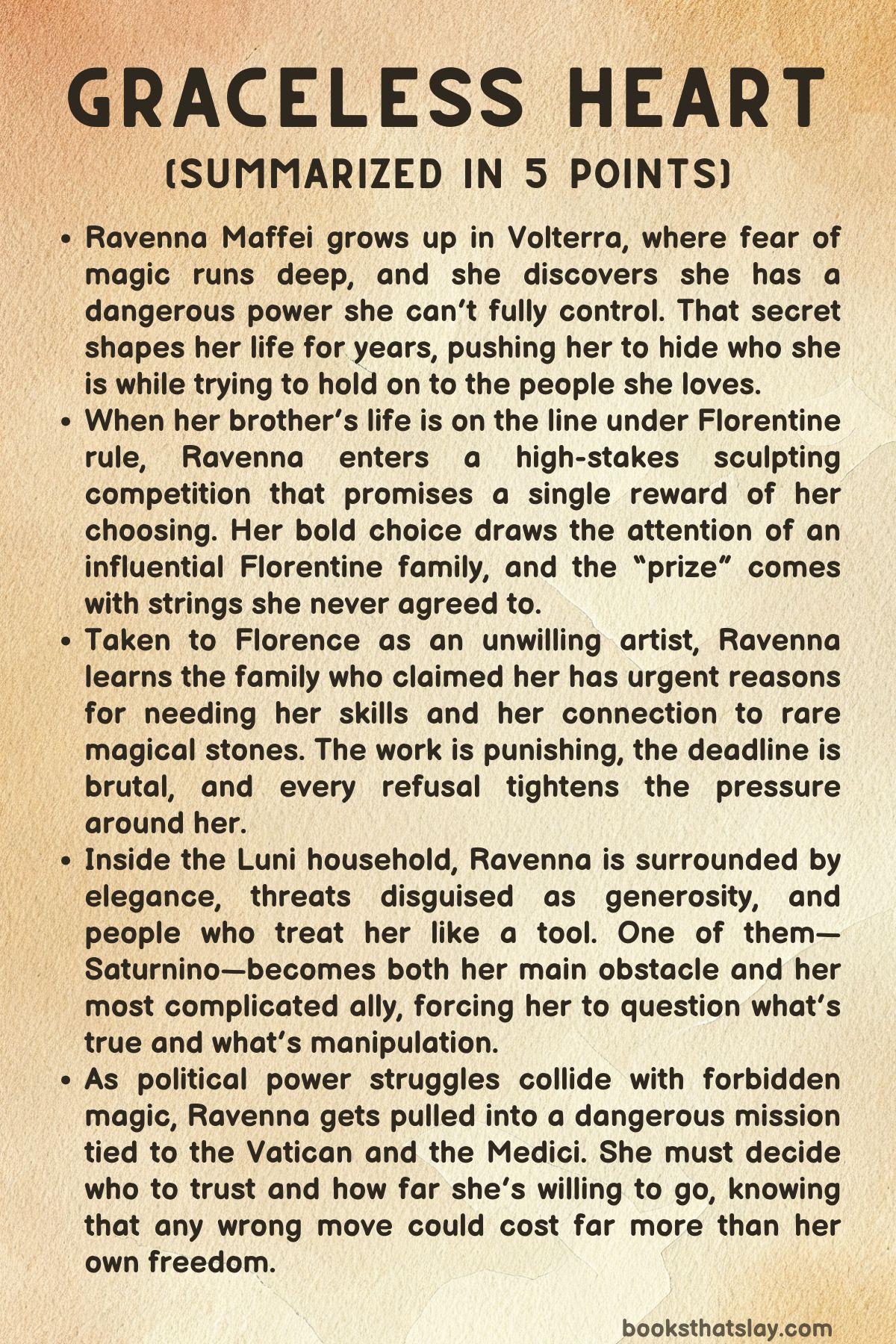
Graceless Heart by Isabel Ibanez is a Renaissance-set fantasy romance that starts in a small Tuscan city where superstition rules and magic is a death sentence. Ravenna Maffei is a gifted young sculptress with a secret: her body holds a strange power that can drain life, and she has spent years trying to keep it buried.
When war and occupation place her brother in a public cage, Ravenna gambles everything on a Florentine contest that promises one impossible reward. Her victory saves him—but costs her freedom. Taken to Florence by an immortal noble house, Ravenna is forced into a dangerous bargain involving enchanted gemstones, political enemies, and the Vatican’s ruthless reach, while her feelings for the Luni heir become both a weakness and a weapon. It’s the 1st book of the Spellbound History Quartet.
Summary
At thirteen, Ravenna Maffei learns the truth about herself in the worst way. In an alabaster quarry outside Volterra, she wanders too deep and nearly falls into a hidden shaft.
A stranger tries to save her, but panic ignites something inside her. A blue force erupts from her body and latches onto the man, aging him in seconds until he collapses and dies.
The magic keeps going, consuming what remains until only bone is left, then slides back into Ravenna’s chest as if it belongs there. Ravenna is left trembling, sick with horror, convinced she has become something monstrous.
Her aunt is terrified too—not only of what happened, but of what the town and the Church would do if they ever knew.
Ten years later, Volterra is no longer safe for different kinds of people, and it is certainly not safe for Ravenna’s family. Florence controls the city after violence tied to Medici power, and the occupation uses fear as a daily tool.
Ravenna’s brother Antonio has been arrested as a warning and left hanging in an iron cage over the main piazza, starving and exposed. A curfew keeps the streets empty at night, but Ravenna moves through them anyway, dragging a ladder and risking soldiers’ blades just to reach him.
She brings him food and tells him she will free him. Antonio, weak and furious, begs her to stop.
If he escapes, soldiers will punish the rest of the family. Ravenna refuses to accept that choice.
She has heard that the next day a powerful Florentine family, the Luni famiglia, will arrive to host a sculpting competition. The winner will receive a “boon,” a reward that can be anything they ask.
Ravenna’s plan is simple: she will win and demand Antonio’s release. Antonio tells her it is a lie she is selling herself, because famous sculptors will compete and she cannot beat them.
Ravenna hears the despair beneath his anger and answers with stubborn certainty. Hope is the only thing she can still offer him, and she will not take it back.
In her studio, Ravenna prepares a marble figure of Pluto, god of the underworld. Her home is lined with charms meant to ward off fae, and her tools are arranged with the careful discipline of someone who cannot afford mistakes.
Yet something keeps pulling at her attention: the memory of a cold, beautiful stranger she saw the night before in a tense exchange with Capitano Lombardi. While carving Pluto’s face, Ravenna unknowingly shapes it into that stranger’s likeness.
When her little sister Tereza toddles in and insists the statue needs “something shiny,” Ravenna looks at the piece and realizes she needs an edge to compete. Desperation pushes her toward the one thing she avoids: magic.
Ravenna retrieves a hidden gemstone—Nightflame, moonstone-blue with a cobalt fire at its center—rare, valuable, and dangerous. Handling it marks a person as a witch in the eyes of the world.
But Antonio is dying in a cage. Ravenna carves a hollow in Pluto’s chest and sets the Nightflame where a heart would be, sealing her gamble into stone.
At the competition, her work draws not admiration but hatred. The crowd sees the embedded Nightflame and turns vicious, calling her tainted.
Men jeer at the idea of a woman competing at all. People spit near her feet.
Even those suffering under punishment refuse her kindness, terrified that association with her will bring more pain. Ravenna stands through it, holding her posture steady while fear claws at her throat.
Trumpets announce the Lunis’ arrival: Duke Silvio Luni, Duchess Juno, their sons Saturnino and Marco, and their daughter Fortuna. Ravenna recognizes Saturnino immediately—he is the stranger from the night before, the one her statue resembles.
The judging is brutal. Fortuna mocks skilled works as boring, dismisses famous names, and treats artists like toys.
When Saturnino reaches Ravenna’s statue, he first taunts her, then notices Pluto’s face, then goes still at the sight of the Nightflame. His attention sharpens into something focused and proprietary.
He declares Ravenna the winner.
Duke Silvio publicly asks what boon she desires. Ravenna demands Antonio’s release and the dropping of all charges.
The cage is lowered. Antonio collapses into his family’s arms, alive.
Ravenna reaches toward them—and the duke blocks her. He announces that Ravenna is coming with the Luni family to Florence as their artist in residence.
Ravenna protests, insisting she never agreed to that. The duke claims Florence’s authority gives him the right.
Guards seize her. Antonio fights back and is restrained.
Ravenna is shoved into a gilded carriage, the door slamming like a verdict, and the wheels carry her away from everything she has ever known.
Far from Volterra, Pope Sixtus IV watches storms gather over Rome and considers himself untouchable. He despises magic and calls its users abominations, yet he uses an enchanted device—the Echostone—to receive secret reports.
He has his own obsession: a vanished enchantress named Simonetta who once stole priceless statues from him, masterpieces carved from celestial fragments known as Lacrima Coeli. Through the Echostone, a courier reports that the Luni family has received mysterious crates and hides them in the dungeons beneath their palazzo.
There are strange visitors, secret activity, and people who do not return. The pope orders the courier to uncover what the Lunis are hiding.
He also demands answers about Simonetta, and when none come, his anger turns sharp and personal.
Ravenna’s journey toward Florence includes a stop at an inn where she meets Ibrahim and his daughter Amina, who quickly understands she is not a guest. Guards keep Ravenna’s door watched, and at first even force it to remain open.
Ravenna studies the window, measures the drop, and thinks through escape routes. When she opens the shutters, Saturnino appears as if summoned by her intention.
He tells her bluntly that if she jumps, he will be the one to chase her down.
At dinner with the Luni family, they present captivity as opportunity. They promise Ravenna wealth, status, and praise in Florence.
Ravenna answers that she was stolen. The Lunis reveal her deadline: she must create five sculptures by May 10 for a tournament and grand reveal—an impossible demand meant to break her.
Ravenna decides she will run, not work.
That night, Amina secretly helps her by leaving extra sheets and a note. Ravenna ties the sheets into a rope, places a decoy in the bed, and climbs into the darkness.
The moment she moves toward the stables, she senses pursuit. Saturnino catches her effortlessly, restraining her with calm cruelty.
Ravenna’s panic triggers her hidden power; the same dark force that killed a man in the quarry surges into Saturnino through her hands. It does nothing.
Saturnino is immune. The knowledge hits Ravenna like ice—she has relied on fear of her own magic for years, and now she faces someone it cannot touch.
Back inside, Saturnino finds a guard asleep on duty and kills him without hesitation, a casual execution meant as both punishment and warning. Ravenna is locked in again, more isolated than before.
When they reach Florence, the city treats Ravenna as a celebrated artist under noble patronage. The Luni palazzo rises like a fortress, stamped with its motto: “Non sine magia.” Inside, Ravenna is taken down hidden stairs into tunnels where dusty statues stand like prisoners of stone.
She is brought to a circular chamber containing five massive blocks of virgin fae stone, each radiating powerful magic. Ravenna recognizes what they hold: Nightflame gemstones.
Duke Silvio reveals the truth. Ravenna was not taken to carve art for pleasure—she was taken because her body can extract Nightflame from fae stone.
She must remove all five gemstones within twenty-nine days, by May 10. He claims she will be free afterward.
Ravenna can tell he is lying.
As Ravenna navigates the palazzo, she probes Saturnino for answers. He needles her with half-truths and cruelty.
He suggests her family accepted money for her, hinting betrayal, and Ravenna is shaken by the possibility. When she confronts him about Capitano Lombardi, Saturnino admits, without flinching, that he killed him by slitting his throat.
Ravenna’s situation worsens when she receives a sealed letter bearing the pope’s triple-crown wax. The message is not a request but a threat.
Pope Sixtus orders Ravenna to use an upcoming Luni banquet to lure Galeazzo Sforza, Duke of Milan, away from the palazzo to Ponte Vecchio at midnight, “by any means necessary.” Ravenna is terrified. She does not know what the pope intends, only that disobedience means death, and compliance could pull her into something far larger than herself.
The story also reveals the path of Imelda, a disgraced Florentine woman forced into spying. Cast out by her family after being caught with her lover, she survives in poverty until the pope offers restoration in exchange for service.
Imelda becomes a maid in the Luni household, delivering Rome’s commands and managing logistics for Ravenna’s forced role.
At the banquet, Ravenna is dressed to conceal bruises and presented as a jewel in the Luni display. Florence’s elite circles close in around her.
She meets Lorenzo de’ Medici and his wife, and she is introduced to Galeazzo Sforza, who eyes her with open entitlement. Leonardo da Vinci is present too, and he speaks to Ravenna about her statue and about Volterra—Medici troops have left, and someone ensured Lorenzo honored Ravenna’s boon.
He points to Saturnino as the one who pushed for it, complicating Ravenna’s certainty that Saturnino is only her captor.
On the dance floor, Saturnino guides Ravenna and questions her quietly, watching her reactions with unnatural precision. Their chemistry is sharp and confusing, anger rubbing against attraction.
Ravenna tries to trap him into admitting he cares; Saturnino insists it is manipulation, a survival skill. Before she can press further, Sforza pulls Saturnino away for private discussion.
Ravenna uses the chaos to slip into the gardens, where she hides and overhears men discussing strategy against Rome, spies, and a mechanical “war machine” Leonardo has designed. She hears them talk about feeding the pope false reports.
Then she hears them talk about her. Her witch blood is “too diluted,” they say, though she can still extract the five Nightflames.
They discuss replacing her. Sforza crudely suggests he should have her.
Ravenna’s stomach turns. She realizes she is not a person to them, only a tool, and worse—her home might become collateral if their plans require force.
With midnight approaching, Ravenna puts the pope’s order into motion. She positions herself so Sforza will follow, flirts just enough to bait him, and leads him away.
She rides in Sforza’s carriage toward Ponte Vecchio under a bright moon, trapped in close quarters with a man who feels like a threat in human form. Ravenna keeps her hand near the window latch and tracks each turn, prepared to jump if he tries to force her.
The bridge looms ahead, foul with the stink of butcher shops and river rot, and Ravenna braces for whatever the pope has arranged at midnight.
After the bridge events unfold, Florence turns violent and public. Ravenna later watches from a window as a herald reads out names of accused enemies, the crowd screaming for blood.
Bodies hang from the Arnolfo Tower as warnings. When the herald names Ravenna, he points out Antonio’s body among the dead.
The sight breaks her. Saturnino carries her away as she sobs, begging to bury her brother.
Saturnino warns her that any move could tighten the hunt around her, and that the pope’s retaliation against Florence will come fast.
In the aftermath, Saturnino tells Ravenna the hidden history behind the Lunis’ immortality. There is an ancient accord tied to fae and spellcraft, and the Lunis exist because of a witch’s vengeance.
Saturnino and the others were created by Simonetta, meant to punish the pope who rejected their child. Saturnino reveals that the child is Lorenzo de’ Medici, and that the Lunis are bound by magic to protect Lorenzo and the Medici line while keeping his parentage secret.
Saturnino shares his own trauma from early Florence: a calculated friendship that turned into torture, his body broken and thrown into the Arno, where he drowned again and again before escaping. Ravenna is devastated by the cruelty that shaped him and by the loneliness beneath his brutality.
Their relationship shifts from hostility into confession and urgent intimacy. Ravenna kisses Saturnino, and he proposes marriage as a way to claim something real before the spell that sustains him ends.
With the Church unwilling to bless Ravenna, they exchange private vows in Italian, declaring themselves husband and wife. Their union becomes both refuge and risk.
Soon after, a hooded figure appears: the pope’s courier. He reveals himself as a wizard and a vampyre, bound by bargains that prevent him from attacking the pope’s Holy Office directly.
He offers Ravenna a path to end the pope: Sixtus wears enchanted fae-iron chain mail that sustains his unnatural youth. Break one link, and the spell collapses.
The courier can provide a weapon—a mallet prepared to chip away at centuries-old magic—if Ravenna will use her life-draining power to kill the pope once the protection is gone. Time is tight: the Luni spell ends on May 10, and Saturnino will soon turn to stone.
Ravenna and Saturnino return to the Luni palazzo, where Fortuna confronts them with a blade at Ravenna’s throat and forces a reckoning. Ravenna claims agency by offering a plan: lure the pope to Florence with a formal apology, then host a jousting tournament in his honor on May 10, creating a controlled stage for assassination.
Florence has been placed under interdict, but Ravenna argues an apology could coax the pope into lifting it. She promises to extract the remaining Nightflames and claims she can secure a wizard to extend the Lunis’ lives after Sixtus is dead.
The Lunis agree, motivated by fear and hunger for continued power.
As Florence suffers riots, executions, and panic, preparations reshape the city into a trap. Ravenna is allowed, finally, to bury Antonio.
On the morning of the tournament, Saturnino gives her marriage documents and an iron key, telling her where to flee if he is lost. In the crowded piazza, the pope arrives, proud and armored, and announces his champion.
Saturnino rides to compete, taking Ravenna’s token, and provokes the pope with deliberate disrespect to draw attention away from Ravenna’s approach.
Marco escorts Ravenna toward the pope’s platform, but betrayal strikes: Marco turns her over, expecting the pope to reward him with humanity and a wizard’s help. The Nightflames are brought forth, spilling blue light.
The courier appears, weak in daylight, and slips the prepared mallet into Ravenna’s hand. Ravenna acts in the narrow window she has: she strikes the chain mail, cracks it, breaks the enchanted link, and the protection collapses.
The pope answers with cruelty. He reveals Ravenna’s family in chains and threatens to kill them if she harms him.
Papal troops flood the square and seize Lorenzo, forcing the Lunis forward by their binding duty to protect him. Sixtus unveils Il Dragone, a fire-spewing war machine powered by a stolen Nightflame, and flames tear across the piazza.
Ravenna is dragged to a stake and accused publicly as a witch. Saturnino screams that he loves her as his spell ends and his body turns fully to stone.
Then the impossible happens. Ombretta, the black cat Ravenna has tried to protect, transforms into Simonetta—the witch who created the Lunis and Lorenzo’s mother.
The courier supports her with a magical aid, and together they stop the war machine and smother the flames. Simonetta confronts the pope, calling him by his true name, and turns him into a snake.
Ravenna begs for Saturnino, and though Simonetta is reluctant to interfere, she agrees. With a Nightflame, she restores Saturnino to life—human again.
He wakes, finds Ravenna, and they cling to each other in the ruined square as the city reels from the collapse of the pope’s power.
A year later, Ravenna lives at the palazzo with Saturnino, pregnant and planning visits from family. The surviving Lunis remain trapped as statues, and Ravenna intends to refurbish and restore them.
Simonetta visits from time to time, still searching for four missing Nightflames Marco hid. The story closes with the sense that the immediate threat has passed, but the magic that changed Ravenna’s life is still active in Florence, and the next struggle is already taking shape.
Characters
Ravenna Maffei
Ravenna is the emotional and moral core of Graceless Heart, defined by a constant tug-of-war between fear of what she is and fierce loyalty to the people she loves. Her first catastrophic magic surge in the quarry doesn’t just mark her as dangerous in the eyes of Volterra—it brands her internally with shame, self-disgust, and the belief that she is fundamentally “wrong.” That guilt becomes the engine behind many of her choices: she’s not merely trying to save Antonio, she’s trying to prove to herself that she can create more good than harm.
Ravenna’s artistry is inseparable from her survival; sculpting is her discipline, her refuge, and eventually her weapon, because she learns that beauty can be used as leverage in a political world that treats her as disposable. What makes her compelling is how she remains brave without becoming reckless: she plans, bargains, calculates risks, and still allows herself moments of tenderness—especially with Ombretta and, later, Saturnino—suggesting her humanity persists even when everyone around her reduces her to “witch.” Her arc is ultimately about agency: she begins as someone taken, caged, and commanded, but ends as someone who can negotiate with monsters, defy institutions, and still choose love without surrendering her will.
Saturnino Luni
Saturnino initially presents as the perfect predator—cold, watchful, and cruelly efficient—yet his role is far more tragic than that mask suggests. He is built to be a guardian and a weapon, bound by ancient magic to protect Lorenzo and the Medici line, and that binding distorts how he relates to choice, intimacy, and morality.
His brutality, such as killing a guard without hesitation, isn’t framed as impulsive violence so much as an ingrained code: failure endangers the mission, and the mission is the only stable meaning in a life defined by unnatural duration and repeated assassination attempts. What humanizes him is the way his instincts betray him around Ravenna—catching her, tracking her, reading her—and then gradually shifting from control to protection that he can’t fully explain.
His scars and his drowning trauma expose the cost of being made into something in-between: hard to kill, hard to love, and easy to fear. With Ravenna, he becomes the story’s clearest example of desire colliding with duty; he tries to treat attraction as strategy, but it keeps becoming something else, something that risks undoing him.
His transformation at the end—returning to being human again—lands as both liberation and vulnerability: the same man who felt untouchable becomes someone who can finally live a life that is not only a function of a spell.
Duke Silvio Luni
Silvio embodies aristocratic entitlement sharpened into policy: he smiles like a patron while behaving like a captor. He uses cultural power—competitions, boons, patronage—as a velvet glove for coercion, and Ravenna’s “victory” is revealed to be a carefully managed acquisition.
What distinguishes him from a simple tyrant is how calmly he justifies theft as governance: Volterra belongs to Florence, therefore Ravenna belongs to Florence, therefore her body and labor are resources to be relocated. He is also the public face of the Luni family’s secrecy, insisting on oaths and silence, which suggests he understands that their immortality and magical infrastructure are politically explosive.
Silvio’s menace comes from how he never needs to raise his voice; the machinery of his status does that for him.
Duchess Juno Luni
Juno’s presence reinforces that the Luni family’s control isn’t maintained by one domineering patriarch alone; it is a household ideology. She participates in the same cultivated coldness, the same insistence that Ravenna’s life is improved by being placed among elites—an argument that reframes captivity as opportunity.
Juno functions as a social architect, someone who understands presentation and compliance, which makes her dangerous in a subtler way than Saturnino’s physical threat. She helps normalize the family’s moral distortions, turning exploitation into “tradition” and obedience into “privilege,” and that normalization is part of what makes Ravenna’s resistance so lonely in the early Florence sections.
Fortuna Luni
Fortuna is the Luni most openly strategic about power, and she treats people the way a jeweler treats stones: assessing value, cutting away resistance, polishing what can be used. Her judgments in the sculpting competition show her as cultured but ruthless—she’s not impressed by near-perfection unless it serves a purpose—and when she turns her attention to Ravenna, that ruthlessness becomes psychological pressure.
Fortuna understands domination through intimacy and optics; tightening pearls around Ravenna’s throat is emblematic of her method, a gesture that reads as adornment to onlookers and threat to the wearer. She also functions as a commentator on Saturnino, repeatedly diagnosing his “problem” with Ravenna and pushing seduction as a tool, which reveals how she views emotional connection not as sacred but as exploitable.
Even after the climax, her continued existence as a trapped statue leaves her as a lingering moral question: she is both villainous and, in a sense, a relic of someone else’s original cruelty.
Marco Luni
Marco is the story’s clearest portrait of selfish ambition masquerading as pragmatism. Where Saturnino is bound by duty and Fortuna by strategy, Marco is driven by envy and appetite—he wants advantage, recognition, and survival on his own terms, even if that means trading others to buy himself a better outcome.
His betrayal at the tournament is especially chilling because it shows he understands Ravenna’s plan well enough to exploit it, yet feels no kinship with her shared risk. Marco’s desire to be made “the chosen one” exposes the rot at the heart of the Luni dynamic: immortality has not made them wise, it has made them desperate to secure permanence at any cost.
In the aftermath, his hiding of the missing Nightflames becomes a final act of spiteful control—an attempt to remain relevant even in absence.
Pope Sixtus IV, also called Claude
The pope is a contradiction that fuels the book’s broader tension between faith and power: he publicly condemns magic as abomination while privately relying on magical instruments, bargains, and enchanted protection to maintain youth and dominance. His chain mail becomes more than armor—it is his theology made physical, a belief that he can weaponize holiness as immunity while committing atrocities in God’s name.
What makes him terrifying is not merely his cruelty but his self-justification; he frames punishment as purification, execution as righteousness, and control as divine mandate. His obsession with the stolen statues and with Simonetta reads as both greed and wounded pride, suggesting that his hatred of magic may be inseparable from the fact that magic once outwitted and humiliated him.
Being reduced to a snake is poetic justice rather than simple revenge: it strips him of the institutional costume that made his brutality “legal,” exposing the human pettiness underneath.
Simonetta, also known as Ombretta
Simonetta is the story’s most mythic figure, operating like a living secret that refuses to stay buried. As Ombretta, she appears as a watchful cat—small, underestimated, present at key emotional pressure points—so her reveal lands as both twist and retroactive explanation: the “ordinary” comfort Ravenna clings to is actually the original architect of the world’s biggest horrors.
Simonetta created the Lunis out of revenge, which immediately complicates her morality: she is capable of monstrous acts, but those acts were born from betrayal and systemic cruelty. Her relationship to Lorenzo and the revelation about his parentage widen the world of Graceless Heart from personal survival to dynastic myth, while her final interventions show a selective compassion—she will not fix everything, but she will prevent certain endings.
The fact that she restores Saturnino only after reluctance makes her feel less like a benevolent fairy godmother and more like someone negotiating the cost of mercy, deciding what she owes and what she refuses to give.
The Pope’s Courier, a wizard and vampyre
The courier is the novel’s slipperiest character, defined by layered constraints: he serves the pope, fears him, bargains around him, and still looks for angles that advance his own survival. His vampyre nature and daylight weakness add a physical limit that mirrors his moral one—he cannot directly strike the institution he is bound away from harming, so he becomes an expert in indirect violence.
This makes him both ally and hazard for Ravenna: he offers real tools, real intelligence, and a path to victory, but his help is transactional, and his history suggests he has survived by switching masks when necessary. His practicality contrasts Ravenna’s emotional urgency; he is willing to weaponize anyone, including her, if it means ending the pope and breaking constraints that choke him.
Yet his preparation of the mallet and the careful engineering of the assassination also show a strange respect: he believes Ravenna can do what he cannot, and he invests in making her strike count.
Imelda
Imelda is a portrait of how quickly status becomes vulnerability in a world governed by patriarchal control and papal influence. Her fall—from a curated marriage prospect to an outcast scraping by—illustrates that “honor” is often just compliance enforced with social annihilation.
Imelda’s recruitment as a spy is not framed as simple villainy; it is desperation harnessed by power, a bargain that offers restoration at the cost of becoming an instrument. What makes her dangerous is how effectively she blends service with surveillance; she moves through the Luni household as a helper while shaping Ravenna’s options, nudging her toward the pope’s trap with rehearsed calm.
Imelda also functions as a warning version of Ravenna: a woman cornered into sacrificing autonomy for survival, except Imelda chooses reintegration into the system rather than rebellion against it.
Pietro
Pietro represents the complicated mercy of familial loyalty inside a rigid society. He helps Imelda when the family discards her, which shows genuine care, but his aid is still constrained by what he can safely do without destroying himself.
Pietro also becomes a tool in the pope’s leverage network, whether by association or by implication, demonstrating how authoritarian structures turn private affection into a vulnerability to be exploited. His significance lies less in direct action and more in what he reveals: love exists in this world, but it often has to operate in secret.
Alessandro
Alessandro is the catalyst for Imelda’s ruin, but he is also evidence that romance is treated as a political act in Florence’s elite culture. His presence in her backstory exposes how “scandal” is selectively deployed; the actual moral issue is not love, but disobedience and loss of control.
Alessandro’s diminished role after the scandal underscores the gendered imbalance: the consequences fall heaviest on Imelda, while his life can be re-routed through new employment and quieter exits.
Antonio Maffei
Antonio functions as Ravenna’s anchor and her wound. His imprisonment in the iron cage is not just personal tragedy; it’s public theater designed to break a community into obedience, and that context makes Ravenna’s mission feel both intimate and political.
Antonio’s skepticism toward her plan is important because it frames him as protective rather than passive—he understands how regimes punish families, and he fears becoming the spark that burns everyone else. His death later is a devastating reversal that reshapes the story’s stakes: Ravenna’s earlier success at saving him is exposed as temporary mercy granted by larger forces, and her grief becomes one of the few moments that truly fractures her composure.
Antonio’s absence haunts the remainder of the plot as the cost Ravenna carries into every subsequent bargain.
Tereza Maffei
Tereza embodies innocence colliding with a world that refuses to protect it. Her small request that the statue needs “something shiny” is childlike, yet it unintentionally nudges Ravenna toward the dangerous decision to use the Nightflame—showing how even gentle moments in Ravenna’s life are threaded with consequences.
Tereza also functions as a symbol of what Ravenna is trying to preserve: family continuity, childhood safety, and a future that is not built from fear. Even when she isn’t on the page, her existence makes threats to Ravenna’s family feel sharper and more coercive.
Maria
Maria is Ravenna’s closest connection to ordinary life in Volterra, and her fear is a social mirror: she reacts the way a friend would react when love collides with a community’s violence. Maria doesn’t romanticize Ravenna’s defiance; she understands that exposure could destroy the inn, the family, and Ravenna herself.
That realism makes her loyalty meaningful, because she stays emotionally close even while recognizing how dangerous Ravenna’s choices are. Maria’s role highlights how isolation is manufactured: even people who care about Ravenna must calculate their proximity to her, because association itself can become a sentence.
Ravenna’s Mother
Ravenna’s mother is shaped by survival math. Her love is real, but it operates under the constant threat of Church violence and civic retaliation, so it becomes conditional in outward expression—protect the family business, protect the younger children, and if necessary sacrifice the one who draws danger.
The implication that she demanded more coin when Ravenna is taken complicates her into someone neither purely cruel nor purely protective; she is a parent making choices in a world that rewards compliance and punishes compassion. Whether that choice is betrayal or desperate pragmatism remains morally raw, and that unresolved ambiguity is part of why Ravenna’s sense of abandonment cuts so deep.
Ravenna’s Father
Ravenna’s father represents a quieter, steadier fear—less calculating than the mother, more visibly pained by what the family is forced to consider. His warnings carry the weight of someone who knows the town’s appetite for scapegoats and understands how quickly a rumor becomes a noose.
He contributes to the story’s tension by embodying the cost of Ravenna’s courage: every time she acts, someone like her father has to imagine the mob at their door. His position makes him sympathetic but also illustrates how caution can become paralysis when power is predatory.
Capitano Lombardi
Lombardi is the face of Volterra’s militarized control—curfews, intimidation, and the enforcement arm that turns political occupation into everyday fear. His disappearance and confirmed murder expose how little the law matters when immortal nobles are involved; authority exists until someone richer, older, and more magical decides it doesn’t.
Lombardi’s death also marks an early, irreversible line for Saturnino: it clarifies that Ravenna is not dealing with patrons who merely pressure her, but with figures who erase obstacles permanently.
Tomasso
Tomasso functions as the practical machinery of Luni power: the hands that seize, the voice that obeys orders, the facilitator of abduction disguised as employment arrangements. He is not the architect of cruelty, but he is its instrument, and that makes him thematically important.
Through Tomasso, the story shows how oppression often relies on people willing to perform the small violent acts—grabbing an arm, locking a door, escorting a captive—so that the powerful can keep their hands clean.
Gioberto
Gioberto appears briefly, but he anchors the quarry scene in normalcy before it becomes nightmare. His presence emphasizes that Ravenna’s first tragedy happens in an ordinary transaction—stone for sculpting—making the horror feel like an intrusion into daily life rather than a battle she chose.
By being connected to the mundane economy of Volterra, he highlights how magic terrorizes not only rulers and rebels, but also workers and families who simply happen to be nearby.
Ibrahim
Ibrahim provides a moment of grounded humanity in transit, showing how ordinary people recognize coercion even when they can’t safely challenge it. His inn becomes a temporary stage where Ravenna’s captivity is made explicit—guards, open doors, rules—and his role underscores how systems of power rely on widespread compliance from civilians who must keep their businesses running.
He isn’t framed as heroic or cowardly; he is a realist surviving in a dangerous political landscape.
Amina
Amina is a small but crucial spark of solidarity. Her choice to leave extra sheets and a note is a deliberate risk, the kind of quiet defiance that rarely gets celebrated but can change outcomes.
Amina sees Ravenna as a person rather than a spectacle, and that recognition matters because Ravenna has been treated as an object for so long. Even though the escape attempt fails, Amina’s help proves that compassion exists outside Ravenna’s family and outside noble politics, and that is emotionally sustaining even when it doesn’t immediately free her.
Lorenzo de’ Medici
Lorenzo is positioned at the intersection of politics, protection, and mythic parentage. Publicly, he is the powerful figure around whom alliances and threats orbit; privately, he becomes the secret the Lunis are compelled to guard, which reframes him as both beneficiary and prisoner of magical systems.
His connection to Ravenna’s fate is double-edged: his world can offer her protection and prestige, but it also turns her into a pawn in a conflict with Rome. The revelation about his hidden identity binds him to the story’s most intimate betrayals and vendettas, making him symbolic of how personal sins become public history.
Galeazzo Sforza
Sforza is predation wrapped in charm and rank. He treats Ravenna as entertainment and entitlement, openly appraising her and pressing intimacy as if her consent is a minor detail.
As a political figure, he is valuable to multiple factions, which makes him the perfect bait in the pope’s scheme; as a man, he represents the everyday sexual menace Ravenna must navigate in elite spaces. His role intensifies the sense that Ravenna is threatened not only by magic and institutions, but by the ordinary cruelty of powerful men who believe they have the right to take.
Leonardo da Vinci
Leonardo functions as a bridge between art and war, reminding the reader that genius in Florence is not purely aesthetic—it is also technological and militarized. His presence validates Ravenna as an artist among legends while also hinting that art can be repurposed into machines that decide the fate of cities.
He offers Ravenna information rather than direct rescue, which suits his role as observer and maker: he notices, understands, and nudges events by revealing truths at key moments.
Duke of Urbino
The Duke of Urbino is used as a symbolic champion in the tournament—an extension of the pope’s power, prestige, and theatrical dominance. He matters less as a fully developed person and more as a living emblem of papal influence and martial spectacle, making Saturnino’s violent victory over him read like a deliberate insult to Rome’s authority.
His presence raises the stakes of the tournament from a local event to an international display of allegiance and intimidation.
Mirandola and Bramante
Mirandola and Bramante appear as benchmarks of the established artistic hierarchy Ravenna is expected to lose against. They represent the gatekept world of recognized male mastery, where reputation is treated as proof of worth and where a young woman from a controlled town is presumed unqualified by default.
Their near-perfect work being dismissed also reinforces how the Luni family’s judgment isn’t truly about art—it is about utility, magic, and acquisition.
The Bodone Family
The Bodone family, marked by excommunication and fear, illustrate how the Church’s punishments isolate people into self-preservation. Their rejection of Ravenna’s help is heartbreaking not because it is cruel, but because it is rational: association with a suspected witch can deepen their suffering.
They serve as a social warning sign in the story—proof that even kindness can be dangerous when institutions weaponize stigma—reinforcing why Ravenna’s isolation is structural, not merely personal.
Themes
Fear, Control, and the Cost of Being Labeled “Other”
Volterra’s relationship with magic is not only superstition; it is a system of social control that decides who belongs, who must hide, and who can be destroyed without remorse. Ravenna’s first uncontrolled burst of power in the quarry becomes a private trauma, but it also becomes a public threat the moment anyone else could name it.
From then on, her life is shaped by vigilance: the charms on the windows, the constant awareness of how the Church and the crowd might react, the readiness to be denounced by her own family if that is the price of their survival. That pressure turns identity into a performance.
Ravenna is not simply frightened of what she can do; she is frightened of what people will say she is, because the label “witch” functions like a legal sentence. The hostility she receives at the sculpting competition shows how fast fear becomes violence.
The Nightflame in her statue is treated as contamination, and the crowd reacts as if her mere presence endangers them. Even charity becomes risky, as shown when an excommunicated family refuses her help because association carries punishment.
In this world, fear is contagious and politically useful, and it pushes ordinary people into complicity.
The theme grows harsher once Ravenna reaches Florence, where fear is refined into institutional power. The pope condemns magic yet uses magical tools, proving that moral language is a mask for control.
He frames magic-users as abominations while quietly depending on enchanted objects to maintain dominance and extend his life. That hypocrisy matters because it exposes the real fear: not spiritual corruption, but losing control.
The pope’s threats, his surveillance network, and his willingness to weaponize public executions show that the label “other” is a convenient target for maintaining authority. Ravenna’s life becomes a series of forced choices under that threat—comply, betray, lure, endanger herself, endanger her family.
The story keeps returning to the same pressure point: once society decides you are dangerous, innocence is irrelevant. Ravenna’s struggle is not to prove she is harmless; it is to survive a world that has already decided what she is allowed to be.
Art as Leverage, Identity, and a Battlefield for Power
Ravenna’s sculpting is not presented as a gentle vocation; it becomes the language through which she tries to claim agency in a world determined to deny it. Her decision to compete is a direct confrontation with the structures that limit her: she enters a public space dominated by celebrated male sculptors and a hostile crowd, not because she expects admiration, but because art is the only tool she has that can move the people who hold power.
The “boon” attached to the competition makes creation transactional, turning beauty into bargaining. That is the brutal irony: she must offer something extraordinary to purchase basic mercy for her brother.
The statue of Pluto becomes a statement of desperation as much as skill, and the Nightflame embedded where a heart should be signals the central conflict—she is forced to expose the very thing that could get her killed in order to save someone she loves.
Once the Luni family claims her, art becomes forced labor, and the theme shifts from self-expression to exploitation. Ravenna is “celebrated” in Florence in the same moment she is imprisoned, a contradiction that shows how patronage can disguise captivity.
The Lunis promise wealth, status, and elite circles, but those are just gilded restraints, and her body of work is treated like a resource to be extracted on a deadline. The five blocks of fae stone and the demand to remove the Nightflames turn sculpting into an industrial process tied to immortality, political schemes, and violence.
Ravenna’s hands become valuable not because of art’s meaning, but because she can access magic sealed inside stone. That shift reframes creativity as a battlefield where powerful families compete over who controls rare materials and the people capable of shaping them.
At the same time, the theme refuses to reduce art to mere utility. Ravenna’s craft remains part of her identity, and that is why control over her work becomes control over her self.
The humiliation she faces at the competition and the forced production schedule in Florence both attempt to tell her what her art is allowed to mean: either proof of corruption or proof of ownership. Yet Ravenna continues to use artistry as strategy—reading spaces, anticipating audiences, understanding spectacle, and recognizing that public display can be manipulated.
The tournament, the banquet, the presentation of her statue, and even the war machine are all performances staged for political ends. In that context, art is not separate from power; it is one of its main instruments.
Graceless Heart treats creation as something that can liberate, but it also shows how easily creation is turned into a weapon when the wrong hands control the stage.
Coercion, Consent, and the Psychology of Captivity
Ravenna’s journey to Florence is framed without romantic gloss: she is taken, guarded, watched, and threatened, and the story keeps returning to the question of what consent can mean under confinement. Even when the Luni family claims to “improve” her life, every improvement arrives as a form of control—locked doors, armed escorts, impossible deadlines, and open warnings about her family’s safety.
The setting itself reinforces the psychological dimension: she is transported in a gilded carriage that signals prestige to onlookers while functioning as a cage. In Florence, the public assumes she is lucky, which isolates her further because her suffering is invisible to the society around her.
Captivity is not just physical; it is narrative. Others tell the story of what is happening to her, and that story is designed to remove her ability to protest.
Saturnino embodies the theme’s complexity because he is both captor and protector, both threat and refuge. He stops her escape attempts, promises pursuit, and demonstrates lethal enforcement by killing a guard for sleeping.
Those actions establish a world where punishment is immediate and life is cheap. At the same time, the story shows moments that confuse Ravenna’s emotional boundaries: his instinct to prevent falls, his tenderness with Ombretta, his fury at seeing bruises on Ravenna’s throat, his interventions that ease pressure on Volterra.
The tension matters because it mirrors how coercive environments can distort attachment. Ravenna is starved of safety and autonomy, and any gesture of protection can feel like relief even when it comes from someone who participates in her confinement.
That does not make her feelings false; it shows how human need reacts under pressure.
The theme becomes especially sharp when intimacy enters the story. Ravenna’s first kiss occurs in a context where she is being interrogated, threatened, and emotionally cornered, and that framing complicates the romance rather than simplifying it.
Her responses move between desire, fear, curiosity, and resistance, and she explicitly asks Saturnino not to kiss her again, signaling her attempt to reclaim boundaries. Later, their private vows and marriage proposal carry a different weight because they arrive after disclosure and vulnerability, including Saturnino’s history of brutal assault and his admission that his identity is not what it appears.
Still, the larger structure remains: Ravenna’s choices are repeatedly shaped by threats to her family and by political violence around her. Her body and her future are treated as bargaining chips by multiple forces—Fortuna’s threats, the pope’s commands, Sforza’s predatory interest, Marco’s betrayal.
The result is a sustained examination of how consent, trust, and love are tested in environments designed to erase autonomy.
Time, Mortality, and the Hunger to Cheat Death
The story’s supernatural politics revolve around an obsession that is profoundly human: the refusal to accept time’s limits. Ravenna’s earliest magic manifests as accelerated aging that kills a stranger in seconds, making time itself a source of horror.
That moment establishes a moral wound that never fully closes because it ties her power to irreversible loss. Later, the pope’s extended youth and his enchanted chain mail reveal time as the ultimate currency of power.
He presents himself as a spiritual authority, yet his private actions show a ruler terrified of death, guarding his body like a fortress and using forbidden tools to keep aging at bay. His hatred of magic is therefore not consistent ethics; it is resentment and fear mixed with dependence.
He condemns what he uses, and that contradiction shows that immortality is not a triumph but an addiction.
The Luni family represents a different version of the same hunger. Their motto, their secrecy, and their underground chamber of fae stone position longevity as a project requiring resources, workers, and sacrifice.
Their immortality is conditional, maintained by spells and rare objects like Nightflames, which turns eternal life into an economy. Ravenna’s task to extract five gemstones by a deadline makes time a weapon against her: the countdown forces compliance and reduces her to a function.
Even Saturnino’s fate is ruled by timing, since he will turn to stone when the spell ends. That ticking limit changes how characters behave, pushing them toward desperate bargains and brutal choices.
Mortality becomes a lever that others can pull to force action, and immortality becomes something people will commit atrocities to maintain.
The theme reaches its climax when technology and magic converge in the war machine powered by a stolen Nightflame. Here, cheating death is not only personal; it becomes militarized.
The pope does not just want to live longer; he wants to dominate history, to burn opposition, to rewrite political reality through terror. The interdict, public executions, and mass fear are extensions of the same impulse: if he cannot control time, he will control everyone else’s lives.
Against that, Ravenna and Saturnino’s relationship becomes a counterpoint that does not deny mortality but tries to make meaning within its limits. Their private marriage, their willingness to risk everything, and Ravenna’s later pregnancy emphasize continuation rather than eternal stasis.
The final transformations—Simonetta revealed, the pope reduced to a snake, Saturnino restored to humanity—reframe immortality as unstable and morally risky. Extended life is shown as something that often requires exploitation, secrecy, and violence, and the story asks what kind of life is worth preserving.