Hard Feelings Summary, Characters and Themes
Hard Feelings by Jennifer Millikin is a contemporary romantic comedy that starts with a misunderstanding and turns into an inconvenient, very public marriage. Cecily Hampton, a capable assistant in publishing, agrees to drinks with Dominic Bellinger, her client’s cousin and literary agent.
The night goes sideways, and months later they collide again at a Vegas wedding weekend—where tequila, pride, and bad timing end with them legally married. What follows is a forced proximity setup with real stakes: family pressure, old wounds, and a grandmother who refuses to let everyone keep pretending they’re fine.
Summary
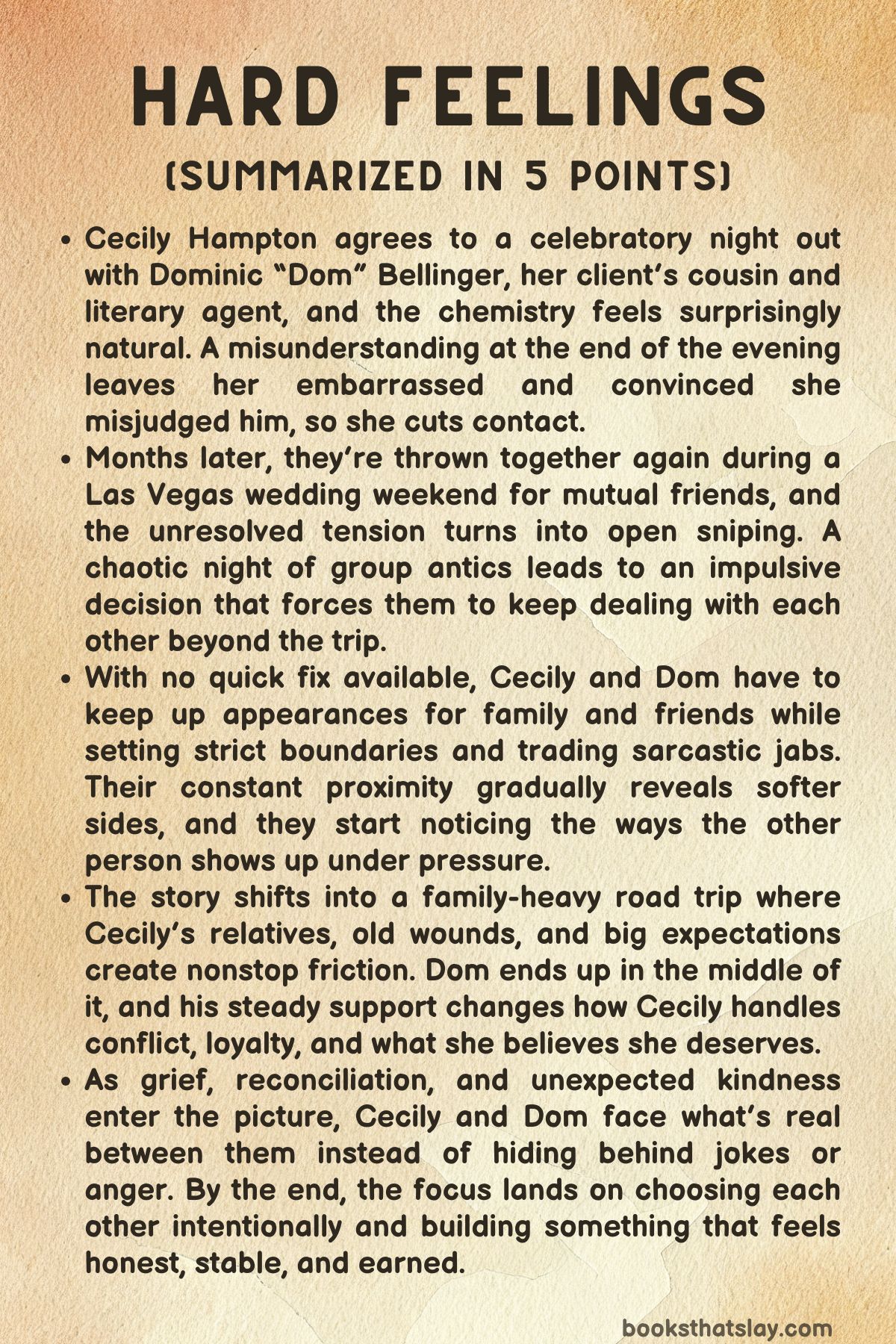
Cecily Hampton agrees to meet Dominic Bellinger for drinks in Phoenix. Dominic is her client Klein’s cousin and literary agent, and the overlap makes Cecily uneasy—especially because her boss, Paisley, is dating Klein.
Still, Cecily goes, half-expecting it might be a date. At the bar, she recognizes Dominic immediately from his agency photo.
He is charming, attentive, and surprisingly easy to talk to. Their conversation turns flirtatious, the kind that makes Cecily relax despite herself.
A bartender Cecily already knows serves her favorite blueberry mojito, and the night feels promising.
Then Dominic steps away to take a call and doesn’t come right back. Cecily’s nerves spike, and she goes looking for him.
As she approaches a hallway near the bathrooms, she overhears him on the phone complaining about a woman—mocking her laugh and calling her the worst. Cecily is convinced he means her.
Humiliated, she leaves without confronting him. Outside, fueled by anger, she persuades a bachelorette group to loudly embarrass Dominic by wishing him happy birthday, then drives home.
She blocks his number and decides she misread everything about him.
Eight months later, Dominic still can’t make sense of that night. He replays the date over and over, wondering why Cecily vanished mid-evening and cut him off without explanation.
He’s irritated, bruised, and annoyed at himself for caring. When Klein announces a joint bachelor and bachelorette weekend in Las Vegas—celebrating Klein and Paisley’s upcoming wedding—Dominic agrees to go and silently wonders if Cecily will be there.
Vegas greets Dominic with chaos. His luggage goes missing, he waits too long for a rideshare, and a woman spills coffee on his shirt in the hotel lobby.
With no time to change properly, he shows up late to the group dinner in a ridiculous novelty shirt Klein mailed him for pool antics. The shirt’s crude slogan instantly makes everyone laugh.
Cecily, seated with the group, does not laugh. She glares.
Dominic responds like an idiot: he flips her off as he walks past. Klein, amused and unaware of the history, seats them next to each other.
Dinner turns into a polite war. Dominic orders a blueberry mojito to needle Cecily.
Cecily fires back with a drink called a Ballbuster. Their conversation becomes a string of sharp remarks disguised as banter, and the table reads it as chemistry.
Shots arrive for toasts, and the night slides into drunkenness. Later, at a club with bottle service, Cecily loosens up.
Dominic watches her laugh and dance and feels the tension shift into something less controlled. When Klein asks what is going on, Dominic claims nothing.
Cecily finally approaches Dominic at the club, leads with an insult, then asks him to dance. They move together with heat and hostility in equal measure, trading crude jokes and daring each other to react.
The night blurs into the kind of bad decision Vegas is known for.
Cecily wakes up the next morning with a brutal hangover in a hotel bed that isn’t hers. Panic hits fast—until she realizes she’s in Dominic’s room.
Dominic appears from the bathroom, shirtless and far too calm. Cecily is wearing his novelty shirt and demands to know if they slept together.
Dominic tells her they did not. He explains that she was too drunk to give enthusiastic consent, so he didn’t touch her that way.
Cecily is still reeling when Klein and Paisley hammer on the door and burst in. Paisley is holding a photo of Cecily and Dominic under a neon “Just Married” sign, Dominic dipping Cecily like they’re in a movie.
Cecily’s memory snaps back in messy pieces: Dominic suggested it as a very Vegas thing, and they followed through. Cecily promptly runs to vomit while Paisley tries to help.
The wedding was real, and worse, Cecily sent the photo to her entire family. Dominic checks the annulment rules and finds they can’t file until Monday.
Cecily is supposed to fly home Sunday, but Dominic will be back in Phoenix afterward and offers to handle it together on Monday. When they’re finally alone, the tension returns.
Dominic calls Cecily his wife “for the weekend,” and Cecily rejects the label on instinct even though it’s technically true.
Monday arrives with Cecily and Dominic driving to an emergency family meeting called by Cecily’s grandmother, Ophelia. Cecily tries to prepare Dominic for what he’s walking into.
She describes her family as difficult: her grandmother is bold and unpredictable, her sister Kerrigan has no filter, her brother Duke is guarded, her mother Marilyn is emotionally absent, and her father Glenn is controlling and obsessed with appearances. When they pull into a gated mansion in a wealthy mountainside neighborhood, Dominic realizes Cecily’s family has money—lottery money, Cecily explains, courtesy of Ophelia.
Cecily lays down strict rules before they go inside: the marriage was a mistake, they’re annulling it after today, and Dominic must not act like a real husband. Ophelia opens the door delighted, greeting them as newlyweds and treating the whole situation like entertainment.
Out by the pool, Cecily introduces Dominic to the family, and the meeting immediately turns adversarial. Glenn demands an annulment.
Cecily refuses to be ordered around, even if she wants it too. Marilyn suggests they throw a reception quickly—before Cecily starts “showing.” Glenn implies Dominic might be after their money.
Dominic holds his ground, stating he has a career and doesn’t want anything from them.
Then Ophelia ends the fight with a calm, devastating announcement: she has end-stage heart failure. The shock silences everyone.
Ophelia says she didn’t tell them sooner because she didn’t want pity or control. She called the meeting for a second reason too: she has planned a three-week Arizona road trip starting next Monday, traveling in a luxury motor coach, staying in hotels and cabins, and doing carefully curated activities.
She wants the entire family together, including a death doula named Rainbow. And she insists Dominic is coming too.
Afterward, Cecily tells Dominic he doesn’t have to do this. Dominic refuses to leave her to handle it alone.
Ophelia privately asks Dominic to join because Cecily will need support, then offers him a THC gummy to take the edge off. Dominic accepts, and the timing becomes a problem: the gummy makes him too impaired to go to court that afternoon for the annulment.
Cecily is furious. Back at Klein and Paisley’s house, friends laugh about the story, and Cecily finally admits out loud that she hates Dominic.
Dominic snaps back that the feeling is mutual, and in the heat of the argument he announces he’s going on the road trip. He also refuses to cooperate with an annulment until after it ends, effectively holding the marriage hostage.
Cecily vents to Paisley and their friend Paloma, who encourage her to talk to Dominic before being trapped with him for weeks. Cecily explains the original misunderstanding: she overheard Dominic insulting a woman on the phone and assumed it was her.
Meanwhile, Dominic admits to Klein that refusing the annulment was partly to irritate Cecily, but also because he sees how her family treats her and thinks she needs someone on her side.
The road trip begins with forced proximity and constant teasing from the family about the “newlyweds.” Cecily and Dominic stop drinking. They bicker openly, using insults like nicknames, but the edge starts to shift into familiarity.
A late-night incident in a hotel bathroom—where Cecily panics because a cricket brushes her while she’s on the toilet—breaks some of the tension. Dominic handles it without mocking her, and Cecily is embarrassed but quietly grateful.
At a dude ranch, attraction becomes harder to ignore. Dominic watches Cecily ride a horse and can’t stop thinking about her.
He takes a photo of her, touches her lower back a moment too long, and catches himself wanting more than pretend affection. Cecily, reading the signals, expects a kiss.
Dominic panics and rubs his nose against hers instead of kissing her. Cecily is offended, and in the scramble of emotions she accidentally kicks him in the crotch while mounting her horse.
In front of the family, Dominic still defends her when her father makes a comment about the marriage, and Cecily thanks him afterward, surprised by how much it lands.
Cecily and Dominic finally hike away from the family to talk honestly. Dominic explains why he avoided kissing her earlier: he didn’t want their first real kiss to be staged in front of her parents.
He wanted it private and chosen. Cecily fights him with sharp words, but the honesty cracks something open.
They kiss for real, intense and mutual, stopping only when they hear people nearby. Soon after, they stumble upon a shaded pool occupied by older nudists who cheerfully invite them to join.
Cecily recognizes one of them as her former principal, and she and Dominic flee, horrified and laughing. The shared absurdity becomes its own kind of bond.
As they travel through Arizona, the trip becomes a pressure cooker that forces truth out of everyone. Cecily talks more openly about her fear of getting attached to temporary kindness from her mother.
Dominic shares his own unstable childhood shaped by his father’s schemes and constant moving. Their attraction turns physical in ways that skirt the marriage issue: Cecily wants him, but she fears consummating the marriage will make annulment impossible.
Dominic offers a compromise—he’ll take care of her without crossing the legal line—and when Cecily admits she’s close to “combustion,” he pulls her into the motor coach and brings her to orgasm with his hands, careful and controlled, while they keep quiet because people are nearby. Cecily returns to dinner with him afterward, rattled and relieved, no longer able to claim she loathes him.
Their relationship continues to intensify. Cecily initiates oral sex the next morning, using action instead of words because she struggles to express affection directly.
Dominic accepts it as truth: she cares, even when she can’t say it cleanly. In small moments—music playlists, shared jokes, small gifts—trust builds.
A snowstorm creates a crisis when the motor coach gets stuck on a mountain road. Outside, the men argue over what to do, and tensions explode.
Dominic steps between Cecily and her brother Duke when Duke lashes out. Glenn again demands an annulment.
In the middle of it, Duke reveals his own hurt: he feels like Cecily “left,” and he’s been stuck carrying the family’s burdens alone. The confrontation forces the siblings into a more honest conversation afterward, and Cecily and Duke finally speak without their old defenses.
The group reaches Flagstaff and stays at the historic Hotel Monte Vista, famous for ghost stories. Cecily is scared; Dominic teases her but also reassures her.
That night, they become intimate, and Dominic later feels pressure on his throat that Cecily insists she didn’t cause. The strange moment shakes him, and they only describe it vaguely to the others, letting Kerrigan turn it into a running joke.
During a night out, the family almost feels functional. They ride a party bike, play games, and laugh together.
Dominic wins a trivia question using knowledge from a classic novel, and Cecily kisses him in celebration. Later, Ophelia privately tells Cecily she engineered this trip so the family couldn’t avoid the truth anymore.
She also tells Cecily plainly that Dominic is in love with her.
The next morning, Cecily wakes with a surge of panic at 6:47 a.m. Her father appears in the lobby with the same sense of dread.
They race to the motor coach, where Rainbow opens the door frantic. Ophelia is unresponsive.
Emergency services arrive, but Ophelia dies that morning. The trip ends instantly, replaced by shock and logistics.
Dominic takes over practical tasks—arranging transport back to Phoenix, returning the motor coach early, canceling plans—because someone has to function. The family, stripped raw, stays near each other in awkward, quiet grief.
Cecily returns home with Dominic, and he stays with her through the first days when grief hits in waves and ordinary life feels unreal.
In the aftermath, Dominic tells Cecily his boss approved a Phoenix branch of his agency, allowing him to move and be with her long-term. Cecily slowly returns to work.
Her father calls with a change in his voice and asks her to help plan Ophelia’s memorial. He admits he and Marilyn were “assholes.” Cecily meets her parents at Ophelia’s house and finally speaks about what their upbringing did to her.
Marilyn apologizes for emotionally disappearing. Glenn apologizes for cruel words and admits he lost himself in business.
He says he will retire and make Duke CEO, shifting the family power dynamic that has controlled them for years.
At Ophelia’s memorial, Cecily gives a speech that honors her grandmother’s blunt humor and force of personality. Cecily then learns Ophelia left her the house.
That night, Cecily tells Dominic she loves him. Dominic reveals Ophelia gave him her diamond ring with instructions to use it when the time was right.
He places it on Cecily’s finger, and the marriage that began as a mistake becomes something they actively choose.
In the epilogue, Dominic is living in Phoenix, the agency’s Phoenix branch is running, and he and Cecily have moved into Ophelia’s old house, reshaping it into a home that fits them. Their friends still tease them about the Vegas marriage, but the story has changed meaning.
What started with a misunderstanding and a reluctant legal bond becomes a partnership built on protection, honesty, and the decision to stay—fully and on purpose.
Characters
Cecily Hampton
In Hard Feelings, Cecily is the emotional center of the story: competent and outwardly composed, but internally reactive, tender, and hyperaware of how easily she can be misread or dismissed. She begins with a strong instinct for self-protection—she interprets Dom’s overheard phone complaint as proof she’s foolish for trusting chemistry, and she chooses disappearance over confrontation because leaving first feels safer than being rejected out loud.
That pattern repeats in subtler ways: she avoids her phone, masks vulnerability with sarcasm, and tries to “perform fine” for her friends and for the wedding weekend because admitting she’s shaken would give the situation power over her. Cecily’s sharpness is part defense mechanism and part personality; her insults and standoffishness aren’t just hostility, they are her way of controlling the temperature in a room where she usually feels emotionally outnumbered—by wealth, by family expectations, and by the messiness of her own desire.
As the road trip forces proximity, Cecily’s growth comes from allowing herself to be seen without the armor: she starts voicing fear about Ophelia’s decline, admits how unpredictable her mother’s warmth feels, and gradually learns that accepting care doesn’t make her weak or obligated. By the end, her arc is less about “softening” and more about integration—she keeps her wit and independence, but she stops using them to disappear from people who want to stay.
Dominic “Dom” Bellinger
Dom is written as a man who looks polished on the surface—good manners, competence, charm—but carries a private ledger of hurt and frustration that leaks out in stubborn, sometimes petty ways. His initial connection with Cecily feels genuine, which is why her abrupt exit and blocking sticks in his mind for months; he rewrites the night because he needs an explanation that doesn’t require accepting that he was simply left.
That need for control shows up again when he refuses the annulment—not purely out of malice, but because he wants leverage in a situation where he feels powerless and because he intuits that Cecily’s family dynamic is predatory in a way she has normalized. Dom’s best traits are protective loyalty and steadiness under pressure: when Ophelia dies, he becomes the person who handles logistics and absorbs shock so others can fall apart.
Yet he’s not a saint; he pokes at Cecily with the mojito, escalates conflict, and uses teasing as both flirtation and shield. Importantly, Dom’s consent boundaries—refusing to sleep with Cecily when she can’t give enthusiastic consent—mark him as someone who will not exploit closeness, even when he wants it badly, and that becomes foundational to Cecily learning she can trust him.
His arc in Hard Feelings resolves when he stops being reactive—stopping the scorekeeping, choosing to relocate, and showing up not as a temporary buffer against her family, but as a long-term partner whose love is practical, consistent, and chosen.
Klein
Klein functions as the social catalyst and pressure amplifier: he is the friend who nudges everyone into the same orbit and then refuses to let the tension stay private. He’s successful, confident, and entertained by chaos, which makes him both a source of warmth and a source of escalation—he teases Dom, seats him beside Cecily, insists the “newlyweds” sit together, and generally treats the accidental marriage as comedic material.
But beneath the provocation, Klein is also an anchor of community: his wedding events create the ensemble setting that traps Dom and Cecily together long enough for their conflict to transform into intimacy. He’s the kind of friend who pushes too hard because he assumes everything will work out, and in doing so he reveals the story’s theme that love often needs friction and forced proximity to break through defensive habits.
Even when he irritates Dom, Klein’s role is ultimately connective—he keeps the group moving, keeps truths from being avoided, and provides a lighter counterweight to the heavier family storyline.
Paisley
Paisley is the supportive, steady friend-boss figure who balances empathy with directness. Her relationship with Klein places her in the middle of overlapping professional and personal spheres, yet she repeatedly chooses care over judgment—she checks in with Cecily, gives her space to process, and later helps manage the “crisis” of the Vegas marriage without shaming her.
Paisley’s presence matters because Cecily’s family environment is emotionally unreliable; Paisley represents a different model of adulthood where relationships can be secure, teasing can be affectionate rather than cutting, and confrontation can happen without domination. When Cecily spirals, Paisley doesn’t intensify the drama—she contains it, offers practical comfort, and encourages the one thing Cecily avoids most: talking to Dom instead of retreating.
In the story’s ecosystem, Paisley is one of the quiet forces that normalize healing by treating Cecily’s feelings as reasonable, not inconvenient.
Paloma
Paloma acts as emotional triage: she’s the friend who can sit with mess and keep it from becoming catastrophe. The “doll-making kit” moment is a small but telling detail—Paloma understands that Cecily needs something physical to do while she talks, because stillness invites panic.
Paloma also helps translate Cecily’s intensity into something workable; she listens, validates, and then gently pushes toward accountability and communication rather than letting Cecily calcify into anger. Where Cecily’s family tends to weaponize reactions, Paloma treats reactions as information.
Her role is less about plot movement and more about showing that Cecily has chosen a support system that counters her upbringing: friends who don’t demand performance, who don’t punish vulnerability, and who can be both comforting and corrective.
Kerrigan Hampton
Kerrigan is the loud, unfiltered sister who uses humor as a battering ram against discomfort. She’s frequently comic—obsessing over maid-of-honor rights, flirting shamelessly, delivering blunt commentary—but she also serves as a mirror to Cecily, showing a different survival strategy from the same family climate.
Where Cecily retreats and intellectualizes, Kerrigan externalizes; she says what others won’t, escalates tension into jokes, and refuses to behave “properly” even in wealthy, high-control spaces. That irreverence becomes oddly stabilizing, because it punctures Glenn’s authority and the family’s performative image management.
Kerrigan is also a reminder that love in this family often arrives sideways: she can be chaotic and intrusive, yet she’s present, engaged, and protective in her own messy way. Her openness makes her a pressure-release valve, and her flirtation with Christopher hints at her own desire to be seen outside the Hampton script.
Duke Hampton
Duke is the sibling shaped by duty and proximity to power—aloof on the surface, but carrying a deep reservoir of resentment and exhaustion. He appears aligned with his father, which initially frames him as judgmental, yet his later outburst reveals that his stiffness is largely a trauma response: he has been “the one who stayed,” absorbing the family’s pressure, managing the parents’ volatility, and watching Cecily leave while he remained trapped in responsibility.
Duke’s anger at Cecily isn’t simply moral outrage about Vegas; it is grief disguised as blame, the pain of feeling abandoned reframed as indignation. When the snowstorm forces the family into a literal stuck position, Duke’s emotional truth surfaces in the same moment the vehicle gets unstuck—an on-the-nose but effective parallel that signals the start of real change.
His conversation with Cecily afterward shows his capacity for honesty and repair once he’s no longer performing toughness. Duke’s arc isn’t romantic; it’s relational—he begins to step out of the role his father sculpted for him and into one where his feelings can exist without being converted into control.
Glenn Hampton
Glenn is the story’s clearest embodiment of image obsession and patriarchal control. His first instinct is command—demanding an annulment, interrogating Dom’s motives, framing Cecily’s choices as an affront to family reputation.
He operates as though authority is love: if he can force the “correct” outcome, he believes he’s protecting the family, but what he’s actually protecting is the facade. His cruelty is pointed because it targets identity and autonomy, which is why Dom’s refusal to be cowed becomes so important; Glenn is used to men either competing with him or appeasing him, and Dom does neither.
Yet Glenn is not left as a caricature. The shock of Ophelia’s death and the later admissions—calling himself and Marilyn “assholes,” apologizing, stepping back from the business—show a man forced to confront the cost of his rigidity.
His change doesn’t erase the harm, but it repositions him from untouchable antagonist to flawed parent capable of accountability, which is crucial for Cecily’s ability to grieve Ophelia without also carrying the full weight of lifelong parental neglect.
Marilyn Hampton
Marilyn represents a quieter, arguably more destabilizing kind of harm: emotional absence. Where Glenn is openly controlling, Marilyn is evasive, retreating into distance and politeness when conflict would require her to choose a side.
Her suggestion of rushing a reception “before Cecily starts showing” exposes a tendency to manage discomfort through social performance and implication rather than direct care. For Cecily, this absence is a wound that doesn’t bruise visibly; it makes Cecily doubt warmth when it appears and brace for it to vanish.
Marilyn’s later apology matters because it names the pattern—she admits she disappeared—and because it comes with an action that speaks in Cecily’s emotional language: making childhood favorite foods, a tangible attempt to mother her in the present. Marilyn’s character underscores that neglect can coexist with love, and that repair often begins not with grand declarations but with sustained presence and small, consistent gestures.
Ophelia “Savage Grandma” Hampton
Ophelia is the gravitational force of the Hampton family and the narrative’s moral engine. Her “savage” humor and bluntness make her memorable, but her deeper role is as orchestrator of truth: she uses her impending death to force proximity, to interrupt generational avoidance, and to create a space where family members can no longer hide behind roles.
Ophelia’s lottery wealth gives her power, yet she wields it not as a weapon but as leverage for connection—she creates a road trip that is equal parts luxury and intervention, choosing shared experiences as the method for emotional excavation. Her relationship with Cecily is especially central because Ophelia is the one familial bond that feels safe; she sees Cecily clearly, names what others won’t, and still delights in her.
Ophelia’s request that Dom come isn’t simply meddling; it’s strategic care—she recognizes Cecily needs a steady ally when the family dynamics intensify. Even after her death, Ophelia continues shaping the story through what she leaves behind: the house, the ring, and the permission for Cecily to build a life rooted in choice rather than obligation.
Rainbow
Rainbow functions as both outsider and guide, someone whose presence makes death speakable in a family trained to either dominate or evade. As a death doula, Rainbow symbolizes a kind of emotional literacy the Hamptons lack: she can name what’s happening without escalating it, hold fear without turning it into blame, and stay calm at the moment of crisis.
Her inclusion on the trip also reframes Ophelia’s “savage” style into something more tender—Ophelia isn’t only stirring the pot; she is planning for dignity and support at the end. Rainbow’s dynamic with Ophelia has a quiet authority, and her matter-of-factness contrasts sharply with the family’s theatrics, making her a stabilizing presence even when she appears briefly.
By existing alongside the romantic plot, Rainbow helps the story keep its emotional stakes honest: love is blooming, yes, but mortality is real, and the characters’ growth is measured by how they show up when the jokes stop.
Sally Whitaker
Sally Whitaker is a work-world antagonist who highlights Dom’s professional values and his impatience with privilege masquerading as competence. As a nepo-baby associate pushing a manuscript Dom dislikes, she represents the kind of insulated entitlement that frustrates him—people who advance through connections while others grind through taste, judgment, and labor.
Her presence is also revealing because Dom’s conflict style emerges at work the same way it does with Cecily: blunt, stubborn, and fueled by a strong internal code. Sally is less a fully explored person than a narrative contrast, but she’s important because she situates Dom as someone who takes his job seriously and doesn’t easily defer to hierarchy, which later explains why he can stand in front of Glenn without folding.
She sharpens our sense that Dom’s protectiveness is not just romantic—it’s tied to a broader refusal to tolerate manipulation.
Halston
Halston is a small but effective supporting presence who grounds the early scenes in familiarity and social texture. As the bartender who knows Cecily through Klein, Halston implicitly links the personal and professional circles that make Cecily nervous in the first place.
The blueberry mojito detail becomes a recurring symbol of connection and provocation—first a comfort, later a weaponized callback when Dom orders it to needle Cecily. Halston’s main function is atmosphere and continuity: the kind of side character who makes the world feel lived-in, where relationships have history and everyone is only a couple degrees away from everyone else.
Christopher
Christopher appears at a pivotal moment when the family is literally stranded and emotionally on the brink. His practical competence—showing up with a chain, towing them out—contrasts with the Hamptons’ tendency to turn stress into conflict.
In a story full of people talking around issues, Christopher simply solves the immediate problem, and that competence briefly resets the family’s emotional temperature. His easy banter also invites play back into the group, and his flirtation with Kerrigan offers a small glimpse of possibility beyond the family system: connection that isn’t loaded with legacy, money, or image.
He’s a reminder that sometimes the person who changes the day isn’t the one with the deepest backstory, but the one who arrives with a calm presence and a clear next step.
Quint
Quint is another minor character whose role is less about personality and more about creating a setting where Dom’s feelings become unavoidable. As the cowboy guide, he represents the “real world” outside the Hamptons’ wealth and drama, and his presence puts Dom and Cecily into a public, structured intimacy—riding in a line, touching at the small of her back, being watched by family.
Quint’s trail ride sequence matters because it’s where attraction shifts into tenderness and where Dom’s restraint becomes visible; he wants Cecily, but he also wants their first real moments to be theirs. Quint is essentially the facilitator of a liminal space: far enough from the family to breathe, close enough that the family’s gaze still shapes choices.
Johann Bradford
Johann Bradford exists as a comedic jolt that also reveals something important about Cecily and Dom’s emerging bond. The nudist pool encounter is absurd, but their shared horrified laughter becomes a kind of intimacy test—can they be embarrassed together and still feel connected?
Johann’s friendliness and immediate invitation to pickleball pushes Cecily and Dom into a brief moment of teamwork, including Dom’s quick-thinking choice to use a false name to protect privacy. Johann is less a character to be understood deeply and more a device that converts tension into shared humor, reinforcing that their relationship is starting to include companionship, not just heat and sparring.
Mrs. Abbot
Mrs. Abbot is a punchline with teeth: the former principal appearing in a nudist setting collapses Cecily’s sense of control and propriety in the funniest possible way. The significance isn’t Mrs. Abbot’s inner life, which the story doesn’t explore, but what she triggers in Cecily—shock, disbelief, and then the impulse to broadcast it at the cookout, which is Cecily’s way of reclaiming power over embarrassment.
That choice signals growth: earlier Cecily runs from humiliation; here she names it loudly, turns it into a story, and survives the social fallout. Mrs. Abbot’s cameo, then, indirectly marks a shift in Cecily from avoidance to ownership.
Themes
Miscommunication, Assumptions, and the Damage of Unspoken Truths
A single overheard phone call sets off months of fallout because Cecily assumes Dominic is insulting her and chooses disappearance over confrontation. That choice doesn’t just end a promising night; it reshapes how both of them interpret each other afterward.
Cecily carries the humiliation like proof that she can’t trust her own instincts, while Dom spends eight months replaying the date, trying to invent explanations that protect his ego and soften the rejection. What makes the misunderstanding so powerful is not only that it happens, but that both of them keep feeding it.
Cecily tells Paisley “Fine,” shuts down curiosity, and blocks Dom, treating silence as safety. Dom responds by hardening into resentment, so when they meet again he uses petty needling—ordering her drink, flipping her off, turning dinner into a contest—to force a reaction that confirms she dislikes him.
The story keeps showing how quickly people create narratives when direct information feels risky. In Vegas, their hostility is partly real and partly performance, because neither wants to admit they still care about what the other thinks.
Even the accidental marriage grows from that same pattern: they treat the night like a joke until consequences arrive, and then they treat the consequences like a joke until family pressure makes it terrifying. Later, the road trip becomes a forced laboratory for honesty.
Cecily’s friends push her to explain the original incident; Dom admits that his refusal to annul is partly spite and partly concern; and eventually the “nose rub” becomes a miniature version of the theme—Cecily reads it as rejection, Dom meant it as protection of something meaningful. By making them repeatedly crash into the results of assumption-based thinking, Hard Feelings argues that intimacy doesn’t collapse mainly from conflict; it collapses from the stories people tell themselves when they refuse to ask the uncomfortable question out loud.
Consent, Respect, and Redefining What Safety Looks Like in Attraction
The relationship is physically charged, sarcastic, and often combative on the surface, but it keeps returning to a surprisingly strict standard: desire is not allowed to override care. The clearest example arrives the morning after the club.
Cecily wakes terrified, unsure what happened, and Dom makes a choice that matters more than any flirtation—he did not sleep with her because she couldn’t give enthusiastic consent. That moment quietly rewrites him in her mind, because it proves his self-control isn’t about moral grandstanding or fear; it’s about valuing her autonomy even when he wants her.
It also reframes the entire enemies-to-lovers arc: the real turning point isn’t when they trade insults or dance close, but when he behaves like a safe person while she’s vulnerable.
From there, the book explores how respect can coexist with messy emotions. They still push each other’s buttons, and Cecily still uses sharp language as armor, but Dom repeatedly draws boundaries that protect her.
He defends her against her father’s control, refuses to treat her as property, and insists her permission is what matters. When he calls her his wife “for the weekend,” it’s annoying and provocative, yet it also carries a promise that he will show up and take the social consequences with her.
Even when sexual tension escalates later, the story keeps emphasizing intentionality: he doesn’t want their first real kiss to be a performance; he wants it to belong to them privately, without an audience using it as proof of anything. Cecily’s struggle becomes recognizing that safety isn’t the absence of intensity; it’s the presence of respect inside intensity.
Her attraction stops feeling like a trap when she sees Dom’s consistency—protective without being controlling, attentive without demanding repayment. The result is a romance where physical closeness becomes meaningful not because it is daring, but because it happens inside a framework of choice, clarity, and mutual regard.
Family Pressure, Emotional Neglect, and the Fight to Own Your Adult Identity
Cecily’s family dynamic is not background noise; it is one of the main forces shaping how she loves, argues, and protects herself. Her father’s cold, image-driven approach trains her to expect judgment first and empathy last.
Her mother’s emotional absence teaches her that asking for warmth might lead to disappointment, so Cecily learns to survive by minimizing her needs and presenting competence instead of vulnerability. Even when the Vegas marriage is accidental, her family treats it like a public scandal that must be controlled.
They leap to suspicion, money fear, and pregnancy panic, revealing that they see Cecily less as a person making choices and more as a problem to manage. This pressure explains why Cecily reacts so strongly to being ordered around; refusing the immediate annulment becomes a way to protect the one thing she rarely gets to own—her agency.
Dominic becomes a mirror that exposes how distorted the family’s rules are. He walks into the confrontation and immediately centers Cecily’s permission rather than Glenn’s approval, which is the opposite of what Cecily grew up with.
The family’s conflict with him is partly about class and suspicion, but it’s also about losing control over Cecily. Duke’s outburst during the snowstorm widens the theme by showing the cost of the family system on every sibling: he feels abandoned, overloaded, and manipulated into carrying responsibilities while resentment calcifies.
The book doesn’t treat these revelations as instant healing; instead, it shows slow shifts—one honest conversation in the passenger seat, one moment where the father goes quiet instead of dominating, one admission that the parents were “assholes.” Those changes matter because they move the family away from performance and toward accountability.
Cecily’s growth lies in refusing to stay the version of herself that the family script requires. She stops shrinking, stops hiding behind sarcasm alone, and eventually speaks her childhood pain directly.
The inheritance from Ophelia becomes symbolic too: Cecily is no longer trapped inside her parents’ emotional economy. By the end, she is building a home and a marriage on her terms, not as a rebellion, but as a conscious decision to define adulthood as self-ownership rather than obedience.
Grief, Mortality, and How Love Can Become a Way of Staying Present
Ophelia’s illness changes the stakes of everything. The road trip isn’t just a quirky setup; it’s a countdown that forces the Hamptons to be together without their usual escape routes.
Ophelia uses time as leverage, not to punish them, but to corner them into honesty before she is gone. Her announcement stops a family fight instantly, showing how quickly petty control battles collapse when mortality is named.
Yet the book doesn’t allow the diagnosis to become sentimental. Ophelia stays blunt, humorous, and commanding, and that tone shapes how grief is approached later: not as a polished lesson, but as something raw that interrupts plans and exposes what people avoid.
Cecily’s experience of grief is layered with fear of abandonment and a lifetime of not being emotionally held. She is stunned not only by Ophelia’s decline, but by how quickly it accelerates, how her swelling worsens, how the end approaches despite all the activity meant to postpone the reality.
The haunted-hotel stop, the early-morning panic at 6:47 a.m., and the sprint to the RV capture how grief often arrives first as intuition—your body knowing before your mind accepts it. When Ophelia dies, the family is forced into a kind of stunned togetherness: awkward meals, shared logistics, uncertain comfort.
Dominic’s response matters because he doesn’t make grief about himself. He handles the practical tasks, stays close, and supports Cecily through waves of shock without demanding that she perform strength.
What grief also does is clarify what love is for. The romance isn’t only about chemistry; it becomes a structure that helps Cecily stay present instead of dissociating.
Dom’s decision to move, the parents’ surprising accountability, and Cecily’s memorial speech all show different versions of showing up when time is limited. Ophelia’s final involvement—texting Dom encouragement and giving him the ring—positions love as continuity, a way for something enduring to remain after a person is gone.
Cecily saying “I love him” doesn’t read like a romantic milestone checkbox; it reads like an acceptance that life is unstable and that choosing someone steady is not a loss of independence, but a form of courage.