Hemlock by Melissa Faliveno Summary, Characters and Themes
Hemlock by Melissa Faliveno is a contemporary literary horror novel with elements of folk-horror and psychological realism, set in the Northwoods of Wisconsin. It follows Sam, a woman trying to hold herself together while returning to her family’s isolated cabin after years away.
She comes with a practical goal—repair the place and sell it to help her father—but the land is heavy with the unsolved mystery of her mother’s disappearance. As Sam works, drinks, remembers, and unravels, the forest presses closer. The story asks what we inherit from family, what sobriety costs, and what it means to become someone new.
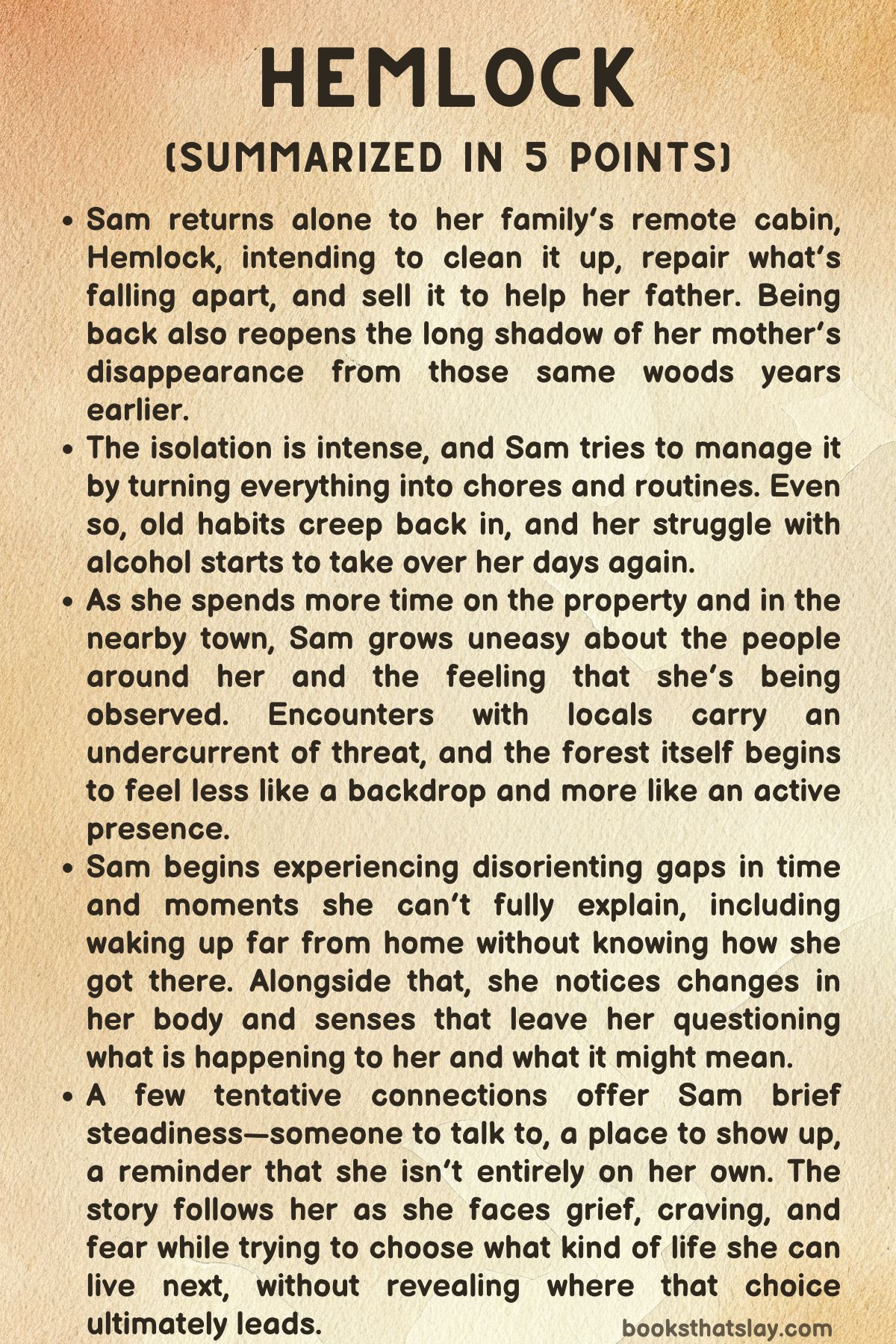
Summary
Sam drives through the dark Northwoods and reaches her family’s remote cabin, Hemlock, late at night. The road is narrow, the forest close, and the quiet feels alert.
In her nightmares the cabin grows enormous and confusing, but in front of her it looks small and plain. She sits in the car long enough to consider leaving, then forces herself to unload her bags.
The place is stale and neglected, and the electricity is out. She goes down into the basement with only her phone light, fighting panic, flips breakers, gets the septic and power running, and turns on the taps until the rusty well water clears.
The cabin is full of dust, dead insects, mouse droppings, and the clutter of a life that stopped moving. Outside, the stars are sharp and the coyotes sound near enough to matter.
Sam has come from Brooklyn in a rush that felt less like a choice than a pull. She packed quickly, drove overnight, slept at a truck stop, then continued north.
The long drive triggers the history of her working-class family—factory work, layoffs, the brittle promises of pensions—and the grim stories that cling to the region. She buys cigarettes at a gas station and keeps going, choosing the cabin over her hometown.
By morning, she is exhausted from a night of listening to every creak. She makes coffee and sits on the porch, thinking about her father building the cabin over years of weekend labor and naming it Hemlock.
Sam tells herself she’s here for a straightforward reason: clean it up, fix what she can, then sell it so her father can have money and a fresh start. The cabin is falling apart—rotting boards on the deck, a leaky sink, an overgrown yard, and a basement and garage stacked with her parents’ stuff.
But the real reason the place feels dangerous is her mother. Years earlier, her parents were at the cabin in autumn.
Her mother went for a walk and never came back. Search crews combed the woods for weeks.
Sam returned from New York to help, but the search slowed as winter approached, and eventually it ended without answers. After that, her father refused to return.
The cabin became a site of frozen time, and Sam learned to keep her questions packed away. Now she has come back in his place, trying to handle what he cannot.
She throws herself into work: scrubbing, hauling, pulling weeds, sorting, cleaning. The physical effort helps her stay inside the moment, but she also feels watched.
The woods seem to notice her. Not long after arriving, she finds an old six-pack in the basement.
She has been sober for ten months, yet she drinks one beer on the porch. The relief is immediate, and the decision repeats itself.
One becomes more. Soon she is buying alcohol in town.
She can feel the pattern forming: waking foggy and ashamed, swearing she’s done, then craving it again by evening.
Flashbacks show her leaving New York while her partner, Stephen, helps her pack. He is worried, asking why she has to go alone.
They talk about escaping the city together someday, but he can’t leave because of responsibilities. Sam promises she’ll return soon, even as she senses that something in her wants distance more than comfort.
At the cabin, the strange begins quietly and then doesn’t stop. Sam sets up a deer feeder even though locals disapprove, and a shopwoman in town advises her to call it “squirrels” if anyone asks.
One evening, as Sam drinks on the porch, a thin doe comes to the feeder. Sam hears the doe speak—clear as if it were normal—warning her that she is alone, that she doesn’t belong there right now, that she should stop drinking, and that something is coming in the woods.
Then the deer goes back to eating like nothing happened and disappears into the trees.
Not long after, a neighbor appears. A burly man named Danny knocks and introduces himself, offering firewood and acting friendly, but Sam stays behind the locked door.
She notices a pistol tucked at his waist. His tone carries an edge: he repeats that it’s dangerous for a woman to be alone out there and invites her to come drink at his place down the road.
When he leaves, Sam feels her body tense as if he has marked the cabin as a place he can enter whenever he wants.
Sam makes supply runs into the nearby town, Boundary Pass, and calls her father when she can find cell service. Their conversations skim the surface—repairs, weather, logistics—while everything emotional stays unspoken.
In town she catches people watching her. At a lakeside bar, she orders a brandy old-fashioned.
A white-haired man sits beside her and probes for information—whether she’s alone, where she’s staying—like a test. She leaves without eating, buzzed and hyper-aware of men’s attention, and the dark feels thicker on the walk back to her truck.
Then time breaks. Sam wakes before dawn in unfamiliar woods, barefoot, freezing, and disoriented.
For a moment she feels as if she’s outside her own body, watching herself from above until the cold snaps her back. She can’t remember how she got there.
A brief image flashes in her mind—small hands in a mirror, coarse hair on knuckles—then vanishes. She follows early light through dense trees, hears sounds behind her, runs, and eventually reaches the clearing with the cabin.
The porch light is still on, as if she never left. Inside she showers under scalding water, trying to scrub away fear and the sense of a missing piece.
Sam begins to talk to animals and trees as if it is the most natural thing in the world, and the cabin work makes her body stronger. The doe speaks again, warning her about drinking and about losing time—waking up without knowing where she is or who she is.
The warning hits too close to home. Sam remembers her mother’s last years: hidden drinking, paranoia, the dread Sam felt as a teenager not knowing what she’d find at home.
Shaken, she pours out her remaining alcohol and tries to hold the line.
For a while, staying busy works. Then alcohol appears again, as if it returned on its own.
Sam finds herself holding a bottle she doesn’t remember opening. At dusk she feels pulled toward the tree line, drawn by a whisper-like sound that reminds her of her mother humming in the woods.
She has always assumed her mother drowned in the lake, but now she wonders if the truth is somewhere else—further in, deeper under.
A neighbor named Lou-Ann visits one afternoon and sits with Sam for tea. They talk about the hemlock tree and hemlock as poison.
Lou-Ann asks about Sam’s life, and Sam admits she lives in New York and has been gone a long time. Lou-Ann tells her to hold on to the person who loves her, a gentle warning that lands like a plea.
Soon Sam wakes in the woods again, but this time she isn’t afraid. She is naked and not cold.
Her body feels different—covered in thick dark hair—and she moves with ease, senses sharp, confidence steady. She walks back to the cabin as if the forest knows her and she knows it back.
At the cabin her boots are neatly by the door, like someone put them there. Inside she finds evidence of bourbon she doesn’t remember drinking.
She sleeps for hours, heavy and blank.
She calls Stephen and admits the doe has been speaking to her. He listens, tries to make sense of it, and suggests the voice might sound like Sam’s mother.
The connection rattles her. Nearly a month passes without Sam realizing it.
When she finally speaks to Stephen again, he hears something off—he asks if she’s been drinking. Sam can’t answer.
Shame and the old instinct to hide rush in. She ends the call, shuts off her phone, and walks toward the woods as night closes.
Her body continues changing. Her hair grows darker and thicker.
She stops menstruating. Fat drops away and muscle arrives, hard and defined.
Her chest flattens and she likes how it feels. Her eyesight improves.
Her voice deepens. New coarse hairs appear along her jaw and neck.
Instead of correcting it, she looks at herself and thinks of a childhood idea: if people already treat you like a monster, why not stop apologizing for it?
A storm hits, knocking out the power. In the darkness, Sam hears scraping, a crash, something dragged outside.
She sees a human figure at the tree line during a lightning flash. By morning, muddy bare footprints cross her porch and move through the cabin to her bed.
She realizes someone was inside while she slept—and then sees that her own feet and legs are muddy, too, as if she ran outside during the night without remembering.
In town she meets Gina at the hardware store, a young woman who flirts openly and offers to come help with the sink, clearly offering more than plumbing advice. Sam is caught off guard by how much she wants the attention.
Gina gives her number, and Sam leaves smiling, both excited and uneasy about Stephen in the background of her mind.
On the road back, Sam hears gunshots, then footsteps following her. Panic rises, and she runs until she finds her driveway.
On the porch is a bundled stack of firewood tied with twine and a note from “neighbor.” The gesture is meant to seem kind, but it feels like a claim. Sam can almost smell Danny in the air.
Wanting company and a brighter room than her own cabin, Sam calls Gina and agrees to meet at the Beer Bar. The night turns into hours of beer and shots, queer recognition in a place that doesn’t offer it easily, and the risky relief of being desired.
Sam thinks she sees Danny in the bar, watching, but he’s gone when she looks again. Later, under stars and faint northern lights, Gina rides away on her motorcycle and Sam drives home, spinning.
The next morning Sam wakes in the woods again with an empty gun beside her and no memory of how she got there. Terrified by the blank spaces, she calls Lou-Ann, who takes her to breakfast.
In the car and at the diner, Lou-Ann talks about alcoholism as a family disease and asks about Sam’s history. Sam admits it runs through generations.
She also confesses the other truths: the talking doe, her changing body, the missing time, the sense that something in her is returning.
Lou-Ann connects Sam’s experiences to Indigenous stories, including Deer Woman—protective and dangerous in some versions—and to the windigo, a figure tied to endless hunger and destruction. The mention of hunger sparks an old memory: as a child, Sam ate a deer’s heart cooked by her grandmother, who told her it would make the deer part of her.
The memory clicks into place beside her current cravings and transformations. Lou-Ann asks the question Sam can’t avoid: what is she becoming?
Sam returns to the lake, watches loons, and accepts that the woods no longer feel like an enemy. She finds a small pouch of dried herbs left on her door handle like a gift.
She listens to voicemails—Stephen saying he loves her, Gina asking to see her again—and panic closes her throat. When Stephen calls, he tells her he is leaving.
He wants a future with someone who is present, someone who wants a family, and he believes Sam has been gone for a long time. Sam cycles through anger and grief, then finally lets the call end without begging.
She drives to town and buys bourbon and beer, telling herself it will be the last time. Instead of drinking alone, she goes to the Beer Bar and drinks hard, chasing numbness.
Afterward her memory cuts out. In the revealed events, she drives drunk, nearly kills herself with the gun, drives with her eyes closed, hits a doe, and crashes her truck into a pine.
She wakes deep in the forest, naked but warm, beside the injured doe and a sleeping fawn. The doe speaks calmly, tells her she has work to do, and urges her forward.
Then Sam wakes again near the wreck, clothed, freezing, and hurt. The doe is dead on the hood of the truck.
Sam breaks with grief, making an animal sound she doesn’t recognize as her own. She carries the doe into the woods, digs a grave with her hands, buries her, and walks home at dawn.
At the cabin, Sam burns her bloodied clothes in the fire pit. She calls Lou-Ann for help, and Lou-Ann comes immediately, holds her, and brings her to a recovery meeting.
Sam doesn’t speak; she just sits among other people’s stories and feels, for the first time in a long while, that she might survive.
Later, Lou-Ann tells her a local story about Danny: his family place is abandoned, and he vanished after drinking at the Beer Bar—his truck found, but not him. The cabin’s name gains another layer of menace.
Sam searches her parents’ bedroom and finds a hidden shoebox containing photos, trinkets, a book on Celtic mythology, and her mother’s journal with a letter addressed to Sam. Her mother apologizes, suggests some things are fated, urges Sam to stop fighting what is inside her, and says Sam will hear her in the woods and the trees.
She ends with love and a promise of waiting.
The next day Sam makes coffee and writes three letters: to Gina, apologizing and leaving the door open for a kinder future; to her father, with love and the intention to come see him; and to Stephen, telling the truth about how she left emotionally long before she left physically, honoring what they had while releasing him to a life he wants. She seals and stamps them, then decides to walk to town to mail them, arrange to tow the wrecked truck, and face what happened.
She chooses a simple commitment—one day at a time—listening to the woods as she steps into the life that is taking shape.
Characters
Sam
Sam is the emotional and narrative center of Hemlock, a woman who arrives at her family’s isolated cabin carrying equal parts practicality and dread. On the surface, she comes with a clear, fix-it plan—clean the place, repair it, sell it, help her father restart—but that plan is also a form of self-management: if her hands stay busy, maybe her mind won’t tear open.
What makes Sam compelling is the way she lives in two registers at once. She is competent and resourceful—turning on breakers, clearing rot, splitting wood, running, swimming, surviving storms—but she is also someone whose internal life is porous, easily breached by fear, inherited pain, and craving.
Her alcoholism isn’t framed as a single bad habit; it is a system of relief and punishment, a daily cycle of shame, denial, and compulsion that mirrors the family secrecy she grew up inside. As the woods begin to “answer” her—through missing time, waking up elsewhere, and the talking doe—Sam’s struggle shifts from only resisting relapse to confronting a deeper question: whether she is losing herself or finally becoming something more truthful.
Her body’s transformation intensifies that question, pushing her beyond the categories that once defined her and into a self that feels both frightening and strangely right. By the end, Sam’s arc doesn’t resolve into neat healing; it resolves into choice and direction—staying alive, asking for help, telling the truth in letters, and accepting that her future won’t be a return to the old life but a step toward an unknown life she can meet sober and awake.
Stephen
Stephen functions as Sam’s tether to her Brooklyn life and to a version of stability she both wants and resists. He is not written as a savior or a villain; instead, he is the person who sees enough to be frightened, who worries she will vanish, and who keeps trying to reach her through humor, tenderness, and direct questions.
His presence highlights Sam’s central pattern: she instinctively hides—her drinking, her fear, her confusion, even her love—because secrecy feels like survival. Stephen’s patience has limits, and his eventual decision to leave is less a sudden betrayal than a final acknowledgment of what has been happening for a long time: Sam has been physically present in their relationship while emotionally disappearing.
At the same time, he remains humane even in rupture—naming his needs, refusing to shame her, and insisting his love isn’t conditional on her being “fixed.” Stephen represents the life Sam could have continued performing—partnership, future plans, the city—yet he also represents the cost of that performance when she cannot be honest about who she is becoming. His exit becomes one of the story’s sharpest catalysts, stripping away the last reason Sam can use to pretend she’s only “visiting” the cabin, and forcing her to confront whether she will keep choosing disappearance or choose a new kind of presence.
Sam’s Mother
Sam’s mother is the haunting absence that shapes the cabin’s atmosphere long before any supernatural element becomes explicit. Her disappearance is not merely a backstory mystery; it is the emotional blueprint for Sam’s fear of becoming unrecognizable to herself.
Through Sam’s memories, her mother emerges as someone who carried hidden drinking, paranoia, and a fragile grip on coherence, turning the home into an unpredictable place where dread lived in the walls. This history is crucial because it makes Sam’s experiences at the cabin feel like both horror and inheritance: missing time and talking animals could be magic, madness, or the family disease wearing a different mask.
The mother also embodies the story’s idea that some legacies are not explained in daylight—there are things that remain unsolved by searches, by logic, by simply leaving town. Yet she is not framed only as tragedy.
Her journal and letter reposition her as someone who knew more than she could safely say, someone who believes fate and transformation are real forces, and someone who finally offers Sam a kind of permission that is also a warning: stop fighting what is in you, listen to the woods, and understand that the line between terror and calling is thin. In that sense, the mother becomes both the source of Sam’s dread and the most intimate guide into the transformation Sam has been resisting.
Sam’s Father
Sam’s father is defined by labor, retreat, and the kind of love that shows itself more through building than through speaking. He built the cabin over years, naming it and shaping it with his hands, which makes his refusal to return after his wife’s disappearance feel like a profound collapse of meaning—when the place becomes the site of loss, his relationship to it breaks.
His conversations with Sam—focused on repairs, weather, logistics—reveal a family style of coping where emotion is edged out by tasks, as if feelings are too dangerous to touch directly. This is not coldness so much as a protective numbness, and Sam inherits it even as she suffers from it.
He also serves as one of Sam’s original motivations: she wants to sell the cabin for him, to give him money and possibility, to do something concrete that might stand in for what cannot be repaired. What’s quietly powerful is how his absence forces Sam into the role of caretaker and fixer, a role that becomes both her strength and her trap.
By writing him a letter near the end, Sam begins to shift their relationship out of avoidance and into something more honest, suggesting that her healing is not only about sobriety or transformation, but also about changing the family’s language of love from silence into truth.
Danny
Danny is the story’s most overtly threatening human presence, a figure who brings the predatory edge of the outside world right up to Sam’s locked door. His friendliness is performative, and the pistol, the repeated emphasis that it’s “dangerous” for a woman alone, and the insistence on shared beers read less as neighborliness than as a script of control.
In a story where the woods themselves feel alive and morally complex, Danny represents a more mundane danger: entitlement, surveillance, and the way isolation can make someone vulnerable to a man who decides she is his to manage. His presence also tangles with Sam’s altered senses and missing time, creating a constant uncertainty about what is “real” threat versus what is being amplified by fear, alcohol, or transformation.
The later revelation that Danny vanished—truck found, body not—adds a chilling resonance: he becomes a cautionary echo of the book’s folklore currents, a man who fits the pattern of someone swallowed by the same landscape he tried to dominate. Danny ultimately functions as a foil to the deer mythology invoked in Hemlock: if there is a force in the woods that protects, punishes, or balances, he is the kind of person the old stories would be designed to confront.
Lou-Ann
Lou-Ann arrives as something rare in Sam’s isolated world: a steady, non-coercive human connection that does not demand performance. Where many characters approach Sam with probing curiosity or veiled threat, Lou-Ann approaches her with practical warmth—tea, breakfast, rides, conversation—and she listens without rushing to label Sam’s experiences as either insanity or magic.
Her significance deepens when she frames alcoholism as a family disease and speaks directly about the risks of isolation, offering Sam a kind of intergenerational realism that doesn’t shame her. Lou-Ann is also the character who bridges the gap between Sam’s lived reality and the story’s mythic layer, naming Deer Woman and windigo not as gimmicks but as cultural stories that carry lessons about hunger, harm, protection, and consequence.
That framing helps Sam reinterpret what is happening to her as transformation rather than pure breakdown, while still keeping the danger intact. Most importantly, Lou-Ann becomes the person Sam can call at 6 a.m.
when things go wrong, and the person who brings her into a recovery meeting without spectacle. Lou-Ann represents a different kind of belonging: not the seductive belonging of the woods, but the human belonging that makes survival sustainable.
Gina
Gina embodies possibility—romantic, sexual, social, and identity-based—at a moment when Sam’s sense of self is cracking open. She is flirtatious, open, and direct, and the ease with which she asks about pronouns and loneliness reveals a tenderness that contrasts with the town’s watchfulness.
Gina also mirrors Sam in key ways: she left, lived elsewhere, and returned because family pulled her back, which makes her a living example of the push-pull dynamic Sam is trapped inside. Their connection offers Sam a glimpse of being desired without having to be “good,” and being understood without having to explain everything.
At the same time, Gina becomes a pressure point for Sam’s shame and avoidance—Stephen’s presence in Sam’s mind, the drinking that accelerates during their night out, and the fear of being seen. Gina is not positioned as a solution; she is positioned as a door.
Sam’s later letter to her—apologizing and suggesting “someday”—captures Sam’s pattern of retreat when intimacy becomes real, but it also shows growth: instead of disappearing without a trace, Sam tries to leave honesty behind. Gina represents the life Sam might still build with other people in it, if she can stop running from herself first.
Sam’s Grandmother
Sam’s grandmother is the deep-root figure beneath the family’s strange inheritance, the one who carries old practices and stories that blur the line between superstition and lived knowledge. Through her, Sam learns a way of relating to animals and the natural world that is intimate and reciprocal—talking to birds, feeding creatures, believing trust can be built across species.
The grandmother also anchors one of the most formative and unsettling memories: having Sam eat a deer’s heart and telling her that by eating it, the deer becomes part of her. That act functions like a mythic seed planted in childhood, something Sam half-forgets and then slowly realizes has been inside her all along.
The grandmother’s storytelling introduces transformation as a lineage rather than a freak event, which matters because it reframes Sam’s changes as connected to family identity instead of only illness or trauma. Even when she is not present in the timeline, her influence shapes how Sam interprets the woods—not only as a place of danger, but as a place that speaks a language her blood already knows.
The Doe
The doe is both character and conduit, a presence that moves between the natural and the uncanny without fully belonging to either category. At first, she appears in the ordinary context of feeding deer, but her speech turns her into a moral witness—warning Sam about being alone, about drinking, about something approaching.
What makes the doe’s role rich is the way she functions as both external guide and internal mirror. Sometimes her voice feels like a conscience Sam cannot access on her own; sometimes it feels like the woods speaking through a familiar mouth; sometimes it feels like an echo of Sam’s mother, as Stephen suggests.
The doe also insists on accountability, repeatedly linking alcohol to losing time and losing self, as if intoxication makes Sam more vulnerable to the forces moving through the forest. Yet the doe is not simply a guardian angel.
She is sharp, sarcastic, instructive, and occasionally unsettling, carrying the story’s critique of human destruction and entitlement. Her final arc—found dead after Sam’s blackout crash, paired with Sam waking beside her and a fawn—turns the doe into the story’s most devastating symbol of cost and care.
Whether read as spirit, protector, or embodiment of an older myth, the doe’s presence pushes Sam toward the same end point every time: wake up, face what you’ve done, and decide what kind of being you will be.
Sam’s Partner-Cat
The cat is a small but telling detail: a domestic anchor tied to Stephen and to the Brooklyn life Sam is leaving behind. When Stephen mentions taking care of the cat as he ends the relationship, it underscores the heartbreak in practical terms—love reduced to logistics, a shared home dissolving into who keeps which living thing safe.
In a story filled with wild creatures and forest omens, the cat quietly represents the ordinary intimacy Sam cannot currently sustain, and the sense that her transformation has consequences not only in her body but in the everyday bonds that once made her life feel human and knowable.
Themes
Grief, disappearance, and the urge to make meaning
Sam’s return to Hemlock isn’t only a practical trip to repair and sell a decaying property; it is a confrontation with a disappearance that never became a story with an ending. Her mother’s vanishing leaves behind a kind of grief that has no object to hold onto, because there is no body, no certainty, and no shared language in the family to name what happened.
The cabin becomes a physical archive of that unresolved loss: the dust, the broken fixtures, the mouse droppings, the rotting boards, and the basement’s darkness all mirror what the family has avoided touching for years. Sam tries to convert grief into a to-do list—scrub, fix, sort, sell—because action feels safer than feeling.
Yet the more she repairs the place, the more the place repairs access to memory, pulling her back into moments she has tried to outrun: the searches, the winter closing in, her father’s withdrawal, her own reflex to keep emotions cordoned off. The narrative keeps pressing on a painful truth: grief that is denied does not disappear, it simply changes form.
It becomes vigilance at night, the sense of being watched, the impulse to drink, and the strange missing hours that hint at parts of the self split off to survive.
The theme also works through how communities respond to disappearance. The search effort shrinks as seasons change, and with that shrinking comes a message Sam absorbs deeply: some people do not get found, and some losses are permitted to fade.
That abandonment by process—by attention, by institutions, by neighbors who move on—deepens the personal abandonment Sam already expects in love and family. When Sam disappears in smaller ways, through missing time in the woods, it feels like she is repeating the logic of her mother’s absence, testing whether anyone will come, whether she herself will come back, whether the world notices.
Later, when she discovers her mother’s journal and letter, the story shifts from unanswered disappearance to a different kind of meaning: not a solved mystery, but a claim that the woods hold a voice, that fate and choice tangle, and that listening might be another way to live with loss. The ending doesn’t convert grief into neat closure; it shows grief being carried forward with new boundaries, new honesty, and an acceptance that some truths arrive through living rather than proof.
Addiction, relapse, and the inherited patterns of silence
Sam’s drinking is not presented as a simple craving for alcohol; it functions like a lever that pulls open old family machinery. She arrives with sobriety behind her, a fragile structure built through effort, and then the cabin applies pressure in exactly the places that structure is weakest: isolation, fear, memory, and the long-standing belief that she must handle everything alone.
The first beer reads like a small exception, almost a reward after work, but the relapse escalates with a recognizable rhythm—morning shame, daytime bargaining, evening compulsion. What makes it especially brutal is how quickly the cabin turns relapse into secrecy.
There is no one around to witness, interrupt, or challenge her story about “just one.” Even phone calls become a kind of performance: she and her father talk logistics instead of emotions; with Stephen she tries to sound fine; with herself she keeps promising tomorrow will be different.
The family legacy of drinking sharpens this theme. Sam’s memories of her mother’s hidden alcohol and the dread of coming home to unpredictable conditions show how addiction trains a household in quiet surveillance and denial at the same time.
Children learn to scan for danger while also learning not to name it. Sam carries that training into adulthood: she withholds, evades, and tries to manage perception, even with a partner who loves her.
This inherited silence is as damaging as the substance itself because it isolates the person inside their own narrative. The turning point isn’t simply the decision to pour out bourbon; it’s the repeated realization that willpower alone cannot win against a pattern that has been rehearsed across generations.
The story makes clear that relapse is not only chemical; it is relational and environmental. Being alone in the woods, being watched by men in town, feeling unsafe, feeling untethered from time—each condition increases the appeal of numbness.
At the same time, the book refuses to frame recovery as a triumphal transformation into a “fixed” self. Recovery appears as a set of choices made while still frightened, still grieving, still uncertain of what is real in her own mind.
Lou-Ann’s practical compassion and the recovery meeting offer a different inheritance: a communal language for pain that does not require performance. Sam’s later letters signal a movement away from secrecy toward accountability.
She does not send a dramatic confession to earn forgiveness; she tells the truth because it is the only way to stop living in split selves—one who is loved and one who is hiding. The theme lands on a sobering insight: addiction thrives where silence is rewarded, and healing begins when the story can be spoken without punishment.
Bodily autonomy, identity, and becoming outside familiar categories
Sam’s changing body is central to how the story explores identity as something lived, sensed, and negotiated rather than neatly declared. The physical shifts—hair thickening, menstruation stopping, muscles emerging, voice deepening, senses sharpening—are not treated as cosmetic curiosities; they change how Sam experiences safety, desire, and self-recognition.
Early on, she exists in a constant low-grade fear of being seen and judged, shaped by childhood cruelty that labeled her “feral” and by social expectations about what a woman should look like and how she should behave. The cabin reactivates those old judgments, but it also offers a setting where different rules apply.
In the forest, strength, sharp perception, and hunger are not moral failures; they are survival traits. As her body moves toward something more animal, she experiences a kind of relief that complicates fear.
The shrinking of her breasts and the flattening of her chest feel good to her; the new power in her limbs feels familiar. This is not simply horror at bodily change; it is an awakening to a self that has been called monstrous by others and therefore kept hidden.
The theme also connects bodily change to desire and intimacy. With Gina, Sam feels seen in a way that is both tender and risky, especially in a small town where being queer can mean exposure and threat.
Gina’s question about pronouns doesn’t resolve anything; it highlights Sam’s honest uncertainty. Sam cannot offer a clean label because she is in the middle of becoming, and the becoming itself is the point.
Her guilt about Stephen is real, but it is mixed with a recognition that she has been “gone” long before she physically left. The body becomes the site where that truth surfaces: she can no longer pretend she is the same person living the same story.
Her attraction, her shifting sense of gendered embodiment, and her preference for solitude all push against the life Stephen wants. When he leaves, the pain is sharp, but the narrative suggests the separation is also an acknowledgment of reality rather than a moral verdict.
Importantly, the book doesn’t present identity as pure liberation. Becoming “something unnamed” is frightening because it removes the protections of familiar categories.
It makes Sam harder to place, and in a world that polices what it can name, that can be dangerous. The tension between empowerment and vulnerability stays active: her improved senses help her detect threats, but missing time makes her doubt her own agency.
The final movement toward living “one day at a time” does not resolve her identity into a single word; it frames identity as a practice—choosing honesty, choosing care, choosing what kind of creature to be in relation to others and to the land.
Land, myth, and the moral weight of the natural world
The Northwoods setting is not a neutral backdrop; it functions as a moral environment that watches, remembers, and responds. Sam arrives with city logic—fix the property, sell it, leave—but the land keeps refusing to be treated as a commodity or a stage for private drama.
The woods carry her mother’s absence, her father’s labor, and older histories of extraction and hardship that appear in Sam’s thoughts about factories, layoffs, and broken promises. Lou-Ann’s family stories deepen this by tying survival to policies, hunger, and the violence done to land and people across generations.
In that context, the cabin is not only a family asset; it is part of a larger story about what gets taken, what gets abandoned, and what is expected to endure.
Myth enters as a way to speak about forces that ordinary language cannot hold. The talking doe is not merely a whimsical device; it behaves like a moral messenger with sharp opinions about alcohol, danger, and human destruction.
Its voice pushes Sam toward accountability, not comfort. When Lou-Ann names legends like Deer Woman and windigo, the theme shifts from personal haunting to cultural warning: stories exist to encode knowledge about predation, hunger, imbalance, and consequence.
The windigo’s endless appetite resonates with addiction, with consumption as a way of life, and with the historical hunger produced by dispossession. Deer Woman’s protective danger resonates with Sam’s experiences of men who feel entitled to her body and fear.
Myth does not replace reality here; it offers a structure for interpreting reality’s patterns—especially the patterns of harm.
The land also becomes a place where listening is an ethic. Sam’s childhood memories of talking to animals with her mother and grandmother suggest a lineage of attention rather than domination.
Even small details—crows leaving offerings, the act of feeding deer, the sense that trees have voices—frame the natural world as responsive. That responsiveness has teeth.
When Sam drives drunk, hits the doe, and crashes, the consequence is immediate and devastating. The doe’s death is not symbolic in a distant way; it is a loss Sam must carry with her hands as she buries the body and mourns with an animal sound she cannot translate into polite grief.
The moment forces a recognition that love for the natural world is not aesthetic; it demands responsibility.
By the end, the theme resolves not into pastoral peace but into a new relationship with place. Sam does not “escape” the woods; she accepts that returning to New York would mean returning to denial.
Staying near the cabin becomes a commitment to truth-telling, recovery, and a life shaped by attention to what the land asks of her. The final sense of moving forward while listening suggests that the natural world is not a cure, but it can be a teacher—stern, maternal, and unsentimental—about what it means to live without hiding.