George Falls Through Time Summary, Characters and Themes
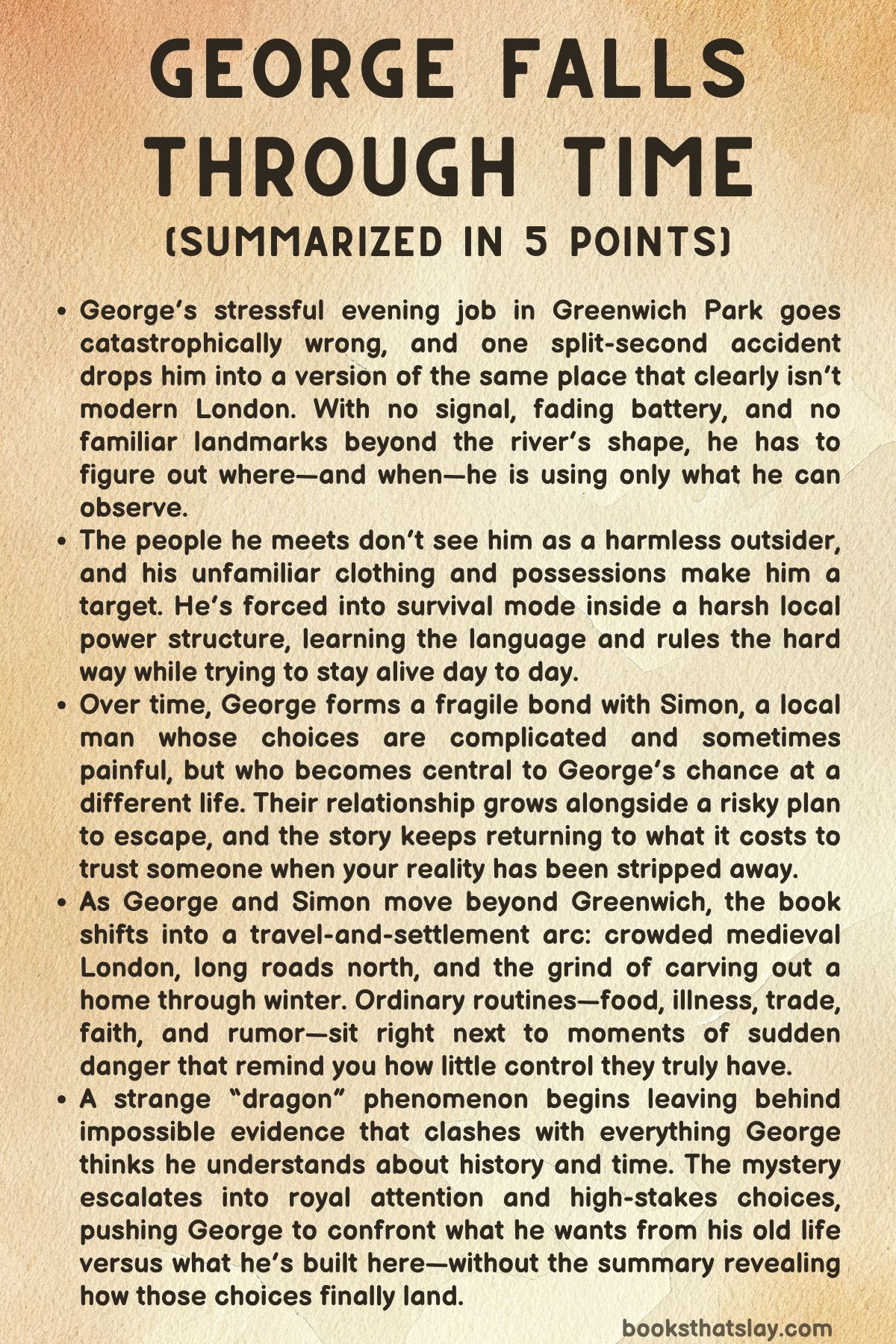
George Falls Through Time by Ryan Collett is a time-slip adventure that starts with an ordinary bad day and turns into a fight for survival in medieval England. George, a London dog-walker juggling money stress and messy relationships, loses two dogs in Greenwich Park and—during a frantic scramble to recover them—falls into another century.
Stripped of safety, language, and identity, George is forced to adapt to a world that is both brutally unfamiliar and eerily recognizable. What begins as a desperate attempt to get home becomes a deeper question: when your old life feels like it’s already broken, what does “home” even mean?
Summary
George is on the phone with an internet provider, trying to fix a ridiculous problem: his ex-boyfriend’s name is still on George’s account, and the company refuses to change it. While arguing, George is also walking six dogs in Greenwich Park, even though the dog-walking app only allows four.
It’s already late, the owners keep sending messages, and George is trying to hold everything together while moving through the park.
Then two dogs vanish. One is Ryley, a reliable small bichon frise.
The other is Matilda, a huge Afghan hound whose owner is a wealthy Russian exile—exactly the kind of client George cannot afford to lose. Panic hits hard.
George searches deeper into the park as the light fades. The remaining dogs grow restless, tugging and whining, and George’s phone keeps buzzing with demands for photos and updates.
George finally spots Matilda inside the deer enclosure, calm as if she belongs there. George ties the other dogs to the fence and climbs into the enclosure to grab Matilda by her collar.
George tries to find a way out, heading toward a wooden gate with a small gap near the ground. At the same time, everything goes wrong: the dogs tied outside start a vicious fight, a security guard enters with a torch, Matilda bites at George’s wrist as she struggles, and the phone keeps ringing—owners and the internet company piling on at once.
George stumbles, falls, and the world doesn’t behave like it should. Reality smears and flips.
There’s a violent rush of disorientation and white light, like George is being shoved through a warped tunnel.
George wakes in daylight, still in Greenwich—yet not. The park is greener, denser, and wilder.
The deer are there, but the enclosure fences and walls have vanished. There are no paved paths, no familiar gardens, no roads, no signs, no modern noise.
George climbs to a vantage point where the Royal Observatory should be and looks out at the Thames. The river is there, but the skyline is wrong.
There is no Canary Wharf, no modern London at all—only forests, fields, smoke, and scattered settlements. Boats move on the water, wooden and rowed.
George realizes the geography fits Greenwich, but the era doesn’t. George’s phone has no signal and little battery.
George takes a photo anyway, then starts walking toward the nearest signs of people.
The first locals George meets react with fear and avoidance. A barefoot older man speaks in a dialect that sounds distantly like English but wrong in rhythm and vocabulary.
He confirms the place name as “Grenwych.” When two younger men arrive, they become suspicious of George’s clothes. They tug at the fabric, fascinated and hostile at once.
More people gather, including a man in leather armor with a long knife. The crowd turns violent.
They tear off George’s clothes, remove shoes and underwear, and drag George naked into the settlement. George is bound, paraded through streets, mocked, and displayed like an animal while onlookers grab and examine the stolen modern items.
George is thrown into a dirt cell in a stone building. Days pass.
Then weeks. There is hunger, beatings, interrogation that George cannot understand, and feverish sickness.
Eventually George is given gray slop to eat and, later, a rough tunic. George is allowed into a small yard sometimes, then assigned chores.
Over time George begins to understand the dialect. It is English, older and rougher, but learnable.
As George becomes useful, the worst violence eases. George is moved through the manor compound to work: courtyard, kitchen, storerooms, hall.
George realizes the manor sits close to where the Royal Naval Hospital and the University of Greenwich will one day stand.
Trying to anchor the time, George asks about the year and is told it is the twenty-eighth year of King Edward’s reign. That doesn’t solve much—there are multiple King Edwards.
George thinks about escape, but survival is immediate, and routines are powerful. George also starts forming uneasy ties with two indentured servants, Simon and Wulfric.
They were part of the original assault, yet now they are constant presences. They talk about freedom, about distant lands, and even insist that dragons exist somewhere far away, spoken of as rumor and possibility.
Simon and Wulfric take George into the woods to hunt an eight-point stag in preparation for their lord’s visit. In the forest they turn threatening again, pointing a bow at George and ordering George to shoot, convinced George might be a soldier—maybe even a Dane.
George can’t handle the weapon. The deer scatter.
And then Matilda appears, alive and steady among the animals, somehow having survived months in the wild. Wulfric tries to shoot her, but George stops him, proving she recognizes George.
George unclips Matilda’s jeweled collar, realizing it could be valuable leverage. Simon proposes a deal: he will help smuggle George away in the lord’s caravan heading toward London, but only if George hands over the collar once safely hidden.
Back at the manor, the situation tightens fast. George is locked back in the cell and shackled.
The caravan arrives, and the lord interrogates George personally, holding a cut swatch taken from George’s modern shorts. The lord speaks multiple languages and does not behave like a simple local tyrant.
He mocks George’s claim of being from the future and presses for a “real” origin. George insists George is from Greenwich but from another time, mentions Matilda, and then breaks down, saying George is “nothing.” When the jeweled collar becomes visible, the crowd reacts.
The lord takes it at knifepoint and slices it away. Strangely, he announces George should be believed—because George is nothing.
That night the manor is loud with music and drinking. Wulfric, drunk, comes to the cell with keys, appearing to free George.
Instead, he attacks, beating George while insulting George as Danish. Simon intervenes, locks Wulfric away, and drags George into the night.
George blacks out and wakes at dawn in a wet forest area Simon calls Deptford. Simon admits he believes George’s story, and he reveals what he kept: George’s phone, stolen the day George was captured.
The screen once glowed blue before the battery died. George explains what it is, what the internet is, and why the device matters in George’s world—but it’s useless here.
They smash it with a rock and decide to sell the pieces: metal to smiths, tiny components to jewelers who mistake them for strange stones.
Their plan is to reach London, sell what they can, and move quickly before anyone from Greenwich comes after them. As they set off, George realizes something sharp and unsettling: George doesn’t want to go back.
Not to the manor, and not to the modern life that already felt unstable.
They walk toward London, moving through mud and built-up countryside until they reach Southwark and London Bridge. Medieval London is an assault of smells and noise—manure, animals, herbs, sweat, shouting.
At the city entrance George is stunned by severed heads on spikes, but most people treat it as normal background horror. Inside the walls, London is smaller than modern London yet packed and intense, full of movement and commerce.
A festival is underway: a “Round Table” tournament meant to raise support for war. Simon explains that the jousts are partly staged, performance mixed with real danger.
George and Simon eat, drink, and watch the crowds. Their conversation about King Arthur and dragons draws attention nearby.
A patriotic woman argues with an older ragged man who denounces the war. The dispute escalates until the woman’s oldest boy draws a dagger and lunges.
Simon yanks George away before they are caught in the violence, and they disappear into side streets.
They spend the day drifting through the festival, buying food and cheap objects, drinking heavily, watching a stage performance of Arthur rescuing Guinevere, and moving through taverns and markets. As night falls, George becomes drunk and emotionally raw.
Simon’s touch lingers longer. George feels both comforted and uncertain.
Memories of George’s modern life surface: loneliness, attempts at belonging, a relationship that left residue, and a past moment of panic and dissociation in a crowded club in Sitges. Those memories crash against the physical press of medieval London.
George vomits in the street during the late-night crush. Mounted men push through.
George and Simon reach an inn and sleep in a crowded room, holding close for warmth.
After the festival they leave early, buy better clothing and supplies, and head north with other travelers. They aim for land connected to Simon’s family.
The travel is steady but hard: cold, mud, and constant fear of authority. On a wooded stretch they hear the desperate crying of an infant off the road.
George starts toward it. Simon stops George urgently, forcing them onward.
The cries continue behind them in the dark. Later, in Lincoln, George confronts Simon.
Simon admits it was likely what George fears—an abandoned baby—but insists they could not safely intervene and would not know how the city would treat a foundling.
They continue to York, consult a detailed local map, and secure information and papers for a smallholding. Winter deepens as they reach the coast near Scarborough and find a snow-buried hut that becomes their home.
Life turns into a daily grind of fire, food, animals, illness, and cold. George develops a chronic cough.
They work relentlessly. As spring approaches George digs trenches to manage water and runoff.
One day a strange chemical-tasting smoke cloud passes over the land, arriving and vanishing too quickly to explain.
Simon returns from Scarborough with supplies, a donkey, and a medicinal salve for George’s throat. While applying it, their closeness shifts into a sexual relationship.
Their intimacy is mixed with guilt, especially Simon’s guilt over the violence at Greenwich, but they move forward together. They travel to Scarborough openly affectionate, trade goods, and attend church.
A vicar treats their relationship casually and approvingly when Simon describes them as lovers.
Then armed royal men arrive at the hut and demand George by name. George is summoned to an audience with King Edward on June 14 and ordered to travel under escort, led by Piers Gaveston.
George reacts with practical curiosity, but Simon panics, convinced the king is brutal and that their status—escaped captive, escaped servant, and lovers—could lead to death. As departure nears, Simon confesses something that rattles George: the night before George first arrived in Greenwich, Simon says a radiant figure appeared and told him George would come, that Simon must pledge his life to George, that they would escape, fall in love, and that the king’s summons would confirm it.
Now Simon fears the figure may not have been an angel at all.
They meet Piers Gaveston beside a small church at exactly three o’clock. Piers is youthful, polished, and surrounded by men.
He treats the summons like routine business and says the king is moving north quickly, with an audience in Durham the next day and war preparations toward Berwick. They ride into a military world of tents and noise.
In a private tent they’re fed and given ale. Prince Edward arrives—young, beautiful, and openly affectionate with Piers, kissing him without hiding it.
The prince warns George and Simon that the king often drags ordinary people into interrogations fueled by paranoia and fantasy. He advises them to avoid talking about myths, Scotland, or the prince’s dead mother, and not to feed the king’s obsessions.
In the king’s tent, Edward questions George intensely about identity and origin. Then the king abruptly identifies George’s clothing material, even naming plastic and polyester.
He connects this to reports of “dragon attacks” along the eastern coast: a creature that appears on moonless nights, hides itself in smoke, brings acid rain, and leaves behind melted strange materials. The king produces evidence from a wooden box: a charred, twisted plastic bottle with a recognizable label—a Diet Coke bottle.
George confirms it. Simon blurts that George is a time traveler, even naming future monarchs in confusion.
The king focuses on the material proof and the way odd goods have surfaced along trade paths. He says they will be sent back home—but with orders.
On the next black moon they must hunt the dragon and stop the attacks. Prince Edward will accompany them with troops to observe.
If rumors continue, the king threatens to kill them and destroy their land. The king refuses to let Piers join, assigns him to the war front, and even strikes the prince to enforce it.
George is ordered to ride at dawn, with the warning that if George truly comes from another time, George should erase this history.
Back at the smallholding, Prince Edward and ten men set up camp. The prince criticizes George and Simon’s rough living and takes over the hut for himself, his scribe, and messenger.
Supplies are sent for. The soldiers’ discipline fades into idling, feasting, and reckless bathing.
The prince spends much of his time writing letters to Piers.
On the new moon, smoke rolls in heavy and fast, turning the land into a choking eclipse. The prince panics, orders George and Simon bound, and forces them to track the source.
In low visibility, they ride toward a peak, and the ground collapses into a sudden drop. George, a soldier, and a horse fall into a crater.
The soldier and horse die. George survives badly injured and staggers toward heat and orange flashes.
A massive dragon moves through collapsing earth and molten flow. It spits magma.
George grabs the dead soldier’s sword and tries to face it. The dragon suddenly fails to produce fire, advances anyway, and then chaos erupts—mounted charges, arrows, screams.
Simon drags George away as another soldier dies. The dragon vanishes into smoke and sinking ground.
At dawn, George, Simon, Prince Edward, and one surviving soldier wake near cooling black crust. When they break it open, the “magma” reveals burning debris: melted plastics, rubber, metal, electronics, branded packaging, bottles in multiple languages—modern waste fused into the landscape.
Prince Edward rides for Scarborough to report, refusing to take George and Simon with him to avoid spreading panic. George and Simon argue about fleeing, then return home and keep working, now living with the fact that something impossible has marked their world.
Over a year later, George scavenges the blasted field like someone digging up a future that shouldn’t exist. George’s cough is worse, and the relationship with Simon has cooled into tense routine.
While digging, George uncovers the outline of a buried car-like shape and spends days excavating it. One evening the ground collapses.
George falls into a lava tube and then into a larger cavern, bleeding and injured. In the darkness, a dragon opens its eyes—awake, huge, and able to speak.
The dragon calmly questions George and identifies George as a time traveler by smell, accurately guessing George’s origin era. George explains the accident and says it is 2026 back home, and that George has been stuck in 1300–1301.
The dragon says it can travel through time at will. It claims it feeds elsewhere and expels molten debris here, which is why future waste appears in the countryside.
It describes “spontaneous time combustion” as a rare human event triggered by extreme stress and heartbreak. It also claims the past is only an echo behind a singular present.
The dragon offers to send George back, but the method is horrifying: the dragon must swallow George to do it.
George runs, sick with fear. On the way home, George sees something even stranger: a man in bright white equipment with a glass helmet sprints across the crater and climbs into the dragon’s open mouth.
The dragon launches and vanishes at impossible speed. George returns to Simon shaken, and they cling to each other.
Simon begs them to leave and start over. Before they decide, Simon reveals an army has arrived.
Prince Edward’s forces have expanded into a chaotic encampment led by a brutal commander called Smear. The soldiers treat dragon-hunting like sport.
Smear orders George to guide them to the crater and threatens to burn down the hut if George refuses. George complies.
That night George and Simon argue in the woods. George insists fighting the dragon will kill many people.
Simon pleads for reassurance, asks if George loves him, and George says yes through tears.
The next evening the dragon returns with overwhelming force, erupting into the crater in a white-hot storm of fire and molten debris. Soldiers charge and die in waves.
Arrows vanish in heat. The ground collapses into a widening pit.
Horses and people burn and disintegrate. George and Simon run as fire spreads into the trees.
In the chaos, George becomes consumed by longing for the modern world and decides George has to leave. George tries to frame it as saving a child from the camp, but George moves toward the crater instead.
The dragon speaks as if this is scheduled, saying its handlers have prepared a pathway to send George back to 2026. It says George can’t travel like the suited passenger George saw; instead, the dragon’s stomach will trigger George’s combustion back to his time.
Before George commits, Simon falls into the pit and breaks his leg, screaming that the dragon said George’s name. Then Simon vanishes completely—no body, no blood—through spontaneous time combustion.
George begs the dragon to send George to Simon, but the dragon says it can only send George along the arranged pathway to 2026 and mocks George for hesitating. Enraged and desperate, George enters the dragon’s mouth—but instead of surrendering, George drives the sword up through the dragon’s throat and attacks, ripping it open.
Molten debris and modern waste spill out as George keeps crying for Simon and stabbing until the dragon dies.
After the destruction cools, George is alone in the crater. George finds the child soldier alive but horribly injured.
George patches the child up, takes a small dragon tooth as proof, finds a horse, sends the child toward the king, and leaves without returning home, disappearing into a new life elsewhere.
Years pass. George survives by working, traveling, and staying out of reach of the crown.
Eventually a message draws George back to Scarborough. King Edward II believes there has been another dragon sighting and wants to harness the reality of time travel.
George insists the dragon is dead but goes with the king to the old crater and shows the buried remains. Afterward, on the surface, George finds an intact glass-and-plastic helmet with lights—like the one worn by the suited man George saw entering the dragon.
George returns to the old smallholding and finds the hut maintained and warm. Simon is there, older.
Simon explains that when Simon vanished, Simon first appeared in the future, got medical help, and then spent years learning to time travel through unstable jumps while searching for George. Simon rebuilt parts of the home, including adding a window.
Simon warns George not to open the door if George doesn’t want to know what brought George back. George opens it anyway.
Outside, perched on a tree branch, a smaller, younger dragon watches them, suggesting that the story is not finished—and that whatever caused George’s fall through time is starting again.
Characters
George
In George Falls Through Time, George is the emotional and moral center of the story: a modern Londoner whose life already feels precarious before time travel turns it into a survival ordeal. At the start, George’s phone fight with the internet provider while juggling too many dogs shows a person living in constant, low-grade stress—overextended, under-supported, and quietly furious at systems that don’t care.
That baseline matters because when the deer enclosure chaos peaks—missing dogs, security guard, Matilda biting, owners calling—George’s collapse into time travel doesn’t feel like random fantasy; it feels like the universe answering an already fraying nervous system. Once stranded, George’s identity is repeatedly stripped away in the most literal terms: his clothes, language, autonomy, and dignity are taken, and the early captivity is built to crush the modern assumption that the world will recognize your personhood.
What makes George compelling is that he doesn’t become a heroic “chosen one” in response; instead, he becomes adaptive in small, unglamorous ways—learning the dialect, accepting chores, reading power, and picking the moments when resistance will not simply get him killed. Even his later decisions keep that messy realism: he can be brave and cowardly in the same day, protective and self-interested in the same breath.
His bond with Matilda and his eventual intimacy with Simon show his need for attachment and continuity, but the narrative also makes clear that love doesn’t magically “heal” him; it complicates him, exposing the parts of George that crave safety while also craving escape. The dragon arc pushes this to a breaking point, because George’s longing for home becomes less about a place and more about relief from being trapped in a life where violence, cold, and authority can erase you overnight.
His final choices—defying the dragon’s demand, responding to Simon’s disappearance, and living forward rather than returning to the smallholding—paint George as someone whose defining trait is not bravery or cleverness, but the stubborn insistence to remain a self even when history tries to turn him into an object, a rumor, or a tool.
Simon
Simon begins as part of George’s trauma and then becomes the person most responsible for George’s continued life, forcing the reader to sit inside moral contradictions rather than clean redemption. Early on, Simon participates in the humiliation and imprisonment of an incomprehensible outsider, not as a cartoon villain but as someone shaped by a world where fear of the strange is a survival reflex and cruelty is normalized by hierarchy.
When the story pivots, it does not pretend that this past disappears; instead, Simon’s later loyalty carries an ongoing undertow of guilt and self-justification, and his tenderness always exists beside the knowledge that he once helped break George. His decision to protect George, flee with him, and admit he kept the phone is both pragmatic and deeply personal: he recognizes in George not just opportunity, but meaning.
Simon’s “prophecy” confession reveals how his inner life is structured by faith, fear, and longing, and it reframes his devotion as something that may be love, may be obsession, and may be a desperate attempt to give a brutal world a narrative that makes suffering feel directed rather than random. When he and George become lovers, the relationship is not written as a simple transformation from violence to romance; it stays complicated, sometimes tender and sometimes transactional, with Simon’s need for reassurance often clashing against George’s unstable sense of safety.
Simon’s most haunting trait is his realism: he understands how quickly intervention can become death, as shown by the abandoned infant moment, and he understands the danger of royal attention long before George fully does. Yet this realism is paired with a deep emotional dependence on George, so that Simon’s fear reads not only as self-preservation but as terror of losing the one anchor that made his life feel chosen.
His disappearance through spontaneous time combustion is devastating because it is both unfair and thematically precise: the story uses Simon to show that love in this world does not guarantee protection, and that the forces governing time and power treat human bonds as incidental. When he returns later—older, changed by years of searching and unstable jumps—Simon becomes a living proof that devotion can survive even when the timeline does not, and the rebuilt hut and added window symbolize something he has learned that George has not: survival is not only escaping danger, but also constructing a place where tenderness can exist without apology.
Matilda
Matilda is far more than a lost dog; she functions as the story’s hinge between worlds and as a recurring test of what George values when everything else is stripped away. Her initial disappearance triggers the cascade into the deer enclosure, and her calm presence among deer feels like an eerie preview of later temporal dislocation—Matilda appears already adapted to a space where the usual rules don’t apply.
When she reappears months later, alive in the wild and sitting among deer as if time has passed differently for her, Matilda becomes a symbol of continuity that makes George’s experience feel less like madness and more like a strange ecology of time. She also becomes leverage: her jeweled collar is one of the few pieces of modern wealth that can translate into medieval power, and George’s choice to protect her from Wulfric and remove the collar shows a collision between affection and survival economics.
Matilda’s presence highlights George’s capacity for care even after degradation; he can be traumatized, hungry, furious, and still refuse to let an animal be harmed for convenience. At the same time, Matilda also represents class and ownership: she is tied to a wealthy Russian exile in George’s original life, and the collar’s value reminds us that objects carry social meaning across contexts even when the people who valued them are gone.
In a story crowded with men who want to use George, Matilda is one of the few beings who simply recognizes him without needing him to “prove” anything, which makes her an understated emotional lifeline.
Wulfric
Wulfric embodies the story’s most volatile blend of insecurity, violence, and tribal suspicion, operating as a personal antagonist who is also a product of his time. He begins as one of the men involved in George’s capture and humiliation, which positions him within a culture where the unfamiliar is treated as threat and dominance is asserted through public cruelty.
Unlike characters who later develop complexity through guilt or curiosity, Wulfric tends to intensify rather than soften; his aggression feels fueled by a need to secure status and certainty in a world where power is always precarious. His fixation on George as “Danish” reveals how identity is weaponized: he doesn’t need George to actually be an enemy, he needs George to fit an enemy-shaped story that justifies violence.
The drunken episode where he appears to free George and then attacks him is especially revealing because it shows Wulfric’s sadism is not merely obedient cruelty under orders; it’s personal, opportunistic, and emotionally charged. Even his attempt to shoot Matilda carries symbolic weight: he wants to destroy the one thread that ties George to a recognizable self and to any “proof” of belonging.
Wulfric’s role is not to be a mastermind but to show how dangerous ordinary men can become when fear, alcohol, resentment, and a permissive culture of brutality align, and how quickly the vulnerable can be re-victimized even when escape seems near.
The Lord of the Manor
The lord represents institutional power in its most chilling form: calm, educated, multilingual, and fully capable of cruelty without needing to raise his voice. Where Wulfric is chaotic violence, the lord is controlled violence, the type that can interrogate, mock, and decide fate while treating a human being as an interesting problem.
His fascination with George’s clothing—cutting a swatch of modern fabric—signals that his curiosity is not humane; it is acquisitive, like a collector examining a rare object. The lord’s reaction to the jeweled collar is equally telling: he recognizes value instantly, takes it at knifepoint, and uses the moment to stage a public judgment that is less about truth and more about narrative control.
When he declares George should be believed “because George is nothing,” it reads as a philosophy of domination: the outsider’s story is irrelevant, the outsider’s personhood is irrelevant, and the lord can afford to “grant” belief precisely because it costs him nothing. He functions as an early demonstration that intelligence does not equal enlightenment; the story refuses the comforting idea that education makes power gentler.
Instead, the lord shows how sophistication can sharpen exploitation, and how authority can turn a person’s despair into entertainment for a crowd.
Piers Gaveston
Piers appears briefly but leaves a strong impression as a figure of courtly polish and pragmatic command, someone who moves through power as if it were weather. He is youthful, stylish, and accustomed to being obeyed, and his tone toward George and Simon is not openly cruel but unmistakably hierarchical—he treats their summons like paperwork, their fear like inconvenience.
What makes Piers interesting is how normal the machinery of control feels in his presence: he doesn’t need to threaten because the system threatens for him, and he has internalized protocol so deeply that human stakes become secondary. His relationship with Prince Edward, marked by open affection, also complicates the era’s social assumptions inside the story; the narrative doesn’t frame their intimacy as scandal in itself so much as another court fact that becomes dangerous depending on who chooses to weaponize it.
Piers ultimately functions as a mirror to George’s earlier modern bureaucratic frustration: George can’t get an internet account name changed in 2026, and in medieval England he can’t escape royal administration either—Piers is the human face of the message that systems don’t care, they only process.
Prince Edward
Prince Edward is presented as sharp, young, and emotionally exposed beneath his rank, a man who understands the violence around him because he has lived inside it as both beneficiary and target. His open kiss with Piers shows confidence and intimacy, but the later backhand from the king reveals just how conditional his safety is, even as heir.
The prince’s warning to George and Simon—don’t indulge the king’s obsessions, don’t mention certain topics—shows political intelligence that is born from survival rather than cynicism; he knows that paranoia and fantasy can become policy in an instant. When he accompanies them back to their smallholding, his criticisms and his takeover of their hut highlight his entitlement, yet the story also paints him as someone trying to manage chaos with the limited tools he has: authority, troops, and a belief that observation can become control.
His panic during the smoke event and his later retreat to Scarborough after the devastation are significant because they show the boundary between noble theater and real catastrophe; he can command drills and feasts, but the dragon collapses the illusion that power equals mastery. In many ways, the prince embodies a transitional kind of leadership—less myth-driven than the king, more aware of consequences—yet still trapped in a structure where empathy rarely overrides political necessity.
King Edward
King Edward is defined by a dangerous blend of intelligence, obsession, and sovereign entitlement, making him less a traditional tyrant and more a paranoid curator of reality. His interrogation style is intimate and theatrical: he clears the tent, reduces the room to a small circle, and forces George into a direct encounter with power that feels personal rather than procedural.
His ability to identify “plastic” and even “polyester” instantly makes him uncanny, and the reveal of the Diet Coke bottle anchors his paranoia in something real, transforming what could have been dismissed as superstition into a material mystery. The king’s fixation on dragons, Arthurian myth, and “proof” suggests a mind that collects stories and evidence the way rulers collect territory, and his threat—stop the rumors or be killed—shows how he converts uncertainty into coercion.
He is also brutally performative in family dynamics: striking the prince and refusing Piers is not only cruelty, it’s governance through humiliation, ensuring everyone understands that affection and loyalty are subordinate to his will. What makes Edward terrifying is that he is not irrational in the simple sense; he is rational within a worldview where any anomaly is either a threat to be eliminated or a resource to be weaponized.
His instruction that George should “erase this history” is especially bleak: it frames time as something the powerful feel entitled to edit, and it hints at a ruler who cannot tolerate a world that contains forces outside his authorship.
Smear
Smear is a concentrated embodiment of militarized cruelty, the kind of man who treats fear as a tool and suffering as entertainment. Unlike the king, who obsesses over explanations and evidence, Smear operates through immediate dominance: he threatens to burn down George and Simon’s home, forces George to guide the troops, and turns the dragon hunt into sport.
His presence shows how quickly royal attention metastasizes into local catastrophe; once the king’s interest becomes an armed encampment, the land and the lovers’ fragile life are no longer theirs. Smear’s leadership style reveals a particular ugliness: he doesn’t only want obedience, he wants degradation, the clear demonstration that other people’s lives are accessible to his whims.
He functions narratively to strip away any remaining fantasy that the dragon is the only monster; human institutions can be just as predatory, and often more casually so. The chaos and slaughter that follow are not merely the dragon’s doing, but the result of Smear’s insistence on charging into forces he cannot understand, dragging everyone else into the consequences.
The Dragon
The dragon is the story’s most conceptually rich character, because it behaves less like a mythic beast and more like an intelligence that treats time as terrain. It speaks calmly, questions George with unsettling precision, and identifies him as a time traveler by smell, framing human history as something it can read and navigate in ways people cannot.
Its explanation of “spontaneous time combustion” turns George’s accidental fall into something closer to a rare biological or metaphysical reaction to extreme stress and heartbreak, and this reframing is crucial because it relocates the story’s core mystery from machines to bodies and emotions. The dragon’s claim that the past is an “echo” behind a singular “present” suggests a philosophy that is both dismissive and predatory: what matters is where it can feed and where it can dump the molten waste of its travels.
The dragon’s “future trash” expulsions make it an ecological disaster and a temporal one, littering medieval land with modern debris and turning time travel into pollution. Most chilling is the bargain it offers George—return home, but only by being swallowed—because it forces the question of consent under coercion: when the alternative is death, captivity, or endless loss, is any choice truly free?
The dragon’s relationship to “handlers” and an “arranged pathway” implies a wider system behind it, whether other beings, future humans, or structures of time itself, and the suited figure George sees suggests that some travelers interact with the dragon in controlled, technological ways that George is denied. When George kills the dragon, it is not simply a victory over evil; it is an act of grief and fury against a creature that treated love, bodies, and timelines as disposable logistics.
The Suited Passenger
The suited figure George sees is brief on the page but expansive in implication, functioning like a crack in the story’s reality that widens into a whole hidden infrastructure. The bright white equipment and glass helmet suggest controlled travel, protection, and purpose, sharply contrasting George’s accidental, traumatic displacement and the dragon’s insistence that George must be digested to move through time.
This person’s calm sprint into the dragon’s mouth reframes the dragon as a portal with protocols, not merely a wild predator, and it hints that time travel is not only a freak accident of heartbreak but also a practice someone, somewhere, may be managing. The later discovery of an intact helmet near the crater strengthens that unease by leaving behind an artifact that does not belong in medieval England, turning the suited passenger into a lingering question rather than a solved clue.
As a character, the suited figure is less an individual than a sign that George’s suffering is happening on the edge of a larger, organized relationship between eras, and that the story’s timeline may be part of a cycle engineered, exploited, or at least knowingly repeated.
The Vicar
The vicar plays a small but important role as a counterpoint to the expected cruelty of the era, offering a moment where social acceptance arrives quietly instead of through struggle. When Simon describes himself and George as lovers and the vicar treats it casually and approvingly, the scene destabilizes simplistic assumptions about medieval life being uniformly hostile in every social dimension.
The vicar’s warmth doesn’t erase the story’s brutality, but it matters because it shows that pockets of ordinary kindness can exist even under harsh systems, and that George and Simon’s relationship is not only a private refuge but can, in rare spaces, be spoken aloud without immediate punishment. Narratively, the vicar is a reminder that cultures are not monoliths, and that survival is sometimes aided not by grand allies but by brief encounters with people who choose not to make your difference their battleground.
Ryley
Ryley is primarily a catalyst, but still meaningful as the “dependable” missing dog whose loss signals the moment George’s controlled chaos becomes uncontrollable. Ryley’s disappearance, paired with Matilda’s, exposes the fragility of George’s already overloaded life, where even his work is shaped by rule-bending and constant risk management.
While Matilda carries symbolic weight through the jeweled collar and her later reappearance, Ryley’s role is quieter: he represents the ordinary responsibilities George tries to meet, the kind that modern gig work turns into constant anxiety. In that sense, Ryley is part of the story’s opening argument that George’s world is not stable even before time fractures—he is already living in a system where one small failure can spiral into disaster.
Themes
Identity stripped down to survival and rebuilt by choice
George’s arrival in the past forces an immediate confrontation with what identity even means when it is not protected by social norms, technology, or legal rights. The first settlement does not treat George as a person with a history; they treat him as an unknown substance to be tested, feared, and used.
Being torn out of his clothes, paraded, and held in a cell isn’t only violence against his body—it is a practical method of reducing him to labor and obedience. In that environment, “who George is” becomes irrelevant compared to what George can do and what George can endure.
The story keeps returning to the idea that identity is not just internal; it is granted or denied by others. George’s modern markers—fabric, phone, speech patterns—are read as suspicious signals rather than proof of humanity.
Even when he starts learning their dialect and becoming useful, acceptance is conditional, revocable, and tied to the manor’s needs.
What’s striking is how George’s sense of self doesn’t recover by reclaiming the past he came from; it recovers by making deliberate selections in the new world. The relationship with Simon is part of that rebuilding, but it’s not presented as a simple rescue.
George’s selfhood grows through repeated decisions: refusing to abandon Matilda, choosing to run, choosing to live as a traveler, choosing a smallholding life even when it hurts and scares him. Later, when George says he does not want to return to his original life, it lands as more than fatigue or fear.
It reads like a recognition that his old identity was already unstable—held together by routines and fragile belonging. The medieval world brutalizes him, yet it also removes the distractions that once helped him avoid hard truths.
By the time kings and armies take an interest, George has learned that identity is not a fixed label tied to time period. It is something that can be stolen, traded, reshaped, and reclaimed, sometimes at terrible cost.
The theme becomes clearest when George is treated as “nothing” by authority, and yet that “nothing” turns out to be a strange kind of freedom: if no one will validate you, you either disappear inside that emptiness or you build a new self from whatever you can still choose.
Power as everyday coercion, not just crowns and swords
The story shows power working through constant small pressures long before it becomes openly political. Even the opening problem with the internet account hints at a modern version of the same thing: an individual stuck in a bureaucratic system that refuses to recognize a basic truth and forces him to argue while doing exhausting work.
That frustration becomes a preview of what follows in the past, where power is not paperwork but the threat of hunger, beating, exposure, and public humiliation. The manor’s control is not abstract; it is measured in how much food you get, whether you are allowed outside, how quickly a misunderstanding becomes pain.
George’s captivity is a lesson in how authority maintains itself by making uncertainty feel dangerous. If language is unclear, then any answer can be framed as insolence.
If someone looks different, then violence can be sold as “necessary caution.”
As George moves through London and later into rural life, the theme expands from one lord’s cruelty to a wider system that normalizes cruelty. The heads on spikes aren’t treated as a shocking anomaly by the crowd; they are part of the city’s daily rhythm, a visible reminder that punishment is meant to be seen.
Festivals and tournaments are not only entertainment; they are recruiting tools, fundraising tools, and emotional tools that turn war into a shared performance. People argue about it in the street, and the argument becomes physical fast, suggesting a society trained to resolve disagreement with force.
Even “choreographed” jousts carry the message that violence is honorable when it serves the right story.
When royal power arrives at George and Simon’s hut, the personal becomes explicitly political. The summons, the escort, the threats, and the demand that George must help hunt the dragon show how rulers treat ordinary lives as resources.
George is not asked; he is assigned. Simon’s panic makes sense because he understands what George is still learning: royal attention is rarely a gift.
It is surveillance, leverage, and risk. The prince’s advice about what not to mention to the king shows another layer of coercion—power also controls conversation, shaping what truths are safe to speak.
Later, the commander Smear turns power into raw blackmail, threatening to burn their home unless George complies. Across these scenes, the theme isn’t simply “kings are dangerous.” It is that power operates through dependency and fear at every level: employers, apps, lords, crowds, soldiers, and rulers all become mechanisms that can trap a person.
George Falls Through Time keeps asking what it means to stay human when the structures around you are designed to make compliance feel like the only way to survive.
Love as refuge, burden, and moral test under extreme conditions
George and Simon’s relationship grows inside a landscape shaped by violence and scarcity, which makes affection feel both precious and complicated. Their bond begins in a setting where trust should be impossible: Simon was part of the initial assault, yet later becomes the one who intervenes, runs with George, and risks punishment to help him escape.
That history never fully disappears; it sits behind the tenderness like a shadow that can’t be ignored. The relationship develops through practical needs—warmth, shared food, shared secrecy—and then shifts into intimacy, but the story doesn’t treat intimacy as a simple healing arc.
It shows how closeness can be both a shelter and a pressure cooker. When survival is the daily priority, love can feel like the only soft thing left, and that can make it feel frighteningly necessary.
This theme deepens when the two face moments that force hard choices. The crying infant on the road is a pivotal test: George wants to respond, Simon refuses, and neither position is easy to dismiss.
George’s impulse carries compassion, but it is also shaped by modern assumptions about what responsibility looks like and what help is possible. Simon’s refusal is shaped by lived knowledge of danger and the likelihood that intervention could lead to death or capture.
The conflict isn’t just about morality; it is about incompatible worlds inside the same partnership. Their later winter hardship adds another layer: care becomes routine, and routine can drain tenderness until it feels like obligation.
George’s chronic cough and Simon’s herbal treatment show how love sometimes becomes maintenance rather than romance, and maintenance can still be love even if it no longer feels bright.
The king’s involvement and the dragon hunts strain the relationship further by turning private devotion into public risk. Simon’s prophecy confession complicates the bond by introducing the possibility that his loyalty was shaped by something he couldn’t understand, something that might not be holy at all.
That raises an uncomfortable question: is Simon choosing George freely, or is he obeying a story that was planted in him? George’s feelings are also tested when longing for modern comfort returns during crisis.
His urge to leave isn’t framed as villainy; it reads like psychological exhaustion meeting temptation. Then the story delivers its harshest version of this theme when Simon vanishes through spontaneous time combustion at the moment George is trying to decide what to do.
Loss becomes instantaneous, with no body, no closure, only absence. George’s response—attacking the dragon rather than accepting the pathway home—turns love into a moral line he refuses to cross.
Yet even that decision is complicated: he does it with rage, grief, and desperation, not with clean heroism. Love here is not a gentle answer; it is a force that exposes who George is when everything collapses, and it keeps demanding a choice even when no choice is safe.
Time travel as trauma response and the cost of trying to control fate
Time travel is not presented as a fun mechanism or a puzzle to solve; it behaves like a symptom that arrives at the worst moment. George’s initial shift happens in the middle of overlapping crises—missing dogs, a violent brawl, a guard’s torch, a bite, nonstop calls, panic and exhaustion.
The transition feels like reality breaking under pressure, which makes the idea of “spontaneous time combustion” later feel consistent rather than random. Time travel becomes a physical expression of stress and heartbreak, turning inner collapse into an outer event.
That framing matters because it ties the fantastic element to the human one: time is not just a backdrop, it is something the body and mind can rupture when pushed beyond limit.
Once George is in the past, the story explores the illusion that time can be mastered. George tries to anchor himself by identifying which King Edward rules, by using objects like Matilda’s collar as leverage, by treating his phone as proof even when it’s dead.
Those attempts reflect a modern instinct: if you can name the system, you can navigate it. But the past does not cooperate with that logic.
Language shifts, violence rewrites plans, and objects take on unintended meanings. The phone becomes treasure and then scrap; tiny components become “stones” a jeweler misreads.
Evidence doesn’t produce understanding; it produces pursuit. The king’s interest in plastics and dragon reports shows how quickly anomalies become tools for paranoid control.
Instead of reacting with wonder, royal power reacts with strategy: observe, command, threaten, weaponize. Time travel becomes something rulers want to harness, which raises the theme’s core question: what happens when people who already control life and death think they can also control time?
The dragon complicates the theme by introducing a being that treats time as territory. Its claim that it can time travel at will and that it “feeds elsewhere” and expels debris here reframes the landscape: the past is being polluted by future waste, not by accident but as a byproduct of a creature’s habits.
The “future trash” in the lava field becomes a physical sign that time is not cleanly separated. It also becomes a metaphor for consequences that do not stay where they belong.
When George finds the suited “passenger,” the theme expands beyond George and Simon into the hint of organized involvement—someone else, from some other system, moving through the dragon’s mouth with preparation and equipment. That glimpse suggests that control of time might already be a project, not a mystery.
The cost of trying to control fate becomes brutal in the final confrontations. The dragon offers George a return pathway that requires surrendering his body to being swallowed, turning time travel into consumption.
The king tries to turn the dragon hunt into a managed operation, but it becomes slaughter. Simon vanishes in a way that feels both random and horribly personal, and George’s attempt to force the outcome—begging to be sent to Simon, then choosing violence instead—shows the limit of agency.
Even when George kills the dragon, the theme refuses closure: the later discovery of the helmet and the appearance of a younger dragon imply that cycles restart and that certainty is temporary. Time here is not a straight line that can be corrected by one decisive act.
It is a force that reacts to trauma, attracts control, and keeps demanding payment from anyone who tries to treat it like property.