Fruit of the Flesh Summary, Characters and Themes
Fruit of the Flesh by I.V. Ophelia is a dark, psychological gothic romance set among old money, private cruelty, and carefully staged respectability. It follows Petronille De Villier—fragile in public, ferocious in survival—and Arkady Kamenev, an immigrant sculptor whose calm discipline masks something dangerous and deliberate.
Their marriage begins as a calculated insult to her powerful family, but it quickly becomes a volatile partnership shaped by control, desire, and shared secrecy. As bodies disappear and society watches, the couple must decide what they are willing to do to protect each other—and what parts of themselves they will no longer hide.
Summary
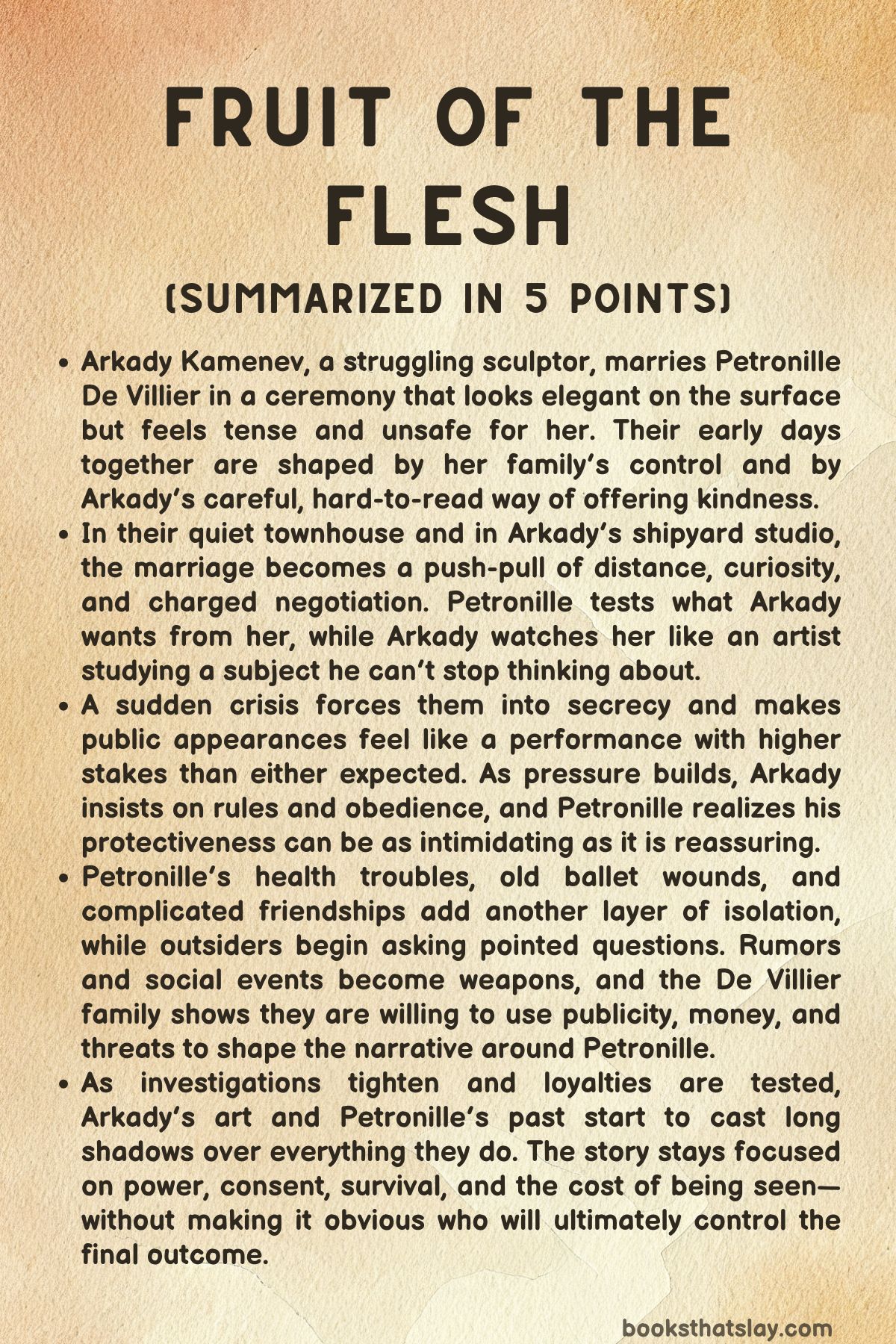
Petronille De Villier marries Arkady Kamenev in a small ceremony inside her father’s lavish home, surrounded by wealth that feels more like a cage than a blessing. Petronille arrives in a poorly fitted dress and carries a bouquet that includes datura, a flower that signals risk as much as beauty.
When Arkady lifts her veil, he sees a woman who looks delicate, frightened, and cornered. During the kiss, he tastes her tears and notices their sharpness, as if even her grief has been conditioned into something bitter.
At the wedding dinner, the De Villier family performs warmth for their guests while maintaining a private dominance over their daughter. Petronille’s father watches her with confident possession, and her mother’s careful styling hides bruises and injuries under fine clothing.
Petronille, once a ballerina, senses judgment from every glance and assumes her past will be used as another weapon against her. A datura bloom falls into her wineglass, and she briefly considers drinking it, but Arkady stops her and warns her it would only make her sick.
For a moment, his gentleness feels real. Then Petronille catches a different expression on him—cold, controlled, almost blank—directed toward her father before he returns to polite charm.
It leaves her unsure whether Arkady’s kindness is affection or strategy.
Their wedding night brings them to Petronille’s neglected townhouse, quiet and dusty, without servants. The house carries the imprint of loneliness: cluttered books, preserved insects, old flowers, sealed letters never opened, and remnants of ballet life, including broken shoes and costumes.
Petronille admits she chose Arkady to spite her parents—she married someone they couldn’t easily use for status or alliances. In the intimacy that follows, Arkady’s grip turns unexpectedly harsh, and Petronille responds by provoking him, daring him to take what she assumes men always want to take from her.
Instead of following through, Arkady pulls back in a detached way that feels as unsettling as violence. He retreats to the sofa with a cigarette, leaving her alone with the aftertaste of fear and confusion.
In the morning, Arkady studies the house like an artist studying a still life. He notices a padlocked basement door and the worn runner leading down to it, suggesting frequent use despite the lock.
Later, he watches Petronille sleeping and sees a moth settle on her face, feeding at the moisture near her eye as if she’s crying even in rest. The image sparks his imagination in a way nothing else has.
Outside their home, the city carries its own unease. Newspapers mention missing people and rumors of linked disappearances.
Arkady meets his friend Konstantin, a deputy coroner exhausted by family life and blunt about how the world reads status. Konstantin warns Arkady to keep appearances tidy: Arkady is poor, foreign, and disposable in the eyes of polite society.
Arkady privately agrees—if he vanished, few would care. If Petronille vanished, it would become a spectacle.
Petronille discovers Arkady has left a handmade card with his studio address and a note instructing her to call only for emergencies. She meets her friend Lorelei, who is shocked by the marriage and crude in her curiosity about the wedding night.
Petronille says nothing happened. When she visits Arkady’s studio near the shipyards, she finds an entire warehouse of statues.
Arkady measures her with his gaze, reads her proportions like a blueprint, and flirts with a mix of mockery and restraint. He crowds her near the kiln, smears clay on her dress, comments on her blush, then abruptly steps back into work.
The push-and-pull leaves her unsettled, and also curious.
As Arkady spends more time at Petronille’s townhouse, the fragile routines of their marriage take shape: separate sleeping spaces, shared silences, and a growing awareness that both are hiding things. A man from the coroner’s office, Vincent Carlisle, appears at the door with an air of entitlement and familiarity toward Petronille.
He calls Arkady “the new fool” and implies Petronille belonged to him first. Arkady refuses him entry and burns his card with a cigarette, filing the moment away as a threat.
Petronille’s health worsens. She becomes pale, nauseated, shaky, and exhausted.
Arkady recognizes signs of anemia, but Petronille still avoids telling him everything she carries. Her family continues to intrude.
Her father appears at her townhouse uninvited, interrogates her about whether the marriage has been consummated, and reminds her she has no power to bargain with him. Even after he leaves, danger returns: Vincent Carlisle forces his way into the home, furious that Petronille is avoiding him.
He claims she promised herself to him and assaults her. Petronille fights back with a letter opener, misjudges the distance, and slashes his neck.
Blood pours. In panic, she tries to stop the bleeding, smearing the room with evidence.
Arkady arrives mid-chaos. Vincent tries to demand police, but Arkady responds with frightening calm.
He takes the letter opener and drives it through Vincent’s eye, killing him. He orders Petronille to bathe, stay silent, contact no one, and let him handle everything.
His control is absolute, and Petronille, shaken, obeys.
The next day Arkady brings Petronille out in public to build an alibi. At the botanical gardens, he corrects her behavior, insists on discipline, and refuses to discuss what he did with the body.
He makes her taste honeysuckle nectar, then kisses her with a force that doubles as a warning. He leaves bruises and hides them afterward, rehearsing the performance of a respectable couple as if it is another craft.
Slowly, their relationship shifts from hostile distance to negotiated intimacy. Petronille and Arkady begin sharing small routines—breakfast promises, cautious honesty, and flirtation that becomes explicitly structured around consent.
Arkady introduces a “secret word” so she can stop him, and he forces her to speak her desires instead of swallowing them. Petronille discovers that directness gives her leverage she has never been allowed before.
Their sexual connection becomes both refuge and battleground: she wants tenderness and proof she matters; he wants control and safety from his own impulses. He admits he fears what he might do if he loses restraint.
Meanwhile, Petronille’s world tightens. A botanist gives her an unlabeled nightly remedy for fogginess and paranoia.
Commissioner Hunt begins pressing her about Vincent Carlisle’s disappearance, implying her father stands behind the pressure. Petronille’s mother shows a different kind of cruelty: she commissions tabloid coverage about Petronille’s secret wedding and humiliates her publicly, insisting scandal can be monetized.
At a high-society charity gala, Petronille performs grace while feeling trapped under attention. Arkady participates in the spectacle too—bidding aggressively in an auction for her gown, stirring other men into competition, and then pulling Petronille into a private room where their intimacy becomes secretive and risky.
As suspicion grows, Petronille searches Vincent’s abandoned office at the coroner’s building, hunting for what he kept hidden. She finds locked drawers and realizes she needs keys, suspecting evidence may be somewhere closer to Arkady’s studio.
At home, Arkady and Petronille make a darker vow of loyalty, acknowledging that they are now bound not just by marriage but by mutual threat. Arkady admits something in him is wrong, and Petronille steadies him without demanding full answers.
Their bond becomes strangely practical: rules, aftercare, and the shared understanding that safety must be constructed, not wished into existence.
The investigation turns public when Commissioner Hunt brings Petronille in for questioning. He shows her files on Arkady, including records of violent behavior in childhood and evaluations by a doctor.
He raises questions about other disappearances and suggests Arkady’s visits to the morgue and missing documents point to secret “deliveries.” Arkady, enraged by another humiliating publication using Petronille’s image, storms into the precinct and confronts Petronille’s father. Hunt and De Villier offer Arkady bags of cash and demand he disappear and accept blame for Vincent’s murder so Petronille can remarry and the family can remain untouched.
Arkady refuses to be owned, but he takes the money—because they have given him a different weapon.
Petronille later comes to Arkady’s studio and finds it arranged like a private stage: candles, music from her old ballet, and her worn pointe shoes presented like an offering. Arkady blindfolds her and guides her through a performance designed for his gaze, using sculpture and choreography to merge her past with his obsession.
Afterward, they share food and honesty. Arkady admits he has intrusive thoughts about hurting people and avoided penetrative sex out of fear.
Petronille senses that his restraint is not gentleness—it is containment.
The situation breaks open when the morning paper reports a severed arm nailed outside a factory with documents accusing a pharmaceutical company of human experimentation. Petronille discovers travel bags and piles of money in the studio and realizes Arkady is preparing to run.
In panic, she knocks a statue and breaks it—revealing black, brittle material inside that suggests the sculptures may contain human remains. Horrified, she flees, convinced Arkady has been doing far worse than she understood, and that she has been standing in a gallery of hidden bodies.
Arkady searches for her and, in his own home, uncovers something even worse: Lorelei’s corpse hidden under floorboards, surrounded by moths and pesticide bottles, with signs of crude attempts to manage decay. The discovery reframes everything—Petronille is not merely a victim in this story.
She has secrets of her own, and they are older than Arkady.
Petronille runs to her mother’s mansion and finds her burning photographs and papers. Her mother mocks her, then reveals Petronille is not her biological child and suggests her real mother was a maid.
The implication deepens into something monstrous: Petronille’s family fed her human flesh since childhood, shaping hunger into habit and shame into control. Vincent Carlisle’s role at the coroner’s office was not only predatory—it was useful for supply and concealment.
Arkady turns to Konstantin at the morgue as evidence piles up. He admits he killed Vincent “for her” and sets a final plan in motion.
Petronille receives Arkady’s letter and follows his instructions to a last meeting. She finds his sketch journals—studies of her body, her expressions, her sleeping face with moths in her hair—and a message calling her to one final performance.
At a theater, Arkady confronts Petronille directly, accusing her of consuming bodies and demanding the truth of when it began. He reveals an audience: bound patrons, police, Commissioner Hunt, Petronille’s parents, and Vincent’s decaying body displayed as proof.
Arkady admits he has used abusers as material, filling sculptures with them, including people from his own past. Petronille finally speaks the truth aloud: her family fed her human flesh as a child, including her biological mother, and later relied on Vincent and others to manage a growing supply of remains tied to exploitation and experimentation.
Arkady offers Petronille the chance to leave him forever, but she refuses the clean escape. Instead, she turns toward the captives and speaks about how her family treated people as disposable.
Then she chooses destruction. She knocks over lanterns, spreading fire through the theater, letting panic and flame erase the staged power around them.
As screams rise, Arkady and Petronille flee together—partners at last in an act that burns the old world down behind them.
In the epilogue, they live in a rural valley near an orchard, quiet and sunlit, wearing altered symbols of their former lives. The peace feels real but not innocent.
When a moth falls into Petronille’s tea and drowns, she drinks anyway, calm and unchanged in the smallest ways that matter.
Characters
Arkady Kamenev
In Fruit of the Flesh, Arkady is introduced as a poor immigrant sculptor whose outward gentleness reads, from the beginning, like a deliberate performance rather than a natural warmth. His defining trait is control—of materials, of spaces, of narratives, and eventually of people—and the story repeatedly shows how easily he can switch masks: tender husband in public, cold strategist in private, and predatory presence when he wants Petronille off-balance.
His artistry is not just a profession but a moral language he uses to justify what he does; “inspiration” becomes a hunger that turns bodies into reference, then into medium, and finally into containment. Arkady’s bond with Petronille grows through a paradoxical intimacy: he is one of the first people to take her fear seriously, yet he also amplifies it, shaping her dependence by solving crises with violence and then demanding obedience as the price of safety.
The novel frames him as both protector and threat, and his “care” often arrives braided with coercion—alibis staged as dates, tenderness delivered after bruises, and consent structured as a system he designs and administers. By the end, his vigilante logic is laid bare: he sees abusers as raw material, “muses” to be transformed into objects, and he positions himself as an artist-judge who can decide who is disposable, mirroring the same dehumanizing calculus he claims to oppose—except he turns it into aesthetics.
Petronille De Villier
Petronille is the emotional core of the novel, written as a woman whose body has long been treated as property—managed, displayed, bruised in secret, and traded in social economies she never consented to join. Her early presentation is all restraint and survival: trembling at her wedding, tracking her father’s gaze like a predator’s shadow, and testing Arkady with provocation because confrontation feels safer than vulnerability.
The story makes her contradictions purposeful rather than inconsistent—she both craves gentleness and distrusts it, both fears domination and is drawn to intensity when it offers a strange form of clarity in a life full of gaslighting and performance. Petronille’s past as a ballerina is more than backstory; it becomes her vocabulary for control, discipline, and dissociation, and the recurring references to La Sylphide sharpen her fear of being “handled” into harm by a man who thinks love means possession.
Her illness and anemia externalize an internal state: depletion from years of deprivation, secrets, and bodily violation, while the locked basement and sealed letters operate like physical metaphors for what she has been trained not to name. As the plot escalates, Petronille’s agency does not arrive as purity or moral cleanliness; it arrives as choice under corruption—she learns to speak wants aloud, to set boundaries, and then, in the climax, to weaponize the spectacle her family built around her.
Her final act—turning confession into catastrophe—reads as both vengeance and liberation, a refusal to let the family’s machinery keep converting people into consumable parts.
Adrien De Villier
Adrien functions as the novel’s clearest embodiment of institutional predation: a wealthy father who treats his daughter as an asset to be managed and a liability to be punished. He appears with the calm entitlement of someone used to winning, and his cruelty is not impulsive but administrative—interrogations about consummation, insinuations about “patrons,” and threats delivered as reminders of leverage rather than bursts of anger.
What makes Adrien especially dangerous is his capacity to turn violence into normalcy through money and influence: he can orchestrate press humiliation, steer police pressure, and negotiate scapegoats as if he is balancing accounts. When he demands Arkady “disappear” and accept blame, it clarifies his worldview: people are interchangeable, truth is purchasable, and public morality is a costume to be fitted on whoever has the power to tailor it.
Even his evils feel industrial—linked to “farms,” exploited workers, and factory symbolism—suggesting a man who does not merely harm individuals but sustains systems that grind individuals down. He is not seduction; he is infrastructure.
Madame De Villier
Petronille’s mother is the novel’s sharpest portrayal of cruelty disguised as refinement, a woman who treats reputation the way a butcher treats a carcass—something to carve, display, and sell. Her violence is often “clean,” expressed through clothing chosen to hide bruises, social scripts designed to trap Petronille in shame, and a philosophy that scandal is not something to avoid but something to monetize.
She weaponizes the press with chilling creativity, manufacturing public narratives that humiliate her daughter while framing the humiliation as strategy, as though dignity is an expendable resource. Her later revelations—about Petronille’s parentage and the implied disposal of Petronille’s biological mother—recast her as a curator of horror who understands power as the ability to decide what becomes truth, what becomes rumor, and what becomes ash in a fireplace.
She is also a mirror to Arkady in an unsettling way: both know how to stage scenes, both understand the leverage of spectacle, and both treat bodies as instruments—one for art, one for status. The difference is that she insists she is doing it for the family, and that self-justification is part of her monstrosity.
Cosette De Villier
Cosette reads as one of the quieter expressions of survival inside the De Villier orbit—present enough to signal family dynamics, cautious enough to avoid becoming a target. Her conversations with Petronille suggest a sister who has learned to measure speech, to keep emotions contained within socially acceptable tea-table boundaries, and to offer concern without challenging the structures that make concern necessary.
Her role is less about decisive action and more about contrast: she highlights how normalized Petronille’s suffering has become, because even sisterly worry operates inside rules set by their parents. She represents the version of a child who adapts by compliance and careful positioning, a foil to Petronille’s eventual refusal.
Félice De Villier
Félice is the sister who comes closest to articulating an exit fantasy—hinting Petronille is still young enough to change course and probing whether Arkady treats her well. Those moments frame Félice as more emotionally perceptive than the household’s polished cruelty would normally allow, as if she can see the trap even if she cannot spring it.
In Fruit of the Flesh, her function is to offer Petronille a fleeting impression of being seen without being consumed, which makes the family’s broader machinery feel even more isolating: even the “best” support available is partial, cautious, and constrained by fear. Félice’s proximity to compassion becomes another reminder that empathy inside a violent system often survives only in whispers.
Lorelei
Lorelei begins as Petronille’s bridge to something like ordinary friendship—gossipy, intrusive, sometimes vulgar, but also familiar and socially alive in ways Petronille has been trained to suppress. Her teasing about wedding-night expectations and her push for gatherings make her feel like a pressure toward normalcy, yet the story gradually stains that normalcy with unease: the expensive accessories, the sense that someone is funding her, and the later appearance of a brooch tied to Petronille’s mother suggest Lorelei is being pulled into the same exploitative orbit she doesn’t recognize.
Lorelei’s tragedy lands partly because she is both sharp and naïve—she notices surfaces, misreads depths, and underestimates how dangerous Petronille’s world is. Her death, concealed in the floor with moths and poison, becomes a grotesque inversion of friendship: the one person Petronille tried to keep close is transformed into evidence, infestation, and silence.
Lorelei’s arc underscores a central idea of the book: proximity to predatory power contaminates bystanders first, then devours them.
Konstantin “Kostya”
Kostya serves as Arkady’s human tether—an exhausted deputy coroner with a crying infant, a wife, and the dull ache of ordinary responsibility. His teasing and practical advice about keeping up appearances grounds Arkady in social reality while also revealing a blunt class awareness: Arkady is poor, foreign, and therefore vulnerable to narratives others will write about him.
Kostya is neither pure conscience nor eager accomplice; he is a man trying to keep his life from collapsing, and that exhaustion makes him susceptible to being pulled into Arkady’s crises. Yet he also pushes back when the horror becomes undeniable—accusing Arkady, demanding explanations, and insisting on the reality of murder rather than the romance of “muses.” Kostya’s importance lies in what he represents: the possibility of a normal moral framework existing adjacent to the story’s decadence, and how easily that framework gets overwhelmed when power, fear, and spectacle enter the room.
Vincent Carlisle
Vincent is the story’s most immediate, personal predator—less grand than the De Villiers but terrifying because his entitlement is direct and physical. He barges into Petronille’s home, claims she “promised” herself to him, and treats her body as a debt to be collected, turning the domestic space into a trap.
Vincent also represents institutional rot: as a coroner’s office figure, he isn’t just a violent man but a node in the system that manages bodies and evidence, implying that official structures meant to protect can be repurposed to exploit. His death is a turning hinge—Petronille’s act of self-defense becomes a crisis Arkady resolves with chilling composure, binding them together through shared culpability.
Even after he dies, Vincent keeps exerting force through absence: the missing body, the investigation, the severed arm displayed as public accusation, and the implication that he supplied “remains” all make him a lingering contaminant, the kind of man who keeps harming people even when he’s no longer alive.
Commissioner Hunt
Hunt is the face of law as theater—less interested in truth than in leverage, spectacle, and the pleasure of making someone squirm under official light. He interrogates Petronille with insinuations and contradictions, exploiting her fear of the press and her family’s influence, then pivots to Arkady with files, logs, and institutional breadcrumbs that suggest he knows how to build a narrative of monstrosity.
His menace comes from his opportunism: he is willing to serve the De Villiers when it benefits him, willing to threaten Petronille with humiliation, and willing to treat justice as a bargaining chip. He embodies the book’s recurring insistence that power is not a single villain but a network—police, press, wealth, and secrecy reinforcing each other until “investigation” becomes another method of coercion.
William, the Ballet Master
William appears as a representative of the ballet world’s politics—casting as currency, attention as power, and women’s bodies as both art and commodity. His boasting about Lorelei’s role underlines how quickly the system replaces Petronille and how easily it rewards those willing to play its games.
He also helps tie Lorelei’s rising status to the De Villier machinery: professional opportunity and social exploitation start to look like neighboring rooms in the same building, connected by the same doors.
Helen
Helen and her friends operate as social predators of a smaller scale—cruel not through institutions like the De Villiers, but through humiliation, gossip, and the joy of watching someone flinch. Their mocking of Petronille and insinuations about her impact on Lorelei illustrate how women in competitive, status-driven environments can become enforcers of the very systems that harm them.
Helen’s function is to show that Petronille has no truly safe public space: even shopping for undergarments becomes an arena where her identity can be rewritten by someone else’s sneer.
Themes
Control, Performance, and the Politics of Appearances
From the first moments of Fruit of the Flesh, the marriage functions less like a private bond and more like a public staging where power is measured by who can dictate the script. Petronille’s wedding dress does not fit, her bouquet carries datura, and her tears are described as acidic—details that signal how the ceremony is designed to look proper while concealing something corrosive underneath.
Her father’s toast is a demonstration of ownership disguised as affection, and her mother’s careful concealment of bruises turns clothing into a tool of censorship. This insistence on appearances becomes a recurring social technology: Petronille is evaluated for her history as a ballerina, pressed to confirm consummation as proof of “success,” and later dragged into publicity through tabloid exposure that is not meant to reflect her life but to manufacture a profitable narrative about her.
The humiliation is not incidental; it is leverage, a way of reminding her that even her body can be converted into currency, gossip, and compliance.
Arkady understands this ecosystem immediately and weaponizes it with a colder precision than Petronille expects. When he summons her to the botanical gardens after Vincent’s death, the goal is not comfort or processing trauma—it is alibi-building.
He disciplines her posture, her speech, and even her “decency,” treating public space like a stage where survival depends on credible performance. The charity gala pushes this to an extreme: Petronille has to execute social grace while feeling trapped, and Arkady’s bidding war for her gown turns her into a contested object, a spectacle men compete over.
The scene is disturbing not only because it eroticizes possession, but because it reveals how easily polite society accepts violence when it is dressed as entertainment. Even Arkady’s tenderness can operate inside that system; he tidies her collar to hide marks, helps her change into a plain gown that won’t raise suspicion, and coaches her on “playing a part.” The point is not that appearances are superficial—it is that appearances are the terrain on which coercion happens.
In this world, reputation is treated like a legal document others can rewrite, and the person being described is expected to live inside the forgery.
What makes the theme sharper is that performance is also Petronille’s trained language. Ballet taught her discipline, endurance, and how to move under scrutiny while ignoring pain.
That skill, once artistic, becomes a survival reflex as she navigates interrogations, social rituals, and threats from authorities like Commissioner Hunt. The book keeps showing how performance can be both a cage and a weapon: Petronille is forced to act in ways that protect abusers, yet she also learns how to adopt roles strategically, how to appear compliant while gathering information, and how to remain outwardly composed while deciding what she will and won’t surrender.
The final “show” at the theater makes the metaphor literal—an audience, a spotlight, bound spectators, and staged confession—but the theme has already established that the whole society has been a theater all along. The difference at the end is that Petronille stops performing for their approval and uses spectacle against them.
Consent, Desire, and Negotiated Safety Under Threat
The relationship between Arkady and Petronille is charged from the beginning, but the story refuses to treat intimacy as either purely romantic rescue or purely predatory dominance. Instead, it presents a tense progression where desire is constantly entangled with fear, trauma history, and the practical risk of exposure.
Early interactions are defined by testing and misreading: Petronille provokes Arkady on the wedding night, daring him to force her, partly as self-defense—if she controls the escalation, she controls the damage—and partly as a way to confirm what kind of man he is. Arkady’s response is unsettling because it mixes aggression with restraint: he grips her wrist and neck, then withdraws, choosing distance rather than conquest.
This does not resolve the threat; it complicates it, suggesting that Arkady’s control is deliberate and his violence is managed, not absent. Petronille becomes alert to the possibility that his kindness is not softness but strategy, and that his restraint may come from something darker than morality.
After Vincent’s assault and Arkady’s calm killing, intimacy becomes even more complicated because it occurs inside shared criminality and mutual vulnerability. Arkady’s insistence on obedience at the gardens—silence, posture, compliance—slides easily into sexual pressure, including the deliberate use of risk to heighten control.
Yet the narrative also introduces a structured vocabulary of consent once Petronille and Arkady begin sexual contact in earnest. The “secret word” is not a decorative detail; it marks a shift from guessing and coercion toward explicit negotiation.
Petronille starts articulating what she wants directly, and Arkady repeatedly frames boundaries around intoxication and consciousness, refusing to pursue her when she cannot fully participate. That refusal does not make him safe in a simple way—his capacity for violence remains—but it does show a code that is not dependent on social law or moral purity.
In their private world, safety is something they attempt to engineer through rules, aftercare, and clarity, because outside forces have made ordinary safety impossible.
The theme grows more disturbing and more honest when Petronille confronts her own response to intensity. She worries that liking the charged encounters means something is wrong with her, and Arkady answers by separating desire from shame: the intensity, he suggests, can be about control and safety rather than corruption.
That conversation matters because Petronille’s life has been shaped by other people using her body as property—her father’s interrogation, Vincent’s entitlement, her mother’s commodification of scandal. In that context, choosing intensity on her own terms becomes a form of agency, even if it looks dangerous from the outside.
The book does not pretend that negotiated consent erases unequal power; Arkady is physically dominant, socially precarious, and psychologically volatile, while Petronille is socially protected but privately trapped. Their negotiations are fragile precisely because external threats keep forcing urgency into their choices.
Still, the story treats consent as a practice rather than a vibe: they talk, set limits, revise misunderstandings, and insist on language that makes responsibility visible.
What ultimately makes this theme central is that consent is never only sexual in the book; it is also about who gets to decide the terms of a life. Petronille is denied consent by her family, by officials who threaten her with publicity, by systems that treat women as currency, and by histories that altered her appetite and identity without her permission.
Against that, the moments where she demands Arkady sleep in the bed, where she refuses to be used and discarded, where she insists on being heard—those become parallel to the “secret word.” They are attempts to build a reality where a boundary exists and is respected, even if the surrounding world is built to ignore boundaries entirely.
The Body as Material: Art, Evidence, and Ownership
Bodies are repeatedly treated as materials that can be shaped, displayed, hidden, sold, or disposed of, and that blunt reduction is the engine of both horror and critique. Arkady’s craft begins with clay and sculpture, but his gaze is already trained to measure people as forms: he studies Petronille’s proportions by sight, watches a moth drink moisture near her eye as if that tiny act reveals an aesthetic truth, and searches the morgue for “inspiration” in a burned young woman’s remains.
The artistic impulse here is not merely appreciation; it risks becoming extraction. Arkady’s studio is a warehouse of statues, and the story gradually turns that warehouse into an argument about what art can conceal when the artist has access to bodies others deem disposable.
The later revelation that sculptures may contain human remains is not only a twist; it is the literalization of a social reality the book has been building from the start—wealthy systems already treat people as raw material, and Arkady simply makes the logic visible by putting it inside marble.
The De Villier family embodies this theme from a different angle: they do not sculpt bodies into art; they sculpt bodies into leverage. Petronille’s mother hides bruises with custom garments, managing surfaces like a curator manages exhibits.
The tabloid campaigns convert Petronille’s intimacy into product, selling exposure as influence while stripping her of authorship over her own image. Commissioner Hunt’s interrogation uses photographs and records as weapons, turning the private body into public evidence.
Vincent’s role as coroner and fixer intensifies the theme by linking institutional authority to bodily management; the morgue becomes not only a place for truth but a place where truth can be edited, misfiled, redirected, or monetized. When Hunt slides visitor logs and cremation records across the table, the message is clear: the state’s language for bodies—files, forms, chains of custody—can also become a form of coercion when officials decide who counts as suspect and who counts as untouchable.
Petronille’s own body is the most contested material in the book. Her anemia and nausea make her physiology a battleground even before the cannibalistic revelation, and the repeated attention to fruit, iron deficiency, and appetite prepares the ground for the later truth that her hunger was engineered.
The horrifying disclosure that her family fed her human flesh since childhood reframes “nourishment” as domination: eating becomes a method of indoctrination, a way to bind Petronille to family secrets through her own body. Even memory is implicated; her fogginess, tremors, and flashbacks suggest that bodily experience has been used to destabilize her capacity to narrate her life clearly.
The body is not simply harmed; it is trained, shaped into a vessel for someone else’s system.
Against that, the book places moments where the body becomes a site of reclaimed authorship. Petronille dancing in Arkady’s studio is not just sensual performance; it is her returning to a language she once controlled.
Arkady’s direction and blindfold complicate the agency, but the scene also gives Petronille a space where her movement is not being auctioned or mocked—it is witnessed in a different key, treated as chosen expression rather than public commodity. Later, the “oath” involving minor cuts pushes the theme into ritual: blood becomes a symbol of loyalty, threat, and mutuality, which is unsettling but consistent with a world where legal and moral systems have already failed.
In the end, bodies remain central as evidence and as accusation: Vincent’s severed arm nailed outside a factory, documents about experimentation, bound patrons in a theater. The story argues that when institutions erase people, the body becomes the last undeniable record, and making that record visible is both violent and necessary.
Survival, Complicity, and the Ethics of Retaliation
The narrative repeatedly forces the question: what does survival require when every available system is corrupt, and what happens to a person who survives by adopting the methods of their captors? Petronille begins as someone cornered by family cruelty, social judgment, and predatory men who assume entitlement.
Her marriage is partly an act of sabotage against her parents, but it is also a confession that she sees no clean route out. Arkady, too, enters from the margins—poor, immigrant, easily disposable in public perception—and he recognizes that the rules will never protect him.
That shared awareness creates a volatile bond: they do not meet in innocence; they meet in a world where innocence has no practical power. When Vincent assaults Petronille, she fights back and wounds him, but it is Arkady who commits the decisive killing.
His calmness is frightening, yet it also exposes a grim fact: formal justice is not presented as an option. The book is not asking whether murder is right in an abstract sense; it is showing a landscape where authorities are aligned with abusers, where evidence is controlled by the powerful, and where retaliation becomes the only form of immediate protection.
As pressure escalates—interrogations, blackmail, tabloid threats, coercive deals—the story tracks how survival begins to demand complicity. Petronille is forced to lie to police, manage timelines, and participate in alibi construction.
Arkady accepts money offered as a trap, carrying literal bags of cash meant to purchase his disappearance. Each step narrows the range of moral choices until “good” and “bad” are replaced by “useful” and “fatal.” This is where the book becomes psychologically sharp: it does not present complicity as a sudden fall from grace, but as a sequence of constrained decisions where each action is justified as necessary, and each necessity reshapes the self.
Petronille’s obsessive bathing after the bloodshed captures this perfectly—she is trying to scrub off the fact of participation, but the outside world continues as if nothing happened, reinforcing how private guilt can grow in isolation while public reality refuses to acknowledge the crime.
The theme becomes most challenging when the story reveals Petronille’s history of cannibalism imposed by her family and later continued through Vincent’s supplies. That revelation destabilizes simple victim-perpetrator categories without erasing the original coercion.
Petronille was shaped into this, trained into secrecy and appetite, and yet she is also responsible for actions taken later, including the crude attempt to manage Lorelei’s body. The narrative forces the reader to confront how exploitation reproduces itself: a person raised inside a system that treats humans as expendable may begin to use expendability as a tool, even when trying to escape.
Arkady’s confession that he used abusers as “muses,” filling sculptures with them, extends the dilemma. His victims are not random; many are framed as predators and exploiters.
The retaliation is targeted, but it is still dehumanizing by design, and it risks becoming an identity rather than an act. Arkady’s fear of his own impulses suggests he knows that once violence becomes a solution, it can become the only language available.
The theater finale concentrates the theme into a single moral catastrophe: an orchestrated confrontation, forced witnessing, confession, and then Petronille deliberately spreading fire toward a bound crowd that includes abusers and enablers. The act is framed as liberation, but it also confirms that Petronille has stopped seeking a justice system and started authoring her own verdicts.
The book does not sanitize that; it shows the terror, the spectacle, the final kiss amid burning. Survival here is not purity; it is escape purchased with destruction.
The epilogue’s quiet valley and the moth drowning in tea underline the cost: peace exists, but it is not innocence restored. It is a new life built by people who have learned to live with what they have done and what was done to them, sipping calmly in a world that still contains small, indifferent deaths.