Dawn of the Firebird Summary, Characters and Themes
Dawn of the Firebird by Sarah Mughal Rana is an epic fantasy set in an empire shaped by faith, tribal memory, and ancient bargains. A child born under strange signs grows up carrying two inheritances: the songs and wounds of her mountain tribe, and the ruthless expectations of an imperial court that treats people as tools.
As war spreads and unseen forces move behind human politics, she is forced to master a holy power tied to “Heavenly bonds,” survive poison and betrayal, and decide what she is willing to sacrifice to protect what remains. It’s a story about identity, power, and the cost of choosing survival.
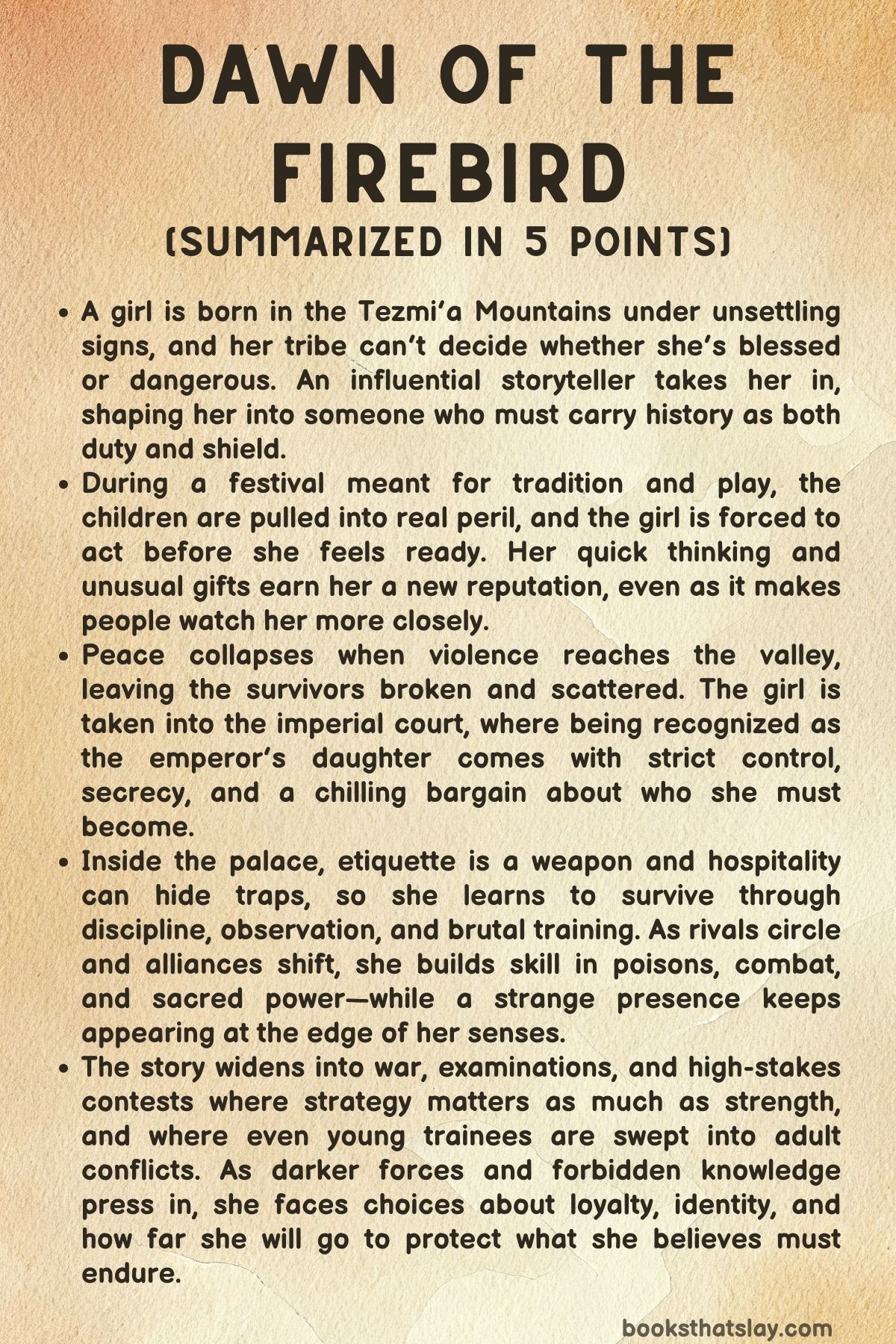
Summary
In the year 495 after Nuh’s Flood, a girl is born in the Tezmi’a Mountains of the Azadniabad Empire. Her mother, Ayşenör—called Uma—dreams of cold Heavenly light, nūr, spilling from her infant.
The tribal leaders dream of the opposite: shadow, conflict, and ruin. Many in the valley call the baby an omen, and the early years do little to calm them.
Birds crowd around the child wherever she goes. Food spoils when wild flocks descend.
Accidents and bad luck seem to follow her family. Fear settles into the community like a second winter.
The only person with the authority to redirect that fear is Babshah Khatun, the khan’s favored wife and the tribe’s chief storyteller. Babshah silences the gossip and claims the girl for her own purpose, declaring she will train the child as an apprentice folkteller.
The role is sacred: the storyteller holds the tribe’s history, its laws, its grief, and its pride. Babshah binds the girl to the duty of memory, even as others look at her as a curse.
At seven years old, during the Flood Festival, Babshah takes the children deep into the valley near a dangerous mountain pass. Uma warns her about enemy patrols, but Babshah insists on a game that is also a lesson: a “hunt by folktelling,” where children pair with birds and “hunt” by telling stories to shape attention and courage.
The girl’s milk-brother, Haj, rejects her; he believes she brings disaster, and her small, soot-dark buzzards seem weak compared to other children’s birds.
The game turns real when screams tear through the forest and the ground shudders. Children scatter, convinced a monster is nearby.
In an open pasture, Babshah refuses to let anyone run. She identifies the creature as a karkadann, a rare horned jinn-beast with blue fur and burning eyes.
Instead of ordering warriors, she forces the girl forward, blackens her eyes with sormeh, and straps on a ceremonial mask. Babshah begins an ancient creation story—angels, jinn, humans, and the old wars—while the girl uses clay, shadow-play, and movement to hold the beast’s attention.
Her twin buzzards strike in coordinated bursts, buying her seconds. Timing her prayer and her breath to Babshah’s signal, she leaps and drives an arrow into the vulnerable underside of the creature’s neck.
The karkadann collapses and dissolves into darkness, leaving behind a shining horn. When the khan and warriors arrive, awe replaces suspicion.
The khan names her “jinn huntress,” while Babshah claims her as “folkteller.” The valley’s fear softens into wary respect, and the girl grows into adolescence telling stories beside Babshah, learning how words can bind a people together.
By thirteen, admiration cannot cover everything she lacks. She has never been formally named.
Worse, she is the emperor’s child, yet he will not claim her openly. Uma says the emperor forbade her from giving the girl a name, promising he will name her one day.
The khan tries to steady her, gifting earrings and threading her arms in tribal designs, telling her she carries both the tribe’s heart and the empire’s symbol: the Heavenly Crane. But peace breaks with violence.
Raids hit Tezmi’a gorge. Caravans are slaughtered, the dam is destroyed, and floodwaters ruin the northern pass.
Haj is returned dead, and Hawah is taken captive. The girl sees something unnatural—a twisting shadow with a single white eye rising from Haj’s corpse—but Uma insists she imagined it and sends her away.
The raids worsen, hunger spreads, and the valley braces for the worst. On the winter solstice, Uma presses a dagger into her daughter’s hand: if she is captured, she must choose death over what enemies will do to her.
Babshah calls for a story night to hold the tribe together. She tells of Nuh’s ark, the Heavenly Raven and Crane, and the creation of the Eajīz—warriors bound to Heaven through seventy-seven golden bonds.
Mid-story, the attack begins. An arrow strikes Babshah in the stomach.
Fire arrows fall. The girl is hit, her cousin Sheeth dies protecting her, and the camp collapses into chaos.
Uma drags her onto a horse and rides toward a border garrison, but raiders catch them. The girl shoots from horseback, yet they are overwhelmed.
She is thrown to the ground, cut, pinned, and almost violated. Uma is dragged away.
In desperation, the girl uses the dagger to kill her attacker. She sees another raider about to execute Uma, and something inside her breaks open.
A freezing force pours through her body. Golden threads rise from her like cords tied to the sky.
Cold nūr erupts and slices her mother’s attacker apart, then lashes out at others. Reinforcements arrive too late to save most of the tribe.
The valley burns. Bodies lie everywhere.
The khan’s head is mounted on a spear. From thousands, only a few hundred survive.
The massacre is remembered as the Night of Tezmi’a.
Uma brings the girl to the imperial capital. In a palace hall, the emperor—her father—refuses to claim her publicly at first and tries to send Uma away.
When a guard grabs Uma, the girl’s nūr flares again, exposing what she is: an Eajīz. The emperor’s reaction is immediate and calculating.
He demands secrecy, asks what she offers him, and measures her like a weapon. Sensing the danger, the girl submits, calling herself blank and asking him to “write” her into something useful.
He orders her to forget her past, promises protection, and says monks will train her. Only a few advisers will know the truth.
The court is a different battlefield. When the emperor finally presents her as his daughter, courtiers whisper at her steppe clothing and accent.
Dunya, the emperor’s first wife, humiliates her in public and forces her into her own dining circle as a show of dominance. At the feast, palace customs—who breaks bread, where one sits, who touches food first—become a trap.
The girl eats, is poisoned, and collapses. As she suffocates, she again sees the featureless shadow with the single white eye emerge from her chest and point toward her heart before vanishing back inside.
She abruptly draws breath again, barely alive.
The emperor saves her with harsh methods, then punishes her for being vulnerable. He dangles the antidote and demands she identify the poison correctly.
She does, naming buckleberry juice and ground apricot seed. When Dunya visits her bedside and admits the poisoning was a warning, the girl makes a decision: she will not run.
She rips off her tribal cap, tries to break her own memories, and forces herself to become what the palace requires.
To prove herself, she asks the emperor for tests. He gives her food and has her identify poisons by taste and smell.
She succeeds again and again, learning that in this court, poison is a language. The emperor tells her a brutal truth: she must survive Dunya by winning Dunya’s public acceptance, and she must keep her nūr hidden or be targeted.
He also warns of a larger threat: Sajamistan’s elite Eajīz forces, led by a powerful general.
Her main trainer becomes Eliyas, the emperor’s eldest son and chief dream-interpreter. He teaches her to summon nūr through prayer rather than agony and explains that Eajīz power comes through a “Heavenly Contract” formed by bonds.
She begins to sense seventy-seven bonds within herself, though others cannot see the gold lines she sees. As she trains, her past begins to fade, and Uma watches her daughter forgetting with grief and resignation.
The girl returns to Dunya’s circle and turns the court’s cruelty into a demonstration. Dunya tries to poison Uma through elaborate dishes.
The girl tests the food, names the toxins, and then eats the poisoned meal herself, one bite after another, while calmly calling out methods of concealment. The public display shames Dunya and forces her into a ritual acceptance oath.
The girl wins the moment, though it nearly kills her. Warlord Akashun, watching closely, makes it clear he is interested in her for reasons that are not friendly.
Years pass in relentless training: resistance-building, combat drills, meditation, and study of substances tied to the Unseen. She learns that some poisons do not merely kill the body; they can invite possession.
In Navia, she encounters a scarred woman attacked by birds who calls her “Mitra” and reacts to her bonds. Eliyas subdues the woman and reveals she is possessed by foul jinn and was once Eajīz who broke her contract by turning toward the Unseen.
Soon after, monks are found slaughtered, their bodies defiled in ways that suggest something is hunting through the city.
Political pressure escalates. Akashun arrives with allied warlords and tests the empire’s weakness through insults and provocation.
The emperor considers marrying the girl into a brutal alliance, while also demanding harsher secret training. She is forced to drink escalating doses of “jinn-poisons,” suffering whispers, night terrors, and the steady presence of that white-eyed shadow at her bedside.
The emperor grows absent as wars and shortages deepen, while Eliyas protests that the training is destroying her spirit.
Later, under the name Usur-Khan, she enters brutal examinations and tournaments that shape military rank. She forms a squadron out of overlooked students and children, drilling them with punishing discipline because she needs numbers and loyalty.
In the Marka tournament’s veiled battlefield, she wins through traps, deception, and coordinated affinities—ants carrying metal shards, plants turned into hazards, banners hidden and swapped—outmaneuvering better-equipped rivals. Her victory earns respect and rage, and it sets up a sacred duel custom, the Duxzam, with stakes tied to soul and power.
Then the strangest betrayal arrives: her companion No-Name turns on her, claiming she lacks conviction now that the emperor’s hold over her has weakened. No-Name transforms into a monstrous dîv and refuses obedience.
Hiding in ruins, Usur-Khan follows a scroll altered by creeping shadow and enters a vision of gates to different realms. She sees her seventy-seven bonds as solid rods that can be rearranged to multiply energy, a technique that seems forbidden.
A library Keeper warns that knowledge changes eras, especially when used alongside an emperor. Still, she decides she must reach Heaven’s gates to counter Mitra.
War worsens. In Khor, she witnesses atrocities where occupiers use blood rituals to bind the “mortal soul,” and jinn-poisons are used to turn captives into bait.
A colossal serpent-horror rises from the moat, ghûls swarm, and her former pupil Arezu dies defending civilians with a desperate, self-sacrificing summoning. Grief and fury push Usur-Khan to crush her own bonds in the spiritual plane, unleashing shadowed power that annihilates enemies indiscriminately.
When she can no longer accept the cause she serves, she defects and makes her way back toward Azadniabad’s wartime leadership.
In Navia, she confronts Akashun and learns he has protected himself with a black Veil and has bonded himself to Mitra using her blood—blood taken from her through the emperor’s network. Her nūr cannot pierce him.
Faced with capture and exploitation, she chooses the gates. She meets a Gatekeeper angel who warns that a cleansing flood is coming to end an era of corruption.
She asks for the Eighth Gate to summon the Simorgh, the Third Heavenly Bird, but her request is coldly limited: she will save the Camel Road, not the whole continent. The price is absolute loneliness.
She takes the power anyway, enslaving the Simorgh through a violent act that seals her fate.
Back in the world, a new bond ignites beyond her original count, linking her to others who used the gates. She destroys Akashun and calls the Simorgh into the sky.
A catastrophic flood begins—lands crack, waters rise, storms tear across borders. Birds carry civilians from rooftops and cliffs while nūr barriers protect the Camel Road.
The rest of the world drowns, and the scale of what she has done settles into her bones.
The final cruelty is personal: Tezmi’a, her birthplace, cannot be saved. The angel’s voice tells her the gates take what the warrior values most, and her request was not precise enough to protect her true home.
No-Name vanishes, thanking her. Later, No-Name returns altered and reveals the truth: she is a soul-eater from the Unseen, tied to a Mitra bargain made at Khamilla’s birth.
She is the devoured heart of Khamilla’s soul, hungry and growing, and Khamilla cannot remain separated from her without losing memory, will, and bonds.
In the aftermath, monks attempt to cleanse Khamilla for days as the flood’s devastation becomes the new reality. The Sepāhbad appears with her khanjar and reveals that her hidden identity was always more dangerous than the court knew: Khamilla, eighth child of Emperor Fatih Zahr-zad.
The era has changed, the price has been paid, and the power she claimed has left her both feared and alone—except for the hunger that still follows her.
Characters
Khamilla (the Narrator, later known as Usur-Khan)
Khamilla is the emotional and moral core of Dawn of the Firebird, a character shaped by abandonment, violence, and impossible expectations. Born under ominous signs and denied even a name for much of her childhood, she grows up caught between identities: tribal daughter, imperial secret, divine weapon, and finally world-altering force.
Her early sensitivity to birds, stories, and nūr marks her as different long before she understands what she is, and this difference becomes both her protection and her curse. Trauma repeatedly hardens her—Tezmi’a’s massacre, palace poisonings, the Marka battles—yet she never loses her capacity for attachment, especially toward children, students, and the dead she carries with her in memory.
As she matures, her intelligence becomes ruthless and strategic, but it is driven by hunger for belonging rather than ambition. Her final transformation, breaking her Heavenly bonds and enslaving the Simorgh, reveals the tragic culmination of her arc: a girl who wanted a home becomes a godlike force who reshapes the world, only to lose the one place that ever truly belonged to her.
Uma (Ayşenör)
Uma is Khamilla’s mother and her first, most enduring anchor to humanity. Gentle yet unyielding, Uma balances spiritual intuition with fierce maternal pragmatism, repeatedly acting to preserve her daughter’s life even when doing so costs her safety, dignity, or proximity.
She understands the danger of prophecy and power better than most, attempting to shield Khamilla from both tribal fear and imperial exploitation. Uma’s insistence on truth—forcing the emperor to see his child, refusing to abandon her after poisonings, confronting Dunya publicly—marks her as quietly courageous rather than politically savvy.
As Khamilla begins to forget her past, Uma accepts this loss with sorrow but without resentment, recognizing that survival sometimes requires erasure. She represents the life Khamilla might have lived without empire or destiny, and her fading presence underscores the cost of Khamilla’s ascent.
Babshah Khatun
Babshah Khatun embodies tradition weaponized for survival. As the khan’s favored wife and the tribe’s chief folkteller, she understands that stories are not merely cultural inheritance but tools of power, binding, and command.
Her decision to claim Khamilla as her apprentice saves the girl from tribal violence while simultaneously binding her to responsibility from an early age. Babshah’s actions are often harsh—forcing a child to face a karkadann, refusing to let children flee danger—but they are rooted in absolute belief in preparation over comfort.
Her death during the raid is a turning point, symbolizing the collapse of the old world of oral memory and communal protection. Yet her influence persists in Khamilla’s reliance on narrative, symbolism, and performance as weapons, even in court and war.
The Khan of Tezmi’a
The khan serves as Khamilla’s surrogate father and moral counterpoint to the emperor. He accepts her without fear once she proves herself, honors her dual identity by marking her with both tribal designs and imperial symbols, and treats her not as an omen but as a child entrusted to his people.
His leadership is grounded in care for the collective rather than ambition, and his brutal death during the Night of Tezmi’a crystallizes the injustice that drives much of Khamilla’s later rage. His decapitated head on a spear becomes an image that haunts the narrative, representing the annihilation of a community that valued loyalty over conquest.
Haj
Haj, Khamilla’s milk-brother, represents the fear-driven cruelty of ordinary people confronted with the unknown. His rejection of Khamilla as cursed, his refusal to hunt with her, and his eventual violent death illustrate how superstition fractures intimacy.
The shadow Khamilla sees rising from his corpse hints that his story does not end with death, reinforcing the novel’s theme that denial of darkness does not prevent its return. Haj’s fate weighs on Khamilla as both loss and unresolved guilt.
The Emperor (Fatih Zahr-zad)
The emperor is one of the most chilling figures in Dawn of the Firebird, defined by control, calculation, and conditional affection. He acknowledges Khamilla only when her power becomes undeniable, immediately reframing her existence in terms of utility rather than kinship.
His language toward her—inviting her to be written, forged, and wielded—reveals his worldview: people are instruments, and love is irrelevant to governance. Though undeniably intelligent and strategic, he consistently underestimates the spiritual cost of his decisions, pushing Khamilla toward jinn-poisons and forbidden techniques while claiming necessity.
His absence in the latter stages of the narrative reflects both political overreach and moral abdication, leaving behind a daughter shaped by his methods but no longer loyal to his vision.
Dunya
Dunya, the emperor’s first wife, is a master of soft violence and social annihilation. Her cruelty is expressed not through open force but through etiquette, poison, and humiliation, using palace customs as weapons to assert dominance.
Dunya perceives Khamilla as an existential threat to her lineage and responds with calculated intimidation rather than overt rebellion. Even after being publicly forced into acceptance, her fear and resentment remain palpable.
Dunya represents the internal rot of imperial power: polished, ritualized, and lethal without ever drawing a sword.
Zhasna
Zhasna is both victim and participant in her mother’s cruelty, navigating palace life with practiced awareness. She understands the rules well enough to warn Khamilla while still enabling Dunya’s power plays, embodying the compromises required to survive in court.
Over time, her evolution into a court poet signals a shift from direct competition to narrative influence, suggesting a quieter, more adaptive form of power. Her relationship with Khamilla remains uneasy, defined by proximity rather than trust.
Eliyas
Eliyas, the emperor’s eldest son and Chief Dream-Interpreter, functions as Khamilla’s mentor and partial conscience within the palace. Unlike his father, he treats her with humor, candor, and a degree of genuine care, even as he participates in morally dubious training.
His understanding of Heavenly Contracts and controlled summoning offers Khamilla a less destructive path to power, though he ultimately fails to protect her from imperial excess. Eliyas’s repeated lies to shield her indicate loyalty, but his inability to stop her suffering highlights the limits of benevolence within authoritarian systems.
Akashun
Akashun, the Wolf of the Khajak prefecture, is a predator disguised as an ally. His fascination with Khamilla is rooted in recognition rather than desire; he sees in her a rival force worth corrupting or consuming.
By bonding himself to Mitra using Khamilla’s blood, he literalizes the imperial habit of exploiting others’ bodies and souls for advantage. His death at Khamilla’s hands is both vengeance and inevitability, marking the collapse of a man who believed himself untouchable behind veils and bargains.
No-Name (Mitra)
No-Name is the most unsettling character in the novel, functioning simultaneously as companion, abuser, protector, and parasite. Her shifting forms and contradictory guidance reflect her true nature as the devoured heart of Khamilla’s soul, bound to hunger and survival rather than morality.
By hurting Khamilla “because I care,” she exposes the warped logic of dependence forged through trauma. Her eventual revelation reframes Khamilla’s entire life as the product of a bargain made at birth, complicating notions of agency, destiny, and consent.
Even when she leaves, her absence is as dangerous as her presence, ensuring Khamilla’s struggle with identity is never fully resolved.
Arezu
Arezu represents the cost of hope and loyalty in wartime. As Khamilla’s student, she embodies the possibility that discipline and care can produce defenders rather than weapons.
Her desertion from the pazktab is not betrayal but moral clarity, choosing to protect civilians over institutional obedience. Her brutal death while attempting an impossible summoning devastates Khamilla, serving as the final fracture that pushes her toward breaking her Heavenly bonds.
Arezu’s life and death affirm that innocence and courage are not enough to survive systems built on sacrifice.
Cemil
Cemil is ambition sharpened into doctrine. Brilliant, pragmatic, and emotionally restrained, he consistently chooses strategies that prioritize victory over human cost.
His rivalry with Khamilla is intellectual rather than personal, yet he is repeatedly unsettled by her refusal to detach strategy from memory. Cemil’s discomfort after the Marka defeat suggests that, beneath his certainty, he recognizes the moral vacuum of his approach, even if he never abandons it.
Fayez
Captain Fayez embodies rigid militarism and authoritarian discipline. His disdain for Khamilla’s methods—particularly her use of children and deception—stems less from moral objection than from wounded pride and threatened hierarchy.
By invoking the Duxzam, he escalates personal resentment into sacred violence, revealing how honor codes can legitimize cruelty. Fayez’s leadership contrasts sharply with Khamilla’s: where she inspires loyalty through shared suffering, he enforces obedience through fear.
Hyat
Hyat, the emperor’s brother, is a quiet architect of cruelty, advocating for Khamilla’s use as an asset rather than a daughter. His counsel reinforces the empire’s instrumental view of power and family, making him complicit in the system that ultimately collapses under its own brutality.
Though less visible than the emperor, his influence is deeply corrosive.
Yabghu
Yabghu operates as a bureaucratic obstacle and reluctant enabler. Though often furious at Khamilla’s defiance and methods, he repeatedly backs down when confronted with her competence or the children’s loyalty.
He represents institutional weakness: aware of injustice but unwilling or unable to stop it.
Alif Adel
Adel, the Sajamistani commander, is pragmatic and burdened by the scale of suffering under his command. His willingness to destroy entire quarters to prevent further corruption reflects a grim acceptance of atrocity as necessity.
Unlike the emperor, Adel does not cloak his actions in destiny or righteousness, making him one of the more honest figures in power despite his brutality.
Themes
Fate, Agency, and the Burden of Choice
From the moment of her birth, the protagonist’s life is framed by forces that claim to precede her will—dreams, omens, Heavenly light, and prophecies imposed by elders and rulers alike. Yet Dawn of the Firebird consistently resists the idea that destiny functions as a fixed script.
What emerges instead is a harsh negotiation between what is foretold and what is chosen. The child is labeled an omen before she can speak, hunted by fear long before she understands power, and later claimed by an empire that sees her less as a person and more as an asset.
These pressures attempt to define her future, but they never fully erase her capacity to decide how she responds to them. Each critical moment forces a choice: whether to submit, to survive quietly, or to act in ways that permanently alter the world around her.
Agency in the novel is not framed as freedom without cost. Every assertion of will demands sacrifice.
When she submits to the emperor and asks to be “written,” this is not passivity but a calculated surrender meant to preserve life. Later, her willingness to endure poisons, erase memory, and reshape herself into a weapon reflects a grim understanding that choice exists even within coercion.
The narrative repeatedly shows that refusing to act can be as consequential as acting, particularly in a world governed by imperial violence and sacred contracts. The ultimate use of the Gates, which reshapes geography and history, represents the most devastating exercise of agency in the novel.
It is not portrayed as triumph but as a moment where choosing becomes inseparable from destruction.
What gives this theme its weight is the novel’s refusal to offer moral clarity. The protagonist’s decisions save lives while condemning others.
Fate may create the conditions of her life, but her choices determine its consequences. The story insists that agency does not guarantee justice or peace; it only guarantees responsibility.
By placing a young woman at the center of decisions that gods, emperors, and angels hesitate to make, the novel exposes how power magnifies choice into something terrifying and irreversible.
Memory, Erasure, and the Cost of Survival
Survival in Dawn of the Firebird often requires forgetting, and this forgetting is never neutral. Memory is treated as both anchor and vulnerability, something that sustains identity while also threatening it.
The protagonist’s gradual loss of her past—her tribe, her language patterns, her customs, even her name—does not occur through a single act but through repeated pressures to adapt. Each erasure is framed as necessary: to remain alive at court, to avoid assassination, to function as an imperial tool.
Yet the novel makes clear that memory cannot be fully destroyed, only buried, where it returns in distorted forms such as shadows, visions, and physical pain.
The tension between remembering and forgetting becomes especially pronounced in her relationship with power. The emperor demands obedience that depends on her becoming blank, someone whose past attachments no longer interfere with usefulness.
At the same time, her ability to wield nūr and survive jinn-poisons is directly tied to experiences rooted in trauma and loss. Forgetting dulls her grief but also weakens the moral framework that once defined her limits.
This erosion explains how she later becomes capable of decisions that devastate entire regions while still believing she acts out of necessity.
Memory in the novel also functions as inheritance. Stories told by Babshah, the rituals of the tribe, and the oral histories bound to birds and festivals represent a collective memory that resists imperial rewriting.
When Babshah dies, storytelling does not disappear; it transfers into the protagonist’s body, turning memory into obligation rather than comfort. Even when she tries to sever herself from the past, those stories resurface, demanding to be acknowledged.
The presence of No-Name complicates this theme further. As a being tied to the soul itself, No-Name embodies the danger of fragmented memory.
Separation leads to loss of will and identity, suggesting that memory is not only psychological but structural. The novel ultimately presents survival through forgetting as incomplete and corrosive.
Living requires memory, even when remembering hurts, because without it, power becomes easier to wield and harder to question.
Power, Instrumentalization, and Imperial Logic
Power is rarely abstract; it is practical, measured, and transactional. From the tribal khan to the emperor, authority operates through use rather than care.
The protagonist’s value is repeatedly assessed in terms of what she can accomplish—hunt a beast, survive poison, defeat enemies, secure alliances. Love, protection, and recognition are offered conditionally, contingent on usefulness.
This pattern exposes an imperial logic that treats people as resources, especially those who carry rare or sacred abilities.
The emperor embodies this theme most clearly. His recognition of the protagonist as his daughter coincides exactly with his recognition of her as an Eajīz.
Before that moment, she is expendable; after it, she is guarded, trained, and hidden. The shift is not moral but strategic.
He does not deny affection entirely, but affection itself becomes another method of control. Training, secrecy, and suffering are justified as preparation, reinforcing the idea that power demands sacrifice from those who wield it, but rarely from those who command it.
This instrumental view of power extends beyond the palace. Court politics normalize poisoning, manipulation, and public humiliation as acceptable tools of governance.
Even religious institutions participate, training children for warfare under the language of devotion and contract. The Marka tournament further reveals how violence is refined into spectacle, where children are evaluated not for wisdom but for effectiveness.
The protagonist’s success there depends on adopting the same logic she despises, using fear, deception, and expendability to win.
What makes this theme unsettling is the protagonist’s eventual internalization of imperial logic. By the time she commands floods and enslaves a Heavenly bird, she has accepted that power exists to impose order, even if that order is born from terror.
The novel does not excuse this transformation, but it traces it carefully, showing how systems of power reproduce themselves through those they consume.
Faith, Divine Contracts, and Moral Constraint
Faith is structured through contracts rather than comfort. The relationship between humans and the Divine is governed by rules, bonds, and consequences that function much like law.
The seventy-seven Heavenly bonds are not symbols of blessing alone; they are limits that restrain excess and define responsibility. Through them, power is granted conditionally, requiring discipline, prayer, and restraint.
This framework positions faith as a system meant to prevent absolute domination, even by those chosen to wield sacred energy.
The Eajīz are central to this theme because they exist at the boundary between devotion and violence. Their abilities come from Heaven, yet their actions are carried out in political and military contexts.
This tension raises constant questions about legitimacy. When does Divine power serve justice, and when does it serve ambition?
The monks emphasize restraint, warning that misuse leads to corruption, possession, or loss of self. These warnings are not theoretical; the novel repeatedly shows the aftermath of broken contracts in the form of possessed bodies and ruined minds.
The turning point comes when the protagonist chooses to break the ultimate constraint by manipulating the Gates. This act reframes faith not as guidance but as obstacle.
By enslaving the Simorgh, she converts a sacred relationship into ownership, collapsing the distinction between Divine authority and imperial control. The angel’s warnings underscore that this choice is not misunderstood faith but deliberate transgression.
What follows is not divine punishment in a simplistic sense, but consequence. The loss of her true home demonstrates that even when power is seized, it does not grant precision or mercy.
Faith in the novel is not presented as infallible, but as a structure meant to check human excess. When that structure is destroyed, the result is not freedom but isolation, confirming that constraint was never the enemy.
It was the last barrier between power and total annihilation.
Identity, Belonging, and the Politics of Selfhood
Belonging in Dawn of the Firebird is never secure. The protagonist moves through multiple worlds—tribal, imperial, religious, and martial—without fully belonging to any of them.
Each space demands adaptation, and each adaptation requires the shedding of another layer of self. Identity becomes something performed rather than possessed, shaped by clothing, language, ritual, and obedience.
The novel treats this instability not as personal failure but as the expected condition of those born at the margins of power.
Her earliest rejection by the tribe and later suspicion at court establish a pattern where belonging is conditional and revocable. Even when she is publicly acknowledged as the emperor’s daughter, her place remains fragile, constantly threatened by rivals and customs designed to exclude.
Acceptance requires mastery of palace norms, including cruelty. By learning these rules, she secures her position but loses the innocence that once made belonging meaningful.
Names play a crucial role in this theme. Being unnamed marks her as incomplete, while later titles redefine her according to function rather than essence.
Each name given to her reflects how others intend to use her. The struggle to claim or reject these names mirrors her struggle to define herself outside imposed roles.
The relationship with No-Name represents the most intimate form of fractured identity. As a manifestation of her soul’s hunger and loss, No-Name reveals that belonging is not only social but internal.
Separation from this core results in decay, suggesting that selfhood cannot survive indefinite division. By the end of the novel, belonging to any community has been replaced by survival within power.
The cost of this transition is profound loneliness, reinforcing the idea that identity shaped solely by dominance leaves no space for home.
Violence, Sacrifice, and the Ethics of Survival
Violence in Dawn of the Firebird is not sensationalized; it is methodical, intimate, and cumulative. From raids and executions to tournaments and floods, harm is portrayed as an ordinary tool of governance and survival.
What distinguishes the novel is its focus on how repeated exposure to violence reshapes ethical boundaries. Early acts of killing are framed as defensive or necessary.
Over time, necessity expands until it includes preemptive destruction and mass death.
Sacrifice becomes the language used to justify this escalation. Characters repeatedly frame loss as inevitable, whether sacrificing children in training, villages in war, or entire regions for strategic stability.
The protagonist absorbs this logic gradually, learning to accept pain as proof of strength and loss as currency. By the time she chooses to drown vast lands while preserving a single road, sacrifice has become abstract, measured in numbers rather than faces.
The novel does not allow readers to view this progression comfortably. Moments of personal grief, especially the death of Arezu, rupture the narrative’s strategic calm.
These losses expose the lie that violence can remain controlled or moral. Each sacrifice creates further justification for future harm, forming a cycle that feeds on itself.
By presenting survival as something that increasingly demands ethical compromise, the story questions whether endurance alone is a virtue. The protagonist survives, but the world she leaves behind is broken, and so is her sense of self.
Violence preserves her life while erasing the meaning of living, suggesting that survival without limits ultimately mirrors the destruction it seeks to avoid.