Dead and Breakfast Summary, Characters and Themes
Dead and Breakfast by Kat Hillis and Rosiee Thor is a cozy paranormal mystery about love, community, and second chances, wrapped in vampire humor and small-town drama. Arthur Miller, a reserved vampire with a fondness for order and good biscuits, runs a failing bed-and-breakfast with his theatrical husband, Salvatore, in the town of Trident Falls.
When the new city manager, Nora Anderson, arrives on their doorstep the same day the town’s mayor turns up dead in their garden, Arthur is dragged into a murder investigation. To save Sal, their inn, and the town’s paranormals, he has to become an unlikely detective.
Summary
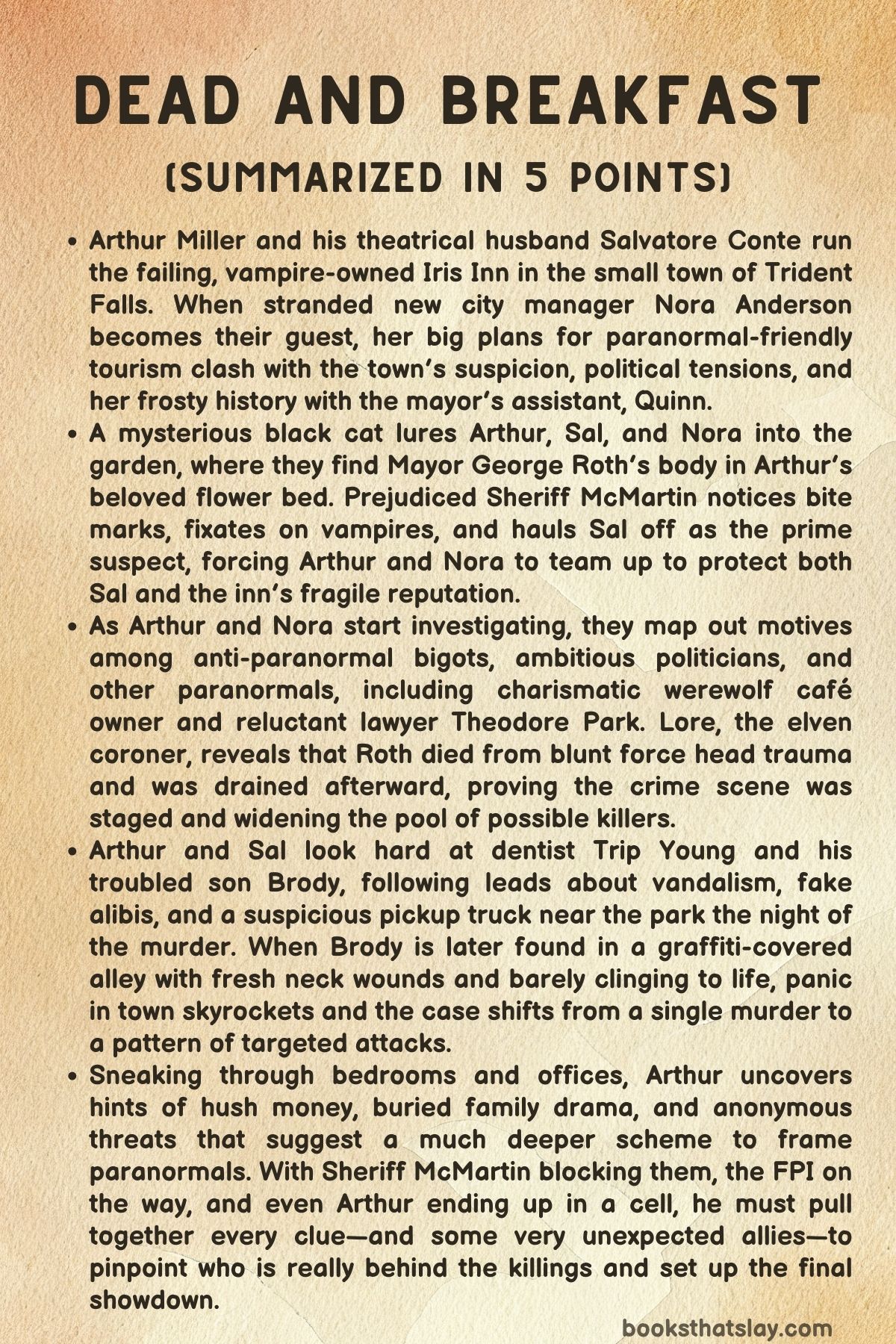
Arthur Miller, a quiet, anxious vampire, runs the Iris Inn in Trident Falls with his flamboyant husband, Salvatore Conte. Business is slow, the town is wary of paranormals, and Arthur is desperate for the inn to be seen as respectable.
Their luck seems to turn when Nora Anderson, the new city manager, shows up needing a place to stay after her promised rental turns out to be a fake. Arthur welcomes her with stiff politeness; Sal smothers her in charm and theatrical hosting.
Sal has plastered the town with flyers for a wine-and-cheese night at the inn, hoping the mayor’s presence will boost their reputation. Nora attends the event and is soon joined by Quinn Clark, the mayor’s assistant, with whom Nora clearly has emotional history and unresolved tension.
The mayor himself never appears. When Sal leaves for a late-night dentist appointment with Dr. Trip Young, the party fizzles.
Quinn departs in frosty silence, Nora apologizes for the awkwardness, and Arthur goes to bed clinging to the hope that at least the inn had one proper guest.
The next morning, Arthur focuses on making a perfect breakfast while bickering with Sal about how much they should tone down their vampiric flair for the sake of “normalcy.” A scruffy black cat appears at the back door; Sal names her Rumble and instantly wants to adopt her. Nora, charmed by the inn and the food, asks to see the garden.
Arthur, shielding himself from the sun with an umbrella, leads Nora and Sal outside. Rumble dashes ahead as if guiding them.
The morning turns horrific when they discover Mayor George Roth lying dead in Arthur’s flower bed, eyes wide open and skin pale, crushing Arthur’s begonias. Nora is shaken; Sal wails theatrically while clearly afraid.
Arthur insists the scene be preserved and has Nora call the sheriff.
Sheriff McMartin arrives and treats Arthur and Sal with suspicion the moment he learns they’re vampires. He fixates on two puncture marks on Roth’s neck and, after hearing Sal was out alone during the likely time of death, decides Sal must be the killer.
Lore, an elven coroner with a calm, offbeat manner, takes the body and promises Arthur she will follow the evidence, not prejudice. McMartin still hauls Sal away in handcuffs, leaving Arthur stunned, with a murder on his property and his husband suspected of a vampire attack.
Nora refuses to abandon Arthur and helps him get to the station—on Arthur’s tandem bike, because he loathes cars. At the jail, they find Sal locked up but cheerfully overdramatic, using humor to mask his fear.
McMartin taunts them, warning that if a vampire is blamed, the town will turn against all paranormals and the inn will be ruined. He mocks the Iris Inn as “Dead and Breakfast,” which Sal instantly decides is actually a fantastic future name.
Quinn arrives to announce that Nora is now acting mayor until a special election. She also reveals that the Federal Paranormal Investigators (FPI) will take over the case soon.
Arthur has had painful experiences with the FPI before and is certain they’ll happily pin the murder on a vampire. He decides he must solve the case himself before they arrive.
Arthur and Nora begin to investigate motives. Roth was openly hostile to paranormals, but Nora’s new tourism plan pushed him toward a more paranormal-friendly stance.
That made him enemies on both sides: bigots who hated paranormals, and paranormals who didn’t trust the sudden shift. Arthur starts a mental suspect list that includes Theodore Park, the popular werewolf owner of Big Bad Brew; Nora herself, who gains power as acting mayor; and the unknown vampire who might have made the bite marks.
When Lore shares her preliminary findings, the picture changes. Roth’s actual cause of death was blunt-force trauma to the back of his head; the neck wound was made after death, and his body was drained later.
Dr. Trip Young confirms the bite is vampiric but claims Sal missed his appointment, wrecking Sal’s alibi. Theodore reveals that McMartin may not have had proper grounds to hold Sal and eventually forces the sheriff to release him.
Arthur and Sal continue investigating, focusing next on Trip Young and his son, Brody. They learn that Brody had his father’s truck the night Roth died and that he lied about where he was.
Anti-paranormal graffiti around town, including at Theodore’s café and possibly the inn, points toward Brody’s recent crowd of bigoted older teens. Arthur and Sal track down Brody’s friends, confirming he was out late in the truck and may have been near the park where Roth died.
When they report their suspicions, McMartin refuses to consider Brody a serious suspect. Later, Arthur and Sal find Brody in an alley, bleeding heavily from fresh vampire-style neck wounds under graffiti that has been partly changed from “fur fiend” to “fur friend.” They call an ambulance, saving his life, but McMartin still treats them as potential attackers.
Arthur’s suspicion briefly swings to Theodore, given the graffiti and his knowledge of the truck’s location, but a visit to Theodore’s home shows no sign of blood and instead suggests Brody has been trying to soften the hateful messages. Arthur and Sal break into Brody’s room at Trip’s house and find letters from Brody’s paranormal mother, cherished keepsakes, pay stubs from McMartin Ranch showing a suspiciously large last payment, and a threatening anonymous text saying, “I know what you did.This isn’t over.” The big paycheck looks like hush money tied to the mayor’s death.
Arthur confronts McMartin about the money and grows convinced the sheriff might be behind everything. However, when Arthur is arrested on flimsy grounds and stuck in a cell, McMartin reveals an ironclad alibi: he was filming an audition for a paranormal reality dating show at the time of Brody’s attack.
Arthur, frustrated, realizes he has once again accused the wrong man.
Alone in his cell, Arthur talks through the case and suddenly notices that a tiny mouse seems to understand him. The mouse responds with nods and gestures and, when bribed with a promise of chips, drags the jail keys to Arthur’s cell.
Arthur realizes that his special vampiric gift is finally emerging: the ability to communicate with animals. He escapes, grabs snacks for the mouse, and heads for the hospital, certain that Trip Young is going to finish what he started with Brody.
At the hospital, Arthur sneaks in through a back entrance, steals scrubs, and pretends to be a visiting doctor. He reaches Brody’s room in the paranormal ward just as Trip arrives.
A nurse recognizes Trip as the boy’s father and questions Arthur, forcing him to drop the disguise. Arthur accuses Trip of murder, and Trip, cornered, lets his mask slip.
Trip explains that he and Roth bonded over their prejudice against paranormals, but Roth’s sudden embrace of Nora’s tourism plan enraged him. They argued in the park; Trip shoved Roth, who hit his head and died.
Afterward, Trip called Brody with the truck to help move the body. Trip faked a vampire bite with a scalpel and left Roth in Arthur’s garden to frame the inn’s vampire owners.
Later, when Brody got scared and threatened to confess, Trip attacked his own son, using Arthur’s dental mold to create a perfect fake bite that would incriminate Arthur. He also admits he despises Brody’s paranormal heritage from his mother.
McMartin arrives mid-confrontation, only to be knocked unconscious by Trip as the dentist tries to stage the scene to blame Arthur. Trip throws every cliché anti-vampire trick he has at Arthur—UV light, garlic, fake holy water—but most of it is useless.
In the struggle, a broken chair becomes a real stake, and Trip nearly kills Arthur.
Rumble the cat appears at the last moment, launching herself at Trip’s face and clawing wildly. Sal then bursts onto the scene in dramatic fashion, declaring his love and loyalty, and together he and Arthur manage to overpower Trip.
A combination of physical chaos, Sal’s miscounted “on three,” pantsing Trip, and Rumble fetching McMartin’s handcuffs ends with Trip pinned and shackled. Brody briefly wakes and confirms his father’s guilt before drifting back to sleep.
With Trip’s confession, the physical evidence, and witnesses present, the case against Arthur and Sal crumbles.
A week later, the inn is reborn as Dead and Breakfast, proudly embracing its vampire owners and spooky charm. Nora, still acting mayor, along with Lore, Theodore, Quinn, and others, help revamp the place.
Tourism is up, the FPI cancels their visit, and Arthur and Sal become minor local celebrities. They decide to stop hiding and live as openly paranormal as they please.
Nora brings Arthur a new mystery: Brody wants help finding his missing paranormal mother, and hiring Arthur might help keep him out of deeper legal trouble and give him hope. Sal presents Arthur with new business cards announcing his next chapter: “Arthur Miller (no relation), VAMP PI: Very Astute Married Paranormal Private Investigator.” As new guests arrive at Dead and Breakfast, cooing over Rumble and the inn’s eerie charm, Arthur quietly takes notes, ready for whatever strange case comes through the door next.
Characters
Arthur Miller
Arthur is the emotional and structural center of Dead and Breakfast. A reserved, anxious vampire with the soul of a fussy innkeeper and the brain of an amateur detective, he starts the story desperate for safety, respectability, and quiet.
His instinct is always to smooth things over: he worries about décor, guest impressions, flower beds, and whether the Iris Inn looks “normal” enough to reassure a town that distrusts paranormals. That obsession with normalcy reflects centuries of survival strategy.
Arthur has learned that blending in is how you stay undead and unharmed, and he initially treats his vampirism as something to be politely hidden behind tasteful curtains and good biscuits.
Emotionally, Arthur is a cocktail of love, guilt, and control. He adores Salvatore deeply, but that love is tinged with fear: fear that Sal’s flamboyance will attract the wrong kind of attention, fear that the inn will fail, and fear that they will lose the fragile life they have built.
His past mortal marriage to Gladys hints at a long history of Arthur choosing safety and convention over authenticity. With Sal, he has finally chosen love and selfhood, but his old instincts still push him toward caution, compromise, and sometimes cowardice.
That tension plays out in his reluctance to leave town when Sal suggests running. Arthur is terrified, but he cannot accept a future bought at the price of someone else taking the blame.
As the mystery unfolds, Arthur’s arc moves from “man who wants to avoid trouble” to “man who runs into danger on purpose.” His supposed hobby as a crime fiction fan becomes a genuine investigative skill set: he interrogates suspects, analyzes motive and means, and challenges authority. At first he relies heavily on others’ expertise—Lore’s science, Theodore’s law, Nora’s political instincts—but by the end he is the one who synthesizes everything into a coherent theory and acts on it.
His late-blooming vampiric ability to communicate with animals is both funny and thematic. It manifests at the exact moment he stops trying to be less vampire and instead leans fully into what he is.
Arthur talking a mouse into stealing jail keys is the turning point: he stops seeing his undead nature as something to downplay and starts seeing it as a tool he can wield in defense of others.
Morally, Arthur is rigorously, almost stubbornly decent. He is committed to truth even when it hurts him, as shown when he honestly reports Sal’s dentist appointment time and inadvertently hands the sheriff a weapon against his husband.
That same integrity, however, gives him credibility with characters who might otherwise dismiss him. Lore, Theodore, and eventually even Nora trust Arthur precisely because he does not take easy shortcuts.
By the end of the book, his decision to stay, face the FPI, and solve the case, even at the cost of his own safety, reframes him from timid innkeeper to principled investigator. Accepting the “VAMP PI” business cards is less about starting a quirky career and more about embracing a new self-definition: not just a vampire trying to survive, but a paranormal detective willing to stand between his community and those who would harm it.
Salvatore Conte
Salvatore is the flamboyant, theatrical counterpoint to Arthur’s quiet restraint. Where Arthur worries about bat-themed plates, Sal wants to lean into them.
He treats the Iris Inn as a stage and himself as both star and director, swirling through rooms with exaggerated hospitality, flirtatious asides, and exuberant drama. This performative nature is not shallow; it is armor.
In a town where paranormals are stigmatized, Sal responds not by shrinking but by amplifying himself. He refuses to make himself smaller to fit human comfort, insisting on being unapologetically vampire, unapologetically queer, and unapologetically extra.
Underneath this outward bravado is a deep, almost desperate loyalty—to Arthur, to the inn, and to the idea that they can build a life that is truly theirs. Sal’s reaction to being arrested for Roth’s murder reveals how vulnerability sits just under his theatrical surface.
His jokes from the holding cell, his harmonica playing, and his insistence on turning “Dead and Breakfast” into a branding opportunity are all coping mechanisms. They allow him to maintain a sense of control and identity even when he is powerless.
Sal’s biggest fear is not prison or even death; it is being reduced to a stereotype, a walking embodiment of other people’s fears rather than a full person.
Sal’s relationship with Arthur is central to understanding him. On the surface, he constantly teases Arthur for being stiff and overcautious.
He pushes Arthur toward visibility and authenticity, encouraging him to stop pretending to be “normal” and to own their vampiric and romantic selves. At the same time, Sal relies heavily on Arthur’s stability.
When he suggests running away together, it shows the way his survival instinct and impulsiveness collide with Arthur’s commitment to doing the right thing. Their argument and temporary separation mark one of the most painful beats in the story, because it is the moment when Sal’s romantic fantasy—of always being able to flee problems as long as they have each other—crashes into Arthur’s moral line.
In the climax at the hospital, Sal becomes the perfect blend of his two selves: dramatic and deeply reliable. He bursts in at just the right moment with a ridiculous line, contributes to Trip’s defeat with both physical help and comic chaos (the pantsing is pure Sal), and immediately frames the entire fight as a shared victory by their little found family: Arthur, Sal, and Rumble.
His acceptance of the Dead and Breakfast rebrand and his surprise gift of “VAMP PI” business cards show his real talent: he can take trauma and danger and spin them into possibility and joy. Sal’s arc is less about changing who he is and more about showing everyone, including Arthur, that flamboyance and courage, camp and commitment, can coexist in the same person.
Nora Anderson
Nora begins as the friendly, slightly frazzled outsider: a city manager stranded in her hometown with nowhere to live and a single battered suitcase. She presents herself as organized, upbeat, and somewhat unflappable, someone who can pivot from housing disaster to municipal planning talk over breakfast biscuits.
But very quickly, Nora’s deeper layers emerge. She is an ambitious reformer returning to a conservative town with a radical vision: to rebrand Trident Falls as a tourist destination that openly embraces paranormals instead of hiding or persecuting them.
That makes her both a potential savior and a threat, depending on who is looking.
Politically, Nora is savvy but not cynical. She understands that tourism and paranormal inclusion are economically intertwined, and she is willing to push traditional power structures to make it happen.
Her tension with Quinn, and her precarious relationship with the late Mayor Roth, show how lonely that position can be. She is constantly navigating between entrenched small-town attitudes and her desire for progress.
Her appointment as acting mayor after Roth’s death thrusts her into power much faster than anticipated, and the story uses that promotion as both a red herring (motive for murder) and a genuine exploration of what it means to lead a divided community.
Nora’s relationship with Arthur is built on mutual respect and shared stakes. She sees immediately that the inn and its vampire owners are crucial to her vision, not just as a quirky business but as living proof that paranormals can be safe, charming, and beneficial for Trident Falls.
When Sal is arrested, Nora could easily distance herself to avoid political fallout. Instead, she leans in.
She drives Arthur to the station, sits with him in public, helps find a lawyer, and eventually quietly advocates for him behind the scenes. Her guilt over unintentionally contributing to Arthur’s later arrest, via Quinn’s actions, underscores how much she cares about consequences, not just optics.
By the end of Dead and Breakfast, Nora has shifted from outsider administrator to genuine ally and friend. She stays in the inn even when it becomes a crime scene, backs paranormal tourism even when it puts her at odds with anti-paranormal constituents, and supports Arthur’s new vocation by connecting him with Brody’s request.
Nora represents a new kind of local leadership: rooted in the town’s past, aware of its flaws, but determined to build a future that is safer and more inclusive, even if that means sharing power and spotlight with vampires, werewolves, elves, and witches.
Quinn Clark
Quinn is introduced as the mayor’s assistant, but that job title hides a great deal of complexity. From the first party scene, Quinn and Nora spark off each other with the kind of tension that suggests messy history: unfinished business, conflicting politics, and possibly past romance.
Quinn projects an air of weary competence, the sort of person who has been managing petty politicians and small-town dramas long enough to develop a thick skin and sharp tongue. They know how things get done in Trident Falls, which often means they also know how often things do not get done for the right reasons.
Quinn’s early interactions with Nora position them as an obstacle to change. They imply that the mayor humors dreamers like Nora but rarely backs them with action.
This can be read as cynicism or as bruised realism from someone who has watched progressive ideas die in committee more times than they can count. As the story progresses, Quinn’s role shifts.
They help deliver the news of Nora’s acting mayorship, navigate the bureaucracy around the FPI, and—crucially—act as a vector through which information reaches the sheriff, sometimes to Arthur’s detriment.
What makes Quinn interesting is that they are never fully sorted into “ally” or “antagonist.” Their choices indirectly contribute to Arthur’s arrest, yet they are not actively malicious; they are operating inside a system built on prejudice and fear, trying to keep it from imploding. Their personal friction with Nora complicates their professional decisions, but it also sets up a rich dynamic in which both have to learn when to trust the other.
Quinn ends up embodying the ambiguous middle ground of Trident Falls: not loudly bigoted like Trip or McMartin, but not yet as bold or idealistic as Nora. Their presence reminds us that institutional change is not just about villains and heroes; it is also about people like Quinn slowly recalibrating what they are willing to accept.
Lore
Lore, the elven coroner, is one of the book’s quiet powerhouses. On the surface, she is a quirky professional: meticulous about her work, dryly humorous, and disinclined to let anyone, human or vampire, interfere with her procedures.
Her insistence on proper chain of evidence, her refusal to let Arthur touch the body, and her careful documentation of the mayor’s injuries mark her as the story’s scientific anchor. When emotions and prejudices run hot, Lore is the one person consistently committed to facts.
Her moral stance is refreshingly simple and uncompromising. Lore will not help a murderer, but she also will not help anti-paranormal bigotry.
That neutrality is not apathy; it is a chosen position of fairness in a town that routinely expects her, as a paranormal, to either play along quietly or pick a side. She extends professional courtesy to Arthur without favoritism, sharing her findings because they are relevant to justice, not because she is automatically pro-vampire.
Her reminder that the true cause of death is blunt-force trauma, not blood loss, is the first major crack in the easy narrative of “vampire killer.”
Lore’s cultural background, including her elven naming customs and her discomfort with human honorifics, adds subtle worldbuilding and underscores her insistence on being seen on her own terms. She refuses to be flattened into “Ms. Lore” or any human label, which mirrors the broader theme of paranormals demanding to be recognized as full people, not stereotypes.
Functionally, she is the bridge between science and marginalization: a paranormal expert whose expertise cannot easily be dismissed, because the town quite literally needs her to understand its dead.
In helping connect Arthur and Theodore, hinting at legal weaknesses in Sal’s detention, and treating Arthur with a baseline of respect, Lore becomes one of his earliest and most reliable allies. She does not join the chaos of the climax, but her influence is in every moment where evidence, not hysteria, prevails.
Lore embodies the idea that justice for paranormals requires both moral courage and technical precision.
Theodore Park
Theodore Park carries two identities that initially irritate Arthur: charismatic werewolf café owner and successful lawyer. To Arthur, Theodore is first and foremost a rival.
Big Bad Brew is everything Arthur is afraid of being: openly paranormal, unapologetically branded, popular, and integrated into town life. The wolf-themed coffee shop, the local fame, and the ease with which Theo occupies space all sharpen Arthur’s insecurities about his own cautious, toned-down approach to running the Iris Inn.
However, Theo quickly proves himself far more than Arthur’s professional jealousy allows. He is a highly competent attorney who does pro bono work for paranormals, a choice that has probably cost him goodwill among the town’s anti-paranormal residents.
When Lore calls him in to help, Theo does not hesitate to take Sal’s case, confront Sheriff McMartin, or push the legal angle that the sheriff lacks probable cause. He understands the system from the inside and knows exactly how it can be weaponized against paranormals—and how to blunt that weapon.
His legal strategy is pragmatic, grounded in recent case law, and a crucial counterweight to McMartin’s overreach.
The scenes where Arthur and Sal suspect Theodore of Brody’s attack are a test of his character and theirs. Theo’s calm, mildly exasperated response to being stalked and accused in his own home shows his patience and a certain weary familiarity with being treated as a monster simply because he is a werewolf.
Yet he does not indulge in outrage. Instead, he shows them his clean clothes, points out their flawed reasoning, and even helps refine their theory by drawing attention to the graffiti change from “fur fiend” to “fur friend.” He is willing to help the people who just broke into his house, because he understands that they are not malicious—they are scared.
By the end of Dead and Breakfast, Theo has become an essential part of Arthur’s emerging network. He represents a model of how a paranormal can live: not hidden or apologetic, but visible, competent, and integrated, using their skills to protect their community.
For Arthur, Theodore is both a mirror of what he could become and a reminder that collaboration among paranormals is necessary if they are to survive in a hostile environment.
Sheriff Patrick McMartin
Sheriff McMartin is the face of institutional prejudice in Trident Falls. Vain, image-conscious, and prone to using his badge as a prop for local celebrity, he initially treats the mayor’s death not as a tragedy to be solved but as an opportunity to confirm his existing biases about paranormals.
The moment he sees puncture marks on Roth’s neck, he jumps to “vampire killer,” handcuffs Sal, and effectively declares the case closed in his mind. His investigative process is less about following evidence and more about finding justification for what he already believes.
At the same time, McMartin is not a flat caricature. The hush money he paid Brody for the movie scandal, and his fear that Arthur will expose it, reveal his priorities: protecting his reputation over seeking truth.
Yet he also has enough professional instinct to know when his own position is in danger, which is why he grows defensive and then slightly more careful once Theodore and Lore begin challenging him. His later alibi video for the paranormal dating show audition is both comedic and humanizing.
It shows him as someone whose ambitions are petty and vain rather than purely cruel; he wants fame, flirting with paranormal-themed entertainment, even as he pushes anti-paranormal policies at home.
McMartin’s greatest failing is not that he hates paranormals, though he clearly does; it is that he is willing to sacrifice actual human and paranormal safety to preserve his narrative. He ignores compelling evidence about Brody and Trip because it is more convenient to blame vampires.
In doing so, he endangers Brody, delays justice for Roth, and nearly delivers Arthur to the FPI as a scapegoat. Yet in the climax, when Trip attacks at the hospital, McMartin is there in person, and though he gets knocked out, his presence matters.
By the end, it is his office and his authority that will process Trip’s arrest and confession.
The book does not fully redeem McMartin, but it complicates him. He is a man whose prejudice is woven into his ego, whose incompetence is amplified by his desire for attention.
If Trident Falls is to change, people like Patrick will either need to adapt or be replaced. For now, he stands as a warning of how dangerous a small man can be when given a big badge.
Dr. Trip Young
Trip Young is the true villain of the story, and he is terrifying precisely because he begins as a seemingly ordinary, respectable professional: the town dentist, a father, a man with a tidy suburban life. His monstrousness is not in supernatural power but in ordinary human cruelty weaponized through knowledge and social standing.
Trip’s hatred of paranormals is ideological, but it is also deeply personal. He loathes his witch ex-partner, resents his son’s “witchy” tendencies, and clings to the alliance he once had with Roth as fellow bigots.
His murder of Roth begins as an impulsive act—an angry shove during an argument about Nora’s pro-paranormal tourism plan—but he immediately shifts into meticulous cover-up mode. This duality defines him.
Trip is reckless enough to kill a man in a rage, yet calculating enough to cut carotid arteries with clinical precision, fake vampire bites with scalpels and dental molds, manipulate crime scenes, and frame specific targets. He weaponizes medical knowledge and trust: as a dentist, he has access to dental impressions, intimate details of jaws and necks, and a built-in aura of respectability that shields him from suspicion.
Trip’s treatment of Brody is perhaps even more chilling than his treatment of the vampires. He sees his son not as a person but as a tool and a shame.
He calls Brody to help move Roth’s body, effectively implicating him in a crime, then later tries to kill him to keep him silent. His contempt is rooted in bigotry against Brody’s paranormal heritage, but also in pure control.
The anonymous threatening text, the hush money from McMartin, and Brody’s tangled feelings toward his mother all intersect in Trip, who tries to manage every narrative except the one where he is guilty.
In the hospital confrontation, Trip plays through every trope of anti-paranormal hysteria. He pulls out UV lights, garlic, fake holy water, and a wooden stake, throwing everything he has been told should work against vampires, much of which fails hilariously.
These moments are darkly comic, but they also reveal how much of his hatred is built on superstition and propaganda rather than reality. When stripped of his myths, he is just a violent man with a wooden chair leg and a willingness to stab.
Ultimately, Trip represents the core theme that the real danger in Trident Falls is not vampires, werewolves, or witches, but humans who will do anything to preserve their own sense of superiority. His downfall, brought about by Arthur’s persistence, Brody’s survival, and the intervention of their small paranormal family, is satisfying because it exposes that truth publicly.
Brody Young
Brody is one of the book’s most tragic and quietly hopeful figures. Initially, he appears in the narrative as a vague troublemaker: a teen involved in graffiti, a kid with a questionable alibi, someone whose whereabouts on the night of the murder are unclear.
This makes him a convenient suspect, especially in the eyes of adults who are ready to believe the worst about angry teens. But as Arthur and Sal dig deeper, Brody’s complexity emerges.
The letters from his witch mother, carefully kept in a shoebox and echoed on his bedroom walls through preserved flowers and ticket stubs, reveal a boy starving for connection. He has never replied to these letters, yet he treasures them.
His repeated attempts to draft a new letter, only to crumple it and toss it in the trash, show someone who is both ashamed and desperate to reach out, someone trapped in an emotional stalemate. The pay stubs from McMartin Ranch, especially the suspiciously large final check, pull him into the web of adult corruption; Brody is a kid caught in a net of secrets he barely understands.
Brody’s involvement with older, bigoted graffiti artists and his initial “fur fiend” tagging around Theodore’s café tell us how easy it is for an isolated teenager to be recruited into hateful messaging. Yet the smear of blue paint over the words, and the evidence that he was trying to turn “fiend” into “friend,” show his inner conflict and his potential for growth.
Brody is not comfortable in the role of bigot; he is a scared kid who has been given a script of hatred and is quietly trying to rewrite it.
His near-fatal attack and survival are the emotional fulcrum of the later chapters. Brody becomes both victim and witness.
Someone tried to silence him using the same vampiric frame-up tactics used on the mayor, which confirms his importance. When he briefly wakes to acknowledge his father’s guilt, he finally steps out of the role of manipulated child and into the role of someone ready to tell the truth, no matter the cost.
The fact that, in the end, he wants to hire Arthur to find his missing paranormal mother suggests a new beginning. Brody may remain legally or emotionally precarious, but he will no longer be alone or voiceless.
Mayor George Roth
Mayor Roth is physically present only as a corpse in a flower bed, but his shadow lies over the entire story. In life, he was a politician whose anti-paranormal stance helped shape Trident Falls’ existing prejudices.
His buttons, slogans, and bigoted policies gave cover to people like Trip and McMartin. Yet his willingness to entertain Nora’s paranormal-friendly tourism proposal reveals his core trait: he is more opportunist than ideologue.
When he sees profit in welcoming paranormals, he pivots, not out of a change of heart, but out of economic self-interest.
That pivot is what gets him killed. Trip experiences it as betrayal—not just of their shared hatred of paranormals, but of the promise that their worldview will remain dominant.
Roth’s death in Arthur’s carefully tended garden is symbolically apt. A leader who cultivated fear ends up buried among the flowers of a man he helped marginalize.
The crime scene itself, with the body moved and staged as a vampire attack, shows how Roth’s own rhetoric has been turned into a weapon against paranormals even after his death.
Roth’s role in the story is to expose how shallow human bigotry can be. He is not a true believer; he is a man who rides the wave of whatever keeps him in office.
That makes him less interesting as a person and more important as a symbol. His murder sets off chain reactions: Nora’s sudden promotion, the FPI’s looming involvement, the town’s rising tension, and Arthur’s forced step into detective work.
In a sense, Roth’s legacy is not his policies but the crisis his death triggers, a crisis that ultimately forces Trident Falls to confront the lies at the heart of its paranoia.
Rumble
Rumble, the small scruffy black cat, begins as a pathetic stray at the back door begging for milk and quickly proves to be anything but ordinary. From the moment they lead Arthur, Sal, and Nora to the mayor’s body, darting ahead and looking back with unmistakable intentionality, Rumble functions as a silent guide.
The cat senses danger, understands urgency, and inserts themselves into the plot whenever things are about to turn. They are present at key investigative moments, and later, dramatically, in the hospital showdown.
Rumble’s intelligence becomes more pronounced as Arthur’s latent animal-communication ability awakens. Although we see that gift most clearly with the mouse in the jail, Rumble’s timing and behavior strongly suggest they have been aware of Arthur’s potential all along, nudging him toward heroic choices.
Their leap onto Trip’s face during the final battle is both slapstick and crucial, disrupting the murderous dentist’s attack at the exact right moment, and their retrieval of the sheriff’s handcuffs cements them as an active member of the team, not mere mascot.
Emotionally, Rumble completes the little family forming at the Dead and Breakfast. Sal’s delighted claim of “Daddy” status for the cat, Arthur’s reluctant affection, and the guests’ cooing over Rumble in the final scene all underscore how the cat has become emblematic of their new life: a little spooky, deeply queer, playfully dangerous, and utterly charming.
There are hints that Rumble may be connected to Brody’s witch mother or to broader magical currents in town, but even without explicit confirmation, the cat clearly represents the subtle, half-seen magic that sides with the vulnerable and the brave.
Mrs. McMartin
Mrs. McMartin, the sheriff’s grandmother, appears briefly but memorably. Answering the late-night knock at the ranch in robe and curlers, she initially assumes Arthur and Sal are there for romantic reasons, warning “no necking” and revealing a blunt, no-nonsense sense of humor.
Her ease with the idea of gay vampires at the door, contrasted with her grandson’s terror of paranormal influence, provides a sharp generational contrast. She may be grumpy and suspicious of unannounced visitors, but she is far less panicked by undead guests than by social impropriety.
Her role is small but thematic. Mrs. McMartin shows that older residents are not necessarily more bigoted and that individual personalities break out of the town’s neat ideological boxes.
Her flirtatious banter with Sal, and her grudging willingness to let them in for serious business, soften the McMartin name and remind us that even within a prejudiced family, there are cracks where warmth and humor can live.
Gladys
Gladys never appears onstage, but her presence in Arthur’s memories is crucial for understanding his emotional landscape. She represents his mortal life: the pragmatic, respectable marriage that allowed him to pass as a conventional man in a conventional world.
Arthur remembers her not with bitterness but with a sort of gentle regret, a recognition that he cared for her even as he compromised parts of himself. That history explains why he clings so fiercely to the idea of being seen as “normal” at the start of Dead and Breakfast.
He has spent a lifetime performing normalcy, first as a mortal husband, then as a vampire innkeeper.
Gladys also functions as a quiet benchmark of how far Arthur has come. With Sal, he has chosen a relationship rooted in honesty and shared monstrosity, rather than in social acceptability.
His transition from the man who married Gladys out of duty to the man who lets Sal rebrand their inn as the Dead and Breakfast and accepts “VAMP PI” on his business card marks a profound shift in how he defines a good life.
Pancake and the Mouse
Pancake, the dog belonging to Brody’s friends, and the nameless gray mouse in the jail are small but significant characters. Pancake’s appearance in the riverfront scene lightens the mood and humanizes the teens Arthur and Sal are questioning.
The dog draws Arthur’s attention, softens the interaction, and reminds us that even in the middle of a murder investigation, ordinary moments of joy and play exist. Pancake’s presence makes the teens feel realistic and concrete, which in turn makes their testimony about Brody more trustworthy.
The mouse in the jail, on the other hand, is the catalyst for one of the story’s most important supernatural beats. By “answering” Arthur’s spoken thoughts and then dragging the keys to his cell, the mouse both confirms Arthur’s new power and literally sets him free to stop Trip’s attempt on Brody’s life.
This tiny creature, overlooked by everyone else, becomes a co-conspirator in saving the town. Together, Pancake and the mouse highlight a recurring motif in Dead and Breakfast: that small, seemingly insignificant beings—whether animals, teenagers, or anxious innkeepers—can alter the course of events in ways the powerful never anticipated.
Themes
Prejudice, Normalcy, and Coexistence
In Dead and Breakfast, prejudice against paranormals shapes every corner of Trident Falls, from city policy to teenage graffiti. The town’s obsession with being “normal” is not abstract; it is literally stamped on buttons and shouted in slogans like “Keep Trident Falls Normal,” and it informs the way human institutions treat Arthur, Sal, and other supernatural residents.
Sheriff McMartin’s immediate assumption that a puncture wound on the mayor’s neck must mean a vampire killer exposes how bigotry shortcuts rational thought. He refuses to consider alternate explanations, holds Sal without proper cause, and twists the evidence to fit a story that confirms his fear and contempt.
This hostility is mirrored in Trip Young’s more personal hatred, which hides behind respectable professions and small-town status. Trip’s friendship with Roth is based on shared anti-paranormal beliefs, and his rage when Roth shifts toward paranormal-inclusive tourism exposes how prejudice can feel like a core identity someone will protect even at the cost of human life.
At the same time, the story shows how coexistence is not just possible but fruitful when fear is abandoned. Nora’s tourism plan is grounded in the idea that paranormals are not threats or curiosities but a vital part of the town’s future.
Her willingness to stay at the inn after the murder, support Arthur, and treat paranormals as partners in civic growth hints at a new social contract built on collaboration rather than suspicion. The Dead & Breakfast rebrand at the end turns the inn’s paranormal nature into a feature instead of a liability, not in a mocking carnival way, but as a confident statement that Arthur and Sal refuse to disappear or pretend to be something they are not.
Prejudice is still present in the world, but the book suggests that normalization of marginalized identities requires not only policy change and economic incentives, but also daily acts of solidarity, friendship, and public visibility that challenge who gets to define “normal” in the first place.
Identity, Authenticity, and Performance
From the opening scenes of Dead and Breakfast, Arthur and Sal are engaged in a constant negotiation over how much of themselves they are allowed to show. Arthur’s instinct is to smooth out their edges, to avoid bat plates, theatrical outfits, and anything that might remind guests they are staying with vampires.
Sal, in contrast, revels in being loud, dramatic, and unashamedly supernatural. This tension is not just about decorating choices; it reveals how marginalized people are pressured to perform palatable versions of themselves in order to access safety, respect, and economic survival.
Arthur’s fear that the town will reject them if they lean into their vampiric identity reflects years of living under suspicion. He wants to be seen as a competent innkeeper and neighbor first, and only then as a vampire.
Sal’s refusal to shrink himself can be read as a defiant insistence that they deserve dignity even when they are unmistakably who they are. Their marriage is queer in both literal and thematic senses: they are a same-gender couple, and they also challenge the town’s rigid categories about what a respectable community member looks like.
The murder case amplifies this identity struggle. Once Sal is accused, Arthur’s carefully polished normalcy strategy collapses; they are treated as monsters regardless of how many biscuits Arthur bakes or how proper his manners are.
Ironically, this crisis is what pushes Arthur toward greater authenticity. He discovers a latent ability to communicate with animals, embraces his growing role as a paranormal detective, and eventually accepts that hiding is futile.
The rebranded Dead & Breakfast and the VAMP PI business card represent a turning point where performance is no longer about erasing their differences, but about owning them with humor and pride. Identity here is shown as something negotiated in relationship with others—Nora’s acceptance, Theo’s respect, Lore’s camaraderie—but ultimately anchored in self-definition.
The story suggests that true safety does not come from passing as normal, but from building a life and community where authenticity is not a liability.
Power, Institutions, and Systemic Bias
The investigation in Dead and Breakfast exposes how power operates through institutions, often in ways that entrench prejudice rather than deliver justice. Sheriff McMartin, as the face of local law enforcement, wields authority with a mixture of vanity and bias.
His hostility toward paranormals is not merely personal; it shapes whom he arrests, how he interprets evidence, and what narrative he presents to the town. Sal’s arrest on flimsy grounds, the failure to read Miranda rights, and McMartin’s single-minded desire to present a vampire culprit to the FPI all point to a system that is more interested in confirming its own assumptions than in finding the truth.
Trip Young, likewise, hides behind professional respectability as a dentist and community figure, using his access to medical tools and records to fake vampire bites and manipulate forensic appearances. His ability to pay Brody hush money and rely on the sheriff’s reluctance to suspect a human neighbor shows the unequal scrutiny humans and paranormals face.
Even the looming presence of the Federal Paranormal Investigators functions as a symbol of distant bureaucracy that may not be any more fair than local authorities, given Arthur’s previous negative experiences. Yet the novel also highlights the ways power can be contested from within and outside these systems.
Lore, as the elven coroner, insists on scientific rigor and refuses to let prejudice dictate her findings; her autopsy results are the first major crack in McMartin’s theory. Theodore uses legal expertise to challenge unlawful detention and force McMartin to either produce evidence or release Sal.
Nora, stepping into the role of acting mayor, shifts municipal power toward inclusion, prioritizing paranormal tourism and treating Arthur as an ally instead of an automatic suspect. The eventual unmasking of Trip at the hospital, in front of medical staff and law enforcement, shows the system briefly corrected: confession, witnesses, and surviving victims align to expose the human villain.
Still, the story leaves an awareness that justice was achieved not because institutions were inherently fair, but because marginalized people learned the rules, found allies inside the system, and refused to cede the narrative to those in power.
Home, Hospitality, and Chosen Family
The Iris Inn, later reborn as the Dead & Breakfast, is more than a business setting in Dead and Breakfast; it is the emotional core where ideas of home, hospitality, and chosen family are tested and reshaped. Arthur’s fixation on the garden, the decor, and the quality of breakfast food reveal his desire to create a sanctuary where he and Sal can live a peaceful, dignified existence despite the town’s suspicion.
Each guest is not simply a source of income but a potential witness to their humanity, someone who might leave with a story that counters the town’s rumors about vampires. Nora’s arrival, stranded and vulnerable, gives Arthur and Sal a chance to extend hospitality that is not purely transactional.
They protect her, feed her, and eventually invite her into the emotional orbit of the inn’s troubles. Over time, this space becomes a gathering point for a growing network: Nora as acting mayor, Lore the coroner, Theodore the werewolf lawyer-barista, and even Rumble the cat, who shifts from stray to treasured companion.
The inn shelters not only bodies but secrets, fears, and new roles. Hospitality in this story is deeply reciprocal.
Arthur and Sal offer safety and comfort, but they also receive protection and loyalty in return when their own lives and reputations are threatened. Chosen family emerges from these acts of mutual care.
Nora stands by Arthur at the police station; Theodore defends Sal’s legal rights; Lore risks professional friction to share autopsy findings that can help their case. Even Brody, initially associated with vandalism and suspicion, becomes part of this extended circle when Arthur advocates for him and later agrees to help him search for his paranormal mother.
The rebranding of the inn into a paranormal-friendly tourist spot mirrors the emotional transformation of the space from hiding place to proud home. By the end, the Dead & Breakfast is not merely a location in a mystery novel, but a symbol of how a house becomes a home when people collectively choose to build trust, share burdens, and claim one another as family beyond blood or species.
Guilt, Responsibility, and Moral Growth
Guilt operates on multiple levels in Dead and Breakfast, shaping how characters respond to danger and how they grow. Arthur’s sense of responsibility is almost compulsive; he feels guilty not only for the murder occurring in his garden but also for every misstep that might have made the inn or his husband vulnerable.
When Sal is arrested, Arthur blames himself for not managing perceptions better, for not insisting on legal counsel earlier, and later for not solving the case quickly enough to prevent further harm. This self-imposed burden may be excessive, yet it propels him into his role as investigator and ultimately enables the truth to surface.
Nora carries her own guilt, especially when political maneuvering and Quinn’s actions contribute indirectly to Arthur’s detention. Her visits to the station and continued efforts to support Arthur reflect a desire to take responsibility for the unintended consequences of her ascent to acting mayor.
Brody’s arc is saturated with guilt of a different kind: the heavy, confused weight of a teenager enmeshed in something far beyond his control. He participates in moving Roth’s body under pressure from his father, gets involved with bigoted graffiti, and later tries to soften his actions by changing “fur fiend” to “fur friend.” His drafts of letters to his absent mother and his anonymous threatening text conversation reveal a conscience in conflict, regretting his choices but unsure how to atone.
Trip, by contrast, is almost defined by his refusal to accept responsibility. He labels Roth’s death an accident but uses that as justification to cover up the crime, frame innocent paranormals, and attempt to silence his own son.
His confession comes not from remorse but from arrogant gloating when he believes he can still control the narrative. The story contrasts these responses: Arthur’s overdeveloped sense of responsibility leads to growth, courage, and new purpose, while Trip’s evasion of guilt leads to increased violence and eventual downfall.
In the end, responsibility is reframed as an ethical commitment to others, not as self-punishment. Arthur’s decision to become a paranormal private investigator and help Brody find his mother channels his guilt into constructive action, suggesting that moral growth lies not in erasing past failures but in using them as fuel to protect and uplift others.
Reinvention, Tourism, and the Commodification of Otherness
Reinvention runs throughout Dead and Breakfast, but it is especially poignant in the way the town and the inn begin to treat paranormal identity as both a genuine community asset and a marketable attraction. Nora’s tourism plan is rooted in pragmatic optimism: Trident Falls is dying economically, and embracing its paranormal residents could revive it.
This idea, however, carries an inherent tension. Turning paranormal lives into a selling point for visitors risks reducing them to curiosities or branding elements rather than neighbors with full interior lives.
Mayor Roth’s shift from anti-paranormal bigotry to exploiting their existence for profit is precisely what enrages Trip Young; he sees it as betrayal, but the critique cuts both ways. The novel suggests that simply monetizing otherness without changing underlying attitudes is unstable and morally shallow.
At the same time, the story is careful to show how self-directed reinvention can be empowering when initiated by the marginalized themselves. Arthur and Sal’s decision to rebrand the Iris Inn as the Dead & Breakfast comes after they have survived being framed, fought for justice, and chosen to stop pretending.
They are not being forced into a theme for someone else’s benefit; they are reclaiming their own narrative, leaning into their vampiric identity with humor and agency. The transformation of the inn, supported by Nora, Lore, Theo, and even media coverage, represents a broader shift in Trident Falls from fearful denial to celebratory acknowledgment.
Yet the book never entirely ignores the risk that tourism can gloss over ongoing prejudice. The anti-paranormal teens, Trip’s violent fanaticism, and McMartin’s earlier bias all remind readers that a spooky-cute brand cannot by itself fix structural injustice.
Reinvention here is valuable precisely because it is tied to deeper relational changes: Brody’s evolving view of paranormals, Nora’s political choices, and Arthur’s acceptance of his role as a public paranormal figure. The commodification of otherness becomes, in their hands, less a form of exploitation and more a strategy for visibility and survival, provided it is grounded in self-definition and mutual respect rather than in the appetites of outsiders alone.