Dead Girls Tell No Tales Summary, Characters and Themes
Dead Girls Tell No Tales by Carissa Ann Lynch is a psychological thriller centered on Adrianna McMahon, a once-successful novelist whose stalled career unexpectedly draws her into the disappearance of a teenage coworker.
What begins as an uneasy friendship with Rebel turns into a murder investigation involving secret writing projects, buried evidence, predatory authority figures, and crimes connected to Adrianna’s own adolescence. The novel combines mystery with a story about shame, survival, memory, and the danger created when vulnerable young people are ignored. Adrianna’s effort to find Rebel gradually forces her to confront truths she has spent decades refusing to acknowledge.
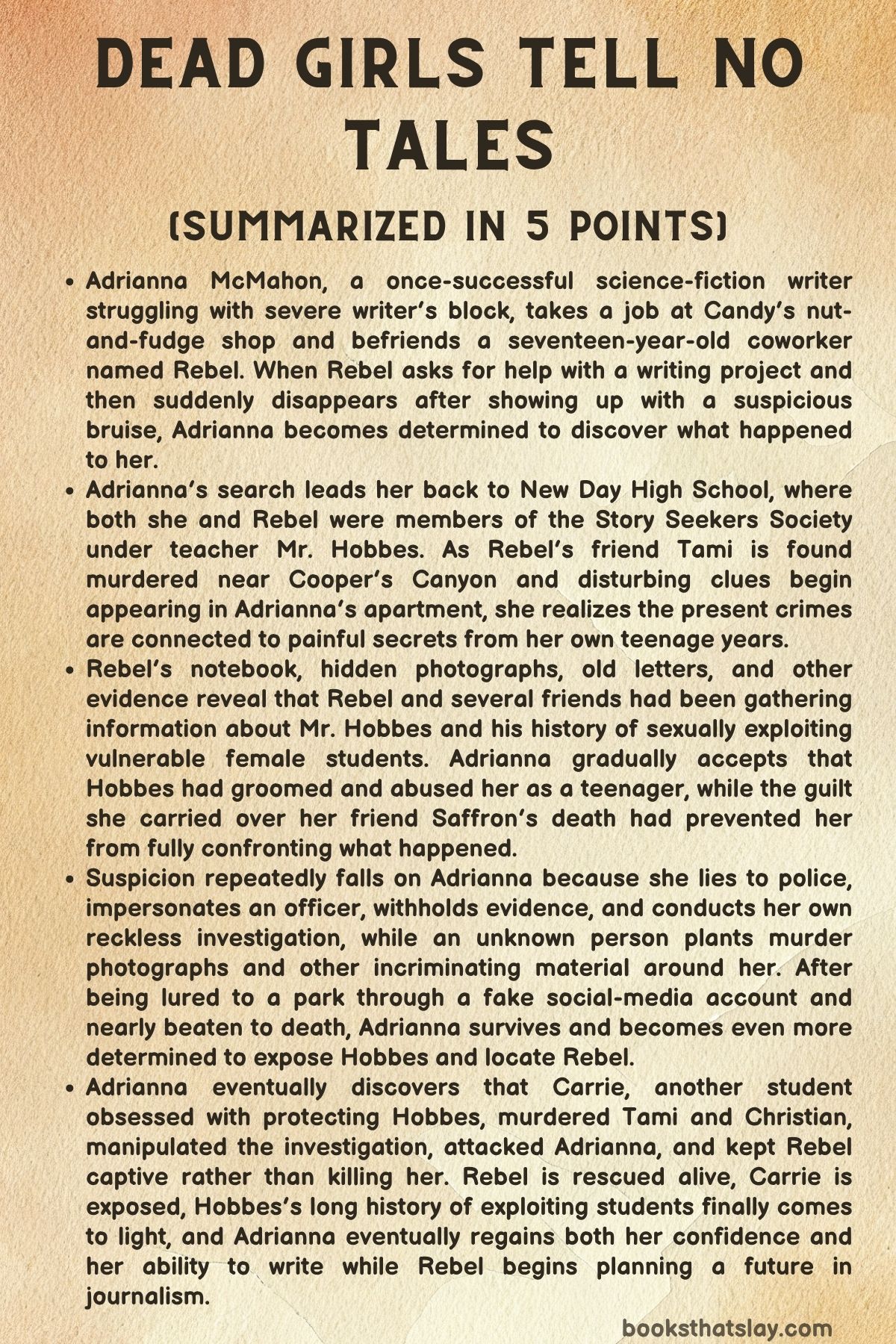
Summary
Adrianna McMahon is thirty-eight and struggling with severe writer’s block after building a career as a science-fiction novelist. She has published ten books and remains under contract for more, but the imagination that once supplied her with entire fictional worlds has stopped producing anything useful.
Her mother, Sarah, repeatedly urges her to find conventional employment, and Adrianna eventually accepts a poorly paid job at an old-fashioned nut-and-fudge shop owned by an eccentric woman named Candy. The work embarrasses her because it seems like evidence of how far her career has fallen, yet the unusual shop briefly gives her hope that interacting with new people might revive her creativity.
At Candy’s she meets Rebel, a seventeen-year-old employee whose real name is Jane James. Rebel is intelligent, observant, socially isolated, and strangely interested in Adrianna’s career as an author.
Rebel soon appears at Adrianna’s apartment with a purple notebook and claims she wants help entering a school writing contest. Although Adrianna doubts that she has anything worthwhile to teach while suffering from writer’s block herself, she reluctantly agrees to mentor the teenager.
Their lessons become increasingly unusual because Rebel asks questions about Adrianna but refuses to let her read the notebook. Adrianna nevertheless enjoys feeling useful again and gradually becomes attached to the girl.
The connection becomes more troubling when Adrianna learns that Rebel attends New Day High School, the same alternative school Adrianna attended during her difficult adolescence. Rebel also seems to know more about Adrianna’s past than she should.
Rebel’s mother, Michelle, eventually confronts Adrianna and angrily orders her to stop seeing the teenager. Although Adrianna understands why a mother might distrust an adult stranger spending time alone with her daughter, Michelle humiliates her by attacking her failed career and isolated lifestyle.
Shortly afterward, Rebel appears outside Adrianna’s apartment wearing heavy makeup that conceals a large bruise. She refuses to explain what happened but finally leaves the mysterious notebook with Adrianna before disappearing into the night.
Rebel then stops attending work. Adrianna becomes increasingly concerned and visits Michelle’s trailer, but nobody answers.
At the shop, Candy treats Rebel’s disappearance as an employment problem rather than a reason for alarm. Adrianna’s fear intensifies when news reports announce that the body of a young person has been discovered near Cooper’s Canyon.
Soon another mystery appears inside Adrianna’s own home. Someone types a strange passage on her computer involving the Whispering Sea, a location from one of her novels, and the message clearly comes from someone familiar with her fictional work.
News footage from Cooper’s Canyon shows a destroyed bicycle near the victim. Adrianna begins wondering whether the body belongs to Rebel and finally turns seriously toward the notebook the girl left behind.
Adrianna secretly contacts New Day High and pretends to be a police officer so she can obtain information. She learns that Rebel has been absent from school for nearly a week, confirming that her disappearance extends far beyond missing work.
Her unauthorized investigation leads to Rebel’s relatives and eventually to information about a group of teenagers associated with New Day’s Story Seekers Society. Rebel belonged to the group alongside Tami, Carrie, and Christian.
The discovery is disturbing because Adrianna belonged to the same writing organization as a teenager. It was run by Mr. Hobbes, a young teacher Adrianna once admired deeply.
Authorities eventually identify the body found at Cooper’s Canyon as Tamara “Tami” Levy. Rebel had told her mother she would be staying with Tami while Michelle attended a conference, meaning Rebel deliberately created a false explanation for her whereabouts shortly before Tami died.
Adrianna begins reading Rebel’s notebook carefully and realizes that sections appear to have been written by different people. Hidden messages refer directly to Adrianna and eventually mention Saffron Mulvaney, Adrianna’s teenage friend who died years earlier.
The name transforms the investigation because Rebel should have had no ordinary reason to know about Saffron. Additional pages describe fictionalized events involving a girl traveling toward Cooper’s Canyon while another person follows her with murderous jealousy, making the notebook seem disturbingly close to Tami’s actual death.
At Candy’s shop, Adrianna discovers a hidden cookie tin containing cigarettes, a key, an old newspaper clipping, and a folded letter connected to Saffron. Someone has preserved evidence from Adrianna’s adolescence and deliberately linked it to Rebel.
The police soon begin examining Adrianna herself. Detectives Dawson and McCabe know she impersonated an officer, secretly obtained Rebel’s information, and continued inserting herself into the disappearance.
Their suspicions worsen when they trace Rebel’s missing phone to Adrianna’s apartment. Adrianna had recovered the device but failed to surrender it immediately, creating another reason for investigators to question her motives.
The investigation forces Adrianna to remember Saffron’s death and the guilt she has carried ever since. Saffron died in a lake while Adrianna was present, and although Adrianna did not cause the death, she has spent years believing she failed her friend.
A second body is soon discovered near Cooper’s Canyon. While the victim remains unidentified, Adrianna becomes convinced that the violence surrounding Rebel and her friends must be connected to New Day.
Returning to the school revives memories of Mr. Hobbes. As a teenager, Adrianna considered him a mentor who treated her as talented and mature when she felt rejected by almost everyone else.
With adult perspective, she begins recognizing how he deliberately created emotional intimacy with vulnerable students and crossed sexual boundaries. What Adrianna once blamed herself for increasingly looks like calculated exploitation by an adult who understood exactly how much power he held.
Her private investigation becomes even more dangerous when someone breaks into her apartment. Nothing valuable is stolen, but her belongings are searched and a photograph of Tami’s murdered body appears on Adrianna’s computer.
The photograph had been placed there before Tami’s identity became public. Adrianna realizes someone connected directly to the murder has entered her home and is deliberately placing evidence around her.
Police process the apartment, but Adrianna remains under suspicion because of her earlier lies. Investigators even raise the possibility that Rebel herself could be responsible for the deaths.
Candy eventually fires Adrianna but gives her an army-green backpack Rebel supposedly left behind. Inside Adrianna finds photographs of Rebel, Tami, and Carrie apparently unconscious or drugged, along with an old photograph of Adrianna herself.
The discovery strongly points toward Mr. Hobbes and suggests that Rebel and her friends had been collecting evidence concerning his treatment of female students. A suspicious writing-contest flyer also confirms that Rebel’s original explanation for approaching Adrianna was based partly on something real.
Meanwhile, Adrianna’s relationship with Sarah briefly improves. Sarah admits that she has often failed to provide the emotional support Adrianna needed, and mother and daughter speak more openly about abandonment, family history, and the damage passed from one generation to another.
Adrianna soon discovers a hidden USB drive in her former apartment. At a public library, she opens it and finds photographs labeled “DeadGirl1” and “DeadGirl2,” the second showing dismembered human remains.
The discovery returns her to police custody. Investigators reveal that they cannot yet identify all the remains and ask a terrifying question about the missing victim’s head, making Adrianna fear that Rebel has been murdered and dismembered.
After her release, Adrianna becomes a subject of intense media speculation. Reporters and online amateur investigators portray her failed career, troubled teenage years, false statements, and relationship with Rebel as evidence that she might be involved in the killings.
Unexpectedly, being forbidden to write helps restore Adrianna’s creativity. She begins privately filling notebooks with thoughts about grief, rage, fear, and everything she has endured.
Her determination to find Rebel nevertheless remains stronger than her caution. Adrianna searches social media and contacts an account supposedly belonging to Christian, another member of the Story Seekers Society.
The person tells Adrianna that Rebel and the girls were preparing an exposé and claims to know who killed Tami and Rebel. Adrianna agrees to meet “Christian” at Brickston Park even though she realizes the meeting could be dangerous.
Someone wearing a mask attacks Adrianna with a baseball bat. She is beaten nearly to death and later found near Cooper’s Canyon, apparently moved there after the attacker believed she had died.
Adrianna survives and eventually regains consciousness in the hospital. She tells police about the supposed meeting with Christian and finally admits that Mr. Hobbes sexually exploited her when she was a teenage student.
The confession creates another conflict with Sarah. Instead of supporting Adrianna, Sarah reveals that she still partly blames her daughter for what happened with Hobbes, accusing her younger self of encouraging him.
Adrianna rejects her mother’s accusations and finally recognizes that she was a vulnerable teenager while Hobbes was the adult responsible for maintaining boundaries. Soon afterward, police discover that the “Christian Lorde” social-media account was fraudulent and had used stolen photographs.
The fake account was almost certainly created to lure Adrianna into the attack. Her suspicion of Mr. Hobbes continues growing, especially as she remembers how he once threatened her and Saffron with expulsion if they exposed his behavior.
Determined to obtain proof, Adrianna goes to Hobbes’s home and enters the apparently abandoned house. There she discovers evidence suggesting he may be preparing to leave, along with a concealed motorized bicycle and a strange upstairs room filled with girls’ clothing, makeup, lingerie, and dolls.
Among the dolls Adrianna sees what appears to be Rebel’s severed head. Because the second corpse discovered by police was missing its head, Adrianna initially believes she has found confirmation that Rebel was murdered.
Then Carrie appears and reveals the truth. She is the person responsible for the killings and much of the campaign to manipulate Adrianna.
Rebel, Tami, Christian, and others had been collecting evidence against Hobbes. They intended to reveal his exploitation of teenage girls, including photographs and accounts connected to former students such as Adrianna and Saffron.
Carrie, however, is obsessively devoted to Hobbes. She refuses to see his behavior as abuse and believes the girls themselves are responsible for attracting his attention.
To protect him, Carrie killed Tami and Christian, manipulated Adrianna through false messages, planted evidence, and attempted to murder her. Rebel was not dead at all; Carrie had kidnapped her and kept her drugged and hidden beneath the dolls.
Carrie points a gun at Adrianna and intends to stage her death as suicide, but the weapon fails to fire. Adrianna attacks her, knocks the gun away, and beats Carrie unconscious before confirming that Rebel still has a faint pulse.
Mr. Hobbes then appears and tries to portray himself as another victim of Carrie. He insists that Carrie acted independently and that he feared her obsession.
Adrianna refuses to accept his attempt to separate himself completely from what happened. Carrie committed the murders, but Hobbes spent years exploiting vulnerable students, teaching them to confuse manipulation with affection and creating the circumstances in which Carrie’s dangerous fixation developed.
Adrianna refuses to kill Hobbes despite having the opportunity. Instead, she tells him that the truth will finally become public and that his ability to control the narrative is ending.
Detective Dawson arrives and takes control of the scene. Carrie is found unconscious, Hobbes is detained, and emergency workers rush to save Rebel.
Adrianna crawls back upstairs and lies beside Rebel until help arrives, refusing to let her face the ordeal alone. Unlike the tragedy involving Saffron years earlier, Adrianna has reached someone in time.
Rebel ultimately survives and later turns eighteen. She begins preparing for college and considers becoming a journalist so she can expose real wrongdoing rather than concentrate on fiction.
Adrianna also rebuilds her future. Her writer’s block disappears, and a new fictional manuscript receives an offer, allowing her to reclaim writing without turning the murders into entertainment.
The truth about Hobbes’s long pattern of exploitation finally becomes impossible to dismiss. Carrie remains responsible for the murders, but the story also exposes the damage caused by adults and institutions that ignored warning signs, blamed vulnerable girls, or protected respected authority figures.
Adrianna cannot undo Saffron’s death or erase what happened during her own adolescence. By the end, however, she no longer treats silence, guilt, and other people’s judgments as the forces that determine who she is.
Characters
Adrianna McMahon
Adrianna is the emotional and narrative center of Dead Girls Tell No Tales, beginning as a thirty-eight-year-old novelist who believes the most important part of herself has disappeared. Her writer’s block is not simply a professional inconvenience; it has stripped away the identity through which she once transformed pain, imagination, and observation into something she could control.
Her decision to work at Candy’s exposes how deeply ashamed she feels about the collapse of her career, yet the job also creates the relationship that changes her life. Rebel initially gives Adrianna a chance to feel knowledgeable and useful again, but the teenager soon awakens a much stronger protective instinct.
Adrianna is impulsive and repeatedly makes dangerous choices. She impersonates a police officer, lies to detectives and Rebel’s family, withholds evidence, trespasses, investigates crime scenes, communicates secretly with strangers online, and eventually enters Hobbes’s home alone.
These actions make her an imperfect investigator rather than a conventionally heroic one. Her fear of authorities partly comes from being treated suspiciously after Saffron’s death, while her obsession with saving Rebel grows from the unresolved belief that she once failed someone she loved.
Adrianna’s greatest development occurs in the way she reinterprets her own adolescence. She spent years believing that because she admired Hobbes, approached him willingly, or participated in moments of intimacy, she bore responsibility for the relationship.
As the investigation progresses, she recognizes the imbalance that her teenage self could not fully understand. Hobbes was the adult, the teacher, and the person responsible for boundaries, while Adrianna was a vulnerable student desperate for approval.
Her relationship with Sarah reveals another part of her struggle. Adrianna wants love without judgment, yet her mother continually tries to manage her life through criticism, leaving Adrianna feeling that her worth depends on professional success and respectable behavior.
The final confrontation allows Adrianna to make a different choice from the people who harmed her. She has the opportunity to respond to Hobbes with violence but instead chooses exposure, survival, and truth, which shows how far she has moved beyond the powerless teenager she once was.
Her renewed ability to write also completes an important personal arc. Creativity returns only after Adrianna stops treating writing as a performance demanded by publishers and begins using language honestly again, allowing her to reclaim authorship over both fiction and her own identity.
Rebel / Jane James
Rebel is the teenager whose disappearance drives most of Dead Girls Tell No Tales, but she is never merely a missing person waiting to be rescued. From her first appearance, she is observant, secretive, stubborn, intelligent, and capable of recognizing qualities in Adrianna that Adrianna herself has stopped valuing.
Her decision to seek Adrianna’s help is more complicated than the supposed writing contest initially suggests. Rebel knows about Adrianna’s history at New Day and understands that the older woman has a connection to the same system Rebel and her friends are attempting to expose.
The nickname “Rebel” reflects her resistance to being defined by other people. Her difficult family circumstances, isolation at school, unusual appearance, and independent behavior make her seem vulnerable, yet she repeatedly takes risks because she refuses to remain passive when she discovers wrongdoing.
Her notebook becomes one of her most important methods of communication. Rather than simply telling Adrianna what is happening, she leaves a trail that combines writing, hidden references, historical connections, and evidence, trusting that Adrianna will eventually recognize the pattern.
Rebel also functions as a younger parallel to Adrianna. Both attended New Day, both were intelligent girls who did not fit comfortably into conventional expectations, and both came into contact with a teacher who knew how to exploit students seeking acceptance.
The crucial difference is that Rebel and her friends attempt to document and expose the misconduct. Their effort shows a younger generation trying to break the silence that surrounded Adrianna and Saffron.
Rebel’s captivity makes her apparent independence tragically vulnerable. Carrie’s attack demonstrates that courage does not guarantee safety, especially when young people confront wrongdoing without reliable adult protection.
Her survival is therefore essential to the conclusion. By applying to college and considering journalism, Rebel refuses to let victimization become the defining fact of her future, and her continuing bond with Adrianna turns their early teacher-student arrangement into a relationship based on mutual loyalty and respect.
Carrie
Carrie is the central murderer in Dead Girls Tell No Tales and one of the most disturbing characters because her violence grows from an obsessive interpretation of exploitation as love. She sees Mr. Hobbes not as an adult abusing his authority but as a misunderstood man who deserves protection from the girls accusing him.
Her loyalty depends on denying the unequal power between a teacher and teenage students. Whenever Rebel, Tami, Christian, or Adrianna identifies Hobbes’s behavior as abusive, Carrie treats the girls as threats rather than reconsidering the man she idolizes.
That distorted belief becomes lethal once Rebel and the others begin gathering evidence. Carrie murders Tami, kills Christian when she becomes dangerous to the secret, kidnaps Rebel, creates false online identities, plants evidence, invades Adrianna’s home, and nearly beats Adrianna to death.
Carrie is also highly manipulative. She understands how suspicious Adrianna already appears and repeatedly places information where it can either frighten her or make investigators believe she is connected to the murders.
Her treatment of Rebel is especially revealing. Keeping Rebel alive while hiding and drugging her suggests that Carrie wants control as much as she wants silence, transforming another girl into an object within the fantasy world she has created around Hobbes.
Carrie remains fully responsible for her crimes. At the same time, the novel places her obsession within an environment where predatory behavior has repeatedly been excused and where girls are encouraged to interpret adult attention as proof that they are unusually mature or special.
Her final confrontation with Adrianna exposes the complete moral collapse of that belief system. Even when directly confronted with the suffering Hobbes caused, Carrie remains committed to protecting him, showing how thoroughly she has built her identity around an abusive relationship.
Mr. Hobbes
Mr. Hobbes represents a different kind of danger in Dead Girls Tell No Tales because he does not need to commit the murders himself to cause enormous damage. His power comes from authority, charm, social respectability, and his ability to recognize insecurity in the students placed under his supervision.
When Adrianna was young, Hobbes presented himself as the rare adult who truly appreciated her imagination. By giving her private attention and treating her as unusually mature, he converted mentorship into emotional dependence before crossing sexual boundaries.
His methods also rely on transferring responsibility to the girls. When Saffron discovers what is happening, Hobbes responds with threats and suggests that troubled students will never be believed over a respected teacher.
That strategy leaves Adrianna carrying shame for decades. She remembers moments when she initiated affection and interprets them as proof of her own responsibility until adulthood allows her to understand that consent cannot erase the teacher’s duty to maintain professional boundaries.
Evidence from Rebel’s generation shows that Hobbes continued similar patterns. Photographs, private meetings, the Story Seekers Society, and the girls’ planned exposé suggest that his behavior was not an isolated event from Adrianna’s adolescence.
His response after Carrie is exposed also demonstrates his instinct for self-preservation. Rather than accept responsibility for influencing her obsession, he immediately presents himself as another frightened victim and separates his misconduct from her crimes.
The distinction is partly true because Carrie alone chooses murder. Yet Hobbes’s insistence that this absolves him ignores the long history of manipulation that created loyalty, secrecy, rivalry, and shame around vulnerable students.
Adrianna’s refusal to kill him is therefore important. She chooses to expose what he did and force him to face consequences rather than allowing him to turn another violent event into evidence that he is somehow the injured party.
Sarah McMahon
Sarah is one of the most complicated family figures in Dead Girls Tell No Tales because her relationship with Adrianna contains real attachment alongside persistent emotional harm. She worries about her daughter’s finances, career, safety, and future, but usually expresses that worry through criticism and attempts to control Adrianna’s choices.
At first, Sarah appears primarily as the voice telling Adrianna that writing has failed and that she needs a normal job. Because Adrianna already feels ashamed of her stalled career, these comments strengthen her belief that love and respect must be earned through success.
Their relationship becomes more sympathetic when Sarah admits that she fears she failed Adrianna and explains that she herself grew up with a cruel mother. Her confession reveals a generational pattern in which one person may reject certain forms of abuse while unconsciously repeating others.
The moment when Sarah comforts Adrianna after the break-in briefly gives them the closeness Adrianna has wanted for years. Sarah’s fear of losing her daughter strips away the judgment that normally dominates their conversations.
That reconciliation collapses when Adrianna reveals the truth about Hobbes. Sarah responds by blaming her teenage daughter, describing her as sexually irresponsible and suggesting that protecting Hobbes’s reputation once seemed more important than recognizing what happened to Adrianna.
The reaction clarifies why Adrianna internalized so much shame. She was not simply manipulated by a teacher; she also lacked a parent willing to tell her unequivocally that the adult had violated his responsibility.
Sarah is therefore neither a simple villain nor an uncomplicated source of comfort. She loves Adrianna but has beliefs and unresolved wounds that repeatedly prevent her from providing the kind of protection and validation her daughter needs.
Saffron Mulvaney
Saffron is absent from the present-day action, yet her death influences nearly every important choice Adrianna makes. She was Adrianna’s friend at New Day, knew about Hobbes’s relationship with her, and became connected to the secrecy and threats surrounding him.
For years Adrianna has treated Saffron’s death as proof of personal failure. Because she could not save her friend, every new disappearance activates an old fear that she will once again stand nearby while someone vulnerable is destroyed.
Saffron also connects the past to the present through letters, newspaper clippings, and the evidence Rebel uncovers. Her history demonstrates that the danger surrounding Hobbes existed long before Rebel’s generation began investigating him.
Within Dead Girls Tell No Tales, Saffron represents the cost of silence that survives long after an event is officially over. Adrianna cannot bring her back, but understanding the circumstances around Hobbes allows her to stop interpreting the entire tragedy solely as a personal moral failure.
Saffron’s memory is also essential to Adrianna’s determination to stay beside Rebel after the final rescue. Saving Rebel cannot reverse what happened years earlier, but it allows Adrianna to respond differently when another young woman needs someone to remain present.
Tami Levy
Tami initially enters the story through her death, making it easy for other characters and the media to reduce her to a murder victim. Adrianna’s visit to the memorial at New Day challenges that reduction by confronting her with photographs of Tami as a child, friend, student, and individual with an entire life beyond the crime.
Her murder becomes the first undeniable evidence that the girls’ investigation has become deadly. Carrie strikes Tami with a vehicle and then strangles her, showing that the killing is deliberate rather than the result of an accident.
Tami’s connection to Rebel is particularly important because Rebel had told Michelle she planned to stay with her. That lie initially creates suspicion around Rebel, but later it becomes clear that the girls were operating within a dangerous effort to expose Hobbes.
Tami’s death also reveals the consequences of leaving young people to confront predatory adults largely on their own. She and her friends gather evidence and pursue the truth, but they lack the institutional protection that should have existed before they were ever required to investigate a teacher themselves.
Christian
Christian is initially presented as another member of Rebel’s circle and one of the young people associated with the Story Seekers Society. For much of the mystery, Adrianna believes Christian may still be alive and capable of explaining what the girls discovered.
The fake social-media account using Christian’s identity becomes one of Carrie’s most effective manipulations. By pretending to be Christian and promising information about the killer, Carrie exploits Adrianna’s desperation and successfully lures her into an ambush.
The eventual revelation that Carrie actually murdered Christian adds another layer to the deception. Christian becomes both a victim and a stolen identity that Carrie uses to create false hope.
Her fate shows how thoroughly Carrie attempts to erase anyone involved in exposing Hobbes. Christian’s death also demonstrates that the girls’ project was not merely school gossip or teenage rebellion; they were collecting information dangerous enough to provoke repeated acts of violence.
Detective Dawson
Detective Dawson initially approaches Adrianna with understandable suspicion. Adrianna has impersonated a police officer, lied about evidence, entered places without permission, obtained confidential information, and repeatedly placed herself near important parts of the investigation.
Despite that suspicion, Dawson is generally more willing than McCabe to consider that Adrianna may be frightened rather than guilty. She continues investigating competing possibilities and eventually takes Adrianna’s allegations against Hobbes seriously.
Dawson’s visit while Adrianna is unconscious also reveals a degree of humanity beneath her professional role. Speaking to Adrianna even when she cannot respond suggests that Dawson understands she may have become another intended victim rather than the perpetrator police once considered possible.
Her arrival at Hobbes’s house provides an important final transfer of responsibility. Adrianna has spent much of the novel acting as though she alone must solve the case, but Dawson’s appearance means trained authorities can finally take control and protect Rebel.
Detective McCabe
McCabe is more confrontational than Dawson and frequently emphasizes how suspicious Adrianna’s actions appear. His skepticism is not baseless because Adrianna repeatedly withholds evidence and makes choices that would alarm any investigator.
His questioning forces Adrianna to see herself from an outsider’s perspective. An isolated adult secretly spending time with a teenager, tracking her family, impersonating police, carrying her phone, and appearing near crime scenes can easily be interpreted differently from how Adrianna understands her own motives.
McCabe can therefore feel antagonistic without functioning as a true villain. His role illustrates how Adrianna’s desperation repeatedly damages her credibility and complicates the legitimate investigation.
The disturbing question he asks about Rebel’s missing head also demonstrates how bluntly law enforcement must sometimes confront possibilities Adrianna emotionally resists. Although the assumption proves incorrect, it forces her to recognize how serious Rebel’s situation has become.
Michelle James
Michelle is introduced in an intentionally hostile manner when she discovers that her daughter has been visiting Adrianna’s apartment. Her suspicion is initially reasonable because a parent has legitimate cause to question an unexplained relationship between a teenager and an unrelated adult.
The cruelty with which she expresses that concern, however, deeply affects Adrianna. Michelle attacks her career, home, maturity, and lifestyle, transforming a parental boundary into a personal humiliation.
Later developments complicate Adrianna’s early fear that Michelle may have harmed Rebel. The bruise, secrecy, and unstable family situation make Michelle seem suspicious, yet her public distress over Rebel’s disappearance appears genuine.
Michelle therefore contributes to the novel’s repeated warning against relying on appearances. Her poor relationship with Rebel and aggressive personality make her easy to suspect, but neither quality makes her responsible for the crimes.
Ronnie James
Ronnie, Rebel’s father, appears less frequently but becomes part of Adrianna’s effort to understand where Rebel could have gone. The fact that neither he nor Michelle knows her true whereabouts highlights how successfully Rebel created a false plan before disappearing.
His insistence that Rebel is alive and incapable of murdering Tami gives voice to the family’s hope while police consider increasingly disturbing possibilities. His role also shows how quickly missing teenagers can become suspects when incomplete evidence is arranged against them.
Rocky
Rocky, Rebel’s uncle, becomes another family connection Adrianna approaches through deception. Their early interaction demonstrates the growing recklessness of Adrianna’s investigation, because she keeps inventing roles for herself in order to obtain information.
Later, Rocky confronts her about those lies but also admits his belief that authorities may be giving up on Rebel. That shared concern creates a limited understanding between them.
Rocky helps demonstrate why Adrianna continues investigating even after being warned to stop. Her methods are dangerous and often wrong, but the fear that Rebel may be forgotten continually pushes her forward.
Aunt Gina
Aunt Gina provides a form of acceptance that Adrianna rarely receives from Sarah. Her home near the lake is connected to painful memories of Saffron, yet Gina herself gives Adrianna warmth without demanding that she justify her career, personality, or life choices.
She also reveals that Adrianna’s father wrote stories and poems when he was younger. The information complicates Adrianna’s understanding of a man she has largely defined through abandonment.
Gina’s role is relatively quiet, but she reconnects Adrianna with the imaginative child she once was. Her presence reminds Adrianna that writing existed before contracts, deadlines, reviews, and professional failure turned creativity into a source of fear.
Candy
Candy is eccentric, secretive, and often emotionally detached from the people working for her. Her shop becomes the unlikely setting where Adrianna meets Rebel and where several important pieces of evidence are later discovered.
Her reaction to Rebel’s disappearance initially seems disturbing because she focuses on staffing rather than the teenager’s safety. Later, her failure to turn Rebel’s backpack over to police reinforces her careless approach to serious situations.
Candy nevertheless functions more as an irresponsible employer than as part of the central conspiracy. Her shop creates an atmosphere of oddness that initially makes almost everyone seem potentially suspicious, while the real danger remains connected to New Day and the girls’ investigation.
Themes
Silence, Disclosure, and the Cost of Hidden Truth
Silence operates as both protection and danger throughout Dead Girls Tell No Tales. Adrianna remains quiet about Hobbes for decades because shame, fear, institutional pressure, and her own uncertainty convince her that speaking would only expose her to more judgment.
That silence never actually resolves what happened. Instead, it allows Adrianna’s self-blame to continue while Hobbes remains respected and gains access to another generation of vulnerable students.
Rebel and her friends represent a direct challenge to that pattern. They collect photographs, personal histories, and evidence because they understand that individual accusations are easy to dismiss while documented patterns are harder to ignore.
Their decision to expose Hobbes is courageous, but the novel refuses to pretend that telling the truth is automatically safe. Tami and Christian are murdered, Rebel is kidnapped, and Adrianna is nearly killed because Carrie becomes determined to preserve the secret.
The story also distinguishes between disclosure and control over disclosure. Carrie repeatedly reveals information in distorted ways, using photographs, false identities, planted evidence, and anonymous messages not to clarify the truth but to manipulate how others interpret it.
Adrianna’s final willingness to identify Hobbes publicly represents a different kind of disclosure. She no longer speaks because someone has forced her into a defensive position; she speaks because she has decided that silence should not continue protecting the adult who harmed her.
The theme ultimately presents truth as necessary but costly. Speaking cannot restore Saffron, Tami, or Christian, yet continued silence would allow the same conditions to survive and place more young people at risk.
Grooming, Power, and Misplaced Responsibility
The relationship between Hobbes and his students examines how exploitation can be disguised as recognition, mentorship, romance, or special attention. Hobbes targets young people who feel misunderstood and gives them the emotional validation they are missing elsewhere.
Adrianna’s teenage memories show why this method is effective. She does not initially experience herself as powerless because she sometimes seeks Hobbes’s affection, participates willingly, and believes their connection proves she is unusually mature.
Her adult perspective exposes the flaw in that reasoning. The responsibility for maintaining boundaries belonged to Hobbes because he was the teacher, the adult, and the person with institutional authority.
Sarah’s reaction demonstrates how easily responsibility can be shifted onto the younger person. By criticizing Adrianna’s behavior rather than Hobbes’s choices, she reinforces the same shame that allowed Adrianna to remain silent for years.
Carrie represents an even more destructive version of this belief. She interprets Hobbes’s attention as evidence that girls compete for his love and therefore views his accusers as jealous participants rather than exploited students.
The contrast between Carrie and Adrianna becomes essential. Both become emotionally affected by Hobbes, but Adrianna eventually recognizes the power imbalance while Carrie protects the fantasy so aggressively that she destroys anyone threatening it.
The novel therefore treats grooming as a process that changes how victims and observers understand responsibility. Harm continues when an adult’s authority is ignored and children are treated as though they possessed equal power within relationships they were never equipped to control.
Guilt, Trauma, and Reinterpreting the Past
Adrianna has spent much of her adult life interpreting painful events through personal failure. Her stalled career confirms that she is unsuccessful, Saffron’s death confirms that she cannot save people, her relationship with Hobbes confirms that she behaved badly, and her father’s abandonment reinforces the belief that people eventually leave her.
The investigation forces these assumptions back into the open. Rebel’s disappearance resembles another possible failure, while evidence connected to Saffron makes it impossible for Adrianna to keep the past separated from the present.
Her memories change as she acquires an adult understanding of situations she originally experienced as a teenager. She begins distinguishing between actions she actually controlled and responsibilities that belonged to adults around her.
This does not erase guilt automatically. Adrianna still regrets choices, including her secrecy, her reckless investigation, and moments when fear prevented her from acting differently.
What changes is her belief that regret must become permanent self-condemnation. She starts recognizing that surviving a painful event does not make her responsible for every consequence that followed it.
The same transformation appears in her determination to save Rebel. At first, she partly treats rescuing the girl as a way to correct what happened with Saffron, as though one successful rescue could repay an old emotional debt.
By the end, Adrianna understands that the past cannot be rewritten. Saving Rebel matters because Rebel is alive and deserves a future, not because her survival can cancel another person’s death.
Storytelling, Identity, and Reclaiming Control
Writing begins as evidence of Adrianna’s failure and ends as evidence that she has regained control over herself. At the beginning of Dead Girls Tell No Tales, the blank page represents professional decline, financial fear, and the disappearance of the identity Adrianna built as a novelist.
Her inability to write is closely connected to avoidance. She has spent years constructing fictional worlds while leaving important parts of her own history emotionally untouched, and once her creativity stops functioning, she no longer has that familiar place of escape.
Rebel brings storytelling back into Adrianna’s life in an unexpected form. The notebook is not simply creative work; it becomes a coded record through which facts, warnings, memories, and accusations can be communicated.
Carrie also uses storytelling, but destructively. She creates false identities, manipulates evidence, stages scenes, and attempts to construct a version of events in which Adrianna becomes either the murderer or another apparent suicide.
The media repeats the same process by arranging true facts about Adrianna into a misleading narrative. Her writer’s block, history at New Day, unusual friendship with Rebel, lies to police, and presence near crime scenes can all be made to resemble evidence of guilt when removed from their proper context.
Adrianna’s return to writing therefore carries more meaning than professional recovery. She starts writing privately when others tell her not to, allowing language to become something she controls rather than something demanded by publishers, investigators, journalists, or killers.
Her new manuscript is fiction rather than a commercial retelling of the murders. That decision allows Adrianna to remain an author without surrendering ownership of traumatic events to public curiosity, and it affirms that neither Carrie’s crimes nor Hobbes’s abuse gets to determine the story she tells next.