Death Card Summary, Characters and Themes
Death Card by Jasmine Smith is a paranormal fantasy centered on Mikaela Broussard, a young Black witch in New Orleans who is expected to inherit leadership of her coven before she believes she is ready.
Her struggle becomes far more dangerous when witches begin losing their magic to a demonic force and a tarot vision shows Mikaela being killed by Joelle Murphy, a young woman she is falling for. The book combines family grief, inherited responsibility, romance, supernatural mystery, coven politics, and questions about whether fate can be changed, with Mikaela’s growing power and confidence at the center of the story.
Summary
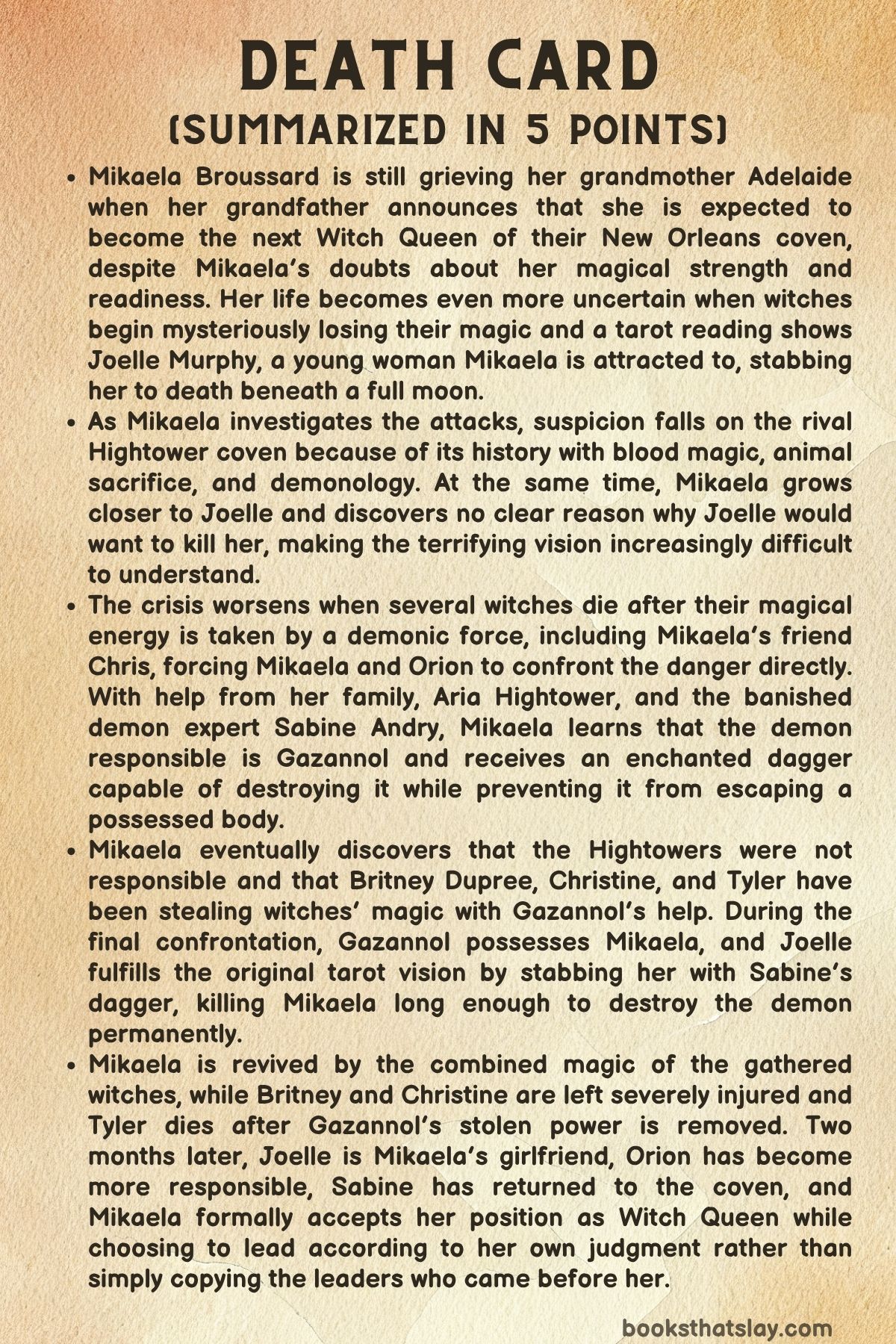
Mikaela Broussard has spent the year since her grandmother Adelaide’s death struggling with grief and uncertainty about her own magical abilities. Adelaide had been the Witch Queen of their New Orleans coven, while Mikaela’s grandfather Ezekiel now carries many responsibilities that Adelaide once handled and her twin brother Orion increasingly copes with loss through drinking, partying, and avoiding his family.
The family’s troubles become more serious when Theresa arrives with her daughter Marian, who has developed glowing veins, strangely colored eyes, and a dark magical presence inside her. Mikaela and Gramps manage to save Marian through healing magic, but afterward the child’s magical spark has completely disappeared, leaving her apparently mortal despite the belief that a witch’s magic cannot simply vanish.
Soon afterward, Gramps publicly announces that Mikaela will eventually inherit Adelaide’s position as Witch Queen. Members of the coven immediately question the decision because Mikaela is young, inexperienced, and strongest in divination rather than the broad range of magic traditionally associated with leadership.
Mikaela herself shares many of those doubts and even admits that she may not want the position. Gramps nevertheless insists that leadership belongs to her family line and begins preparing her for a future she has not chosen for herself.
At Zeke’s, the family occult shop, Mikaela meets Joelle Murphy, an attractive young woman applying for work. During a tarot reading for Joelle, Mikaela touches the Death card and experiences a terrifying vision in which Joelle drives a blade into Mikaela’s chest beneath a full moon.
Mikaela believes genuine visions reveal events that fate has already decided, so the experience convinces her that Joelle will eventually murder her. Gramps takes the vision seriously but unexpectedly hires Joelle anyway, reasoning that keeping her nearby will give Mikaela a chance to discover why the killing happens and perhaps prevent it.
The mysterious magical illness meanwhile claims another victim when James Peterson dies after displaying the same symptoms as Marian. His magical presence disappears, and a strange mark is found on his forehead, leading Mikaela to theorize that someone is not merely destroying witches’ magic but taking it.
Suspicion falls on the Hightowers, a rival magical family with a history of blood magic and ritual sacrifice. Mikaela’s investigation eventually brings her to the Hightowers’ hidden shop and residence, where she overhears Gloria Hightower discussing animal sacrifice and making threatening comments about the Broussard family.
At the same time, Mikaela becomes increasingly close to Joelle. What begins partly as an investigation develops into genuine romantic attraction as Mikaela learns that Joelle is preparing to attend Tulane, has long been fascinated by witchcraft, and desperately wishes magic were real because her mother has multiple sclerosis.
Mikaela secretly reads Joelle’s thoughts and discovers love for her mother and attraction toward Mikaela but no plan to commit murder. Instead of clarifying the vision, their growing intimacy makes Mikaela more confused because the woman she knows seems very different from the killer she saw in the cards.
The magical attacks become unmistakably connected to demons when Gramps reveals that the mark found on James is demonic. Mikaela is furious to learn that Adelaide and the Elders intentionally removed demonology from the coven’s records, believing younger witches would be safer without such knowledge, because their secrecy has left the current generation poorly prepared to confront the threat.
Searching for answers, Mikaela steals a demonology book from the Hightowers and clashes repeatedly with Aria Hightower, the family’s young heir. Although Mikaela initially assumes Aria is involved in the attacks, Aria consistently denies responsibility and gradually reveals enough uncertainty about her grandmother’s practices to make Mikaela question whether the Hightowers are truly behind the killings.
The crisis becomes personal when Chris suddenly develops glowing veins and altered eyes during a party. Mikaela and Orion try to heal him, but the dark force inside him overpowers their combined efforts and Chris dies with the demonic mark on his forehead.
His death devastates their friends and finally forces Orion to confront the danger rather than hiding from it. The Broussards and Hightowers later come close to open magical conflict, but Mikaela intervenes and prevents a battle that could devastate New Orleans.
Mikaela then succeeds in contacting the spirit of her mother, Arielle, who reassures her that she is more capable than she believes and cryptically tells her that “the girl is the beginning and the end.” Mikaela cannot determine whether the warning refers to Joelle or Aria, but communicating with the dead proves that abilities she once considered weak are developing rapidly.
Her investigation into the demonology book identifies the enemy as Gazannol, a powerful demon associated with deception and destruction. Aunt Roberta sends Mikaela and Orion to Sabine Andry, a relative whom Adelaide banished years earlier after discovering her demon research.
Sabine explains that Gazannol can be summoned even by mortals and that possession may allow it to remain in the physical world. She gives Mikaela an enchanted dagger capable of killing a possessed host while preventing the demon from escaping into another body.
The weapon horrifies Mikaela because it closely resembles the blade from her death vision. Soon afterward, she notices that Mike Dupree, Gramps’s political opponent, wears a maroon family crest resembling the symbol Mikaela previously saw while scrying, and she discovers that Gloria Hightower appears on a list of his campaign donors.
On Mikaela and Orion’s eighteenth birthday, the enemy launches a mass attack through contaminated food, infecting numerous members of the coven and killing five people. Mikaela helps save Aunt Roberta and then openly takes control of the response, presenting Sabine’s dagger to the Council and refusing to continue operating under the older generation’s secrecy.
Gramps finally recognizes that he has been claiming to prepare Mikaela for leadership while repeatedly preventing her from actually exercising authority. He yields greater control to her, and Mikaela organizes a plan to confront the Hightowers and summon Gazannol for answers.
On the night of the full moon, Mikaela captures Aria and forces her to assist with the summoning. Gazannol appears but mocks Mikaela for focusing on the wrong family, revealing that mortals summoned it and that Orion and Joelle are now captives.
Mikaela realizes the maroon crest she saw belonged not to the Hightowers but to the Duprees. She also connects the repeated attacks with baked goods supplied at campaign-related events and concludes that demonic material was placed in food so witches’ magical energy could be stolen.
Following Gazannol’s coordinates, Mikaela reaches the forest clearing from her visions and finds Orion and Joelle tied to trees. The attackers are revealed as Britney Dupree, Christine, and Tyler, three mortals who have been using stolen magical power.
Britney’s resentment began years earlier after seeing Mikaela use magic and intensified through academic rivalry, jealousy, and hostility toward the Broussards. She and her accomplices believe Gazannol can permanently grant them magical power, but they fail to understand that the demon has been manipulating them and intends to use Mikaela as a far more powerful host.
Britney threatens Joelle’s life unless Mikaela voluntarily enters the summoning circle. Recognizing that the full-moon scene now matches her vision, Mikaela understands that avoiding the moment was never the true solution; instead, the meaning of the Death card involves transformation as much as physical death.
Mikaela allows Gazannol to possess her in order to save Orion and Joelle. The demon gains control of her body and steps outside the summoning circle, revealing that it never intended to reward Britney, Christine, or Tyler and instead plans destruction on a far greater scale.
Mikaela realizes that her mortal body is Gazannol’s remaining weakness. Orion understands that Sabine’s dagger must be used, but Joelle ultimately takes it and drives the blade into Mikaela’s chest, exactly fulfilling the death vision from their first meeting.
Mikaela dies, and because of the dagger’s enchantment, Gazannol dies with her rather than escaping into another host. Mikaela briefly reaches the ancestral plane and encounters Gran and her mother, but Adelaide tells her that her life is not finished.
The combined power of the Broussard witches and their allies revives Mikaela after several minutes. Tyler dies, Britney and Christine are left severely injured, and Mikaela refuses vengeance, choosing instead to leave them to ordinary authorities.
Her sacrifice establishes her authority within the coven, while her relationship with Aria opens the possibility of peace between their families. Joelle is devastated by having killed Mikaela, but Mikaela understands that Joelle’s action saved everyone, and the two finally acknowledge their feelings for each other.
Two months later, Mikaela is preparing for her formal ascension as Witch Queen. Joelle is her girlfriend and knows the truth about magic, Orion has become a capable manager of Zeke’s, Sabine has returned to the coven, and Mikaela intends to apply to college rather than allowing leadership or grief to define the limits of her future.
During the ceremony, the coven formally accepts Mikaela as its Witch Queen. She honors the women who came before her without pretending that they were incapable of mistakes, promising to protect her people while making decisions according to her own judgment and allowing herself to learn from failure.
Characters
Mikaela Broussard
Mikaela is the central character of Death Card, and her development is built around the difference between possessing power and believing herself worthy of using it. At the beginning of the book, she judges herself largely through comparison with Adelaide, interpreting every difficulty with elemental magic or glamour as proof that she is too weak to become Witch Queen.
Her divination, intuition, healing ability, ancestral communication, mental magic, and increasingly powerful glamours gradually reveal that the problem is not an absence of ability but an identity shaped by grief and self-doubt. Her greatest development occurs when she stops waiting for Gramps or the Council to define what leadership should look like and begins making decisions herself.
Mikaela’s death vision also tests her relationship with control. She spends much of the story trying to escape a future she believes is fixed, only to discover that knowing an event will occur does not mean understanding its meaning.
Her willingness to accept possession by Gazannol is therefore both an act of sacrifice and the moment she fully claims authority over her own choices. She cannot prevent Joelle from stabbing her, but she determines why that act happens and transforms an apparent murder into the means of defeating the demon.
Orion Broussard
Orion serves as both Mikaela’s twin and one of the clearest examples of grief expressed through avoidance in Death Card. After Adelaide dies, he retreats into alcohol, parties, romantic distractions, and physical absence because remaining emotionally available would force him to confront how afraid he is of losing another family member.
His unreliability frustrates Mikaela because she needs his support precisely when he is least capable of offering it. Yet his behavior is not rooted in indifference; his confession reveals that Mikaela’s death vision terrifies him so deeply that emotional distance becomes a form of self-protection.
Chris’s death changes Orion by giving him an immediate enemy against which he can act. He becomes more dependable, accompanies Mikaela to investigate Sabine and the Hightowers, helps during magical emergencies, protects Joelle, and gradually accepts that fear cannot justify abandoning the people he loves.
By the ending, Orion has also developed an identity outside his sister’s story. His successful management of Zeke’s and his relationship with Andrew suggest a future in which responsibility does not have to resemble the path chosen for Mikaela.
Joelle Murphy
Joelle initially appears to be the greatest threat in Death Card because Mikaela literally sees her driving a blade into her chest. The power of Joelle’s characterization comes from the growing contradiction between that image and the person Mikaela actually gets to know.
She is intelligent, curious, ambitious, and deeply interested in Black history, anthropology, religion, and witchcraft. Her fascination with magic becomes more emotionally complicated because her mother’s multiple sclerosis makes the idea of supernatural healing personally meaningful rather than merely academic.
Joelle’s willingness to do anything for her mother occasionally makes Mikaela wonder whether desperation could turn her dangerous, while Joelle’s lie about previously experimenting with magic gives Mikaela additional reasons for suspicion. Nevertheless, her actions consistently show affection rather than malice toward Mikaela.
Her final act fulfills the death vision without making its apparent meaning true. Joelle stabs Mikaela because doing so is the only way to kill Gazannol, making her both the person who seemingly causes Mikaela’s death and one of the people most responsible for saving her.
Ezekiel “Gramps” Broussard
Ezekiel is one of the most influential adults in Death Card, occupying the difficult position of grandfather, political candidate, temporary coven leader, healer, and mentor. He sincerely believes Mikaela should become Witch Queen, but his actions repeatedly reveal a contradiction between believing in her potential and trusting her with real authority.
He announces her future leadership without consulting her, withholds information about demons, directs her investigations, and often decides what she should know or do. These choices come from a desire to protect the family and maintain stability, yet they reproduce the same controlling traditions that leave Mikaela feeling unprepared.
His eventual admission that he has been undermining her is therefore important to his development. Rather than simply declaring that Mikaela is ready, he finally allows her to make consequential decisions and accepts that leadership training requires genuine autonomy.
His political campaign also parallels the supernatural conflict by showing that he believes responsibility extends beyond the coven. He sees public service as another way of protecting marginalized people, even while magical responsibilities continue demanding his attention.
Adelaide “Gran” Broussard
Adelaide remains a powerful presence even though she is already dead when the story begins. Mikaela remembers her as an extraordinary Witch Queen, loving grandmother, magical teacher, and standard against which every later generation measures itself.
Her influence is beneficial but also restrictive. Mikaela has absorbed Adelaide’s belief that authentic visions cannot be changed and interprets this teaching so rigidly that the death vision initially becomes a prison rather than information she can use.
Later revelations complicate Adelaide’s legacy. Her decision to hide knowledge of demons and banish Sabine shows that even a respected leader could make serious mistakes while believing she was protecting her people.
When Mikaela finally reaches her through dreamwalking, Adelaide acknowledges some of those failures and encourages her granddaughter to lead differently. She therefore becomes most valuable to Mikaela not as an impossible ideal but as an ancestor whose wisdom can be respected without treating every decision she made as unquestionable.
Joelle’s Mother
Although Joelle’s mother remains mostly outside the direct action, her illness strongly influences Joelle’s motivations. Her multiple sclerosis gives emotional weight to Joelle’s fascination with magic and explains why the possibility of healing becomes increasingly important to her.
Her condition also helps create Mikaela’s suspicion because Joelle openly admits she would go to extraordinary lengths for someone she loves. Mikaela repeatedly wonders whether discovering the existence of real witches could turn Joelle’s hope into resentment if their magic could not provide an easy cure.
Instead, the ending moves in a more hopeful direction. Once Joelle learns the truth, she works with Miss Connie on a healing potion rather than trying to exploit witches or steal power.
Aria Hightower
Aria begins as a natural suspect because she belongs to the rival Hightower coven and is being raised beneath Gloria’s influence. Mikaela repeatedly interprets Aria’s secrecy, magical knowledge, and association with sacrifice as evidence that she must be involved in the attacks.
Their confrontations gradually expose a more complicated person. Aria is disturbed by her family’s cruelty toward animals, fears Gloria, recognizes the danger of demonology, and repeatedly tells Mikaela that she is investigating the wrong enemy.
Her importance lies partly in challenging Mikaela’s assumptions. Because generations of hostility have taught the Broussards to view the Hightowers as obvious enemies, Mikaela initially interprets nearly every clue through that inherited suspicion.
Once Gazannol exposes the truth, Aria becomes an ally rather than an adversary. Her cooperation creates the possibility that the younger generation can change the relationship between the two covens instead of automatically continuing the conflict they inherited.
Gloria Hightower
Gloria represents the disturbing side of Hightower tradition. She accepts animal sacrifice as a legitimate means of gathering power and responds to Aria’s discomfort by emphasizing collective family benefit over individual moral objections.
Her history and threatening statements make Mikaela’s suspicions understandable, especially because the Broussards already associate the Hightowers with blood magic and earlier unexplained deaths. Gloria therefore functions as a convincing false suspect even though she is not responsible for Gazannol’s current attacks.
She also represents the danger of preserving harmful customs merely because they are traditional. While the Broussards must confront secrecy and excessive control within their own leadership, the Hightowers must reconsider practices that depend upon sacrifice and fear.
Britney Dupree
Britney becomes the principal human antagonist of Death Card, although her motives originate in ordinary resentment long before they become supernatural. She has spent years viewing Mikaela as an academic rival and convinces herself that Mikaela received advantages she did not deserve, especially after losing the valedictorian position.
Discovering Mikaela’s magic gives Britney another basis for envy. Rather than seeing power as something connected to responsibility, family history, discipline, and danger, she sees it as an unfair privilege that she deserves to possess as well.
Gazannol exploits that resentment by giving Britney access to stolen magical energy. Her desire to help her father’s political campaign becomes mixed with personal jealousy until she begins treating murder, magical theft, and possession as acceptable costs.
Britney’s downfall comes partly from believing she can control a power she does not understand. She considers herself Gazannol’s partner when she is actually one of its tools, demonstrating how quickly resentment can become self-destructive when it is combined with the desire for domination.
Christine
Christine is Britney’s closest supernatural accomplice and shares in the theft of witches’ magical energy. Although Britney receives more attention as the personal rival to Mikaela, Christine demonstrates how dangerous wrongdoing becomes when people reinforce one another rather than questioning increasingly extreme choices.
She participates in the rituals, uses demon-tainted blood, and accepts Gazannol’s promises despite the visible deterioration of her own body. The physical consequences show that the stolen magic was never naturally compatible with the mortals using it.
Christine also helps reveal how carefully the attacks were planned. The repeated contamination of food, manipulation of stolen energy, and eventual kidnapping of Orion and Joelle require cooperation rather than a single impulsive act.
Tyler
Tyler, Britney’s boyfriend, is the third mortal involved in the demonic conspiracy. His late reveal beneath the mask confirms that the attacks are the work of a small group that has been operating close to Mikaela’s ordinary social world rather than an ancient magical enemy hidden far away.
He actively restrains Orion and assists Britney and Christine during the final ritual, demonstrating that he is not merely an uninformed associate. Like the others, he accepts stolen magic and participates in Gazannol’s plan without understanding that the demon regards all three mortals as disposable.
His death after Gazannol is forced from Mikaela shows the most severe physical consequence of relying on demonic power. The strength the conspirators believed they owned existed only as part of a relationship that was destroying them.
Aunt Roberta
Roberta initially appears to Mikaela as a demanding relative who repeatedly pressures her about college and the expectations Adelaide had for her. Her criticism can feel intrusive, but she becomes one of the adults most willing to give Mikaela honest information without treating her as incapable of making decisions.
She supports Mikaela’s claim to leadership, directs her toward Sabine, questions the wisdom of completely cutting Joelle out of her life, and encourages her to think rather than simply react to fear. Her approach differs from Gramps because she combines advice with greater respect for Mikaela’s independence.
Roberta also becomes personally endangered during the birthday attack, allowing Mikaela to save someone who has often guided her. Their relationship therefore develops from tension into mutual respect.
Sabine Andry
Sabine is one of the clearest examples of how the older coven’s decisions created unintended consequences. Adelaide banished her after discovering that she had attempted to summon a demon as part of her research, and her expertise subsequently disappeared from the community precisely when that knowledge later became necessary.
She does not romanticize demons and immediately warns Mikaela about the danger of even speaking Gazannol’s name carelessly. Her information about possession, mortal summoners, and the enchanted dagger proves essential to defeating the demon.
Sabine also complicates the coven’s understanding of wrongdoing. Her earlier actions were dangerous, but permanent exclusion prevented any possibility of correction or of using her knowledge responsibly.
Her eventual return shows Mikaela adopting a leadership style more willing to recognize mistakes, reintegrate people, and judge them according to present actions rather than allowing old punishments to define them forever.
Lizzie
Lizzie is one of Mikaela’s closest friends and frequently offers emotional support when Mikaela becomes consumed by fear. Early in the story, she encourages Mikaela to stop living entirely according to predictions about the future, advice that gains greater significance once the true meaning of the death vision becomes clear.
Chris’s death deeply affects Lizzie because he had intended to ask her out shortly before being killed. Her withdrawal afterward demonstrates the personal cost of the attacks beyond the political and magical consequences faced by the coven.
Lizzie also represents the ordinary friendships Mikaela risks losing when responsibility begins consuming her life. Her presence reminds Mikaela that becoming a leader does not require abandoning the personal relationships that keep her connected to the community she intends to protect.
Malik
Malik is a dependable member of Mikaela and Orion’s friend group who becomes increasingly involved in the magical investigation. He accompanies Mikaela while following Aria, helps during emergencies, and remains present when Chris dies.
Chris’s death is especially painful for Malik because he witnesses the sudden transformation of a healthy friend into a victim of Gazannol’s magic. His reaction reinforces the sense that the attacks are not abstract threats but losses affecting interconnected families and friendships.
Malik repeatedly offers practical support without seeking authority for himself. Even near the climax, when he offers to accompany Mikaela to the forest, his role remains that of a loyal friend willing to share danger rather than control her decisions.
Chris
Chris appears primarily as part of Mikaela’s close social circle before becoming one of Gazannol’s victims. His death changes the emotional direction of the conflict because Mikaela and Orion personally witness the magical extraction and fail to stop it despite combining their healing abilities.
The tragedy is intensified by the revelation that Chris had been planning to ask Lizzie out. His future is cut off at the moment when he appears ready to take an important personal step, making the consequences of the attacks painfully specific.
Chris’s death particularly transforms Orion. The event gives Orion an immediate threat to fight and helps move him out of the avoidance and emotional withdrawal that have defined much of his behavior since Adelaide’s death.
Themes
Fate, Choice, and the Meaning of Prediction
Mikaela’s relationship with divination creates the central conflict between knowing the future and understanding it. She begins Death Card convinced that a genuine vision represents something fixed, largely because Adelaide taught her to treat powerful magical visions as unavoidable expressions of fate.
The image of Joelle stabbing her therefore shapes Mikaela’s decisions long before the event itself occurs. She studies Joelle, reads her thoughts, searches her possessions, distances herself emotionally, and eventually ends their relationship because she assumes avoiding Joelle might also mean avoiding death.
What Mikaela repeatedly fails to recognize is that the vision provides an image without explaining its context. She sees the blade entering her chest but does not see that Gazannol will already possess her body, that Joelle will be trying to save her, or that the enchanted dagger will prevent the demon from escaping.
Grandma Rose’s journal and Adelaide’s later guidance gradually introduce a more flexible understanding of prophecy. A vision can reveal an event while human decisions still determine how that event is reached and what it ultimately means.
The Death card itself becomes an important symbol of this distinction because Mikaela initially interprets it almost entirely as physical death. By the climax, death becomes both literal and transformative: Mikaela dies, Gazannol is destroyed, and Mikaela returns with a new understanding of leadership, fate, love, and her own strength.
Grief and the Ways People Respond to Loss
Grief affects nearly every major relationship in the story, but different characters respond to it in sharply different ways. Mikaela remains emotionally attached to Adelaide’s expectations, Orion attempts to escape his pain through alcohol and constant distraction, and Gramps responds by taking on additional responsibilities that allow him to keep functioning.
Mikaela’s grief is especially tied to identity. Because Adelaide was both her grandmother and Witch Queen, mourning her becomes inseparable from Mikaela’s fear that she will never become powerful enough to inherit her position.
Orion shows another side of the same emotional wound. His partying initially looks irresponsible, but his confession reveals that avoidance is his defense against the possibility of another devastating loss, particularly once he learns Mikaela has seen her own death.
Chris’s murder changes that pattern because Orion can respond to an external enemy in ways he could not respond to illness, death, or helpless mourning. Action does not eliminate his grief, but it forces him to reconnect with Mikaela and become emotionally present again.
The story ultimately presents grief as something that must be carried rather than completely conquered. Mikaela can love Gran without obeying every lesson she taught, remember her parents without remaining trapped by their absence, and honor the dead while still applying to college, pursuing love, and imagining a future.
Leadership, Tradition, and Independent Judgment
Mikaela inherits a leadership system filled with expectations created long before she was born. The Broussard women have traditionally led the coven, making her position seem predetermined even though she is barely eighteen and initially uncertain whether she wants the responsibility.
The tension comes from the difference between inheriting a title and becoming capable of leadership. Gramps believes Mikaela should become Witch Queen but initially treats readiness as something he can control by deciding what she knows, which dangers she faces, and when she should be allowed to exercise authority.
Older traditions create similar problems throughout Death Card. Adelaide’s suppression of demonology leaves younger witches unprepared, Sabine’s banishment removes a knowledgeable specialist from the coven, and inherited hostility toward the Hightowers encourages Mikaela to spend valuable time pursuing the wrong suspects.
Mikaela matures when she begins questioning traditions without automatically rejecting the people who created them. She can recognize that Adelaide was a powerful and loving leader while still acknowledging her mistakes, and she can respect Gramps without allowing him to continue making every major decision.
Her final authority therefore rests less on bloodline than on judgment. She prevents unnecessary war, accepts help from former enemies, restores Sabine to the community, refuses revenge against Britney and Christine, and promises to treat leadership as a continuing process of learning rather than proof that she can never be wrong.
Power, Envy, and Responsibility
Magic creates a sharp contrast between inherited ability and the desire to possess power without accepting its responsibilities. Mikaela initially views her magic as inadequate, yet she repeatedly uses what she has to heal, protect, investigate, communicate with ancestors, and ultimately sacrifice herself for other people.
Britney approaches power from the opposite direction. After learning that Mikaela possesses abilities hidden from ordinary society, she interprets magic as another unfair advantage enjoyed by someone she already resents.
Her frustration over academic competition and her family’s political struggle makes Gazannol’s offer especially attractive. Instead of seeing magical power as connected to discipline, danger, community, and moral responsibility, Britney sees it as something that can correct perceived inequalities by placing her above the people she envies.
Christine and Tyler make the same mistake when they accept stolen magical energy despite its visible damage to their bodies. Their increasing physical deterioration reflects the deeper problem with their power: it was taken from victims rather than developed or used within any responsible structure.
Mikaela’s final victory establishes a different understanding of strength. Her greatest act of power is not defeating everyone through superior magic but accepting vulnerability, trusting Joelle and Orion, and allowing her own body to become the means by which Gazannol can be destroyed.