Dear Debbie Summary, Characters and Themes
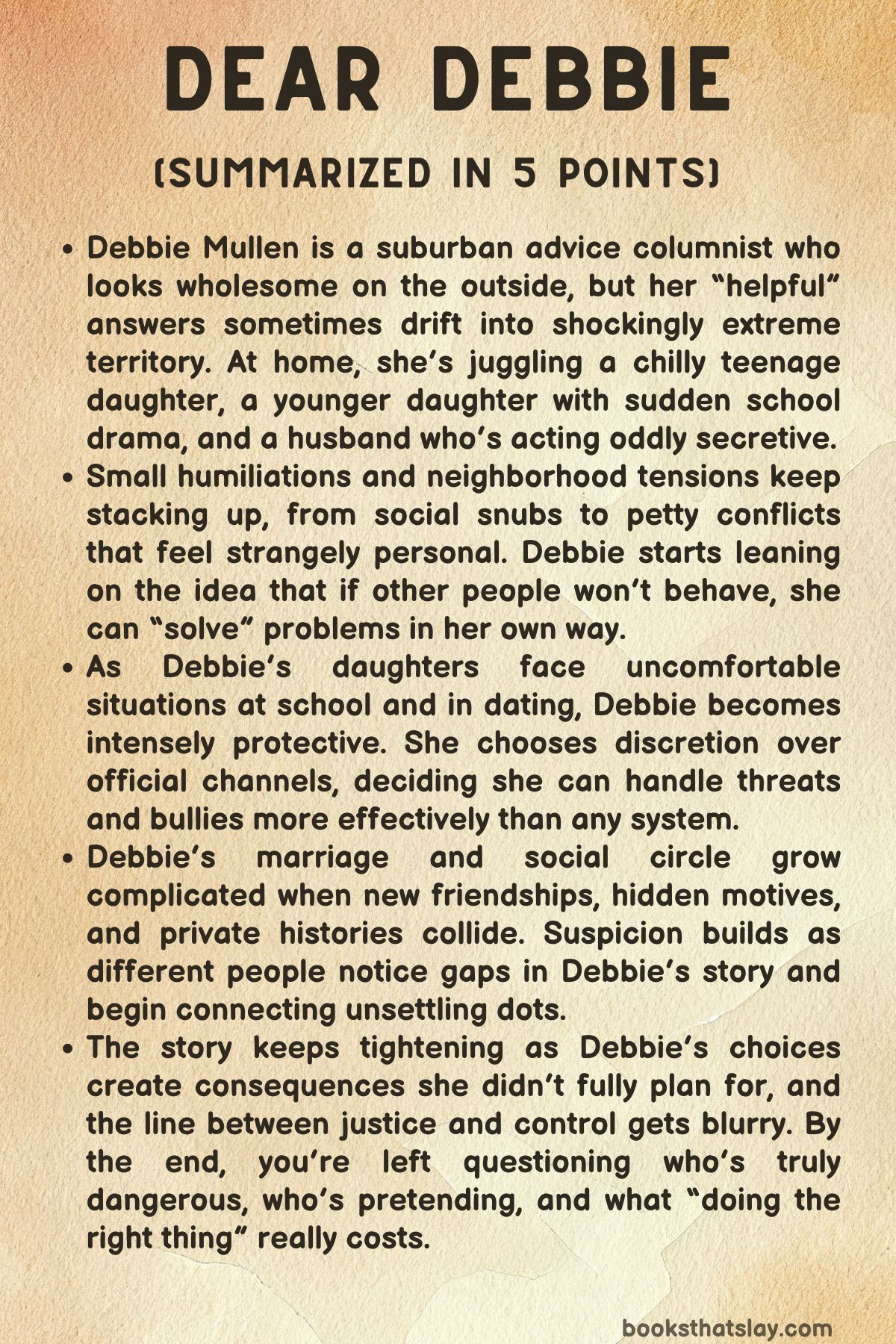
Dear Debbie by Freida McFadden is a darkly comic domestic thriller told through the eyes of Debbie Mullen, a suburban mom who writes an advice column for a small-town paper. On the surface, she’s juggling the usual: a moody teenager, a younger daughter with secrets, a marriage strained by money and silence, and neighbors who smile while keeping score.
But Debbie’s “helpful” advice drafts reveal something else—an imagination that runs hot, sharp, and sometimes illegal. As her family’s problems stack up, Debbie stops asking what’s appropriate and starts asking what works, pushing her tidy Hingham life toward consequences nobody sees coming.
Summary
Debbie Mullen begins her day like she always does: trying to hold her household together while nobody appreciates the effort. Her older daughter, Lexi, refuses to speak to her in the mornings and drifts through the kitchen in headphones, tossing out insults with practiced ease.
Her younger daughter, Isabel—Izzy—rushes out the door, dodging questions about breakfast and plans after school. Debbie’s husband, Cooper, is focused on his own career stress, chasing a partnership at his accounting firm and acting as though Debbie’s problems are background noise.
At work, Debbie writes the “Dear Debbie” advice column for the Hingham Household, answering readers with a cheerful, family-friendly voice. Privately, though, she drafts responses that go far beyond normal advice—fantasies dressed up as solutions, where annoying spouses and rude neighbors meet neat, permanent endings.
These drafts aren’t published, but they show what Debbie is capable of imagining when she feels cornered.
That sense of being cornered grows fast. Debbie gets dressed up for what she believes will be a Home Gardening magazine photo shoot featuring her yard—something that feels like hers, separate from motherhood.
But the crew never arrives. When she calls, she learns there was no appointment and that the magazine chose her neighbor Josephine Dolan instead.
Debbie isn’t just disappointed; she’s humiliated. Josephine adds to it by openly gloating, mocking Debbie’s garden and her attempts to stand out in their neighborhood.
Debbie walks away with her face hot and her pride bruised, and she quietly decides she’s done being the one who takes it.
Debbie’s social world is just as ugly. At her monthly book club, the wealthier women treat her like a charity case they keep around for entertainment.
They criticize her taste, her lack of a college degree, even her food. Debbie brings turkey-and-avocado sandwiches; they respond with fake politeness and smirks.
Debbie’s newer gym friend, Harley Sibbern, watches the dynamic with growing discomfort. Then, during the meeting, the other women suddenly fall violently ill.
Rochelle vomits inside the house; Tabitha and Sloane follow soon after. Debbie appears calm—almost pleased—and Harley begins to wonder if this is coincidence or consequence, especially because Debbie didn’t eat the food herself.
On top of that, Debbie is summoned into the newspaper office and fired. A previous advice column, one where she suggested someone talk to a divorce lawyer, has triggered a threatened lawsuit from an angry husband.
The paper chooses self-preservation over Debbie. Her editor is cut too.
Debbie leaves carrying a small box of desk items and the heavy knowledge that her public role—being the sensible voice for other people—has been stripped away. If the world wants her silent and harmless, she starts to think, maybe she should stop trying to be either.
At home, Debbie presses Izzy about soccer and learns the truth: Izzy was kicked off the team. Lexi adds another detail—Coach Pike is “a perv” who has wandered into the girls’ locker room while they were changing.
Debbie tries to stay calm, but anger finds a place to live. She visits the coach after hours, bringing brownies as a friendly excuse to get him talking.
Coach Pike confirms he cut Izzy and admits he told her to lose weight. He’s cruel about it, and worse, he makes comments that reveal exactly how he views teenage girls.
Debbie leaves convinced that he’s not just harsh—he’s dangerous.
Meanwhile, Cooper’s own life collapses. He asks his boss, Ken Bryant, for a partnership and is dismissed as disposable.
In a moment of panic and pride, Cooper threatens to quit, expecting his boss to blink. Ken doesn’t.
Cooper essentially resigns on the spot and walks out realizing he may have ruined their financial stability. He delays telling Debbie, ashamed and frightened.
Debbie, in turn, hides that she has lost her own job, and both of them pretend everything is fine while their marriage quietly rots from withheld truth.
As this is happening, Cooper begins an affair—though Debbie doesn’t know it at first. He sneaks off by turning off the family tracking app and goes to Harley’s basement apartment.
Harley has befriended Debbie at the gym while sleeping with Debbie’s husband, and she seems to enjoy the imbalance of it, hoping Debbie will discover the betrayal and leave Cooper. Debbie eventually notices hints: a men’s shirt at Harley’s place carrying a familiar scent, Harley’s pointed questions about marriage, and the way conversations circle back to “older married accountants.” Debbie says little, but she watches closely.
Then events begin to snap into place with unsettling speed. Coach Pike is arrested after police discover he placed a camera in the girls’ locker room shower.
Izzy is thrilled because she can rejoin the team with him gone. Cooper, however, is shaken for a different reason: he sees that Debbie’s location history shows she was at an address matching Pike’s home late at night.
Cooper starts to fear Debbie’s involvement in the coach’s downfall, and he begins looking at his wife as if she’s someone he doesn’t fully know.
A more urgent crisis hits when Lexi finally breaks down and tells Debbie what’s happening with her boyfriend, Zane. Zane has topless photos of Lexi and is threatening to spread them unless she has sex with him.
Lexi is terrified of becoming gossip, of the images traveling faster than any attempt to stop them. Debbie promises Lexi she won’t tell the school.
But she also decides she will handle Zane herself.
Debbie arranges a meeting by texting Zane from Lexi’s phone late at night, luring him to an isolated playground at the Hingham Shipyard. She brings beer, drugs one can with opium, and leaves it where he’ll find it.
Zane drinks it, passes out, and Debbie takes his phone, deletes Lexi’s images, and searches until she finds evidence that he distributed nude images of another underage girl. She captures proof and sends it anonymously to school administrators and police.
She returns home and refuses to explain herself to Cooper, who has been watching her location and is now openly suspicious.
The next day, chaos breaks out at the high school: a drunk senior crashes his car into the building. Debbie races there in fear and learns the driver was Zane—called to the principal’s office just before the crash.
Zane survives but is severely injured, possibly permanently. Lexi is devastated, sobbing that this wasn’t supposed to happen.
Debbie can’t understand Lexi’s grief; in Debbie’s mind, she removed a threat. But Lexi sees a ruined body, public attention, and guilt she can’t escape.
Debbie, rattled and furious at old memories stirred by Lexi’s situation, drives to Cambridge and visits the Zeta Pi fraternity house near MIT, where Debbie’s own past trauma began—she was raped in college after being drugged. She tours the house under a fake identity, quietly plotting to set it on fire and make it look accidental.
Yet the fraternity president’s emphasis on safety measures and accountability disrupts her plan. Debbie leaves without lighting anything, but the visit confirms something: when Debbie feels powerless, she looks for a way to make someone pay.
Cooper’s fear becomes panic when he digs deeper into Debbie’s location history and sees she visited Ken Bryant’s home as well. Cooper rushes there and finds Ken dead in bed, shot in the forehead.
Ken’s phone is left behind, and a door camera has recorded Cooper entering the house, making him look guilty. At home, Cooper checks his gun safe and finds his own gun missing.
He believes Debbie took it and that she may have set him up—or worse.
Debbie heads to Harley’s apartment for dinner, intending to confront the affair. Harley expects to confess and believes her lover will arrive too.
When the doorbell rings, a man appears—and Debbie reveals the truth with one sentence: the man isn’t Cooper. He is Jesse Hutchinson, Cooper’s friend, and also the man who raped Debbie years ago.
Debbie has already drugged Jesse using opium slipped into his gym water. As Jesse collapses, Debbie shoots Harley in the forehead.
She then moves to stage the scene as a murder-suicide, tying the deaths to Ken’s murder as well. Debbie has framed Jesse by using Jesse’s gun to kill Ken and planting evidence to connect him to everything.
Cooper arrives outside in time to see enough to be terrified but not enough to stop Debbie’s plan. Debbie distracts him, hides her gloves, and leaves the weapon inside to complete the setup.
Later, Debbie and Cooper return home and share confessions: Cooper admits he’s an alcoholic and has been attending AA in secret; Debbie admits the rape that derailed her college life. When Cooper asks if she killed Ken with his gun, Debbie truthfully says no—because she used Jesse’s gun instead.
The truth is both narrower and worse.
A year later, the outcome looks clean on paper. Jesse is convicted of murdering Ken and Harley and receives two consecutive life sentences.
Cooper starts his own accounting firm and succeeds. Lexi goes to an elite college and breaks with Zane, who faces legal consequences and lives with disability after the crash.
Izzy returns to soccer. Debbie builds a profitable app called Punish Your Husband and sells it for a large sum.
Debbie and Cooper attend couples therapy and appear closer than before.
But the final reality is simple: Debbie won. Not because she healed, not because the world became fair, but because she learned how to control the narrative—who looks guilty, who looks innocent, and who gets removed from the board.
Characters
Debbie Mullen
In Dear Debbie, Debbie is the engine of the story: an advice columnist whose public persona (cheerful, common-sense “family values” guidance) clashes violently with her private impulses and actions. Her replies begin as conventional counsel and then veer into grotesque escalation, which mirrors how her real-life frustrations move from resentment into vigilantism and calculated harm.
Debbie’s identity is tightly bound to being a mother and a “good” suburban woman, so humiliation hits her like an existential threat: being rejected by the magazine, mocked by Josephine Dolan, condescended to by the book club, and treated as replaceable at work all compound into a sense that she is invisible and disrespected. The “buzzing” in her head reads like a pressure gauge for her need to regain control; it quiets when she asserts dominance or punishes someone, linking her emotional relief to coercion.
At the same time, Debbie is not written as purely sadistic—she can be protective and even tender, especially with Lexi’s crisis—yet she processes protection through domination and “solutions” that erase the problem by removing the person. Her backstory of sexual assault and the life-altering silence that followed shapes her obsession with accountability and her allergy to institutional processes; she doesn’t seek justice through systems, she manufactures outcomes.
By the end, Debbie embodies the book’s central moral vertigo: she frames a guilty man for crimes he did not commit to punish him and to “help” others, then rewards herself with a thriving family and fortune, forcing the reader to confront how easily “care” becomes justification for monstrosity when one person decides they are the court.
Cooper Mullen
Cooper functions as both foil and mirror to Debbie. On the surface he is the mild, diligent spouse—an accountant trying to secure partnership, a father trying to keep the household stable—but his passivity hides deep evasiveness: concealed calls, lies about work, and a decision to step outside the marriage rather than confront it.
His humiliation under Ken Bryant triggers a reckless bluff that collapses his career security, and that failure primes him to accept comforting narratives—first about his resignation, later about Debbie’s “odd” behavior—because admitting the truth would require action. Cooper’s fear becomes sharper once he realizes Debbie’s movements align with real-world catastrophes; he moves from guilt to paranoia to survival mode, especially when the missing gun and Ken’s death converge into the possibility that he will be blamed.
Yet Cooper is not simply a victim of Debbie’s darkness; he benefits materially and emotionally from the order she imposes. His eventual confession of alcoholism and long-term AA attendance reframes him as someone who has been managing his own secret life for years, which makes his moral outrage toward Debbie complicated: he demands transparency while living by concealment.
In the ending, Cooper’s “happy resolution” (successful firm, therapy, closeness) reads less like redemption and more like complicity-by-outcome, because his stability is built on a falsely resolved crime that he suspects—at least in part—was engineered.
Lexi Mullen
Lexi is written as teenage contempt sharpened into a weapon, but that cruelty becomes both a symptom and a signal. Her morning “silence rule,” headphones, and constant jabs at Debbie’s chewing, clothes, and charity work establish a household dynamic where Debbie is expected to absorb disrespect without response.
Lexi’s nastiness has a performative edge—especially in front of Zane—and it reads like adolescent power-testing in a family where she senses her mother’s emotional volatility. The shift happens when Lexi’s secret emerges: Zane’s sexual coercion and the threat of image-based abuse.
Suddenly her anger is revealed as a thin cover over fear and shame, and her insistence that authorities not be told reflects the very mechanism that shaped Debbie’s own trauma—silence to avoid social annihilation. Lexi becomes the book’s clearest illustration of how predation thrives in the gaps between “good families” and the realities they refuse to name.
After Zane’s crash, Lexi’s grief exposes another complexity: even when someone harms you, attachment can remain, and Debbie’s inability to understand that shows the generational fracture between emotional experience and punitive logic. Lexi also acts as the story’s moral alarm system—she connects patterns, finds drafts, warns Cooper—yet she lacks power to stop what’s happening, which makes her both witness and collateral damage in Debbie’s war on perceived threats.
Isabel “Izzy” Mullen
Izzy is the quieter daughter, but she becomes the trigger that reveals the rot under respectable surfaces. Her abrupt decision to take the bus home, her panic when Debbie mentions contacting the coach, and her eventual confession that she was cut from the team show a kid trying to manage adult cruelty without adult authority.
Izzy’s storyline highlights how institutions can harm under the guise of “performance” and “standards,” with Coach Pike’s body-shaming functioning as both abuse and grooming-adjacent control. Izzy’s fear is practical—she worries about retaliation or humiliation—while Debbie’s response is absolute, converting a parenting problem into a revenge mission.
When Pike is arrested, Izzy’s relief and hope of rejoining soccer demonstrate what Debbie cannot consistently tolerate: partial, system-driven justice that doesn’t require blood, framing, or total annihilation. Izzy also represents the kind of child Debbie wants to protect most: compliant enough to be “saved,” vulnerable enough to justify intervention, and young enough to still belong to Debbie’s sense of purpose.
Harley Sibbern
Harley is constructed as the story’s social predator, but she is also a study in self-deception. As a trainer, she cultivates intimacy quickly—friendly invitations, supportive listening, “new friend” energy—yet privately she frames Debbie as a stepping stone toward an outcome she wants: Debbie discovering an affair and leaving Cooper.
Harley’s fascination with engineering a dramatic reveal suggests she is addicted to narratives where she is the catalyst, not the villain. Her apartment scene with the men’s shirt is a deliberate bait, and her internal debate about “handling it carefully” shows she understands the risk but believes she can control the story.
Harley’s confrontation with Lisette Inghram expands her character beyond the present affair: she has a history of destructive entanglements that have left real casualties, and her hard refusal to visit Edgar reads as both cruelty and avoidance of accountability. Harley’s end is abrupt and brutal, which is the point: she believes she is playing social chess, but Debbie is playing annihilation.
Harley’s death becomes an example of how the book treats certain forms of manipulation as fatal mistakes when the wrong person decides to “solve” you.
Zane
Zane embodies teenage entitlement turned coercive. He is introduced as obnoxious and controlling—honking outside, grabbing Lexi’s arm during an argument—and his later behavior confirms he is far worse than a rude boyfriend.
The topless-photo threat is a direct form of sexual exploitation and reputational terrorism, and the detail that he circulated another girl’s nude image at a prior school establishes a pattern, not a one-off lapse. Zane’s characterization matters because it tests the reader’s tolerance for Debbie’s methods: he is a plausible target for legal consequences, yet Debbie chooses extrajudicial control—drugging him, unlocking his phone with his face, deleting evidence, and sending an anonymous report.
His crash into the school complicates the emotional math; regardless of guilt, his injury causes real suffering and chaos, and Lexi’s grief forces the story to acknowledge that “removing the threat” can still be traumatic for the victim. Zane ultimately functions less as a fully rounded person and more as the narrative’s pressure point between justice and revenge, showing how quickly Debbie’s “protection” can create unintended fallout.
Coach Pike
Coach Pike is written as the openly abusive adult who hides behind authority. His decision to cut Izzy for weight, his crude comments about “chubby girls,” and his insults toward Debbie expose a worldview where female bodies exist for his appraisal.
Lexi’s accusation that he “accidentally” enters the locker room foreshadows the later arrest for a camera in the showers, confirming that the early warnings were not teen exaggeration. Pike’s significance is that he is one of the few antagonists the system actually catches; his arrest creates a sharp contrast with Debbie’s private campaign, because it proves formal consequences can happen.
Yet the timeline and Debbie’s late-night visit to his house strongly imply she acted first, positioning Pike as both guilty party and narrative scapegoat for Debbie’s escalating confidence. He is less a mystery than a confirmation: Debbie’s instincts about predatory men are correct, but her response to correctness is to claim ownership of punishment.
Ken Bryant
Ken Bryant is the archetype of institutional arrogance—the boss who calls Cooper a “worker bee,” dismisses ambition, and wields power with calm cruelty. His role expands from workplace antagonist to murder victim, and that shift is essential: Ken becomes the bridge between domestic resentment and lethal consequence.
Debbie’s framing of Ken’s death as an act that helps an abused wife positions him as a symbol of hidden domestic violence behind professional respectability; the book uses him to suggest that monsters wear suits and live in nice houses. Ken’s murder also weaponizes Cooper’s vulnerabilities: the missing company funds, Ken’s unreachability, and Cooper’s registered gun create a trap where Cooper can be ruined even if he did nothing.
Ken’s character is therefore less about personal nuance and more about what he enables in others: fear, humiliation, desperation, and the belief that removing him can be “for the greater good.”
Jesse Hutchinson
Jesse begins as Cooper’s supportive coworker and gym buddy, but he becomes the story’s central knot of past trauma and present vengeance. Debbie’s revelation that Jesse is also Hutch—her rapist from college—reframes earlier scenes of friendliness into dramatic irony: the man Cooper trusts is the man who shattered Debbie’s life trajectory.
Jesse’s guilt is explicit in his own admissions about drugging women, which makes him morally culpable even as the specific murders are framed onto him. That ambiguity is the book’s cruelty: it invites the reader to accept an unjust conviction because the convicted person is still repugnant.
Jesse functions as Debbie’s “perfect” target because he is both blameworthy in a general sense and vulnerable to being made the container for multiple crimes. His prison fate—attacked by inmates over past victimization—extends the theme that social punishment often operates independently of legal truth, and that Debbie is willing to let the world’s appetite for retribution do the rest.
Cindy
Cindy appears in two overlapping ways: there is a Cindy connected to the gym environment who notices or could expose the affair, and there is also Cindy described as Ken Bryant’s abused wife who helps drug Jesse before Harley’s death. The story’s emphasis is less on Cindy’s full interiority and more on how she represents a moral lever for Debbie: an abused woman whose suffering becomes a justification for murder.
As “Ken’s abused wife,” Cindy is framed as someone trapped by reputation and power, making Debbie’s vigilantism look like rescue rather than conquest. Yet Cindy’s participation in the framing also stains the rescue narrative; she is not simply saved, she becomes an accomplice to a manufactured outcome.
Cindy’s character underscores a recurring idea in the book: people who feel cornered may accept monstrous solutions when those solutions promise clean endings and plausible deniability.
Garrett Meers
Garrett is the face of institutional self-preservation. As Debbie’s boss, he does not primarily judge her ethics; he judges liability, brand, and the paper’s “family-oriented” image.
His decision to fire Debbie (and Bernice) after a threatened lawsuit shows how quickly organizations sacrifice individuals to protect themselves, especially when the individual’s advice challenged the sanctity of marriage. Garrett’s rigidity also helps radicalize Debbie: he confirms her suspicion that “doing the right thing” is punished when it disrupts social comfort.
He isn’t portrayed as evil so much as cowardly and calculating, which is arguably more infuriating because it feels plausible. By cutting Debbie loose, he unintentionally pushes her toward literalizing her own worst “advice” as action.
Sierra
Sierra, the secretary who escorts Debbie out and repeats talking points about marriage, represents how ideology becomes procedure. She is not presented as a decision-maker; she is a mouthpiece for the organization’s moral branding.
Her calm enforcement of Debbie’s firing—taking the key, controlling Debbie’s exit—shows how power can be exercised politely and still be dehumanizing. Sierra’s character matters because she demonstrates that “values” rhetoric is often deployed by people who are simply following scripts, which makes the harm feel both impersonal and unstoppable.
In Debbie’s eyes, that kind of scripted authority is indistinguishable from cruelty, and it fuels her belief that real outcomes require private action.
Bernice
Bernice is a small but important casualty of professional fallout. Her cleared desk and sudden absence signal the swiftness with which workplaces erase people, and her firing for “approving” a letter suggests she served as a gatekeeper who still lacked protection.
Bernice’s narrative function is to show Debbie that loyalty and competence will not save you when institutions panic. She also provides Debbie an implicit warning: even people adjacent to “controversial truth” get punished.
That lesson nudges Debbie toward secrecy and unilateral control, because public processes harm bystanders.
Rochelle
Rochelle is the queen-bee social antagonist, polished enough to insult you while smiling. She embodies status performance: the larger house, the catered spread, the political party plans, and the weaponized “education” talk that turns book club into a hierarchy test.
Rochelle’s constant micro-humiliations—misnaming Harley, calling Debbie’s sandwiches “cute,” implying Debbie looks older, mocking her lack of college—are not random rudeness; they are dominance rituals designed to keep Debbie in a subordinate role. When Rochelle becomes violently ill after eating Debbie’s food, it reads as poetic reversal, and Debbie’s oddly cheerful demeanor suggests she experiences Rochelle’s suffering as justice restored.
Rochelle also symbolizes the suburban world Debbie both craves and resents: belonging is offered conditionally, and the price is accepting contempt. By making Rochelle physically powerless in front of her own wealth, the story validates Debbie’s desire to puncture the illusion of untouchability.
Tabitha
Tabitha functions as the chorus of cruelty, amplifying Rochelle’s condescension through giggles, mimicry, and social reinforcement. She is less a leader than an eager participant who gains identity by aligning with the group’s highest-status member.
Tabitha’s illness after the sandwiches reinforces how the narrative punishes social aggression: she is not targeted for a grand betrayal, but for casually enjoying Debbie’s humiliation. Tabitha’s character highlights a specific kind of harm—death by a thousand smirks—that can be socially normalized because it’s “just joking.” The book treats that normalization as something Debbie cannot tolerate, and Tabitha becomes collateral in Debbie’s need to make cruelty expensive.
Sloane
Sloane is the intellectual gatekeeper of the book club, using “smartness” as a bludgeon. Her insistence on not “dumbing down” selections and her suggestion of splitting the group if Debbie can’t keep up turn reading into social sorting.
Unlike Rochelle’s aesthetic snobbery, Sloane’s superiority is framed as merit-based, which makes it harder to challenge without seeming defensive—exactly why it’s effective as bullying. Her sickness after the gathering serves the same narrative purpose as Tabitha’s: the story frames humiliation as an offense worthy of consequences, even when delivered with polite vocabulary.
Sloane helps demonstrate why Debbie’s anger is not only about single events, but about an ecosystem of quiet exclusion.
Brett Carlson
Brett is the neighborhood conflict spark, introducing the theme of accusation and surveillance early. His claim that Debbie sabotaged his fuse box, his threat to install a camera, and his warning to Cooper that Debbie is “dangerous” foreshadow the book’s obsession with who is watching whom and how “proof” can be created.
Brett’s aggression also reveals how quickly suburban civility collapses into paranoia; the setting is pristine, but the social fabric is brittle. While Brett is not central to the final plot mechanics, he helps normalize the idea that people already suspect Debbie of wrongdoing, which makes later framing and misdirection feel more plausible.
In a story where Debbie manufactures evidence, Brett is an early reminder that suspicion is a kind of fuel—once lit, it spreads easily.
Josephine “Jo” Dolan
Jo Dolan is Debbie’s aspirational rival, because she has the version of “success” Debbie wants: recognized taste, social influence, and a garden deemed worthy by outsiders. Jo’s smug theft of the magazine feature and her contempt for Debbie’s “realness” expose a social dynamic where worth is conferred by optics, not effort.
Jo isn’t just mean; she is strategic, inviting the magazine and reframing Debbie’s pride as delusion. Debbie’s purchase of Japanese beetle trap refills right after being humiliated signals Jo’s role as a catalyst for Debbie’s sabotage habit—when Debbie feels erased, she seeks to leave a mark.
Jo’s later beetle swarm reads like narrative retribution, and Debbie’s private satisfaction at watching Jo overwhelmed shows that Debbie’s sense of justice is primarily emotional symmetry: you made me feel small, so you must suffer publicly.
Nita Geisler
Nita represents professional gatekeeping disguised as polite logistics. She delivers the devastating news that there was never truly an appointment and that Debbie was replaced because the magazine “went in another direction,” which is the kind of soft corporate language that masks a personal rejection.
Nita’s decision is not framed as malicious—she is doing editorial curation—but for Debbie it becomes proof that her labor and pride can be dismissed without consequence. That dismissal is crucial because it targets the one domain Debbie considered fully hers: the garden as identity beyond motherhood.
Nita’s character therefore functions less as antagonist and more as the agent of Debbie’s humiliation, which is enough to trigger retaliation even without intent.
Bev
Bev, the elderly neighbor Debbie checks on, provides a brief counterpoint to the more predatory adults. Her presence anchors Debbie in a community role that looks genuinely caring, suggesting Debbie can still perform nurturing behavior without manipulation.
Bev also reinforces the theme that neighborhoods are interconnected ecosystems: everyone sees everyone, everyone knows everyone, and small interactions can become leverage later. While Bev does not drive the plot, she humanizes Debbie at moments when the reader might otherwise see only a monster, making Debbie’s later violence more unsettling because it coexists with ordinary kindness.
Lisette Inghram
Lisette arrives like a moral invoice, confronting Harley with the wreckage of Harley’s past. Her story about Edgar’s attempted hanging, survival, and brain damage forces the narrative to expand beyond the current affair and show Harley’s pattern has consequences that persist long after the drama ends.
Lisette’s plea for Harley to visit Edgar is less about revenge than about recognition: someone must look at what happened and admit it mattered. Harley’s refusal and pepper-spraying of Lisette portray Harley as someone who treats accountability as an attack, not an obligation.
Lisette therefore functions as a truth-teller the story briefly permits—she punctures the romanticized “other woman” narrative and replaces it with irreversible harm.
Edgar Inghram
Edgar is mostly offstage, but his role is heavy: he is the example of a life ruined by emotional catastrophe and possibly by his own choices. Through Lisette’s account, Edgar becomes a symbol of how affairs can be framed as thrilling games by some and experienced as annihilating by others.
His brain damage and nursing home placement emphasize that consequences are not always poetic or proportionate; sometimes they are simply bleak and permanent. Edgar’s presence also indirectly warns the reader about Harley’s trajectory: what she calls “handling things” has already ended someone’s life as they knew it.
Lennox Newberry
Lennox, the fraternity president, complicates Debbie’s revenge fantasy by embodying unexpected responsibility. Debbie enters the Zeta Pi house ready to burn it down as symbolic punishment for what happened to her, but Lennox’s seriousness about drink safety, assault prevention, and restricting access to bedrooms disrupts her certainty that the institution is unchanged.
He becomes proof that cultures can shift, at least partially, and that indiscriminate vengeance risks destroying people who are not your perpetrator. Lennox does not erase Debbie’s trauma, but he forces a choice: punish a symbol or confront the more difficult truth that the past cannot be made right by torching the present.
Debbie’s decision not to commit arson is one of her rare moments of restraint, and Lennox is the catalyst for it.
Gerard
Gerard is mostly backgrounded as Rochelle’s husband and political candidate, yet his presence matters as an emblem of public-image obsession. The planned party, the mayor attending, and the glossy performance of civic ambition show a world where appearances are currency, and where scandals are threats to power.
Even without deep characterization, Gerard’s campaign context explains why Rochelle’s home is staged like a showroom and why she treats social gatherings as auditions. He represents the layer of society Debbie can see but cannot access without being judged, intensifying Debbie’s resentment toward those who weaponize prestige.
Themes
Domestic Power and the Performance of Normalcy
Debbie’s life runs on routines that look ordinary from the outside—breakfast debates, school drop-offs, neighborhood chat, a garden shoot, a book club—yet each scene is charged with a struggle over who gets to set the rules inside the home. In Dear Debbie, domestic space is not neutral; it is a place where authority is constantly negotiated, resisted, and reclaimed.
Debbie’s daughters control the emotional weather of the mornings by refusing conversation, mocking her, and withholding information. Cooper controls his own narrative through omission, hiding phone calls, concealing career trouble, and later hiding the real reason he disappears at night.
Debbie, who is outwardly positioned as caretaker and mediator, experiences this as a kind of daily erasure: she is present, working, feeding people, keeping the household moving, yet treated as background noise. That pressure produces a split between the “family-friendly” face she shows and the private force she begins to cultivate.
Her garden becomes a symbol of ownership—something that is hers, not simply a service she provides—so when the photo shoot is taken away and handed to Jo, it feels like a public announcement that even her one personal claim can be overruled. The story repeatedly shows Debbie meeting contempt with politeness, and humiliation with a controlled smile, but the point is not that she is passive; it is that she is studying the social rules so she can use them.
When she lies, she does it with the same calm tone she uses to pour cereal. When she punishes, she frames it as “help.” The advice-column voice amplifies this theme: it is a public mask of reasonableness that can justify anything if it sounds maternal enough.
The unsettling idea here is that normalcy can be a costume, and the person who appears most compliant may be the one most capable of rewriting the rules when the door closes.
Respectability, Class Anxiety, and Social Cruelty
The neighborhood world operates like a polite arena where status is measured through houses, education, food, and effortless confidence. Debbie’s place in Hingham is precarious: she and Cooper “stretched” to live there for school access, which means her belonging depends on constant proof that she fits.
The story shows how quickly that proof can be revoked. Rochelle’s book club is a concentrated display of this dynamic: the other women praise while insulting, smile while excluding, and use cultural literacy as a weapon.
Debbie’s sandwiches become a signal of inferiority; her lack of college becomes a reason to treat her opinion as childish; even her outfit becomes an excuse for someone else’s superiority. This isn’t simply snobbery—it’s enforcement.
The group implies that membership is conditional, that Debbie must earn her seat through the right references and the right kind of confidence, and that if she can’t, she should quietly remove herself. Debbie’s humiliation at the magazine’s decision is another version of the same rule: her garden is not dismissed because it lacks beauty, but because it lacks the “right” story and the “right” woman attached to it.
Jo’s rose garden is “classic,” meaning socially approved; Debbie’s is “not real,” meaning not respectable within that circle’s standards. The theme reveals how respectability becomes a method of control.
People don’t have to shout or threaten; they can deny invitations, misname you, laugh softly at your food, and make you apologize for taking up space. Debbie’s reaction—anger that turns into action—suggests that the violence in the story isn’t born only from personal pathology.
It is also a response to a community that polishes cruelty until it looks like good taste. When Debbie experiences relief after making a line-cutter move back, it signals how starved she is for the feeling of being able to enforce fairness in a world where rules are usually enforced against her.
Language as a Weapon: Advice, Politeness, and Manipulation
The advice column is more than a plot device; it is a lens on how language can sanitize cruelty and turn aggression into “help.” Debbie’s public advice begins as conventional and safe, then slides into commands that are outrageous, illegal, and violent, yet still packaged in the familiar cadence of guidance. The contrast shows how tone can disguise intent.
If something is said with warmth and certainty, it can sound reasonable even when it is monstrous. This mirrors Debbie’s everyday interactions, where she deploys politeness as camouflage.
She acts innocent with Brett while clearly enjoying the power of confusing him. She speaks calmly to Zane while threatening him with a future he suddenly believes.
She deflects Cooper’s questions, answers with partial truths, and keeps her face smooth while her plans advance. The theme suggests that control often depends less on brute force than on narrative control: who tells the story, who frames the motive, who appears credible.
Debbie understands what the community expects a “good mother” to sound like, and she uses that expectation as a shield. Even the newspaper firing reinforces this: the institution claims moral authority by repeating phrases about the “sanctity of marriage,” as if saying the words is the same as protecting families.
Debbie learns from that hypocrisy. If public language can pretend harm is virtue, then private language can pretend violence is protection.
By the end, the story also shows language as an instrument of legal reality. A few screenshots, an anonymous email, a staged text, and carefully placed evidence can redirect blame and build a version of truth that courts accept.
The unsettling conclusion is that the most dangerous person is not the loud one, but the one who can speak in the right voice—maternal, reasonable, concerned—while quietly deciding what other people will be allowed to live with.
Trauma, Memory, and the Risk of Reenactment
Debbie’s college assault is not treated as a distant backstory; it shapes her present choices, her tolerance for threat, and her need to ensure predators face consequences. The trauma emerges when Lexi confesses Zane’s blackmail, and Debbie’s response is immediate and intense because she recognizes the pattern: drugging, coercion, shame, silence, and the way victims are pressured to protect the perpetrator by avoiding “drama.” Trauma is shown as something that can sharpen perception and also distort it.
Debbie correctly identifies danger, but she also begins to see the world as a board of threats that must be neutralized. Her trip to the fraternity house shows the precarious edge of reenactment.
She returns to the physical environment tied to her harm, rehearses a plan to burn it down, and nearly turns her pain into an act that would create new victims. What stops her is not only morality but the unexpected presence of accountability measures and a person who takes consent seriously.
That moment matters because it shows that trauma doesn’t automatically generate violence; violence grows when trauma meets a belief that no one else will act and that only destruction can restore order. Debbie’s behavior also suggests that trauma can become entangled with identity: she wants to be the person who prevents what happened to her from happening again, and that self-image can justify almost anything.
The story further complicates this theme by giving Debbie real wins—Lexi is spared public humiliation, Pike is exposed, Jesse is punished—so the narrative tempts the reader to treat her escalation as “effective coping.” But the emotional cost appears in how her family begins to fear her, in Cooper’s panic when he connects her movements to arrests and deaths, and in Lexi’s anxious plea for her mother not to kill anyone. The theme ultimately presents trauma as a force that demands expression; when it is buried, it can resurface as control, fixation, and a hunger to rewrite endings.
The danger is not that Debbie remembers, but that memory becomes a blueprint for action rather than a reason to seek safety through shared accountability.