Detour by Jeff Rake Summary, Characters and Themes
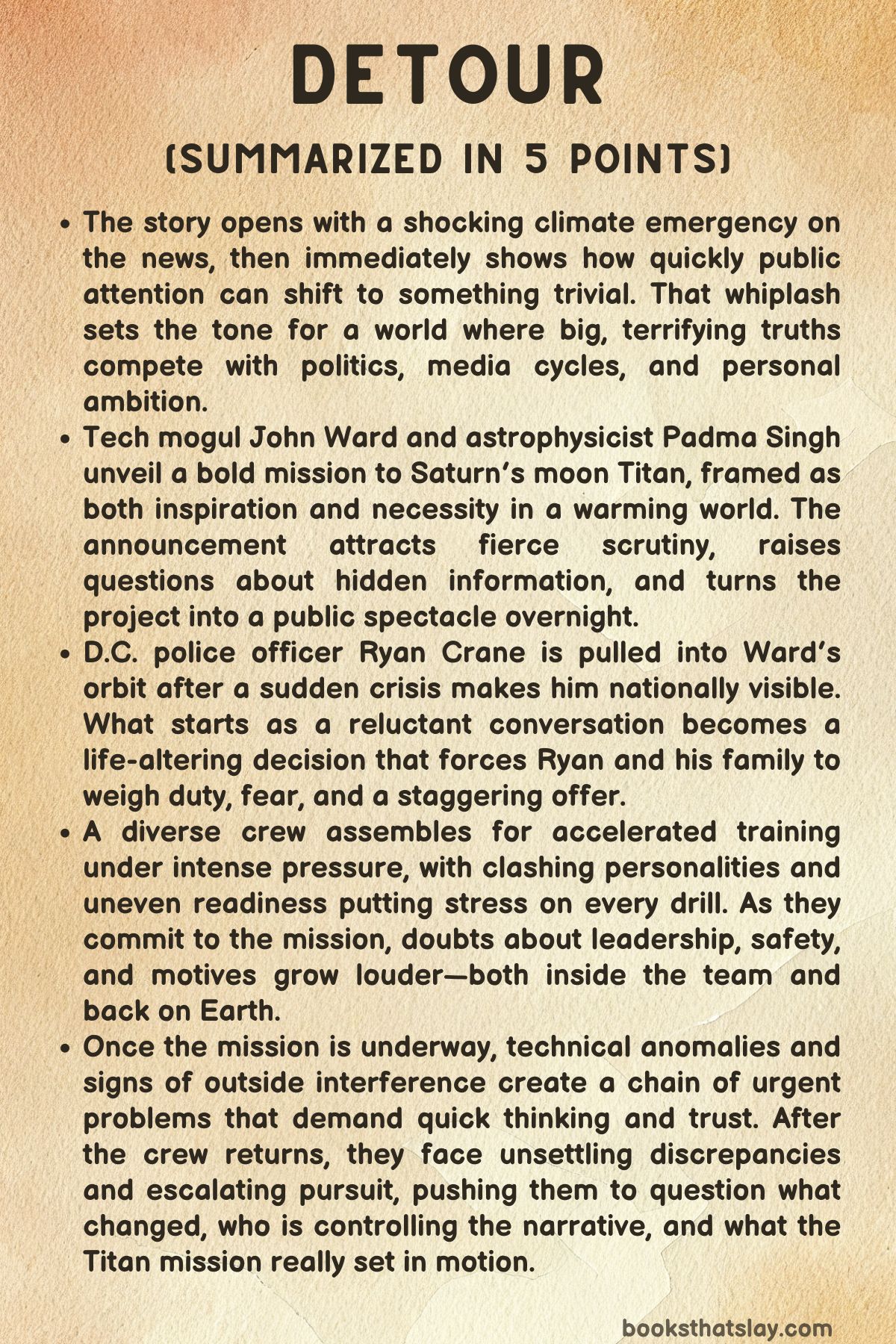
Detour by Jeff Rake is a near-future science thriller that starts with a public dream—sending humans to Saturn’s moon Titan—and quickly turns into a high-stakes fight over truth, power, and reality itself. As billionaire visionary John Ward sells the mission as humanity’s next step, a Washington, D.C. police officer, Ryan Crane, is pulled into the project after saving Ward from an assassination attempt.
The crew’s rushed training, strange data glitches, and secret documents hint that the mission has another purpose. When the team returns to Earth, their lives no longer match what they remember, and the people in charge seem determined to keep them quiet.
Summary
A news broadcast reports a frightening climate update: Antarctica’s Thwaites Glacier has suffered a major collapse, with experts warning that continued failures could push sea levels sharply higher. The segment then abruptly shifts to lighter coverage, highlighting how quickly the world moves on from looming danger.
That same night, John Ward, the founder of Horizons, emails a trusted associate ahead of a major press conference. He frames the coming moment as the payoff for a lifelong fascination with space and a drive to change history.
He hints that his company is on the verge of a breakthrough and urges the recipient to be ready.
In Washington, D.C., police officer Ryan Crane is awakened when his wife, Nina, screams in pain. She is feverish and clutching her lower right abdomen, and Ryan suspects appendicitis.
When emergency services warn an ambulance will be delayed, Ryan decides to drive her to Carter Memorial Hospital. Getting Nina downstairs is harder than expected when the chair lift fails, and the pain is severe.
He calls their neighbor, Darnell, to watch their children—Scarlett and Teddy—then speeds toward the hospital. In his rush, he runs a light and nearly collides with another driver, Padma Singh, who is shaken but unhurt.
Padma returns to her upscale Capitol Hill apartment, funded through Ward’s support and surrounded by high-end automation. She finds a note from her boyfriend, Brett, and discovers he cooked lasagna for a birthday dinner she forgot.
Feeling guilty but fixated on her work, she refuses the food, snacks instead, and goes back to refining her press conference slides. Her paper, “The Case for Titan,” argues Titan is a better target for long-term human settlement than Mars because its thick atmosphere offers radiation protection and local materials could support energy and construction.
With Horizons’ ion engines and Ward’s ship, Starblazer, the journey could take about a year.
At NASA headquarters, Ward meets Padma moments before the press event and tries to steady her. The room is packed with reporters.
Ward introduces the mission, then turns the stage over to Padma, who presents Titan and outlines a two-year proof-of-concept mission that will pave the way for later supply runs and eventual human presence. Ward follows by tying the plan to worsening environmental conditions, pointing to Thwaites as a warning signal.
The press turns hostile. Reporters challenge Ward about political ambitions and hammer NASA administrator Henry Owens about cost.
Owens estimates billions in taxpayer funding, matched by Ward, and the room reacts with outrage. Padma is attacked for not yet having a doctorate, but she holds her ground, arguing the mission’s urgency and the potential technology benefits.
Another question targets a rumored missing report that questioned the project’s viability; Ward brushes it off as bureaucratic misplacement. Afterward, media coverage mocks Ward’s wardrobe and Padma’s appearance, reducing the event to spectacle.
Ryan remains at the hospital, where Dr. Antonio Segura confirms Nina’s surgery went well, though it required open surgery because the condition had advanced. Ryan checks in with Darnell and tries to breathe again.
But outside NASA headquarters later, he spots an unmarked white van lingering near the press crowd. A masked gunman emerges carrying an assault rifle and aims at the cluster of people around Ward.
Ryan, unarmed, shouts a warning and charges. He manages to trip the shooter, seize the rifle, and disrupt the attack long enough for the second masked assailant to retreat.
The van crashes while fleeing, and police swarm the scene. Ryan identifies himself, but one officer, Dan Parish, reacts with visible contempt.
News coverage soon identifies the attackers as twins Mason and Ivy Cavendish. Their manifesto claims Ward is hiding critical information while pretending to address climate threats.
Analysts debate whether the claims are credible, and investigators examine possible ties to extremist online spaces. The attempt backfires politically: Ward’s profile rises, and his polling improves.
In a penthouse suite, Ward reacts with rage and fear, smashing furniture and venting to his assistant, Camila Reyes. She notes the polling bump but warns that it isn’t enough and that Ward’s decision to fly on the Titan mission could destroy a presidential run.
Ward watches footage of Ryan Crane being praised as a hero and begins thinking about how Ryan’s image could benefit him.
Online, a dark web forum buzzes with speculation about a scrubbed document referred to as the Lerner report. At home, Ryan’s family is swarmed by reporters.
Then Ward calls and arrives in person. He thanks Ryan for saving his life, but quickly shifts to a proposal: Ward wants Ryan to join the Titan mission.
Ryan refuses at first, citing the two-year commitment and his family. Ward responds with escalating money, landing on $20 million and giving Ryan three days to decide.
When Ward leaves, Nina demands to know what that was.
Padma receives a message from Ward saying he plans to step down from flying and replace himself with “the hero cop.” Padma is already uneasy about civilians on the crew and worries that the mission is becoming more about headlines than science. Meanwhile, Brett confronts her for forgetting his birthday dinner.
Their argument ends in a breakup, though he still agrees to care for her plants while she is gone. Alone, Padma begins searching for evidence of the rumored secret report, unsettled by the idea that vital information has been buried.
Ryan and Nina talk late into the night. Nina admits the separation will be brutal, but says the money could change their lives and that this is an opportunity that may never come again.
She suggests family help while Ryan is away. Ryan fears space travel, but Nina reminds him danger exists on Earth too.
Ryan promises to decide the next day.
Back at work, Ryan expects recognition but gets sidelined. Captain Hanover tells him he is on desk duty due to federal investigations.
Colleagues treat him coldly, and extra work gets dumped on him. Ryan confides in Simon, a jittery but loyal coworker.
Ryan admits he has been offered a place on the Titan mission. Simon jokes about doomed space stories, then asks what Ryan really wants, suggesting Ryan already knows.
Ward sends Ryan a confirmation email: he qualifies. The crew list includes veteran astronaut Mike Seaver, Della Jameson, Alonso Cardona, lottery winner Courtney “Stitch” Smith, Padma Singh, and Ryan Crane.
The story follows each of them as they prepare. Mike Seaver, famous and experienced, wakes hungover and takes a call from his ex, Helen, who is furious about missed visits and his drinking.
She pushes him toward sobriety and warns that his public image is cracking. Mike claims it is nerves, but drinks anyway, then packs because he can’t resist the chance to be part of history.
Della Jameson, in Chicago, leaves her twin daughters with her mother, Cosette. Cosette urges Della to let the girls’ father, Sean, back into their lives, but Della refuses unless he earns it after his betrayal.
Alonso Cardona, in Austin, rides to the airport with his girlfriend, Maddie, who fears the distance and communication delays will crush them. Alonso tries to reassure her, but receives a message from someone named Ethan and avoids responding.
Stitch, delayed at TSA, insists he is part of the Titan crew and sprints to make his flight after an uncomfortable screening.
At the airport, Padma and Ryan recognize each other—the near-collision driver and the reckless sedan. They talk awkwardly, then more honestly.
Ryan admits he is terrified and was swayed by Ward’s money. Padma admits she recently lost her relationship and has little family support.
They board for Houston.
At Johnson Space Center, the six crew members appear with Ward and Owens for a press conference announcing an intense four-week training program and a launch in five weeks. Reporters attack the plan for allowing civilians aboard.
Owens insists anyone who fails training is cut. Ward projects confidence.
Mike asserts control and signals that this is not a game, publicly positioning himself as the steady hand. Behind the scenes, flight director Bill Blanton calls the timeline reckless and warns people could die, but Owens orders the program forward.
The crew eats together in a lavish new facility funded by Ward. Della pushes for teamwork and clear rules.
Mike drinks, and Della drinks too so he won’t drink alone. Stitch is loud with excitement.
Ward watches from a hidden surveillance setup, identifying Mike and Blanton as obstacles he believes Owens will override.
Training begins brutally. Blanton stresses that performance is life-or-death.
In a VR emergency simulation, Della takes leadership after the scenario declares Mike injured. The group falls apart.
Ryan hesitates, seeking approval. Padma freezes.
Stitch breaks protocol, attempts a solo fix on an oxygen leak, and even shuts off communications. The simulated failures escalate until Blanton ends the run by declaring them dead.
Della calls out communication breakdowns, and Blanton notes they failed every simulation that day, casting doubt on whether the mission should proceed.
Blanton privately confronts Mike after a morning test shows alcohol in his system. He warns that withdrawal in space could kill him and endanger the crew.
NASA leadership wants to pull Mike, but Blanton also admits the mission is moving forward regardless and asks Mike to step up and keep everyone alive. Mike agrees to stop drinking and accept responsibility.
Della backs him, promising support.
Later, aboard Starblazer, Stitch wanders the bunks and finds an envelope hidden inside a book in Ryan’s room. The label suggests it is meant for Ward, and a thumb drive seems to be inside.
Stitch pockets it, telling himself he will return it, but curiosity takes over.
As the mission progresses, problems emerge. Alonso notices something wrong in telemetry: their trajectory has shifted slightly and thrusters are compensating as if new navigation data has been uploaded.
Padma inspects the large satellite they are meant to deploy into Titan orbit and notices it carries unusually advanced communication hardware, more than expected for a standard mapping mission. Stitch suggests Ward may have paid for extra redundancy, but Padma suspects something deeper.
Titan comes into view, and the crew gathers to watch. The moment is short before Alonso points out the problem: the approach numbers are wrong, and if they stay wrong the automated satellite deployment could fail.
Mike takes command, sending Alonso, Padma, and Ryan to the satellite bay to prepare for a manual ejection if needed. Mike and Della remain on the flight deck to diagnose the navigation issue, keeping Stitch nearby as backup.
Communication with Earth is delayed due to distance.
In the satellite bay, systems are locked until navigation is corrected. Alonso tries to override.
Padma argues the satellite is essential for Titan research and future missions, while Ryan pushes back, focused on survival and getting home to his children.
On Earth, Ward watches Mission Control panic as corrupted navigation threatens the crew. Camila warns him that Lerner, tied to earlier trouble, has not truly been contained.
News coverage spreads fear as Nina watches at home, trying to keep their kids calm.
On Starblazer, arguments break out as Mike struggles to interpret the numbers. Stitch proposes that the telemetry is reversed—digits inverted in a recognizable pattern.
Mike refuses to trust him and explodes, but Della detects an external signal interfering with the data and resolves that piece. They still need the correct navigation.
Tension peaks until Ryan demands Mike step aside. Mike finally yields and Stitch corrects the reversed sequence fast enough to restore proper navigation.
The satellite bay reopens with less than a minute to spare. The crew ejects the satellite.
Then a massive impact rocks the ship. Della is thrown into a wall.
Padma is bleeding but conscious, helped by Alonso. They confirm the satellite is in orbit, but Alonso sees odd readings suggesting something else was briefly near it.
A second impact hits and Padma blacks out.
On Earth, relief floods in when Mission Control receives a delayed transmission: the crew is alive and heading home. Starblazer is damaged—communications impaired, a water pipe burst, temperature controls failing, and Padma has a minor head injury—but the hull holds, and the satellite is returning valuable Titan data.
Stitch punches Mike in anger, then Mike grudgingly thanks him.
Ward’s public career continues. He eventually becomes president and announces delays to Titan settlement while promising Earth-focused priorities.
In private, he sends an angry message about a deal and a year of “radio silence,” suggesting a hidden arrangement remains unresolved.
Nearly two years later, the crew returns to Earth under strict control: medical testing, limited contact, and no press. Camila confronts Ryan, demanding an envelope meant for the president—now missing after damage in the bunks.
She warns him not to speak to journalists or even the other crew, and the tone feels like a threat.
Each crew member faces unsettling fallout. Mike reunites with his family and commits to sobriety.
Della returns to find Sean living in her house with their daughters, while her mother is gone. Padma returns to dead plants and notices a suspicious SUV, feeling watched.
Alonso comes home to an empty place—Maddie has left—then Ethan arrives, bringing food and intimacy that doesn’t match Alonso’s memory. Stitch is dropped at a brownstone he does not recognize, and his mother acts strangely affectionate.
Ryan reunites with Nina, but during a private moment realizes something is wrong: Nina does not remember a phrase that was personal to them, and she has no scar from her appendectomy.
Alonso spirals and cancels a talk at an LGBT center, unable to reconcile the life he remembers with the life in front of him. He tells Ethan that the person who made certain choices did not come home, insisting the world is not the same.
He says the crew has been communicating secretly despite threats, and that Padma suspects a multiverse shift with different “branch points” for each of them. Ethan treats it like a breakdown, accuses Alonso of regret, and leaves, saying he needs time.
Stitch, hiding from his mother’s behavior, uses an offline laptop to open Ward’s thumb drive with dark web tools. He finds corporate documents—financial records connected to a South African precious-metals business and material about neural link implants—but nothing that immediately explains the deeper mystery.
He tells Padma it looks like a lot of nothing, though he keeps digging.
Padma studies the changes, noticing each crew member’s life diverges at different moments in the past. Her own changes seem small, mostly centered on her relationship with Brett.
She calls Brett using a burner phone, and he agrees to meet. Brett reveals he was reassigned to review Titan mission data and found photos that alarmed Owens, who ordered him to stay silent.
He urges Padma to meet him in Alexandria.
Ward is revealed to be monitoring Padma’s call through surveillance tied to Castle Keep. Furious, he orders Owens to the Oval and instructs operatives to pick up Brett and others, stating they can make people vanish if needed.
He decides to tighten control over public perception.
Mike learns something else is wrong when Helen shows him their bank account: a $10 million deposit from China Regents Bank. He messages the crew.
Della confirms she received the same. Alonso replies with a warning to run.
Agents approach Alonso’s home. He escapes with a go bag, vaulting fences and sprinting away, then reaches Ethan’s place and begs for a car to get to Virginia.
Ethan refuses to lend the car but offers to come with him, still angry but unwilling to abandon him. Alonso kisses him, and they leave together.
Ryan meets Padma at a bookstore, both trying to evade surveillance. They drive toward Brett’s building, spot a black SUV watching it, and Ryan arranges for a patrol car to disrupt the watcher.
They get inside but find Brett’s apartment ransacked and empty—he has been taken. They flee toward Ryan’s cabin hideout, but Padma insists on retrieving her research laptop first.
Della prepares to run, hides cash, tells Sean to protect the kids and involve her mother, and escapes. A suited agent confronts her, and she fights back hard enough to steal a car and flee toward Virginia.
Mike creates a diversion to move his family to safety with cash while he goes to meet the others.
While Ryan waits outside Padma’s building, a white van arrives and kidnaps Padma. Ryan chases but loses them.
Immediately afterward, Ryan is rammed and assaulted by a suited man. He fights his way free and escapes as police arrive.
Ward goes on CNN and labels the Titan astronauts as traitors working with a foreign government, urging the public to report them. The narrative flips: the crew becomes hunted.
Della reaches a cabin in the Shenandoah Valley and reunites with Mike, Ryan—injured—and Alonso, who arrives with Ethan. They realize Padma is missing and Stitch is unaccounted for.
They decide to stay mobile, find Stephen Lerner, and recover their teammates.
Padma wakes in a basement cell stocked with food and books. Her captors are young and claim they will not hurt her.
They identify themselves as ecoterrorists from her original world and say they know she does not belong in this universe. They ask about Lerner and insist that helping her return is necessary for all of them.
Elsewhere, a Castle Keep operative interrogates Stitch, who is exhausted and barely coherent. Camila arrives furious at the failures and discusses using pressure through surveillance of families, while claiming they have located Lerner in France.
Ward sends another message to a counterpart, threatening “war” over a lack of response. Then breaking news reports another catastrophic collapse of Thwaites Glacier—so sudden and extreme that it suggests something larger is failing.
The story ends with the sense that the universe itself may be destabilizing, and the crew’s fight for answers is tied to forces far beyond a single mission.
Characters
John Ward
John Ward is the story’s prime mover: a visionary entrepreneur who wraps personal ambition in the language of human progress. His childhood loneliness and wonder at the night sky harden into an adult obsession with “discovery,” but that wonder curdles into control when his plans face friction.
He treats people as variables in a mission equation—useful for optics, leverage, or competence—and he is willing to buy outcomes with money, influence, and fear. The assassination attempt briefly exposes the fragility under his swagger, yet even that brush with death becomes something he tries to convert into political momentum, repositioning himself as a figure who deserves power because chaos seems to follow him.
Across the plot, Ward’s central contradiction sharpens: he publicly frames Titan as a hopeful answer to Earth’s accelerating crisis while privately building surveillance and coercive systems to manage information, loyalty, and narrative. By the end, his presidency is less a culmination of leadership than the institutionalization of his need to dominate reality—especially once the crew’s return suggests reality may no longer be stable.
Padma Singh
Padma is the intellectual engine of the Titan project and the character most defined by integrity under pressure, even when that integrity costs her love, comfort, and safety. She begins as a brilliant but exhausted scientist who overcompensates for vulnerability—her insecurity about credentials, her isolation, and her grief—by perfecting the work until it becomes a shield.
Her belief in Titan is not escapism; it is an argument for survivability and long-term thinking, and she takes the hostility of the press personally because it feels like a referendum on whether reason still matters. Once she is in space, her rigidity becomes both strength and liability: she fights for the satellite and the mission’s scientific purpose, yet she can freeze when the stakes become interpersonal and immediate.
After the return, Padma evolves into the group’s interpreter of the impossible, noticing the “branch point” pattern and turning her mind toward multiverse explanations not as fantasy but as the only model that matches the evidence. Her abduction underscores what she has always represented to others: the danger of a person who asks the question no one can safely answer.
Ryan Crane
Ryan Crane is the story’s moral barometer and its most grounded view of extraordinary events, because his instincts are built on domestic responsibility and street-level risk. He begins as a protector in the simplest sense—husband, father, police officer—thrust into crisis by Nina’s medical emergency and later by the assassination attempt, where his courage is immediate and unpolished.
Ward’s offer tempts him not with glory but with security, and Ryan’s internal conflict stays painfully human: two years away from his children is not an abstract sacrifice, it is a daily absence he can already feel. In training and on the ship he often hesitates, seeking permission from authority, which reveals a man shaped by rules who is being dragged into a world where rules are failing.
After the return, Ryan becomes the most viscerally traumatized by the altered reality because his anchor is intimacy—his marriage, their shared private phrase, a scar that should exist—and when those details vanish, his identity fractures. His shift from dutiful cop to hunted fugitive happens fast, but it feels inevitable: once he realizes the world itself can lie, he stops trusting institutions and starts trusting only people, even as those people are taken from him.
Nina Crane
Nina begins as a portrait of sudden vulnerability—pain, fever, the terrifying helplessness of a body failing—and then becomes one of the story’s most consequential emotional forces. Her recovery arc is not just medical; it is the moment the family must renegotiate what sacrifice means, because Ward’s offer arrives exactly when she is most physically compromised and most aware of how precarious their life can be.
Nina’s insistence that they can survive Ryan’s absence is both love and realism: she sees money as a tool that could buy safety, time, and options for their children, and she refuses to let fear make the decision for them. The later revelation that “Nina” has no scar and does not remember their private phrase transforms her from supportive spouse into an unsettling mystery, not because she is villainous but because she embodies the most terrifying consequence of Detour: the possibility that the person you love can be replaced by someone nearly identical.
In that moment, Nina becomes the symbol of what the crew lost—continuity—and why the fight for truth is no longer philosophical but intimate.
Scarlett Crane
Scarlett’s presence is brief but strategically poignant: she is the child’s-eye proof of what Ryan stands to lose and what he is trying to protect. Her sleepy wandering into the crisis, her obedience when Ryan directs her to Teddy, and her existence as someone who depends on routines make the later choice about the mission feel more brutal.
Scarlett is also part of the story’s pressure system: when reporters swarm the home and Ryan becomes a public figure, Scarlett represents the collateral cost of fame and danger that children cannot consent to. Even when she is off-page, she functions as a quiet weight inside Ryan’s decisions, turning abstract heroism into something measured in bedtime stories missed and emergencies handled by someone else.
Teddy Crane
Teddy is the counterpart to Scarlett in the family unit, reinforcing the stakes of Ryan’s absence by doubling the vulnerability at home. He is less directly depicted, but that absence is meaningful: Teddy is the child Ryan cannot constantly see, the one he must imagine being comforted by a neighbor, an aunt, or a “new” Nina in a changed world.
Teddy’s role is to deepen Ryan’s fear that the mission is not simply dangerous because space is lethal, but because time away can create a permanent emotional distance that cannot be repaired with money. In the altered reality, Teddy becomes part of Ryan’s dread that even his children might one day feel unfamiliar, as if the shift could rewrite them too.
Darnell
Darnell is the story’s understated emblem of community competence, the person who shows up when systems fail. He is not dramatic; he is dependable, immediate, and calm—exactly what Ryan needs when emergency services are delayed and the chair lift fails.
His willingness to watch the children without hesitation reinforces the sense that Ryan’s world is built on small acts of trust more than grand institutions. Later, when media attention turns Ryan’s home into a spectacle, the memory of Darnell’s quiet loyalty contrasts sharply with the opportunism and hostility surrounding Ward.
Darnell represents the kind of support that cannot be purchased, which makes Ward’s transactional worldview feel colder by comparison.
Padma’s AI Assistant
The AI assistant in Padma’s building is a small detail with thematic force: it signals how thoroughly Ward’s money has wrapped Padma’s life in curated convenience and surveillance-adjacent automation. The assistant’s polite greetings and frictionless service mirror the way the Titan mission is presented—sleek, inevitable, future-facing—while masking how dependent it is on power and control.
Functionally, it also highlights Padma’s isolation: she lives in a luxurious space where the “voice” that greets her is not family, not a friend, and not love, but a system. In a story that later reveals tapped calls and covert monitoring, the assistant feels like an early whisper that the environment is listening even when it seems benign.
Brett
Brett begins as a symbol of ordinary intimacy—birthday dinner, lasagna in the fridge, the quiet hope of being remembered—and becomes a casualty of Padma’s consuming mission and Ward’s expanding machinery. His breakup with Padma is not framed as melodrama; it is the emotional consequence of living beside someone whose attention has been devoured by history-in-the-making.
Yet Brett’s later importance complicates him: he is not just the hurt partner, he is also a conscientious insider who finds something alarming in Titan mission data and tries to warn Padma. That combination—personal loss and ethical urgency—makes him brave in a very human way, and also tragically vulnerable.
When his apartment is found ransacked and he is gone, Brett becomes the clearest proof that Ward’s world can erase people who know too much, turning a private relationship wound into a political kidnapping.
Henry Owens
Henry Owens is the institutional face of compromise, the man tasked with making the unmakeable appear responsible. As NASA administrator, he performs reassurance—cost estimates, training promises, rules about who gets cut—while simultaneously allowing Ward’s money and timeline to bend the agency’s spine.
He becomes the pressure valve between engineers who see disaster coming and the political reality that says the mission must launch anyway. His role grows darker as surveillance and suppression tighten, culminating in the sense that he is either coerced, complicit, or both.
Owens is frightening precisely because he is plausible: he shows how easily an institution can be turned into a delivery mechanism for someone else’s agenda while still speaking in the language of safety.
Dr. Antonio Segura
Dr. Segura functions as the story’s brief return to grounded professionalism, the kind of competence that is quiet, direct, and life-saving without spectacle. His update to Ryan after Nina’s surgery matters because it is one of the few moments where authority does what it is supposed to do: diagnose, act, fix.
The detail that Nina needed open surgery because of the advanced stage increases the emotional stakes and underlines how close the family came to catastrophe on an ordinary night. Later, when Ryan discovers the absence of a scar, Segura’s earlier reality becomes part of the unsettling contrast, because medicine is supposed to leave evidence—records, healing, marks—and the altered world seems to have rewritten even that.
Dan Parish
Dan Parish embodies the corrosive side of policing culture: resentment, status anxiety, and the instinct to diminish someone who has attracted attention. His disdain toward Ryan after the shooting reads as jealousy dressed up as skepticism, a refusal to celebrate another officer’s bravery because it disrupts hierarchy and ego.
He is not a major antagonist in plot terms, but he sharpens the story’s critique of institutions: even within a system supposedly built on solidarity, people can treat heroism as a threat. Parish’s presence foreshadows how quickly Ryan’s workplace can turn hostile and bureaucratic, priming the reader for the later “desk duty” punishment and the sense that official structures will not protect him.
Captain Hanover
Captain Hanover represents institutional self-preservation over individual merit, the kind of leader who responds to public chaos by removing risk rather than rewarding courage. By placing Ryan on desk duty under the pretext of investigations, Hanover signals that optics and liability matter more than morale or fairness.
This becomes a pivotal emotional betrayal: Ryan expects his world to recognize what he did, but instead it contains him. Hanover’s choice accelerates Ryan’s openness to Ward’s offer because it proves that even good acts do not guarantee security inside the system.
In a story about alternate realities and manipulated narratives, Hanover shows that reality can be distorted without science fiction—just paperwork and authority.
Detective Wilkinson
Detective Wilkinson serves as a social bully within the precinct, weaponizing mockery and workload to enforce conformity. His dumping of extra paperwork is not just pettiness; it is a way of reminding Ryan that fame does not translate to respect in the internal pecking order.
Wilkinson’s antagonism intensifies Ryan’s alienation and reinforces the theme that institutions punish disruption, even when disruption saves lives. He also operates as a mirror to Ward’s more powerful coercion: both men attempt to control Ryan’s choices, one through small humiliations and the other through massive incentives.
Simon
Simon is Ryan’s small island of honesty in a precinct that becomes cold, offering friendship without performance. His nervous humor, coffee-making, and direct question—what Ryan actually wants—provide the emotional clarity that Ryan cannot find in official channels.
Simon does not sell Ryan a dream or shame him for fear; he treats him like a person whose life is about to split in two. That empathy is crucial because it highlights the loneliness of Ryan’s decision and the absence of trustworthy guidance.
Simon’s role is also quietly tragic: he is the kind of friend Ryan will lose if the shift becomes permanent, a reminder that “leaving Earth” is also leaving everyday bonds that cannot be replaced.
Mike Seaver
Mike Seaver is the mission’s combustible core: a legendary astronaut whose public image of calm competence is undermined by addiction, guilt, and fear of irrelevance. He craves the mission because it promises redemption—history, meaning, the chance to be the man people think he is—but his drinking reveals a private collapse that threatens everyone.
As commander, he initially performs dominance, scolding the press and projecting authority, yet in crisis he becomes defensive and brittle, refusing to trust Stitch’s insight until Ryan forces him to step aside. That moment is pivotal: Mike’s flaw is not lack of skill but inability to relinquish control, and the ship nearly pays for his ego.
Afterward, his grudging gratitude and vow to stay sober carry real weight because the story does not treat sobriety as a moral trophy but as daily survival. In the altered world, Mike’s relative contentment—no cravings, family stability—complicates the crew’s crisis: it suggests the new reality is not purely worse, which makes choosing to fight it more ethically messy.
Helen
Helen is the voice of consequences in Mike’s life, refusing to let him romanticize his mission as noble while his family absorbs the damage. Her anger is not cruelty; it is exhaustion from broken promises, missed visits, and the particular loneliness of loving someone whose self-destruction keeps being reframed as stress.
She demands AA not as a rhetorical move but as a boundary for survival. After the return, her discovery of the $10 million deposit forces the family drama into the thriller plot, turning domestic stability into evidence that something is deeply wrong.
Helen’s role makes the story’s stakes intimate: conspiracies are terrifying, but the most devastating betrayal is still the one that happens at the kitchen table.
Della Jameson
Della is the crew’s true backbone: disciplined, emotionally intelligent, and relentlessly pragmatic about teamwork. She instinctively moves toward structure—rules at dinner, communication norms, leadership during simulation—because she understands that survival is not just technical competence but collective behavior under stress.
In the VR disaster she becomes the de facto leader, and her anger afterward is rooted in a clear-eyed assessment that ego and improvisation will kill them. She also functions as Mike’s moral counterweight, offering loyalty without enabling, telling him she has his back while insisting he becomes someone worth backing.
After the return and the reality shift, Della’s protective instincts become feral: she plans, hides cash, escapes through the back, and prioritizes her children’s safety without collapsing into sentimentality. She is the character who proves that courage can be quiet, procedural, and maternal all at once.
Cosette
Cosette is the gravitational pull of family tradition and forgiveness, pushing Della toward reconciliation with Sean not because she is naive but because she values the idea of a whole family. Her pancakes for Nora and Mila and her insistence on pragmatic domestic arrangements show a woman who believes stability is built through compromise.
That worldview clashes with Della’s insistence on earned trust, creating a generational conflict about what accountability looks like after betrayal. When the altered reality reveals that Sean is suddenly living in Della’s house and Cosette is gone, Cosette’s earlier role becomes haunting: she is the absent mediator, the missing glue, and her disappearance intensifies the sense that the new world rearranges relationships with no regard for emotional logic.
Nora Jameson
Nora, one of Della’s twin daughters, represents the part of Della that cannot be mission-first, no matter how capable she is. The goodbye scene emphasizes how the Titan journey is not just about courage but about leaving children who will keep living and growing without you.
Nora’s presence also sharpens the later horror of the altered world: if the shift can rearrange adult relationships and deposit money into accounts, it can also rewrite what childhood looked like during those missing years. Nora is the quiet stake in every risk Della takes afterward, because every escape route and every punch thrown at an agent is ultimately about getting back to her daughters.
Mila Jameson
Mila, as the other twin, doubles the emotional weight and underscores how Della’s motherhood is not a background trait but a defining axis. The twin dynamic also symbolically fits the story’s multiverse themes: two lives running parallel, nearly identical yet distinct, echoing the idea of branching realities.
Mila’s role is less about dialogue and more about what she forces Della to carry—an awareness that heroism is meaningless if it destroys the people waiting at home. When Della flees and tells Sean to protect the kids, Mila is part of the reason Della can detach emotionally in the moment: she trusts the urgency more than comfort, because her children require her to survive.
Sean
Sean is the embodiment of betrayal’s long shadow, a man whose past cheating makes him unacceptable to Della on her terms even if others want forgiveness. He is also a complicated instrument in the altered reality: his sudden presence in Della’s house suggests the world has rewritten the terms of their relationship, forcing Della to confront a life she did not choose.
In the thriller plot, Sean becomes briefly useful—someone Della can command to protect the girls, a resource in a crisis—even as the emotional wound remains. He illustrates how the altered world weaponizes unresolved history: it drags old pain into the present and dares Della to prioritize survival over emotional justice.
Alonso Cardona
Alonso is the story’s most tender portrait of identity under pressure, balancing technical competence with a private struggle to be fully seen. Professionally he is sharp and observant—the first to notice the trajectory shift and the uploaded navigation change—and his anxiety is not incompetence but heightened sensitivity to risk.
Personally, he is divided between versions of himself: the man in a relationship with Maddie, the man haunted by Ethan’s name on his phone, and the man who wants a future where his bisexuality is not a secret he must manage. After the return, his distress is amplified because the new reality seems to validate his feeling that he is split across lives—one man made promises, another came home.
His attempt to cancel the LGBT talk shows how fear can persist even after survival, and his breakdown reveals a longing not just for truth about the universe but for coherence inside himself. When he runs from suited agents and ends up with Ethan, Alonso becomes a living argument that the crisis is not only geopolitical; it is existential.
Maddie
Maddie is Alonso’s emotional tether to the life he thought he was living, and her fears about communication delays and blackouts capture the human cost of distance better than any technical explanation. She worries she cannot match Alonso’s world intellectually, revealing the insecurity that often forms beside ambition, yet her love is genuine in the way she tries to imagine the journey’s loneliness.
In the altered reality, Maddie’s absence—her leaving him—becomes one of Alonso’s clearest “proofs” that the world has changed, because it is not just a different headline or deposit amount, but a missing person in his heart. Maddie represents the life Alonso might have chosen if the mission never happened, and her disappearance turns grief into evidence.
Ethan
Ethan is both longing and confrontation for Alonso: the unresolved past that returns with tacos and tequila, warmth and provocation. He presses Alonso because he wants clarity—about what Alonso wants, about whether promises meant anything—and he reads Alonso’s claims about a changed world as emotional volatility rather than metaphysical truth.
That mismatch is painfully realistic: Ethan’s skepticism is not malice, it is self-protection against being hurt by someone who seems to be retreating into an impossible story. Yet Ethan still shows up, still offers to go with Alonso even when angry, revealing a loyalty that outlasts confusion.
His role highlights one of the story’s sharpest tragedies: when reality shifts, the people you love may become incapable of believing you, not because they don’t care, but because the truth sounds like betrayal.
Courtney “Stitch” Smith
Stitch is the wildcard who looks like comic relief until the plot reveals he may be one of the most dangerous men in the room—not because he is violent, but because he is curious and pattern-oriented. As the lottery winner, he embodies the mission’s public-facing absurdity, and his defensiveness during TSA screening shows a man accustomed to being underestimated and stereotyped.
In training, his impulsiveness nearly kills everyone, yet that same refusal to accept constraints later becomes crucial when he recognizes the digit-inversion pattern and saves the satellite deployment. Stitch’s defining trait is compulsion: he cannot leave the envelope alone, cannot ignore the thumb drive, cannot stop himself from opening what powerful people want hidden.
After the return, his paranoia is justified as he is interrogated and broken down, yet even then he keeps searching for meaning in the USB’s mundane documents, refusing to accept that nothing is there. Stitch represents the story’s thesis that “unimportant” people can become the hinge of history because they do not know which doors they are not supposed to open.
Mason Cavendish
Mason, one of the Cavendish twins, is presented through the lens of violence justified by ideology, a person who believes assassination is moral action rather than murder. The manifesto framing suggests he sees Ward as a symbol of hypocrisy—someone profiting from a future narrative while allegedly hiding the truth about climate collapse and mission viability.
Mason’s role matters less as a fully intimate character and more as a catalyst who reveals how desperate and radicalized the world has become, where climate fear and conspiracy can fuse into lethal certainty. He also triggers Ward’s transformation: without the attack, Ward might not pivot so aggressively into political manipulation and “law and order” branding.
Mason’s legacy is that he proves the story’s world is already fractured before the multiverse fracture becomes explicit.
Ivy Cavendish
Ivy mirrors Mason as the second half of a shared extremism, but her presence underscores the social contagion element of radicalization: twins moving as one, ideology operating like a closed feedback loop. She reinforces the sense that their attack is not random but choreographed, supported by online spaces that amplify paranoia about “scrubbed reports” and hidden truths.
Ivy’s participation also destabilizes easy narratives about lone wolves; the threat is relational, communal, and networked. By existing as a pair with Mason, Ivy reflects the book’s later obsession with doubles, branches, and parallel lives—except her “twin” motif is grounded in human psychology rather than cosmic mechanics.
Camila Reyes
Camila is Ward’s operational blade: polished, strategic, and frighteningly comfortable with coercion when the situation demands it. She speaks the language of campaigns, polling, and positioning, but her real power is in enforcing obedience and managing messes—especially the kind that require intimidation rather than persuasion.
Her insistence that Ward should not fly reveals that she thinks like a strategist first, treating human presence on the mission as a risk to narrative control. After the return, her confrontation with Ryan about the missing envelope is where she becomes most openly threatening, signaling that the machinery around Ward has teeth and that “silence” is not a request.
Camila represents the bureaucratization of menace: she doesn’t need to be cruel to be dangerous, because she believes the ends justify whatever keeps the system intact.
Bill Blanton
Bill Blanton is the mission’s realist and the closest thing to a conscience inside the operational structure, not because he is gentle but because he is honest about consequences. He calls the mission a “clown show,” pushes back on the accelerated timeline, and designs simulations that expose not only technical weakness but behavioral failure.
Blanton’s harshness is an expression of care: he is trying to terrify them into competence because space does not forgive optimism. His confrontation with Mike about alcohol use is one of the story’s most responsible acts of leadership, and his warning about withdrawal shows his focus on hidden risks rather than headline drama.
Blanton’s role also illuminates how compromised NASA has become under Ward and Owens: even a competent flight director can be ordered to “make it work,” turning safety into theater.
Mei
Mei appears as Padma’s handler/escort in the post-return world, embodying the soft-collar version of captivity. Her presence suggests Padma is not free even when she is walking around, and the fact that Padma waits for Mei to step out before using a burner phone implies constant monitoring as a lived condition.
Mei’s role is unsettling because it is ambiguous: she could be a simple security detail, a bureaucrat doing a job, or an active piece of surveillance. That ambiguity is precisely the point—Padma cannot know who is watching for Ward, who is sympathetic, and who is simply following protocol.
Mei represents how control can be administered politely, making oppression harder to name and easier to normalize.
“F”
“F,” the Castle Keep operative, is the story’s clearest embodiment of the hidden state—an agent who treats people as assets, families as leverage, and disappearance as a tool rather than a moral boundary. His interrogation of Stitch, his talk of keeping contracts, and his willingness to propose pressure through “eyes on the families” reveal a mentality in which harm is just a method.
“F” is chilling because he is procedural: he is not driven by personal hatred, but by function, implying a whole system behind him that can run without Ward’s direct involvement. In a narrative increasingly about manipulated reality, “F” represents a more mundane horror: the reality where power does not need cosmic anomalies to ruin lives; it just needs permission.
Stephen Lerner
Stephen Lerner is the story’s gravitational absence, the name that makes multiple factions tense and the missing piece implied by the “Lerner report.” Even when he is offstage, he functions as the symbol of suppressed knowledge—someone connected to earlier warnings, viability concerns, or hidden motives behind Titan’s navigation and communications hardware. The fact that dark web users speculate about scrubbed documents, and that Camila warns Ward that Lerner “hasn’t truly been dealt with,” suggests Lerner is not only a person but a threat vector: proof that the mission has a concealed agenda.
When later claims place him in France, it adds to the sense of an international chessboard in which Lerner’s location matters because what he knows can collapse narratives. Lerner’s importance lies in how everyone reacts to him: to the crew he is a potential key to understanding the altered reality, and to Ward’s apparatus he is a loose end that could unravel everything.
Themes
Media Distraction and the Management of Public Attention
The story opens with a terrifying scientific announcement about the Thwaites Glacier collapse and the scale of sea-level risk, and then the broadcast pivots into a light fashion segment. That cut is not just a joke about TV programming; it establishes a world where attention is treated like a scarce commodity to be redirected on command.
The plot keeps returning to how narratives are packaged, sold, and weaponized: John Ward’s press conference is framed as visionary and urgent, yet it becomes a spectacle about money, outfits, credentials, and personality. Even when the mission’s purpose is argued as a response to planetary danger, the conversation is pulled toward optics—poll numbers, style-site mockery, and a tidy media-ready “hero cop” storyline.
The assassination attempt turns into a ratings event and a political accelerant, feeding Ward’s rise rather than slowing it, which suggests that modern attention systems do not reliably punish instability; they often reward it if it produces a compelling story. Later, the same dynamic escalates into outright propaganda when Ward goes on CNN to brand the returning crew as traitors and urges public reporting.
The point is not merely that media can be shallow, but that public reality becomes something produced through repetition, selective framing, and fear. People on the ground—Ryan’s family facing reporters, Nina watching breaking news about navigation corruption, the crew forced into restricted re-entry conditions—become characters inside a story being told about them, rather than authors of their own lives.
In Detour, the struggle is not only against physical danger in space or political danger on Earth, but against a machine that can swap an existential warning for entertainment, and then swap a complicated truth for a simple enemy label when control is threatened.
Climate Anxiety as Fuel for Competing Agendas
The Thwaites warning sets an emotional temperature that the rest of the narrative exploits: catastrophe is real, measurable, and accelerating, but the response to it is fractured. Ward uses climate fear to justify Titan as a strategic bet, tying exploration to survival and arguing that technological progress is a rational answer to a worsening Earth.
At the same time, the would-be assassins claim Ward is ignoring climate change and hiding information, implying that the same anxiety can radicalize in opposite directions—toward grand projects or toward violent resistance. What makes this theme sharp is that the book does not let climate crisis sit as a distant backdrop; it becomes a currency exchanged between institutions, activists, and political aspirants.
NASA leadership talks in terms of cost, schedule, and feasibility while reporters talk in terms of scandal, and Ward talks in terms of destiny and urgency, but the shared underlying pressure is that Earth feels unstable and time feels short. That pressure makes people more willing to accept extreme tradeoffs: civilians on a rushed mission timeline, a cop offered $20 million to abandon his family for two years, and an agency leadership forced to “make it work” despite private warnings that people could die.
The collapse of Thwaites returning at the end as “catastrophic” and possibly connected to reality destabilization adds a darker layer: climate disaster is not only something humans fail to solve, but something that might be entangled with the broader fracture of the world itself. Even without treating that as literal causality, the thematic effect is clear—when the planet feels like it is coming apart, every plan starts to sound like an emergency plan, and emergency logic gives cover to ambition, secrecy, and coercion.
Climate dread is not a single moral directive; it is a force that intensifies everything else, making it easier for power to justify itself and harder for ordinary people to know which sacrifice is necessary and which sacrifice is being sold to them.
Power, Secrecy, and the Privatization of High-Stakes Decisions
Ward’s influence appears early as money that smooths paths—Padma’s luxury building, private facilities, matched funding, accelerated schedules—but it evolves into something more alarming: the ability to bend institutions and people until they serve a private objective. The crew manifest itself shows how power selects: elite astronauts, specialists, and then a lottery winner and a police officer recruited not for aerospace competence but for narrative utility and personal leverage.
Ward’s offer to Ryan is a clean expression of privatized coercion: it is framed as opportunity, yet it is a transaction that attempts to purchase years of a man’s life and separate him from his recovering spouse and children. Later, this theme sharpens into control systems that resemble state security but answer to Ward’s interests—surveillance, handlers, threats, disappearances, and the shadowy machinery of Castle Keep.
What is striking is how quickly the boundary between public authority and private command erodes. Henry Owens and NASA functionaries appear to negotiate with Ward rather than direct him; Bill Blanton’s warnings are treated as obstacles to be managed; and when the crew returns, the “controlled reunion” feels less like medical caution and more like containment.
The missing envelope and thumb drive become symbols of what power fears most: not failure, but uncontrolled information. Even when Stitch opens the drive and finds documents that appear mundane, the response from Ward’s apparatus implies that “mundane” is not the point; the point is that Ward decides what is visible, what is acceptable to know, and what narrative is allowed to stand.
By the time Ward labels the astronauts traitors on television, power has completed its loop: it manufactures the mission, manages the crisis, controls the aftermath, and then rewrites the crew’s identity in the public mind. Secrecy is not a side detail; it is the operating system of power, and the privatization of that system makes it harder to appeal to shared rules, because the rules shift depending on what protects the person at the center.
Identity Rupture and the Terror of a Familiar World That No Longer Matches
The most personal horror in the story arrives after the mission, when homecoming does not feel like return. Ryan’s discovery that Nina does not remember their private phrase and has no appendix scar is a devastating, intimate proof that something fundamental has shifted.
It is not a cosmic puzzle first; it is a marriage suddenly questioned at the level of touch, memory, and bodily history. That same rupture appears differently for others: Alonso’s life is rearranged so thoroughly that his orientation, relationship history, and self-presentation are thrown into conflict, leaving him unable to speak at the LGBT center because he cannot explain which version of himself is real.
Padma’s branch point seems smaller in some ways yet emotionally brutal—relationships altered, surveillance tightening, and the sense that her life has been edited by an unseen hand. Stitch experiences a warped domestic reality when his mother’s affection feels wrong, as if she is responding to a different person.
The crew’s shared realization that each of them has a different “branch point” deepens the theme: identity is not only internal; it is also a social record written across other people’s memories and the accumulated consequences of choices. When those records diverge, the self becomes contested territory.
This produces a particular kind of loneliness: even when you are surrounded by family, you may be the only one carrying a past that no longer exists here. The book also shows how power exploits that vulnerability.
If you cannot prove the world changed, you can be labeled unstable. If you try to gather with others who remember, you can be framed as conspirators.
The result is a pressure to self-censor and to doubt your own mind, which is why the crew’s burner-email thread and secret coordination becomes more than a plot device; it becomes a survival method for preserving shared reality. The multiverse idea is not used mainly for spectacle.
It functions as a metaphor for the fragility of selfhood when the external confirmations that anchor you—scars, phrases, relationships, history—can be replaced without your consent.
Loyalty, Family Obligation, and the Cost of Choosing “The Bigger Thing”
Ryan’s decision sits at the emotional center of the early story: a husband and father tempted by an extraordinary sum and a historic mission while his wife is recovering and his children are small. The narrative refuses to treat this as a simple greed-versus-nobility choice.
Nina’s support complicates it—she is not merely the spouse begging him to stay; she is practical, ambitious for the family’s future, and aware that danger exists on Earth too. That conversation makes the eventual departure feel like a family decision and also like a wound they are choosing to accept.
Similar strains appear across the crew: Della leaving her daughters behind while navigating a messy co-parent history, Alonso trying to reassure Maddie while hiding old attachments and unresolved parts of himself, and Mike facing the consequences of prior failures as a father while chasing redemption through the mission. Even Padma’s breakup with Brett is not treated as simple romance drama; it shows how devotion to the mission and obsession with proving a case can hollow out a relationship that needed attention now, not later.
These personal ties don’t disappear once the ship launches; they become the stakes that shape conflict under pressure. Ryan’s insistence in the satellite bay that he cares about getting home to his children is not cowardice; it is a competing moral framework that clashes with Padma’s devotion to scientific progress and future settlement.
Later, when the crew returns to a reshaped world, family becomes both refuge and threat—refuge because it is what they wanted back, threat because it may be altered, monitored, or used against them. The Castle Keep idea of “eyes on the families” reveals a grim extension of the theme: loved ones are not only emotional anchors; they are leverage points.
The result is that loyalty operates on multiple levels: loyalty to spouse, to children, to teammates, to truth, and to personal survival. The “bigger thing” may be exploration, money, or history, but the bill is often paid in time away, relationships damaged, and a lingering question of whether the person who comes home can still fit into the life they left.
Competence Under Pressure and the Fragility of Team Trust
The training sequences and the navigation crisis emphasize that heroic outcomes depend less on inspirational speeches and more on whether a group can function when systems fail. The simulated disaster exposes predictable human breakdowns: hesitation, freezing, ego, impulsive rule-breaking, and the need for approval.
The fact that they “die” in simulations repeatedly is not just a training note; it signals that the mission’s timeline and mixed crew composition create risk that no amount of branding can erase. When the real crisis hits near Titan, the story stresses how thin the margin is between salvage and catastrophe.
Locks prevent access, telemetry is corrupted, and delays to Mission Control remove the comfort of immediate external guidance. In that environment, leadership becomes contested.
Mike’s authority is real but compromised by ego and his drinking problem; Della’s competence is steady but constrained by hierarchy; Stitch’s insight is dismissed because he lacks status; Ryan’s courage shows itself not only in physical action but in forcing a leader to step aside. The moment Stitch identifies the digit inversion pattern is important thematically because it challenges the idea that competence only resides in officially sanctioned experts.
He is not a trained astronaut, yet he sees what others miss because of his own mental habits and experiences. The crew’s ability to accept that, even briefly, becomes the difference between failure and success.
Afterward, trust remains damaged: Stitch punches Mike, Mike thanks him anyway, and everyone is left with a sense that survival did not resolve underlying fractures, it merely postponed them. That fragility matters later when the crew must rely on one another again on Earth while being hunted and discredited.
Trust becomes a resource like oxygen—spent quickly, replenished slowly, and essential to survival. Competence is not presented as a stable trait but as something shaped by stress, pride, sobriety, and the willingness to listen to the “wrong” person at the right moment.
Reality Control, Political Legitimacy, and the Manufacturing of Enemies
Ward’s arc from visionary entrepreneur to president is not portrayed as a simple rise; it is portrayed as a transformation of narrative power into institutional power. Once he occupies that office, the tools available to him amplify everything already present: surveillance becomes routine, threats become plausible, and public messaging becomes a weapon that can set citizens against the people he wants contained.
The crew’s sudden $10 million deposits are a brilliant mechanism for this theme because they are designed to look like guilt. It is a planted artifact that makes an accusation feel self-evident and turns the public into a distributed enforcement network once Ward tells them to report sightings.
The “treason” announcement does more than chase them; it rewrites their moral status so that anyone helping them becomes suspect. This theme is reinforced by the quiet terror of handlers, restricted communication, and the suggestion that people can be taken and made to vanish.
When Padma is abducted, the story shows two faces of captivity: one is overtly political, and the other is ideologically motivated by people who claim to understand the multiverse problem. In both cases, the individual is trapped by someone else’s certainty about what the story is and what must be done.
The theme also links back to the opening broadcast choice: control the feed, control the meaning. Even the renewed Thwaites catastrophe near the end, paired with hints that reality is destabilizing, suggests a world where truth is contested on multiple fronts at once—physical reality shifting, political reality being shaped, and personal reality becoming unreliable.
Legitimacy is not earned only by solving problems; it is manufactured by controlling who is believed, who is labeled dangerous, and what evidence the public is allowed to see. The crew’s fight, then, is not merely to survive pursuit but to reclaim the right to define what happened to them and what world they are living in.