Do You Remember Summary, Characters and Themes
Do You Remember by Freida McFadden is a psychological thriller that explores the fragile boundaries between memory, identity, and trust. The novel follows Tess, a woman who wakes up after what seems like a night of celebration, only to find herself in a life she doesn’t recognize.
Her appearance has changed, her home looks different, and a man she does not know claims to be her husband. Caught in a haze of confusion and shifting truths, Tess is forced to question everything she believes about her past, her relationships, and even her own mind. McFadden builds a story full of suspense, leaving readers as unsettled as Tess while she pieces together the truth.
Summary
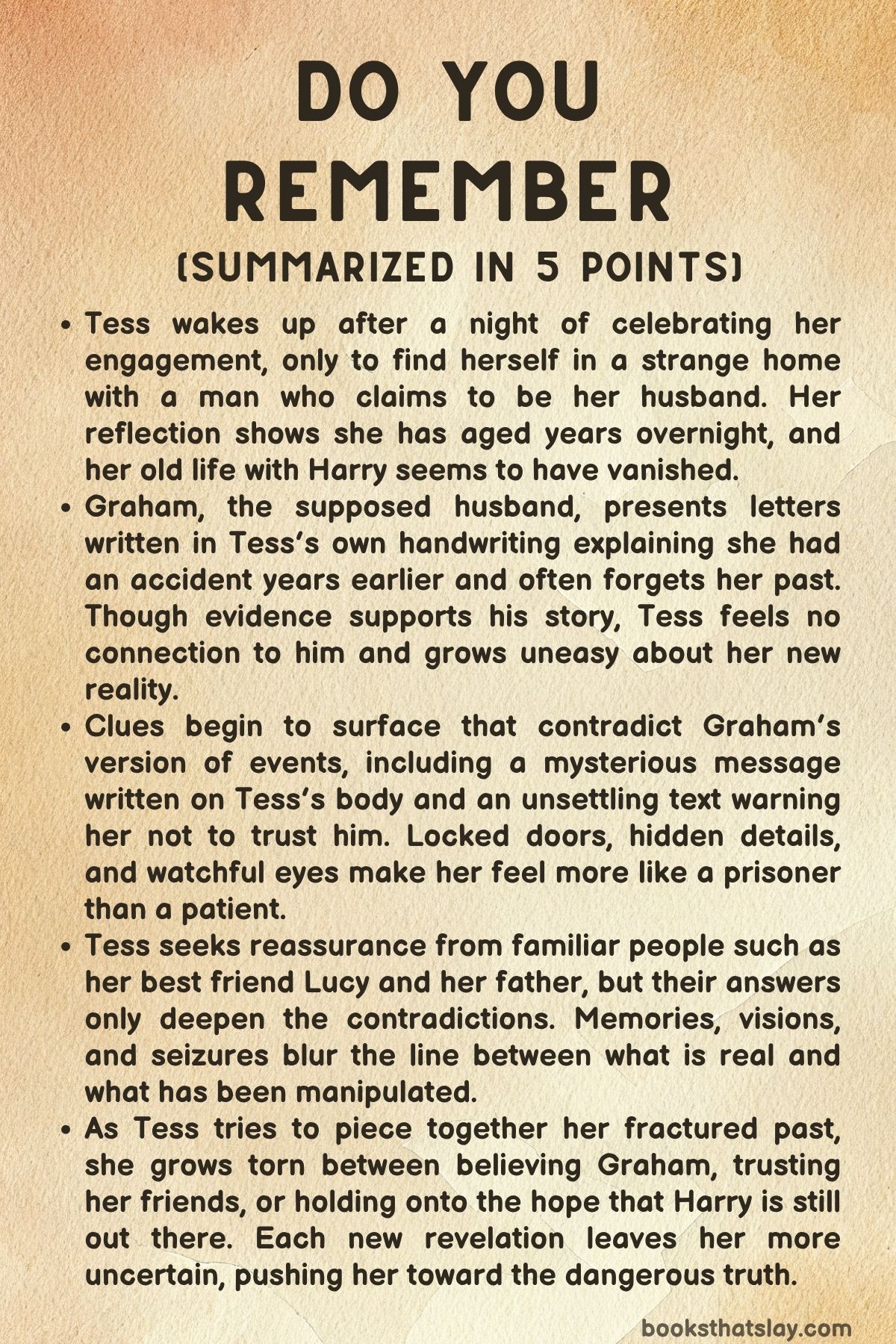
Tess begins her day in confusion, still reeling from what she thought was her engagement celebration with Harry, the man she remembers as her fiancé. The details of the night are blurred, but the real shock comes when she notices strange changes: her bedroom looks unfamiliar, the bathroom has been renovated, and her reflection shows a much older version of herself with short, graying hair.
When she calls out for Harry, a man named Graham appears, insisting he is her husband. Tess resists, but evidence begins to mount: photographs of their wedding and vacations, a letter written in her own handwriting explaining that she suffers from memory loss after a car accident, and a scar on her head confirming the story.
The letter tells her to trust Graham, but her unease deepens when she notices a faded message written on her thigh that begins with the word “Find.”
Graham treats her gently, answering questions and filling in missing years. He explains they have been married for four years, and that he manages her business, My Home Spa, since her brain injury made her unable to handle it.
Tess remains unconvinced, especially after meeting Camila, a woman who helps around the house. The situation grows stranger when Tess realizes the doors are locked from the inside and she is essentially trapped.
That fear escalates when she receives a cryptic text from an unknown number warning her not to trust Graham. The sender knows personal details about her, including the name of her dog Ziggy, and arranges a meeting at a nearby dog park.
Struggling between suspicion and confusion, Tess researches her past online and discovers that her business was thriving but her own name disappeared from the records around the time of her supposed accident. She calls her father and her best friend Lucy, but reaches only voicemail.
Camila watches her closely, and Graham claims everything he does is for her safety. Still, Tess grows convinced that the texter may be Harry and plans to meet him.
Her attempt fails when she is intercepted by security and Camila insists she is delusional, even suggesting Tess imagines the texts from Harry. Shaken and doubting herself, Tess eventually finds herself at the dog park with Graham, but Harry is gone.
Graham comforts her, sharing details of their life together, but Tess remains conflicted.
Her relief comes when Lucy finally calls, reassuring her that Graham is trustworthy and claiming Harry was no good for her. Yet inconsistencies arise: Graham says they met when he saved her from traffic, while Lucy insists he was first hired as an accountant.
These contradictions heighten Tess’s suspicions. She begins to sense that Lucy and Graham may be hiding something from her.
Later, Lucy tells Tess that Harry once assaulted her, a revelation Tess struggles to accept but forces herself to believe. Distrust builds further when Ziggy growls and bites Graham, and when Tess notices strange particles in her drink.
Graham insists he is secretly administering her seizure medication because she refuses to take it willingly. Though bottles with her name appear to support his claim, Tess is unsettled by his controlling behavior.
As her fear grows, Tess notices she is constantly monitored. Graham locks doors, controls her communication, and restricts her access to sharp objects.
Even small moments, like him pushing her to drink juice she dislikes, feel manipulative. Camila offers some comfort but also participates in keeping Tess contained.
When Lucy comes for dinner, Tess is relieved, only to suffer another episode that brings back memories of Lucy encouraging her to marry Graham and cutting ties with Harry. The night ends with Tess realizing something has been slipped into her drink, furthering her suspicion that Graham is drugging her.
One night, Tess wakes with her memory temporarily intact and sneaks into Graham’s office after Camila hints the truth is hidden in his locked desk. She discovers medical records revealing she has a terminal brain tumor and has been part of a clinical trial involving nightly injections that erase her memory.
The treatments, administered by Graham, have left her unable to retain recent experiences. This revelation devastates Tess, but it also confirms that Graham has been controlling her life and withholding vital truths.
Her father and Harry arrive, forcing everything into the open. Graham admits she may only have months left, but Tess chooses to leave him and be with Harry.
Graham tries to negotiate a settlement, demanding control of her house and company, but Tess tears the contract apart after Lucy reveals Graham had been embezzling from her business before her illness. Lucy confesses Graham hired her to cover it up and keep Tess from remembering.
Tess finally sees the depth of Graham’s betrayal and resolves to fight back. She decides to live her remaining time on her own terms, with Harry by her side.
In the final section, Tess learns that her cancer diagnosis may not be as grim as she thought—her tumor has gone into remission. This discovery explains why Graham became desperate to keep her dependent on him.
On the night she first realized the truth, she caught him drugging her drink and wrote a desperate message on her thigh: “Find Harry.” That act set everything in motion, giving her the chance to reclaim her life. By the end, Tess chooses freedom, love, and honesty, even if her future remains uncertain.
The truth, once hidden, finally gives her clarity about who she is and who she can trust.
Characters
Tess
Tess stands at the heart of Do You Remember, her fractured memory and unstable sense of reality shaping the suspense of the novel. Initially introduced as a lively young woman freshly engaged to Harry, Tess wakes to a life she doesn’t recognize, her past seven or eight years seemingly stolen from her.
The confusion she faces—different surroundings, an unfamiliar husband, and altered physical appearance—positions her as both victim and unreliable narrator. Tess is resourceful, often questioning the inconsistencies around her, whether it is Graham’s controlling tendencies, Camila’s unusual loyalty, or Lucy’s evasive explanations.
Her vulnerability due to seizures and memory lapses makes her easy to manipulate, yet her resilience surfaces in her determination to uncover the truth, as symbolized by the message she writes on her own thigh. Ultimately, Tess’s journey is one of reclaiming agency, moving from being a manipulated pawn to a woman willing to make choices about her future, even in the shadow of a terminal illness.
Graham
Graham is portrayed as both caretaker and oppressor, embodying the novel’s central ambiguity. He enters Tess’s life as the supposed savior, rescuing her from an accident and later marrying her, yet his behavior increasingly reveals an unsettling level of control.
His insistence on locking doors, hiding knives, drugging drinks, and monitoring Tess’s every move suggests manipulation, even abuse. At the same time, Graham frames these actions as protection, justified by her fragile health and memory gaps.
His duality keeps both Tess and the reader oscillating between sympathy and suspicion. By the climax, Graham’s self-interest is laid bare: he seeks power over Tess’s company, My Home Spa, and uses her illness to secure both financial gain and control.
However, he is not a one-dimensional villain; his care for Tess, however twisted, seems rooted in genuine attachment, making him one of the most morally complex figures in Do You Remember.
Harry
Harry, Tess’s former fiancé, represents both her lost past and a possible route to freedom. In Tess’s fragmented recollections, Harry is the devoted partner who proposed in a clever, intimate way.
Yet, through Lucy’s accusations and Graham’s narratives, he becomes a figure of betrayal and danger. For much of the novel, Harry remains shadowy—appearing through texts, glimpses, and memories that may or may not be real.
This ambiguity forces Tess to grapple with whether her trust in him is misplaced. By the resolution, Harry emerges as a steadying presence, standing by Tess despite her illness and the chaos surrounding her.
His loyalty contrasts sharply with Graham’s deception, making him not just a character but also a symbol of authenticity and love that endures despite confusion and manipulation.
Lucy
Lucy plays a deceptively supportive role as Tess’s best friend but gradually reveals herself to be complicit in Graham’s schemes. On the surface, she comforts Tess, reassures her about her condition, and insists that Graham is a good husband.
Yet her evasiveness about the past, contradictory stories, and eventual confessions expose her as a figure who betrays Tess’s trust. Lucy’s motivations stem from self-preservation; Graham’s financial leverage and promise of professional advancement keep her loyal.
However, her outbursts of conscience—such as admitting Graham’s embezzlement—demonstrate that she is not entirely devoid of guilt. Lucy embodies the theme of betrayal cloaked in friendship, deepening Tess’s sense of isolation and forcing her to question every relationship in her life.
Camila
Camila, introduced as a housekeeper and companion, oscillates between ally and enforcer. She knows Tess intimately, from her food preferences to her medical vulnerabilities, and at times appears genuinely concerned for her well-being.
However, she also reinforces Graham’s authority, monitoring Tess, restricting her independence, and covering for Graham’s controlling behavior. Camila’s character is layered with quiet resistance; her act of slipping Tess a key to Graham’s drawer suggests a moral conflict and a willingness to help Tess break free when it matters most.
In this sense, Camila embodies the tension between complicity and rebellion, adding nuance to the network of people surrounding Tess.
Tess’s Father
Although his presence in the novel is less dominant, Tess’s father represents a grounding force in her otherwise disoriented world. His attempts to reach her, his insistence on seeing her despite Graham’s interference, and his frustration at her circumstances illustrate a parent’s desperation to protect his daughter.
Unlike Lucy or Camila, he has no hidden agenda, which makes him one of the few figures Tess can truly trust. His role emphasizes the theme of family as a stabilizing counterpoint to manipulation, though his power to help Tess is limited by Graham’s control.
Ziggy
Ziggy, Tess’s dog, may seem a minor character but plays a symbolic role in the narrative. His loyalty to Tess and his instinctive hostility toward Graham act as an emotional compass, highlighting the tension between Tess’s wavering perceptions and the reality of her environment.
When Ziggy growls or bites at Graham, it underscores the danger that Tess struggles to articulate. Beyond symbolism, Ziggy provides Tess with emotional comfort and continuity, anchoring her identity when everything else seems uncertain.
His eventual placement with Tess in her new life with Harry signifies her small but important victory in reclaiming a sense of stability and love.
Themes
Memory and Identity
The instability of memory and its effect on personal identity form one of the most striking themes in Do You Remember. Tess’s shifting perception of her past creates a constant tension between who she believes herself to be and who others claim she is.
Her fragmented memory forces her to rely on external sources—letters written to herself, photos on the dresser, medical records, and accounts from Graham, Lucy, and Camila. Each of these sources offers conflicting narratives, leaving Tess uncertain of her own truth.
This lack of certainty strips her of agency, as she cannot clearly distinguish between genuine recollection and manipulation. The disorienting gaps create a terrifying instability where trust in one’s own mind is eroded, making identity fluid and malleable to the influence of others.
What should be the most intimate sense of self becomes an open battlefield between competing truths. Tess’s repeated oscillation between loyalty to Harry and submission to Graham underscores how memory is not just a personal archive but also a weapon when controlled by others.
The revelation that her amnesia was chemically induced heightens this theme, turning memory from a fragile condition into a deliberate tool of exploitation. The novel forces readers to confront how much of who we are depends on the stories we remember and the dangers that arise when those stories are rewritten by someone else.
Control and Entrapment
Throughout the narrative, Tess finds herself locked, both literally and figuratively, into a life she cannot confirm is truly her own. The repeated image of doors requiring keys from the inside, her restricted access to phones, and Graham’s careful monitoring of her medication reveal a life where autonomy has been systematically dismantled.
What appears to be protection under the guise of medical care transforms into a subtle yet suffocating form of control. The tension lies in Tess’s inability to determine whether these measures are safeguards for her well-being or calculated strategies to confine her.
Camila’s constant supervision blurs the line between companionship and surveillance, and Lucy’s complicity reinforces that Tess is ensnared in a network of control that extends beyond her home. Even the small domestic details—who prepares meals, who handles finances, who manages her former company—become battlegrounds for power.
This entrapment mirrors Tess’s internal struggle, where her mind itself is a cage manipulated by pharmaceuticals and deceit. Her eventual discovery of the embezzlement and the memory-modulating injections exposes control as not just physical but economic and psychological.
The story critiques the exploitation of vulnerability, showing how dependence can be twisted into imprisonment when trust is betrayed.
Love, Betrayal, and Trust
Relationships in the novel are marked by a deep ambiguity, where every gesture of affection is shadowed by suspicion. Tess’s engagement to Harry, filled with romantic optimism, dissolves in her mind after Lucy’s accusations and Graham’s interventions, leaving her unsure if love ever existed as she remembers it.
Graham’s supposed devotion, framed as caretaking, gradually reveals darker undertones of possessiveness and self-interest. The uncertainty about Harry’s fidelity, Lucy’s loyalty, and Graham’s sincerity creates a labyrinth of betrayals where Tess is forced to question every bond.
Trust, which should serve as the foundation of love, is destabilized to the point that Tess cannot even trust her own instincts or recollections. The tension between choosing to believe in the man who calls himself her husband versus the one her body and fragmented memories still long for demonstrates how fragile relationships become when truth is obscured.
By the end, when Tess reclaims her agency and chooses to stand with Harry, the story suggests that trust cannot be coerced or fabricated—it must be rooted in authenticity and choice. Yet the damage caused by betrayal lingers, reminding the reader that once trust is eroded, it reshapes the course of love irreversibly.
Mortality and Choice
The revelation of Tess’s brain tumor and the looming shadow of her limited lifespan shift the narrative toward questions of mortality and the meaning of choice when time is scarce. Her condition forces her to confront not only death but also the quality of the life she wishes to live.
Graham’s participation in a clinical trial that erases her awareness of her diagnosis embodies the temptation to escape suffering through ignorance. Yet Tess’s rejection of further treatment later in the story illustrates a conscious embrace of her autonomy.
By choosing to spend her remaining months with Harry rather than submit to further manipulation or medical interventions, she asserts control over the only aspect left to her—how she spends her final days. The novel underscores that mortality, though terrifying, is not solely defined by decline, but also by the freedom to define one’s legacy, relationships, and priorities.
Tess’s decision to live in honesty rather than in a curated illusion highlights the value of clarity and agency even in the face of inevitable loss.
Power, Deception, and Exploitation
Beneath the personal struggles of Tess lies a larger theme of power and its corrupting potential. Graham’s manipulation of her illness, Lucy’s willingness to hide financial fraud, and Camila’s dual role as both caretaker and enforcer all reveal how those surrounding Tess exploit her vulnerability for personal gain.
The manipulation of medical treatment, the confiscation of communication, and the rewriting of her personal history transform care into domination. Deception becomes a recurring survival tactic for those around her, whether through outright lies, withheld truths, or selective half-revelations.
What makes this exploitation chilling is its intimate scale—carried out not by strangers but by those Tess should have been able to trust most. The business embezzlement entwines personal betrayal with financial betrayal, showing how Tess’s life and identity are not only emotionally compromised but also economically stripped from her.
By ultimately uncovering these truths and refusing to sign Graham’s contract, Tess reclaims a measure of power. The theme suggests that exploitation thrives where truth is obscured, and survival depends on uncovering deception even at great emotional cost.