Dom-Com Summary, Characters and Themes
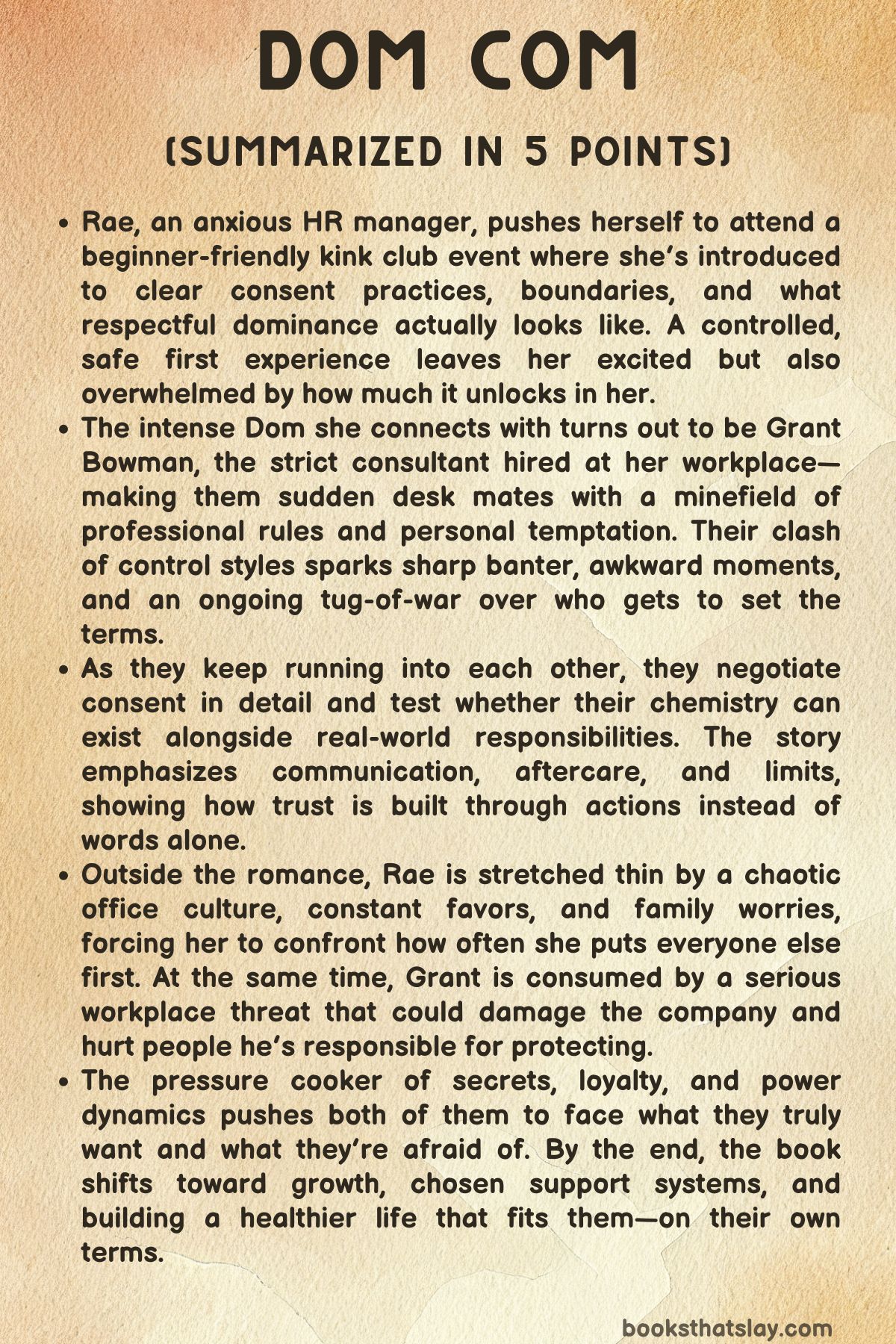
Dom-Com by Adriana Anders is a contemporary romance that pairs workplace tension with a carefully negotiated BDSM dynamic. Rae Jensen, a stressed-out HR manager who’s tired of carrying everyone else’s needs, visits a private kink club to explore submission in a safe, structured way.
There she meets “the General,” a disciplined Dom who prioritizes consent and communication. The twist lands fast: he’s Grant Bowman, the new consultant at her company—and her new office mate. As professional boundaries collide with private desire, they navigate power, trust, and responsibility while a corporate sabotage threat tests the stability of Rae’s workplace and their growing connection.
Summary
Rae Jensen spends days circling a red-brick building, working up the nerve to step inside the basement kink club she has researched online. She’s anxious, still raw from her breakup with Brendan, and already bracing for more stress at work because her company is returning to in-office life under a new consultant named Grant Bowman.
At the door to Off the Cuff, she hesitates long enough that the bouncer—Harlow, dressed in black—notices. A pack of drunk men jostles her, knocking her phone down, and Siri blurts out that she’s looking for the club.
Mortified, Rae expects judgment. Instead, Harlow calmly checks her registration under her last name and lets her through.
Rae is surprised by what she finds inside: a polished, welcoming space that feels upscale rather than grimy or dangerous. At the front desk, the platinum-blonde hostess introduces herself as Mistress Daff and cheerfully explains that tonight is guest night.
The event is Dom/sub speed dating. Rae hands over her phone and personal items, answers intake questions about her identity and what she’s seeking, signs a waiver, and reviews her BDSM checklist—an explicit, detailed form designed to clarify interests, limits, and boundaries.
When Daff suggests she pick a kink name, Rae chooses “Sunny.” She receives a name tag that openly labels her as new and a printed version of her checklist to use during the event.
Behind the scenes, Grant Bowman is at the club too, finishing a plumbing fix behind the bar. The event is being run by Lucas, nicknamed Tank, who enjoys the social buzz and the chance to welcome new people into the scene.
Grant is less enthusiastic about speed dating, believing kink requires care and attention that a fast rotation can’t always support. Still, he stays involved because the club matters to him, and he trusts Tank’s judgment.
When Sunny enters, Tank clocks her nerves and reads enough of her checklist to realize she’s looking for a specific kind of dominance: firm control without cruelty, intensity without pain, and clear communication.
Rae sits through a string of short dates that leave her discouraged. Some men are awkward and unsure how to lead.
Others push dynamics she doesn’t want, or treat her boundaries like a menu they can negotiate away. She keeps noticing one man at the bar—broody, sharp-eyed, and visibly annoyed by the spectacle—who somehow feels more commanding than anyone she’s spoken to.
Her night turns when she’s paired with a man who calls himself “Daddy Brice.” He grabs at her checklist and starts pressuring her, ignoring the clear limits she already stated. Rae freezes, unsure whether to cause a scene.
Before she has to fight her way out of the moment alone, the man from the bar steps in. His voice cuts through the noise with authority.
He yanks the offender away, orders him to stop, and hands him off to staff. Harlow physically escorts the man out, and the club’s response makes it plain that consent violations are not tolerated.
The man who intervened returns to Rae and apologizes for what happened. He doesn’t flirt or play hero.
He explains, simply and directly, what a responsible Dom does: set ground rules, ask questions, listen, and treat the submissive’s consent as the center of everything. Rae, shaken but also relieved, asks if he’s a Dom.
He hesitates and says he isn’t looking for a sub. Tank solves that problem by calling him over anyway.
He calls the man “Gen” and tells him he owes Sunny a speed date for disrupting the rotation. Cornered and clearly irritated by Tank’s grin, the man sits.
He introduces himself as “the General.” Rae admits what she wants: to give up control in a way that feels safe, to stop carrying the mental load for everyone, and to experience dominance without being hurt. The General listens, then confirms something important—she wants submission, not pain.
He keeps his tone steady, gives instructions that are specific and achievable, and emphasizes that communication is non-negotiable. Rae chooses to call him “Sir,” and the shift in energy is immediate.
Grant—the man behind the title—recognizes how closely Rae’s checklist aligns with his own preferences. He tells himself he shouldn’t take on someone new to the scene, and he definitely shouldn’t start anything that could become complicated.
Even so, he starts building consent in deliberate steps. He begins with nonsexual touch, placing his hands where she agrees, checking her reactions, and watching her body loosen as he works tension out of her shoulders and back.
Rae responds to his control with a mix of surprise and need, and when he praises her, the words land like a switch flipping.
Rae’s nerves make her chatter, and she briefly derails the moment with a random conversation about cat Halloween costumes. Grant doesn’t punish her for it.
He guides her back, makes her name what she wants, and corrects her when she tries to offer vague, blanket permission. He wants clarity, not guesswork.
When he tells her to touch herself through her dress, she obeys, turned on by how steady his authority feels. The speed-dating room shifts around them as other pairs begin scenes, but Rae is locked into Grant’s focus, feeling controlled without feeling trapped.
The event ends abruptly when Tank announces time. Rae’s floating, overwhelmed, and not ready to deal with normal life again.
Grant tries to stop her from rushing out, insisting on aftercare—basic post-scene support to ensure she’s grounded and okay. Rae refuses, insisting she’s fine and claiming she has people waiting at home.
She tries to flatten the moment into a joke, tosses him exaggerated compliments, and bolts.
Outside, Rae tells Harlow she had an amazing night, even if it was a lot. She goes home to her small garage apartment, feeds her cat Pepe, and loses herself in the miniature “book nook” scenes she builds—tiny, detailed worlds that make her feel capable and calm.
She calls her best friend Samantha to debrief, then gets an alert from her father’s monitoring app. Rae checks on him with her sisters and video-calls him.
He’s warm and upbeat, wearing his Christmas robe early, and wants to see her newest miniature project. The call steadies Rae.
She decides she might go back to the club the next weekend.
Grant can’t let the unfinished scene go. Feeling responsible, he texts Harlow for Rae’s number, then immediately regrets crossing that line—but the contact happens anyway.
Rae replies to Grant’s check-in, thanks him for making sure she got home safe, and admits she’d like to play again. Grant fights his own interest and says no to that.
He offers something safer: he can show her around the club and introduce her to reputable Doms. Rae agrees, polite but clearly disappointed.
Grant saves her contact anyway, telling himself it’s just in case she needs advice. He labels her “Subby Sunny,” then lies awake fantasizing about her.
On Monday, Rae arrives at work carrying supplies and cookies, preparing for the chaos of Sugar’s new office. Samantha gushes about the renovated space and casually mentions they’re located above a club.
Rae’s stomach drops when she realizes the address is the same building as Off the Cuff. Inside, Sugar is exactly as chaotic as ever: Dorothy, the founder, sweeps in with hugs and bold ideas, talking as if everyone’s personal lives are community property.
Rae hurries toward a staff meeting and collides with a tall man who steadies her. She recognizes his voice before she sees his face.
It’s him.
In front of the entire team, Rae blurts, “Sir?” Silence lands. The man stiffens, furious and confused, demanding to know what she’s doing there.
Rae snaps back that she works there—she’s Rae Jensen, the HR manager. He introduces himself as Grant Bowman, the consultant hired to investigate a supposed security problem and streamline operations.
Rae realizes, all at once, that the Dom she trusted with her body is now positioned as a potential threat to her coworkers’ jobs—and he’s about to share an office with her.
The meeting is a disaster. Grant tries to impose discipline, including banning snacks during business, and the staff pushes back hard.
Dorothy backs nobody consistently, bouncing between demands and jokes. Rae watches Grant push control harder, and she senses something personal underneath his rigid professionalism.
Afterward, Grant confronts Rae privately. He declares they need rules: no mixing personal and professional, and he insists she should not return to the club.
Rae refuses to be controlled outside work, especially by a man claiming they must keep the worlds separate. Their argument is interrupted by Dorothy’s latest strange benefits idea, which Rae immediately supports as a way to keep Dorothy happy and keep the day moving.
Their shared office becomes a pressure cooker. Rae is constantly interrupted by employees who treat her like the company’s caretaker, and she keeps saying yes out of habit.
Grant watches her absorb everyone’s needs and gets increasingly irritated—partly because he’s trying to do a high-stakes investigation, and partly because he’s watching Rae exhaust herself. When Rae tries to wrangle a heavy water cooler alone, she spills water all over herself, soaking her clothes.
Grant handles the jug easily, then scolds her for taking on tasks that aren’t hers. When her shirt turns see-through, he blurts that she should take it off.
A coworker walks in at the wrong moment and jokes, and Rae flees in humiliation.
Grant panics about the boundary he just crossed and responds the way he always does when scared: he tightens control. He types up “OFFICE RULES” and leaves them on Rae’s desk—no touching, door always open, and the club off-limits.
Rae arrives early, sees the list, and adds her own rule in retaliation: no glowering. The childishness of it doesn’t erase the real problem: their attraction is alive, and neither of them is good at pretending it isn’t.
Despite the rules, their dynamic keeps slipping into place in the margins. Grant notices Rae’s discomfort at her desk and buys her an ergonomic footrest without making a big deal of it.
He learns her coffee preferences and takes over small caretaking tasks. Rae is unsettled by how much that gentleness affects her, and she’s furious that it feels good.
Late nights at the office become dangerous. They end up alone, and the tension snaps into a private, consensual power-exchange scene.
Grant explains that what he wants isn’t just sex—it’s control through delay, making Rae wait until he decides she can finish. Rae agrees, eager and compliant.
They keep it quiet, aware that they could be interrupted. Grant checks in on consent through structure: rules, warnings, and clear options.
When Rae finally climaxes, Grant’s reaction surprises her. He turns tender, kissing her in a softer way than she expected from him.
Dorothy interrupts them by knocking and telling them it’s time to go. Grant restores the room to normal in seconds.
Rae escapes to her car, mortified and laughing at how close they came to being caught.
Their private arrangement becomes more explicit. After Rae spends a night caring for sick family members, Grant sees how exhausted she is and steps into a more direct caretaking role at work.
He also becomes more vocal about how she’s being used by everyone around her. In a moment that is both controlling and oddly protective, he restrains Rae to her chair with her own belt in a way she can undo easily, hiding it so others won’t see.
Rae is shocked—but also realizes how much she responds to his leadership when it’s anchored in care rather than force.
When Rae’s sister and Samantha appear unexpectedly, Rae panics, and Grant smoothly covers for her. After they leave, Rae confronts Grant about what he’s doing.
He pushes the conversation into explicit negotiation: limits, safe words, what is allowed, what is off-limits, and what kind of intensity Rae wants. Grant provides proof of recent STI testing and insists on protection.
Only after that does he take her into a more intense scene, and afterward he refuses to let her rush away. If they continue, he wants it done properly, including aftercare and check-ins.
They formalize their arrangement by phone: Grant will stay within Rae’s limits, get consent before adding anything new, and provide aftercare. He sets a hard end date tied to his consulting assignment—no more than three weeks.
He also sets a rule that feels designed to test Rae’s patience: no orgasms unless he permits them, and complete honesty from her. Rae responds by wearing lingerie to work just to provoke him, determined to challenge his control without breaking their agreements.
At the same time, Sugar’s bigger crisis erupts. Dorothy’s son-in-law, Dane Wabash, claims there’s been a data breach, that Sugar’s user information has appeared on the dark web, and that he “caught it in time.” He tries to use the accusation to fire Grant and take control with the investors’ support.
Dorothy refuses to be pushed out of her own company, and Grant becomes laser-focused on proving what’s real. Rae tries to support him, but Grant turns cold, blaming himself for being distracted and insisting their relationship was a mistake.
Rae is crushed and furious. She refuses to let him rewrite what they shared into nothing, but he keeps pulling away.
Rae leaves and breaks down at home.
While Rae is hurting, her family life shifts too. Her sisters drag her to check on their father when he seems off, only to discover he’s fine—and dating Rae’s former English teacher, Laura Barcom-Tancredi.
The shock gives way to an odd kind of relief. Their father is alive, happy, and allowed to have a life of his own.
It forces Rae to confront how much she’s been living as the family’s manager instead of as a person who also deserves care.
Grant’s investigation finally turns. Dane provides a “sample” of the leaked data, and Grant recognizes it immediately: it’s dummy data—fake information Grant planted as a security trap.
That means Dane didn’t access real user data. He accessed a decoy file.
Grant traces how it happened and realizes the access came through Dorothy’s home setup. Her home computer can reach the office network, and the password is based on personal details Dane would easily know as family.
Dane used that weak point to access the dummy file and tried to frame it as a breach.
The last missing piece comes from Samantha. She shows up late at night, sick with guilt, and confesses she was dating a married man: Dane.
She didn’t know the full scope at first, but she hid it too long, and she’s already called Dorothy and Grant to admit what happened. Rae takes the hit hard—not just betrayal, but exhaustion from always being the one holding everyone together.
With her sisters and friends around her, Rae finally admits she can’t keep carrying everything alone.
The showdown happens at the office. Dane arrives with investors and attempts to humiliate Dorothy and seize control.
Then Grant walks in with a cyber crimes detective and a forensic accountant. They lay out the case: Dane accessed Dorothy’s personal computer while everyone was away, pulled the dummy data, and tried to use it as leverage.
They also reveal evidence of financial crimes—embezzlement and money siphoned from Dorothy’s accounts. Grant assures the investors that real user data was not distributed.
Dorothy takes control, offers the investors a buyout packet with a deadline, and Dane is led away, no longer in charge of the narrative.
In the aftermath, Rae changes her life. She leaves Sugar and leans into her miniature business full time.
Her work explodes in popularity after an influencer boost, and Rae learns to say no without apologizing. She builds the kind of career that doesn’t require her to be everyone’s emotional employee.
Grant, meanwhile, sits with the consequences of his fear. He regrets how he ended things with Rae, realizes how narrow his life has been, and understands that control has been his shield.
A message from his mother about choosing independence nudges him toward a different kind of courage: not dominance as armor, but honesty as risk.
By November, Grant finds Rae at a harvest market where she’s selling her work. He’s nervous, unpolished, and direct.
He tells her she changed him. He tells her he loves her.
Rae is overwhelmed, but she kisses him, and they agree to start again without hiding behind contracts and deadlines. Grant brings her to his home and reveals he built her a backyard workshop modeled after her dream workspace, stocked and ready, with thoughtful details that prove he’s been paying attention the whole time.
Rae accepts, not as a surrender, but as a choice.
Months later, they settle into a shared life that includes affection, family, pets, and kink shaped on their own terms—no rules unless they want them. Rae’s father is happy, Dorothy remains part of their extended orbit, and their friends and sisters fill their home.
In the epilogue, they host Thanksgiving with a crowded, messy, joyful house, and Rae recognizes that her life is bigger now—not because she’s doing everything for everyone, but because she finally let herself be met, supported, and loved.
Characters
Rae Jensen
Rae is the emotional lens of Dom Com, a woman who is outwardly competent and inwardly overloaded, using careful control as armor until she deliberately seeks a space where she can safely relinquish it. Her first night at Off the Cuff shows both her courage and her vulnerability: she arrives anxious, carrying recent relational hurt, work stress, and the dread of being judged, yet she still chooses to walk through the door and advocate for what she wants.
Rae’s character is defined by an intense sense of responsibility—at work she absorbs everyone’s needs, and at home she monitors family crises, nurtures her cat, and pours meticulous care into her book-nook craft. That caretaking instinct is both her strength and her trap; it keeps her reliable and loved, but it also leaves her depleted, resentful, and prone to self-erasure.
Her kink curiosity isn’t portrayed as a sudden personality shift, but as an honest expression of a long-standing craving: she wants to stop bracing for impact and feel held by structure, clarity, and consent. Over time, Rae’s arc becomes less about finding a Dom and more about finding herself—learning to set boundaries, say no without guilt, and build a life where her generosity isn’t constantly exploited.
Her eventual success with her miniature business is the clearest symbol of that growth: she turns her devotion to detail and beauty into independence, and when love returns, she meets it from a place of choice rather than need.
Grant Bowman
Grant is the story’s central tension engine—a man who is deeply controlled, hyper-competent, and fiercely principled about consent, yet emotionally avoidant and terrified of wanting more than he can manage. As “the General” at Off the Cuff, Grant’s dominance is careful rather than cruel: he insists on questions, clear rules, safewords, step-by-step consent, and aftercare, and his response to boundary violations is swift and protective.
That steadiness is not performative; it’s rooted in a genuine ethical framework that makes him a safe presence in a setting where vulnerability can be mishandled. At work, those same traits harden into rigidity—he tries to impose order on Sugar’s chaos, not only because he prefers discipline, but because he believes disorder is dangerous, especially with a looming security threat.
His internal conflict is that he is drawn powerfully to Rae precisely because she cracks his narrow life open; she’s warmth, humor, mess, and heart, everything he pretends he doesn’t have time for. When the breach crisis peaks, Grant retreats into fear and self-blame, defaulting to the only “solution” he trusts: cutting off emotion and calling their bond a mistake.
His later turnaround isn’t a simple grand gesture; it’s an acceptance that love requires risk, humility, and repair. The workshop he builds for Rae is meaningful because it’s not dominance—it’s service, observation, and commitment, a physical proof that he has learned to support her dreams without controlling the terms of her life.
Samantha
Samantha functions as Rae’s closest mirror, the friend who provides warmth, humor, and practical encouragement while quietly carrying her own messy secret. She is the first person Rae reaches for after Off the Cuff, which establishes Sam as Rae’s emotional home base: the one who makes Rae feel safe enough to confess uncertainty without being shamed.
At work she appears upbeat and supportive, but the narrative gradually reveals exhaustion, evasiveness, and distraction—signals that she is dealing with something she can’t admit. Her arc becomes a study in how shame isolates people: she hides the identity of the married man she’s been seeing because speaking it aloud would force her to confront what it says about her choices.
When the truth surfaces—that the man is Dane—Sam’s guilt is not framed as melodrama but as a realistic rupture in trust, especially because her silence contributes to the workplace crisis and Rae’s emotional spiral. Yet Sam also shows integrity when it matters: she confesses, apologizes, and comes to Rae with supplies and support, accepting the consequences rather than defending herself.
Ultimately, Sam’s character underscores the book’s theme that secrecy corrodes relationships, while honesty—though painful—can become the first step toward repair and community.
Dorothy
Dorothy is the chaotic, charismatic heartbeat of Sugar, an entrepreneur whose leadership style is impulsive, indulgent, and fiercely loyal. She treats her company like a family in the best and worst ways: she showers people with affection, creates quirky traditions, and believes morale is as vital as metrics, but she also enables disorder by making whimsical decisions and outsourcing structure to others.
Dorothy’s superficial flightiness disguises a core of steel; when threatened, she becomes decisive and strategic, refusing to be bullied out of what she built. Her blind spot is trust—she assumes closeness equals safety, which is why her insecure home tech setup becomes the weak point that Dane exploits.
Still, she owns her mistake once the truth is clear, collaborates with Grant rather than competing with him, and pivots fast to protect both the company and its people. Dorothy also represents a particular kind of power that contrasts with Grant’s: where he uses rules and restraint, she uses relationship and momentum.
By the end, her presence at the crowded Thanksgiving table signals that her version of “family” has widened into something earned, not just declared.
Lucas “Tank”
Tank plays the role of gatekeeper and instigator within Off the Cuff, blending community responsibility with a blunt, teasing style that nudges people toward what they actually want. As the event runner, he’s attentive to compatibility and safety, quickly noticing that Rae’s interests don’t match his own rougher preferences, and redirecting her rather than trying to fit her into his dynamic.
His influence over Grant is particularly important: he calls Grant out, pushes him into a speed date he wants to avoid, and uses humor and pressure to force a moment of connection that becomes the story’s catalyst. That meddling could read as intrusive in another context, but here it reflects a community culture where experienced members intervene to prevent harm and encourage ethical play.
Tank’s presence also signals that kink in this world is not purely private fantasy; it’s social, structured, and shaped by norms that protect newcomers. He’s less about romance and more about the ecosystem—someone who keeps the environment functional, safer, and a little bit unpredictable.
Harlow
Harlow is the club’s physical boundary line, the person who controls access and makes “safety” feel tangible rather than theoretical. He’s introduced as intimidating—a black-clad bouncer watching Rae hesitate—but that intimidation quickly becomes reassuring once he verifies her registration and calmly handles the situation with the drunken men outside.
His decisive removal of the pushy “Daddy” later reinforces his role as enforcer of consent culture: when someone crosses a line, Harlow doesn’t debate, he acts. He also functions as a quiet connector between Grant and Rae after the speed-dating night, facilitating communication while still keeping the club’s systems in place.
Harlow’s characterization is efficient but significant: he represents the infrastructure that allows vulnerability to exist inside the club without turning into danger, and he helps the story insist that safety is a practice maintained by people, not just a word on a waiver.
Mistress Daff
Mistress Daff is the welcoming architecture of Off the Cuff, a hostess whose warmth and competence turn Rae’s fear into something manageable. Her introduction—enthusiastic, polished, and organized—immediately reframes Rae’s assumptions about kink spaces; instead of sleaze, Rae finds professionalism, cleanliness, and clear process.
Daff guides Rae through consent-forward logistics: intake questions, pronouns, identity, a waiver, and the detailed checklist that later becomes foundational to Rae and Grant’s dynamic. She is also a subtle model of confidence—someone who treats kink not as shameful secret but as a normal part of adult life with rules and etiquette.
Although she doesn’t dominate the plot, Daff’s presence matters because she sets the tone: the book’s kink isn’t a chaotic temptation, it’s structured, negotiated, and supported by competent women as well as men.
Brendan
Brendan exists mostly as a shadow over Rae, but that shadow clarifies what Rae is moving away from. He represents the past that makes Rae second-guess herself—romantic disappointment, emotional residue, and the fear that desire leads to humiliation.
Even when he’s not physically present, Rae’s attempts to avoid thinking about him show how recently she was hurt and how hard she works to keep pain contained. Brendan’s narrative function is contrast: against him, Rae’s experience with Grant feels radically different—not because it is instantly perfect, but because it is grounded in listening and consent rather than taking.
He is less a fully drawn antagonist and more a marker of Rae’s starting point, the reason her first act of bravery is simply choosing a new door.
Hannah
Hannah helps anchor Rae’s family identity, emphasizing that Rae’s sense of duty didn’t appear at work out of nowhere—it’s woven into her family life. Through Hannah, we see Rae as the sibling who takes responsibility, who responds to alerts, who coordinates when something might be wrong with their father.
Hannah’s connection to Rae’s book-nook work, including commissions, also reinforces the idea that Rae’s craft is not a random hobby but a meaningful thread tying her to home, memory, and care. While Hannah isn’t a constant on-page presence, she contributes to the story’s emotional realism: Rae’s romantic journey is happening alongside ordinary family obligations, the kind that make personal needs easy to postpone.
Otty
Otty intensifies the family dynamic by showing how Rae’s private burdens become visible when crisis hits. When their father’s heart-rate readings spike and he doesn’t answer, Otty’s arrival with Hannah becomes an intervention—proof that Rae is not the only one who can carry worry, even if Rae usually tries to be.
Otty’s presence also heightens Rae’s vulnerability at work when she unexpectedly appears in the office; those moments force Rae to juggle identities—professional, sister, submissive—while still pretending nothing is happening. Otty functions as both pressure and support, someone who complicates Rae’s attempts at compartmentalization and nudges her toward the truth that she needs help, not just more endurance.
Rae’s Father
Rae’s father is a gentle emotional counterweight, a source of warmth that complicates Rae’s fear of vulnerability. His heart monitoring app creates a recurring thread of anxiety—Rae is always one alert away from panic—which explains part of why she is so tightly wound and so practiced at managing stress.
Yet when he appears, he’s affectionate, chatty, and disarmingly present, asking to see Rae’s miniature work and offering uncomplicated praise that makes her feel seen. His late reveal—that he is dating Laura, and that he met her through the Sugar app—adds humor and tenderness while also reinforcing a core theme: intimacy is possible at any stage of life, and people can surprise you by choosing joy.
He also indirectly supports Rae’s arc toward releasing responsibility, because the story makes clear he is not a fragile object she must constantly rescue—he is a whole person capable of love, desire, and decisions.
Ms. Barcom-Tancredi (Laura)
Laura brings an unexpected softness and possibility into Dom Com, arriving as a twist that shifts a family “emergency” into a revelation about adult companionship. As Rae’s former English teacher, she represents continuity with Rae’s past, but her presence in Rae’s father’s life reframes that past as something living rather than finished.
The initial shock gives way to acceptance, and that progression mirrors the book’s broader attitude toward taboo and judgment: what matters is consent, happiness, and honesty, not the labels outsiders might impose. Laura also quietly reinforces the Sugar app’s intended purpose—connection—at the moment when the company’s reputation is under attack, turning what could be mere plot garnish into thematic balance.
Dane Wabash
Dane is the story’s central manipulator, a man who weaponizes performance, access, and plausible-sounding concern to seize control. He positions himself as a whistleblower—claiming he found a leak and “saved” the company—while simultaneously using intimidation, investor pressure, and public humiliation to destabilize Dorothy and isolate Grant.
His cruelty isn’t only professional; it turns personal when he brandishes intimate photos and uses Rae and Grant’s vulnerability as leverage. Dane’s threat works because it exploits weak points: Dorothy’s trusting nature, the company’s messy culture, and the fear that shame will keep people quiet.
The reveal that his “sample” data is actually dummy data planted by Grant exposes Dane’s pattern: he doesn’t need truth, he needs a story that creates panic and gives him authority. His relationship with Samantha adds another layer of harm, showing how his self-interest spreads outward, pulling others into secrecy and guilt.
Dane’s eventual takedown is satisfying not because it’s flashy, but because it restores moral order: he is confronted with evidence, investigated, and removed, and the people he tried to control reclaim agency.
Klaus
Klaus functions as a barometer for the workplace culture, representing the staff’s anxious loyalty to Sugar and their suspicion of outsiders. His birthday celebration and the office’s food traditions highlight how the company bonds through ritual and familiarity, which makes Grant’s disruption feel threatening even when his concerns are valid.
Klaus’s confrontation with Rae about Grant also shows how employees look to Rae as an emotional regulator, someone expected to soothe fears and keep the environment stable. He isn’t framed as malicious; he’s a colleague reacting to uncertainty, voicing what others whisper.
Through Klaus, the narrative shows the social cost of workplace turmoil: even small moments become charged when everyone suspects something bigger is wrong.
Blake
Blake works alongside Klaus as another voice of office rumor and concern, amplifying the sense that Rae is always being watched, evaluated, and pulled into everyone’s emotional needs. Blake’s worry about Grant harming the company adds pressure to Rae’s already complicated position, because she can’t fully deny the threat without revealing the personal truth that would make the situation even messier.
Like Klaus, Blake isn’t an enemy; he’s part of the anxious ecosystem that makes Rae’s people-pleasing both socially rewarded and personally punishing. His presence helps underline why Rae’s growth—learning to stop carrying everything—matters not only for her romance, but for her survival in a workplace that constantly asks for more.
Pepe
Pepe, Rae’s cat, is a small but meaningful emotional anchor, representing comfort, routine, and uncomplicated affection in a story full of negotiation and uncertainty. Rae feeding him, returning home to him, and building her quiet life around caring for him highlights how nurturing is Rae’s default language—and how she deserves spaces where she is nurtured back.
Pepe also supports the tone: he’s part of the cozy domesticity Rae is building even before the romance stabilizes, suggesting that Rae’s happy ending is not “being rescued,” but expanding a life she already made with her own hands.
Devil Cat
Devil Cat reflects Grant’s hidden softness, a living contradiction to his stern exterior. The cat’s presence at Grant’s home, lounging in the workshop Grant builds for Rae, signals that Grant’s world has always had room for attachment—he just kept it contained and private.
Devil Cat also mirrors Grant himself: a creature with sharp edges who still wants comfort, territory, and belonging. By sharing that part of his home life with Rae, Grant is doing something more intimate than any command—he is inviting her into permanence, routine, and the unglamorous reality of partnership.
Themes
Consent, Boundaries, and Ethical Power Exchange
The speed-dating night at Off the Cuff establishes a sharp contrast between performative dominance and responsible dominance, and Rae’s experience becomes a practical lesson in what consent actually looks like when power is part of the attraction. She arrives anxious, carrying old relational baggage and the fear of being misread, and the club’s process—intake questions, waiver, checklist, a chosen name—frames kink as something that runs on clarity rather than impulse.
That structure matters because Rae meets people who push fantasy as entitlement: men who project their preferred roles onto her, rush escalation, or assume that “submission” equals broad permission. The turning point comes when a man tries to override her limits and treat her checklist as an argument to win, not information to respect.
Grant’s intervention is not only protective; it becomes instructional. He articulates the core ethic: a Dom sets ground rules, asks questions, listens, and keeps the submissive in control of consent even while directing the scene.
Rae’s arousal is tied to this exact combination—firmness with care—because it allows her to let go without feeling trapped.
As their dynamic continues, consent stays active rather than ceremonial. Grant repeatedly redirects Rae away from vague, blanket approval and toward specific agreements, which shows a theme many romances skip: wanting intensity does not eliminate the need for precision.
When “punishment” is mentioned, it is treated as something to negotiate, not something a Dom can improvise as discipline. Even the orgasm restriction later is framed as consensual structure with defined time limits, not as coercion.
The story keeps returning to the idea that the sub’s freedom is protected by the Dom’s responsibility, and that trust is built through repetition—check-ins, safewords, aftercare, proof of testing, and explicit limits. This theme also extends beyond sex: the workplace “rules” and the fight over what either of them can control show how easily boundaries can be misused as a way to manage fear.
The book argues, through consequences, that boundaries work only when they are mutual, specific, and respectful; otherwise they become another form of pressure wearing the mask of safety.
Control, Letting Go, and the Need to Feel Safe
Rae’s desire is not simply to be told what to do; it is to stop carrying the mental load that dominates her everyday life. She enters the club tense, self-conscious, and preoccupied by the expectation that she must manage everyone’s reactions.
Her attraction to submission is rooted in the relief of temporarily handing over decision-making to someone who is paying close attention. Grant’s style fits that need because his control is deliberate: he slows the pace, keeps instructions clear, and watches for signs that her mind is drifting, not to scold her for imperfection but to bring her back into the experience.
The story treats that “headspace” as a real psychological state with inputs and outputs—tone, permission, pacing, praise, and the safety of knowing she can stop everything. Rae’s humor and random distractions during the first scene are not played only for comedy; they show her nervous system protecting itself.
When she realizes what Grant is asking for, she chooses to step into it, and that choice is presented as the key difference between surrender and being pushed.
Grant, meanwhile, uses control as a shield in his own life. He insists he does not take “newbies,” rejects commitment, and tries to reduce what he feels to a contained scenario.
His control extends to his job: he wants meetings run his way, cookies removed, chaos minimized, and the company’s vulnerabilities sealed. But the more he feels, the more his self-control slips—at work, where their proximity tempts him into behavior he immediately recognizes as a risk.
Their relationship becomes a pressure test: Rae wants to let go safely, while Grant wants to stay safe by not letting anything matter. The plot repeatedly shows that control without emotional honesty becomes brittle.
When the breach crisis hits, Grant defaults to shutdown, and he calls their connection a mistake not because it was empty, but because it threatens his ability to stay armored. Rae’s growth is visible in how she refuses to accept that framing.
She stops negotiating against his fear and begins prioritizing her own well-being. In the end, the theme resolves not with Rae giving up submission or Grant giving up dominance, but with both redefining control as something flexible: they keep power play because they enjoy it, not because it is a substitute for emotional security.
Safety becomes the real aphrodisiac, and letting go becomes possible only after both characters prove they can handle what happens after intensity, not just during it.
Identity, Shame, and Owning Desire
Rae’s first walk past the building captures a familiar conflict: wanting something intensely while expecting to be judged for it. Her anxiety is not only about kink; it is about visibility—being seen wanting, being seen choosing, being seen as someone who does not fit the polite expectations she manages at work and in her family.
The club’s environment challenges her assumptions. It is clean, organized, and professional, which undermines the stereotype that kink is automatically unsafe or degrading.
That shift matters because Rae’s shame is partly borrowed from cultural messaging that frames female desire as either “acceptable” romance or “dirty” appetite. By choosing a kink name and wearing a tag that openly states what she is looking for, she experiments with honest self-definition.
Even the checklist functions as a tool for identity: it forces her to separate curiosity from limits, fantasy from practice, and desire from obligation.
Grant has his own version of shame: he is comfortable with dominance, but he is uncomfortable with how much he wants Rae. He hides behind principles—no newbies, no commitment, separation of work and private life—yet the story shows how those principles can become excuses when they are used to avoid vulnerability.
His internal conflict intensifies once Rae becomes his colleague, because now his desire is entangled with reputation, authority, and the fear of harming someone. That fear is not irrational, but it becomes unhealthy when it turns into rigid denial.
Rae’s embarrassment in the staff meeting—blurting out a private honorific—creates a public collision between her hidden self and her professional self. Instead of treating it as a humiliation she must erase, the narrative treats it as a forced integration: she cannot keep splitting herself into “work Rae” and “wanting Rae” forever.
The later reconciliation emphasizes ownership of desire as maturity rather than recklessness. Rae’s success with her book-nook work symbolizes a broader shift: she stops shrinking her wants to fit other people’s comfort.
Grant’s love confession lands because it is not a seduction tactic; it is a surrender of his earlier defenses. The theme suggests that shame fades when desire is paired with self-respect and when partners treat each other’s wants as normal human truths rather than secrets to manage.
Kink, in this frame, becomes one language for honesty, not the reason the characters need honesty.
Work, Power, and the Ethics of Professional Boundaries
The workplace storyline in Dom Com is not just a convenient setup for proximity; it raises the question of what authority means when personal dynamics exist in the same space. Rae is HR, which makes her especially sensitive to fairness, safety, and the informal labor people try to dump on “the helpful one.” Grant arrives as a consultant expected to cut costs, so he is immediately coded as a threat.
Their private roles—Dom and sub—collide with public roles—desk mates with unequal perceived power—creating a constant risk of blurred consent. The “office rules” are an attempt to impose clarity, but they also reveal how power can be wielded paternalistically.
Grant’s insistence that Rae not return to the club contradicts his claim that personal and professional must be separate. His boundary becomes control, and Rae correctly calls it out.
The office itself is chaotic: Dorothy leads through whim, traditions, and emotional closeness, while Grant leads through structure and risk assessment. Their conflict dramatizes a theme about organizational power: a company can be functional even when it does not match a rigid corporate template, but it becomes vulnerable when informal access and weak security are treated casually.
The breach crisis shows that “power” at work is not only about who can fire whom; it is about who has access, who is trusted by default, and who is allowed to operate without scrutiny. Dane exploits relational access—family knowledge, proximity to Dorothy’s home setup—to manufacture a narrative of competence and take control.
Grant counters not with dominance theater but with evidence, procedure, and external accountability: law enforcement, forensic accounting, and clear proof.
Rae’s arc in the workplace focuses on invisible labor. She says yes to everything, absorbs interruptions, and becomes the emotional buffer for the entire team.
Grant’s frustration is partly protective and partly personal, but the story makes a clear point: competence can become a trap when it is rewarded with more unpaid expectation. Rae’s later ability to say no—paired with her decision to leave and build a career around her craft—reframes power as choice.
The romance ends up supporting this theme rather than undermining it: Grant’s grand gesture is not only a gift; it is a practical redistribution of resources that respects Rae’s work as real work. Professional boundaries remain important, but the book argues they should protect autonomy, not police desire, and that ethical leadership—at work and in intimacy—depends on transparency and accountability.
Care, Aftercare, and Chosen Family
Care appears in two parallel systems: kink aftercare and everyday caretaking in family and community. Rae’s first exit from the club shows what happens when care is interrupted.
She leaves in a heightened state and insists she is fine, partly because she is overwhelmed and partly because she is used to being the one who handles herself. Grant’s reaction reveals his value system: he is unsettled not because he lost control of a scene, but because he believes responsibility continues after the intensity ends.
That belief becomes a consistent marker of his character. Even when he tries to deny emotional involvement, he checks on her safety, wants her to have reputable contacts, and frames follow-up as a duty rather than flirtation.
Rae’s home life reinforces why she struggles to receive care. She is managing her father’s health monitoring, supporting sisters, soothing a best friend, and still trying to hold her own life together.
She feeds her cat, works on miniatures, bakes for coworkers, and responds to constant demands. Care is her default mode, so accepting care feels unfamiliar and sometimes threatening.
Grant’s softer actions—making her coffee, buying a footrest, quietly handling laundry—are significant because they meet her where she lives: in small practical help rather than speeches. This tenderness unsettles Rae precisely because it is not a performance; it suggests she does not have to earn care through usefulness.
The theme widens into chosen family through the ensemble: Samantha, the sisters, Dorothy’s strange but loyal workplace culture, and eventually the full-house Thanksgiving epilogue. Even the dad’s unexpected romance adds a layer: care does not have to shrink with age or illness; it can expand into new companionship.
When Rae finally admits she cannot carry everyone’s burdens alone, it is not framed as failure. It is framed as the moment she joins the mutual-care system instead of operating as a one-person support staff.
The final domestic rhythm—friends, pets, messy gatherings—signals that stability is not silence or perfect order. Stability is a network where people show up, tell the truth, repair harm, and keep choosing each other in practical ways.