Don’t Answer the Phone Summary, Characters and Themes
Don’t Answer the Phone by Miranda Rijks is a psychological thriller about desire, secrecy, obsession, and the danger of mistaking possession for love.
At its center is Daniella Morris, a married woman whose dissatisfaction with one part of her otherwise stable marriage leaves her vulnerable to the attention of Lucas Denman, a charming stranger with deeply disturbing motives. What begins as forbidden attraction gradually becomes a fight for survival as Lucas inserts himself into Daniella’s family, eliminates obstacles, and reveals a history shaped by violence and jealousy. The novel also examines marriage, friendship, abuse, guilt, and the consequences of hiding uncomfortable truths.
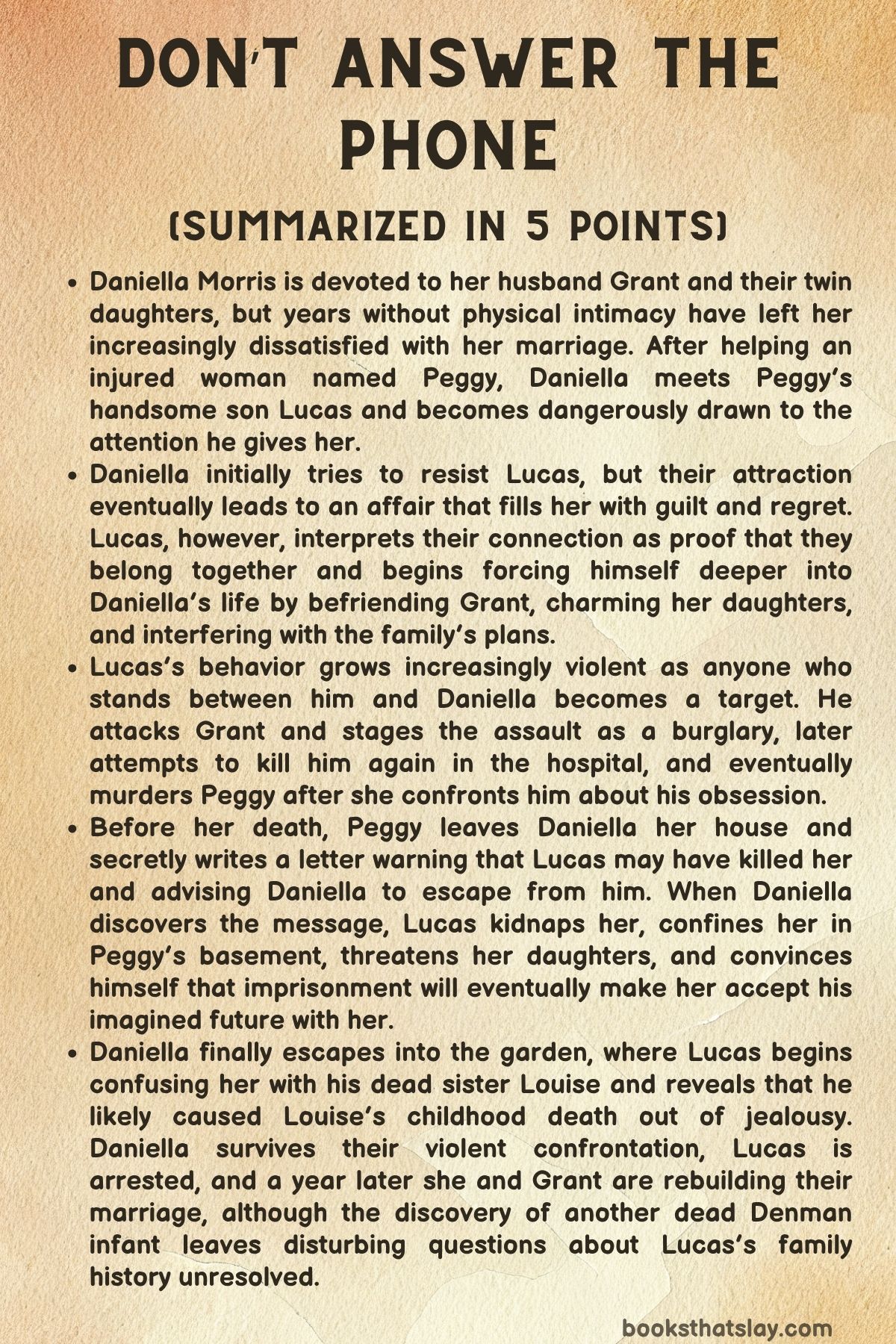
Summary
Years before the main events, Peggy Denman lives in a seemingly respectable household with her controlling husband and three children. While she is distracted by a ringing telephone, her young daughter suffers a fatal fall, and Peggy immediately suspects that the death was not truly accidental.
In the present, Daniella Morris lives in Boston with her husband, Grant, an MIT professor, and their twin daughters, Arlyse and Tasia. The girls are preparing to leave home, forcing Daniella to confront a long-standing problem in her marriage: she loves Grant deeply, but their physical relationship has been almost nonexistent for years.
While cycling to a couples-counseling appointment, Daniella witnesses an elderly woman named Peggy being attacked. She scares away the assailant, accompanies Peggy to the hospital, and there meets Peggy’s handsome son, Lucas, whose attraction to her is immediate and powerful.
Lucas quickly becomes fixated on Daniella. He visits her street late at night simply to stare at her house, then uses Peggy’s Labrador, Bippie, as an excuse to encourage Daniella to return regularly and walk the dog.
Daniella is troubled by her own reaction to Lucas because she genuinely values Grant’s kindness, humor, loyalty, and companionship. Couples counseling makes the problem clearer: Grant does not regard the absence of sex as especially troubling, whereas Daniella increasingly experiences it as a painful absence from their marriage.
Lucas begins openly pursuing Daniella and eventually persuades her to have dinner with him. Daniella lies to Grant about the outing, accepts Lucas’s compliments and attention, and responds when he kisses her, although she quickly stops him and declares that she loves her husband.
Lucas interprets her rejection not as a boundary but as temporary resistance. He immediately ends his engagement to Jade, even after she claims to be pregnant, because he has already convinced himself that Daniella is the woman with whom he should spend his life.
Daniella tries to distance herself from Lucas, but the temptation remains. During a period when Grant and the twins are away, Lucas engineers another encounter, enters Daniella’s home, and the two have sex, leaving Daniella overwhelmed by guilt even though the encounter temporarily satisfies the passion she has missed for years.
Peggy, meanwhile, understands that her son is far more dangerous than Daniella realizes. Lucas repeatedly demands money from her, becomes physically threatening when she refuses, and shifts between cruelty and false tenderness with disturbing ease.
The danger becomes more complicated when Jade confronts Daniella at the Silken Stem, the artificial-flower business Daniella owns with her longtime friend Lesley. Jade announces that Lucas abandoned her while she was pregnant and angrily warns Daniella to stay away from him.
Soon afterward, Jade is found dead from an overdose, apparently having taken her own life. Lucas claims she left a note saying she could not live without him, while Peggy responds to the death with an uneasiness suggesting that she knows more about Lucas and his capacity for harm than she is willing to say.
Grant begins making sincere efforts to repair his marriage, but Daniella discovers that her attraction to him has not returned. Her situation becomes frightening when Grant unexpectedly introduces Lucas as his new personal trainer and friend, revealing that Lucas has deliberately entered the Morris family’s daily life.
Lucas charms Grant and the twins and arranges to join them on a snowboarding weekend. During the trip he behaves carefully, but one of Grant’s ski bindings later appears to have been deliberately tampered with, raising the possibility that Lucas has already begun trying to remove him.
Peggy increasingly challenges Lucas about his obsession and tells him he needs professional help. His reaction becomes so violent that she is forced to flee toward a bathroom while he follows her carrying a knitting needle, confirming that even his mother is no longer safe from his rage.
Daniella begins imagining a new life away from Boston and prepares to sell the family home. The open house is mysteriously canceled by someone impersonating Grant, while Daniella’s friendship with Lesley is also deteriorating because Lesley’s boyfriend, Matt, is pressuring them to expand the Silken Stem into a much larger business.
Peggy asks Daniella to accompany Lucas to Jade’s funeral. At the hotel, Lucas becomes physically aggressive after Daniella rejects his plans for a future together, gripping her wrist until another guest intervenes, and Daniella finally begins to understand that his behavior is more than romantic persistence.
Lucas then decides Grant is the main barrier separating him from Daniella. After spending an evening with Grant, he steals a key, returns to the Morris home in disguise, attacks the sleeping Grant repeatedly with a hammer, stages the scene as a burglary, and steals the couple’s wedding photograph.
Grant survives because a neighbor notices suspicious activity and calls the police. Detective Sandy Briar quickly recognizes that the attack looks personal because valuable possessions have been ignored while the wedding photograph alone has disappeared.
Lucas later visits the hospital intending to kill Grant with stolen insulin, but Grant unexpectedly awakens and recognizes him before he can complete the plan. Fearful that Grant will expose him, Lucas decides he must stop waiting and take Daniella away.
Peggy finally asks Lucas directly whether he attacked Grant. Instead of denying it, Lucas threatens her, and she subsequently dies in what initially appears to be a medical incident.
Lucas tells Daniella that Peggy has died and uses Bippie as another means of maintaining contact. His private thoughts soon reveal that he murdered his mother and has justified the act by convincing himself she forced him to do it.
Peggy’s will creates another connection between Daniella and Lucas because she leaves her valuable Ivy Street house to Daniella. Daniella is confused by the gift, while Lucas interprets it as proof that Peggy wanted them together.
When Daniella meets Lucas at the house to sort Peggy’s belongings, she discovers a letter Peggy wrote before her death. Peggy warns that Lucas may have killed her and explains that she left the property to Daniella so Daniella could sell it, move away, and protect her family from him.
Lucas realizes that Daniella now understands the truth. He attacks her, knocks her unconscious, and imprisons her in the basement of Peggy’s house, convincing himself that confinement is merely a temporary measure until she accepts that they belong together.
Daniella realizes she cannot overpower him directly and begins pretending to cooperate. As Lucas talks about his childhood, she learns about his violent father, the abuse inflicted on Peggy and Lucas, and the jealousy surrounding Lucas’s younger sister Louise, whose supposedly accidental death becomes increasingly suspicious.
Lesley eventually realizes that Daniella is missing. When Lucas forces Daniella to telephone her at gunpoint, Daniella secretly uses the word “sunflowers,” an old distress signal between the two friends, hoping Lesley will recognize that she is in danger.
Lucas prepares to transport Daniella elsewhere, but she distracts him and escapes into the backyard. He follows her to the old treehouse, where memories of Louise overwhelm him and he begins calling Daniella by his sister’s name.
The truth about Louise emerges during the confrontation. Lucas’s fragmented memories strongly indicate that he deliberately caused his sister’s fatal fall because he resented the affection their father gave her and now intends to repeat the act with Daniella.
Lucas attacks Daniella in the decaying treehouse and begins strangling her. She reaches his fallen gun and shoots him twice before losing her balance and falling from the structure herself.
Both survive. Grant’s recovering memory identifies Lucas as his attacker, and police discover the stolen key, disguise, altered wedding photograph and other evidence connecting him to the attack and attempted hospital murder.
Further investigation indicates that Lucas murdered Peggy with insulin, although the investigation into Jade produces a surprising conclusion: Peggy may have killed Jade herself in an attempt to remove a woman she believed stood between Lucas and Daniella. Jade had not actually been pregnant.
Daniella finally confesses her affair to Grant, only to learn that Grant had deliberately encouraged Lucas’s interest in her because he believed a brief affair might satisfy the needs he could not fulfill. Both recognize how badly secrecy, assumption, and avoidance damaged their marriage and agree to continue counseling with complete honesty.
A year later, Daniella and Grant live in Rockport and are rebuilding their marriage. Their daughters are doing well, Daniella and Lesley have repaired their friendship, and Lucas has faced trial.
One last discovery prevents the past from being completely closed. During demolition of Peggy’s former home, builders uncover the remains of another Denman infant named Daniella, who died from a broken neck, raising fresh questions about the family’s history of unexplained child deaths and leaving the full truth about Lucas’s childhood unresolved.
Characters
Daniella Morris
Daniella is the central viewpoint through which much of Don’t Answer the Phone examines temptation, guilt, self-deception, and personal responsibility. She begins as a woman who genuinely loves her husband but has spent years suppressing dissatisfaction with the physical side of their marriage, making Lucas’s attention especially powerful because it awakens a part of her identity she feels she has lost.
Her affair cannot be dismissed as something Lucas simply forces upon her, because Daniella repeatedly recognizes the danger and still makes choices that deepen the connection. What makes her sympathetic is her awareness of her failures: she experiences guilt almost immediately, sees Grant’s goodness clearly, and eventually accepts that secrecy has placed both her marriage and her family at risk.
Daniella also develops substantially once attraction gives way to fear. During her imprisonment she becomes strategic rather than impulsive, pretends to cooperate with Lucas, draws him into conversations about his past, uses the sunflower distress signal with Lesley, and creates an opportunity to escape.
Her final growth comes through honesty rather than physical survival alone. By confessing the affair, accepting the consequences of her choices, and rebuilding rather than pretending nothing happened, she ends the story more self-aware and emotionally responsible than she began.
Lucas Denman
Lucas is the principal antagonist of Don’t Answer the Phone, but the book makes clear that his danger is rooted not simply in anger but in a distorted understanding of love. Almost from the moment he meets Daniella, he interprets attraction as destiny and treats every rejection as temporary confusion rather than an independent decision he must respect.
His behavior becomes progressively more controlling because he believes desire gives him moral permission to rearrange other people’s lives. He ends his engagement, manipulates Peggy, infiltrates Grant’s friendship circle, sabotages the house sale, attacks Grant, attempts to kill him again in hospital, murders his mother, kidnaps Daniella, and threatens her daughters.
Lucas’s childhood explains aspects of his personality without excusing them. His father’s violence, humiliation, comparisons with Louise, and confinement in the basement contribute to his rage and insecurity, but Lucas repeatedly chooses to repeat rather than reject the cruelty he experienced.
His most disturbing characteristic is his ability to reinterpret violence as love. Even while holding Daniella captive, he regards gifts, flowers, clothes, food and imagined future plans as evidence of tenderness, refusing to acknowledge that a relationship requiring force cannot be love.
The final confrontation exposes how strongly his adult obsession is connected to childhood jealousy. When he begins seeing Daniella as Louise, the distinction between romantic rejection and sibling resentment collapses, revealing that his desire to possess Daniella has always contained a powerful urge to punish women who do not affirm his worth.
Peggy Denman
Peggy is among the most morally complicated characters in Don’t Answer the Phone because she is simultaneously a victim of abuse, a frightened mother, an enabler, and possibly a killer. Her marriage to Jim teaches her to survive through silence, appeasement, and careful management of male anger, habits she later repeats when dealing with Lucas.
She recognizes that Lucas is dangerous long before Daniella does. She gives him money when threatened, tries to calm his violent episodes, worries about his ability to become a father, and eventually realizes that his fixation on Daniella may end in murder.
At the same time, Peggy repeatedly protects him from the consequences of his behavior. Her guilt over the abuse he suffered from Jim encourages her to indulge him, while her belief that Daniella might initially make him happy shows how desperately she wants an external solution to a problem she cannot control.
Her possible responsibility for Jade’s death adds a darker dimension. If the investigators are correct, Peggy becomes capable of violence herself when she imagines it could secure Lucas’s happiness, showing how years of fear and distorted loyalty have damaged her judgment.
Her final letter to Daniella is therefore both confession and attempted correction. By leaving Daniella the house so she can escape Lucas, Peggy finally chooses the safety of another woman over the protection of her son, though that realization arrives too late to save her own life.
Grant Morris
Grant occupies an unusual position in Don’t Answer the Phone because he is neither a conventional neglectful husband nor an entirely innocent partner. He is kind, loyal, intelligent, dependable and deeply connected to Daniella, yet he underestimates how painful their lack of physical intimacy has become for her.
His early resistance to counseling shows his discomfort with confronting weaknesses in the marriage. Grant loves Daniella but assumes companionship should be sufficient, creating a gap between the relationship he believes they have and the dissatisfaction she has concealed.
He nevertheless responds to counseling by making genuine efforts. He exercises, becomes more physically affectionate and supports Daniella during her business conflict, reinforcing why she repeatedly recognizes him as the safest and most dependable person in her life.
The revelation that Grant intentionally encouraged Lucas toward Daniella complicates his apparent innocence. He believed a controlled affair might satisfy her unmet needs, but the decision demonstrates his own failure to communicate honestly and his tendency to solve emotional problems indirectly.
His survival and eventual willingness to confront the truth allow the marriage to continue on different terms. Grant and Daniella do not finish as a magically repaired couple; instead, they acknowledge that secrecy and avoidance nearly destroyed them and commit themselves to a more honest partnership.
Lesley
Lesley is Daniella’s oldest friend and business partner, and her role highlights the importance of loyalty that can survive serious conflict. She initially encourages Daniella to enjoy Lucas’s attention, even offering to cover for her, showing that she does not fully appreciate the emotional and marital consequences of the situation.
Her own judgment becomes compromised when she begins dating Matt. Excited by his vision for expanding the Silken Stem, she becomes increasingly dismissive of Daniella’s reservations and allows a new relationship to threaten both their business partnership and their friendship.
Their disagreement becomes painful because Lesley begins treating Daniella as an obstacle rather than an equal partner. However, Matt’s eventual behavior exposes how strongly he has been manipulating her ambitions.
Lesley ultimately proves her loyalty during Daniella’s kidnapping. She recognizes the significance of the word “sunflowers,” understands that Daniella is secretly signaling danger, and helps direct the police toward Ivy Street.
That action restores an important truth about their friendship. Although romance, money and resentment temporarily separate them, the deep knowledge created by decades of friendship becomes one of the main reasons Daniella survives.
Jade
Jade initially appears mainly as the rejected fiancée who confronts Daniella, but her role becomes more tragic as the truth develops. She has built a future around Lucas and is devastated when he abruptly abandons their engagement after becoming obsessed with another woman.
Her claim that she is pregnant initially seems to increase Lucas’s cruelty because he responds by telling her he does not want the baby. Later evidence indicates that the pregnancy was false, suggesting Jade may have invented it in desperation to prevent Lucas from leaving.
Her visit to Daniella shows anger but also vulnerability. She sees Daniella as the person destroying her relationship without understanding that Lucas’s capacity for obsession and abandonment is the deeper problem.
Jade’s death initially appears to demonstrate the emotional destruction Lucas leaves behind. The later suggestion that Peggy murdered her transforms Jade into an even more disturbing casualty of the Denman family, killed not simply because of Lucas’s rejection but potentially because Peggy viewed her as an obstacle to her son’s imagined happiness.
Matt
Matt enters the story as Lesley’s exciting new partner and apparently confident businessman. His ambitious proposals for the Silken Stem initially sound like opportunities, but his speed, certainty and desire for control immediately make Daniella suspicious.
His behavior gradually shows that he is less interested in preserving the partnership than in gaining influence over the company. He encourages Lesley to see expansion as financial liberation while privately preferring Daniella to leave entirely.
Matt therefore functions as a smaller parallel to Lucas. He is nowhere near as violent, but both men enter existing relationships, present themselves as solutions, encourage rapid change, and exploit emotional vulnerabilities to advance their own goals.
Once Lesley refuses his plans, Matt abandons the relationship. His departure confirms Daniella’s instincts and forces Lesley to recognize how thoroughly personal attraction had affected her business judgment.
Arlyse Morris
Arlyse is one of Daniella and Grant’s twin daughters and represents the approaching change that initially forces Daniella to reconsider her marriage. Her coming departure creates the prospect of an empty house in which Daniella and Grant will no longer be able to organize their lives mainly around parenting.
Arlyse also becomes important to the danger surrounding Lucas because he deliberately charms the twins and later follows them online. His willingness to threaten Daniella through her children exposes how completely he views her family as something he can absorb or manipulate.
By the end of the book, Arlyse is thriving at college. Her stability provides a contrast with the chaos her parents have survived and suggests that Daniella and Grant’s attempts to protect their daughters from the worst of the crisis have largely succeeded.
Tasia Morris
Tasia shares much of Arlyse’s narrative function but remains an important part of Daniella’s emotional world. She is excited about travel, college and new independence, which intensifies Daniella’s fear that her identity as a mother is changing at the same time her marriage feels uncertain.
Lucas’s ability to gain the twins’ trust makes his intrusion into the family especially threatening. Daniella is not merely trying to escape an unwanted lover; she is trying to protect daughters who have innocently accepted Lucas as their father’s friendly personal trainer.
When Lucas reveals that he has been communicating with the girls online, Tasia becomes part of the leverage he uses against Daniella. The threat confirms that no boundary matters to him once it interferes with his fantasy of creating a new family.
Detective Sandy Briar
Detective Sandy Briar brings rational scrutiny into a story dominated by secrecy and emotional confusion. From the beginning of the investigation into Grant’s attack, Briar notices details that Daniella would rather explain away, especially the untouched valuables and the missing wedding photograph.
Her questions force Daniella to confront the possibility that the attack was personal. Briar also becomes significant because she gathers separate pieces of evidence that eventually reveal the full scale of Lucas’s actions.
Grant’s memories, the stolen key, the disguise, the altered photograph and the insulin syringe allow Briar and the police to connect Lucas to both the original attack and the later hospital attempt. Her continued investigation also leads to conclusions about Peggy, Jade and the unidentified violence within the Denman family.
Briar represents the pressure of facts against comfortable explanations. Each discovery removes another layer of denial until Daniella can no longer treat her affair, Lucas’s obsession and the Denman deaths as unrelated events.
Linda Gibson
Linda Gibson, Daniella and Grant’s couples counselor, has a relatively limited presence but serves an important structural purpose. She gives the couple a space in which the central weakness of their marriage can finally be spoken aloud.
Linda encourages them to rebuild intimacy gradually rather than treating sex as an isolated problem. Her advice exposes the emotional difference between Daniella and Grant: Daniella feels deprived and increasingly desperate, while Grant feels wounded by the idea that his companionship is not enough.
Daniella later attends alone and begins admitting her attraction to another man, although she still hides the true extent of what has happened. Linda therefore becomes associated with honesty that Daniella approaches slowly but does not fully embrace until much later.
The fact that Daniella and Grant continue counseling after the crisis shows that therapy itself was not the problem. Their earlier failure came from entering the process while still withholding important truths from each other.
Jim Denman
Jim Denman is mostly present through memories, yet his influence shapes nearly every tragedy within his family. He abuses Peggy physically, controls her behavior, demands sex regardless of her wishes and uses his wealth and family power to make her afraid of leaving.
He also subjects Lucas to severe punishment and humiliation. Lucas describes being whipped, locked in the basement and repeatedly compared unfavorably with Louise, creating an environment in which affection becomes associated with competition, fear and domination.
Jim’s behavior does not absolve Lucas of responsibility for later crimes, but it demonstrates how violence can shape a child’s understanding of power. Lucas eventually becomes physically stronger than his father yet carries forward many of the same controlling patterns.
The apparent favoritism Jim shows Louise becomes especially destructive. Lucas learns to regard another person receiving love as evidence that something has been taken from him, an attitude that later reappears in his hatred of Grant and anyone else who stands between him and Daniella.
Louise Denman
Louise is dead long before the central story begins, yet her presence becomes increasingly important as Lucas’s history is uncovered. Peggy’s initial reluctance to discuss her daughter signals that Louise’s death remains surrounded by guilt, fear and unresolved suspicion.
Lucas remembers Louise as the child their father considered prettier, cleverer and more lovable. Rather than directing his anger toward the abusive parent who created this competition, Lucas appears to have redirected his resentment toward his younger sister.
During the treehouse confrontation with Daniella, his memories strongly suggest that he deliberately caused Louise’s fatal fall. His repeated use of Louise’s nickname while attacking Daniella reveals that the two women have psychologically merged in his mind.
Louise therefore becomes essential to understanding Lucas. His obsession with Daniella is not only about desire; rejection reactivates the childhood rage of a boy who believes someone else has received the love, admiration and importance that should belong to him.
Daniella Denman
The infant Daniella Denman appears only through the final discovery of her remains, yet that revelation greatly enlarges the mystery surrounding the Denman family. She was approximately four months old when she died from a broken neck, and her body was secretly buried in the garden.
Her name creates an eerie connection with Daniella Morris, although the story does not establish whether that similarity influenced Peggy’s attachment to the adult Daniella. What matters more is the evidence that another unexplained child death existed inside the family long before Lucas’s adult crimes were exposed.
The book deliberately leaves the infant’s killer unidentified. Lucas refuses to discuss either sister, and the physical evidence cannot establish whether he, Peggy, Jim or someone else caused the death.
Her remains therefore prevent the ending from becoming completely reassuring. Even after Lucas is captured, the Denman household still contains secrets that neither the police nor the surviving characters can fully reconstruct.
Andrea Johnson
Andrea Johnson is the Realtor hired by Daniella as she prepares to sell the family home and begin a new life. Her role is brief but significant because the canceled open house becomes one of the first clear signs that an unseen person is actively interfering with Daniella’s attempt to leave Boston.
Andrea believes Grant personally withdrew the property and provides enough detail for Daniella to realize that someone has convincingly impersonated him. The incident initially generates uncertainty because several people could theoretically benefit from preventing the sale.
Lucas later admits internally that he was responsible. Andrea’s involvement therefore helps transform what might initially look like administrative confusion into evidence of deliberate surveillance and control.
Philip Morton
Philip Morton is Peggy’s attorney and the person responsible for revealing the unusual terms of her final will. His meeting with Lucas and Daniella creates a crucial turning point because Peggy’s decision to leave the Ivy Street property to Daniella brings her back into direct contact with Lucas.
Morton himself does not know the private reason behind the inheritance. To Lucas, the will appears to be Peggy’s approval of his imagined relationship, while Daniella regards the gift as confusing and inappropriate.
Only Peggy’s hidden letter later explains the truth. Morton therefore functions as the neutral messenger whose legal announcement unintentionally brings two completely opposite interpretations of Peggy’s final intention into conflict.
Bippie
Bippie, Peggy’s Labrador, repeatedly becomes a means through which human relationships are created or manipulated. Lucas initially uses the dog to encourage Daniella to visit Peggy, knowing that regular walks will provide more opportunities for contact.
For Peggy, Bippie offers companionship within a frightening household. For Daniella, caring for him strengthens her friendship with Peggy and later creates another reason to remain connected after Peggy dies.
Lucas again tries to use Bippie strategically by claiming the dog may have to be surrendered unless Daniella takes him. Eventually, however, Bippie becomes part of Daniella and Grant’s new life in Rockport rather than part of Lucas’s manipulation.
His final place in their home quietly changes the meaning attached to him. Something Lucas repeatedly used to gain access to Daniella ultimately remains with the family that survives him.
Themes
Obsession Versus Love
Lucas repeatedly uses the language of romance to justify behavior that destroys the freedom of the person he claims to love. In Don’t Answer the Phone, his attraction to Daniella quickly becomes a belief that they are destined for each other, allowing him to treat her marriage, refusals and fear as temporary obstacles rather than clear expressions of her own will.
The difference between love and obsession becomes visible through the issue of choice. Grant’s relationship with Daniella is imperfect, but it is built on years of companionship and ultimately depends on both people deciding whether they still want the marriage, whereas Lucas believes his feelings alone are sufficient to determine Daniella’s future.
His conduct becomes increasingly violent as reality refuses to match his fantasy. He ends his engagement, manipulates his mother, infiltrates Daniella’s family, attacks Grant, murders Peggy, kidnaps Daniella and threatens her daughters, yet continues describing these actions as steps toward a loving life together.
The contradiction is especially clear during Daniella’s captivity. Lucas buys clothes, flowers, champagne and comfortable bedding and interprets these gestures as proof of affection even while restraining her in a basement.
The story therefore separates emotional intensity from genuine love. Powerful desire may feel convincing to the person experiencing it, but without respect, consent and recognition of another person’s independence, that intensity becomes possession rather than intimacy.
Marriage, Desire, and Honesty
Daniella and Grant’s marriage is not presented as loveless, which makes their crisis more complicated. They share humor, family history, loyalty, intellectual companionship and genuine affection, yet their physical incompatibility has remained largely unresolved for years.
Daniella initially responds by suppressing dissatisfaction rather than communicating its full emotional importance. Grant makes a similar mistake from the opposite direction because he assumes that since the lack of sex does not deeply trouble him, the marriage remains fundamentally secure.
Lucas enters precisely where that silence has created vulnerability. His attention makes Daniella feel desired again, and she temporarily treats passion as evidence of something profound even though almost everything else she values in a relationship already exists with Grant.
The affair exposes how easily unmet needs can become dangerous when a couple relies on assumptions instead of difficult conversations. Even counseling initially fails because Daniella continues hiding Lucas while Grant also conceals his extraordinary decision to encourage the other man’s interest in his wife.
Their eventual reconciliation does not erase what happened. Daniella must admit the affair, while Grant must acknowledge that treating her emotional and physical needs as a problem another man could solve was reckless and deeply misguided.
Their improved relationship at the end grows from greater honesty rather than perfection. The marriage survives because both finally accept that intimacy requires uncomfortable truth, mutual responsibility and continuing effort.
Cycles of Abuse and Inherited Violence
Violence within the Denman family develops across generations rather than appearing suddenly with Lucas. Jim abuses Peggy physically and sexually, terrorizes Lucas, uses wealth as a form of control and creates a household in which fear determines how everyone behaves.
Lucas grows up experiencing both humiliation and favoritism. Being compared unfavorably with Louise teaches him to associate another person’s affection with his own rejection, while severe punishment teaches him that power belongs to whoever can frighten or physically dominate someone else.
As an adult, he reproduces the structure he once suffered under. He threatens Peggy, takes her money, terrorizes women who resist him and eventually attempts to control Daniella through physical confinement, emotional manipulation and threats against her children.
Peggy is also shaped by the same cycle. Years of surviving Jim teach her to appease danger rather than confront it directly, and that habit continues with Lucas as she gives him money, excuses his behavior and repeatedly tries to manage his moods.
The possibility that Peggy murdered Jade shows an even darker consequence. A woman who spent years as a victim may herself cross moral boundaries when fear, maternal loyalty and distorted ideas about protecting her son override normal judgment.
The story never suggests that abuse automatically produces abusers. Instead, it shows how untreated trauma, secrecy and repeated avoidance can allow destructive patterns to continue until individuals consciously choose to interrupt them.
Appearance, Secrecy, and the Danger of Denial
From the earliest family scene, appearances conceal disturbing realities. Peggy outwardly possesses a prosperous husband, children and a comfortable home, yet beneath that image she hides bruises, fear and a household ruled by violence.
The same gap between appearance and reality shapes Daniella’s life. Her marriage looks stable and affectionate, which is largely true, but both partners have avoided acknowledging a major area of dissatisfaction, allowing the appearance of completeness to substitute for genuine communication.
Lucas also depends on appearances. He presents himself as charming, attentive, professionally successful and socially confident, enabling him to win Grant’s friendship and impress the twins while concealing financial dependence, rage, violence and an increasingly elaborate obsession.
Even crimes are disguised through false explanations. Grant’s attempted murder is staged as a burglary, Peggy’s killing resembles a medical death, Jade’s death initially appears to be suicide, and Louise’s childhood death remains officially categorized as an accident.
By the end of Don’t Answer the Phone, survival depends on refusing those convenient explanations. Detective Briar notices evidence that does not fit the burglary story, Daniella finally accepts what Peggy’s letter says about Lucas, Grant recovers memories that identify his attacker, and Lesley recognizes that Daniella’s strange telephone conversation contains a hidden warning.
The final discovery of the buried infant reinforces the point that secrets do not disappear because people stop discussing them. Concealment may postpone consequences for years, but unresolved truth continues influencing the lives built above it.