Divergent by Veronica Roth Summary, Characters and Themes
Divergent by Veronica Roth is a dystopian coming-of-age novel about identity, choice, courage, and the dangers of forcing human beings into rigid categories.
Set in a future Chicago divided into five factions, the story follows sixteen-year-old Beatrice Prior as she discovers that her personality cannot be reduced to a single prescribed virtue. Her decision to leave her family and enter Dauntless places her in a demanding initiation system while a larger political conflict develops around her. What begins as a personal search for belonging gradually becomes a struggle against manipulation, authoritarian control, and a social order that fears independent thought. The book kickstarts the Divergent series by Roth.
Summary
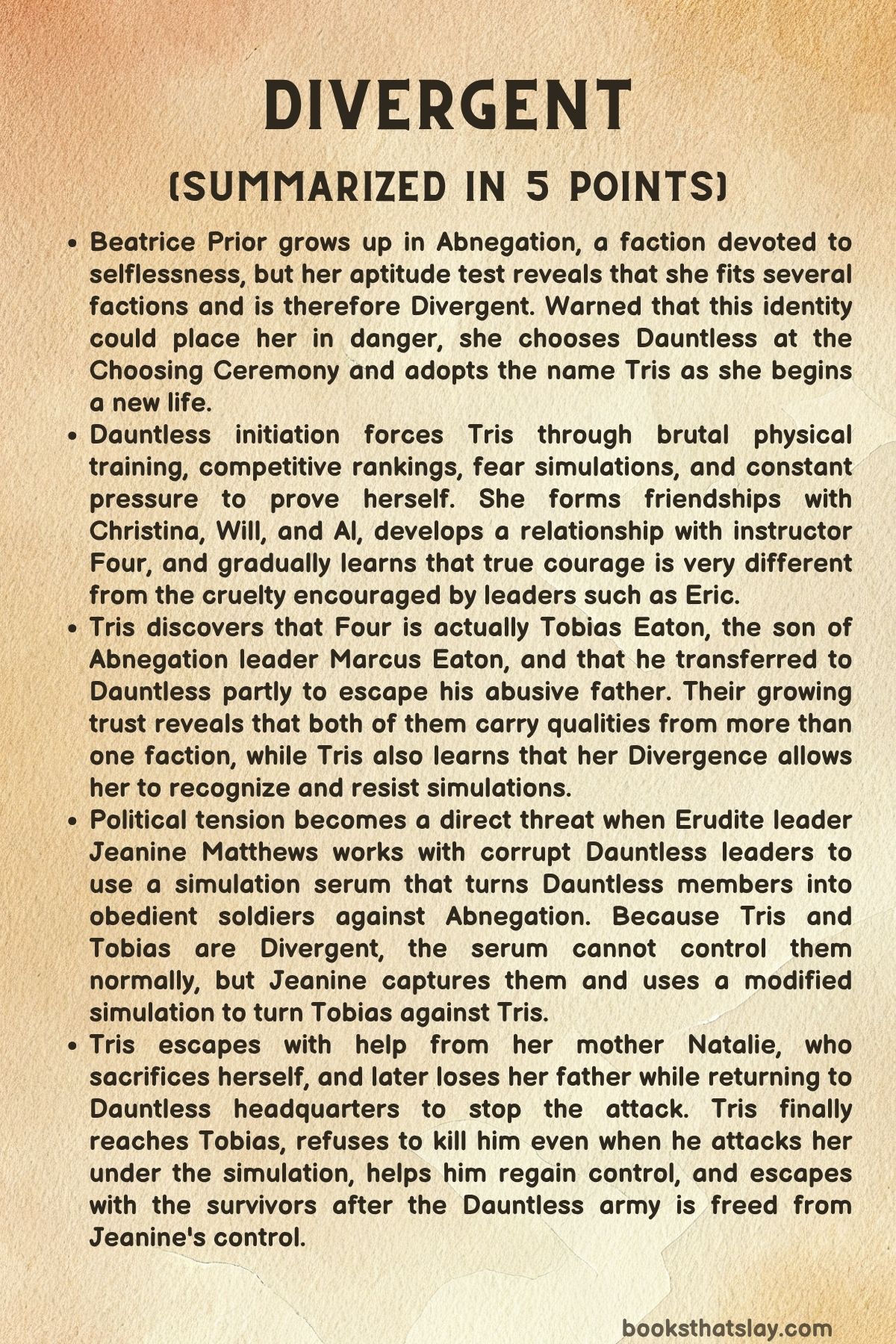
Sixteen-year-old Beatrice Prior has grown up in Abnegation, the faction devoted to selflessness. Although she loves her parents, Andrew and Natalie, and her older brother Caleb, she has always struggled to behave with the effortless generosity expected of her, and she secretly feels drawn to the freedom and fearlessness of the Dauntless.
Before Choosing Day, Beatrice undergoes an aptitude test administered by a Dauntless woman named Tori. The simulation reveals that Beatrice possesses strong tendencies associated with Abnegation, Dauntless, and Erudite rather than fitting naturally into one faction, and Tori identifies her as Divergent while warning her to hide the result because discovery could be deadly.
The discovery makes Beatrice’s decision more difficult rather than easier. Erudite does not appeal to her because of its increasingly hostile political campaign against Abnegation, so she sees her real choice as remaining with her family or embracing the courage and freedom she associates with Dauntless.
At the Choosing Ceremony, Caleb shocks the Prior family by selecting Erudite. Beatrice initially feels obligated to remain in Abnegation because her parents have already lost one child to another faction, but when her turn arrives, she chooses Dauntless and leaves behind the life in which she has always felt incomplete.
Her introduction to Dauntless immediately tests the courage she has chosen to value. She jumps onto a moving train, leaps from a rooftop into an unseen net, and introduces herself as Tris rather than Beatrice, symbolically creating a new identity for the life she hopes to build.
Dauntless initiation proves much harsher than Tris expected. Transfers must compete for limited membership positions, and those who rank too low will become factionless, turning friendships into potential rivalries and making survival dependent upon physical performance, emotional control, and the ability to withstand fear.
Tris becomes close to Christina, Will, and Al, while Peter, Molly, and Drew repeatedly target her because they see her as weak. Her instructor Four teaches her to compensate for her small size through speed and strategy, and Tris gradually becomes stronger while developing an attraction to him.
The brutality of Dauntless leadership soon becomes clear through Eric, a young leader who treats pain and cruelty as evidence of strength. He forces Christina to hang above the chasm after she surrenders in a fight, allows dangerous punishments to continue, and creates an atmosphere in which fear of failure is almost as powerful as the desire to succeed.
Tris herself changes under this pressure. After Peter humiliates her and she endures repeated attacks, she defeats Molly in a fight but continues beating her after victory is certain, forcing Four to stop her and raising the possibility that defending herself against cruelty could gradually make her cruel as well.
Visiting Day brings an important discovery when Natalie comes to see Tris. Tris notices that her mother understands Dauntless headquarters far too well for someone supposedly raised in Abnegation, and Natalie eventually reveals through her behavior that she was originally Dauntless before transferring factions.
Natalie also appears to understand Tris’s dangerous difference. She advises her daughter not to attract attention and asks her to investigate the simulation serum through Caleb, linking Tris’s personal secret to the worsening political conflict between Erudite and Abnegation.
Meanwhile, Dauntless initiation becomes even more disturbing when Edward, one of the strongest candidates, is stabbed in the eye while sleeping. Peter and his allies are strongly suspected, yet the attack receives no meaningful investigation, demonstrating how the ranking system encourages initiates to treat one another as obstacles rather than companions.
The second stage of initiation focuses on fear simulations. Tris quickly discovers that she can recognize simulations while experiencing them and can even manipulate their rules, which confirms that her Divergence allows her to resist mental conditioning.
Tori explains that this ability is extremely dangerous because Dauntless leaders are searching for people who demonstrate it. Tori’s own brother George was Divergent and was killed after being discovered, making Tris understand that hiding her identity is now necessary for survival.
Competition becomes personal when Peter, Drew, and Al attack Tris and attempt to throw her into the chasm. Four rescues her, but the greatest shock is discovering that Al, whom Tris considered a friend, participated in the assault because fear and desperation had overcome his better nature.
Al later begs for forgiveness, but Tris refuses to grant it. Soon afterward he kills himself by jumping into the chasm, leaving Tris angry at a faction culture that celebrates his death as brave after helping create the conditions that broke him.
Her relationship with Four becomes increasingly important during this period. He invites Tris into his private fear landscape, where she learns that he has only four major fears and discovers that his real name is Tobias Eaton, the son of Abnegation leader Marcus Eaton.
One of Tobias’s fears reveals that Marcus physically abused him when he was young. His transfer to Dauntless was therefore not simply a rejection of Abnegation but an escape from his father, and his willingness to reveal this history creates a level of trust between him and Tris that soon develops into a romantic relationship.
As Tris moves toward her final initiation test, the political crisis becomes impossible to ignore. Erudite leader Jeanine Matthews has intensified her propaganda campaign against Abnegation, and Tobias discovers evidence that Erudite is preparing an attack with the assistance of certain Dauntless leaders.
The unanswered question is how Erudite could make an entire faction participate in the assault. Tris discovers the answer after becoming the highest-ranked initiate and receiving what Eric describes as a tracking injection: the serum is actually designed to place Dauntless members under computer-controlled simulation.
That night, almost every Dauntless member becomes an unconscious soldier. Because Tris is Divergent, the serum cannot control her, and she pretends to be affected until she notices that Tobias is also conscious, revealing that he is Divergent too.
The two attempt to escape as the controlled Dauntless march into the Abnegation sector, but Eric discovers them. Tris is wounded, and both are captured and taken before Jeanine, who confirms that Erudite intends to destroy Abnegation using Dauntless as an unwilling military force.
Jeanine has also created a new serum specifically for Divergent people. Tobias is injected with it, and instead of becoming unconscious, his perceptions are altered so completely that he sees Tris as an enemy while retaining his intelligence and fighting ability.
Tris is taken away to die inside a water-filled tank, but Natalie rescues her. Her mother finally reveals that she too is Divergent and explains that people like them threaten the faction system because they cannot be conditioned to think according to a single pattern.
Natalie sacrifices herself so Tris can escape. Soon afterward, Tris encounters the mind-controlled Will and is forced to shoot him when he aims his weapon at her, leaving her responsible for the death of a close friend who had no control over his actions.
Tris reunites with Caleb, Andrew, Marcus, and other Abnegation survivors. Rather than simply flee, she decides that the simulation must be stopped at its source, and she recognizes that neither Abnegation nor Dauntless can completely define her anymore.
Tris, Caleb, Andrew, and Marcus return to Dauntless headquarters, later taking Peter with them because he can help them navigate the compound. During their attempt to reach the control room, Andrew sacrifices himself so Tris can continue, leaving her to lose both parents within a matter of hours.
Inside the control room, Tris discovers Tobias operating the system under Jeanine’s altered simulation. He attacks her because he genuinely perceives her as an enemy, and Tris eventually gains an opportunity to shoot him but cannot bring herself to do so.
Instead, she chooses the same principle that guided her through her final fear landscape: courage and selflessness do not have to be opposites. Tris places her weapon in Tobias’s hand, presses the barrel against her own forehead, and trusts that some part of him remains capable of recognizing her.
Her refusal to fight him breaks through the false perception. Tobias recognizes Tris, shuts down the simulation, and frees the controlled Dauntless before they can continue the massacre.
Tris, Tobias, Caleb, Marcus, and Peter escape by train toward Amity territory. With both Abnegation and Dauntless shattered, Tris no longer possesses a faction she can simply call home, but she finally accepts what she once feared: she is Divergent, and her identity is defined by the ability to contain courage, intelligence, selflessness, loyalty, fear, and independent choice at the same time.
Characters
Tris Prior
Tris Prior, born Beatrice Prior, is the central character of Divergent and the person through whom the novel examines identity, fear, independence, and moral choice. She begins as a girl who believes her difficulty fitting into Abnegation represents a personal failure, but she gradually understands that her personality contains qualities associated with several factions rather than one.
Her transformation into Tris is not a simple movement from weakness to strength. She becomes physically stronger and more assertive, but the book repeatedly tests whether strength will make her compassionate or cruel, especially when she beats Molly excessively, refuses Al’s plea for forgiveness, and later has to live with killing Will.
What distinguishes Tris most is her refusal to accept that courage and selflessness must belong to different identities. Her final actions show that her strongest decisions often combine both qualities, particularly when she risks herself to save others and refuses to kill Tobias even when doing so would appear strategically easier.
Tobias Eaton
Tobias Eaton, known throughout most of Divergent as Four, initially appears to be a severe and emotionally controlled Dauntless instructor. His quiet authority gradually proves very different from Eric’s aggressive leadership because Tobias believes courage requires judgment, discipline, and the ability to act despite fear rather than a love of danger.
His past explains many of his choices. Marcus abused him during childhood, and Tobias entered Dauntless partly to escape that violence, yet he never completely rejects the values of Abnegation and remains deeply suspicious of people who desire authority for its own sake.
Tobias’s relationship with Tris develops because each recognizes something familiar in the other. Both belong emotionally to more than one faction, both fear being controlled by others, and both eventually learn that vulnerability can require as much courage as physical risk.
Natalie Prior
Natalie Prior emerges as one of the most important hidden influences in Divergent. For much of Tris’s childhood, Natalie appears to be an ideal Abnegation mother, calm and self-effacing, but Visiting Day reveals that she understands Dauntless customs because she was born into that faction before transferring.
Her later revelation that she is Divergent changes Tris’s understanding of both her mother and herself. Natalie has survived by adapting her outward identity while retaining qualities that cannot be contained by one faction, making her an earlier version of the struggle Tris is only beginning to understand.
Her death also gives the concept of selflessness its strongest practical meaning. Natalie does not sacrifice herself because Abnegation doctrine tells her to do so; she knowingly chooses death so her daughter can survive, demonstrating that genuine selflessness comes from love and deliberate choice rather than social conditioning.
Andrew Prior
Andrew Prior is committed to Abnegation and strongly believes in the ideals of service, restraint, and collective responsibility. His early disappointment at Tris’s transfer makes him appear rigid, particularly because he sees her decision as a rejection of both her faction and family.
Yet Andrew’s later actions reveal that his love for Tris remains stronger than his anger. He accompanies her back into Dauntless headquarters and ultimately sacrifices himself so she can continue toward the control room, proving that beneath his strict devotion to Abnegation lies genuine courage as well as selflessness.
Caleb Prior
Caleb initially appears to be everything Tris believes an Abnegation child should be. His calm behavior and apparent selflessness make his decision to choose Erudite especially surprising, forcing Tris to recognize that even the person closest to her has concealed parts of himself.
His commitment to Erudite later creates painful distance between the siblings. Caleb accepts much of his new faction’s criticism of Abnegation and initially places faction loyalty above family, showing how quickly institutional belonging can reshape personal relationships.
He nevertheless assists Tris when the consequences of Jeanine’s plan become undeniable. His technical knowledge becomes valuable in the effort to stop the simulation, suggesting that intelligence itself is not dangerous; the moral question is how that intelligence is used.
Christina
Christina is one of Tris’s closest friends and represents a more open, expressive form of courage than Tris experienced in Abnegation. Coming from Candor, she speaks directly, shows affection freely, and helps Tris adjust to the social and physical culture of Dauntless.
Her punishment above the chasm reveals the cruelty hidden within Eric’s definition of bravery. Christina is afraid and injured, yet she endures the punishment without becoming emotionally hardened, making her an important contrast to characters who respond to Dauntless pressure by embracing cruelty.
Will
Will is intelligent, friendly, and curious, forming part of Tris’s closest group of companions during initiation. His willingness to discuss political questions also shows that disagreement does not have to destroy friendship, particularly when he and Tris debate whether criticism of Abnegation might contain legitimate concerns.
His death becomes one of Tris’s greatest emotional burdens. Under simulation control, Will tries to kill her, forcing Tris to shoot him even though she knows that his actions are not truly his own, turning Erudite’s technological manipulation into a deeply personal tragedy.
Al
Al is physically large but emotionally vulnerable, making him an important challenge to Dauntless assumptions about strength. He dislikes hurting people and initially appears gentle, yet the fear of failure and becoming factionless gradually overwhelms him.
His participation in the attack on Tris demonstrates how fear can distort a basically compassionate person. His later remorse is genuine, but Tris cannot forgive an attempted murder, and his suicide exposes the destructive effect of a system that treats emotional vulnerability as weakness and then praises his death as courage.
Peter
Peter represents ambition without moral restraint. He treats initiation as a competition in which other people are obstacles, humiliates Tris, attacks weaker initiates, and is strongly implicated in the assault on Edward.
His character also demonstrates that cruelty does not eliminate self-preservation or practicality. When the political conflict escalates, Peter helps Tris and the others reach the control room because cooperation offers him the best chance of survival, showing that his behavior is driven less by loyalty than by personal advantage.
Jeanine Matthews
As the central political antagonist of Divergent, Jeanine Matthews represents intelligence separated from empathy and restrained by no meaningful ethical limit. She believes Abnegation must be removed from power and uses propaganda, scientific research, political alliances, and behavioral control to achieve that objective.
Jeanine’s greatest fear is not simply another faction but people whose minds cannot be reliably predicted. Divergent individuals threaten her project because their independence prevents the faction system from functioning as a complete mechanism of social control.
Her treatment of Tobias shows the extreme endpoint of her worldview. Instead of merely controlling his body, she alters his perception of reality itself, demonstrating how dangerous knowledge becomes when human beings are treated as systems to be programmed rather than individuals with moral autonomy.
Eric
Eric embodies the corrupted form of Dauntless courage. He values aggression, endurance, domination, and obedience, often treating unnecessary suffering as a useful test of strength.
His hostility toward Four is partly ideological because Tobias represents a very different understanding of bravery. Where Tobias values control and thoughtful action, Eric rewards recklessness and intimidation, making their rivalry a conflict over what Dauntless should actually represent.
Eric’s alliance with Jeanine also reveals that his harsh training philosophy is connected to political ambition. His willingness to transform Dauntless members into weapons shows that he values power more than the freedom supposedly protected by his faction.
Tori
Tori begins as the administrator who discovers Tris’s unusual aptitude result and immediately becomes one of the few people aware of her secret. Her decision to falsify the official result saves Tris from immediate danger and establishes the seriousness of Divergence before Tris fully understands it.
Her fear is rooted in personal loss. Tori’s brother George was Divergent and was killed after being discovered, so her warnings come from experience rather than abstract suspicion.
Marcus Eaton
Marcus Eaton presents one of the clearest contradictions between public reputation and private behavior. As an important Abnegation leader, he publicly represents selflessness and moral authority, yet Tobias’s fear landscape confirms that Marcus physically abused his son.
The revelation prevents faction identity from functioning as proof of character. Marcus may belong to a group organized around selflessness, but his treatment of Tobias demonstrates that institutional labels cannot guarantee private morality.
His presence among the survivors also creates unresolved tension. Tris’s immediate defense of Tobias against Marcus near the end reflects her understanding that survival does not erase responsibility for earlier abuse.
Uriah
Uriah represents the more joyful and communal side of Dauntless culture. He welcomes Tris into activities shared by Dauntless-born initiates and helps her experience the faction as a place of friendship, excitement, and belonging rather than constant competition.
His invitation to the zip-line outing is particularly important because it makes Tris feel accepted by people who were born into the faction. Through Uriah, she begins wanting to remain Dauntless because she genuinely values parts of its community rather than simply because she cannot return home.
Marlene
Marlene is another Dauntless-born initiate who helps broaden Tris’s understanding of her chosen faction. She participates in the friendships and social experiences that offer relief from the violence and pressure surrounding initiation.
Her presence is significant because the story does not present every Dauntless member as cruel or reckless. Characters such as Marlene demonstrate that courage can coexist with friendship, humor, and ordinary human connection.
Molly
Molly is one of Peter’s closest allies and repeatedly participates in humiliating Tris. Her physical strength and willingness to exploit weakness make her an important early antagonist during initiation.
Her fight with Tris becomes a turning point because Tris defeats her and then continues attacking after victory is secured. Molly therefore functions not only as an opponent but also as a test of whether Tris will reproduce the same cruelty she has condemned in others.
Drew
Drew is another member of Peter’s aggressive group and participates in the intimidation surrounding Tris. His most serious action is taking part in the attack intended to throw her into the chasm.
Unlike Al, Drew is not presented as deeply conflicted about that violence. His role strengthens the sense that Dauntless competition has created a culture in which some initiates consider attempted murder a legitimate way to remove rivals.
Edward
Edward is one of the strongest and highest-ranking transfer initiates. His success makes him a direct threat to Peter’s ambition, and he becomes the victim of one of the most brutal acts during initiation when a knife is driven into his eye.
His fate exposes the failure of Dauntless leadership to protect its own initiates. The absence of meaningful punishment sends the message that achieving rank matters more than justice, allowing violence to become another competitive strategy.
Myra
Myra is closely connected to Edward and chooses to leave Dauntless with him after his attack. Her decision places loyalty to a person above loyalty to faction, directly challenging the principle that faction should come before personal relationships.
Although her role is limited, that choice carries thematic weight. She willingly accepts the insecurity associated with leaving rather than abandon Edward after he is seriously injured.
Max
Max is a senior Dauntless leader whose authority initially appears more conventional than Eric’s open hostility. However, his later connection to Jeanine’s political scheme reveals that corruption within Dauntless extends beyond one unusually cruel young leader.
His participation demonstrates how institutional betrayal can occur at the highest level. The faction supposedly devoted to courage is compromised by leaders willing to surrender the freedom of their own people in exchange for influence in a new political order.
Cara
Cara, Will’s sister, represents the intellectual confidence and political suspicion common within Erudite. During Visiting Day, she repeats accusations against Abnegation, creating tension with Natalie and revealing how thoroughly factional political narratives shape ordinary interactions.
Her presence also complicates the conflict by showing that Erudite citizens are not necessarily identical to Jeanine. People can absorb arguments promoted by their faction without personally designing the violence that those arguments are later used to justify.
Lauren
Lauren helps administer the fear-based stages of Dauntless training. Through her explanations, Tris learns that most people possess many more fears than Tobias, making the significance of his nickname and emotional discipline clearer.
Lauren also represents the structured side of Dauntless training that exists apart from Eric’s personal cruelty. Her role helps distinguish legitimate preparation for confronting fear from the abusive practices that increasingly dominate the faction.
George
George is Tori’s deceased brother and never directly participates in the present action, yet his fate has major consequences for Tris. Like Tris, he was Divergent, and his death after discovery provides concrete evidence that the danger surrounding Divergence is real.
His story also shapes Tori’s willingness to protect Tris. Through George, the novel establishes that the persecution of people who resist classification began before Tris became aware of the larger conflict.
The Factionless Man
The factionless man Tris encounters before Choosing Day occupies only a brief part of the story, but his presence gives physical reality to one of Tris’s greatest fears. Becoming factionless means losing community, occupation, status, and protection within a society that demands permanent classification.
His encounter with Tris also reveals qualities she has not fully acknowledged in herself. She offers him food out of compassion but immediately prepares to defend herself when he grabs her, showing both selflessness and assertiveness before she consciously accepts either combination.
Themes
Identity Beyond Social Categories
The faction system assumes that human beings can be understood through a single dominant virtue, but Tris’s experience repeatedly demonstrates how inadequate that assumption is. Divergent makes her inability to fit one category the foundation of her identity rather than a defect she must eventually correct.
At first, Tris understands herself through opposition: she thinks she must choose between being selfless like Abnegation or courageous like Dauntless. Her aptitude result creates anxiety because she has been raised to believe that a stable identity requires one clear answer, while her instincts continually provide several.
Her growth comes from recognizing that qualities do not cancel one another. Intelligence helps her succeed in Dauntless strategy, compassion influences her decisions during moments of crisis, and courage allows her to protect other people even when doing so requires sacrifice.
By the end, Tris stops trying to determine which faction represents her true self. Losing the social structures that once defined her is painful, but it also allows her to understand that identity can remain flexible, contradictory, and unfinished.
Divergence therefore becomes more than a biological or psychological resistance to simulation. It represents the freedom to possess several values simultaneously and to make choices based on circumstances rather than obeying an identity assigned by society.
Courage, Fear, and the Meaning of Bravery
Dauntless culture claims to honor courage, but the novel continually asks what courage actually requires. Eric equates bravery with refusing weakness, tolerating pain, taking risks, and dominating others, while Tobias teaches Tris that fear remains present even in courageous people.
The distinction becomes important throughout initiation. Christina hanging above the chasm, Al being forced toward knife targets, and initiates being encouraged to fight beyond reasonable limits reveal how easily the language of bravery can justify humiliation and abuse.
Tris gradually learns that courage is meaningful only when connected to judgment. Her most courageous acts are not necessarily the spectacular Dauntless stunts but choices made while afraid, such as protecting others, returning to stop the simulation, continuing after her parents’ deaths, and refusing to kill Tobias.
Fear itself is therefore not presented as failure. Tobias has four fears rather than none, and Tris’s simulations demonstrate that acknowledging fear can make purposeful action possible.
The novel ultimately separates bravery from aggression. Genuine courage involves understanding what one fears, deciding what deserves protection, and accepting personal risk without treating pain or violence as achievements in themselves.
Power, Propaganda, and Control
Political power in Divergent operates through information long before it operates through weapons. Erudite publications repeatedly accuse Abnegation leaders of corruption and abuse, creating an atmosphere in which suspicion can be transformed into public justification for removing them.
The effectiveness of Jeanine’s campaign comes partly from mixing legitimate questions with false or manipulated accusations. Even Tris recognizes that some concerns about Abnegation’s political dominance might deserve discussion, but those concerns are used to support a much larger project of conquest.
Technology then turns political manipulation into direct physical control. The simulation serum removes Dauntless members’ ability to choose while preserving their usefulness as soldiers, allowing Jeanine to gain an army without requiring genuine loyalty.
Divergent people are especially threatening because they remain aware during simulations. Their danger to Jeanine therefore comes from the fact that they cannot be reliably controlled, making independent thought itself a political threat.
The story’s conflict shows how authoritarian power depends on reducing individuals to predictable units. Propaganda controls interpretation, faction loyalty controls social behavior, and simulation technology controls the body, while Divergence threatens all three by preserving the possibility of individual judgment.
Selflessness, Love, and Sacrifice
Selflessness initially appears to belong exclusively to Abnegation, but Tris repeatedly discovers it in people from other factions. Christina helping her when she is injured, Tobias protecting her while risking suspicion, and Tris defending Al from Eric all demonstrate that compassionate behavior cannot be contained within a single social group.
The most powerful examples involve sacrifice motivated by personal love rather than faction doctrine. Natalie deliberately gives her life so Tris can escape, while Andrew later dies helping his daughter reach the control room, turning the values they taught her into actions rather than slogans.
Tris’s own understanding of sacrifice changes as well. She once worries that choosing Dauntless proves she is selfish, yet many of her bravest choices involve placing herself in danger for another person.
Her confrontation with Tobias gives this idea its clearest expression. Rather than kill him to reach the computer, Tris accepts the possibility of her own death and trusts him to overcome the altered simulation.
The story therefore refuses to separate courage from selflessness as neatly as the faction system does. Sacrifice becomes meaningful when it is freely chosen, and love becomes one of the strongest reasons a person can find the courage to risk everything for someone else.