Don’t Let Him In Summary, Characters and Themes
Don’t Let Him In by Lisa Jewell is a psychological thriller about a charming stranger who enters the lives of vulnerable women by becoming exactly the man each of them wants.
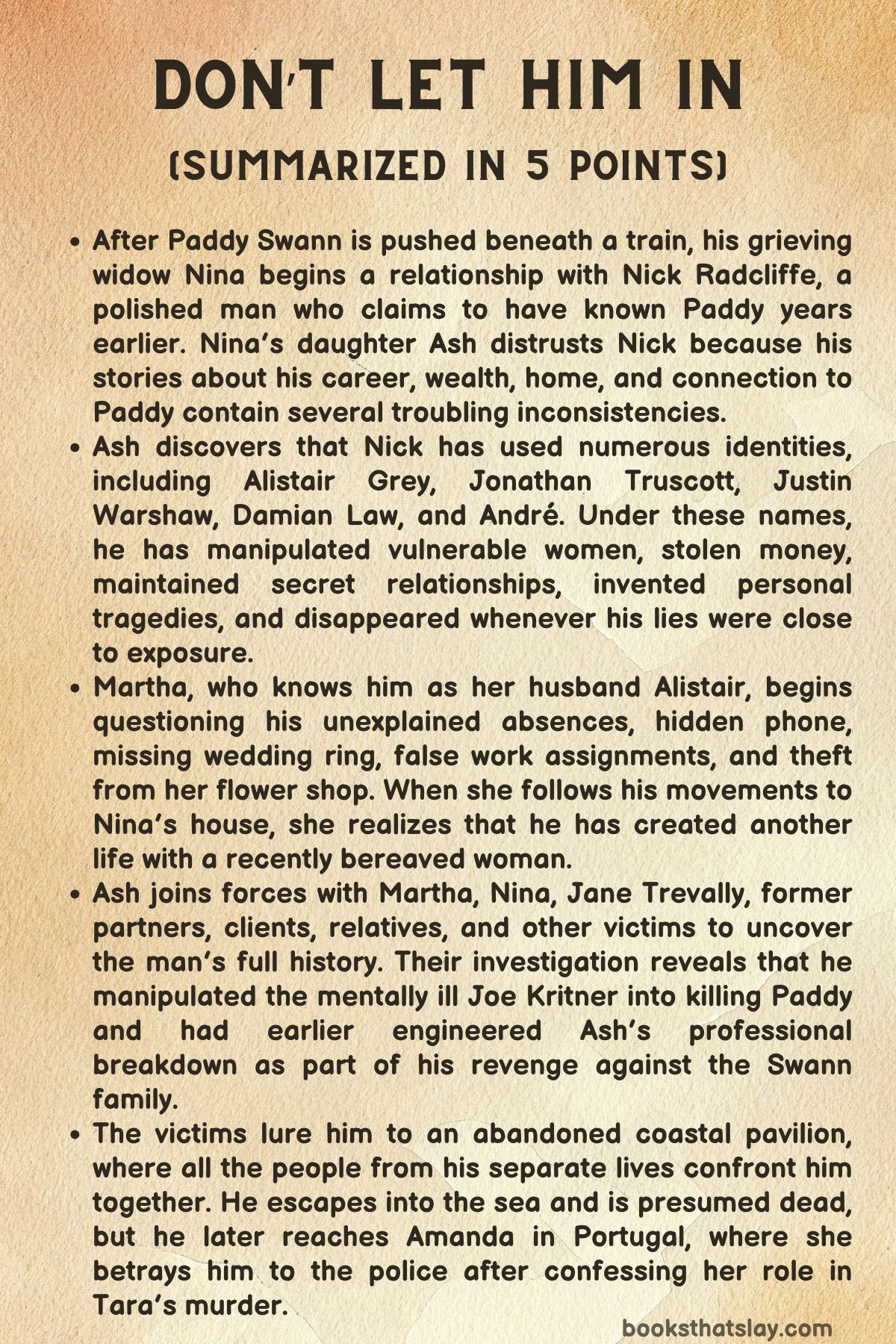
After restaurateur Paddy Swann dies in an apparently random attack, his widow Nina begins seeing Nick Radcliffe, a polished businessman who claims to have known Paddy years earlier. Nina’s daughter Ash distrusts him, while florist Martha struggles with the unexplained absences of her husband, Alistair. Their separate suspicions gradually expose a man with numerous identities, concealed families, financial schemes, and a long history of emotional and physical violence.
Summary
After the funeral of successful chef and restaurateur Paddy Swann, an unnamed flower-delivery driver brings an extravagant bouquet to the Swann family’s impressive seaside house. The man studies the grieving family with unsettling interest and thinks about the single mistake Paddy made that will continue harming his wife and children.
Paddy’s daughter Ash is devastated by her father’s sudden death. He was pushed beneath a London Underground train by Joe Kritner, a stranger suffering from serious mental illness, and the killing has been treated as a random act.
Several weeks later, Ash finds a condolence card from Nick Radcliffe, who claims to have worked with Paddy decades earlier. Nick later sends Nina an old Zippo lighter that supposedly belonged to Paddy, giving her a physical connection to her dead husband.
Nina begins corresponding with Nick and eventually agrees to meet him. A year after Paddy’s death, Nick visits the Swann house and immediately appears confident, considerate, handsome, and attentive.
Ash feels threatened by how naturally he occupies Paddy’s home. Nick’s polished manner makes Nina appear joyful again, but Ash notices inconsistencies surrounding his career, finances, residence, and past.
Elsewhere, florist Martha is married to Alistair Grey, an attractive hospitality consultant whose work regularly takes him away without warning. Al misses holidays, fails to answer messages, changes his explanations, loses his wedding ring, and returns from supposed emergencies with fresh haircuts and implausible stories.
Martha repeatedly questions him, but Al responds with apologies, tears, romantic gestures, and references to ADHD or childhood trauma. His tenderness toward Martha’s children, particularly Jonah, makes her want to believe that his unreliability is his only serious fault.
Flashbacks reveal that Alistair, Nick, and several other men are the same person. His real name is Simon Smith, though he has also lived as Jonathan Truscott, Damian Law, Justin Warshaw, André, and other identities.
Four years earlier, Simon was married to Tara while secretly maintaining a relationship with Martha. He manipulated Tara into financing imaginary pensions, business projects, travel, vehicles, and investments while presenting every financial demand as part of their shared future.
When Tara began questioning his work, debts, unexplained absences, and hidden devices, Simon recognized that he was losing control. Tara’s daughter Emma encouraged her to remove him from the house and warned Simon that the police would investigate him if anything happened to her mother.
Simon then returned to Amanda, his first wife, who had believed him dead for more than twenty years. He claimed that dangerous creditors had forced him to stage his death to protect Amanda and their sons, Sam and Joel.
Amanda remained angry but emotionally vulnerable to him. Simon moved into her flat, extracted money from her wealthy sister, and used Amanda’s financial support to continue courting Martha.
Tara eventually followed Simon and discovered Amanda’s home. When she confronted him, Simon strangled her while Amanda, confused and still controlled by him, restrained Tara’s arms.
Simon and Amanda concealed the murder. Amanda later impersonated Tara on surveillance footage, while Simon used Tara’s phone to send misleading messages before they disposed of her remains.
Simon moved into Martha’s cottage under the identity Alistair Grey. He became a father figure to her sons and later had a daughter, Nala, with her, but continued disappearing for escort work, fraudulent ventures, surveillance, and other relationships.
His interest in Paddy began after dining at one of Paddy’s restaurants. Simon became intensely jealous of Paddy’s confidence, wealth, successful business, attractive wife, devoted children, and public popularity.
He began researching the entire Swann family. He discovered Nina and Paddy’s separate affairs, studied Ash’s emotional vulnerability, and learned about her infatuation with her married publishing boss, Ritchie Lloyd.
Simon impersonated Ritchie in letters and communications, encouraging Ash’s obsession until her behavior caused a professional and psychological crisis. The experience destroyed her career plans, brought her back to her childhood home, and made her doubt her own judgment.
Simon also selected Joe Kritner as a weapon against Paddy. Knowing Joe was psychologically vulnerable, Simon convinced him that Paddy was a terrorist carrying a bomb and paid him to push Paddy beneath an approaching train.
After Paddy’s death, Simon entered Nina’s life as Nick Radcliffe. He used information gathered through surveillance to appear connected to Paddy and presented himself as another grieving person capable of understanding Nina’s loss.
Ash gradually notices evidence that Nick is lying. She finds a wedding ring in Nina’s bedroom, a pacifier clip and dog bag in his coat, vague business claims, a deleted professional profile, and expensive pink packaging that appears connected to local shops rather than Mayfair.
Nick offers explanations for each discovery. His wedding ring supposedly belonged to a dead fiancée, while the child and dog accessories supposedly belong to neighbors whose toddler and pet he occasionally helps.
Ash contacts Jane Trevally, Paddy’s former girlfriend. Jane does not recognize Nick and insists that the Zippo never belonged to Paddy, since he was known for borrowing cheap lighters rather than carrying an expensive one.
Jane uses private investigators and other contacts to help Ash. They discover that Nick previously worked as life coach Justin Warshaw, targeting emotionally vulnerable women, increasing his fees, encouraging clients to borrow money, and creating intense emotional dependence.
Former clients Sarah May and Laura Drummond confirm his pattern. Laura also connects him to Tara’s disappearance, explaining that Emma had been investigating the man Tara knew as Jonathan Truscott.
While Ash investigates Nick, Martha’s trust in Al deteriorates. His disappearance during Nala’s medical emergency leaves her without transport, and she later discovers missing business funds, a hidden phone, inconsistent hotel stories, and a restaurant receipt proving he lied about his location.
Martha places a tracker in Al’s car. It eventually leads her to Nina’s large seaside house, where she realizes her husband has established another life with Paddy’s widow.
At the same time, Ash traces Nick’s pink gift boxes to Martha’s flower shop. An employee identifies the man in Ash’s photograph as Martha’s husband, Alistair Grey.
Ash and Nina visit Martha, and the women compare their experiences. Rather than treating one another as rivals, they recognize that Simon has manipulated both of them through different identities.
Their investigation expands through former partners, clients, relatives, employees, escort clients, stalking victims, and Simon’s adult sons. Ash also visits Joe Kritner, who immediately identifies Nick’s photograph as the “Silver Man” who convinced him to kill Paddy.
Simon’s financial position collapses as his identities begin connecting. He flees Nina’s house, stays with longtime escort client Jessie Bland, and demands £20,000 from her.
When Jessie refuses, Simon strangles and blackmails her. Jessie initially fears public exposure but ultimately reports the assault, giving the police a recent complaint, visible injuries, banking records, and traceable cash.
Martha then sends Simon a forgiving message and invites him home. Appealing to his vanity and desire for a comfortable family life, she convinces him that she regrets doubting him.
Martha brings Simon to the abandoned Bangate Cove pavilion, the location of a business project he hoped she would finance. Inside, dozens of people connected to his hidden lives are waiting.
The gathering includes Nina, Ash, Jane, Emma, Jessie, Sam, Joel, former life-coaching clients, stalking victims, women he dated or exploited, and people damaged by his commercial schemes. Their presence destroys the isolation on which his lies depended.
Simon is confronted with his real history. His parents were not cruel abusers, as he claimed, but supportive people whom he frightened and drained financially.
When Emma calls him a loser, Simon loses control and attacks her. His sons restrain him and demand answers about Amanda, while Emma demands to know what happened to Tara.
Simon escapes from the pavilion and runs into the freezing sea. Sam and Joel attempt to rescue him, but he disappears beneath the water and is presumed drowned.
The apparent death prevents a trial and leaves Amanda and Tara’s fates unresolved. Ash nevertheless gains confidence from proving that her suspicions were rational and that Simon had deliberately caused both Paddy’s murder and her earlier breakdown.
Nina admits that her marriage to Paddy was loving but imperfect. She reveals their affairs and acknowledges that Paddy’s personality often dominated the family, allowing Ash to release the idealized image she had been protecting.
Ash prepares to leave home and rebuild her adult life. Nina plans to sell the large house, reorganize the restaurants, and create a future shaped by her own needs rather than Paddy’s expectations.
In the Algarve, however, Amanda sees Simon approaching her cottage with dyed hair and a changed appearance. He survived the sea and expects Amanda, who has hidden in Portugal for years, to protect him again.
Amanda has made a different choice. After sacrificing her relationship with her sons and helping Simon hide Tara’s murder, she has agreed to confess her crimes.
A detective is waiting inside, and police vehicles approach the cottage. Simon walks forward believing Amanda remains under his control, but she steps aside and allows the police to arrest him.
Characters
Ash Swann
Ash is the central investigator and emotional viewpoint of Don’t Let Him In. At the beginning, she is grieving Paddy, living in her childhood bedroom, working in a temporary boutique job, and carrying shame from the collapse of her publishing career.
Her previous psychological crisis has damaged her confidence in her own perceptions. Every time Nina dismisses her concerns about Nick, Ash fears that she may once again be turning uncertainty into obsession.
Her suspicion nevertheless grows from careful observation rather than irrational jealousy. She notices Nick’s wedding ring, inconsistent employment claims, unfamiliar domestic objects, false memories of Paddy, suspicious packaging, and changing explanations.
Ash’s greatest strength is her willingness to continue investigating even when the people closest to her doubt her. She contacts Jane, Sarah, Laura, Emma, Martha, former business associates, Simon’s sons, and Joe Kritner, gradually converting scattered inconsistencies into a clear pattern.
Her investigation is also an act of recovery. Simon had previously exploited her attraction to Ritchie Lloyd and helped create the breakdown that destroyed her confidence, meaning that uncovering his identity allows her to reclaim the judgment he tried to take from her.
Ash ultimately becomes the person who connects Simon’s victims and reveals his responsibility for Paddy’s death. She moves from emotional dependence and self-doubt toward independence, courage, and a more mature understanding of her parents.
Simon Smith
Simon Smith is the predator at the centre of Don’t Let Him In, operating under identities that include Nick Radcliffe, Alistair Grey, Jonathan Truscott, Damian Law, Justin Warshaw, André, and Simon. Each identity is constructed for a particular woman, family, profession, or financial opportunity.
He is highly observant and quickly identifies what people need. To Nina he becomes a refined widower who understands grief, while to Martha he becomes a loving family man and ambitious hospitality consultant.
Simon does not rely on completely unbelievable stories. He mixes genuine emotional insight, selective truths, attractive gestures, and plausible weaknesses so that questioning him feels cruel or unfair.
His manipulation is financial as well as emotional. He pressures women into loans, remortgages, investments, transfers, gifts, and business ventures while making them believe the money serves a shared future.
Simon repeatedly presents himself as wounded. Dead fiancées, abusive parents, business failures, medical conditions, ADHD, dangerous creditors, bereaved relatives, and family emergencies are used to explain contradictions and redirect attention toward his suffering.
His affection is not always entirely false, which makes him more disturbing. He appears to feel attachment toward Martha, Nala, Jonah, and even some of his victims, but his emotions remain subordinate to possession, comfort, admiration, and control.
Rejection wounds his pride and produces retaliation. He stalks women, sabotages Bar Amelie, manipulates Ash, arranges Paddy’s murder, attacks Jessie, kills Tara, and responds violently when Emma publicly names his failure.
Simon’s sense of superiority prevents genuine accountability. Even when surrounded by victims, he views them as people who voluntarily welcomed him and therefore contributed to their own suffering.
Nina Swann
Nina is Paddy’s widow and the mother of Ash and Arlo. Her grief is intense, but it exists beside an emerging awareness that Paddy’s death has freed her from a marriage in which his tastes, ambitions, and personality usually controlled family life.
Nick appears when Nina is ready to imagine a second stage of adulthood. His calm attention contrasts with Paddy’s dominant energy, allowing her to feel visible as an individual rather than merely as Paddy Swann’s wife.
Her attraction to Nick makes her resistant to Ash’s warnings. Nina interprets his inconsistencies as signs of a complicated past and sometimes treats Ash’s concern as a recurrence of her earlier instability.
This failure causes real harm because Ash begins to feel unsafe discussing her perceptions. Nina’s mistake is not a lack of intelligence but a willingness to choose emotionally comforting explanations over painful ones.
Once the evidence becomes undeniable, Nina does not continue defending Nick. She believes Ash, apologizes for dismissing her, accepts Jane’s involvement, and joins Martha in planning Simon’s exposure.
Nina also confronts the mythology surrounding Paddy. By admitting their affairs and the imbalance within the marriage, she helps Ash replace an impossible image of family perfection with a more honest understanding of love.
Martha
Martha is a capable florist, business owner, mother, and divorcée who believes Alistair Grey has given her a surprising second chance at romance. Her cottage, children, flower shop, and creative identity form the stable life Simon wants to occupy.
She is not naturally passive or helpless. Her difficulty lies in the emotional investment she has placed in the belief that Al is fundamentally good despite his unreliability.
Simon uses isolated moments of tenderness to erase larger patterns of harm. His support for Jonah, affection for Nala, praise for Martha’s work, and domestic usefulness make her repeatedly reconsider evidence that should alarm her.
Martha gradually shifts from asking Al for explanations to collecting independent proof. The tracker, missing money, coastal sounds, restaurant receipt, hidden phone, and discovery of Nina’s house finally show her that explanations are merely another tool he controls.
Her meeting with Nina could have produced jealousy, but Martha immediately recognizes their common danger. She becomes essential to Simon’s capture by inviting him home, performing forgiveness, and leading him to Bangate Cove.
Martha’s emotional conflict remains complicated because some of her happiest experiences involved Al. Her ability to acknowledge genuine attachment without allowing it to excuse abuse represents one of her strongest developments.
Paddy Swann
Paddy is dead before most of the main events, yet his personality shapes the entire story. He was a charismatic chef, restaurateur, father, husband, drinker, host, and public figure whose energy filled every room.
Ash remembers him as a loving and nearly heroic father. Simon sees him as an undeserving rival who possesses the wealth, family, professional success, and admiration Simon believes should belong to him.
Paddy was generous and socially confident, but he was not flawless. His affair, his emotional dominance within the marriage, and his tendency to shape family life around his own preferences complicate Ash’s idealized memory.
His death initially appears random. The later revelation that Simon manipulated Joe Kritner into killing him changes the entire meaning of the family’s grief and confirms that Simon had targeted the Swanns long before approaching Nina.
Amanda Law
Amanda is Simon’s first wife and the mother of Sam and Joel. She spent more than twenty years believing Damian Law was dead and watched her children grow up mourning a father who had deliberately abandoned them.
Simon reappears when he needs shelter and money. Amanda’s anger is repeatedly weakened by unresolved love, shock, nostalgia, and her desire to understand why he disappeared.
Her involvement in Tara’s murder makes her both victim and offender. She restrains Tara while Simon strangles her, helps conceal the death, impersonates Tara on surveillance footage, and later assists Simon’s campaign against Bar Amelie.
Amanda sacrifices contact with her sons and grandchild while waiting for Simon in Portugal. Her loyalty demonstrates how completely prolonged manipulation can distort moral judgment and personal identity.
Her final decision breaks that pattern. By confessing, accepting punishment, and arranging Simon’s arrest, Amanda stops protecting him and chooses responsibility over another cycle of escape.
Tara Truscott
Tara is the woman Simon marries while living as Jonathan Truscott. She begins as a financially secure divorcée with a home, career, adult children, and independent life.
Over four years, Simon persuades her to contribute more than £200,000 and accumulate enormous debt. He uses imaginary pensions, investments, travel plans, business opportunities, and emotional crises to make financial exploitation appear like marital cooperation.
Tara gradually recognizes that Jonathan knows everything about her while she can verify almost nothing about him. Her questions concerning his work, colleagues, finances, travel, and hidden life mark the beginning of her escape.
Her decision to follow him reveals Amanda and the false identity of Damian Law. Tragically, discovering the truth places her directly in danger, and Simon murders her rather than allow his identities to collapse.
Tara’s fate shows the extreme risk faced by someone leaving a controlling relationship. Her suspicions were accurate, but Simon’s violence prevented her from obtaining safety or public vindication.
Emma Greenlaw
Emma is Tara’s protective daughter and one of the few people who distrusts Jonathan from the beginning. She observes his financial secrecy, inconsistent employment, unexplained travel, and growing influence over her mother.
She identifies him to women who reported being followed at night and warns that she will contact the police if Tara is harmed. Her vigilance threatens Simon because she cannot be isolated through romance or financial promises.
After Tara disappears, Emma lives with guilt, anger, and uncertainty. She continues searching for answers while raising daughters who never knew their grandmother.
Emma becomes an important ally to Ash because she understands both Simon’s patterns and the danger of confronting him too early. Her advice helps the women keep him close until enough evidence and witnesses can be assembled.
Calling Simon a loser attacks the fragile self-image beneath his confidence. His violent reaction confirms that humiliation and perceived failure are among the strongest triggers for his aggression.
Jane Trevally
Jane is Paddy’s former girlfriend and a figure Ash initially knows through family stories about obsession and instability. Meeting her reveals a thoughtful, perceptive woman who has developed far beyond the dramatic young person described by others.
Jane immediately challenges Nick’s story because she does not recognize him and knows the Zippo was never Paddy’s. Her detailed memory, once treated as evidence of unhealthy attachment, becomes valuable evidence.
She also recognizes Ash’s fear of being dismissed as unstable. By believing her without hesitation, Jane gives Ash the external validation she needs to continue investigating.
Jane contributes money, contacts, confidence, social access, and persistence. She assists with record searches, interviews former victims, enters Bar Amelie, tracks Simon’s earliest family, and helps connect information that official systems had kept separate.
Her relationship with Ash also repairs an old family distortion. Jane is no longer simply the woman Paddy rejected but an ally who helps his daughter uncover the truth about his death.
Arlo Swann
Arlo is Paddy and Nina’s son and Ash’s younger brother. He remains more distant from the household’s grief and spends much of his time pursuing his own social life.
When he meets Nick, Arlo responds positively to his charm and informal friendliness. He views Ash’s evidence as uncertain and believes Nina’s happiness is more important than investigating every contradiction.
His reaction increases Ash’s isolation, but he is not deliberately cruel. He represents the natural appeal of accepting a pleasant explanation when the alternative is frightening and disruptive.
Arlo’s affectionate relationship with Ash remains intact despite their disagreement. His presence also shows how Simon changes his manner depending on the family member he wants to influence.
Joe Kritner
Joe Kritner is the mentally ill man convicted of pushing Paddy beneath a train. For most of the story, the Swanns regard him as the stranger whose random violence destroyed their family.
When Ash visits him, she encounters a vulnerable, diminished person rather than the simple monster she imagined. His descriptions of a “Silver Man” had previously been dismissed because they appeared alongside paranoid claims.
Joe immediately identifies Simon’s photograph. He explains that the Silver Man paid him, told him Paddy was a terrorist carrying a bomb, and instructed him to push Paddy when the train arrived.
Joe remains responsible for the physical act, but Simon deliberately weaponized his illness. His character illustrates how a calculating offender can hide behind the actions of someone whose testimony authorities are unlikely to trust.
Jessie Bland
Jessie is an older woman who has paid Simon for companionship and sex over many years while knowing him as André. She gives him expensive possessions, emotional attention, and continued access to her private life.
Simon privately despises Jessie despite accepting her money and gifts. His contempt reveals his hostility toward women whose financial power he depends upon.
When she refuses to provide £20,000, he threatens to expose their relationship and then strangles her. He assumes that shame will keep her silent, just as secrecy protected him in earlier relationships.
Jessie’s decision to report the assault becomes crucial. By accepting possible embarrassment, she gives the police a current crime, documented injuries, banking evidence, and a direct reason to pursue him.
Her actions show that Simon’s control weakens when victims refuse isolation. The private information he intended to use as a weapon loses its power once Jessie tells the truth herself.
Sam and Joel Law
Sam and Joel are Amanda and Simon’s sons. They grow up believing their father Damian Law died, attend his funeral, and build adult lives around that loss.
Learning that their father survived and deliberately abandoned them creates a second bereavement. The man they mourned did not die but chose to erase them while becoming a partner and father figure in other families.
At Bangate Cove, they confront Simon and demand answers about Amanda. When he escapes into the sea, they instinctively attempt to rescue him despite everything they have learned.
Their reaction demonstrates the emotional power of biological connection and unresolved childhood loss. They want justice and truth, yet part of them still responds to him as the father they spent decades missing.
Laura Drummond
Laura knew Simon as Justin Warshaw, an emotionally attentive life coach who entered her life when she was vulnerable. He converted professional guidance into personal control and eventually lived with her and her daughters.
Her experience helps establish that Simon’s methods are systematic rather than accidental. He isolates emotionally vulnerable women, makes them feel uniquely understood, creates dependency, and introduces financial pressure.
Laura later connects Justin to Tara and Emma. Her testimony gives Ash evidence that Nina’s boyfriend is linked not only to fraud but to a woman’s disappearance.
Her warning that Simon is dangerous prevents Ash from viewing the investigation as a simple exposure of infidelity. Laura understands that losing control can make him violent.
Sarah May
Sarah is another former life-coaching client targeted by Simon as Justin Warshaw. He approaches her while she is crying, offers a free session, and slowly increases both the price and frequency of their meetings.
Simon makes Sarah feel that he alone understands her. This emotional intensity disguises the exploitative nature of the relationship and encourages her to consider borrowing from her parents.
Sarah’s visit to his home reveals a woman and two young girls who appear to be his family. That discovery directly contradicts Nick’s later claim that he never married or had children.
Her willingness to speak with Ash and Jane adds independent confirmation to Laura’s account. Sarah represents the many victims whose experiences initially seem isolated until compared with the larger pattern.
Martha’s Children
Troy, Jonah, and Nala demonstrate how Simon enters entire families rather than merely romantic relationships. By becoming useful, affectionate, entertaining, and emotionally perceptive, he makes his presence valuable to both mother and children.
Jonah’s uncertainty about gender receives an unusually compassionate response from Simon. His promise of acceptance appears sincere and becomes one of the strongest reasons Martha continues believing in him.
Troy is initially more receptive than Jonah to Simon’s expensive car, confidence, and excitement. Their different reactions show that children can experience the same manipulative adult in very different ways.
Nala creates the strongest permanent bond between Simon and Martha. His disappearance during her medical emergency reveals that moments of loving fatherhood cannot make him dependable when another part of his hidden life demands attention.
Grace
Grace is Martha’s friend and practical source of support. She observes Al’s behavior more critically than Martha but avoids forcing conclusions before Martha is prepared to accept them.
During Nala’s illness, Grace provides the transport and assistance that Al should have supplied. She later offers childcare, financial help, accommodation, and emotional stability as Martha’s marriage collapses.
Grace represents dependable care without manipulation. Her actions contrast with Simon’s dramatic declarations, showing that genuine support is often quieter and more consistent than his performances.
Marcelline
Marcelline is Ash’s employer and confidante at the boutique. She listens to Ash’s concerns about Nick without automatically dismissing them as jealousy or instability.
Her old pink gift box becomes an important clue connecting Nick’s supposedly exclusive Mayfair gifts to a local business. Through Marcelline’s former boyfriend, Ash begins tracing the packaging to Martha’s Garden.
Marcelline’s role is small but meaningful because she provides a non-family space in which Ash can speak freely. She helps transform a vague visual memory into evidence that exposes Simon’s current marriage.
Nina, Martha, Ash, and the Other Victims
The women Simon targets differ in age, wealth, family structure, profession, confidence, and emotional circumstances. Their variety disproves the idea that only a particular kind of person can be manipulated.
Simon succeeds because he adjusts himself to each person rather than repeating one obvious script. He offers grief companionship, professional guidance, romance, fatherhood, sexual attention, business ambition, or rescue according to the vulnerability available.
Their alliance reverses his method. Once they share information, they recognize that the contradictions he explained individually are parts of a single deliberate system.
Themes
Identity as Performance
Simon’s identities are not simple false names but complete emotional performances. In Don’t Let Him In, each version of him includes a profession, family history, romantic wound, vocabulary, wardrobe, financial story, and carefully selected set of gestures.
Nick Radcliffe is polished, wealthy, connected to restaurants, and capable of understanding Nina’s grief. Alistair Grey is a loving stepfather, hospitality consultant, supportive husband, and partner in Martha’s creative ambitions.
Jonathan Truscott appears to be Tara’s devoted husband, while Justin Warshaw becomes an unusually attentive life coach. André offers sexual companionship, and Damian Law returns as the supposedly sacrificed husband who disappeared to protect his family.
These identities succeed because Simon understands that people rarely verify every detail when someone consistently meets their emotional expectations. His warmth, tears, gifts, meals, physical affection, and apparent vulnerability create a sense of truth stronger than documentary evidence.
The novel also examines how ordinary people perform roles. Nina preserves the image of a perfect marriage, Ash performs stability after her breakdown, Martha acts as though she trusts Al, and Amanda behaves like a loyal wife long after loyalty becomes destructive.
Freedom begins when these performances end. The victims regain control by admitting grief, shame, desire, complicity, doubt, and error, while Simon loses power when the identities he kept separate are placed in the same room.
The Manipulation of Vulnerability
Simon does not create every weakness he exploits, but he studies vulnerability with extraordinary precision. Bereavement, loneliness, divorce, professional failure, financial anxiety, sexual secrecy, family conflict, and low self-confidence become entry points into other people’s lives.
Nina’s grief makes her receptive to a man who appears to remember Paddy and understand loss. Martha’s hope for a lasting second marriage encourages her to reinterpret Al’s disappearances as symptoms of pressure, trauma, or disorganization.
Ash’s earlier breakdown makes her doubt her own observations. Simon has already strengthened that weakness by impersonating Ritchie and encouraging the obsession that damaged her career.
His most calculated exploitation involves Joe Kritner. Simon recognizes that Joe’s paranoid fears can be directed toward Paddy and that the man’s mental illness will make his account of the Silver Man sound unreliable.
The victims are not foolish. Simon’s success depends on offering emotional relief at moments when skepticism feels like rejecting love, compassion, hope, or personal recovery.
The story therefore separates vulnerability from blame. The responsibility belongs to the person who identifies another individual’s pain and deliberately converts it into money, access, silence, violence, or control.
Isolation, Shame, and Collective Truth
Simon survives by keeping information separated. Tara knows Jonathan, Martha knows Alistair, Nina knows Nick, Jessie knows André, Amanda knows Damian, and former clients know Justin.
Each woman sees only part of the pattern. A lost ring, missing money, hidden phone, false business trip, unexplained absence, or strange gift can be rationalized when considered alone.
Shame also prevents communication. Jessie fears her children learning about the escort arrangement, Amanda fears admitting her role in Tara’s death, Ash fears appearing mentally unstable, and Martha fears acknowledging how long she accepted impossible stories.
Simon depends on these fears because silence protects him better than the quality of his lies. His stories are often inconsistent, but victims hesitate to compare experiences or expose personal details.
The Facebook group and Bangate gathering reverse this structure. Once the women, children, clients, relatives, and witnesses speak to one another, every contradiction becomes evidence of deliberate predation.
Collective testimony also restores confidence. Ash realizes that her suspicions were rational, Martha sees that Al’s behavior was calculated, Jessie overcomes humiliation, and Emma receives confirmation that Tara’s disappearance followed a larger pattern.
Truth becomes powerful not because one person produces perfect proof but because many partial accounts support one another. Simon’s control ends when private shame becomes shared knowledge.
Grief, Imperfection, and Emotional Renewal
Paddy’s death leaves Ash and Nina grieving different versions of the same man. Ash protects an ideal father, while Nina remembers a loving but dominant husband whose personality often controlled their home.
Simon exploits the gap between public image and private reality. His envy depends on believing that Paddy possessed a flawless life, even though the Swann marriage contained affairs, resentment, compromise, and emotional imbalance.
Ash initially fears that acknowledging Paddy’s imperfections will betray him. Simon’s final letter attempts to use family secrets as another weapon, assuming that the truth will destroy her connection to her father.
Instead, the truth allows Ash to grieve more honestly. Paddy can remain loved without being perfect, and Nina can value her marriage without pretending it fulfilled every part of her identity.
Martha faces a similar conflict with Al. Some moments of tenderness may have been genuine, but emotional sincerity does not cancel deception, financial abuse, abandonment, or violence.
Amanda must also separate love from protection. Her eventual confession recognizes that devotion becomes destructive when it requires helping someone avoid responsibility.
Renewal begins when the characters stop preserving idealized relationships. Nina imagines a smaller home and independent future, Ash prepares to leave, Martha releases the marriage she wanted to believe in, and Amanda chooses justice over another escape.