Great Big Beautiful Life Summary, Characters and Themes
Great Big Beautiful Life by Emily Henry is a contemporary romance and family drama about ambition, memory, public mythology, and the secrets people keep in the name of love.
Henry follows aspiring biographer Alice Scott as she competes with celebrated writer Hayden Anderson for the right to tell the life story of reclusive heiress Margaret Grace Ives. What begins as a professional contest develops into a complicated romance and an investigation into several generations of buried history. Through Margaret’s account, the novel examines how inherited fear shapes families, how the media transforms private suffering into entertainment, and whether painful truths can create freedom rather than destruction.
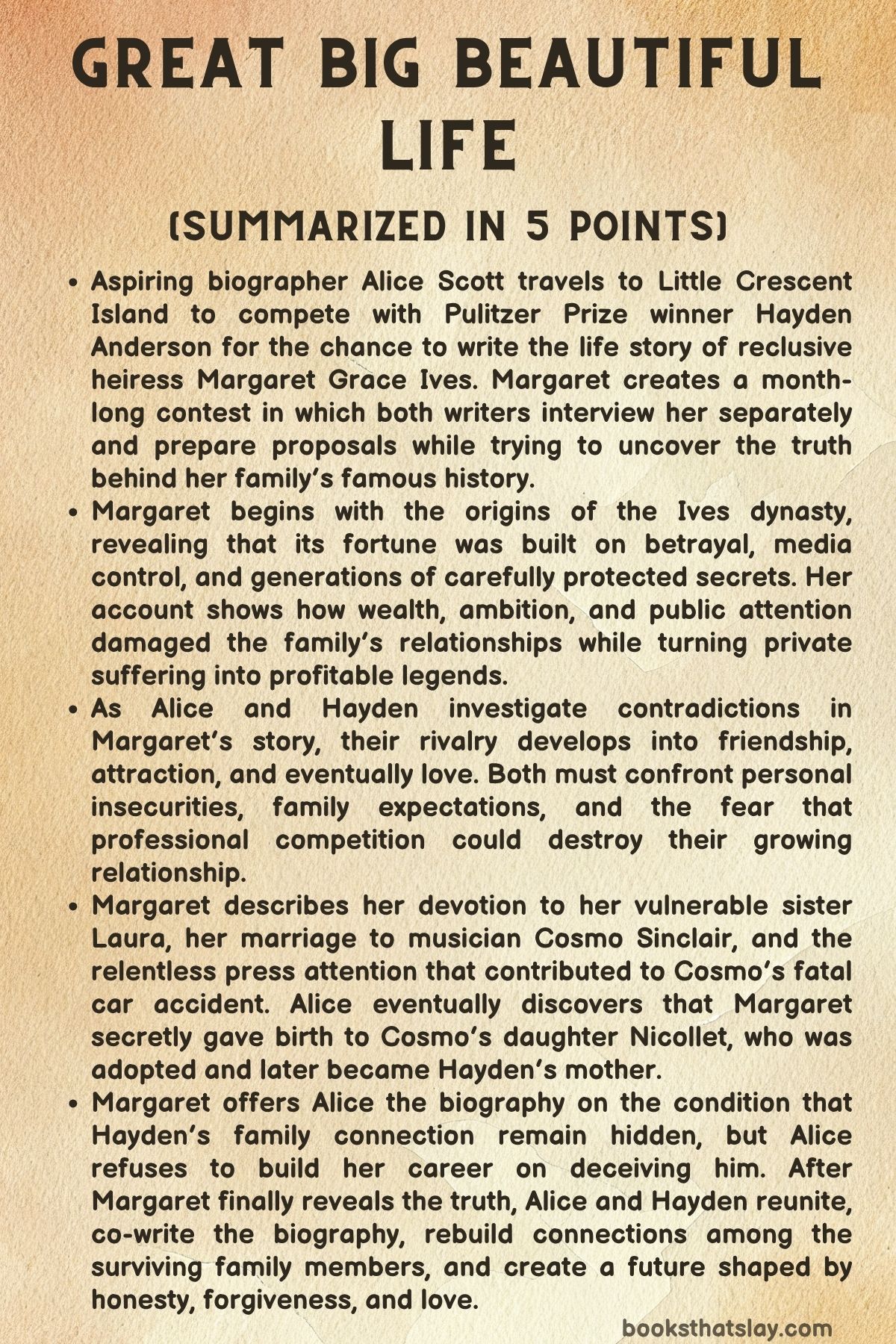
Summary
Alice Scott travels to Little Crescent Island, Georgia, hoping to secure the opportunity that could establish her as a serious biographer. Although she currently writes celebrity profiles for The Scratch, she dreams of producing a substantial book about Margaret Grace Ives, a vanished heiress from a powerful newspaper and entertainment dynasty who was once married to legendary musician Cosmo Sinclair.
Alice has spent weeks searching for Margaret after receiving an anonymous clue about an artist living under another name on the island. During their first meeting, Alice promises to preserve Margaret’s voice, but Margaret warns that she does not want a flattering account designed to justify her choices; she wants a writer willing to discover the complete truth, including the moments when she behaved badly.
Alice soon learns that Margaret is also considering Hayden Anderson, a Pulitzer Prize-winning biographer known for his acclaimed book about musician Len Stirling. Hayden’s reputation, experience, and guarded personality make him intimidating, but Alice takes comfort in realizing that he regards her as a genuine competitor.
Margaret invites both writers to dinner and announces that she will not choose immediately. Instead, Alice and Hayden will participate in a paid, month-long competition, interviewing her on alternating days and preparing sample proposals before Margaret decides whether either of them deserves the project.
Alice and Hayden are housed in neighboring rooms at the same hotel, forcing them into regular contact. Their early conversations are marked by suspicion, teasing, professional defensiveness, and growing attraction, but Alice begins noticing that Hayden’s severity conceals fairness, protectiveness, and considerable personal insecurity.
Their first meaningful connection occurs after a fire alarm drives them from the hotel. At an all-night diner, Hayden reveals that he grew up feeling like a disappointment beside his respected father and successful brother, while Alice explains that her mother dismisses her career and that her childhood was shaped by fear for her frequently ill sister, Audrey.
Alice’s tendency to search for goodness in people comes partly from those childhood experiences. Hayden initially interprets her optimism as performance or naivety, but he gradually recognizes that it is a deliberate way of meeting a world Alice knows can be painful.
Margaret begins her account several generations before her own birth. Her ancestor Lawrence Richard Ives escaped poverty during the western mining boom, but his fortune was founded on betraying his friend Thomas Dougherty and secretly taking control of a valuable silver claim.
When Thomas attempted to expose him through a newspaper, Lawrence bought the publication. That decision created the Ives media empire and established a destructive family principle: whoever controls the story can control the consequences.
The fortune never gives Lawrence the security he desires. His estranged sister Nicollet rejects him, Thomas remains a source of guilt, and Lawrence dies surrounded by wealth but haunted by the people he sacrificed while trying to protect himself from loss.
Alice notices inconsistencies in Margaret’s recollections and wonders whether she is deliberately altering details. Hayden has noticed similar contradictions, and their shared intellectual curiosity brings them closer even though their nondisclosure agreements prevent them from fully comparing information.
After Alice describes her late father and her fear that too little of him has been preserved, Hayden understands that her career is not simply about fame. Interviewing people allows her to protect voices, habits, memories, and stories from disappearing.
Their attraction finally leads to a kiss, but Hayden stops because he fears that competing for the same job will eventually make them resent each other. His caution hurts Alice, yet it also reveals that he already sees their connection as something capable of becoming serious.
Margaret continues with Lawrence’s descendants. Gerald Ives expands the family newspapers into a populist empire and pursues political influence, but his life changes when he falls in love with actress Nina Gill.
Gerald secretly fathers a daughter with Nina. To protect their reputations, his widowed sister Gigi raises the child as Ruth Nicollet Allen, while Gerald’s extraordinary attachment to Ruth is publicly misunderstood.
Nina later leaves Gerald after falling in love with a doctor. Margaret’s correction of the public account demonstrates how often the family’s private lives were simplified into scandalous legends that ignored ordinary motives, emotional contradictions, and human weakness.
Gerald’s son Frederick is pushed into controlling the family’s film studio even though he lacks confidence in his abilities. There he meets director Doris “Bernie” Bernhardt, whose intelligence, independence, and refusal to flatter him turn professional conflict into love.
Frederick and Bernie marry and have two daughters, Margaret and Laura. Although their home appears magical and extravagant, the girls grow up without dependable emotional security because their parents’ love is damaged by affairs, resentment, ambition, and their inability to compromise without feeling erased.
Margaret responds by becoming bright, rebellious, and publicly outrageous. Laura becomes quiet, anxious, and emotionally vulnerable, causing Margaret to build much of her identity around protecting her sister.
Meanwhile, Alice and Hayden continue spending time together away from the interviews. Hayden explains that his previous relationship with Piper ended after career competition poisoned their intimacy, clarifying why he fears that he and Alice will repeat the same pattern.
Alice gradually ends her undefined relationship with Theo, a photographer who expects her to initiate every meaningful encounter. Hayden, by contrast, repeatedly appears when she needs him, remembers what matters to her, and treats her ambitions seriously even while competing against her.
When Alice takes Hayden to visit her mother, Angela, she confronts the old belief that Angela neither respects her career nor genuinely likes her. Hayden’s interest in Alice’s childhood records and family memories makes her feel valued, while Angela’s emotional reserve continues to leave Alice uncertain of her place in the family.
Margaret explains that she once took Laura to a Cosmo Sinclair concert, hoping to give her sister a night of freedom. A dangerous crowd surge separates them, Gerald dies while they are away, and the press blames the sisters for abandoning him.
Cosmo visits the House of Ives to apologize. Margaret initially intends to reject him, but his gentleness and sincerity disarm her, and their immediate connection develops into a passionate relationship.
Margaret stays away from Cosmo for years because loving him feels like betraying Laura. When they reunite, Laura gives Margaret permission to pursue her own happiness, and Margaret and Cosmo secretly marry.
Their privacy is quickly destroyed by photographers. At the same time, Laura enters the Atwood Center, cuts off contact with Margaret, and later becomes trapped inside the organization.
Margaret helps federal authorities expose Atwood, but the rescue turns Laura into the target of overwhelming media attention. Dr. Cecil Willoughby assists with Laura’s recovery and eventually becomes one of the few people trusted by both sisters.
A severe storm on Little Crescent Island changes Alice and Hayden’s relationship. Hayden crosses through dangerous weather to make sure Alice is safe, proving that his concern is stronger than his desire to maintain emotional distance.
Hayden confesses that his mother once nearly died from an overdose while his family concealed her illness to protect his father’s political campaign. The experience taught him to distrust cheerful appearances because he knows that apparent stability can hide extreme suffering.
Alice and Hayden stop pretending that their relationship is temporary. Hayden admits that he loves her but asks her to wait until Margaret chooses a biographer before responding, afraid that the outcome of the competition could distort everything between them.
Their investigation leads them to an old photograph of Cecil. Alice identifies him as the doctor who treated Laura and publicly announced Cosmo’s death, proving that the island resident she knows as Captain Cecil has concealed decades of involvement with the Ives family.
Margaret finally describes the last period of her marriage. Believing she might be pregnant, she and Cosmo imagine becoming parents, but the press intensifies its pursuit of them until they conclude that no child could live safely beneath such attention.
When Margaret later suffers severe abdominal pain, Cosmo drives her toward medical treatment while photographers chase them. His panic and desperation contribute to a collision in which he is fatally injured.
Margaret awakens after surgery and learns that Cosmo has died. She appears at his funeral in her wedding dress, fulfilling the tragic image expected by the public, and then withdraws from the world while accepting the cruel idea that everyone close to her is eventually harmed.
Cecil later marries Laura, and they have a daughter, Jodi. Margaret eventually reconnects with Laura during the final months of Laura’s life and promises to reveal a long-buried truth, although fear prevents her from fulfilling that promise.
As the competition ends, Hayden says that Alice deserves the biography and that he values their relationship more than the job. He has even asked Margaret whether they can write the book together, but Margaret has refused.
Alice then discovers that Hayden’s adopted mother is named Nicollet and was born shortly after Cosmo’s death. The information allows her to understand the secret behind Margaret’s contradictions, Cecil’s involvement, and Margaret’s unusual determination to bring Hayden to the island.
Margaret admits that she was pregnant during the crash. Cecil helped her conceal the pregnancy, deliver a daughter named Nicollet, and arrange an adoption because Margaret believed surrendering her child was the only way to protect her from the press and the Ives legacy.
Hayden is therefore Margaret and Cosmo’s grandson. Margaret originally created the biography competition as an excuse to spend time with him after previous attempts to contact him had failed.
Margaret offers Alice the biography on the condition that Hayden’s connection remains secret. Alice refuses because accepting would require her to build her career on withholding the truth from the man she loves.
Unable to betray Margaret’s confidence or lie to Hayden, Alice ends their relationship and leaves the island. Hayden knows she is hiding something, but Alice can only tell him to ask Margaret.
Alice returns to Angela and finally expresses her belief that her mother does not respect her. Angela admits that she has always loved Alice but has struggled to understand her since Alan’s death, allowing them to begin discussing their grief instead of protecting themselves through distance.
Alice starts recording family memories, reconnects with Audrey, and decides to write about her parents. She learns that telling a meaningful story does not require an extraordinary public subject and that the ordinary details of a family can possess lasting value.
Alice also sends Margaret a letter urging her to tell Hayden the truth. In it, she describes Hayden’s goodness and admits that she loves him.
Several weeks later, Hayden arrives with the letter after Margaret has finally explained his identity. Alice and Hayden confess their love, reconsider their future plans, and choose to build a life that respects both of their careers and family responsibilities.
They eventually co-write Margaret’s biography while protecting Nicollet’s privacy. Nicollet cautiously develops a relationship with Margaret, and the families that secrecy once separated begin forming new connections.
Alice and Hayden later have a daughter named Laura Grace. As Alice records her own family’s history for their child, she accepts that sorrow cannot be erased, but its meaning can change when people tell the truth, offer forgiveness, and allow love to reshape what remains.
Characters
Alice Scott
Alice is the emotional and narrative center of Great Big Beautiful Life, beginning as an ambitious journalist who believes Margaret’s biography could finally prove the seriousness of her work. Her determination is genuine, but it is also tied to her desire for approval from a mother who rarely validates her choices.
Her optimism is not evidence of an easy life or an inability to recognize cruelty. It is a conscious response to childhood fear, bullying, her sister’s illness, and the death of her father, allowing her to approach difficult people with curiosity rather than immediate condemnation.
Alice’s fascination with interviewing comes from her fear that people can disappear before their stories are preserved. She regrets not recording more of her father’s voice and habits, so she treats storytelling as a way of resisting the finality of loss.
Her central weakness is that she extends more understanding to strangers than to herself. She minimizes her own pain, accepts Theo’s lack of effort, avoids confronting Angela, and assumes that requesting love or praise would make any positive response meaningless.
Hayden challenges this pattern by taking her ambitions seriously and showing up without being asked. Through him, Alice learns that love should not depend on making herself convenient, cheerful, or emotionally undemanding.
Her refusal of Margaret’s offer is the clearest demonstration of her moral development. Alice gives up the opportunity she has pursued because success obtained through deception would violate the values that made her want to become a biographer in the first place.
By the conclusion, Alice no longer measures a story’s value solely through fame, publication, or professional recognition. Writing about her parents and recording her family’s memories allows her to understand that ordinary lives also deserve careful preservation.
Hayden Anderson
Hayden initially appears arrogant, suspicious, and emotionally inaccessible. His Pulitzer Prize and established reputation make him a threatening rival, while his assumption that Alice might manipulate him reinforces the impression that he expects the worst from others.
His guardedness develops from a childhood dominated by perfection, public appearances, and concealed suffering. His family protected his father’s political career by hiding his mother’s mental-health crisis, teaching Hayden that polished surfaces may cover dangerous realities.
Hayden’s work as a biographer reflects his desire to uncover the vulnerable person beneath a public legend. He distrusts easy narratives because his own family taught him how damaging they can become when appearances matter more than truth.
Despite his cold manner, Hayden repeatedly behaves with fairness and care. He proposes an equal interview schedule, waits until Alice is safely inside, protects her from an aggressive stranger, crosses through a storm to check on her, and eventually offers to surrender the project rather than lose her.
His fear of mixing romance with professional competition comes from his failed relationship with Piper. Rather than simple cowardice, his caution reveals how seriously he views Alice and how deeply he fears repeating an old injury.
Hayden’s connection to Margaret gives his interest in biography an unexpected personal dimension. Without knowing it, he has spent his career examining memory, identity, and damaged public legends while living inside a concealed family history of his own.
His decision to forgive Alice reflects his growing ability to distinguish secrecy chosen for selfish control from silence maintained under an impossible ethical obligation. By choosing a shared life and co-writing the biography, he becomes both participant and author of the history once withheld from him.
Margaret Grace Ives
Margaret is the central mystery of Great Big Beautiful Life, a former heiress whose glamorous public identity conceals decades of grief, guilt, fear, and isolation. She is charming, theatrical, intelligent, controlling, and capable of testing people before allowing them close.
Her account of the Ives family is both confession and warning. By beginning with Lawrence rather than herself, she shows that her decisions cannot be separated from generations of betrayal, emotional neglect, media manipulation, and attempts to protect loved ones through control.
Margaret spent much of her youth performing confidence so that public attention would remain focused on her instead of Laura. This protective role becomes so central to her identity that pursuing personal happiness feels like an act of abandonment.
Her relationship with Cosmo offers freedom from the Ives world, but it also strengthens her belief that happiness carries punishment. Gerald dies after the concert, Laura withdraws after the marriage, Cosmo dies while trying to protect her, and the press converts each event into proof of Margaret’s destructive influence.
Giving Nicollet up for adoption is Margaret’s most consequential decision. She acts from love and terror, believing secrecy will protect her daughter, but she also denies Nicollet knowledge of her origins and denies herself the possibility of being accepted despite the danger.
The biography competition reveals Margaret’s continuing tendency to manipulate circumstances rather than risk direct rejection. Instead of honestly approaching Hayden, she constructs an elaborate professional contest that places both him and Alice inside a story whose real purpose they do not understand.
Margaret’s eventual confession does not erase the harm created by her secrecy, but it allows her to stop repeating the family pattern. Her final years become less isolated because she accepts that loving people requires giving them enough truth to make their own choices.
Laura Ives
Laura is Margaret’s younger sister and the person around whom many of Margaret’s most important decisions are organized. Sensitive, anxious, and uncomfortable with public attention, she grows up in the same unstable household as Margaret but responds through withdrawal rather than performance.
Margaret’s protectiveness helps Laura survive intense scrutiny, yet it can also prevent Laura from developing an identity separate from being protected. Their bond therefore contains genuine devotion alongside guilt, dependency, and resentment.
The Cosmo Sinclair concert becomes a lasting source of trauma for Laura because it is connected to Gerald’s death and the public accusation that she abandoned him. Her later decision to release Margaret from responsibility shows generosity, but her subsequent withdrawal leaves Margaret uncertain about whether that permission was sincere.
Laura’s involvement with the Atwood Center reflects her need for structure, safety, and belonging. The organization exploits those needs, and even after Margaret helps free her, the resulting publicity subjects Laura to another form of control.
Her relationship with Cecil gives her a quieter life outside the Ives spotlight. Becoming Jodi’s mother allows Laura to create a family, yet her separation from Margaret means that this stability is built beside an unresolved loss.
Their reunion near Laura’s death gives both sisters a limited chance to recognize that love survived the years of silence. Laura’s request that Nicollet be told the truth becomes an attempt to prevent the next generation from inheriting the same separation.
Cosmo Sinclair
Cosmo is remembered publicly as a legendary musician and as the doomed husband of an infamous heiress, but Margaret’s account restores his private identity. He is shy, sincere, playful, emotionally perceptive, and far less commanding in personal life than his public image suggests.
His first meeting with Margaret is shaped by apology rather than seduction. He recognizes that the concert harmed Laura and approaches Margaret with genuine concern, immediately distinguishing himself from people who treat the sisters as symbols or entertainment.
Cosmo offers Margaret a relationship in which she is not required to be the Tabloid Princess, Laura’s protector, or the representative of the Ives dynasty. Their love is founded on recognition, conversation, desire, and the feeling that each can exist more freely beside the other.
He is not able to protect Margaret from the media world surrounding them. His increasing fear of photographers contributes to the desperate drive that ends in the fatal crash, showing how devotion can become dangerous when combined with panic and relentless intrusion.
Cosmo’s legacy continues through Nicollet and Hayden even though he never knows about either of them. His music also connects Alan, Alice, Margaret, and Hayden across generations, turning art into a form of presence that survives the artist.
Nicollet
Nicollet is Margaret and Cosmo’s secret daughter and Hayden’s adoptive mother. Although she remains outside most of the direct action, her existence reorganizes the meaning of the entire story.
Margaret chooses her name because Nicollet represents the person for whom someone would surrender everything. The name therefore carries both love and danger, since the Ives family repeatedly confuses sacrifice with making irreversible decisions on another person’s behalf.
Nicollet grows up free from the paparazzi and public burden Margaret feared, suggesting that the adoption may have protected her in important ways. At the same time, she is denied knowledge of her biological parents, her connection to Cosmo, and the reasons Margaret surrendered her.
Her cautious relationship with Margaret respects the fact that biological connection does not automatically create intimacy. Reconciliation must be built gradually because Margaret cannot reclaim the years that secrecy removed from both their lives.
Angela Scott
Angela is Alice and Audrey’s mother, an activist and practical woman whose emotional reserve causes Alice to feel judged and unwanted. She values demanding work and social usefulness, making Alice believe that celebrity journalism appears trivial to her.
Her reserve becomes stronger after Alan’s death. Rather than openly sharing grief, Angela withdraws into labor, independence, and routines that allow her to continue functioning without exposing vulnerability.
She has nevertheless followed Alice’s career more closely than Alice realizes. Her familiarity with Alice’s profile and Hayden’s biography shows that apparent disinterest does not equal indifference, though her qualified praise continues to wound her daughter.
Angela’s eventual confession demonstrates that she struggles to understand Alice rather than failing to love her. Their reconciliation begins when both stop expecting the other to interpret silence correctly and start speaking directly about disappointment, admiration, and grief.
Alan Scott
Alan, Alice’s late father, is the source of many of her happiest memories and much of her emotional motivation. His love of Cosmo’s music connects Alice personally to Margaret’s history long before she understands the family secret.
Alan is remembered as joyful, humorous, intelligent, and willing to appear unserious. Angela initially misjudges these qualities before recognizing that his playfulness does not diminish his depth or reliability.
His death leaves Alice haunted by everything she failed to record. That regret shapes her belief that stories preserve people and eventually inspires her to create a fuller account of her parents for the next generation.
Although absent from the present action, Alan influences Alice’s standards for love. Hayden’s combination of intelligence, attention, humor, and emotional steadiness reminds her that affection should make a person feel more fully alive rather than constantly uncertain.
Audrey Scott
Audrey is Alice’s sister, whose severe childhood illnesses affected the entire family. Alice’s fear of losing her created a lifelong habit of vigilance and taught her how quickly ordinary happiness can be interrupted.
Because the family’s attention frequently centered on Audrey’s health, Alice learned to minimize her own needs and become emotionally easy to manage. This helps explain why she tolerates unclear relationships and hesitates to ask directly for reassurance.
Audrey’s later Peace Corps work demonstrates strength and independence rather than permanent fragility. Her adult relationship with Alice becomes healthier when they reconnect and share family memories without allowing childhood roles to determine every interaction.
Jodi
Jodi is Laura and Cecil’s daughter, Margaret’s niece, and Nicollet’s cousin. Her strict schedules, guarded manner, and intense loyalty initially make her appear more like Margaret’s manager than a member of her family.
She protects Margaret’s privacy because she understands the damage caused by public exposure. Her severity is therefore a practical response to decades of family history rather than simple unfriendliness.
Jodi also helps create the biography competition and recruits Alice as the second candidate. Although this makes her part of Margaret’s deception, she is attempting to give Margaret access to Hayden while preventing an immediate emotional confrontation.
Her presence during Margaret’s final years suggests that family can be built through sustained care rather than public declarations. She remains beside Margaret when most of the world knows her only as a vanished legend.
Dr. Cecil Willoughby
Cecil first presents himself as a friendly island restaurant owner, using humor and local familiarity to place Alice at ease. His concealed identity later reveals that he has been connected to Margaret, Laura, and the Ives secrets for decades.
As a physician, he treats Laura, helps her leave the Atwood crisis behind, and later marries her. His relationship with Laura offers the privacy and steadiness that her original family could rarely provide.
Cecil also helps Margaret conceal her pregnancy and arrange Nicollet’s adoption. He acts from loyalty and concern, but his assistance contributes to a secret that shapes several generations.
His easy companionship with Alice contrasts with the seriousness of what he knows. By living as Captain Cecil, he creates an ordinary public identity that protects his family while remaining close enough to help Margaret when necessary.
Theo
Theo is Alice’s casual romantic partner before her relationship with Hayden. He is attractive, familiar, and willing to offer occasional attention, but he avoids emotional initiative and expects Alice to organize nearly every encounter.
His repeated hints that he might visit place responsibility on Alice to request his presence. This allows him to enjoy connection without risking direct rejection or committing himself to her needs.
Theo is not presented as deliberately cruel. His passivity simply becomes incompatible with Alice’s growing recognition that she deserves someone who actively chooses her.
His contrast with Hayden helps Alice understand the difference between availability and devotion. Theo waits to be invited, while Hayden repeatedly appears because Alice’s well-being matters to him.
Lawrence Richard Ives
Lawrence is the founder of the Ives fortune and the origin of many destructive family patterns. Poverty and the death of his brother Dicky fill him with a desperate need for security, wealth, and control.
His betrayal of Thomas Dougherty provides the money that establishes the family empire. Although Lawrence tells himself that his actions will protect Nicollet, his pursuit of power destroys the relationship he intended to save.
Buying a newspaper to silence Thomas teaches future Ives generations to manage reality through ownership of the narrative. His fear becomes institutional power, allowing private guilt to influence public culture.
Lawrence’s life demonstrates that understandable motives do not excuse harmful choices. Love for his sister may explain his ambition, but it cannot undo his betrayal or the suffering produced by his need to control every outcome.
Thomas Dougherty
Thomas is Lawrence’s friend and business companion during the western mining period. Lawrence’s decision to cheat him transforms friendship into the foundational betrayal of the Ives dynasty.
Thomas attempts to expose the injustice through journalism, trusting public truth to challenge private power. Lawrence’s purchase of the newspaper defeats that effort and shows how wealth can silence accountability.
Although Thomas occupies only an early part of the family history, his loss continues through later generations. He represents the moral debt hidden beneath the glamour, influence, and cultural authority of the Ives name.
Gerald Ives
Gerald is Lawrence’s son, raised with wealth but deprived of emotional approval. His expansion of the newspaper empire and pursuit of political power are attempts to earn the recognition his father withheld.
His relationship with Nina reveals a capacity for passionate love, but Gerald continues to manage personal life through concealment. Allowing Gigi to raise Ruth protects his public position while denying his daughter the truth of her parentage.
Gerald’s devotion to Ruth is sincere, yet it is shaped by secrecy and possession. His attachment later leaves Laura especially vulnerable when she becomes emotionally dependent on him.
His death becomes another event distorted by the press. Rather than being understood within a complicated family situation, it is used to condemn Margaret and Laura through a simple narrative of selfish abandonment.
Nina Gill
Nina is a successful actress whose relationship with Gerald alters the Ives family. She is creative, charismatic, and unwilling to let motherhood destroy the career and identity she has built.
Her pregnancy is concealed, and Ruth is raised as Gigi’s daughter. Nina’s decision reflects the limited choices available to a famous woman whose professional life depends on public perception.
She later leaves Gerald after falling in love with her doctor in Switzerland. Public accounts treat her disappearance as a glamorous mystery, while Margaret’s version restores the ordinary emotional reality of a woman choosing a different life.
Nina’s story demonstrates how the Ives family converts personal decisions into controlled legends. Her complexity is reduced because mystery is more profitable than truth.
Ruth Nicollet Allen
Ruth is the secret daughter of Gerald and Nina, raised by Gigi without knowledge of her true parentage. Her middle name connects her to the family idea of total sacrifice.
Gerald’s unusually strong affection for Ruth confuses outsiders because the biological relationship remains hidden. His love gives her importance within the family but also places her inside a structure of secrecy she cannot understand.
Ruth’s death in a plane crash intensifies the family’s belief that those they love are destined to be lost. It also frees Margaret from some of Gerald’s control while leaving Laura more emotionally dependent on him.
Frederick Ives
Frederick is Gerald’s son and Margaret and Laura’s father. He inherits enormous responsibility without possessing the confidence or temperament necessary to manage it comfortably.
His relationship with Bernie gives him purpose because she sees through his privilege and refuses to treat him as powerful merely because of his name. Their love is genuine, but Frederick struggles when Bernie’s ambitions challenge his expectations of marriage.
He seeks comfort through affairs and fails to provide stability for his daughters. These failures do not erase his affection, but they show that love without accountability cannot create a secure family.
His later friendship with Bernie suggests that relationships can survive after their original form becomes impossible. Even so, reconciliation cannot restore the childhood security Margaret and Laura lost.
Doris “Bernie” Bernhardt
Bernie is a talented film director who refuses to surrender her intelligence or career for Frederick’s comfort. Her professional strength is especially significant within a Hollywood system that repeatedly attempts to diminish women.
She loves Frederick deeply, but marriage places her in conflict with expectations that require her to become smaller. Her refusal to abandon directing protects her identity, even though the conflict contributes to the family’s instability.
Bernie is neither a neglectful mother without feeling nor a perfect victim of Frederick’s weakness. She is a complicated parent whose ambition, frustration, devotion, and limitations all affect her daughters.
Her later marriage to Roy demonstrates that love can become healthier when a partner does not experience independence as rejection. Roy’s security allows Bernie to acknowledge that part of her will always love Frederick.
Gigi
Gigi is Gerald’s widowed sister and the woman who raises Ruth as her own daughter. She participates in the concealment of Ruth’s parentage, taking on the practical and emotional responsibilities created by Gerald and Nina’s choices.
Her role shows how women within powerful families are often expected to absorb the consequences of other people’s reputational concerns. Whatever personal desires she possesses are subordinated to protecting the Ives structure.
Gigi’s care gives Ruth a mother, but the arrangement also reinforces the family belief that secrecy is an acceptable substitute for informed choice. Her motherhood is both an act of generosity and part of a deception.
Francine Ives
Francine is Frederick’s sister and one of Gerald’s children. Like Frederick, she grows up with wealth but receives little dependable emotional attention.
She revives the family’s women’s magazine and develops an eccentric independence that separates her from the roles imposed on other members of the dynasty. Her professional success suggests one way of using inherited power without becoming entirely consumed by family expectations.
Although less central than Frederick, Francine provides a contrast to relatives who seek security through romance or public approval. She constructs a life through work and individuality rather than attempting to repair every inherited wound.
Piper
Piper is Hayden’s former romantic partner and professional rival. Their relationship ends after competition for the same promotion creates resentment and distrust.
Her importance lies mainly in the fear she leaves behind. Hayden interprets his experience with Piper as proof that love and professional rivalry cannot coexist, causing him to resist Alice even after recognizing their connection.
The eventual success of Hayden and Alice’s partnership challenges the conclusion he drew from Piper. Their relationship survives because both are willing to value fairness, direct communication, and the other person’s autonomy.
Roy
Roy is Bernie’s second husband and a quiet example of emotionally secure love. He understands that Bernie’s history with Frederick remains important and does not demand that she erase it to prove her commitment.
His acceptance allows Bernie to enter a relationship without sacrificing part of herself. Through Roy, the story suggests that mature love can make room for memory, grief, and former attachments without treating them as threats.
Themes
Truth, Secrecy, and the Right to Choose
In Great Big Beautiful Life, secrecy is often defended as an act of protection, yet it repeatedly removes other people’s ability to make informed choices. Lawrence conceals his betrayal, Gerald hides Ruth’s parentage, Margaret arranges Nicollet’s adoption in secret, and the Anderson family covers up a mental-health crisis to preserve a political campaign.
The motives behind these decisions are not always selfish. Margaret genuinely fears that the press will destroy her daughter, while Hayden’s family believes public exposure will worsen his mother’s suffering and damage everyone connected to them.
The harm comes from deciding that one person’s fear gives them the authority to control another person’s identity. Nicollet grows up without knowledge of her parents, Hayden approaches Margaret without understanding their connection, and Alice is placed in a competition whose real purpose has been hidden from her.
Alice’s refusal of the biography becomes a rejection of this pattern. She understands that withholding the truth from Hayden would protect Margaret from rejection, but it would also deny Hayden the freedom to decide whether he wants a relationship with his grandmother.
The novel does not argue that every private fact must become public. Alice and Hayden eventually protect Nicollet’s identity, demonstrating that privacy can be ethical when it respects the wishes of the person most affected.
The essential distinction lies between protecting someone’s chosen privacy and controlling their life through concealed information. Truth may produce pain, anger, or rejection, but genuine connection becomes possible only when people are trusted to respond for themselves.
Love, Sacrifice, and Fear of Loss
Love frequently appears through sacrifice, but the novel questions whether surrendering something valuable always benefits the person being protected. Lawrence pursues wealth for Nicollet, Margaret gives up her child, and Alice nearly gives up Hayden rather than violate Margaret’s confidence.
These actions arise from devotion, yet fear often shapes them more strongly than trust. The characters imagine the worst possible outcome and make permanent decisions before their loved ones can express what they actually want.
Margaret’s life demonstrates how protection can become an identity. She directs attention away from Laura, denies herself Cosmo for years, rescues Laura from Atwood, and later surrenders Nicollet because she believes closeness to her will cause destruction.
Her tragedy is not that she loves too deeply, but that she assumes love requires her to control the danger alone. By treating herself as a destructive force, she refuses to believe that others might knowingly accept the risks of loving her.
Alice begins with a similar habit. She hides her needs from Angela, tolerates Theo’s uncertainty, and considers ending her relationship with Hayden without letting him share responsibility for the decision.
Hayden repeatedly challenges this belief by appearing, asking difficult questions, and insisting that Alice allow him to choose. Their relationship becomes healthier because neither is permitted to protect the other through silent withdrawal.
Sacrifice gains meaning when it is freely chosen rather than imposed. The closing relationships succeed because the characters stop deciding what others can bear and begin building lives through shared responsibility.
Memory, Storytelling, and Survival
Stories preserve people, but they also determine how those people will be understood. Alice becomes a journalist because she fears that death can erase voices, habits, jokes, and ordinary moments before anyone recognizes their value.
Her regret over Alan shapes her approach to Margaret. She does not simply want facts about an heiress and a musician; she wants to recover the human beings hidden beneath photographs, headlines, rumors, and cultural legends.
Margaret understands the danger of storytelling because her family built its power by controlling newspapers and entertainment. The Ives empire could elevate reputations, destroy enemies, turn private mistakes into public identities, and replace complicated lives with profitable myths.
Her own account therefore resists easy moral categories. Lawrence can love his sister and betray Thomas, Frederick can adore Bernie and fail his daughters, and Margaret can surrender Nicollet from love while still causing lasting harm.
Hayden’s biographies pursue the same complexity through a different temperament. Where Alice begins with empathy and hope, Hayden begins with suspicion, but both seek the vulnerable person beneath the public image.
Alice’s decision to write about her parents expands her understanding of what deserves preservation. A life does not need fame, scandal, inherited wealth, or historical importance to justify being recorded.
The final family history is an act of survival rather than a denial of mortality. Alan and Cosmo remain present through music and remembered details, while Margaret’s confession allows Nicollet, Hayden, Alice, and Laura Grace to understand the lives that shaped their own.
Public Image, Media Power, and Private Identity
The Ives family’s influence begins when Lawrence buys a newspaper to prevent Thomas from exposing him. From that moment, media power becomes both the source of the family’s wealth and the force that eventually turns against its descendants.
Gerald expands the empire by recognizing that outrage and spectacle attract attention. His family benefits from selling simplified stories about others, but Margaret later discovers that the same system has no loyalty to its creators.
Margaret becomes the Tabloid Princess because performing scandal gives her limited control over public attention. By acting outrageous, she protects Laura, yet the role becomes so convincing that the world stops recognizing the frightened and loyal sister beneath it.
The press transforms Gerald’s death into evidence of selfishness, Laura’s trauma into entertainment, Margaret’s marriage into a spectacle, and Cosmo’s fatal accident into a romantic curse. These accounts are memorable because they are dramatic, not because they are accurate.
The novel also shows that public image can influence private self-perception. Margaret absorbs decades of hostile coverage until she begins viewing herself as a blast zone whose love inevitably harms others.
Alice and Hayden’s work offers a possible corrective, but biography is never presented as neutral. Selecting facts, arranging events, and interpreting motives always give the writer significant power over another person’s legacy.
Responsible storytelling therefore requires humility. The final biography succeeds because it neither worships nor condemns Margaret, respects Nicollet’s privacy, and acknowledges that a truthful life story must preserve contradiction rather than force a human being into a convenient legend.