Down with the Shipmans Summary, Characters and Themes
Down with the Shipmans by Meg Mitchell Moore is a contemporary family novel about three adult sisters who return to their late mother’s beach house for a compulsory week with their widowed father.
What begins as an unwanted reunion becomes a reckoning with grief, financial trouble, professional betrayal, marriage problems, family resentment, and the possible loss of the house that has preserved their happiest memories. Through Mae, Jordan, and Natalie, the book examines the difference between maintaining a successful appearance and admitting that life has become unmanageable. It also shows how families change when people stop protecting old assumptions and begin telling one another the truth.
Summary
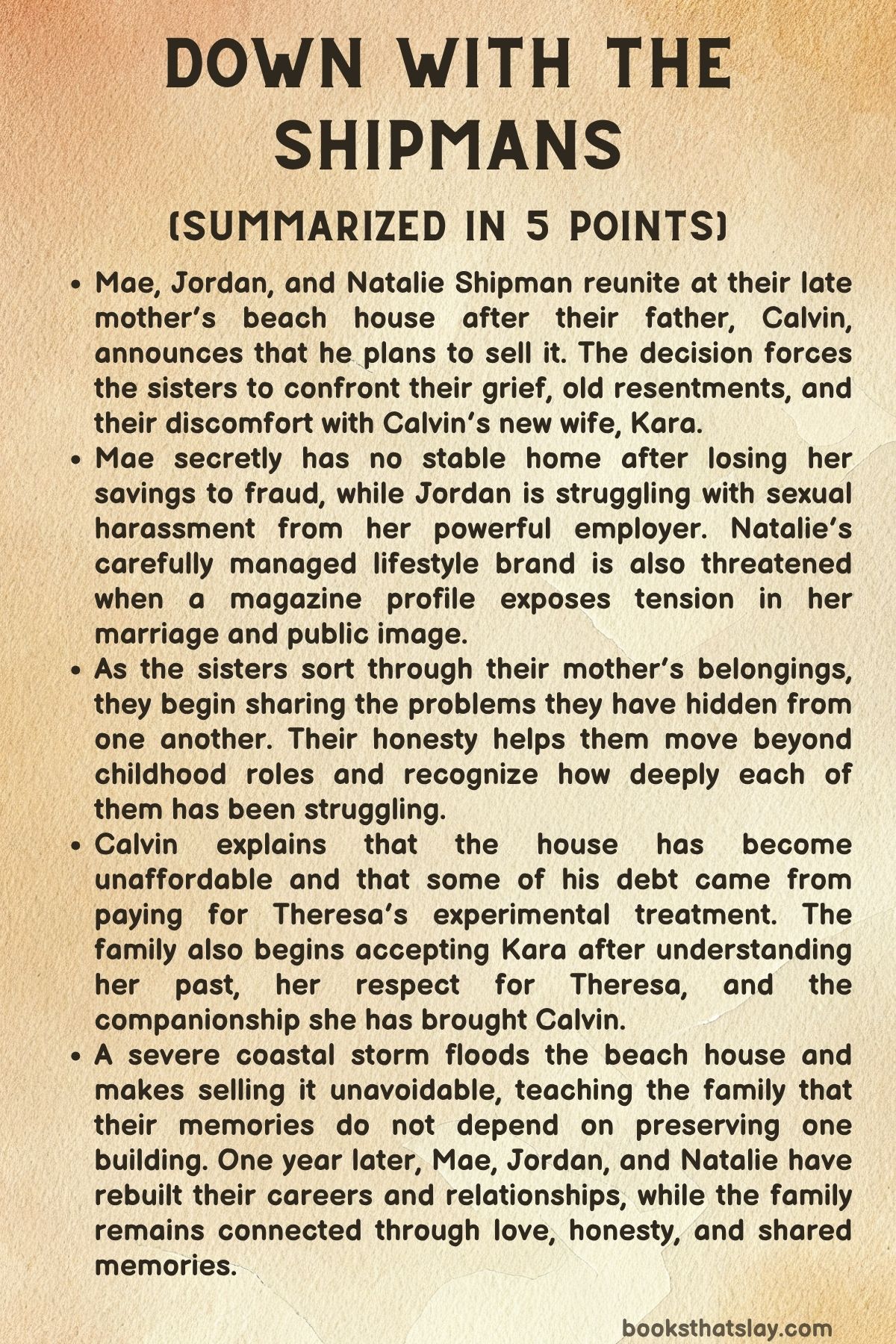
Twenty-nine-year-old Mae Shipman is driving from Boulder, Colorado, to Rye, New Hampshire, with most of her belongings packed into an aging Subaru. Her destination is Ruby on Rye, the beach house that belonged to her late mother, Theresa, where Mae’s father, Calvin, has ordered his three daughters to spend a week together.
Mae is accompanied by Leo, an anxious young pit bull mix she is training for a client. She needs the job because she is nearly broke, secretly homeless, and uncertain about whether her struggling career as a dog trainer can provide her with a stable future.
A tense encounter outside a motel demonstrates how fragile Mae’s position has become. When a child approaches Leo despite Mae’s warning, the dog lunges, and although Mae prevents anyone from being hurt, the child’s mother blames Leo and declares that he should be put down.
Mae continues defending the dog because she believes his fear can be managed through patience, structure, and trust. Her determination to rehabilitate him reflects her own hope that damaged lives do not have to be abandoned.
Meanwhile, Mae’s older sister Natalie travels from her Vermont dairy farm with her three children and their golden retriever, Cinnamon. Natalie has built a profitable social-media business around an idealized version of farm life, traditional domesticity, cooking, parenting, and marriage.
A major magazine profile that was supposed to celebrate her success instead creates a public-relations disaster. Readers focus on an embarrassing remark from her husband, Austin, and Natalie fears that the online identity supporting her family is starting to collapse.
Their middle sister, Jordan, leaves New York City, where she works in crisis communications for the demanding and powerful Bernadette. Although Jordan appears professionally successful and emotionally controlled, she is concealing a disturbing experience involving her employer.
Mae reaches Ruby on Rye first and discovers that the locks have been changed. A Realtor named Nikoletta soon reveals that the change is connected to a decision Calvin has made without properly preparing his daughters.
Once the sisters and children are gathered, Calvin announces that Ruby on Rye has already been placed on the market. An open house is scheduled for the following Sunday, giving the family only one week to sort through decades of possessions and accept that the house may soon belong to someone else.
The sisters are devastated because the property represents their childhood and their connection to Theresa. Her ashes were scattered in the nearby ocean, and the building has become a physical container for memories that none of them feels ready to release.
Calvin explains that taxes, repairs, flood insurance, and rental management have made the house financially impossible to maintain. He then reveals that Kara, Theresa’s former hospice nurse and his new wife, will be joining them.
Natalie and Jordan resent Kara’s presence and question how quickly Calvin appears to have moved forward after Theresa’s death. Mae is more conflicted because she secretly likes Kara, although she has avoided admitting this to her sisters.
Jordan’s professional crisis follows her into the vacation. Bernadette orders her to pressure a respected journalist into abandoning an article about Bernadette’s mistreatment of employees, while implying that Jordan could become a partner if she cooperates.
Jordan suspects that the accusations are true and becomes increasingly uncomfortable with being expected to deceive the journalist. Her moral unease is intensified by what happened between her and Bernadette during Memorial Day weekend.
Natalie is also forced to reconsider the life she has created. Before marrying Austin and moving to Vermont, she had a promising career in data science, but she later redirected her intelligence and ambition toward the dairy farm, domestic work, motherhood, and online content.
Although her business has brought financial security, it has also trapped her inside an image of perfection. Austin dismisses the magazine controversy as a temporary problem, leaving Natalie to feel that he does not understand the work, sacrifice, and fear behind her public identity.
Mae continues training Leo while hiding the extent of her financial disaster. She has not told her family that a fraudulent QR code emptied her bank account, forced her to leave her apartment, and left her living from her car.
Jordan unexpectedly encounters Simone, a woman with whom she shared an important summer romance years earlier. Simone is returning to the area to open a yoga studio and smoothie business, and her presence reminds Jordan of a more independent version of herself.
The family begins cleaning the garage, where every object seems connected to Theresa. Sorting clothes, photographs, decorations, furniture, and household items becomes emotionally exhausting because every decision feels like a judgment about which parts of their mother’s life deserve to survive.
Mae travels to the airport to collect Kara, but before Kara arrives, Leo reacts aggressively to another dog. Mae is shaken by the incident and worries that all her efforts with him may not be enough.
Kara finds Mae crying and responds with warmth rather than judgment. Their reunion exposes the fact that Mae genuinely cares about her father’s new wife and has been hiding that affection to avoid conflict with Natalie and Jordan.
During the drive home, Kara speaks openly about growing up with an alcoholic mother and losing her first husband in an accident. Her honesty almost encourages Mae to confess her own problems, but Mae remains afraid of appearing irresponsible.
Kara’s arrival creates immediate tension. Even the question of where she should sit at dinner becomes emotionally charged because Natalie and Jordan view any place beside Calvin as a position that once belonged to Theresa.
The conversation becomes more painful when Calvin reveals that some of the debt attached to Ruby on Rye came from loans used to finance Theresa’s secret experimental medical treatment in Switzerland. His daughters learn that his financial burden is partly the result of his desperate attempt to keep their mother alive.
Kara also explains that she cannot carry a child and refuses to apologize for becoming Calvin’s wife. She acknowledges that the sisters may resent her, but she insists that her relationship with their father is real and that she has a legitimate place in the family.
Nikoletta later explains that changing flood regulations make it likely that any buyer will demolish Ruby on Rye and replace it with a raised modern structure. Natalie and Mae are horrified by the idea, while Jordan understands that the decision may be financially and environmentally practical.
The sisters’ outing in Portsmouth exposes old resentments. Natalie accuses Jordan of placing work above Theresa during their mother’s illness, while Jordan feels that Natalie has reduced a complicated period to an unfair judgment.
Mae then accidentally reveals that she attended Calvin and Kara’s wedding even though the sisters had agreed to boycott it. She explains that Kara was kind, Calvin was lonely, and attending the wedding helped Mae feel less alone herself.
Simone interrupts the growing argument by encouraging the sisters to remember ordinary moments with Theresa rather than treating grief as a competition. Her intervention helps them move away from accusation and toward a more generous understanding of their shared past.
Back at the house, Jordan finally tells Natalie that Bernadette sexually harassed and threatened her at a party. The revelation explains Jordan’s anxiety, her avoidance of work-related questions, and her growing refusal to protect her employer.
Mae then admits that her bank account was emptied, she lost her apartment, and she has effectively been living in her car. Natalie and Jordan are shocked by how completely they failed to recognize their younger sister’s distress, and they promise that she will no longer face it alone.
Calvin later speaks tenderly with Mae and tells her that her smile resembles Theresa’s. The comment reassures Mae that her mother remains present through the family rather than only through the house and its possessions.
Mae soon learns that Leo’s intended owner is moving to Dubai and can no longer take him. Mae wants to adopt Leo, but her lack of housing and money makes permanent responsibility for him seem impossible.
Jordan confronts Calvin about marrying Kara. Calvin explains that the loneliness after Theresa’s death became unbearable and that loving Kara does not cancel or diminish the love he still feels for Theresa.
Natalie spends time with Kara and begins to see her as more than the woman who married Calvin. Kara speaks about admiring Theresa, witnessing death as a hospice nurse, and understanding that grief does not end simply because a surviving spouse finds companionship.
Natalie admits that she was completely unprepared for her mother’s death. This admission allows hostility to give way to a more honest relationship between the two women.
Simone also helps Jordan recognize that Bernadette’s conduct was sexual harassment rather than merely inappropriate workplace behavior. She encourages Jordan to leave the firm and create an independent crisis-communications business.
Heavy rain later confines the family indoors, but it also brings several turning points. Mae’s supervisor, Hal, tells her that her success with Leo has attracted potential clients and that he wants her to specialize in difficult board-and-train cases.
Jordan calls Bernadette, names the harassment directly, refuses to mislead the journalist, and resigns. When Bernadette tries to intimidate her, Jordan ends the conversation and chooses professional uncertainty over continued submission.
Jordan offers to represent Natalie and Austin as her first clients. She suggests that Natalie abandon the polished traditional-wife image and show a more honest version of marriage, parenting, work, and exhaustion.
Austin unexpectedly arrives from Vermont, forcing him and Natalie to confront the problems beneath the magazine controversy. He admits that his damaging comment may have been an unconscious attempt to disrupt a lifestyle that no longer felt real to him.
Austin believes Natalie has become more focused on recording family life than experiencing it. Natalie answers that her work has provided essential financial security and that she gave up her career, independence, and professional identity to support the farm.
Rather than treating one person as entirely responsible, they recognize each other’s sacrifices. They agree that they still want another child and begin imagining a quieter future in which Natalie can return to technology while remaining connected to the farm.
A powerful coastal storm then reaches Ruby on Rye during high tide. With a major surge predicted, the family gathers upstairs while water, wind, and waves strike the house.
Calvin admits how deeply he misses Theresa and how difficult it is to accept that the property cannot remain unchanged forever. Mae repeats his own lesson that a house is a structure, while a family is made of people.
Floodwater enters the first floor and destroys furniture, appliances, flooring, walls, and many of the belongings the sisters had sorted. The planned open house becomes impossible, but the storm also removes the illusion that the family can preserve the building indefinitely.
Nikoletta recommends selling the damaged property directly to a developer who will demolish it and construct a safer house. The family reluctantly accepts that rebuilding Ruby on Rye in its old form would only expose it to the same danger again.
As they begin discussing what a future house might look like, their attitude changes. They are no longer treating change as a betrayal of Theresa but as part of adapting to a landscape and a family that cannot remain fixed.
The sisters later walk along the beach beneath a rainbow and remember their mother’s familiar advice. When Leo escapes, Mae calls him, and after a moment of hesitation, he runs directly back to her.
His successful recall proves that patience and reliability have taught him to trust. Mae understands that she has also found a home through the people who will respond when she asks for help.
One year later, the expanded family gathers at Tanglewood for a Fourth of July James Taylor concert. Calvin and Kara’s home contains objects rescued from Ruby on Rye, and Kara has restored Theresa’s garden rather than trying to erase her memory.
The beach property has been sold to a developer planning a safer house suited to the changing coastline. After repaying his debts, Calvin gives each daughter ten thousand dollars from the remaining money.
Mae uses her share to repay what she owes, settle her bills, buy equipment, and establish Fido in the City, a business that prepares rescue dogs for urban life. She and Leo live in Jordan’s spare bedroom, where Mae performs administrative work in exchange for rent.
Jordan’s independent crisis-communications firm is thriving, particularly after the article about Bernadette leads former clients to abandon her. Jordan has rebuilt her career around honesty rather than loyalty to a destructive employer.
Natalie completes her advertising commitments and closes her social-media accounts. Now seven months pregnant, she uses her data-science background to explore affordable wearable technology for dairy cows while her children prepare to attend public school.
Calvin reduces his teaching schedule, Kara’s mother is sober, and the sisters have accepted Kara as part of the family. As the concert begins, Mae silently tells Theresa that they still miss her but believes that everyone will be all right.
Characters
Mae Shipman
Mae is the emotional center of Down with the Shipmans, even though she initially sees herself as the least successful member of the family. At twenty-nine, she is financially unstable, ashamed of having lost her savings, and living from her car while pretending that her work and housing are under control.
Her secrecy comes from more than embarrassment. Mae has spent years occupying the role of the younger sister whose difficulties are overlooked because Natalie and Jordan appear to have larger responsibilities and more established lives.
Her relationship with Leo reflects her deepest beliefs about fear and recovery. She refuses to define him by his worst reactions, understanding that anxiety can produce dangerous behavior without making an individual permanently unworthy of care.
Mae applies this compassion more easily to Leo than to herself. She considers his problems treatable but views her own financial mistakes as evidence that she has failed at adulthood.
Her willingness to accept Kara also demonstrates her emotional openness. Unlike her sisters, she can recognize Calvin’s loneliness and Kara’s kindness before the family has officially decided that doing so is acceptable.
Mae’s growth occurs when she stops confusing independence with isolation. By admitting that she has lost her money and home, she allows Jordan and Natalie to support her and begins building a life based on trust rather than concealment.
Jordan Shipman
Jordan appears disciplined, successful, and emotionally controlled, but her professional confidence has been built inside a harmful power structure. She works in crisis communications, where she is expected to shape public truth according to the interests of wealthy or influential clients.
Bernadette’s harassment exposes the personal cost of Jordan’s career. Jordan knows how to manage other people’s scandals, yet she initially struggles to name what happened to her because Bernadette has mixed intimidation with promises of partnership and advancement.
Her silence also reflects shame and fear of being doubted. As a capable professional known for handling difficult situations, Jordan finds it humiliating that she could be manipulated and threatened by her own employer.
Jordan’s conflict with Natalie reveals an older wound concerning Theresa’s illness. Natalie interprets Jordan’s work obligations as emotional absence, while Jordan believes her sister has judged her without understanding what she was carrying.
Simone helps Jordan recover the part of herself that values personal freedom over conventional success. Their renewed connection does not simply revive an old romance; it reminds Jordan that she once imagined a life directed by her own choices.
Her resignation is therefore both moral and personal. By refusing to lie for Bernadette, Jordan stops using her professional skills to preserve abusive authority and begins creating a business that reflects her own standards.
Natalie Shipman
Natalie has built an apparently successful life from marriage, motherhood, farm work, and online influence. Her polished public identity presents domestic life as orderly, traditional, and emotionally satisfying, but the image hides fatigue, resentment, and uncertainty.
Before moving to the dairy farm, Natalie had a promising future in data science. Her later success as a lifestyle creator demonstrates her adaptability, yet it also shows how thoroughly she redirected her education and ambition toward supporting Austin’s world.
Natalie’s anger after the magazine article comes partly from fear that years of labor can be destroyed by one careless comment. She knows the family depends on her income, so public criticism threatens both her reputation and their economic security.
Her relationship with Austin has suffered because neither fully acknowledges what the other has sacrificed. Natalie believes she gave up professional independence for the farm, while Austin feels that their private life has become material for an audience.
Natalie’s resentment toward Kara grows from unresolved grief rather than simple dislike. Accepting Kara feels dangerous because Natalie fears it will weaken her loyalty to Theresa.
Her eventual change does not require her to reject motherhood or the farm. Instead, she begins imagining a life in which she can use her technical abilities, protect her family’s privacy, and stop performing perfection for strangers.
Calvin Shipman
Calvin creates the family gathering by ordering his daughters to spend a week at Ruby on Rye. His decision initially appears controlling and secretive because he does not reveal the planned sale until everyone has arrived.
His secrecy reflects both poor communication and emotional avoidance. Calvin knows the house is financially unsustainable, but he delays the confrontation because he understands what the property represents to his daughters.
The revelation that he borrowed money for Theresa’s experimental treatment changes the meaning of his financial choices. He did not simply mismanage the house; he accepted heavy debt while trying to save his wife.
Calvin’s marriage to Kara becomes the central source of conflict between him and his daughters. He insists that new love does not replace old love, presenting grief as something that can coexist with companionship rather than something that must be completed before life continues.
In Down with the Shipmans, Calvin represents the painful reality that parents possess emotional lives their adult children may not fully understand. His daughters see him primarily through his relationship with Theresa, while he must live with the daily loneliness that followed her death.
By the end, Calvin accepts both the loss of the house and the possibility of a new family structure. He preserves meaningful objects and memories without demanding that the past remain physically unchanged.
Kara
Kara enters the family carrying the disadvantage of being perceived as Theresa’s replacement. Because she cared for Theresa as a hospice nurse before marrying Calvin, the sisters view her presence as emotionally complicated and potentially disloyal.
She refuses to behave apologetically simply to make the daughters comfortable. Kara understands their grief, but she also insists that her marriage is valid and that she will not accept permanent treatment as an intruder.
Her personal history explains her directness. She grew up with an alcoholic mother, lost her first husband in an accident, and learned through hospice work that death can leave survivors emotionally stranded.
Kara’s inability to carry a child adds another layer to her position in the family. She is joining an established group whose bonds were formed through Theresa, yet she cannot create a parallel biological family with Calvin.
Her admiration for Theresa is genuine rather than competitive. Restoring Theresa’s garden later proves that Kara does not need to erase the dead in order to claim a place among the living.
Kara ultimately becomes an example of mature love. She accepts that Calvin will always miss Theresa and understands that sharing his future includes respecting the life he had before her.
Austin
Austin is Natalie’s husband and a dairy farmer whose careless magazine comment triggers a public controversy. At first, he appears dismissive of the damage because he does not understand how fragile Natalie’s online business has become.
His later admission reveals that the remark may have expressed dissatisfaction he had been unable to discuss directly. Austin no longer wants every private experience turned into content for an audience.
His frustration is valid, but his behavior also shows how easily he takes Natalie’s labor for granted. He has benefited from the income and publicity she created without fully appreciating the constant planning, performance, and criticism involved.
Austin and Natalie’s confrontation becomes productive because both move beyond blame. He recognizes what she surrendered for the farm, while she recognizes that their family life has become controlled by branding and public expectation.
His arrival at Ruby on Rye shows his willingness to repair the marriage rather than retreat from conflict. By agreeing to a quieter future, another child, and Natalie’s return to technical work, he becomes an active partner in reshaping their life.
Simone
Simone represents a life Jordan might have chosen if she had valued independence and emotional honesty over professional status. Their earlier summer romance remains important because it belongs to a period when Jordan was less guarded.
Her return is not presented as a magical solution to Jordan’s problems. Instead, Simone functions as someone outside the Shipman family who can see Jordan without the expectations attached to her role as a sister or crisis manager.
She identifies Bernadette’s behavior as sexual harassment with a clarity Jordan has been avoiding. By naming the experience, Simone helps Jordan separate professional ambition from coerced loyalty.
Simone also intervenes during the sisters’ argument by asking them to remember ordinary moments with Theresa. This changes the emotional direction of the conversation because small memories allow grief to become shared rather than competitive.
Her plans to open a yoga studio and smoothie business also emphasize self-directed work. Simone’s presence encourages Jordan to imagine success as ownership of her choices rather than proximity to a powerful employer.
Theresa Shipman
Theresa is deceased before the story begins, yet she remains one of its most influential figures. Ruby on Rye, the family photographs, the objects in the garage, Calvin’s debts, and the sisters’ conflicts are all shaped by her absence.
Each family member remembers her differently. Mae associates her with comfort and resemblance, Natalie links her to caregiving and unfinished grief, Jordan carries guilt and resentment connected to the period of her illness, and Calvin remembers the private desperation of trying to save her.
Theresa’s memory has become so powerful that change feels like betrayal. Selling the house, accepting Kara, discarding possessions, or allowing Calvin to love again initially seems equivalent to abandoning her.
The book gradually separates remembrance from preservation. Theresa remains part of the family after the house is lost because her influence survives through habits, stories, expressions, advice, gardens, and relationships.
Her role demonstrates that the dead can remain emotionally present without controlling the future. The family honors her most successfully when they stop using her memory as a reason to resist every new form of life.
Leo
Leo is both a dog with serious behavioral difficulties and a reflection of Mae’s emotional condition. His aggression is rooted in fear, uncertainty, and a lack of reliable security rather than simple viciousness.
Mae recognizes that punishing him without understanding his anxiety would only deepen the problem. She gives him structure, distance, repetition, and patience, even when public incidents leave her humiliated.
Leo’s uncertain future mirrors Mae’s homelessness. He is supposed to belong to a client, but when that arrangement collapses, Mae wants to keep him despite lacking the resources to provide a permanent home.
His successful recall near the end becomes a decisive emotional moment. By running back to Mae, Leo demonstrates that he now sees her as a trustworthy source of safety.
The relationship is mutually restorative. Mae gives Leo a sense of home, while caring for him helps her discover a professional purpose and believe that stability can be built gradually.
Bernadette
Bernadette is Jordan’s employer and the clearest embodiment of abusive professional power. She uses status, opportunity, intimidation, and secrecy to control employees while relying on Jordan’s skills to protect her public reputation.
Her offer of partnership is not a sincere reward. It functions as leverage, suggesting that Jordan can gain influence only by helping conceal misconduct and remaining silent about her own mistreatment.
Bernadette’s harassment becomes more damaging because she expects Jordan to manage the consequences. She treats Jordan’s professional competence as a tool that can be turned against the truth.
When Jordan resigns, Bernadette responds with belittlement and threats rather than accountability. Her reaction confirms that the working relationship was based on dominance rather than mentorship.
The later loss of clients suggests that public image cannot permanently protect someone whose conduct has harmed others. Bernadette’s downfall also marks Jordan’s transition from managing dishonest narratives to building a more ethical professional identity.
Hal
Hal is Mae’s supervisor and an important source of professional validation. Unlike members of Mae’s family, he understands the difficulty of rehabilitating dogs like Leo and can recognize the skill behind Mae’s progress.
His offer for Mae to specialize in board-and-train cases changes how she views her work. What she has regarded as a precarious job begins to look like the foundation of a distinct career.
Hal’s support is especially meaningful because it is based on observed ability rather than sympathy. He does not rescue Mae from her financial problems, but he provides an opportunity that allows her to rescue herself.
His role demonstrates the importance of being accurately seen. Mae’s family initially overlooks her crisis, while Hal notices her patience, persistence, and talent.
Nikoletta
Nikoletta is the Realtor responsible for explaining the practical realities surrounding Ruby on Rye. Because she delivers information about changed locks, the sale, flood regulations, demolition, and development, the sisters initially associate her with the threatened destruction of their past.
Her perspective is less emotional but not cruel. She understands that the property exists within a changing coastline, rising insurance costs, building regulations, and repeated flood risks.
Nikoletta’s recommendation after the storm forces the family to confront the limits of restoration. Repairing the building would preserve its appearance temporarily while leaving it exposed to the same danger.
She therefore represents reality rather than sentiment. Her presence reminds the family that love for a place does not eliminate environmental or financial facts.
Scarlett, Evangeline, and Natalie’s Children
Natalie’s children reveal both the warmth and strain within her domestic life. They are part of the family image she has marketed online, but they also have needs and futures that cannot be reduced to content.
Their presence at Ruby on Rye connects the next generation to Theresa and the beach house. At the same time, their lives show that family continuity does not require preserving every old custom or possession.
Scarlett’s outing with Natalie and Kara helps create a less confrontational setting in which the women can speak honestly. The children’s eventual move toward public school also signals Natalie’s retreat from the controlled lifestyle she had been presenting.
They represent the future the adults are trying to protect. The choices made by Natalie, Austin, Calvin, Kara, and the sisters will shape whether that future is governed by appearance, secrecy, and inherited resentment or by greater honesty and flexibility.
Themes
Grief, Memory, and Letting Go
Grief in Down with the Shipmans is expressed through attachment to places, objects, routines, and family roles. Ruby on Rye matters because it appears to preserve Theresa in physical form, allowing the sisters to imagine that part of their childhood remains untouched.
The planned sale therefore feels like a second death. Sorting the garage becomes emotionally exhausting because donating or discarding an object seems equivalent to deciding that a memory no longer deserves protection.
Calvin’s marriage creates a similar conflict. Natalie and Jordan initially treat acceptance of Kara as a weakening of their loyalty to Theresa, while Calvin understands from experience that continued love for the dead does not prevent new love among the living.
The coastal storm forces the family to confront what gradual reasoning could not achieve. Once the first floor floods and many possessions are destroyed, preservation is no longer a realistic choice.
The family’s growth lies in recognizing that memory is not stored only in buildings. Theresa survives through Mae’s smile, Calvin’s stories, the sisters’ ordinary recollections, Kara’s restored garden, and the advice remembered on the beach.
Letting go is therefore not presented as forgetting. It is the decision to carry the past in forms that do not prevent the family from responding to present needs or future change.
The Difference Between Appearance and Reality
Each sister has constructed an outward identity that conceals a private crisis. Mae appears independent while living from her car, Jordan appears professionally powerful while being harassed by her employer, and Natalie appears to possess an ideal domestic life while her marriage and public brand are under strain.
Their secrecy is sustained by comparison. Each woman assumes that her sisters are more stable, successful, or emotionally capable, so she hides information that might make her seem weak.
Natalie’s social-media career provides the clearest example of life becoming distorted by presentation. The farm, marriage, children, and household are transformed into a profitable image that leaves little room for boredom, anger, exhaustion, or disagreement.
Jordan’s work creates a professional version of the same problem. She is paid to control narratives, yet she must decide whether reputation management has become dishonest protection of an abusive person.
The family improves when private reality is finally spoken aloud. Mae’s homelessness, Jordan’s harassment, Calvin’s debt, Kara’s infertility, and Austin’s unhappiness become manageable only after they are named.
The novel does not suggest that privacy itself is dishonest. Instead, it distinguishes healthy privacy from secrecy that isolates people, protects abuse, or forces individuals to maintain identities that no longer reflect their lives.
Family Roles and Adult Sisterhood
Mae, Jordan, and Natalie return to Ruby on Rye as accomplished adults, but proximity quickly revives the roles they occupied as children. Natalie becomes controlling and judgmental, Jordan becomes defensive and work-focused, and Mae becomes the underestimated younger sister whose troubles receive less attention.
These roles influence how the women interpret one another. Natalie sees Jordan as emotionally absent, Jordan sees Natalie as self-righteous, and both assume that Mae is less burdened because she does not have a spouse, children, or prestigious career.
Their arguments reveal that sisterhood does not automatically produce understanding. Shared history can create intimacy, but it can also encourage people to believe they already know one another and therefore do not need to ask questions.
The revelations about harassment and homelessness break these assumptions. Natalie and Jordan realize that Mae’s apparent freedom has hidden serious instability, while Mae and Natalie understand that Jordan’s professional confidence has concealed fear and shame.
Their relationship becomes stronger when they stop using old identities as permanent definitions. They begin treating one another as adults whose lives have developed beyond the family roles assigned in childhood.
The week does not eliminate conflict, but it creates a more honest form of closeness. Their bond becomes based less on memory and obligation and more on attention, shared responsibility, and the willingness to believe one another.
Home, Security, and Adaptation
Ruby on Rye initially appears to be the family’s emotional home, but the story repeatedly questions whether a building can provide lasting security. The house is expensive, vulnerable to flooding, burdened by debt, and physically unsuited to the changing coastline.
Mae’s situation makes the question of home more immediate. She has possessions but no stable residence, professional ability but little financial protection, and a dog she loves but cannot initially house.
Leo also lacks security. His fearful behavior improves only when Mae consistently proves that she will protect, guide, and return for him.
The storm destroys the belief that stability can be achieved by keeping everything unchanged. Ruby on Rye cannot survive in its old form, just as Natalie cannot preserve her marriage through a perfect online image and Jordan cannot preserve her career by remaining loyal to Bernadette.
Adaptation becomes the more reliable form of security. The property is sold for safer development, Natalie returns to technical work, Jordan builds her own firm, Mae creates a specialized dog-training business, and Calvin combines his life with Kara’s without erasing Theresa.
By the end, home is defined through dependable relationships rather than permanent structures. Mae and Leo live with Jordan, Kara preserves Theresa’s garden, and the family gathers in a new place while remaining connected to those they have lost.