Dream State Summary, Characters and Themes | Eric Puchner
Dream State by Eric Puchner is a literary novel that explores love, friendship, regret, and the long consequences of choices. Set largely in Montana, the story follows three central characters—Cece, Charlie, and Garrett—whose lives remain connected for decades after a complicated wedding.
The narrative moves across time, showing how relationships evolve as people grow older and face illness, parenthood, environmental change, and personal failures. Through shifting perspectives and moments from different stages of life, the novel examines loyalty, guilt, and the ways people imagine the futures they might have lived.
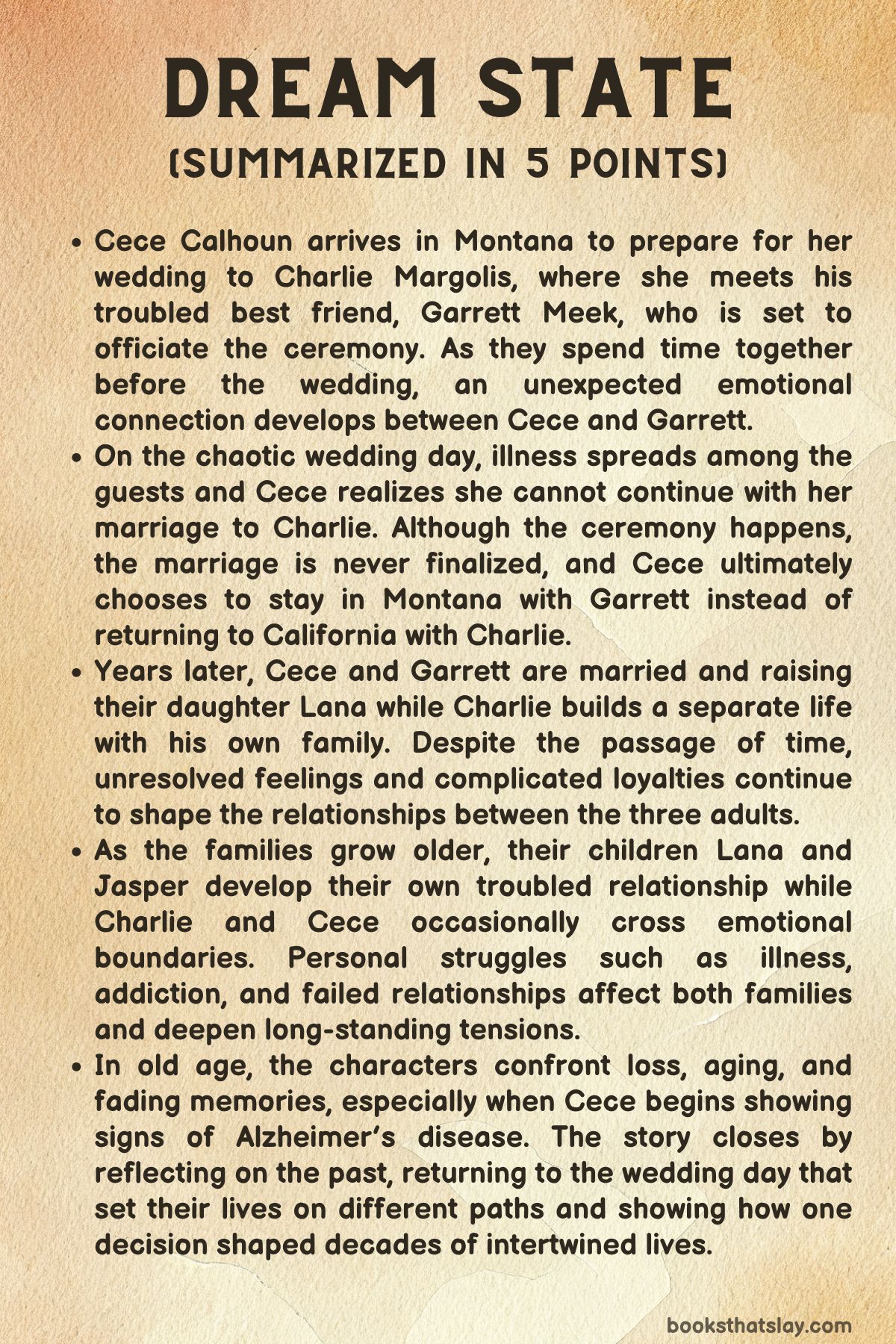
Summary
The story begins in the summer of 2004 in the small town of Salish, Montana. Cece Calhoun arrives at a lakeside cottage owned by the family of her fiancé, Charlie Margolis.
The cottage sits near orchards with a quiet lake across the road, and Cece quickly becomes attached to the peaceful surroundings. She is preparing for her upcoming wedding to Charlie, who is finishing work obligations before joining her.
Soon after arriving, Cece meets Garrett Meek, Charlie’s longtime college friend who has been asked to officiate the wedding. Garrett appears unkempt and withdrawn, which surprises Cece because Charlie always described him warmly.
Garrett works a physically demanding job loading luggage at a small airport and spends most of his time caring for his father, who is dying from pulmonary fibrosis. Garrett has also struggled with mental illness in the past, including depressive psychosis and a suicide attempt, though medication now helps stabilize him.
While waiting for Charlie’s arrival, Cece spends weeks organizing the wedding. Garrett occasionally helps her with errands such as searching thrift stores for vintage china.
Although their personalities are very different, they begin to form a strange connection. One day Garrett takes Cece hiking in Glacier National Park.
During the hike Cece’s fear of heights overwhelms her when they encounter a mountain goat on a narrow path. Garrett calmly helps her down the trail, holding her hand and guiding her safely.
The moment leaves Cece unexpectedly comforted by him.
Their interactions grow more complicated. Garrett finds himself increasingly drawn to Cece, even though she is about to marry his best friend.
One night, after drinking heavily, he sends Cece a long email confessing personal details about his life. He describes his friend Elias’s death years earlier and hints that he blames himself.
He also admits that spending time with Cece makes him feel alive again after years of emotional numbness. Realizing how inappropriate the message is, Garrett sends another email begging her not to read it.
Meanwhile Charlie arrives in Montana with his family for the wedding week. Although the wedding plans appear complete, Cece seems restless and anxious.
Charlie senses her unease but assumes it is ordinary pre-wedding nerves. Several family members become sick with norovirus, which creates tension as the ceremony approaches.
On the night before the wedding, Garrett sits at the hospital bedside of his father, who has suffered a stroke. The situation brings back memories of Garrett’s earlier life with Charlie and Elias.
During college the three men became inseparable after meeting in a philosophy class. Their friendship deepened through adventures and reckless behavior.
Years earlier they went skiing in Colorado, where Elias was buried in an avalanche. Garrett tried desperately to dig him out, but Elias died, leaving Garrett burdened with guilt that has never faded.
The wedding day finally arrives amid chaos because many guests are still sick. Garrett arrives late and distracted by worry about his father.
When he accidentally walks into a room where Cece is crying with her bridesmaids, she reacts sharply toward him. The ceremony still takes place, but events soon unravel afterward.
Cece becomes ill with the virus and, during the confusion that follows, realizes she cannot continue the marriage. The wedding certificate is never officially filed.
Instead of returning to Los Angeles with Charlie, Cece stays behind and admits that she has fallen in love with Garrett.
Nine years later, the story resumes. Cece and Garrett are now married and living in Montana with their seven-year-old daughter, Lana.
Their lives revolve around the same lake where everything began. Charlie, who now owns the cottage, invites them for a visit.
Although everyone behaves politely, the reunion is awkward. Charlie has married a woman named Angeliki and has two children, including a son named Jasper.
Cece still feels unsettled by seeing Charlie again. During a swim in the lake they share a tense moment that suggests unresolved emotions.
Afterward Cece and Garrett return home, discussing how strange Charlie’s behavior seemed.
As the years pass, the narrative follows each character’s life. Garrett works as a wildlife biologist studying animals such as wolverines in remote wilderness areas.
Cece works long hours in restaurants before eventually opening a small bookstore. Their daughter Lana grows into a curious and outspoken teenager.
Charlie, meanwhile, struggles privately with lingering feelings for Cece. After she left him years earlier he fell into depression and unhealthy habits.
His brother eventually helped him rebuild his life and meet Angeliki, though their marriage later deteriorates.
Charlie’s son Jasper develops a heart condition that requires a pacemaker. The illness brings anxiety to the family and deepens Charlie’s protective instincts.
Over time Jasper grows into a troubled young adult who struggles with addiction and resentment toward his father.
The families continue meeting at the lake during summers. When Lana and Jasper are teenagers, they form their own complicated relationship.
One afternoon they discover Cece and Charlie embracing secretly in the cottage basement, revealing that unresolved attraction still exists between them. Years later Cece and Charlie eventually sleep together after a disappointing event at Cece’s bookstore.
The encounter remains mostly unspoken afterward but adds tension to the already fragile network of relationships.
Time continues to move forward. Lana becomes an aspiring actor and later a filmmaker.
Jasper’s addiction worsens, leading to repeated stays in rehabilitation. Charlie and Angeliki eventually divorce.
The lake cabin remains a central meeting place where the characters confront their past and present.
Decades after the wedding, Cece and Garrett return again to the cottage with old friends. Their marriage has grown distant, shaped by routine and years of small disappointments.
During a late-night conversation Charlie drunkenly admits to Garrett that he once slept with Cece years earlier. Surprisingly, Garrett does not react with anger.
Instead he feels a strange sense of relief, as if the confession settles unfinished tension between them.
In later years Lana travels with Charlie to visit Jasper at a desert commune devoted to extreme environmental beliefs. Jasper rejects ordinary society and refuses to acknowledge his father.
Eventually he steals Charlie’s car and disappears for a while before they locate him again in a nearby town struggling with drugs. The encounter highlights the ongoing pain within Charlie’s family.
As everyone grows older, the story turns toward aging and memory. Cece begins showing signs of cognitive decline after getting lost during a hike.
Medical tests suggest the early stages of Alzheimer’s disease. She becomes frightened and embarrassed by the diagnosis but tries to follow advice intended to preserve her memory.
Garrett and Charlie, now elderly men, hike together in the mountains where they once skied as young friends. They talk about the past, including Elias’s death and the complicated love triangle that shaped their lives.
Charlie believes Cece ultimately found greater happiness with Garrett, though Garrett wonders whether her life might have been similar with either man.
Cece’s condition gradually worsens. Eventually she can no longer remember Garrett’s name, though she still becomes distressed when he is absent.
Lana returns frequently to help care for her mother.
Environmental change also alters the setting that once held so many memories. Wildfires destroy much of Salish, including the Margolis cottage by the lake.
Lana later returns with cameras to document the ruins while working on a film honoring Jasper, who has died from an overdose.
In the final scenes, the narrative returns to the day of Cece and Charlie’s wedding in 2004. Garrett officiates the ceremony and imagines the future the couple might share.
His speech describes a life filled with scenes around the lake and the surrounding wilderness. The vision represents a future that never truly happened, yet echoes through the decades that follow.
The story ends with guests celebrating beside the lake after the ceremony. Charlie retreats early because he is sick, while the remaining guests jump into the water under the summer night.
Cece joins them, standing at the edge of a life that will soon change in ways none of them yet understand.
Characters
Cece Calhoun
Cece begins Dream State as a capable, restless young woman trying to perform the role of “perfect bride” in a place that feels both idyllic and unsettling. She is drawn to the Montana landscape because it offers quiet, space, and a sense of possibility—things she seems to crave more than the polished future Charlie represents.
Her history sharpens this hunger: losing her mother as a teenager leaves her with a private grief and an instinct to control what she can, especially when life feels uncertain. Cece’s tension before the wedding isn’t simply nerves; it reads like her body recognizing a mismatch she can’t yet articulate.
With Garrett, she encounters someone who sees through performance and doesn’t expect smoothness from her, and that recognition becomes dangerous. Across the later timelines, Cece’s life shows both the courage and the cost of choosing disruption—she builds a family, a livelihood, and eventually a bookstore, but she also carries an ongoing ache for the life she didn’t take.
Her later cognitive decline is especially painful because Cece is someone who has spent years trying to keep herself oriented through willpower and effort; Alzheimer’s strips away the very tools she relied on. Even as memory fails, her emotional patterns remain—her agitation when Garrett is absent suggests that love persists in the body after language and chronology fall apart.
Garrett Meek
Garrett is the novel’s most haunted figure, shaped by mental illness, survivor guilt, and a deep fixation on the natural world as both refuge and moral measuring stick. He presents as cynical and disheveled when Cece first meets him, but the messiness isn’t just lifestyle—it’s a form of self-protection, a way of keeping people at a distance so they can’t ask for what he fears he cannot give.
His past includes hospitalization, suicidality, and the trauma of Elias’s death, which he appears to experience as a personal failure even when the event is beyond any one person’s control. Garrett’s environmental outrage can read like principle, but it also functions as displacement: when human relationships feel unstable, the clarity of ecosystems and species survival gives him something concrete to fight for.
As a husband and father, he is loving but often absent, pulled by the demands of fieldwork and by the identity he has built around endurance and solitude. His friendship with Bengt matters because it offers a rare adult intimacy that isn’t complicated by betrayal or history.
Yet the unresolved triangle with Charlie and Cece still shadows him; even when he “wins” Cece, he never fully escapes the feeling that happiness is borrowed and could be reclaimed by the past. In old age, his refusal to give up on a wolverine everyone believes dead mirrors his own refusal to accept loss as final—a stubborn, aching insistence that if he keeps searching, something can still be saved.
Charlie Margolis
Charlie is charismatic, ambitious, and used to being admired, but beneath the confidence he carries a surprisingly deep need to be chosen. In 2004 he arrives with the momentum of a successful medical career and the assumption that the future can be secured through planning, status, and good decisions.
Cece’s unease threatens that worldview because it suggests that desire and loyalty can’t be controlled by merit. After the wedding collapses, Charlie’s long depression reveals how much of his identity depended on the story he told himself about being the kind of man who gets the life he wants.
His later invitation to Cece and Garrett, years afterward, is not just hospitality—it’s a test he sets for himself, an attempt to prove he is over her, and it fails immediately. Charlie’s life becomes a series of adaptations: he marries Angeliki, becomes a father, and tries to build stability, but the emotional wound remains active, shaping his choices and his self-image.
As a parent, he can be intensely devoted, especially when Jasper’s health scares surface, yet he also radiates the pressure of expectation—he wants his children to make him feel forgiven by becoming proof that life turned out fine. His drinking and occasional outbursts suggest a man who has never fully learned how to metabolize disappointment.
In old age, Charlie’s ability to admit certain truths—about Cece’s happiness, about the past—shows growth, but it’s the kind that arrives late, after damage has already spread through multiple lives.
Lana
Lana is raised in the long shadow of an origin story that the adults around her can’t fully neutralize, no matter how carefully they try to domesticate it into “the past.” As a child she brings lightness and humor to a household strained by work absences and simmering resentment, and her playful energy often exposes the emotional weather her parents are trying to hide. As she grows older, her curiosity turns sharper; she asks questions, tests boundaries, and moves toward risk in ways that feel like both adolescence and inheritance.
Her relationship with Jasper is shaped by that shared inheritance—each of them is living inside the consequences of a love triangle they didn’t create, and their attraction carries a charge of rebellion and fatalism. Lana’s later move to Los Angeles and pursuit of acting suggest a desire to become someone self-made, someone not defined by the lake and the family history lodged there, yet she remains tethered through summers, crises, and calls from Charlie.
As an adult, she becomes a documentarian, which fits her psychology: she is someone who tries to hold experience in a frame, to create narrative order around chaotic emotion. When she joins Charlie to retrieve Jasper from the desert commune, she functions as both witness and moral counterweight—less invested in Charlie’s self-justifications, more willing to name what she suspects.
Lana’s adult competence does not erase her vulnerability; it simply gives her a craft for containing it.
Jasper
Jasper grows up with an unstable emotional inheritance: a father marked by longing and regret, a mother eventually absent, and a family story that includes betrayal even if it isn’t spoken aloud. His medical condition and pacemaker make him physically different from a young age, and that difference can intensify the feeling that his body is unreliable—an anxiety that often pairs with later risk-taking.
Jasper’s resentment toward Cece is not only about the divorce; it’s about the sense that adult desire rewrote the rules of his life before he had any say. As a teenager, his connection with Lana is both genuine and combustible: they are drawn to each other, but they also use each other to test power, attention, and hurt.
In young adulthood, addiction becomes the language through which his pain speaks most loudly. His cruelty—like repeating Charlie’s claim that he wished Garrett had died instead of Elias—suggests a person weaponizing history to force others to feel as trapped as he does.
The desert commune episode shows how vulnerable he is to totalizing belief systems that promise purity and certainty; the ideology gives him structure, identity, and a way to claim moral superiority while still running from intimacy. His eventual overdose, whether intentional or not, reads as the bleak endpoint of a life spent oscillating between wanting love and distrusting it.
Jasper is tragic not because he lacks intelligence or sensitivity, but because he cannot sustain hope without immediately sabotaging it.
Angeliki
Angeliki enters Charlie’s life as a stabilizing presence introduced through family ties, and she helps him build the domestic future he wants after Cece. She appears practical and capable, someone who can manage family life and partnership with fewer theatrics than Charlie’s earlier romantic narrative.
Yet her marriage to Charlie unfolds under the pressure of his unresolved longing; even when he is devoted, there is an emotional elsewhere that she can likely feel. Their eventual divorce suggests not a single rupture but an accumulation—years of carrying the weight of Charlie’s inner comparisons and his need to reenact a story he never finished.
Angeliki’s relative quietness in the narrative can be read as realism: she is not centered because the novel’s emotional engine is elsewhere, but her presence matters because she represents the collateral lives formed in the wake of the original choice. Her children’s struggles, and Charlie’s turbulence, imply how hard it is to build something sturdy when one partner is still in conversation with a former life.
Bengt Isaksson
Bengt functions as Garrett’s adult anchor and as proof that Garrett can still form a meaningful bond outside the gravitational pull of college history. Their partnership in the field is built on competence, shared hardship, and trust, the kind of friendship that emerges when people rely on each other in real conditions rather than nostalgia.
Bengt’s importance is that he offers Garrett a relationship without the old hierarchies and betrayals—no competition for love, no unresolved guilt, no symbolic roles assigned decades earlier. Through Bengt, Garrett’s commitment to conservation work feels less like solitary obsession and more like community, even if small.
Bengt also quietly highlights what Garrett lacks at home: steadier communication, less defensiveness, and the ability to be present without fleeing into mission.
Paige
Paige appears primarily as Cece’s friend during the wedding period, and her role is to provide a grounded countervoice to Cece’s spiraling uncertainty. She listens without turning Cece’s doubts into melodrama, and she represents the kind of friendship rooted in history rather than romance—someone who knew Cece before she was trying to become a bride.
Paige’s reassurance is imperfect, not because she’s careless, but because she cannot feel what Cece feels from the inside; she offers the cultural script that marriage jitters are normal, which is both comforting and misleading. In that way, Paige embodies how well-meaning friends can unintentionally help someone override their own instincts.
Her presence underscores Cece’s loneliness: even surrounded by people, Cece is carrying a private sense of wrongness that no one else can name for her.
Elias
Elias is present largely through memory, but he remains one of the most powerful forces in the book because his death becomes the wound around which Garrett’s adult self is organized. In college he is charismatic and central, the kind of friend who makes life feel larger, and his relationship with Sabina and talk of marriage hint at the future path the trio might have taken if nothing shattered.
The avalanche death is the defining rupture: it produces Garrett’s guilt and mental collapse and also freezes Charlie’s and Garrett’s friendship in a complicated state where everything afterward is measured against what was lost. Elias becomes a symbol Garrett cannot set down, not simply because he misses him, but because blaming himself keeps the world feeling controllable—if it was Garrett’s fault, then tragedy has rules.
Over decades, learning to release that guilt becomes one of Garrett’s hardest forms of growth, even if it never fully resolves.
Sabina Gonzales
Sabina appears as an early object of fascination and later as a romantic link in the college friend group, and her significance lies in what she triggers in the men around her. For Charlie, noticing Sabina’s attention toward Garrett sparks both admiration and competition, setting a template for how Charlie relates to Garrett—affection braided with comparison.
When Sabina dates Elias and marriage enters the conversation, she becomes part of the moment when youthful freedom begins tilting toward adulthood and commitment. Even without extensive page-time, Sabina’s role helps explain why marriage becomes such a charged idea in the novel: it is not just an institution, but a symbol of who gets to claim a future and who feels left outside of it.
Brig
Brig’s stroke and the friends’ reunion operate as a marker of time’s passage and the body’s vulnerability. He is less a driver of plot than a living reminder that the youthful intensity of college cannot be sustained; everyone is aging, breaking down, and carrying histories that are no longer abstract.
Brig’s presence at the cottage, including being helped into the lake, creates a scene of communal tenderness that briefly interrupts old resentments. He also provides the occasion for Charlie’s volatility and the group’s uncomfortable recognition that their shared past still has sharp edges.
Soledad
Soledad, as Brig’s wife, brings a steadying, practical energy to the reunion environment. Her care for Brig and her willingness to participate in the group’s social life suggest resilience and a capacity to hold joy alongside illness.
When she proposes charades, it reads like an attempt to restore normalcy and play, to keep the gathering from collapsing into grief or tension. In a story where many relationships are strained by secrecy and longing, Soledad represents a more direct form of partnership—care enacted openly, without the same layers of hidden narrative.
Gail Tippler
Gail Tippler matters less for who she is in a biographical sense and more for what she represents to Cece: aspiration, validation, and the hope that Cece’s bookstore can become a meaningful life project rather than a consolation prize. The disastrous reading night—storm, low turnout, Cece’s impaired state after taking the wrong medication—becomes a humiliating collision between dream and reality.
Gail’s refusal to soften the moment by signing books or staying for dinner makes her a catalyst for Cece’s vulnerability and shame. In the aftermath, Cece’s decision to meet Charlie and the intimacy that follows suggest that disappointment can reopen old doors; Gail’s role is to provide the emotional trigger that sends Cece back toward a familiar source of recognition, even when it risks everything she has built.
Becky
Becky appears during the later summers as Charlie’s girlfriend after his divorce, and her role is to reveal patterns Charlie cannot escape. Jasper’s complaint that Charlie likes Becky because she resembles Cece is telling whether or not it is literally true; Becky becomes a screen onto which the family projects its unresolved story.
The fights between Charlie and Becky, observed by the younger characters, reinforce how instability repeats itself across relationships when the deeper issue remains unaddressed. Becky is not simply a villain or a placeholder—she is another person pulled into Charlie’s emotional weather, another example of how the past keeps recruiting new participants.
Teá
Teá, Charlie and Angeliki’s daughter, functions as part of the younger generation’s social world around the cottage. Her presence, along with her friend Pranavi, shows the way family drama becomes entertainment, rumor, and leverage among teenagers.
When she reports Charlie and Becky’s fighting and participates in taking Becky’s phone, she illustrates how children absorb adult instability and then mirror it back through boundary-testing behavior. Teá’s actions also highlight how the cottage environment, meant to be restorative, often becomes a stage for secrecy and conflict.
Pranavi
Pranavi appears alongside Teá during the summer episodes, contributing to the teenage group dynamic where curiosity and mischief mix with genuine unease about what the adults are doing. Her role supports the sense of a wider community around the lake—friends who witness the fractures and participate in small acts that feel thrilling in the moment.
Through her, the novel shows how the younger generation moves through the fallout not only as victims but also as observers who learn to treat dysfunction as normal background noise.
Themes
Love, Loyalty, and Betrayal
In Dream State, the relationships between Cece, Charlie, and Garrett form a complicated emotional triangle that continues to shape their lives for decades. What begins as a wedding story gradually reveals the fragile nature of loyalty within close friendships and romantic commitments.
Cece arrives in Montana intending to marry Charlie, yet her growing connection with Garrett complicates the future she thought she had chosen. Garrett’s friendship with Charlie had once been defined by shared experiences, risk-taking adventures, and promises of lifelong loyalty.
When Garrett develops feelings for Cece, those old promises become morally complicated rather than simple.
The emotional conflict intensifies because none of the three characters are portrayed as entirely selfish or entirely innocent. Garrett struggles with guilt because he understands that his attraction to Cece threatens the bond he once valued most.
Cece also recognizes the consequences of her feelings, but she cannot ignore the sense of emotional understanding she experiences with Garrett. Charlie, who appears confident and successful early in the story, eventually becomes the person most deeply wounded by the shift in loyalty.
His later struggles with depression, smoking, and lingering resentment reflect the emotional damage caused by that early betrayal.
The theme continues long after Cece chooses Garrett instead of Charlie. Even years later, unresolved attraction between Cece and Charlie resurfaces, leading to moments of intimacy that complicate her marriage.
These incidents reveal that emotional attachments do not disappear simply because people attempt to move on with their lives. Garrett’s reaction when he learns about Cece and Charlie’s affair years later is particularly revealing.
Instead of responding with anger, he reacts with a strange calmness, suggesting that the emotional bonds among the three have never truly been cleanly separated.
Through this complex relationship, the novel examines how love and loyalty are rarely simple moral categories. Friendships and marriages carry expectations of commitment, yet human emotions often challenge those expectations.
The characters’ decisions ripple across decades, influencing their marriages, their children, and their memories. In this way, Dream State portrays betrayal not as a single dramatic event but as a long process that continues to affect relationships long after the original choice is made.
Memory, Time, and the Changing Meaning of the Past
Time operates as a powerful force in Dream State, shaping the characters’ understanding of their own lives. The narrative shifts across decades, allowing the reader to see how moments that once seemed decisive become reinterpreted as people age.
Early events, such as the avalanche that kills Elias or the wedding where Cece abandons Charlie, remain emotionally significant long afterward. These memories follow the characters through different phases of adulthood, altering the way they understand themselves.
Garrett’s guilt about Elias’s death illustrates how memory can become a lasting burden. For years he believes that he failed his friend, carrying a sense of responsibility that contributes to his depression and emotional isolation.
Even as he builds a life with Cece and their daughter, the past remains present in his thoughts. Only much later in life does he begin to question whether his guilt was justified.
This gradual shift in perspective demonstrates how memories change as people reconsider them over time.
Cece’s experience with Alzheimer’s disease introduces another dimension to the theme of memory. As her cognitive abilities decline, the memories that once shaped her identity begin to fade.
The same events that haunted the characters for decades eventually disappear from Cece’s awareness. Her inability to remember Garrett’s name or their shared history emphasizes how fragile human memory truly is.
Moments that once seemed defining can vanish entirely when the mind begins to fail.
The structure of the narrative also reflects the influence of time. By returning to earlier periods and revisiting the wedding from a later perspective, the story emphasizes how the meaning of past events evolves.
The wedding ceremony itself becomes symbolic of imagined futures that never actually occur. Garrett’s speech during the ceremony describes a hopeful life for Cece and Charlie, yet the reader later understands that this imagined future will not unfold as predicted.
Through these shifting perspectives, Dream State presents the past as something constantly reinterpreted rather than fixed. Time reshapes memories, revealing new meanings and dissolving old assumptions.
The characters’ lives demonstrate that personal history is never entirely stable; it changes alongside the people who remember it.
Human Connection and Emotional Isolation
Many of the characters struggle with loneliness despite being surrounded by family, friends, and communities. Emotional isolation appears repeatedly throughout Dream State, especially through Garrett’s experiences with depression and his difficulty maintaining close relationships.
After the traumatic loss of Elias and his own mental health crisis, Garrett often feels disconnected from the world around him. Even when he is physically present among others, he senses a barrier between himself and the people he cares about.
Cece initially represents a break in that isolation. Garrett explains that her presence reminds him of what happiness once felt like.
This emotional awakening is one of the reasons his feelings for her become so powerful. However, the novel shows that forming a relationship does not completely eliminate loneliness.
As their marriage continues over the years, Cece and Garrett occasionally feel distant from one another despite sharing a life together. Their conversations sometimes become routine, and their frustrations about work and family responsibilities create subtle emotional gaps.
Charlie also experiences a deep form of isolation after Cece leaves him. Although he eventually builds a family with Angeliki and their children, the emotional wound from his earlier relationship continues to influence his behavior.
His later interactions with Cece reveal that he never fully resolved his feelings. Even while appearing successful and stable, Charlie carries an internal loneliness tied to unresolved love and disappointment.
The theme extends to the younger generation as well. Jasper struggles with addiction and resentment, often feeling alienated from his father and the expectations placed upon him.
Lana pursues an acting career that takes her far from her family, creating another form of distance between generations. These individual struggles show that emotional isolation can occur within families as easily as among strangers.
Through these experiences, Dream State portrays human connection as something fragile and difficult to sustain. Relationships may provide moments of comfort, but they do not eliminate the deeper sense of separation that many characters feel.
The novel suggests that loneliness is not always caused by physical absence; it often exists quietly within everyday life, even among people who love each other.
Nature, Environmental Change, and the Passage of Life
The natural landscape of Montana plays a significant role in shaping the story and reflecting the characters’ lives. Mountains, forests, and the lake near the Margolis cottage appear repeatedly across the decades, creating a sense of continuity even as human relationships change.
At first, the environment represents beauty, freedom, and adventure. The characters hike, ski, and swim in landscapes that seem timeless and untouched.
Garrett’s career as a wildlife biologist deepens this connection to nature. His work tracking animals such as wolverines reflects his belief that the natural world deserves protection and respect.
For him, observing wildlife provides a sense of purpose that helps counterbalance his earlier struggles with depression. His dedication to environmental research also illustrates how closely he identifies with the wilderness around him.
However, the story gradually reveals that the natural environment is not as permanent as it once appeared. Climate change and human activity alter the landscape over time.
The lake near the cottage begins shrinking, and forest fires become increasingly destructive. Eventually, a wildfire destroys much of the town of Salish, including the cottage where many of the characters’ memories were formed.
This destruction emphasizes the vulnerability of places that once seemed stable.
Nature also mirrors the stages of human life. In their youth, the characters approach the wilderness with excitement and recklessness, skiing through dangerous terrain and exploring remote areas.
As they grow older, those same landscapes become associated with reflection and memory rather than adventure. The mountains where Garrett once skied with Elias later become places where he and Charlie discuss aging, illness, and the friends they have lost.
The death of animals and the disappearance of wildlife further reinforce the theme. Garrett’s search for a wolverine that he hopes is still alive ends with the discovery that the animal has died.
The moment symbolizes the fading of things that once seemed resilient. Just as ecosystems change and species disappear, the characters’ lives also move through cycles of growth, loss, and decline.
Through the changing environment, Dream State connects personal history with the broader transformations occurring in the natural world. The landscapes that frame the story remind readers that both human lives and natural ecosystems are temporary, shaped by forces that unfold slowly across time.