Empire of Silence Summary, Characters and Themes
Empire of Silence by Christopher Ruocchio is a science fiction novel that blends complex political intrigue, moral dilemmas, and rich character development in a universe on the brink of war. The story is narrated by Hadrian Marlowe, the eldest son of a powerful family, and unfolds across multiple layers of political and personal conflict.
With themes of ambition, legacy, and duty, the book delves into Hadrian’s journey as he navigates the weight of his family’s expectations, the impact of war, and his struggle for self-identity. Set against the backdrop of an intergalactic empire facing an alien threat, Empire of Silence explores the complexities of power, betrayal, and personal sacrifice.
Summary
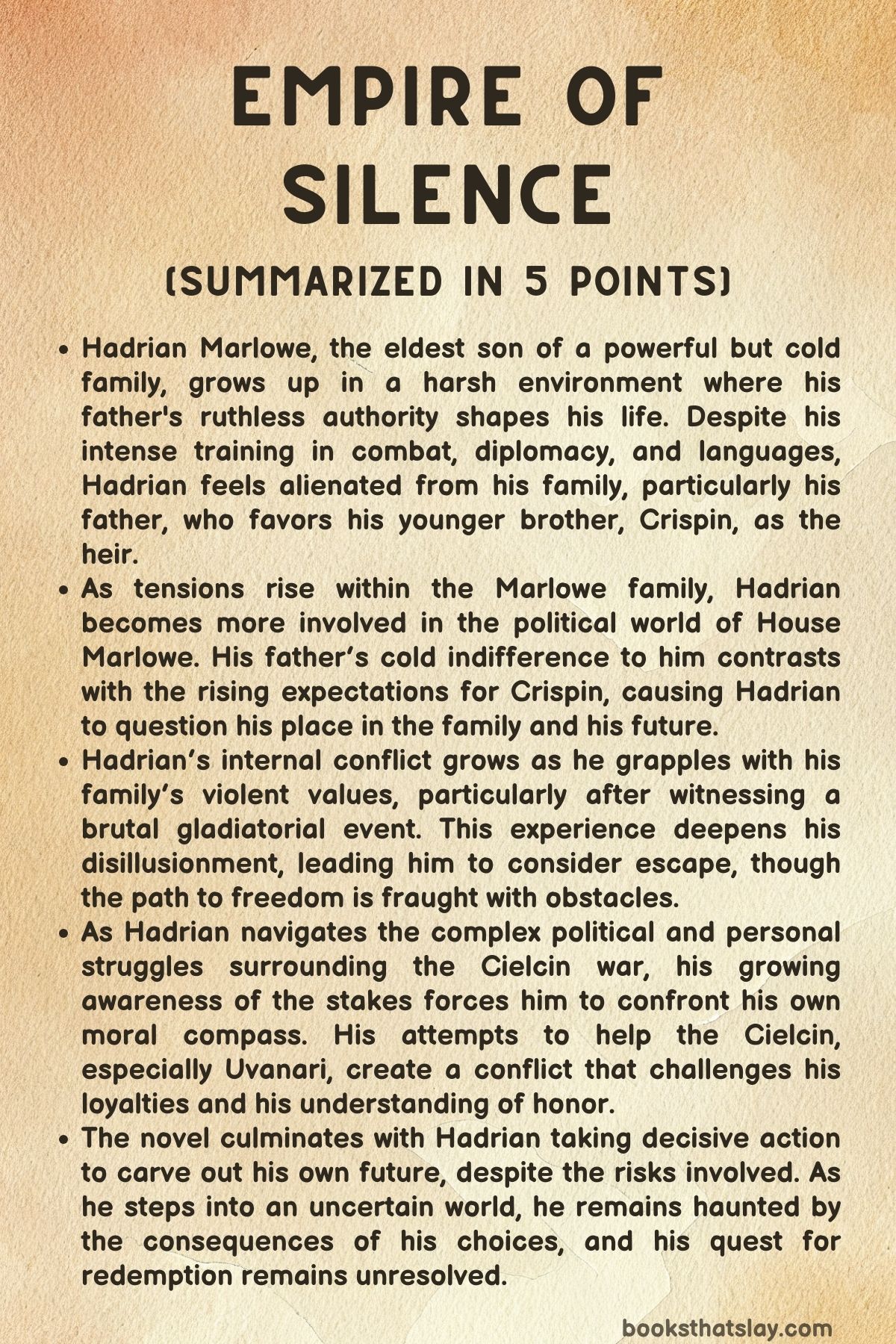
Hadrian Marlowe is the eldest son of Alistair Marlowe, the Archon of the Meidua Prefecture, a powerful and influential family within the empire. Raised in a harsh and militaristic environment, Hadrian’s upbringing is far from traditional.
His mother, who preferred the company of women, was absent from his early life, leaving him to be raised by tutors and servants at the family estate, Devil’s Rest. His father, a cold and authoritative figure, is more concerned with continuing the family’s legacy than with providing Hadrian with the emotional support most children receive.
Instead, Hadrian receives intense education and physical training to prepare him for leadership, though it is clear from an early age that his father’s favoritism lies with his younger brother, Crispin.
Hadrian’s relationship with Crispin is marked by rivalry and tension. Crispin, larger and stronger than Hadrian, is groomed as the favored heir to their father’s estate, while Hadrian’s talents are often overlooked.
Despite his skills in diplomacy, languages, and combat, Hadrian finds himself sidelined in favor of his more physically dominant brother. His struggle for recognition from his father deepens as he grows older, leading him to question his place within the family and the empire.
His father’s coldness toward him only intensifies his feelings of inadequacy.
The novel unfolds against the backdrop of the Cielcin War, an ongoing conflict between humans and the Cielcin, a hostile alien race. Hadrian’s knowledge of the Cielcin and his proficiency in their language become important assets as the war escalates.
However, Hadrian’s internal conflict is not limited to the battlefield. He is deeply conflicted about the role he is expected to play within his family and the larger political world.
As he navigates the treacherous waters of power, betrayal, and family expectations, Hadrian’s desire to escape the confines of his father’s estate and pursue a different path grows stronger.
Hadrian’s frustration with his family’s politics intensifies when he learns that his father has not declared him as his heir. Instead, his father favors Crispin, whose physical prowess makes him more appealing as a future leader.
Hadrian’s desire for independence becomes a defining element of his character as he contemplates his future. His father’s repeated dismissals and coldness lead him to consider escape, and he begins to make secret financial arrangements to fund his departure from the estate.
As Hadrian’s discontent grows, he also becomes involved in the political machinations surrounding his family’s dealings with the Wong-Hopper Consortium. While his father and Crispin dominate the discussions, Hadrian is left to the sidelines, and his involvement feels like a mere formality.
This sense of alienation drives him further away from his family, and he begins to question whether he has the strength to live up to the brutal expectations of his lineage.
Despite his frustration, Hadrian is not without allies. His mentor, Tor Gibson, offers him guidance, though Gibson’s advice is often cryptic and subtle.
Hadrian’s growing sense of rebellion culminates in his decision to take control of his destiny, even if it means betraying his family’s expectations. His quest for autonomy becomes a key theme in the novel, as he wrestles with the burden of legacy and the desire to forge his own path.
As the novel progresses, Hadrian’s journey takes him to the political and military frontlines of the Cielcin conflict. He is thrust into situations that force him to confront his own beliefs about power, loyalty, and duty.
The war with the Cielcin, an alien species that threatens humanity’s existence, is portrayed as a backdrop to Hadrian’s personal struggles. His relationship with the Cielcin, especially his interactions with their captain, Uvanari, becomes an essential part of his character development.
The narrative shifts to explore Hadrian’s role as a translator and negotiator for the human authorities, who are holding the Cielcin in captivity. Uvanari, having suffered tremendous torture, requests death as a means to end his suffering.
Hadrian’s moral conflict over granting Uvanari’s wish brings to light the complex dynamics between humans and the Cielcin, adding another layer to his character’s journey. His actions during this critical moment prompt him to reflect on the moral implications of his choices and the larger consequences of the conflict.
As Hadrian navigates his personal and political struggles, the novel delves into the intricate relationships within his family. His strained relationship with his father, his rivalry with Crispin, and his growing dissatisfaction with his family’s expectations serve as the driving forces behind his desire to escape.
His internal conflict is mirrored in the larger political landscape of the empire, where the war with the Cielcin is escalating, and power struggles are at the forefront.
Hadrian’s journey takes him from the elite society of Emesh to the grim realities of the Colosso, a brutal gladiatorial arena. As he watches fighters die for the entertainment of the masses, Hadrian’s discomfort with his family’s values becomes more pronounced.
The spectacle of violence, which his brother Crispin revels in, is something that Hadrian cannot reconcile with his own beliefs. This internal struggle is a defining moment in his character’s arc, as he begins to question the system that has shaped his life.
Despite his growing disillusionment, Hadrian’s desire for redemption and freedom remains. He contemplates a life outside the rigid structures of his family and the empire, though the path to freedom is fraught with uncertainty.
His internal battle between his duty to his family and his desire for self-determination becomes a central theme as he wrestles with his identity and future.
The story concludes with Hadrian’s decision to break free from his family’s oppressive grip. As he steps into an unknown future, he reflects on the consequences of his actions and the unresolved questions surrounding his path.
Hadrian’s journey is one of self-discovery, sacrifice, and the pursuit of autonomy, as he confronts the complexities of family, power, and war in a universe that demands loyalty and submission.
Characters
Hadrian Marlowe
Hadrian Marlowe is the protagonist and narrator of Empire of Silence, a complex character caught between the brutal expectations of his family and his own moral compass. Born as the eldest son of Alistair Marlowe, Archon of Meidua Prefecture, Hadrian’s early life was shaped by his father’s cold, authoritative rule and his mother’s absence.
His upbringing, steeped in military discipline and intellectual rigor, fosters a sharp mind but leaves him estranged from the family dynamics, particularly with his younger brother, Crispin, who is physically stronger and favored by their father. Hadrian’s early education, led by figures like Sir Felix Martyn and Tor Gibson, molds him into a skilled combatant and diplomat, yet he is burdened with a deep-seated dissatisfaction with his family’s power-driven world.
His relationship with his father is fraught with emotional distance and dismissal, leaving Hadrian feeling inadequate and alienated. This emotional neglect manifests in his constant striving to prove himself, despite being undermined by his father and overshadowed by Crispin.
Throughout the story, Hadrian grapples with his sense of duty, a growing disillusionment with his family’s politics, and a desire to escape the expectations placed upon him, seeking a path that diverges from the oppressive legacy of House Marlowe.
Alistair Marlowe
Alistair Marlowe, Hadrian’s father, is a quintessential example of a ruthless patriarch who places family legacy and power above all else. As the Archon of Meidua Prefecture, he governs with an iron fist, caring little for the emotional or moral considerations of his family.
His coldness towards Hadrian, his disinterest in his son’s growth, and his preference for Crispin reveal a man obsessed with control and authority. Alistair’s dismissive treatment of Hadrian stems from his belief that only those who embody the strength and ruthlessness of a true ruler are worthy of leadership.
Alistair’s power-driven mindset leaves no room for weakness, and his treatment of Hadrian reflects his expectation that his son should conform to the harsh realities of governance. Alistair’s actions and decisions significantly shape Hadrian’s internal conflict, driving him to question his place in the family and ultimately fueling his desire to break free from the suffocating legacy his father imposes on him.
Crispin Marlowe
Crispin Marlowe, Hadrian’s younger brother, serves as both a rival and a foil to Hadrian’s character. Physically stronger and more in tune with the brutal demands of their father’s world, Crispin embodies the qualities that Alistair values in a successor.
His favored status as the heir to House Marlowe, a position that Hadrian desires, creates a tense dynamic between the two brothers. Despite their competitive relationship, Crispin’s role in the narrative is defined not just by his rivalry with Hadrian but also by his unquestioning acceptance of the harshness and violence of their family’s legacy.
Whereas Hadrian struggles with his moral compass, Crispin embraces the ruthlessness required to rule, even participating in the bloody spectacles of the Colosso. Their relationship is complicated, as Crispin represents the embodiment of their father’s ideals, constantly challenging Hadrian’s more conflicted view of power and inheritance.
Tor Gibson
Tor Gibson is Hadrian’s tutor and one of the few figures in his life who provides a moral and intellectual anchor. Gibson’s influence on Hadrian goes beyond the educational sphere, as he instills in him a sense of curiosity about the broader universe, especially regarding the Cielcin, the alien species threatening humanity.
Gibson’s teachings, which blend science, history, and philosophy, help shape Hadrian into a well-rounded and deeply thoughtful individual. While Gibson is not directly involved in the family politics, his mentorship provides Hadrian with the intellectual tools to challenge the oppressive system in which he is ensnared.
His guidance becomes particularly significant as Hadrian navigates his future and contemplates the possibility of escape. Gibson encourages Hadrian to consider a path that diverges from his family’s expectations, subtly guiding him toward the realization that he does not have to conform to the violent, power-hungry world that his family represents.
Valka Onderra
Valka Onderra, a xenologist, plays a pivotal role in expanding Hadrian’s worldview and offering him a glimpse into a different perspective on the world. A sharp contrast to the nobility around her, Valka’s intellectual approach to the alien species, especially the Umandh, and her disdain for the treatment of these creatures by the elite, offers Hadrian a sense of purpose outside the oppressive nobility he is part of.
Throughout their interactions, Valka serves as a catalyst for Hadrian’s evolving views on power, status, and the intricacies of societal systems. She challenges his preconceptions, sparking in him a desire to rethink his position and the roles he has been forced to play.
As a fellow outsider to the nobility’s artificial politeness, she provides a sanctuary of intellectualism and authenticity for Hadrian, leading him toward a deeper understanding of the complexities surrounding his life.
Uvanari
Uvanari, a Cielcin captain, is a tragic figure whose suffering is central to Hadrian’s moral dilemma. Tortured and broken by human captors, Uvanari embodies the existential struggle between honor and survival.
As a member of an alien species with a deeply ingrained tradition of self-destruction to avoid dishonor, Uvanari represents the harshness of the interspecies conflict and the personal consequences of war. Hadrian’s interactions with Uvanari are filled with tension, as he navigates the complex dynamics between mercy, responsibility, and the devastating impact of war.
Uvanari’s plea for death to end its suffering forces Hadrian to confront the deep moral quandaries of his actions. The Cielcin’s culture and the devastating toll the war takes on them are a reminder to Hadrian of the broader stakes in his quest for autonomy and his role in the unfolding political events.
Uvanari’s story highlights the tragic cost of the empire’s expansionist ambitions and the personal consequences of Hadrian’s involvement in the galaxy’s complex political machinations.
Anaïs and Dorian Mataro
Anaïs and Dorian Mataro, siblings from the noble Mataro family, represent the superficial and morally bankrupt nature of the elite society Hadrian finds himself in. Their relationship with Hadrian, initially cordial and interested in his past, gradually reveals the cold, transactional nature of their interactions.
Anaïs, in particular, presses Hadrian to embellish his past to fit the expectations of the nobility, showcasing the performative aspect of court life. As Hadrian reluctantly participates in their social games, it becomes increasingly clear that he is just another pawn in a world built on appearances and power.
The Mataros, though offering Hadrian temporary camaraderie, serve as a stark reminder of the emptiness that pervades the elite circles he struggles to navigate. Their relationship with Hadrian deepens his inner conflict, as he becomes more aware of the falsehoods he must tell to survive in their world.
Pallino
Pallino, one of Hadrian’s former companions from his gladiatorial days, serves as a key figure in Hadrian’s reckoning with his past. Unlike the nobles and intellectuals surrounding him, Pallino represents a more visceral connection to Hadrian’s earlier life, a time when he was closer to a simpler, more honest existence.
Pallino’s presence in the narrative forces Hadrian to confront the personal cost of his decision to abandon his old life for a more secure but hollow existence in the aristocracy. Pallino’s loyalty and desire to reconnect with Hadrian reflect the genuine relationships that Hadrian sacrificed in his pursuit of power and safety.
In many ways, Pallino represents the part of Hadrian he left behind—a world of camaraderie, loyalty, and shared hardship, which contrasts sharply with the cold, political games he now finds himself trapped in.
Themes
Power and Legacy
In Empire of Silence, power and legacy are central to the protagonist Hadrian Marlowe’s internal and external struggles. Hadrian is constantly weighed down by the expectations of his father, Lord Alistair, and the Marlowe family’s legacy.
His father’s indifferent, authoritative manner forces Hadrian to deal with a life that revolves around duty rather than personal desire. The story delves deep into Hadrian’s sense of obligation to continue the Marlowe family’s ruthless rule, contrasting with his personal aspirations and discomfort with the violent, authoritative nature of the Marlowe estate.
The familial power structure is rigid, and Hadrian’s position within it seems to be a constant point of friction. His desire to become more than just an heir to a brutal legacy places him at odds with his father, who views him as weak and inadequate in comparison to his more physically dominant brother, Crispin.
Hadrian’s story reflects the heavy burden that comes with the inheritance of power. This theme expands to include his own doubts about whether he should embrace the violent, authoritarian model set by his father or pursue a different path that aligns more with his intellectual interests.
His growing alienation from the system he’s a part of speaks to the psychological toll that the pursuit of power takes on an individual, especially when they are conflicted between their desires and their familial obligations. The legacy of power is further complicated by the political manipulation surrounding the Marlowe family’s estate and the increasing conflict with the Cielcin.
Hadrian’s struggle to assert his place within this legacy ultimately leads him to question the very notion of power itself and whether his life will be defined by the legacy of his father or by his own actions.
Family Dynamics and Betrayal
Family dynamics in Empire of Silence are complex and deeply entwined with themes of rivalry, affection, and betrayal. The protagonist’s relationship with his father, Lord Alistair, is one of cold distance and disappointment.
Hadrian’s desire to prove himself to his father contrasts sharply with Alistair’s indifference towards him. Hadrian is dismissed and marginalized, especially in comparison to his younger brother, Crispin, who enjoys favor due to his physical prowess.
This relationship is a critical element in understanding Hadrian’s internal turmoil, as he grapples with feelings of inadequacy and resentment. The rivalry between Hadrian and Crispin serves as a catalyst for Hadrian’s deeper exploration of his own worth and his future within the Marlowe legacy.
The dynamic between Hadrian and his mother is equally distant. She, caught in her own personal struggles, offers little emotional support to Hadrian, furthering his sense of isolation.
Despite being born into a prestigious family, Hadrian’s emotional needs are largely neglected, and this neglect influences his decision to seek validation outside of his family. His growing discontent with his family’s treatment of him and his eventual desire to escape their suffocating expectations reflect how deeply familial ties can affect one’s sense of self.
This theme of familial tension is also evident in the political and military pressures surrounding the family, where loyalty is tested and personal aspirations collide with family obligations. The emotional distance in Hadrian’s relationships with his family drives him towards a path of betrayal, as he chooses to seek his own destiny rather than fulfill the role that his family demands.
Identity and Self-Discovery
Hadrian’s journey in Empire of Silence is deeply marked by his quest for identity and self-discovery. His early life is shaped by the rigorous expectations placed upon him as the heir to the Marlowe estate, but as the narrative progresses, Hadrian becomes increasingly aware of the dissonance between the person his family wants him to be and the person he desires to become.
His intellectual aspirations, including his passion for languages and history, set him apart from his father’s militaristic values. This tension between who he is and who he is expected to be is a key aspect of his identity crisis.
Hadrian’s internal struggle is further complicated by his recognition that his physical limitations and lack of alignment with his family’s vision for the future render him an outsider in his own home. This feeling of alienation only intensifies as he navigates the expectations of the ruling class, where cruelty, ambition, and violence are the means to success.
His experience with the gladiatorial combat, and the tragic events that unfold as part of his family’s cruel spectacles, heighten his disillusionment with his role in this violent system. His attempts to reconcile his desires for intellectual fulfillment with the violent expectations of his family are a major part of his personal evolution.
Ultimately, Hadrian’s decision to escape the life prescribed for him becomes a pivotal moment in his search for autonomy and self-actualization. This theme explores how self-discovery often involves painful choices, including the rejection of familial expectations and the embrace of one’s true nature, no matter how much it conflicts with external pressures.
The Impact of War and Violence
The constant backdrop of war, particularly the conflict with the Cielcin, serves as a grim reminder of the brutal reality of the world in Empire of Silence. Hadrian’s life is shaped not only by his family’s oppressive rule but also by the ongoing violence and conflict surrounding humanity’s fight for survival.
The Cielcin, an alien species, represent a threat to human dominance, but the war with them is portrayed as more than just a battle for control—it is a symbol of the devastating consequences of unchecked violence. Hadrian’s role in these conflicts is complicated by his intellectual and moral opposition to the brutality that war demands.
Hadrian’s involvement with the Cielcin war, particularly his role as a negotiator and translator, forces him to confront the ethical implications of his actions. He becomes personally entangled in the lives of the Cielcin, particularly the tortured Captain Uvanari, whose suffering makes Hadrian question the morality of his society’s war efforts.
Hadrian’s internal conflict grows as he is forced to balance his loyalty to his family and his role in the conflict with his growing empathy for the alien species. The theme of violence in the story is not only physical but also psychological, as characters like Hadrian are forced to live with the repercussions of their choices and the moral compromises they make in pursuit of their goals.
The violence of war, and the subsequent manipulation of power and resources, are integral to the narrative, underscoring the destruction it brings to both the individuals directly involved and the broader societal structure.
The Corruption of Power
As Hadrian navigates the political machinations within the Marlowe family and the broader galactic empire, the theme of the corruption of power becomes increasingly evident. The Marlowe family’s dominance is built on manipulation, coercion, and ruthless ambition, with each member of the family vying for control and favor.
Hadrian’s struggle with his family’s values reflects a larger commentary on the nature of power itself: how it corrupts those who seek it, and how it distorts familial relationships.
Hadrian’s own journey involves a continuous battle with the corrupting influence of power. His initial desire to prove himself to his father and to take on the mantle of leadership is tempered by his increasing awareness of the morally bankrupt system he is inheriting.
The cutthroat politics of the Marlowe family, coupled with the larger galactic power structures at play, create an environment where power is pursued at any cost, and loyalty is sacrificed for personal gain. The theme of corruption is also explored through the broader galactic conflict, where political and military leaders manipulate entire populations for their own benefit, often without regard for the collateral damage they cause.
Hadrian’s eventual rejection of this system represents a desire to break free from the corrupting influence of power, though he remains aware of the complexities and consequences of his decisions.