End of Days Summary and Analysis
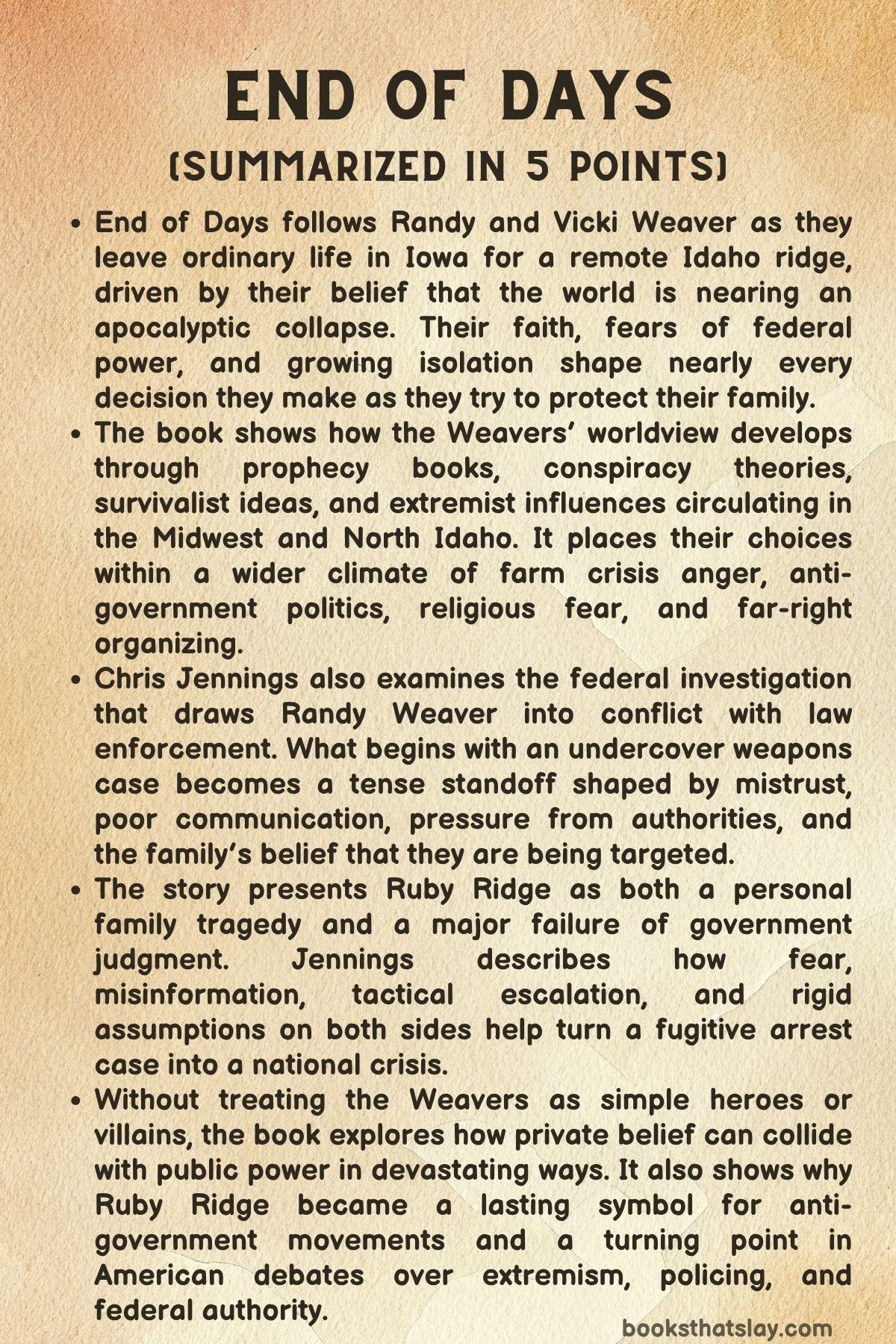
End of Days: Ruby Ridge, the Apocalypse, and the Unmaking of America by Chris Jennings is a nonfiction account of the beliefs, fears, mistakes, and government decisions that led to the deadly 1992 Ruby Ridge siege in Idaho. The book follows Randy and Vicki Weaver from ordinary life in Iowa into an isolated world shaped by apocalyptic religion, conspiracy theories, racism, survivalism, and distrust of federal authority.
Jennings also examines the law enforcement choices that turned a weapons case into a national tragedy. At its center, End of Days is about a family trapped by its convictions and a government response that escalated fear into violence.
Summary
Randy and Vicki Weaver left Iowa for the mountains of North Idaho because they believed the world was moving toward its final battle. Their view of life had been shaped by biblical prophecy, end-times books, conspiracy theories, survivalist politics, and Vicki’s visions of a mountain refuge.
They came to believe that the federal government was tied to a coming “New World Order,” a force they saw as hostile to God and ready to destroy families like theirs. In 1983, they moved with their children to a remote ridge near Ruby Creek, where they built a rough cabin, stored food, kept weapons, and prepared for the disaster they thought was coming.
Before Ruby Ridge became a national event, the Weavers had lived a fairly ordinary life in Cedar Falls, Iowa. Randy had served in the army and worked at John Deere.
Vicki cared for the home and children. Over time, however, their beliefs grew more extreme.
Vicki read apocalyptic books that interpreted modern politics, the Cold War, Israel, nuclear fears, and global institutions as signs of the approaching end of the world. She began to believe God was sending her visions of escape.
Randy accepted her certainty, and together they pulled away from mainstream church life.
Their home became the center of a small Bible study group. Vicki took on the role of religious authority, while Randy preached about judgment, government corruption, and the need to prepare.
The family changed its habits, rejected many ordinary comforts, homeschooled the children, observed Old Testament practices, and grew suspicious of churches they believed had compromised. Their religious thinking also absorbed racist and antisemitic ideas from Christian Identity circles and the wider far right.
In the economic strain of the Midwest farm crisis, anti-government movements found new listeners, and the Weavers became receptive to claims about federal tyranny, Jewish bankers, gun confiscation, and martial law.
Their move to Idaho seemed to confirm their sense of mission. North Idaho offered isolation, weak regulation, survivalist communities, and far-right networks.
The Weavers bought land on Caribou Ridge and began living as though the final conflict might arrive at any time. Randy also became involved around the edges of Aryan Nations gatherings and Christian Patriot circles, though he often seemed more interested in preaching than organizing.
In 1988, he ran unsuccessfully for county sheriff on a platform shaped by far-right ideas about local authority and resistance to federal power.
Federal attention came through an undercover weapons investigation. At Aryan Nations events, Randy met a man introduced as “Gus Magisono,” who was actually Kenneth Fadeley, an informant working with the Bureau of Alcohol, Tobacco and Firearms.
Fadeley posed as a biker and weapons buyer while trying to gather information from white power and Christian Identity circles. Randy was not the major target the ATF wanted, but agents hoped he might lead them to more important radicals.
After repeated contact, Randy sold Fadeley two illegally shortened shotguns. The government recorded the sale but hoped to use the charge mainly as pressure to make Randy cooperate as an informant.
When agents confronted Randy in 1990, he refused to help them. He believed informing violated his religion and saw the encounter as proof that the government was beginning its campaign against his family.
Vicki shared that belief and sent defiant letters declaring that they would not submit. Randy was indicted later that year and arrested in January 1991 through a staged roadside stop designed to keep the arrest away from the cabin.
He was released on bond, but he misunderstood parts of the legal process and believed a conviction could cost him his land. A mistaken letter also gave him the wrong trial date.
Even after the court allowed time for the confusion to clear, the Weavers decided Randy would not appear.
Once Randy became a fugitive, the U.S. Marshals Service took over. Deputy Marshal Dave Hunt tried for months to resolve the case without violence.
He reached out through neighbors and friends, but the Weavers grew more isolated and more certain that federal agents planned to kill them. Reports from neighbors described armed threats, racist harassment, and confrontations.
The marshals developed a plan to monitor the cabin, learn the family’s routines, and arrest Randy when he was away from his children. Hidden cameras were placed around the property, but the family discovered at least one and knew they were being watched.
By the summer of 1992, pressure on law enforcement had increased. Newspapers and television crews portrayed Randy as a dangerous armed fugitive who had kept federal agents at bay.
Helicopters and reporters near the ridge fed the family’s fear. In August, six deputy marshals entered the property before dawn to scout and check surveillance equipment as part of the larger arrest plan.
They did not intend to raid the cabin that day. But the Weaver dog, Striker, sensed them in the woods and began barking.
Randy, his son Samuel, family friend Kevin Harris, and two of the girls reacted as the family had practiced. They grabbed weapons and moved out to check the road.
Sam and Kevin followed Striker downhill, while Randy took another route. In the woods, three marshals in camouflage and masks tried to avoid detection.
Randy encountered one of them, refused an order to freeze, and ran back uphill, convinced he had found a government ambush. Soon after, Striker reached the road with Sam and Kevin nearby.
Marshal Arthur Roderick shot and killed the dog to protect the marshals’ position. Sam, furious, fired into the woods.
Randy fired into the air to draw Sam and Kevin back.
The marshals returned fire. Sam was hit first in the arm, then in the back as he tried to retreat uphill, and he died on the road.
Kevin Harris fired toward the muzzle flashes and killed Deputy Marshal William Degan. Kevin escaped to the cabin and told the family that Sam was dead.
Randy and Vicki went down, found their son’s body, and carried him home. They cleaned him, wrapped him, and placed him in Vicki’s shed while rain fell and sirens gathered below the ridge.
Degan’s death transformed the situation. The FBI took command and treated the family as armed religious extremists who had murdered a federal officer.
Inaccurate and exaggerated reports circulated about tunnels, explosives, outside fighters, and earlier attacks. The FBI’s Hostage Rescue Team arrived, and commanders approved broad rules of engagement that allowed snipers to shoot armed adults near the cabin under conditions that were later heavily criticized.
The next evening, Randy, Sara, and Kevin stepped outside as a helicopter flew nearby. Randy moved toward the shed where Sam’s body lay.
FBI sniper Lon Horiuchi shot him in the arm. Randy, Sara, and Kevin ran back toward the cabin.
Horiuchi fired again at Kevin as he entered the doorway. The bullet killed Vicki Weaver, who was standing inside holding baby Elisheba, and then wounded Kevin.
The surviving family members were trapped inside with Vicki’s body, Kevin badly hurt, and the children screaming in terror.
For days, communication failed. The FBI used armored vehicles, loudspeakers, and negotiators, but the family believed surrender meant death.
Negotiators kept calling for Vicki, not knowing she was dead, which made the survivors think the agents were mocking them. Outside, protesters, journalists, anti-government activists, gun-rights supporters, white separatists, religious radicals, and local citizens gathered near Ruby Creek Bridge.
The siege became a national spectacle.
The standoff began to shift when Bo Gritz, a far-right figure Randy trusted, was allowed to mediate. He learned that Vicki was dead and passed that information to the FBI and the crowd outside.
With help from Jackie Brown, he slowly persuaded the family to let Kevin leave for medical treatment and allowed Vicki’s body to be removed. On August 31, Randy, Sara, Rachel, and baby Elisheba finally walked out.
Randy was arrested, and the children were sent away from the ridge.
The aftermath made Ruby Ridge a lasting symbol of federal overreach for anti-government movements. Randy Weaver and Kevin Harris were tried for murder but were acquitted of the most serious charges; Randy was convicted only of failing to appear in court.
The Weavers and Kevin later received settlements from the government. In public memory, Ruby Ridge became linked with Waco and the Oklahoma City bombing as part of a dark period when distrust, extremism, poor judgment, and state power collided with deadly results.
Key Figures
Randy Weaver
Randy Weaver is one of the central figures in End of Days, and the book presents him as a man whose ordinary beginnings gradually turn into radical isolation, fear, and confrontation. At first, Randy appears as a husband, father, former soldier, and factory worker trying to build a stable family life.
Over time, however, his thinking becomes shaped by apocalyptic religion, conspiracy theories, survivalist politics, and a deep distrust of federal power. His move from Iowa to the remote Idaho ridge shows how completely he comes to believe that the world is nearing a final spiritual and political collapse.
Randy’s tragedy lies in the fact that he sees himself as a protector of his family, yet many of his choices place that family in greater danger.
Randy is also portrayed as stubborn, proud, and increasingly unable to separate caution from paranoia. His refusal to cooperate with federal agents after the illegal shotgun case grows out of both personal defiance and religious conviction.
He believes informing on others would violate his faith, and he and Vicki interpret government pressure as proof that prophecy is unfolding around them. This makes Randy both a victim of government overreach and a participant in the escalation that follows.
He is not shown as a simple hero or villain; rather, he is a flawed man whose fear of tyranny, commitment to his beliefs, racial and extremist associations, and devotion to family all combine into a deeply unstable situation.
As a father, Randy is protective but also dangerous in the way he trains his children to expect attack. His world teaches them that outsiders, especially federal agents, are enemies.
This makes the children part of the siege mentality rather than separate from it. Randy’s grief after Sam’s death reveals his human vulnerability, but his earlier decisions have already helped create the conditions in which that death becomes possible.
By the end of the book, Randy stands as a tragic figure: a man who wanted freedom, spiritual purity, and family survival, but whose beliefs and actions helped lead his family into catastrophe.
Vicki Weaver
Vicki Weaver is one of the most powerful and tragic figures in the book. She is not merely Randy’s wife or a background presence; she is a driving force in the family’s spiritual direction.
Her visions of a mountain refuge, her intense reading of biblical prophecy, and her belief that God had chosen a path for the family shape nearly every major decision the Weavers make. Vicki’s role as the family’s theologian gives her great influence.
She interprets world events, government actions, and personal hardship through an apocalyptic lens, and she helps transform ordinary anxiety into religious certainty.
Vicki is presented as deeply devoted to her family, but that devotion is inseparable from her extreme beliefs. She wants to protect her children from a corrupt world, yet her definition of protection requires isolation, obedience, armed readiness, and suspicion of nearly everyone outside the family’s circle.
Her letters to officials and extremist contacts show a woman who believes she is standing against evil forces rather than negotiating with ordinary institutions. This makes her fearless in one sense, but also rigid and unreachable.
She does not simply fear the government; she spiritually interprets it as an enemy within a cosmic battle.
Her death is one of the book’s most devastating moments because she is killed while holding baby Elisheba, standing inside the doorway of the family home. The image captures the terrible collision between private domestic life and militarized federal force.
Vicki’s character represents the emotional and religious core of the Weaver family, and her death changes the siege from a law enforcement crisis into a national symbol of government violence. In End of Days, she becomes both a mother destroyed by state power and a believer whose certainty helped lead her family toward the very apocalypse she feared.
Samuel Weaver
Samuel Weaver is one of the most heartbreaking characters in the story because he is a child shaped by the fears and conflicts of adults. Sam grows up in an environment where guns, prophecy, survivalism, and distrust of outsiders are normal parts of family life.
He is loyal to his parents and deeply attached to the family dog, Striker. His reaction when Striker is shot shows him as emotional, impulsive, and still very young.
His rage is not the calculated aggression of an adult extremist; it is the furious grief of a boy who sees his dog killed in front of him.
Sam’s death is central to the moral tragedy of the book. He is armed, but he is also a minor caught in a confrontation he did not create.
His attempt to run uphill before being shot in the back makes his death especially disturbing. The book presents him as both a participant in the armed standoff culture of the Weaver household and a victim of the deadly confusion that surrounds the federal operation.
His killing intensifies the family’s belief that the government has come to destroy them, and it hardens the siege into grief, anger, and fear.
Sam also represents the cost of raising children inside an apocalyptic worldview. He has learned to respond to perceived threats with weapons because that is the world his parents have prepared him for.
Yet he does not fully understand the legal, political, and tactical forces surrounding the family. His death shows how adult ideology can consume children before they are old enough to choose it for themselves.
Sam is therefore one of the book’s clearest symbols of innocence damaged by extremism, fear, and state violence.
Sara Weaver
Sara Weaver is portrayed as a young person forced into adult terror far too early. She is present during the crisis, sees the armed fear inside her family, witnesses her father being shot, and experiences the horror of her mother’s death inside the cabin.
Sara is not simply a passive child in the background; she becomes one of the emotional witnesses through whom the human cost of the siege is felt. Her screams after Vicki is killed reveal the unbearable shock of children trapped inside a home that has become a battlefield.
Sara’s character is important because she shows the psychological damage caused by both the family’s isolation and the government’s assault. She has been raised to believe that agents of the state are dangerous enemies, and then the events on the ridge seem to confirm that belief in the most traumatic way possible.
This makes her experience especially painful: the worldview she inherited from her parents becomes fused with real violence. The government is not merely imagined as a threat; in her eyes, it has killed her brother and mother.
At the same time, Sara’s presence reminds the reader that the Weaver household was not only a political or religious problem. It was a family home filled with children.
Any analysis of the armed standoff must account for the fact that young people were living inside the consequences. Sara’s character gives the book much of its emotional force because she survives the events but carries the burden of seeing the people closest to her destroyed.
Rachel Weaver
Rachel Weaver is less central than Randy, Vicki, Sam, or Sara, but her role is still significant because she represents the younger children caught inside the family’s world. Like Sara, Rachel grows up in isolation, surrounded by religious certainty, survivalist fear, and armed preparation.
She is part of a household where the boundary between family loyalty and militant suspicion becomes dangerously blurred. Her childhood is shaped not by ordinary social life but by the belief that outside forces may soon attack.
During the siege, Rachel’s terror becomes part of the emotional reality inside the cabin. After Vicki is killed and Kevin is wounded, Rachel is trapped with the surviving family members in a space filled with grief, injury, confusion, and fear.
She is old enough to understand danger but still a child, which makes her situation especially painful. Her presence challenges any attempt to see the event only as a battle between law enforcement and armed adults.
Rachel’s character also helps show how the Weaver children inherited a world they did not create. She did not choose the move to Idaho, the family’s ideology, Randy’s legal conflict, or the federal response.
Yet she is forced to live through the consequences of all of them. In this way, Rachel represents the silent suffering of children inside extremist households and state confrontations alike.
Elisheba Weaver
Elisheba Weaver, the baby of the family, is the most innocent figure in the book. She has no understanding of prophecy, politics, law enforcement, guns, or ideology, yet she is physically present at the center of the violence.
Her presence in Vicki’s arms when Vicki is killed gives the scene its most devastating symbolic power. The baby turns the moment from a tactical shooting into an image of domestic innocence pierced by state force.
Elisheba’s character does not develop through speech or action, but through what she represents. She embodies the vulnerability of the family’s children and the complete collapse of any meaningful separation between combatant and noncombatant during the siege.
The fact that she survives while her mother dies holding her adds to the emotional weight of the event. She becomes a living reminder of what the confrontation did to the Weaver family.
In the larger structure of the book, Elisheba represents the future left behind after the disaster. She is too young to remember the ideology that shaped the family or the decisions that brought them to the ridge, but her life is permanently marked by them.
Her character shows that the consequences of fanaticism, fear, and official violence extend even to those with no agency at all.
Kevin Harris
Kevin Harris is one of the most morally complicated figures in the book. As a family friend living close to the Weavers, he becomes deeply involved in their isolated world.
He is loyal to them, armed with them, and present during the fatal encounter in the woods. His shooting of Deputy Marshal William Degan is one of the central acts of violence in the story, yet the book also presents the moment as chaotic, confusing, and shaped by fear after Striker and Sam are shot.
Kevin is not portrayed simply as an outsider who causes trouble. He is a young man drawn into the Weaver family’s orbit and, by August 1992, effectively part of their defensive circle.
His loyalty to the family becomes inseparable from the armed confrontation with the marshals. When he fires toward the muzzle flashes and kills Degan, his action changes the entire event.
What began as a surveillance operation and confrontation around the road becomes the killing of a federal officer, bringing the full force of the FBI onto the ridge.
Kevin’s later wounding by the sniper’s second shot makes him both a shooter and a victim. He kills, but he is also badly injured in a shot that kills Vicki.
This dual position makes him one of the book’s most complex characters. He stands at the intersection of personal loyalty, armed resistance, panic, and state retaliation.
His eventual acquittal of murder reflects the legal uncertainty around his actions, while his role in the story remains emotionally and morally unresolved.
Deputy Marshal William Degan
William Degan is a crucial figure because his death transforms the Ruby Ridge situation into a national federal crisis. As one of the deputy marshals conducting surveillance on the Weaver property, he enters the story as part of a law enforcement effort to monitor and eventually arrest Randy.
Degan is not shown as a symbolic villain; he is a federal officer operating within a risky and poorly controlled mission. His death in the woods becomes the event that drives the FBI’s heavy tactical response.
Degan’s character matters because he represents the human cost on the law enforcement side. The book does not allow the reader to see the tragedy only through the Weaver family.
Degan’s killing shows that the danger on the ridge was real and that federal officers were also vulnerable. At the same time, his death becomes the basis for exaggerated assumptions about the Weavers, contributing to the perception that the cabin held murderous extremists who had ambushed federal agents.
In narrative terms, Degan’s death changes everything. It brings armored vehicles, FBI snipers, revised rules of engagement, protesters, national media, and a siege atmosphere.
He becomes a fallen officer whose death is used to justify a massive escalation. The tragedy is that his killing, like Sam’s, emerges from confusion, fear, and a mission that had already placed armed men close to an armed and paranoid family.
Deputy Marshal Larry Cooper
Larry Cooper appears as one of the marshals most directly involved in the fatal exchange near the road. His role is significant because he is likely the marshal who shot Sam as Sam turned to run uphill.
This places Cooper at the center of one of the most controversial and painful moments in the book. He is part of a team trying to avoid a direct assault on the cabin, but the surveillance mission collapses into sudden violence once the dog detects the marshals.
Cooper’s character reflects the fear and uncertainty experienced by officers operating in the woods. He and the other marshals are camouflaged, hidden, and concerned about being exposed.
Once shots are fired, the situation becomes chaotic and deadly. Cooper’s likely shooting of Sam is legally and morally troubling because Sam is a teenage boy and appears to be moving away.
Yet Cooper is also acting in a moment of panic after being fired upon and while believing his team is in danger.
Through Cooper, the book explores the danger of ambiguous armed encounters. He is not presented as a simple murderer, but neither is his action treated as clean or uncomplicated.
His role shows how tactical secrecy, fear, and poor communication can produce irreversible violence in seconds. Cooper’s presence also complicates the idea of victimhood because he survives the encounter while both Sam and Degan die.
Deputy Marshal Arthur Roderick
Arthur Roderick is important because he shoots Striker, the family dog, and that act becomes the immediate trigger for Sam’s enraged response. In tactical terms, Roderick fears that the dog will reveal the marshals’ hidden position.
In emotional terms, killing the dog turns a tense surveillance encounter into a deeply personal violation for the Weaver family. Striker is not merely an animal in the story; he is Sam’s dog and part of the family’s protective world.
Roderick’s decision reveals how law enforcement logic and family emotion collide. From the marshal’s perspective, the dog is a threat to concealment.
From Sam’s perspective, the dog is a beloved companion being killed by hidden intruders. The book uses this moment to show how quickly different perceptions of the same event can produce disaster.
Roderick’s act may have seemed tactically necessary to him, but it has catastrophic consequences.
As a character, Roderick embodies the dangers of a covert operation conducted around people who already expect an ambush. His presence in camouflage and his decision to shoot the dog confirm the Weavers’ worst fears.
He is not the most developed figure in the book, but his action is one of the most consequential. Without the killing of Striker, the chain of rage, gunfire, and death might have unfolded differently.
Striker
Striker, Sam’s yellow Labrador, is a small but emotionally important presence in the book. He functions almost like an alarm system for the family, detecting the marshals hidden in the woods and setting the fatal encounter in motion.
His barking and movement downhill draw Sam and Kevin into the woods, while his death creates the emotional explosion that follows. Though an animal, Striker plays a decisive role in the human tragedy.
Striker represents the family’s sense of home, loyalty, and protection. To the marshals, he is a tactical problem.
To Sam, he is a companion. This difference in meaning is what makes his killing so explosive.
When Roderick shoots Striker, Sam’s response is immediate and emotional. The death of the dog collapses the distance between suspicion and violence.
In the book’s larger moral structure, Striker shows how even a seemingly small tactical decision can have enormous consequences. His death is not equal to the deaths of Sam, Degan, or Vicki, but it is the spark that ignites the first gunfight.
The dog’s role reminds the reader that tragedies sometimes turn on moments that seem minor to one side and unbearable to the other.
Lon Horiuchi
Lon Horiuchi is one of the most controversial figures in the book because his sniper shots define the second stage of the tragedy. As an FBI Hostage Rescue Team sniper, he arrives after Degan’s death, under rules of engagement that allow deadly force under broad and deeply questionable conditions.
His first shot wounds Randy as Randy moves near the shed where Sam’s body lies. His second shot, aimed at Kevin Harris, passes through the cabin doorway, kills Vicki, and wounds Kevin.
Horiuchi represents the cold, distant power of militarized law enforcement. Unlike the chaotic gunfight in the woods, his shots come from a position of surveillance, calculation, and official authorization.
This makes his role especially disturbing. The book presents his actions within the context of faulty assumptions, exaggerated intelligence, and illegal or improper rules of engagement, but the human result remains clear: a mother holding a baby is killed inside her home.
As a character, Horiuchi is less emotionally developed than Randy or Vicki, but his narrative function is enormous. He becomes the symbol of federal overreach and lethal misjudgment.
For critics of the government, his shot embodies the belief that the state had declared war on a family. For the book, his role shows how institutional fear and tactical aggression can turn a standoff into a moral disaster.
Bo Gritz
Bo Gritz enters the book as a mediator after days of failed communication between the FBI and the surviving family members. He is a far-right figure admired by Randy, which gives him credibility that federal negotiators lack.
His importance lies in the fact that he can speak to Randy in a language of trust, shared suspicion, and ideological familiarity. Where official negotiators fail, Gritz is able to create a channel of communication.
Gritz is not presented as a neutral saint. He belongs to the same broader anti-government and far-right world that helped make Ruby Ridge symbolically powerful.
However, in the immediate crisis, his role is constructive. He learns that Vicki is dead, communicates this to authorities and protesters, helps arrange Kevin’s removal for medical care, and gradually persuades the surviving family to surrender.
His presence shows that negotiation depends not only on authority but also on credibility.
In narrative terms, Gritz helps bring the siege to an end. He functions as a bridge between the isolated cabin and the outside world.
His role also reveals a major failure by law enforcement: the FBI had surrounded the cabin with force but could not establish meaningful trust. Gritz’s success demonstrates that the crisis required human understanding as much as tactical control.
Jackie Brown
Jackie Brown plays a quieter but important role in the final movement of the story. She helps Bo Gritz persuade the family to allow Kevin to leave for medical treatment and Vicki’s body to be removed.
Her presence matters because the surviving family members are traumatized, distrustful, and convinced that surrender may mean death. In that emotional environment, any person who can help build trust becomes significant.
Jackie’s character represents compassion and practical mediation. Unlike the armed officers, protesters, or ideological figures surrounding the siege, she is important because she helps humanize the process of ending it.
Her involvement suggests that the crisis cannot be resolved by force alone. The family needs reassurance, sympathy, and gradual persuasion before they can step out of the cabin.
Though she is not one of the central figures, Jackie Brown helps shift the story from violence toward survival. Her role emphasizes the importance of care after catastrophe.
In a book filled with armed men, prophecy, suspicion, and political rage, her contribution stands out as a quieter form of courage.
Kenneth Fadeley, also known as Gus Magisono
Kenneth Fadeley is the undercover ATF informant who helps draw Randy into the weapons case that later becomes the legal foundation of the crisis. Posing as Gus Magisono, a biker and gunrunner, he enters the extremist circles around Hayden Lake and the Aryan Nations.
His false identity allows him to build relationships with men like Frank Kumnick and Randy Weaver while secretly recording conversations and gathering evidence.
Fadeley’s character is important because he represents the hidden world of federal infiltration. To law enforcement, he is a tool for reaching dangerous radicals.
To Randy and Vicki, once they learn of the operation, he becomes proof that the government is deceptive and predatory. The shotgun transaction involving Fadeley gives federal agents leverage over Randy, but it also strengthens the Weavers’ belief that they have been set up.
In the book, Fadeley complicates the boundary between legitimate investigation and entrapment-like pressure. Randy does sell him illegal weapons, but the government’s larger goal is to use the charge to make Randy inform on others.
This makes Fadeley a key figure in the chain of events that leads from extremist gatherings to indictment, fugitive status, surveillance, and siege. His role shows how undercover tactics can produce consequences far beyond their original purpose.
Frank Kumnick
Frank Kumnick is a significant figure in the extremist network around Randy Weaver. He introduces Randy to Fadeley, believing him to be Gus Magisono, and helps connect Randy more directly to the world of Aryan Nations gatherings, white power circles, and revolutionary talk.
Kumnick is suspicious of informants and even tries to check Fadeley for a wire, but his paranoia fails to expose the hidden microphone.
Kumnick’s character shows the mixture of bravado, racism, conspiracy, and incompetence that runs through some of the radical circles in the book. He talks about forming a successor to the Order and is associated with alarming schemes, yet the scene in which he uses a stud finder to search for a wire also reveals a darkly absurd side of the extremist underground.
He is dangerous not because he is especially disciplined, but because his fantasies of violence exist within networks that federal agents are actively monitoring.
For Randy, Kumnick serves as a bridge into deeper suspicion from law enforcement. Even if Randy says he is not interested in joining an insurgent group, his association with Kumnick places him closer to people the ATF wants to investigate.
Kumnick therefore helps explain how Randy, who often preferred preaching about Yahweh and prophecy, becomes entangled in a federal weapons investigation.
Herb Byerly
Herb Byerly is one of the ATF agents who approaches Randy after the shotgun sale and tries to pressure him into cooperating. His role is important because this encounter marks the moment when Randy fully understands that the government has evidence against him.
Byerly offers help if Randy provides information, but Randy sees the offer as a demand that he betray his religious principles and his associates.
Byerly represents the bargaining logic of federal law enforcement. To the agents, Randy is a potential informant who can lead them to more significant radicals.
To Randy, the offer is spiritual corruption and government coercion. This mismatch deepens the conflict.
Rather than pulling Randy into cooperation, the encounter drives him and Vicki further into defiance.
As a character, Byerly is not explored emotionally in great depth, but his function in the book is crucial. He helps turn a weapons case into a test of identity for Randy.
After this meeting, Randy and Vicki interpret the government’s actions as the beginning of the prophesied attack they had long expected. Byerly’s attempt to gain cooperation therefore has the opposite effect: it strengthens the family’s resistance.
Steve Gunderson
Steve Gunderson, like Herb Byerly, is part of the ATF effort to confront Randy with evidence from the shotgun transaction and persuade him to cooperate. His presence in the meeting reinforces the pressure Randy feels from federal authority.
The agents believe they are offering Randy a way to reduce his trouble by helping them. Randy believes he is being asked to become a traitor.
Gunderson’s character represents the institutional confidence of law enforcement. He and Byerly approach Randy with photographs, evidence, and a clear expectation that legal pressure will produce cooperation.
They underestimate how Randy’s religious and conspiratorial worldview will transform that pressure into proof of persecution. The failure of this encounter is one of the key turning points in the book.
Gunderson’s role also shows how the government’s strategy depends on reading Randy as a rational legal actor rather than as a man already living inside an apocalyptic narrative. Because the agents do not fully grasp how Randy and Vicki interpret the world, they misjudge the effect of their actions.
Gunderson is therefore part of the wider pattern of official miscalculation that runs through End of Days.
Dave Hunt
Deputy Marshal Dave Hunt is one of the more patient law enforcement figures in the book. After Randy fails to appear in court, Hunt spends months trying to resolve the situation through negotiation, friends, neighbors, and indirect contact.
Unlike the later tactical response, his approach is slower and more cautious. He recognizes that the presence of armed children at the cabin makes a direct arrest dangerous.
Hunt’s character is important because he represents the possibility of a less violent path. He does not simply rush the cabin.
He tries to understand the family’s network and waits for an opportunity to arrest Randy away from the children. This does not mean every part of the marshals’ strategy succeeds, but Hunt’s approach shows more awareness of the risks than the later FBI escalation.
At the same time, Hunt is still part of the machinery that closes around the Weaver family. His months of negotiation do not overcome the family’s distrust.
The longer Randy remains a fugitive, the more pressure builds, and the more likely a confrontation becomes. Hunt’s role therefore carries a sense of tragic frustration.
He tries to avoid disaster, but the situation moves toward disaster anyway.
John Todd
John Todd is a conspiracy preacher whose influence on Randy and Vicki helps deepen their apocalyptic worldview. He claims to be a former Illuminati witch and insider, warning that Satanists, musicians, politicians, churches, and global organizations are working toward the Antichrist’s One World Government.
Though already discredited by many evangelical leaders, his message fits the fears the Weavers are already developing.
Todd’s character matters because he represents the spread of conspiracy religion into ordinary lives. He does not need to live with the Weavers or join them on the ridge to affect their choices.
His claims reinforce their belief that hidden evil controls politics, culture, and organized religion. For Vicki and Randy, such teachings make withdrawal from mainstream society seem not only reasonable but spiritually necessary.
In the book, Todd functions as one of the voices that radicalize the family’s imagination. His influence helps turn fear into certainty.
By validating the idea of secret global plots, he makes the Weavers more receptive to extreme interpretations of government action. He is therefore part of the intellectual and religious environment that prepares the family for Ruby Ridge.
Hal Lindsey
Hal Lindsey is not a direct participant in the Ruby Ridge standoff, but his influence is central to the Weavers’ transformation. His apocalyptic writing gives Vicki and Randy a framework for interpreting modern events as signs of the approaching End Times.
Through his ideas about Israel, the Antichrist, the Tribulation, and Armageddon, global politics becomes sacred prophecy for the Weavers.
Lindsey’s role in the book is that of an ideological catalyst. His work helps move Vicki’s religious imagination toward certainty that the world is nearing its final crisis.
Randy comes to share this belief, and together they begin preparing for collapse. The mountain refuge, the food storage, the suspicion of world government, and the urgency of survival are all strengthened by this apocalyptic framework.
As a character in the broader narrative, Lindsey represents the mainstreaming of end-times thinking in American religious culture. The Weavers are extreme in their later choices, but the ideas that influence them are not born in isolation.
Lindsey’s popularity shows how apocalyptic fear circulated widely before taking a particularly intense form in the Weaver household.
Gordon Kahl
Gordon Kahl appears as a symbolic figure whose life and death influence the wider anti-government movement surrounding the Weavers. As a tax-resisting Christian Patriot and Posse Comitatus figure who killed federal marshals before dying in a fiery standoff, he becomes a martyr to extremists.
His story helps unify survivalists, tax protesters, white supremacists, and apocalyptic Christians.
Kahl’s importance lies in the example he provides. To the radical right, he proves that the federal government is an enemy and that resistance can be sanctified.
His death becomes part of the mythology of government tyranny. This mythology matters because it shapes the atmosphere into which Randy and Vicki move when they settle in northern Idaho.
In the book, Kahl functions as a dark foreshadowing of Ruby Ridge. His conflict with federal authority, his fugitive status, the death of marshals, and his transformation into a martyr all echo later elements of Randy Weaver’s story.
Kahl shows that Ruby Ridge did not emerge from nowhere; it grew out of an existing culture of armed resistance and apocalyptic anti-government belief.
Ronald Reagan
Ronald Reagan appears in the book as part of the larger political and religious atmosphere of the 1980s. He is not a direct character in the Ruby Ridge conflict, but his era matters.
Conservative politics, Cold War fear, religious revivalism, and end-times language all become more visible during his presidency. This helps normalize talk of Armageddon, spiritual warfare, and global struggle.
Reagan’s significance is contextual. The Weavers’ beliefs are extreme, but they develop during a period when apocalyptic language has entered mainstream political and religious discussion.
This does not make Reagan responsible for the family’s choices, but it places their thinking within a broader national mood. Fear of nuclear war, global government, and moral decline gives their private anxieties public echoes.
As a figure in the book’s background, Reagan helps show how fringe and mainstream ideas sometimes overlap. The Weavers move far beyond ordinary conservatism, but they draw energy from a culture in which end-times expectation and political suspicion are widely discussed.
His presence in the book widens the story beyond one family and one ridge.
Jerry Falwell
Jerry Falwell represents the rise of politically active evangelical conservatism in the world surrounding the Weavers. Like Reagan, he is not directly involved in the standoff, but his prominence helps illustrate the environment in which apocalyptic religion and conservative politics become intertwined.
His influence belongs to the broader culture that makes end-times language politically powerful.
Falwell’s role is important because the book does not portray the Weavers as emerging in a vacuum. Their beliefs are extreme, but they are intensified versions of themes circulating through religious television, prophecy literature, and conservative activism.
Falwell represents the more mainstream side of that movement, where concerns about morality, national destiny, and spiritual conflict become part of public life.
In relation to the Weavers, Falwell helps explain how religious fear could feel socially validated even before it moved into more radical territory. The family’s later isolation and extremist associations are their own choices, but the atmosphere of religious-political urgency around them makes those choices easier to imagine.
Pat Robertson
Pat Robertson, like Falwell, appears as part of the religious-political culture that shapes the book’s background. He represents the blending of evangelical media, conservative politics, and apocalyptic concern.
His importance lies not in direct action but in the way figures like him helped make spiritual interpretations of world events part of ordinary public discourse.
Robertson’s presence helps show that the Weavers’ end-times thinking existed within a larger ecosystem of sermons, broadcasts, books, and political messages. Randy and Vicki absorb ideas from many sources, and Robertson belongs to the public religious world that gives those ideas cultural force.
Through such figures, global politics can appear as a stage for prophecy.
As a character in the broader landscape of the book, Robertson helps connect private belief to national culture. The Weavers’ path is extreme, but the language of spiritual warfare and approaching crisis is not theirs alone.
His role therefore helps the book explain how radical certainty can grow from ideas already circulating in more acceptable forms.
Vaughn Trueman
Vaughn Trueman is one of the people connected to the Weavers’ home Bible study period in Iowa. His role is significant because he helps show that Randy and Vicki’s beliefs develop within a small community before the family fully isolates itself.
The home Bible studies become a space where prophecy, survivalism, religious separation, and distrust of mainstream institutions intensify.
Trueman’s presence suggests that the Weavers’ transformation is social as well as private. They are not merely reading books alone; they are discussing, teaching, and reinforcing ideas with others.
Vicki becomes the theologian of the group, while Randy preaches, and people around them help create an atmosphere of shared conviction. Such small circles can make extreme beliefs feel normal and supported.
Although Trueman is not a central figure in the later standoff, his role helps explain the family’s earlier radicalization. He belongs to the stage of the story when the Weavers are moving away from ordinary church life and toward a stricter, more isolated religious identity.
That transition is essential to understanding everything that follows.
Shannon Brasher
Shannon Brasher is another figure associated with the Weavers’ home Bible study community. Like Vaughn Trueman, Brasher helps show that the family’s beliefs are reinforced through relationships and gatherings.
The Weavers’ home becomes a place where religious searching hardens into separation from mainstream churches and society.
Brasher’s importance lies in the social texture of the book. Radicalization is not presented only as the result of one book, one preacher, or one political movement.
It happens through repeated conversations, shared fears, and group validation. People like Brasher show that Randy and Vicki’s ideas circulate among friends before they become the foundation for a mountain refuge.
As a minor character, Brasher helps mark the period when the Weavers are still embedded in a community but are beginning to pull away from ordinary life. This makes the later move to Idaho feel like the result of a long process rather than a sudden decision.
Brasher’s role is small, but it contributes to the book’s explanation of how the family’s worldview forms.
Chuck Howarth
Chuck Howarth appears as one of the more significant Montana radicals whom the ATF hopes Randy might help them reach. His role in the book is less personal than strategic.
Federal agents see Randy as potentially useful because he may provide access to people considered more important in radical networks. This explains why the government wants to pressure Randy into becoming an informant.
Howarth’s character matters because he shows that Randy is not necessarily the main target in the broader investigation. The ATF is interested in larger extremist circles, and Randy becomes valuable because of who he might know.
This makes the shotgun charge more than a simple weapons case. It becomes leverage within a wider operation.
Although Howarth does not dominate the story, his presence helps clarify the government’s motives. Agents are not only responding to Randy’s illegal sale; they are trying to penetrate a radical network.
That larger goal contributes to the pressure placed on Randy and therefore to the escalation that follows.
David Trochmann
David Trochmann, like Chuck Howarth, is part of the wider radical environment that federal investigators want to understand. The ATF hopes Randy might connect them to figures such as Trochmann, which makes Randy useful beyond his own actions.
Trochmann’s significance is therefore tied to the government’s investigative strategy.
His presence helps show the networked nature of the anti-government movement. The book is not only about one isolated family but also about a broader world of Christian Identity believers, white separatists, survivalists, and militia-like activists.
Trochmann represents the kind of figure federal agents believe may pose a larger threat than Randy himself.
As a character in the book’s background, Trochmann helps explain why the government does not simply treat Randy as a minor weapons offender. Investigators believe he may be a doorway into something bigger.
That belief increases the stakes of the case and helps push events toward confrontation.
Themes
Apocalyptic Fear and Religious Certainty
Randy and Vicki’s choices are driven by a belief system that turns fear into duty. Their move to North Idaho is not presented as a simple search for privacy, but as a response to what they see as divine warning.
Vicki’s visions, prophecy books, and literal readings of scripture create a world in which ordinary events become signs of the End Times. Economic crisis, social change, federal authority, and global politics are all interpreted as proof that final judgment is near.
In End of Days, this certainty becomes dangerous because it leaves little room for doubt, compromise, or ordinary legal resolution. The family’s cabin becomes more than a home; it becomes a fortress against a world they believe is already spiritually corrupted.
Their faith gives them purpose and discipline, but it also isolates them from neighbors, churches, courts, and officials. The tragedy grows from this closed worldview, where surrender feels like betrayal and government action appears not as law enforcement but as fulfillment of prophecy.
Isolation and the Collapse of Trust
The family’s physical isolation on the ridge reflects a deeper emotional and political separation from society. Their withdrawal begins as a search for safety, but it gradually becomes a condition that intensifies suspicion.
Distance from ordinary community life makes outside contact feel threatening, while each government action confirms the family’s belief that enemies are closing in. The remote cabin, armed routines, homeschooling, religious discipline, and rejection of mainstream institutions all build a world where the family depends almost entirely on its own interpretation of events.
Trust breaks down on every side. The Weavers do not trust churches, courts, banks, reporters, or federal agents.
Law enforcement, in turn, increasingly sees the family through reports of weapons, extremist contacts, threats, and fugitive status. This mutual distrust makes peaceful communication harder before the shooting even begins.
Once violence occurs, every action is filtered through fear. Calls from negotiators, helicopter movements, surveillance, and armored vehicles no longer look like attempts at control; they look like proof of a coming attack.
Government Power, Misjudgment, and Escalation
The conflict shows how state power can become destructive when fear, poor information, and institutional pressure shape decisions. What begins with a weapons charge becomes a large federal operation involving marshals, surveillance, tactical teams, snipers, armored vehicles, and national attention.
The authorities do have reasons for concern: Randy is a fugitive, the family is armed, and an officer has been killed. Yet the response is marked by errors and assumptions that deepen the crisis.
Reports exaggerate the danger, officials treat the cabin as a battlefield before real negotiation has taken place, and the revised rules of engagement allow deadly force under conditions later seen as unjustifiable. The killing of Vicki while she holds her baby becomes the clearest example of how a law-enforcement mission can lose moral control.
End of Days does not excuse the Weavers’ extremism, racism, or armed defiance, but it shows that official power carries a special burden. When government agents act on fear instead of restraint, their mistakes can turn a standoff into a national wound.
Extremism, Identity, and the Search for Belonging
The Weavers’ story is shaped by the appeal of movements that give frightened people a sense of order, identity, and enemies to blame. Their beliefs do not develop in isolation from history.
The farm crisis, apocalyptic media, Christian Patriot ideas, Posse Comitatus arguments, white separatist circles, and conspiracy preachers all provide language for their anger and fear. These movements offer simple explanations for complex problems: banks, Jews, federal agents, global government, corrupt churches, and modern society become part of one hostile system.
Randy and Vicki are drawn into this world because it makes their anxieties feel meaningful and their isolation feel righteous. Extremism here is not only political; it is also emotional.
It gives the family a heroic role as chosen survivors resisting evil. That identity becomes harder to abandon as conflict grows.
Even when Randy resists becoming an informant or joining a larger insurgent plan, he remains inside a culture of suspicion and racial hatred. The result is a family tragedy tied to a wider national crisis of radicalization.