Eldrith Manor Summary, Characters and Themes
Eldrith Manor by Leigh Rivers and Anita St. Graves is a dark paranormal romance about grief, guilt, curses, and two damaged people bound together by a spell gone wrong. The story begins with Lincoln “Lynx” Taylor, a desperate young man who dies under a curse, then shifts to Sable Eldrith, a lonely woman haunted by her sister’s death and her family’s crimes.
When Sable tries to summon her sister at her ruined family estate, she brings Lynx back from Hell instead. What follows is a dangerous, strange, and emotional story about death, survival, love, and the choice to save someone even at the cost of freedom.
Summary
Eldrith Manor opens many years in the past, with Lincoln “Lynx” Taylor fighting to keep his life from falling apart. At only twenty, Lynx is responsible for his five-year-old brother, Dylan, after their mother’s death.
He is poor, exhausted, and terrified that one mistake could send Dylan to an orphanage. When he arrives late to his railroad job, his boss, Stuart, uses the excuse to fire him.
Stuart falsely claims Lynx has been late many times before and refuses to give him his final pay.
Desperate and afraid, Lynx makes a reckless choice. He steals Stuart’s valuable gold stopwatch, intending to sell it and escape the city with Dylan.
Stuart and his son Andrew catch him before he can get away. Stuart takes the watch back, then stabs Lynx with a strange dagger marked with a family crest.
As Lynx dies, Stuart’s curse sends him to Hell. Lynx’s last thoughts are of Dylan, the little brother he failed to protect.
In the present day, Sable Eldrith is living in the apartment where her sister Ella died. Her life has become small and bleak.
She works from home in a customer service job she hates, while her wealthy parents are in prison for embezzlement. After their public downfall, Sable spent years trying to keep Ella alive through illness.
Ella died almost a year earlier, and Sable is still crushed by guilt because their final conversation was an argument.
On what would have been Ella’s birthday, Sable breaks down after reading that her parents were denied permission to visit Ella’s supposed grave. The article enrages her because Ella has no grave.
Drunk, grieving, and alone, Sable enters Ella’s room and finds an old family dagger hidden in a carved wooden box, along with Ella’s grimoire. Believing she has nothing left to lose, she decides to use one of Ella’s spells to summon her sister.
Sable drives to the abandoned Eldrith Manor, the ruined estate once owned by her family. She brings Ella’s urn, the dagger, candles, chalk, and the grimoire.
In Ella’s old bedroom, she draws a summoning circle and repeats the Latin words from the spell. The ritual works, but Ella does not appear.
Instead, Lynx is pulled out of Hell.
He appears beautiful, frightening, and furious. Without understanding where he is or who Sable is, Lynx snaps her neck.
Once he realizes he has returned to Earth, he searches the manor, hoping the curse has ended and that he might still find Dylan. But each time he tries to leave the property, he is dragged back to Sable.
Sable wakes as a ghost beside her own corpse. Lynx kills her again to test whether she can stay dead, but she keeps returning in ghostly form.
She soon understands that she is trapped at Eldrith Manor behind an invisible barrier. Lynx is trapped too, tethered to her because she summoned him.
Their early days together are hostile and chaotic. He demands that she fix the spell and free him, while she insists she never meant to summon him at all.
She only wanted Ella.
As the days pass, Sable learns how to exist as a ghost. She discovers that she can pass through objects, touch things with effort, alter her clothing, and still needs rest.
When she tries the spell again, she accidentally summons Tony, Lynx’s loud, flirtatious roommate from Hell. Tony confirms that he and Lynx are demons.
He also reveals his hellhound form, Tidus. Unlike Lynx, Tony can open a portal back to Hell, but when Lynx tries to enter it, Hell rejects him and throws him back.
The tether to Sable still holds him.
Sable gradually accepts that she is dead. She decides to bury her body and Ella’s ashes under a willow tree where she and Ella once made childhood promises.
Lynx surprises her by helping carry and bury her corpse. This act shifts something between them.
They begin to speak more honestly about loss: Sable about Ella, and Lynx about Dylan. Their anger does not vanish, but it becomes mixed with understanding.
The manor is later invaded by college students throwing a party. Sable is furious that living people are trashing her home, especially while her parents are giving interviews that paint her as unstable and accuse her of stealing Ella’s ashes.
She starts haunting the partygoers, and Lynx joins her. Their mischief turns serious when they stop a man from assaulting a drugged girl.
The night brings Sable and Lynx closer, but it also exposes Lynx’s jealousy when Sable reacts to Mitchell, someone from her past. Lynx attacks him and warns Sable to run before someone else dies.
He chases her through the manor in demon form, and the fear, anger, and desire between them finally explode.
After Sable and Lynx give in to their attraction, the encounter ends badly when Sable falls through a window and Lynx disappears. Sable is furious and humiliated, but what hurts most is the loneliness that returns in his absence.
While wandering through the manor and forest, she discovers that her buried corpse has been dug up and mutilated. If anyone finds it, the police may identify her, her parents could regain control of the estate, and her situation could become even worse.
Sable searches for her missing remains and finds Lynx, who explains that he has been trapped elsewhere on the property in a Hell-like state. When a police cruiser arrives, the danger grows.
Sable sees what appears to be a fresh human arm, suggesting that someone else has died on the grounds. The officers are investigating Connor, a missing man from the party.
Lynx, confused by modern police and cars, nearly ruins the interaction, but Sable coaches him through it. He lies, and the officers leave.
Lynx struggles with his feelings for Sable. He learns that the year is 2025 and realizes that centuries have passed since his human life.
Sable teaches him how to use a phone, and their conversations become less cruel. He still resists apologizing fully for killing her, but his actions begin to show care.
He searches the forest for the scattered pieces of her body and tries to protect the grounds from Tor’Oth, soul-sucking demons drawn by residue from Hell.
Their fragile peace is broken when Tidus attacks paranormal investigators at the manor, killing several people. Sable and Lynx are forced to hide more bodies.
Tony admits that the demon energy around the estate is drawing attention from Hell. Soon after, a Tor’Oth attacks Sable.
Lynx kills it, but Sable is wounded by its venom. She suffers fever, pain, hallucinations, and nightmares.
Lynx stays with her, tends her wounds, comforts her, and finally allows himself to admit how much she matters to him.
As Sable recovers, she finds a hidden ledger in the basement that proves more of her parents’ crimes. She wants it delivered to the authorities so they cannot win their appeal.
She also tells Lynx more about the abuse she endured from her parents. Their bond becomes softer and more open.
They kiss, protect each other, and begin to acknowledge their feelings, even when they cannot yet say everything plainly.
Then Sable finds the dagger from the ritual in Ella’s room. Lynx recognizes it as the blade that killed him.
When he learns that Sable’s family name is Eldrith, and that her family is connected to the company tied to his death and damnation, he feels betrayed. He lashes out in pain and rage.
In the chaos, Sable accidentally stabs him with the dagger. The curse breaks.
Lynx becomes human again and can finally leave the property.
Before he can return to Sable, Tor’Oth take her to Hell. Lynx is free, human, and no longer bound to the manor, but he chooses to go after her.
Tony takes him into Hell, where they are captured. Tony dies helping him, and Lynx reaches Sable while she is trapped in a nightmare of the night Ella died.
The Devil offers Lynx a bargain: his soul in exchange for Sable’s freedom. Lynx accepts.
The Devil then tries to manipulate Sable with a similar offer, claiming Lynx traded her soul away. Instead of saving herself, Sable chooses to sacrifice herself so Lynx can be free.
Because both Lynx and Sable willingly choose each other, and because neither truly belongs in Hell anymore, the Devil releases them. Sable returns human, and Lynx remains human too.
Their curses are broken. They confess their love and begin a life together.
Sable gives the ledger to Agent Mackney, ensuring that her parents will remain in prison. More than a year later, Lynx and Sable visit Dylan’s grave.
Lynx learns that Dylan survived, lived a full life, had a family, and passed Lynx’s name down through later generations. This knowledge gives Lynx the peace he never had.
With Sable beside him, he leaves the grave ready to face the future, no longer ruled by Hell, guilt, or the past.
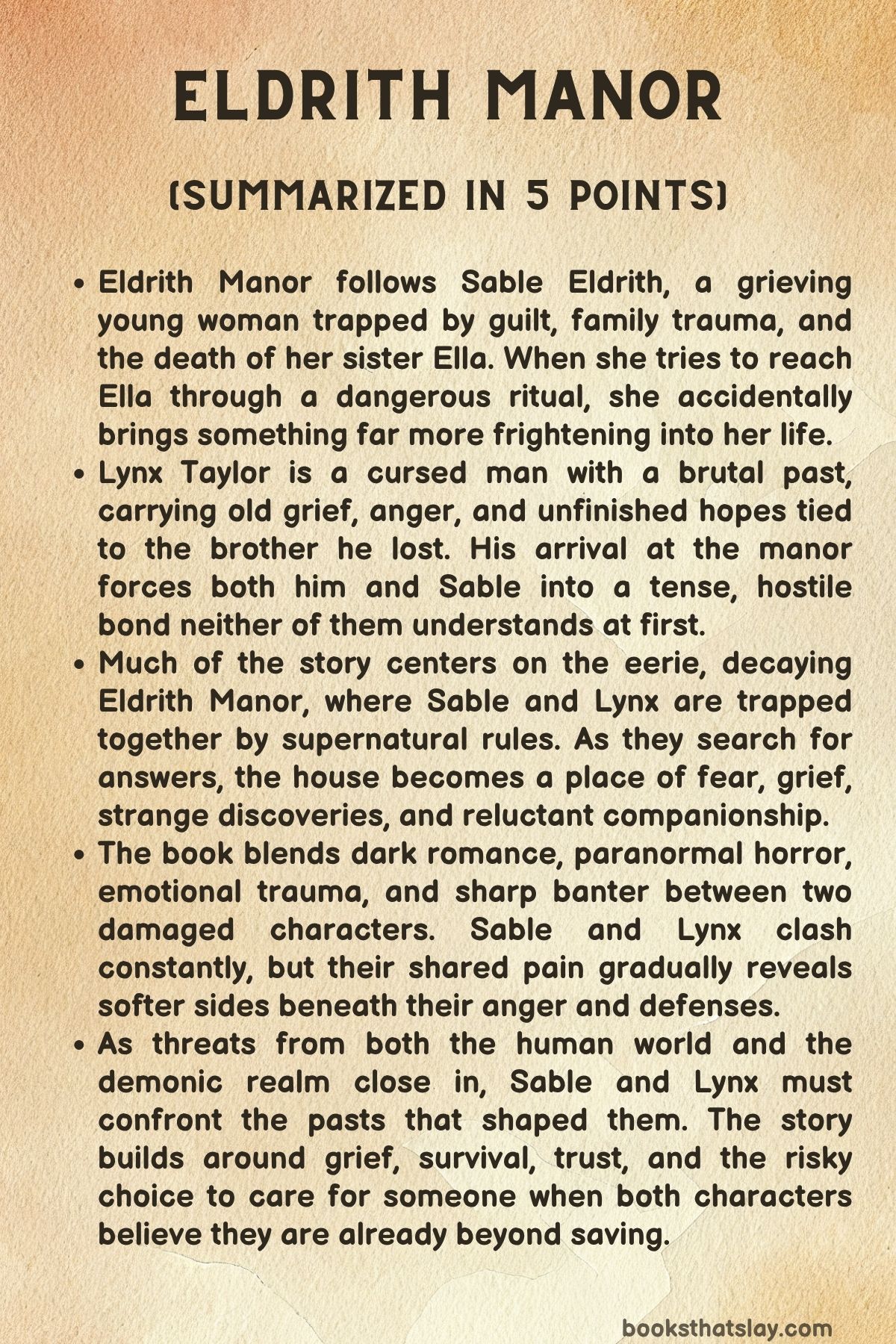
Characters
Sable Eldrith
Sable Eldrith is the emotional center of Eldrith Manor, and her character is shaped by grief, guilt, loneliness, and the desperate need to reclaim something that death has taken from her. At the beginning of the book, she is not presented as a powerful or confident heroine but as someone barely surviving.
She lives in the apartment where Ella died, works a draining customer service job, and carries the emotional wreckage of her family’s collapse. Her parents’ crimes and imprisonment have left her socially and financially damaged, but the deeper wound is Ella’s death.
Sable’s guilt over their final argument makes her grief especially destructive because she cannot simply mourn Ella; she also punishes herself for failing to save her sister emotionally, physically, and spiritually.
Sable’s decision to perform the ritual shows both her recklessness and her deep devotion. She does not summon Lynx because she seeks danger or power; she is trying to reach Ella.
This makes her mistake tragic rather than foolish. Her grief pushes her beyond ordinary reason, and the abandoned manor becomes a reflection of her own inner state: ruined, haunted, neglected, and full of buried family secrets.
After Lynx kills her and she becomes a ghost, Sable is forced into a strange second existence where she must confront not only death but also her own unfinished attachments. Her ghostly state makes her more vulnerable, but it also gives her room to change.
She learns to exist without the ordinary protections of life, and slowly her fear turns into anger, wit, defiance, and courage.
Her relationship with Lynx reveals some of her strongest qualities. She is frightened of him, but she does not remain passive before him.
She argues, resists, challenges, and eventually understands him. Their connection develops because both characters are trapped, both are grieving siblings, and both carry guilt over the people they could not save.
Sable’s compassion grows alongside her desire, and she begins to see Lynx not merely as a demon but as a man who was cursed, abandoned, and broken by injustice. At the same time, Sable is not defined only by romance.
Her determination to expose her parents through the ledger shows her moral clarity. Even after death, she wants truth, accountability, and protection from the people who harmed her and Ella.
By the end of the book, Sable’s transformation is profound. She moves from wanting to die or disappear into choosing life, love, and freedom.
Her willingness to sacrifice herself for Lynx proves that her love has become selfless rather than desperate. She begins the story as someone trying to bring back the dead because she cannot move forward, but she ends as someone who accepts the past without letting it imprison her.
Sable is a tragic, fierce, wounded, and ultimately resilient character whose journey is about learning that survival is not betrayal, love is not weakness, and grief does not have to become a permanent grave.
Lincoln “Lynx” Taylor
Lincoln “Lynx” Taylor is one of the most tragic and morally complex figures in the book. His human life begins in poverty and responsibility, not evil.
At only twenty, he is trying to raise Dylan after their mother’s death, and his desperation comes from love rather than greed. When he steals Stuart’s gold stopwatch, the act is wrong, but it is rooted in panic, fear, and a brother’s terror of losing the only family he has left.
His death is brutal because it punishes a desperate mistake with eternal damnation. The curse placed on him turns him into a demon, but the book makes it clear that his monstrosity is not his original nature.
It is something done to him, then something he learns to survive within.
As a demon, Lynx is violent, frightening, proud, and often cruel. His first act after being summoned is to kill Sable, which immediately establishes the danger he represents.
Yet his cruelty is complicated by centuries of torment and by the belief that everyone he loved is gone. He is a character who has been trapped for so long that rage has become his language.
His desire to escape the manor is not simply about freedom; it is about the impossible hope of finding Dylan. When he realizes centuries have passed, the emotional weight of his loss becomes clearer.
He has not just lost his brother; he has lost time, history, humanity, and the life he might have lived.
Lynx’s development is shown through small acts before it becomes open devotion. He helps Sable bury her body and Ella’s ashes, searches for her remains, protects the manor, tends to her when she is poisoned, and eventually risks everything to rescue her from Hell.
These actions matter because Lynx is not naturally gentle after centuries of suffering. Every tender gesture feels like a part of his buried humanity returning.
His bond with Sable forces him to confront guilt, desire, protectiveness, and love. He begins by seeing her as the reason he is trapped, but he eventually sees her as the person who gives his existence meaning again.
His greatest moment comes when he chooses Sable over his own freedom. After the curse breaks and he becomes human, he could leave.
Instead, he enters Hell as a mortal man, knowing the cost may be his soul. This choice completes his transformation.
Lynx is no longer only the cursed demon who wants escape; he becomes the man who is willing to be damned again so someone else can live. His visit to Dylan’s grave at the end gives his arc peace.
He learns that Dylan survived, lived fully, and carried Lynx’s memory forward. That knowledge releases him from the deepest wound of his past.
Lynx’s journey is about recovering humanity after centuries of darkness and proving that love can survive even damnation.
Ella Eldrith
Ella Eldrith is absent for most of the present action, but her presence shapes nearly everything Sable does. She is the dead sister Sable tries to summon, the person whose room remains emotionally sacred, and the source of Sable’s deepest guilt.
Ella functions as both a character and a haunting memory. Through Sable’s grief, she becomes a symbol of lost innocence, family damage, and the kind of love that survives death but can also become unbearable when mixed with regret.
Ella’s importance lies in the emotional history she shares with Sable. The childhood promise beneath the willow tree suggests that the sisters once created their own private world of loyalty and safety against the cruelty of their family.
Ella’s illness and death forced Sable into the role of caretaker, and that role left Sable exhausted, protective, and emotionally dependent on the idea that she had to save her sister. Their final argument makes Ella’s death even more painful because Sable remembers her not only with love but with shame.
Ella therefore becomes the wound Sable keeps reopening.
Although Ella does not return through the ritual, her grimoire and hidden dagger set the plot in motion. This gives her a strange power within the book.
She is gone, yet the objects connected to her change everyone’s fate. Her room becomes the place where grief, magic, family history, and danger converge.
The fact that Sable summons Lynx instead of Ella also shows the tragic gap between what the living want from the dead and what the supernatural world actually gives them. Ella cannot be recovered in the way Sable wishes, and Sable’s journey depends on accepting that truth.
Ella’s role is ultimately to show what Sable must learn to release. She is not forgotten, dismissed, or replaced by Lynx.
Instead, Sable’s love for Ella becomes part of her healing. By burying Ella’s ashes with her own body under the willow tree, Sable gives both of them a form of rest that their family denied them.
Ella remains one of the emotional foundations of the story because her death explains Sable’s despair, her courage, and her eventual need to live for herself.
Tony
Tony is one of the most vivid supporting characters in the story, bringing humor, chaos, loyalty, and supernatural danger into the book. When Sable accidentally summons him, his loud and flirtatious personality immediately changes the atmosphere.
Unlike Lynx, who is brooding, guarded, and bitter, Tony is playful and provocative. He teases, jokes, and disrupts tension, but his lightness does not mean he is harmless.
He is still a demon connected to Hell, and his hellhound form, Tidus, reveals the terrifying power beneath his charm.
Tony’s friendship with Lynx is important because it gives readers a glimpse of Lynx’s existence before Sable summoned him. As Lynx’s roommate from Hell, Tony knows the demonic world and understands parts of Lynx that Sable does not.
He is often comic relief, but he also serves as a bridge between the manor and Hell. His ability to open portals makes him crucial to the plot, especially because Lynx cannot use those portals while tethered to Sable.
Tony’s presence confirms that Lynx’s problem is not simply physical imprisonment but a deeper magical bond.
Tony is also morally complicated. As Tidus, he attacks the paranormal investigators and kills several people, forcing Sable and Lynx to deal with the consequences.
This moment reminds the reader that Tony’s humor does not erase his demonic instincts. He can be entertaining and loyal while still being dangerous.
That contradiction makes him more than a simple sidekick. He belongs to Hell, and Hell’s violence remains part of him.
His death while helping Lynx rescue Sable gives his character unexpected emotional weight. Tony may joke and flirt, but when it matters, he acts with loyalty and courage.
His sacrifice proves that he values Lynx and is willing to pay a terrible price for that bond. Tony’s arc adds humor, danger, and heartbreak, making him a memorable figure whose loyalty becomes more powerful than his mischief.
Tidus
Tidus is Tony’s hellhound form, and this form represents the more primal and terrifying side of Tony’s nature. While Tony can speak, tease, and interact socially, Tidus is a reminder that demons are not merely charming supernatural beings.
They are dangerous creatures with instincts that can turn deadly. The transformation into a huge hellhound gives physical shape to the violence and power that Tony usually hides beneath humor.
Tidus’s attack on the paranormal investigators is one of the moments where the supernatural threat becomes impossible to soften. Until then, the manor’s danger often feels tied to Sable and Lynx’s private conflict, but Tidus expands that danger outward.
His violence draws more consequences to the property and increases the pressure on Sable and Lynx. The deaths also connect the manor more strongly to Hell, showing that demonic presence leaves residue, attracts attention, and cannot be contained easily.
As a character form, Tidus complicates Tony by showing that he is not only a loyal friend but also a creature capable of destruction. This duality makes Tony’s later sacrifice more meaningful.
The same being who can cause horror can also choose loyalty. Tidus therefore represents the beast within Tony, while Tony’s actions show that even a creature from Hell is not limited to brutality alone.
Dylan Taylor
Dylan Taylor is the heart of Lynx’s human past. Though he is only five when Lynx dies, his importance is enormous because he is the reason Lynx makes the desperate choices that lead to his curse.
Lynx’s love for Dylan defines who he was before Hell. He was not a criminal by nature or a monster by desire; he was a young man terrified that his little brother would be taken away and placed in an orphanage.
Dylan represents family, innocence, and responsibility.
For Lynx, Dylan is also the great unanswered question. After centuries in Hell, Lynx does not know whether Dylan survived, suffered, forgot him, or died alone.
This uncertainty keeps Lynx emotionally trapped even beyond the magical tether. His need to find Dylan is one of the few human hopes left inside him.
It is a hope mixed with dread because he knows too much time has passed, yet he cannot stop loving the brother he lost.
The revelation that Dylan lived a full life gives Lynx one of the most important forms of closure in the story. Dylan survived, had a family, and passed Lynx’s name through generations.
This means Lynx’s sacrifice and love were not meaningless, even though he was stolen from Dylan’s life. Dylan becomes proof that something good continued after Lynx’s death.
His grave scene allows Lynx to grieve properly at last, not with rage or uncertainty but with peace.
Dylan’s role is quiet but essential. He represents the love that existed before the curse and the healing that becomes possible after it breaks.
Through Dylan, Lynx’s story comes full circle: the brother he failed to return to was not lost to despair, and Lynx can finally stop living inside the moment of his death.
Stuart
Stuart is one of the clearest human villains in the story. As Lynx’s boss, he holds economic power over a desperate young man and uses that power cruelly.
By falsely accusing Lynx of repeated lateness and firing him without final pay, Stuart does more than dismiss an employee. He pushes Lynx into panic while knowing that Lynx depends on the job to support Dylan.
His actions expose a harsh imbalance between wealth and poverty, authority and helplessness.
Stuart’s cruelty becomes even more severe when he catches Lynx with the stolen watch. Lynx’s theft is wrong, but Stuart’s response is monstrous.
He does not seek justice through ordinary means; he stabs Lynx with a cursed family dagger and condemns him to Hell. This makes Stuart responsible not only for Lynx’s death but for centuries of suffering.
The punishment is wildly disproportionate, revealing Stuart as a man whose pride and possessiveness matter more to him than another person’s life.
The dagger connects Stuart to the larger curse and to the Eldrith family’s dark legacy. His role in the past is brief but foundational.
Without his greed, violence, and curse, Lynx would never become a demon and Sable would never summon him. Stuart’s villainy is especially disturbing because it begins in a realistic abuse of power before turning supernatural.
He represents the kind of human evil that opens the door to Hell.
Andrew
Andrew is a smaller but still significant figure in Lynx’s backstory. As Stuart’s son, he is present during the confrontation over the stolen stopwatch, and his role places him within the family system that destroys Lynx.
He does not carry the same weight as Stuart, but his presence reinforces the idea of inherited power. Stuart is not acting alone as an isolated cruel man; he belongs to a family structure that owns valuable objects, carries cursed weapons, and has enough authority to crush someone like Lynx.
Andrew’s main function is to witness and participate in the moment Lynx is caught. He helps create the trap from which Lynx cannot escape.
Because the book later reveals the importance of family names, bloodlines, and inherited crimes, Andrew’s connection to Stuart matters. He suggests that cruelty and privilege may continue through generations, just as trauma does.
Although Andrew is not deeply developed in the provided events, he contributes to the atmosphere of injustice surrounding Lynx’s death. He stands on the side of power while Lynx stands on the side of desperation.
His role helps sharpen the contrast between the wealthy family that curses and the poor brothers who are torn apart.
Sable’s Parents
Sable’s parents are central antagonistic forces even though much of their harm is revealed through aftermath, memory, and legal consequences. They are wealthy criminals imprisoned for embezzlement, but their wrongdoing extends beyond financial corruption.
They abused Sable and Ella, manipulated public narratives, and continued trying to control the family story even after Ella’s death. Their interviews portraying Sable as a troubled addict show their cruelty clearly.
They are more concerned with reputation and control than with truth or grief.
Their abuse explains much of Sable’s emotional damage. She is not only mourning Ella; she is also recovering from a childhood in which love was twisted by power, neglect, and cruelty.
Her parents’ behavior makes the manor feel like an inherited prison. Even after they are physically absent, their influence remains in the estate, the family name, the hidden ledger, and Sable’s fear that they could regain control.
They represent the past refusing to stay buried.
The ledger becomes crucial because it gives Sable a way to fight them with evidence rather than emotion alone. Her desire to deliver it to the authorities shows that she wants more than personal revenge.
She wants accountability. She wants to stop them from rewriting the truth and escaping punishment.
In this sense, her parents function as a human mirror to the supernatural curse. Both trap people through inherited power, secrecy, and violence.
By ensuring that the ledger reaches Agent Mackney, Sable breaks part of their hold over her life. Her parents may have shaped her suffering, but they do not get to define her ending.
Their role in the story highlights themes of family corruption, public lies, and the courage required to expose the people who were supposed to protect you.
The Devil
The Devil is the ultimate manipulator of the story’s supernatural world. Unlike the more physically violent demons, the Devil’s power lies in temptation, bargains, and emotional cruelty.
He understands guilt and love well enough to weaponize them. When Lynx enters Hell to save Sable, the Devil offers him a bargain that targets his deepest wound: his willingness to sacrifice himself for someone he loves.
This mirrors Lynx’s original human tragedy with Dylan, making the bargain especially painful.
The Devil’s manipulation of Sable is equally cruel. By claiming that Lynx traded her soul away, he tries to turn love into betrayal.
His strategy depends on making each character believe that sacrifice must be lonely and that love will ultimately become a trap. He does not simply want souls; he wants despair, mistrust, and surrender.
This makes him a powerful symbolic antagonist as well as a literal one.
What defeats him is not strength in the ordinary sense but mutual selflessness. Lynx chooses Sable, and Sable chooses Lynx.
Neither tries to save themselves at the other’s expense. Their love breaks the logic of the Devil’s bargains because both are willing to give everything without demanding ownership of the other.
This is why his release of them feels like a victory over the emotional rules of Hell itself.
The Devil’s role in Eldrith Manor is important because he tests the central relationship at its deepest point. By placing Lynx and Sable inside a moral trap, he reveals the truth of their transformation.
They are no longer defined by guilt, fear, or selfish survival. They are capable of love that frees rather than possesses.
Tor’Oth
The Tor’Oth are soul-sucking demons from Hell, and they function as a constant reminder that the manor’s supernatural problems are larger than Sable and Lynx’s personal conflict. They are not emotionally complex in the same way as Lynx or Tony, but their presence raises the danger surrounding the property.
They represent Hell’s hunger reaching into the human world, drawn by demonic residue and the broken boundaries created by the ritual.
Their attack on Sable is especially important because it shifts Lynx into a more openly protective role. When Sable is wounded by venom and suffers fever, hallucinations, pain, and nightmares, Lynx’s response reveals how much he has changed.
The Tor’Oth cause physical harm, but their larger narrative purpose is emotional. They force Lynx to care for Sable, stay with her, and confront the depth of his attachment.
The Tor’Oth also become agents of separation when they take Sable to Hell after the curse breaks. At that point, Lynx has finally become human and free, but their attack turns freedom into a test.
Their role is to pull Sable into the realm Lynx has escaped, forcing him to choose whether freedom means leaving the past behind or risking everything for love. Through them, the story makes Hell not just a place but an active force that tries to reclaim wounded souls.
Mitchell
Mitchell is important because of what he reveals about Sable and Lynx’s developing relationship. He is someone from Sable’s past, and Lynx’s reaction to him exposes jealousy, possessiveness, and fear.
Lynx’s attack on Mitchell is not merely a burst of violence; it shows how poorly Lynx understands his own feelings at that stage. He wants Sable, but he has not yet learned how to love without threatening, chasing, or dominating.
For Sable, Mitchell’s presence stirs old history and complicates the emotional tension at the manor party. The situation forces her to see the dangerous side of Lynx’s attachment.
Lynx tells her to run or someone else will die, which shows that he recognizes the violence inside himself even if he cannot yet control it. Mitchell therefore becomes a catalyst for one of the darker turning points in Sable and Lynx’s relationship.
Although Mitchell is not a central character, his role matters because he brings jealousy into the open. He helps expose the difference between attraction and trust.
At that point in the book, Lynx and Sable are drawn to each other intensely, but their bond is still unstable and dangerous. Mitchell’s presence reveals that before their love can become healing, it must pass through fear, rage, and emotional honesty.
Connor
Connor is mainly significant because his disappearance brings the police to the manor and increases the pressure on Sable and Lynx. As one of the people connected to the party, his missing status turns the chaos at the estate into a legal threat.
His disappearance suggests that the manor is no longer merely a hidden supernatural prison; it is becoming a place that attracts outside suspicion.
Connor’s role also contributes to the growing problem of bodies and evidence on the property. Sable is already afraid that her own mutilated corpse might be discovered, and Connor’s case makes the danger more immediate.
If the police uncover what has happened, Sable’s parents could regain influence over the manor, the truth of Sable’s death could be distorted, and the supernatural secrecy surrounding Lynx could collapse.
As a character, Connor is less developed than the major figures, but his narrative function is clear. He represents the consequences of the manor’s violence spilling into the ordinary world.
Through him, the book shows that Sable and Lynx cannot keep treating death and haunting as private matters. The living world is beginning to notice.
Agent Mackney
Agent Mackney represents lawful accountability in a story filled with curses, family secrets, and supernatural bargains. Sable’s decision to give the ledger to Mackney is important because it shows her choosing a concrete, human form of justice.
After everything magical and demonic that happens, the ledger plot grounds the story in real consequences. Sable’s parents cannot be defeated only through emotional growth; their crimes must be exposed.
Mackney’s role is brief but meaningful. By receiving the ledger, Mackney becomes the channel through which Sable protects herself, Ella’s memory, and the future of the manor from her parents’ manipulation.
This matters because Sable’s parents are skilled at controlling narratives. They lie publicly, distort Sable’s image, and try to maintain power despite imprisonment.
Mackney’s involvement helps ensure that truth has somewhere official to go.
In the larger structure of the story, Agent Mackney helps close the human side of the conflict. Hell, curses, and demons are resolved through sacrifice and love, but the crimes of Sable’s parents require evidence and justice.
Mackney therefore represents the world Sable returns to as a living person: imperfect, legal, practical, but still capable of holding wrongdoers accountable.
Themes
Grief, Guilt, and the Need for Release
Sable’s life is shaped by loss long before the supernatural events begin. Ella’s death leaves her trapped in an emotional state where memory becomes punishment, especially because their final conversation ended in anger.
Her attempt to summon Ella is not only an act of love but also an act of desperation, driven by the belief that one more conversation might undo years of guilt. Lynx carries a different kind of grief: he is haunted by Dylan, the little brother he failed to protect after being cursed and taken from life.
Both characters are bound to the dead, but their grief keeps them from seeing the living future still possible for them. Eldrith Manor uses haunting literally, yet the deeper haunting comes from regret.
Sable must accept that love does not require endless self-blame, while Lynx must learn that Dylan’s life continued even without him. Their release comes when they stop trying to rewrite the past and choose peace instead.
Love as Sacrifice and Choice
The relationship between Sable and Lynx begins through violence, fear, and resentment, but it gradually becomes a study of love as action rather than simple attraction. Their bond grows through difficult choices: Lynx helps bury Sable’s body, searches for her remains, tends her wounds, and finally gives up his hard-won freedom to rescue her.
Sable, in turn, chooses Lynx’s safety over her own when faced with the Devil’s bargain. These sacrifices matter because neither character is naturally selfless at the beginning.
Lynx has survived Hell by becoming ruthless, while Sable has learned to protect herself through anger and emotional distance. Their love is convincing because it is tested by danger, betrayal, fear, and freedom.
When Lynx becomes human, he could leave, but he does not. When Sable is offered a way out, she chooses him.
Love becomes meaningful because it is freely chosen, not forced by the curse or the tether.
Imprisonment, Freedom, and Emotional Captivity
Physical boundaries are central to Eldrith Manor, but the story’s strongest prisons are emotional ones. Sable is trapped on the estate as a ghost, unable to leave the place tied to her family’s cruelty, Ella’s death, and her own unresolved pain.
Lynx is trapped by a curse that has lasted for centuries, first in Hell and then on the property through his tether to Sable. Yet both characters were imprisoned even before the supernatural rules took hold.
Sable was controlled by abusive parents, public shame, poverty, and grief. Lynx was trapped by debt, desperation, and the impossible responsibility of raising Dylan alone.
The breaking of the curse is therefore more than a magical event. It shows that freedom requires truth, trust, and the courage to stop defining oneself by suffering.
By the end, freedom is not simply leaving the manor or Hell; it is being able to live without fear ruling every choice.
Family, Betrayal, and Found Belonging
Family in the story is often a source of damage rather than comfort. Sable’s parents exploit, abuse, and publicly distort her life even after her death, showing how family power can become a form of control.
Lynx’s tragedy also begins with a powerful family whose cruelty destroys him and separates him from Dylan. Blood ties carry pain, debt, shame, and betrayal, yet the story does not reject family completely.
Ella remains Sable’s deepest emotional bond, and Dylan remains Lynx’s reason for fighting even after centuries have passed. What changes is the meaning of belonging.
Sable and Lynx create a bond not based on obligation, inheritance, or control, but on recognition and choice. They understand each other’s wounds because both have been abandoned by the systems that should have protected them.
Their future together suggests that family can be rebuilt through loyalty, tenderness, and mutual protection rather than blood alone.