False Witness by Phillip Margolin Summary, Characters and Themes
False Witness by Phillip Margolin is a legal thriller that explores the pursuit of justice and the devastating impact of corruption and deceit. The novel follows Karen Wyatt, a woman who has been wrongfully imprisoned for a crime she did not commit.
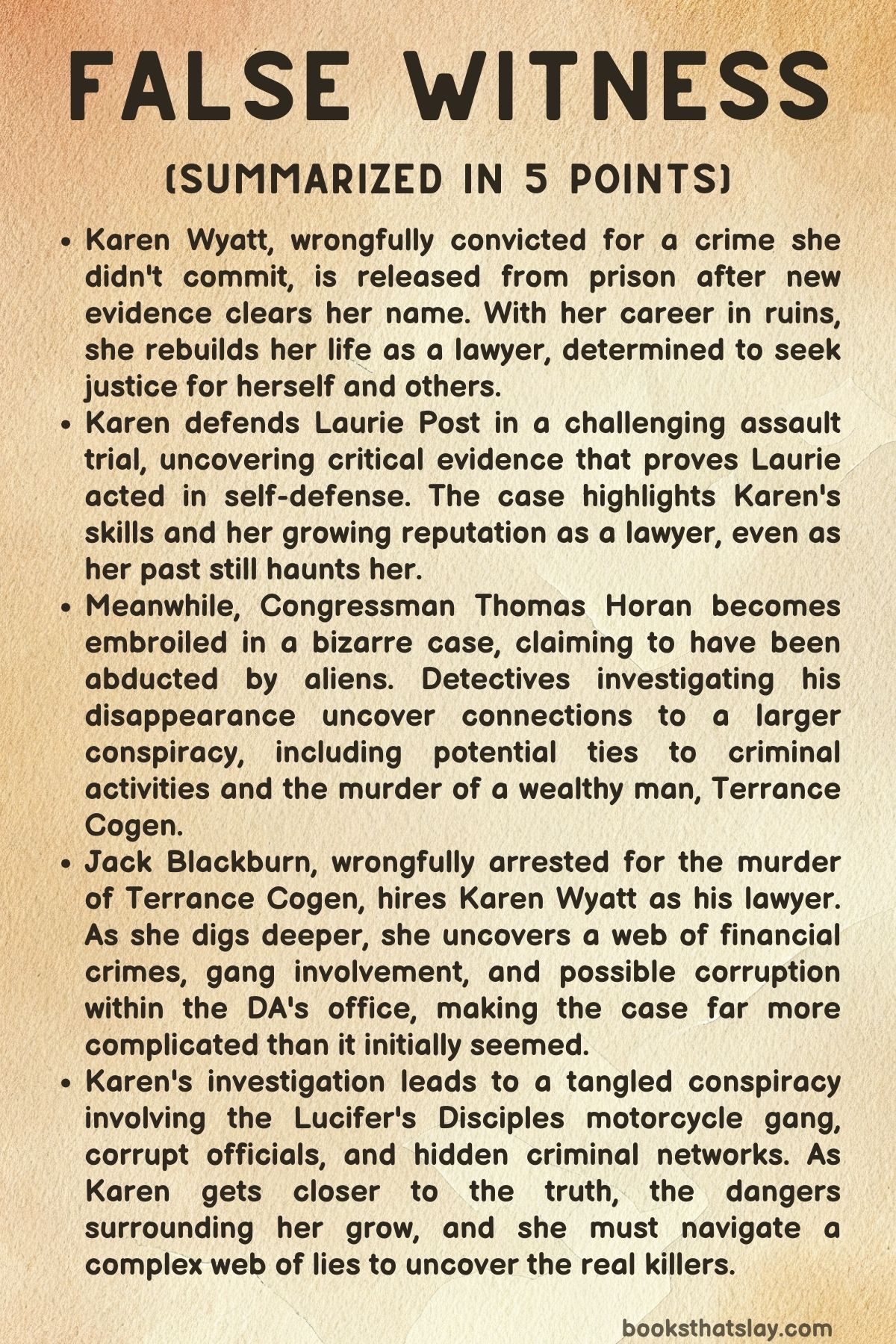
After her release, she works tirelessly to rebuild her life and career while seeking justice for herself and others. As Karen navigates her professional journey, she becomes involved in complex cases, including a high-profile murder investigation and a potential conspiracy involving corrupt law enforcement and political figures. With a focus on legal strategy, criminal investigations, and a determined protagonist, the novel uncovers layers of betrayal, secrets, and unresolved issues that ultimately shape Karen’s future.
Summary
Karen Wyatt, once a successful lawyer, had her life shattered when she was wrongfully convicted for a crime she didn’t commit. After serving a year in prison at Coffee Creek Correctional Facility, Oregon’s women’s prison, new evidence surfaced that proved her innocence.
With the help of her attorney, Harry Schmidt, who took on her case pro bono, Karen’s conviction was overturned, and she was released. The key witness in the case, Garrett Loman, a forensic expert, revealed that Karen had been framed by corrupt police officer Max Ellis.
Ellis had orchestrated the plot, planting Karen’s fingerprints on a cocaine package in order to punish her for exposing corruption in the police department during a previous case. Loman testified that Ellis and other officers had been involved in falsifying evidence and framing Karen, though both Ellis and the drug dealer Julio Cortez were murdered before they could testify.
Despite the grim circumstances, Karen’s conviction was vacated, and she was released with her lawyer recommending her reinstatement to the Oregon State Bar. Though grateful for her newfound freedom, Karen was determined to sue those responsible for her wrongful conviction, focusing not on her bitterness but on her desire for justice.
Three years later, Karen had rebuilt her life and established a thriving law firm. Her reputation as a successful lawyer grew as she handled cases that aligned with her values.
One such case involved Laurie Post, a woman accused of assaulting her abusive boyfriend. Despite the prosecution’s efforts to paint Laurie as guilty, Karen uncovered crucial evidence that suggested Laurie acted in self-defense, leading to a not guilty verdict.
Karen’s success brought her both professional growth and financial independence, though the memories of her wrongful imprisonment still haunted her.
Meanwhile, Congressman Thomas Horan became embroiled in a bizarre incident after a UFO hearing in Washington, D.C. He claimed to have been abducted by aliens, a story that was difficult to believe, yet he insisted it was true. The detectives investigating his disappearance, Audrey Packer and Chad Remington, were skeptical but soon learned that Horan had been found disoriented miles from where he was supposed to be.
His wife, Francine, offered little assistance, leaving the detectives to unravel the mystery of his strange story.
As Karen’s legal career flourished, she became involved in another complex case. Jack Blackburn, a man with a troubled past, found himself arrested for the murder of a wealthy man named Terrance Cogen.
Jack, who had been driving a luxury car he claimed to have borrowed from a man named Billy, was accused of killing Cogen, whose body was found in a bloody living room. Jack maintained his innocence, but the police found evidence, including fingerprints on Cogen’s wallet, that seemed to implicate him.
Detectives Packer and Remington investigated further, discovering Cogen’s ties to organized crime and financial corruption, which likely provided a motive for murder. Jack’s lawyer, Karen, believed he had been framed and began working to clear his name, uncovering a web of deceit involving Cogen’s fraudulent schemes, the Lucifer’s Disciples motorcycle gang, and several other key figures.
The investigation into Cogen’s murder deepened as more evidence emerged, pointing to the involvement of powerful individuals, including Congressman Horan, who had political connections to Cogen. As the detectives and Karen pieced together the puzzle, they discovered the true extent of the conspiracy surrounding Cogen’s death, including the involvement of Billy Kramer, a man who had worked closely with Cogen and who may have framed Jack for the murder.
As Karen continued her defense of Jack, she uncovered more about the complex and dangerous world of corruption that had ensnared so many people.
Simultaneously, Muriel Lujack, a district attorney, began investigating the Lucifer’s Disciples motorcycle gang’s involvement in the case and suspected that a corrupt DA had played a role in framing Karen Wyatt. Muriel’s inquiry revealed a mole in the DA’s office, but her investigation hit a dead end.
She reached out to Karen, who cautiously agreed to look into the matter further. As Muriel dug deeper, she uncovered more about the gang’s criminal activities, including money laundering and ties to the murder of Terrance Cogen.
Meanwhile, the detectives continued to investigate Horan’s involvement in the murder, with the possibility that his memory loss after his alleged alien abduction might be linked to his knowledge of the crime.
As the investigation escalated, Billy Kramer was caught in a dangerous game with the Disciples, and Karen Wyatt found herself dealing with the growing threats posed by the gang. At the same time, the detectives learned that Rosemarie Cogen, the victim’s estranged wife, might have been involved in her husband’s murder.
She denied any involvement, but evidence began to mount against her. She was kidnapped by Walter Zegda, a powerful figure in the Disciples, who interrogated her about her role in the criminal activities linked to Cogen.
However, Rosemarie survived the ordeal, and the investigation continued, with Karen and the detectives uncovering more about the criminal conspiracy that surrounded Cogen’s death.
The story reached a climax as Karen’s investigation into the corrupt DA’s office and the involvement of the Disciples led to a series of shocking revelations. With the help of her team, Karen managed to uncover the truth behind the murder of Terrance Cogen and the vast network of corruption that had been hidden for so long.
Ultimately, Jack Blackburn was exonerated, and the true perpetrators of the crime were brought to justice, though the shadow of the Disciples’ power continued to loom large. Meanwhile, Rosemarie Cogen was arrested for her role in her husband’s criminal activities, and Karen Wyatt was left to reflect on the journey she had taken to rebuild her life and seek justice for herself and others.
Characters
Karen Wyatt
Karen Wyatt is the central character in False Witness, a determined and resilient woman who has endured a wrongful conviction, imprisonment, and the hardships of rebuilding her life. Initially a successful lawyer, Karen’s world is turned upside down when she is framed for a crime she didn’t commit.
After being exonerated, she begins the arduous process of regaining her career and trust in herself. With the help of her dedicated attorney, Harry Schmidt, Karen manages to clear her name, and as she rebuilds her career, her drive for justice becomes stronger than any bitterness or victimhood she could have harbored.
Now a successful lawyer once again, Karen is careful in choosing cases that align with her personal values, and her previous experiences with injustice shape how she navigates both the legal system and her personal life. Despite her financial independence and professional success, Karen’s past and the trauma of wrongful imprisonment continue to inform her decisions, making her a complex character motivated by justice rather than revenge.
Jack Blackburn
Jack Blackburn is a character marked by failure, bad luck, and poor decisions. His life takes a darker turn when he is arrested in possession of a luxury car that he didn’t know was connected to a murder.
Jack is presented as a man who, despite being involved in criminal activities, is not inherently malicious but instead seems to be a victim of circumstance. His arrest, in connection with the murder of wealthy businessman Terrance Cogen, throws him into a complex web of lies, deceit, and dangerous people.
Throughout the investigation, Jack’s insistence on his innocence sets the stage for the eventual involvement of his defense lawyer, Karen Wyatt, who works tirelessly to clear his name. His story reveals the theme of being caught in a system where even the innocent can become entangled, making Jack a sympathetic figure, albeit one with a history of poor choices.
His role in the narrative ultimately serves to underscore the complexities of justice and the impact of one’s environment and decisions.
Congressman Thomas Horan
Congressman Thomas Horan is an intriguing character whose actions add an element of mystery and confusion to the story. Horan’s public claim of being abducted by aliens sets off a chain of events that leads detectives to question the veracity of his story and his involvement in the murder of Terrance Cogen.
Initially, his alien abduction narrative seems outlandish and detracts from the more grounded investigations at hand. However, as the investigation into Cogen’s death deepens, Horan’s connections to the victim through political donations and a long-standing friendship emerge, complicating his position.
His eccentric behavior, coupled with the uncovering of his ties to Cogen’s illicit financial dealings, raises suspicions and keeps both the detectives and readers guessing. Though Horan is portrayed as a skeptic, his involvement in the conspiracy surrounding Cogen’s death shows how even the most seemingly unremarkable individuals can be drawn into a larger web of corruption.
Muriel Lujack
Muriel Lujack is a district attorney who plays a pivotal role in uncovering the layers of corruption within the legal system. Driven by a desire to expose wrongdoing within her own office, Muriel becomes an ally to Karen Wyatt, offering her a potential lead regarding a mole in the DA’s office who may have been responsible for framing Karen.
Muriel’s role in the investigation highlights her courage in pursuing justice, even at the risk of her own safety. Her growing involvement in the case also brings her into contact with the dangerous Lucifer’s Disciples gang, illustrating the precarious balance between law enforcement and criminal influence.
Her relationship with her old friend Naomi Baker further complicates her professional life, as she navigates the murky waters of corruption and crime. Muriel is a determined, principled character, whose commitment to uncovering the truth brings her into dangerous situations, but also makes her an invaluable asset to Karen’s quest for justice.
Rosemarie Cogen
Rosemarie Cogen is a character whose role in her husband’s criminal activities reveals a hidden layer of the story. Initially, she appears to be a grieving widow, but as the investigation unfolds, her involvement in her husband’s illicit dealings becomes clearer.
Rosemarie’s cold indifference to her husband’s murder and her complicated relationship with Walter Zegda suggest that she may have been complicit in his financial crimes, and possibly even in his death. Despite her initial claims of innocence, Rosemarie’s eventual arrest and conviction for manslaughter highlight her deeper connection to the criminal underworld, including her links to the Lucifer’s Disciples gang.
Throughout the story, she remains tight-lipped about the location of the stolen money, and her continued fear of Zegda’s retaliation paints her as a woman caught in the crossfire of a dangerous world. Rosemarie’s fate, marked by her plea deal and her prison sentence, underscores the theme of accountability and the consequences of being involved in a web of crime and deception.
Audrey Packer and Chad Remington
Audrey Packer and Chad Remington are the detectives tasked with solving the murder of Terrance Cogen. As seasoned law enforcement officers, their investigation is methodical, though they are initially skeptical of the more bizarre aspects of the case, such as Congressman Horan’s alien abduction claims.
Audrey and Chad’s partnership is essential in unraveling the complex conspiracy surrounding Cogen’s death, as they uncover ties between the victim, the Lucifer’s Disciples gang, and political corruption. While Audrey takes a more pragmatic approach to the investigation, Chad is willing to entertain more unconventional leads, such as exploring Horan’s claims under hypnosis.
The detectives’ determination to piece together the puzzle is integral to the story’s progression, as they not only chase down the truth behind the murder but also confront a larger conspiracy involving powerful individuals. Their persistence in investigating every angle of the case, even when faced with personal risks, makes them reliable yet vulnerable figures in the overarching narrative.
Billy Kramer
Billy Kramer is a complex character who becomes embroiled in the murder of Terrance Cogen and the subsequent investigation. He is depicted as someone who has been involved in criminal activities, including theft and possibly even murder, yet his role is less clear-cut than that of a typical antagonist.
Billy’s connection to Cogen through money laundering and his association with the Lucifer’s Disciples gang position him as a key figure in the conspiracy surrounding Cogen’s death. He claims to have found Cogen’s body and, in his panic, frames Jack Blackburn for the murder.
However, his involvement with the gang and the mounting pressure to keep his secrets hidden reveal a man on the edge, caught between the law and the dangerous people he has allied himself with. Billy’s eventual fate, shaped by his own fear of the Disciples, demonstrates the extent to which his criminal life has led him into a spiral of violence and betrayal.
Walter Zegda
Walter Zegda, a powerful member of the Lucifer’s Disciples motorcycle gang, is a menacing figure whose influence runs deep in the criminal underworld. As a key player in the conspiracy surrounding Terrance Cogen’s murder, Zegda’s role becomes central to the investigation.
His ruthless methods of intimidation and violence, including the kidnapping and torture of Rosemarie Cogen, reflect his dangerous character and unwavering loyalty to the gang. Zegda’s involvement in the financial crimes that led to Cogen’s death, as well as his relentless pursuit of those who threaten the gang’s operations, position him as a significant antagonist in the story.
His interactions with other characters, including his violent treatment of Billy Kramer and his close scrutiny of Muriel Lujack’s investigation, show just how far Zegda is willing to go to protect the secrets of the Disciples. His power and brutality make him one of the most formidable and feared figures in the narrative.
Raymond Castor
Raymond Castor, a member of the Lucifer’s Disciples, plays a crucial role in the unraveling of the criminal conspiracy tied to Terrance Cogen’s death. Initially, Raymond is portrayed as an enforcer for the gang, but after being bailed out by Karen Wyatt, he begins to question his loyalty to the Disciples.
Raymond’s character arc highlights themes of redemption and survival as he seeks to escape the dangerous life he’s led. His connection to Nikki Randolph and the deal he strikes with Karen to reveal the name of the corrupt DA who framed her adds layers to his character, as he grapples with the implications of betraying his gang.
Raymond’s narrow escape from an assassination attempt by Zegda’s men underscores the high stakes of his decision, and his eventual alliance with Karen marks a turning point in his life, as he seeks a way out of the gang’s influence.
Themes
Justice and Injustice
The theme of justice and injustice runs deeply throughout False Witness. The protagonist, Karen Wyatt, serves as a stark example of both the profound impact of a miscarriage of justice and the long road to rectification.
Her wrongful imprisonment for a crime she did not commit exemplifies how systemic flaws and corrupt individuals can manipulate the judicial process. Despite having been exonerated and her conviction vacated, Karen is faced with the difficulty of rebuilding her life, not only in terms of her career but also her trust in a system she once served with unwavering dedication.
The journey of seeking justice extends beyond her personal case to the storylines surrounding the murder of Terrance Cogen and the ongoing struggles of those trapped in the web of corruption, such as Billy Kramer. As the narrative unfolds, it becomes clear that the legal system is riddled with imperfections—whether it be through the actions of corrupt law enforcement, manipulative figures, or a failure to fully uncover the truth.
The pursuit of justice, especially when the law fails to protect those who are innocent or exploited, becomes central to the characters’ quests. However, Karen’s drive for justice is not rooted in vengeance but in her resolve to confront the injustices that shaped her life and to bring accountability, highlighting the emotional toll that injustice exacts on its victims.
Corruption
Corruption is a pervasive theme that impacts every level of society within False Witness. The novel presents corruption in various forms, whether in law enforcement, politics, or business dealings, all of which contribute to the manipulation and destruction of innocent lives.
Karen Wyatt’s wrongful conviction was not an isolated event but the result of a larger scheme orchestrated by corrupt individuals, notably Max Ellis, a police officer involved in falsifying evidence. Similarly, the character of Terrance Cogen, a wealthy and influential man, serves as another example of how corruption can seep into even the most respectable circles, manipulating financial systems and leading to a web of criminal activities.
The Lucifer’s Disciples motorcycle gang further represents the extremities to which organized crime can infiltrate both local and high-level affairs, from money laundering to murder. The novel paints a grim picture of how power can be abused and the lengths people will go to protect their interests.
Even within the legal system, corruption threatens the pursuit of justice, as shown by the involvement of certain figures in the District Attorney’s office and the challenge of exposing a mole within the ranks. Throughout the book, the characters’ battles against these corrupt forces become symbolic of a larger struggle to restore moral and legal integrity, showcasing the impact of power abuse and the determination needed to combat it.
Redemption and Rebuilding Life
The theme of redemption is explored in False Witness through Karen Wyatt’s journey of personal recovery and the rebuilding of her life after being wrongfully imprisoned. Her experience of a harsh and unjust punishment leads her to a place where she is not only fighting for her own justice but also for the opportunity to reclaim the career and reputation she lost.
The theme of redemption is particularly poignant because it extends beyond simply seeking revenge against those who wronged her; instead, Karen is focused on using her newfound freedom to fight for the greater good, helping others who find themselves in similar situations. Her transformation from a victim of a flawed system to a powerful and influential attorney is a testament to human resilience and the possibility of redemption.
The process is difficult and fraught with challenges, especially as she deals with the memories of her incarceration and the constant reminders of her past. Her success in clearing Jack Blackburn’s name further reflects her desire to right the wrongs of the past and make a positive impact, not just for herself but for society as a whole.
The characters surrounding Karen also experience forms of redemption, such as Rosemarie Cogen, who, after confessing to her role in her husband’s criminal activities, faces the consequences of her actions. This theme highlights that redemption is not always easy, nor is it guaranteed, but it remains a vital element of personal growth and moral integrity.
Betrayal and Loyalty
Betrayal and loyalty are central to the narrative of False Witness, with characters constantly grappling with the dualities of trust and deception. From the beginning, Karen’s wrongful conviction serves as a betrayal by those she trusted—specifically by the corrupt law enforcement officers who framed her.
This sense of betrayal is compounded by the character of Garrett Loman, a forensic expert who, though initially complicit in the corruption, later becomes a whistleblower. His ultimate decision to expose the truth exemplifies the complex dynamics of loyalty, as he is torn between his professional integrity and the threats posed by the corrupt system.
Betrayal runs even deeper when looking at characters like Billy Kramer and the Lucifer’s Disciples, whose manipulative actions contribute to the downfall of others. The precarious relationships between the characters, especially the tenuous bonds formed under duress, reveal the vulnerability of loyalty in a corrupt and dangerous world.
The loyalty exhibited by Karen toward her clients, particularly in her defense of Jack Blackburn, contrasts sharply with the deceit surrounding her, highlighting the moral cost of betrayal. As the investigation into the various murder cases and corruption unfolds, the theme of betrayal serves as a catalyst for the characters to either embrace or abandon their loyalties, often leading them down dark and dangerous paths.
Power and Manipulation
In False Witness, power and manipulation are key forces driving both the narrative and the moral dilemmas faced by the characters. Those with power, whether political, legal, or criminal, use their influence to manipulate others for personal gain.
The character of Congressman Thomas Horan exemplifies how political figures can manipulate public perception, especially in his bizarre claim of being abducted by aliens. This claim serves as a diversion, potentially masking deeper, more sinister truths about his involvement in corrupt activities.
Power is also represented through the figures of Walter Zegda and the Lucifer’s Disciples, whose control over others is exercised through fear and violence, demonstrating how manipulation can thrive in the shadows. The manipulation of Karen Wyatt’s life, both in her wrongful conviction and in the cases she pursues as a lawyer, reveals the destructive potential of those in power who use their influence to control outcomes for personal benefit.
Even within the confines of the legal system, manipulation takes the form of orchestrated lies, falsified evidence, and the suppression of truth. As the characters navigate these power structures, they are often forced to confront the moral compromises that come with their involvement in these webs of manipulation.
Ultimately, the theme highlights how power dynamics shape the fates of individuals, influencing their actions and decisions while exposing the fragility of integrity in the face of such overwhelming force.