Fast Lane Summary, Characters and Themes | C.S. Quill
Fast Lane by C.S. Quill is a college romance about two people who meet at the wrong moment and slowly become exactly what the other needs. Lane O’Neill is a guarded university junior with a sharp mouth, loyal friends, and grief he keeps locked away.
Lois Hogan is a freshman whose life falls apart after a breakup leaves her without a home. What begins as an awkward act of kindness turns into a tense roommate arrangement, then friendship, desire, and love. The book mixes campus life, found family, humor, emotional healing, and slow-burn romance. It’s the 1st book of the Campus Drivers series.
Summary
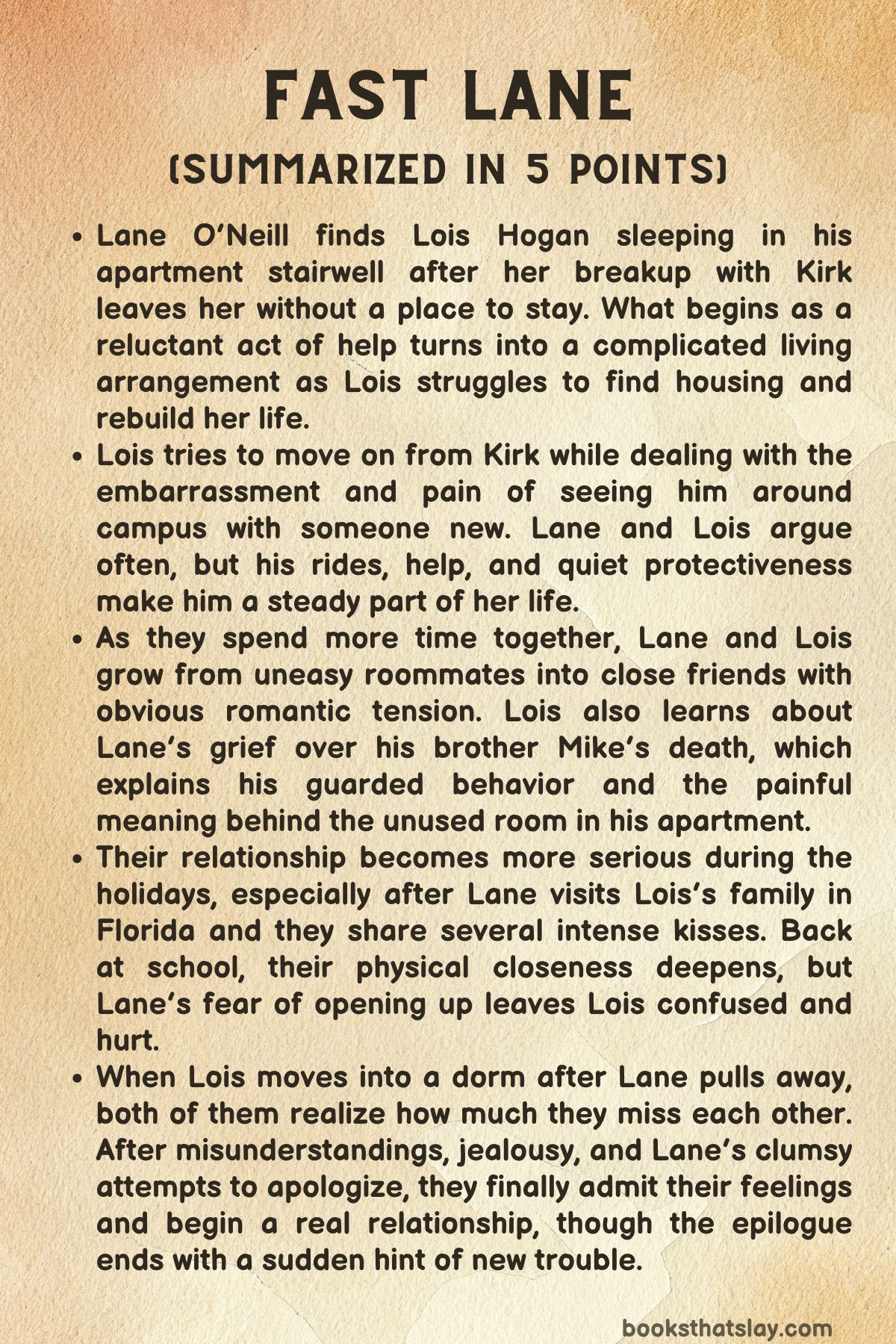
Fast Lane follows Lane O’Neill, a junior at Sycamore Heights University, whose ordinary night changes when he finds a hooded girl sleeping in the stairwell of his apartment building after midnight. Lane is one of the Campus Drivers, a group of students known for helping people get around, but he is not exactly eager to bring a stranger into his home.
Still, the situation is too strange and too vulnerable to ignore. The girl has nowhere safe to go, so Lane lets her sleep on his couch for the night.
By morning, Lane learns that the girl is Lois Hogan, a freshman at the university. Lois has just been dumped by her longtime boyfriend, Kirk, and the breakup has left her in an even worse position because she had been living with him.
After Kirk ends things, she is pushed out of the apartment they shared, leaving her homeless, humiliated, and unsure what to do next. Lois is still in shock and still hoping Kirk might answer her messages or explain himself.
She tries to handle the situation with as much dignity as she can, but her life has been turned upside down.
Lane helps Lois get to campus and lets her keep her belongings in his car while she tries to find a place to stay. Lois hopes to get a dorm room, but there are no rooms available.
She also tries to find another temporary option, but even that goes wrong when the motel she planned to stay in burns down before she can use it. With her choices disappearing, Lois ends up back at Lane’s apartment.
Lane is annoyed by the disruption, but his friends, especially Carter, push him to let her stay.
Carter knows Lane better than most people and understands that Lane’s apartment carries emotional weight. Lane has an extra room, but it is not really empty to him.
It belonged to his brother, Mike, who died in a motorcycle accident three years earlier. Since Mike’s death, Lane has kept that room untouched, almost as if preserving it can preserve his brother.
Carter thinks letting Lois stay might help Lane move forward, but Lane refuses to give her Mike’s room. Instead, Lois remains on the couch while she keeps searching for somewhere else.
Lois and Lane do not become easy friends right away. They clash often, tease each other, argue, and test each other’s patience.
Lois is hurt, embarrassed, and still emotionally tied to Kirk. Lane is blunt, defensive, and not used to sharing his space.
Yet Lane keeps helping her. He gives her rides, lets her stay, and slowly becomes part of her routine.
Their arrangement is supposed to be temporary, but the more time they spend together, the more natural her presence in his apartment begins to feel.
At university, Lois tries to keep her breakup from defining her. She hides parts of the truth from Becca and tries to act like she is managing.
She continues reaching out to Kirk, hoping for some kind of answer or closure, but he ignores her. When Lane’s birthday party brings Kirk back into view, the situation becomes even more painful.
Kirk arrives with Juliet, Carter’s sister, making it clear that he has already moved on. Lois is devastated by the public proof that Kirk has replaced her so quickly, and Lane’s protective side starts to show more clearly.
Lois begins trying to rebuild herself. She runs, diets, studies harder, and focuses on her goal of sports physiotherapy.
Some of these efforts come from a healthy desire to move forward, but some come from the insecurity Kirk left behind. She had spent so long trying to be the girlfriend he wanted that she lost sight of herself.
Lane sees more than she realizes. Even when he annoys her, he notices when she is hurting, and he becomes one of the few people who helps her without asking her to pretend everything is fine.
As Lois and Lane settle into life as reluctant roommates, their friendship deepens. Their arguments become familiar instead of hostile, and their teasing begins to carry warmth.
Lane starts admitting to himself that he likes having Lois around. She makes the apartment feel less empty.
She brings noise, irritation, and life into a place that has been shaped by grief for years. Lane is still guarded, but Lois slowly sees the softer parts of him, especially when she learns more about Mike.
Mike’s death remains the wound Lane cannot fully face. His brother died in a motorcycle accident, and the loss changed Lane’s family and his sense of himself.
November is especially hard for him, and the memories around Mike are tied to guilt, pain, and unfinished grief. Lois does not fix that pain, but her presence makes Lane less alone with it.
She begins to understand why the extra room matters so much and why Lane reacts so strongly to any suggestion that someone else use it.
During the holiday season, Lane becomes more involved in Lois’s world. He goes with her to Florida for Christmas and meets her family.
Lois’s family is loud, affectionate, chaotic, and full of strong personalities, especially her brothers. Lane does not expect to fit in, but he does better than he imagined.
Around them, Lois is seen as more than Kirk’s ex-girlfriend or Lane’s temporary roommate. Lane also gets a fuller picture of who Lois is when she is surrounded by people who love her.
The Florida trip changes the emotional balance between Lois and Lane. When Lois encounters people connected to Kirk and wants to escape an awkward moment, she kisses Lane.
At first, the kiss has a practical excuse, but it leaves both of them shaken. Later, they kiss again, and this time the feeling between them is harder to dismiss.
What had been hidden under arguments and jokes becomes impossible to ignore. They are drawn to each other, but neither knows how to talk honestly about it.
Back at Sycamore Heights, the tension between them grows stronger. Around New Year’s Eve and afterward, their relationship turns physical, but Lane keeps avoiding the emotional conversation that needs to follow.
Lois is confused by his mixed signals. He can be gentle, protective, and intimate, then suddenly distant.
Lane wants her, but wanting her means risking change, loss, and vulnerability. He is not ready to admit how much she matters to him.
Then Lois finally receives the news she had been waiting for: a dorm room is available. On the surface, this should solve the problem that started everything.
Lois finally has a place to live. But neither she nor Lane feels happy about it.
Lois pretends to be excited because she does not want to seem unwanted. Lane acts upset and unsettled because the thought of her leaving forces him to face how important she has become.
In a major step, Lane offers to let Lois stay in Mike’s room. To Lois, this seems like a sign that Lane is opening his heart and making space for her in a real way.
It feels like proof that their relationship is changing. But after making the offer, Lane panics.
The room is still tied too strongly to Mike, and Lane is not ready to let someone else occupy it. Instead of explaining his fear and grief, he pulls away from Lois.
His coldness hurts her deeply, especially because she had believed they were moving closer. Feeling rejected, Lois leaves the apartment and moves into the dorm.
Their separation is painful for both of them. Weeks pass, and Lane misses Lois more than he expected.
Without her, the apartment feels empty again. He starts writing a screenplay about their story, using it as a way to process what happened and say what he cannot manage in person.
He tries to apologize, but he does not handle it well. His jealousy and anger flare when he sees Kirk near Lois, and instead of making things better, he often makes them messier.
Lois, meanwhile, continues to grow stronger. One of her biggest turning points comes when she finally rejects Kirk for good.
Kirk had been the center of her life for so long that walking away from him means reclaiming herself. She tells him she no longer loves him and admits that she lost herself while trying to become his perfect girlfriend.
This moment is important because Lois stops waiting for Kirk to validate her. She begins choosing herself.
Lane’s friends keep pushing him to face the truth. They can see that he loves Lois, even if he keeps hiding behind fear, sarcasm, and bad decisions.
Lane eventually leaves the screenplay in Lois’s room, giving her the story of them from his point of view. It becomes a confession in the only form he can manage at first.
Through it, Lois sees how much he has been feeling and how badly he has struggled to express it.
At Adam and Lewis’s birthday party, the unresolved tension finally breaks open. Lane punches Kirk, which leads Lois to confront him.
She is angry, hurt, and tired of Lane acting without saying what he truly feels. Their argument brings out everything they have avoided: the jealousy, the fear, the pain, and the love underneath it all.
Instead of continuing to hide, Lane and Lois finally face each other honestly. They kiss and admit that they want to be together.
By the end, Lane and Lois become a couple. Their relationship has grown from an accidental rescue into a bond built through arguments, shared space, grief, healing, attraction, and trust.
Lois helps Lane begin to move beyond the frozen pain of Mike’s death, while Lane helps Lois see that she deserves more than the version of herself she became for Kirk. In the epilogue, they are still together, joking about Lois moving back into Lane’s apartment and changing Mike’s room.
Their future seems playful and hopeful, but the book closes with a sudden shift during a basketball game, as Donovan turns and realizes something terrible is about to happen, leaving the ending with a sharp hint of danger.
Characters
The characters in Fast Lane are built around emotional recovery, grief, friendship, romantic confusion, and the slow process of learning how to trust again. Each character has a clear role in shaping Lane and Lois’s journey, whether by supporting them, hurting them, challenging them, or forcing them to face the feelings they keep trying to avoid.
Lane O’Neill
Lane O’Neill is one of the central characters in the book, and his personality is shaped by a mix of humor, protectiveness, fear, and unresolved grief. At first, he appears sarcastic, guarded, and reluctant to get involved in Lois Hogan’s problems, especially when she unexpectedly enters his life after being abandoned by Kirk.
However, his actions reveal a deeper kindness that he tries to hide behind irritation and teasing. Lane gives Lois a place to sleep, drives her around, lets her leave her belongings in his car, and slowly becomes a steady presence in her unstable life.
This shows that although he resists emotional responsibility, he is not indifferent to people who are suffering.
A major part of Lane’s character is his grief over his brother Mike’s death. The unused room in his apartment is not just an empty space; it represents pain, memory, guilt, and his inability to move forward.
His refusal to let Lois stay there is not simple selfishness, but an emotional defense. He is afraid that allowing someone into Mike’s room will feel like replacing or erasing his brother.
This grief explains much of Lane’s emotional inconsistency. He can be warm, playful, and deeply caring toward Lois, but when their relationship begins to feel serious, he panics and pulls away.
Lane’s relationship with Lois reveals both his best and worst traits. He becomes protective when Kirk hurts her, jealous when Kirk remains near her, and emotionally attached even before he is ready to admit it.
Yet he also hurts Lois by avoiding honest conversations and by acting cold when he is overwhelmed. His growth comes from realizing that love requires more than attraction and protectiveness; it requires vulnerability, apology, and the courage to let someone into the parts of life that still hurt.
By the end of the story, Lane becomes more emotionally open, accepting that loving Lois does not mean betraying Mike’s memory, but allowing himself to live again.
Lois Hogan
Lois Hogan is one of the most emotionally important characters in the book because her journey begins with abandonment and slowly becomes a journey toward self-respect. At the beginning, she is vulnerable, heartbroken, and displaced after Kirk dumps her and forces her out of the apartment they shared.
She is a freshman trying to survive a painful breakup while also dealing with practical problems such as finding housing, recovering her belongings, and maintaining appearances in front of people like Becca. Her situation makes her sympathetic because she is not only losing a boyfriend, but also the version of herself she had built around him.
Lois’s character is defined by emotional confusion in the first half of the story. She keeps trying to contact Kirk even though he ignores her, and she struggles to accept that he has moved on.
Her devastation at seeing him with Juliet shows how deeply she had depended on the relationship. However, Lois is not written as weak.
Even when she is hurt, she tries to improve herself, focus on her studies, run, diet, and work toward her interest in sports physiotherapy. Some of these efforts come from insecurity, but they also show her desire to regain control over her life.
Her bond with Lane becomes the emotional center of her development. At first, their relationship is full of clashes, teasing, and irritation, but living together creates intimacy.
Lois gradually sees Lane’s pain, especially his grief over Mike, and she becomes one of the few people who can reach him emotionally. At the same time, Lane’s mixed signals confuse and hurt her, especially when he offers her Mike’s room and then pulls away.
Her decision to leave his apartment and move into the dorm shows growth because she refuses to stay where she feels unwanted. Her strongest moment comes when she rejects Kirk for good and admits that she lost herself trying to be perfect for him.
By choosing Lane only after choosing herself, Lois becomes a stronger and more self-aware character.
Kirk
Kirk functions as one of the main sources of emotional conflict in the story. He is important not because he is deeply sympathetic, but because his actions expose the damage caused by careless love and selfish behavior.
He dumps Lois, ignores her attempts to contact him, and leaves her without a stable place to live. This makes him appear emotionally immature and inconsiderate, especially because Lois had built so much of her identity around their relationship.
Kirk’s quick movement toward Juliet intensifies Lois’s heartbreak. His presence at Lane’s birthday party with Juliet shows that he has already emotionally detached while Lois is still suffering.
This contrast makes him seem cold and insensitive. He also represents the past Lois must outgrow.
As long as she is waiting for his attention, she remains tied to the version of herself that tried to please him at the cost of her own identity.
Kirk’s role becomes especially important near the end because Lois’s rejection of him marks her emotional independence. When she tells him she no longer loves him and recognizes that she lost herself trying to be his perfect girlfriend, Kirk becomes the character who helps reveal how far she has come.
He is not only an ex-boyfriend; he is a symbol of the life Lois must leave behind in order to become confident, honest, and free.
Carter
Carter is Lane’s best friend and one of the strongest supporting characters in the book. He understands Lane well enough to recognize when Lane is avoiding his feelings, and he often pushes him in directions Lane does not want to go.
Carter encourages Lane to let Lois stay longer and sees that Lois’s presence may help Lane confront parts of himself he has kept closed off. His friendship with Lane is blunt, loyal, and sometimes forceful, but it comes from genuine care.
Carter also serves as a bridge between humor and emotional seriousness. He adds pressure, commentary, and friendship to Lane’s life, but he is not just comic relief.
He understands the pain connected to Mike’s room and recognizes that Lane’s refusal to move forward is hurting him. By pushing Lane to admit his feelings for Lois, Carter becomes one of the people who helps move the romance toward honesty.
His connection to Juliet also gives him an indirect role in Lois’s heartbreak, since Juliet becomes involved with Kirk. Even so, Carter’s main function is as Lane’s emotional mirror.
He sees what Lane refuses to say out loud, especially that Lane loves Lois and is afraid of what that love means. Carter’s loyalty makes him one of the most grounded and useful characters in Lane’s life.
Becca
Becca plays an important role in showing the social side of Lois’s life. Lois tries to hide the breakup from her, which reveals Lois’s embarrassment, insecurity, and fear of being judged.
Becca’s presence matters because she represents the normal college world Lois is trying to continue participating in while her personal life is falling apart.
Although Becca is not at the emotional center of the story, she helps show how isolated Lois feels after the breakup. Lois does not immediately lean on her friends in a fully honest way, which suggests that she is struggling not only with heartbreak but also with shame.
Through Becca, the book shows how difficult it can be for someone to admit that a relationship has ended badly, especially when that relationship had become part of their identity.
Becca’s role is quieter than Lane’s or Carter’s, but she still contributes to Lois’s characterization. She helps reveal that Lois is not simply dealing with a private breakup; she is also trying to manage how others see her.
This makes Lois’s emotional journey more realistic because heartbreak is shown as both personal pain and social discomfort.
Juliet
Juliet is significant because she becomes the visible sign that Kirk has moved on from Lois. As Carter’s sister and Kirk’s new romantic interest, she creates tension among several characters at once.
Her presence at Lane’s birthday party with Kirk is especially painful for Lois because it turns Kirk’s rejection into something public and undeniable.
Juliet’s character is important less for her own emotional development and more for the effect she has on the central conflict. She intensifies Lois’s pain and forces Lois to confront the reality that Kirk is no longer waiting for her.
She also complicates the social circle because she is connected to Carter, which means Kirk’s new relationship is not distant from Lane and Lois’s world.
In the story, Juliet represents comparison and replacement. For Lois, seeing Kirk with Juliet makes her feel discarded and inadequate.
This emotional wound pushes Lois into a period of self-improvement, although some of that improvement begins from insecurity. Juliet therefore helps trigger Lois’s transformation, even if indirectly.
Mike O’Neill
Mike is one of the most important absent characters in the book. Even though he is dead before the main events of the story, his presence shapes Lane’s emotions, choices, and fears.
Mike’s death in a motorcycle accident left Lane with deep grief, and the pain becomes especially strong around November. Lane’s apartment, particularly Mike’s unused room, keeps that grief alive in a physical form.
Mike’s room is central to understanding Lane. It is not simply a bedroom; it is a symbol of memory and emotional paralysis.
Lane’s refusal to let Lois use the room shows how tightly he is holding on to the past. He fears change because change feels like loss.
When he later offers the room to Lois, it seems like a major emotional step, but his panic afterward proves that he is not fully healed yet.
Mike’s role also deepens the romance between Lane and Lois. Lois is not just entering Lane’s apartment; she is entering a life marked by grief.
Her presence forces Lane to decide whether he will remain trapped by loss or allow himself to connect with someone new. Mike therefore remains emotionally powerful throughout the story, shaping Lane’s growth even without being physically present.
Lois’s Parents
Lois’s parents appear most strongly through the Florida Christmas visit, where they help show the warmth and chaos of Lois’s family life. They create a contrast with the instability Lois experiences after Kirk abandons her.
Around her family, Lois belongs somewhere. Their presence gives readers a fuller understanding of her background and shows that she comes from a loud, affectionate, and connected home.
Their role also affects Lane. When Lane visits Lois’s family, he is placed in an environment very different from his guarded emotional world.
Instead of being isolated with his grief, he is surrounded by family energy, warmth, and noise. The fact that he fits in better than expected suggests that Lane is capable of belonging and connection, even when he does not believe it himself.
Lois’s parents also help strengthen the emotional bond between Lane and Lois. By bringing Lane into her family world, Lois allows him to see a deeper part of her life.
This visit changes the relationship because Lane is no longer just her roommate or reluctant helper; he becomes someone who has crossed into her personal world and been accepted there.
Lois’s Brothers
Lois’s brothers add energy, humor, and family warmth to the story. They help create the lively atmosphere of the Florida trip and show that Lois comes from a protective and affectionate family.
Their loudness and closeness make the family scenes feel full of life, giving the story a break from the emotional tension surrounding Kirk, Lane, and Lois’s housing situation.
They also help reveal another side of Lois. Around her brothers, she is not just the abandoned girlfriend or the confused roommate; she is a daughter and sister with a place in a larger family structure.
This matters because much of the story focuses on Lois feeling unwanted or displaced. Her brothers remind the reader that she is deeply connected to people outside her romantic relationships.
For Lane, Lois’s brothers are part of the experience of entering her world. Their presence tests his ability to fit into a family environment, and his unexpected comfort around them suggests his emotional capacity for connection.
They help make the Florida trip important not only for Lois but also for Lane’s development.
Adam
Adam is a supporting character connected to the wider social group around Lane and Lois. His birthday party with Lewis becomes an important setting near the end of the story because it brings unresolved tensions into the open.
The party gives Lois and Lane a place where conflict, jealousy, anger, and desire finally collide.
Adam’s individual role is not as emotionally detailed as Lane’s, Lois’s, or Carter’s, but his presence still matters because the birthday party becomes a turning point. It is there that Lois confronts Lane after he punches Kirk, and the confrontation leads to honesty between them.
Adam therefore helps provide the social setting in which Lane and Lois’s unresolved feelings can no longer be avoided.
As part of the friend group, Adam also contributes to the college atmosphere of the story. Characters like him make the world feel populated and active, showing that Lane and Lois’s romance develops within a larger network of friendships, parties, and campus life.
Lewis
Lewis, like Adam, is part of the social circle that surrounds the main characters. His birthday party with Adam becomes significant because it helps bring Lane, Lois, and Kirk into the same emotional space at a crucial moment.
The party setting allows jealousy and unresolved feelings to erupt, leading to Lane’s violent reaction toward Kirk and Lois’s confrontation with him.
Lewis’s importance comes mainly from the role his event plays in the structure of the story. The birthday party becomes a turning point because Lane can no longer hide behind sarcasm, avoidance, or emotional distance.
Lois also stops silently absorbing confusion and hurt, choosing instead to confront him directly.
Through Lewis and the party, the book shows how public social moments can force private feelings into the open. Lewis may not be a central emotional figure, but his presence helps create the situation that finally pushes Lane and Lois toward admitting what they want from each other.
Donovan
Donovan appears most significantly in the epilogue, where the basketball game suddenly shifts into chaos. His reaction creates a dramatic change in tone, especially when he turns and realizes that something terrible is about to happen.
This makes Donovan important because he becomes connected to the closing suspense of the story.
Although Donovan is not developed in the same detailed way as Lane or Lois, his role at the end suggests that the story’s world continues beyond the central romance. The sudden danger surrounding the basketball game interrupts the lighter mood of Lane and Lois joking about moving back in together and changing Mike’s room.
This contrast makes Donovan’s moment feel sharp and alarming.
By the end of Fast Lane, Donovan helps move the story from romantic resolution into a sense of impending crisis. His reaction hints that new conflict is beginning just as Lane and Lois have found emotional stability.
This makes him an important figure in the final mood of the book, even if his role is brief.
Themes
Healing from Grief
Lane’s emotional life is shaped by the loss of his brother Mike, and his grief affects the way he treats people, spaces, and even himself. The unused room in his apartment becomes more than an empty space; it represents memory, guilt, love, and fear.
Lane is not simply refusing to move on because he is stubborn. He is afraid that allowing change will feel like betrayal.
His pain makes him guarded, sarcastic, and emotionally inconsistent, especially with Lois, because closeness forces him to face feelings he has kept buried. The story shows that grief does not disappear just because time has passed.
It can stay hidden inside routines, jokes, anger, and avoidance. Lane’s growth begins when he slowly allows another person into the parts of his life connected to Mike.
By the end, healing is not shown as forgetting the dead, but as learning to live without letting loss control every choice.
Finding Yourself After a Relationship
Lois begins Fast Lane in a state of emotional collapse after Kirk ends their relationship and removes her from the life she had built around him. Her struggle is not only about heartbreak; it is about realizing how much of herself she had changed to keep someone else’s love.
She tries to become better by running, dieting, studying, and focusing on her future, but these efforts also reveal how deeply she has measured her worth through Kirk’s approval. Her eventual rejection of him matters because it is not just a romantic decision.
It is an act of self-recognition. She understands that love should not require losing her personality, confidence, or dignity.
Through Lois, the story presents heartbreak as painful but also necessary. Losing Kirk forces her to question who she has been, who she wants to become, and what kind of love she actually deserves.
Love Built Through Everyday Care
The romance between Lane and Lois grows through ordinary acts rather than grand declarations. Lane gives her a place to sleep, drives her around, stores her belongings, protects her when she is hurt, and slowly becomes part of her daily routine.
Their relationship begins with irritation and teasing, but those small conflicts create familiarity. What makes their bond meaningful is that affection appears before either of them is ready to name it.
Lane notices her moods, Lois learns his pain, and both begin depending on each other in quiet ways. The story suggests that love often develops through repeated care, shared space, and emotional attention.
Physical attraction is present, but it is not enough on its own. Their real connection forms when they become safe for each other, even while making mistakes.
The slow shift from reluctant roommates to partners shows that lasting love is built through presence, patience, and the courage to be honest.
Fear of Vulnerability
Both Lane and Lois want love, but both are frightened by what it asks from them. Lois fears rejection because Kirk made her feel replaceable, while Lane fears intimacy because attachment reminds him of loss.
This creates a painful pattern between them: they grow close, share tender moments, and then one of them pulls back or pretends nothing has changed. Lane’s mixed signals hurt Lois because he offers comfort without giving her emotional security.
Lois, meanwhile, hides her pain behind jokes, denial, or forced excitement, especially when she thinks leaving his apartment might protect her pride. Their conflict shows how vulnerability can feel dangerous even when love is real.
The story treats emotional honesty as the hardest part of romance. Kisses and attraction come more easily than confession, apology, or trust.
Their relationship only becomes possible when they stop hiding behind anger, jealousy, and fear, and finally admit what they mean to each other.