Father Material Summary, Characters and Themes
Father Material by Alexis Hall is a contemporary romantic comedy about family, responsibility, and the uncomfortable distance between wanting to care for someone and knowing how to do it well. Luc O’Donnell and Oliver Blackwood have built a stable life together, but adopting a puppy and becoming emergency foster carers force them to confront fears that love alone cannot resolve.
Through domestic disasters, professional uncertainty, strained friendships, and the arrival of a guarded teenager, the novel examines parenthood as a practice of listening, adapting, apologizing, and remaining present. Its humor supports a serious exploration of abandonment, institutional care, and the many forms a family can take. It’s the 3rd book of the London Calling series.
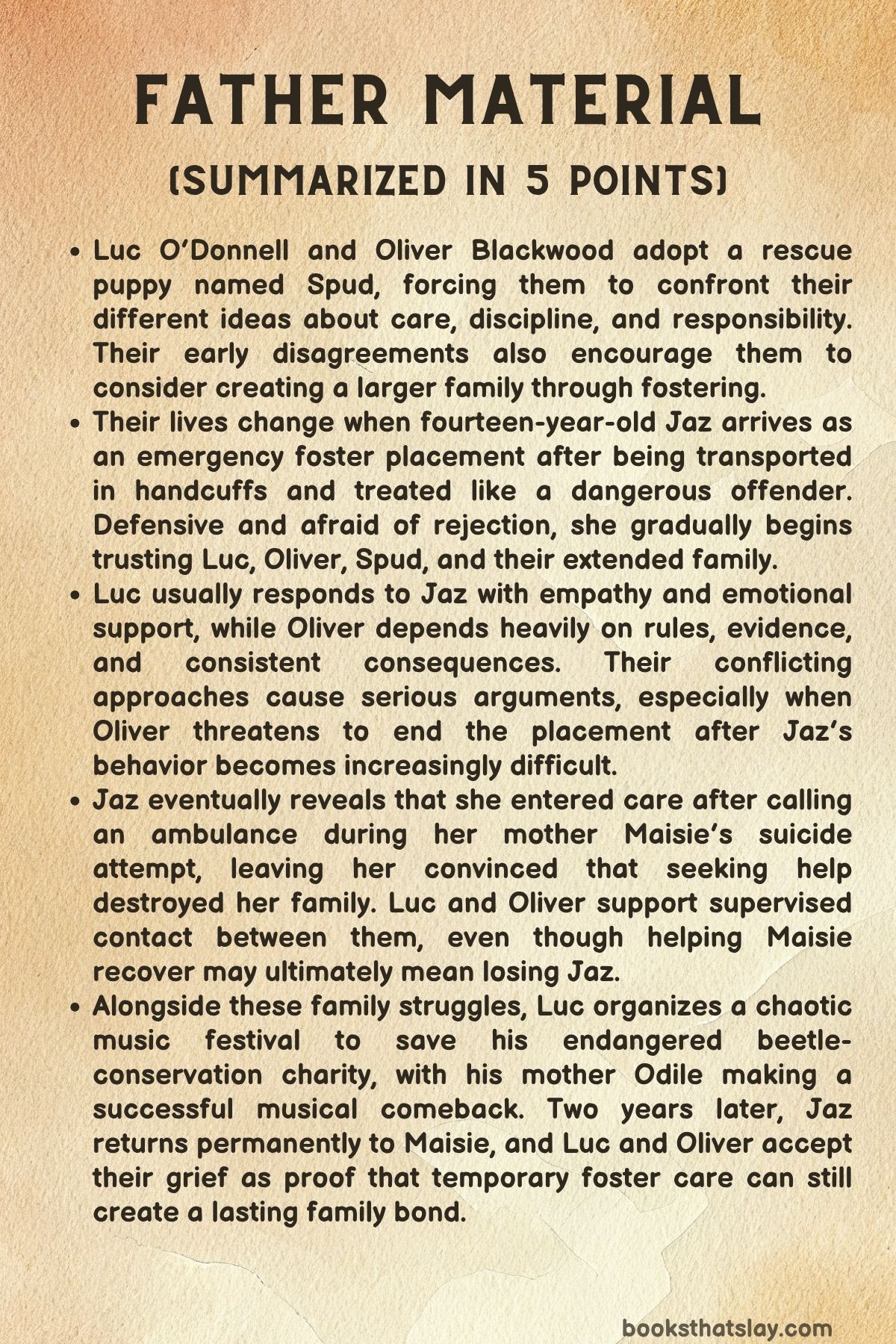
Summary
Luc O’Donnell and Oliver Blackwood attend a birthday party for the young twins of their friends Ben and Sophie. Surrounded by children, discussions about fertility, and questions about whether couples plan to become parents, Luc becomes uncomfortable because he and Oliver have privately begun considering a family of their own.
The immediate source of Luc’s anxiety is less dramatic but still significant: he and Oliver are adopting a rescue puppy named Spud. Luc fears that his laziness, insecurity, and history of irresponsible behavior will make him incapable of caring for another living creature.
Unable to sleep, Luc calls his heavily pregnant best friend, Bridge. Despite being in the early stages of labour, she insists on meeting him at the Millennium Bridge, where she explains that his fear comes from wanting the puppy and being terrified of failing, rather than from genuinely wanting to escape the responsibility.
Bridge’s contractions intensify, forcing Luc to call Priya and Andi for help. They eventually reach the hospital, where Bridge’s husband, Tom, angrily tells Luc that guilt does not erase the risks created by irresponsible decisions.
Oliver arrives after receiving vague messages from Luc and immediately understands what has happened. Instead of condemning him, Oliver argues that Luc has changed without becoming a completely different person and assures him that temporary panic does not mean he will abandon Spud.
Bridge safely gives birth to a daughter named Autumn, and Luc and Oliver rush to the animal shelter. They bring Spud home, where Oliver appears calm and organized while Luc remains frightened by every sound, movement, and possible sign of distress.
Their first major conflict concerns where Spud should sleep. Oliver believes the puppy must learn to remain alone in his downstairs pen, while Luc sees Spud’s crying as evidence of fear and abandonment.
Luc secretly sleeps beside Spud, undermining Oliver’s training plan. Their disagreement reveals a deeper difference between them: Oliver trusts structure and consistency, while Luc reacts strongly to anything resembling emotional abandonment.
Luc nevertheless manages to care for Spud alone while handling another crisis at work. The Earl of Spitalhamstead, whose money supports the Coleoptera Research and Preservation Project, has died, leaving the strange beetle-conservation charity facing an uncertain future.
The new earl, Hilary de Lancy, prefers to be called Saint and has no interest in continuing his father’s support. A former punk musician, Saint resents his father and sees destroying the charity as a way to reject the old man’s values.
At home, Luc and Oliver eventually compromise by moving Spud’s pen into their bedroom. Luc accepts that he must research the puppy’s needs rather than opposing Oliver instinctively, while Oliver admits that expert guidance does not make his personal interpretation automatically correct.
As Spud becomes part of their household, Luc and Oliver return to the question of children. They discuss surrogacy, adoption, and fostering before deciding that they may be able to provide stability to an older child or teenager who needs a safe home.
Luc also becomes determined to save CRAPP. Recognizing that scientific arguments will not persuade Saint, he proposes transforming the annual Beetle Drive into CRAPPstonbury, an alternative music festival designed to appeal to Saint’s punk identity and desire for public attention.
The project is far beyond Luc’s experience, but his friends encourage him to ask for help. Bridge reminds him that accepting assistance is not the same as exploiting people, and Luc begins drawing upon the varied skills and connections of his social circle.
During their fostering assessment, Luc arrives late and covered in mud. He assumes that he has destroyed their chances, but the social worker, Esther, is more interested in their honesty, stability, and understanding of their own painful histories.
Luc discusses his father’s abandonment, public humiliation, and earlier instability. Oliver gradually admits that his respectable upbringing involved severe emotional damage and that his relationship with his father taught him to associate discipline with approval.
Their application progresses, although Luc briefly fears that a reckless night out with Saint and the resulting tabloid photographs will ruin everything. Oliver refuses to interpret one mistake as evidence that Luc has returned permanently to his old behavior.
Luc and Oliver are approved for an emergency placement. Four security guards soon arrive with fourteen-year-old Jasmine Johnson, known as Jaz, who has been transported in handcuffs and carries her belongings in a bin bag.
Oliver challenges the degrading way Jaz has been treated, while Luc immediately senses that she expects to be rejected. Jaz trusts Spud before she trusts either man, and she reacts angrily when Oliver describes her as traumatized.
Luc apologizes and listens as Jaz explains that people in care are constantly watched, interpreted, and reduced to their histories. She reveals that she was restrained after spitting at a guard who had treated her disrespectfully, rather than attacking without provocation as the official account suggested.
At a school meeting, Luc becomes frustrated by adults discussing Jaz as a collection of attendance figures, disciplinary incidents, and improvement targets. Esther warns him that supporting Jaz does not mean encouraging her to dismiss every institution or boundary.
Oliver continues to believe that Jaz requires firm and predictable rules. Luc, however, increasingly recognizes that conventional punishments can reinforce her belief that adults value obedience more than her emotional reality.
When Jaz puts their unpleasant young neighbour Colin into a wheelie bin, Oliver grounds her and confiscates her phone before fully hearing what happened. Jaz produces a polished institutional apology but later disappears with Spud, proving that her outward compliance has not restored trust.
Luc finds her beside a lake and listens without forcing her home. Jaz explains that Colin stole Spud’s ball, provoked her, and filmed the incident, while Luc makes clear that understanding her anger does not make physical retaliation acceptable.
Their relationship develops through such moments of patient presence. Luc does not promise that the placement will last forever, but he repeatedly communicates that Jaz deserves food, attention, protection, and care without having to earn them through gratitude.
When Jaz fails to complete online homework, Luc and Oliver discover that her former school kept a laptop purchased specifically for her educational needs. Oliver retrieves it, demonstrating that his knowledge of institutions and procedures can be used to defend Jaz rather than control her.
Jaz begins visiting Odile, Luc’s mother, and forms a connection with her through blunt arguments, cooking, and music. After entering Odile’s room and playing a guitar without permission, Jaz receives a firm but proportionate response that corrects the behavior without humiliating her.
Odile later lends Jaz the guitar, showing that trust can be restored after a boundary is crossed. Her willingness to treat Jaz as an individual rather than a problem gives Luc and Oliver a model of authority based on confidence, fairness, and continued connection.
Luc and Oliver’s differences become more serious when Jaz is suspended for fighting Trish, who blamed her for her mother’s suicide attempt. Luc understands Jaz’s desire to defend herself, while Oliver focuses on responsibility and the need to prevent violence.
Their professional and domestic crises collide when Saint attempts to reunite his old band. Former members describe him as selfish and controlling, and Saint eventually punches one of them, exposing the hypocrisy of adults demanding emotional control from teenagers while failing to practice it themselves.
After Saint cancels the festival and CRAPP’s funding, Luc finally refuses to manage his behavior. He leaves Saint near Banbury and returns home, accepting that self-respect matters even if the decision costs him his job.
The festival receives unexpected hope when Odile agrees to make CRAPPstonbury the opening event of her musical comeback. She reveals that she never stopped writing songs and does not view parenthood as the destruction of her identity.
Tension within the household rises during a dinner party. After a neighbour falsely accuses Jaz of breaking a greenhouse window, Oliver questions her like a witness rather than immediately expressing trust.
Evidence proves that Jaz was innocent, but Oliver resists apologizing because he believes he never formally accused her. Jaz retaliates by placing meat in his vegan meal, turning the dinner into a confrontation over the difference between procedural fairness and personal loyalty.
The evening worsens as their friends argue about parenthood, infertility, bisexuality, changing friendships, and the assumption that people with children possess more meaningful lives. Years of resentment surface, showing that every form of adulthood contains its own disappointments and exclusions.
Upstairs, Jaz dyes her hair and accidentally breaks the toilet. Overwhelmed, Oliver threatens to contact the fostering agency and end the placement if her behavior continues.
Luc is horrified because removal is Jaz’s deepest fear. Their argument becomes severe, with Luc accusing Oliver of reproducing the controlling behavior of his father and Oliver accusing Luc of avoiding discipline while leaving him responsible for every difficult decision.
Later, they admit that love and preparation have not made them naturally effective parents. Luc explains that Oliver helped him by continuing to love him when he was difficult, and that Jaz must learn that consequences will never erase their loyalty.
Jaz then takes their car and attempts to reach her mother, Maisie. At the police station, Oliver risks his professional standing by claiming that Jaz believed she had permission to drive, protecting her from criminal charges.
Jaz reveals that she became responsible for Maisie after her grandmother died. When Maisie attempted suicide, Jaz called an ambulance despite believing that outside intervention might separate them, and she has blamed herself for entering care ever since.
Oliver assures her that calling for help saved her mother’s life. He also apologizes for threatening removal and admits that his fear of becoming like his father led him to depend too heavily on rules.
Luc and Oliver begin arranging supervised contact between Jaz and Maisie. The first two meetings end with Maisie failing to appear, leaving Jaz devastated and contributing to renewed aggression at school.
Maisie finally attends the third meeting. Her mental illness is severe, but her love for Jaz is clear, and contact gradually continues under supervision.
Oliver begins helping Maisie meet the conditions required for Jaz to return to her. Luc understands that supporting Jaz properly may mean working toward the day she leaves their home.
CRAPPstonbury opens in chaos but draws a large crowd. Saint appears with his former bandmates, the rival sections of a male voice choir trap one another inside portable toilets, and numerous practical disasters require Luc to take control.
Luc refuses to allow Saint’s personal conflicts to dominate the event. After finally admitting that his rebellion was an attempt to earn his father’s attention, Saint agrees to continue funding CRAPP while deciding what kind of future he wants.
Odile begins her comeback performance as Luc, Oliver, and Jaz watch from the wings. Her declaration that she never truly disappeared becomes a promise of continued presence that Luc and Oliver silently extend to Jaz.
Two years later, Jaz is sixteen, has completed her GCSEs, and is preparing to return permanently to Maisie. Luc and Oliver know that the reunification is the outcome Jaz wants and the goal their fostering was meant to support, but they still experience her departure as a profound loss.
Jaz initially leaves with guarded thanks but returns to hug them and admit that she will miss them. Afterward, Oliver grieves the empty house, and Luc reminds him that helping Jaz return to her mother was an act of love rather than a failure.
They do not know whether they will foster again or what their family will become next. They only know that they will face the uncertainty together, carrying the relationship they built with Jaz as permanent evidence that temporary care can still create lasting bonds.
Characters
Luc O’Donnell
Luc is the emotional centre of Father Material, and much of his development comes from confronting the belief that he is naturally unreliable. His earlier life has taught him to expect abandonment, humiliation, and eventual failure, so every new responsibility feels like a test he is certain to fail.
His panic over adopting Spud appears excessive, but it reveals how seriously he takes the possibility of harming someone dependent on him. Luc often interprets fear as proof of incapability, even when that fear actually demonstrates his awareness of what is at stake.
As a foster parent, Luc’s greatest strength is his willingness to listen without demanding a conventional response. He understands that Jaz’s hostility may contain fear, shame, or anger at being constantly judged, and he frequently offers companionship without forcing emotional disclosure.
This empathy can also become a weakness because Luc sometimes confuses supporting Jaz with siding against every rule or institution. Esther correctly warns him that being her ally does not remove his responsibility to guide her, challenge harmful behavior, and help her function in situations she finds unfair.
Luc’s growth is most visible in his ability to remain present during crises. Losing Saint’s support, managing the festival, facing conflict with Oliver, and handling Jaz’s disappearance no longer send him into total self-destruction.
He becomes responsible not by eliminating anxiety but by acting while anxious. By the conclusion, Luc understands that care is not a quality a person either possesses or lacks; it is a series of choices to listen, repair mistakes, and return after moments of failure.
Oliver Blackwood
Oliver is intelligent, devoted, disciplined, and deeply invested in doing things correctly. In Father Material, these qualities make him a dependable partner and a strong defender, but they also create serious problems when he treats emotional relationships like systems that can be managed through preparation and consistent rules.
His approach to Spud reflects both care and inflexibility. Oliver researches puppy training, organizes the household, and accepts responsibility calmly, yet he initially dismisses Luc’s concerns because he assumes that possessing more information makes his interpretation superior.
The same pattern becomes more damaging with Jaz. Oliver believes that boundaries will create security, but he often imposes consequences before understanding the circumstances and interprets compliance as evidence that his method is working.
His professional identity as a barrister encourages him to distinguish evidence from emotion. This helps when he retrieves Jaz’s laptop, challenges the guards who handcuffed her, and protects her at the police station, but it fails when Jaz needs to know whether he trusts her rather than whether he has reached a neutral conclusion.
Oliver’s fear of becoming like his father influences nearly every parenting decision. He associates poor parenting with emotional chaos and therefore depends on structure, only to discover that rigid control can reproduce some of the same harm he wishes to avoid.
His decision to protect Jaz from criminal charges marks a crucial change because he places loyalty above professional safety. By apologizing without excuses and supporting Maisie’s reunification efforts, Oliver learns that responsible authority includes vulnerability, trust, and the courage to admit that his first response was wrong.
Jasmine “Jaz” Johnson
Jaz is a guarded, perceptive, angry, and frequently funny teenager whose behavior cannot be separated from years of instability. She enters Luc and Oliver’s home in handcuffs with her possessions in a bin bag, a humiliating arrival that confirms her expectation that adults already consider her dangerous.
Her hostility functions as both protection and investigation. She challenges rules, steals food from Luc’s plate, refuses gratitude, and provokes Oliver partly to discover what kind of behavior will make them reject her.
Jaz is deeply sensitive to the language adults use about children in care. Descriptions such as traumatized, violent, difficult, or looked after may sound neutral or compassionate to professionals, but she experiences them as identities imposed upon her.
Her actions are sometimes genuinely harmful. She fights, runs away, contaminates Oliver’s food, takes the car, and responds to emotional injury with retaliation, yet the novel never treats her pain as an automatic excuse.
Jaz’s relationship with Maisie explains much of her behavior. She loves a mother who was unable to care for her safely and believes that calling an ambulance during Maisie’s suicide attempt caused their separation.
Her development does not turn her into an obedient or openly sentimental child. Instead, she gradually accepts care, builds relationships with Luc, Oliver, Odile, and Spud, succeeds academically, and allows herself to imagine a future that includes both her mother and the foster parents who helped her return home.
Spud
Spud begins as the focus of Luc’s fear about responsibility but quickly becomes a stabilizing presence within the household. His needs force Luc and Oliver to negotiate daily care, discipline, affection, and compromise before Jaz arrives.
For Jaz, Spud offers companionship without assessment or expectation. She trusts him because he does not ask her to explain herself, behave gratefully, or accept an adult interpretation of her experiences.
Spud also acts as an emotional signal throughout the story. His comfort around Jaz, his distress when something is wrong, and his ability to bring family members into the same physical space give him a quiet role in maintaining connection.
Although he cannot resolve the family’s conflicts, he represents the ordinary responsibilities through which affection becomes practical. Feeding, walking, training, protecting, and comforting him teach Luc that care is built through repeated actions rather than dramatic declarations.
Odile O’Donnell
Odile is Luc’s mother, a former rock star whose unconventional personality is supported by considerable emotional intelligence. She refuses to treat confidence, authority, and kindness as opposing qualities.
Her interactions with Jaz demonstrate a balanced form of parenting. Odile challenges rudeness, protects genuine boundaries, accepts sincere apologies, and then allows the relationship to continue without using shame as a weapon.
Odile’s musical history also challenges Luc’s fear that parenthood erases personal identity. She stopped touring because raising him required a different life, but she continued writing songs and never regarded her career or selfhood as permanently destroyed.
Her decision to return to the stage helps save CRAPPstonbury, yet its deeper importance lies in what it teaches Luc. A parent may make sacrifices without disappearing, and a life changed by caring for a child can later expand in unexpected directions.
Maisie Johnson
Maisie is Jaz’s mother, whose severe depression prevents her from providing stable care despite her love for her daughter. Her absence from the first supervised meetings causes real damage, but the novel does not reduce her to a neglectful parent who simply refuses to try.
Loss and illness have shaped Maisie’s capacity to function. The death of her husband and later her mother leave her increasingly dependent on Jaz, reversing the proper relationship between parent and child.
Maisie’s suicide attempt becomes the event around which Jaz’s guilt is organized. Although Jaz’s decision to call an ambulance saves her life, both mother and daughter must confront the fact that the intervention also exposed how unsafe their home had become.
When Maisie finally attends contact, her affection for Jaz is obvious even though affection alone cannot restore custody. Her gradual progress, supported by Oliver’s legal assistance and structured supervision, shows that reunification requires work, treatment, accountability, and patience rather than sentiment alone.
Bridge
Bridge is Luc’s closest friend and one of the people most capable of recognizing the meaning beneath his panic. Even while entering labour, she understands that Luc’s fear of adopting Spud is different from his earlier resistance to marriage because this time he desperately wants the future that frightens him.
Her decision to meet him on the Millennium Bridge is reckless, but it also illustrates the intensity of their friendship. She refuses to let pregnancy or motherhood redefine her solely as someone who must be protected from other people’s problems.
Later, Bridge becomes an important voice of practical reassurance. She encourages Luc to ask friends for help with CRAPPstonbury and reminds him that adult friendship can survive reduced availability, competing responsibilities, and periods of distance.
Bridge also participates in the disastrous dinner argument, where exhaustion and defensiveness lead her to hurt others. Her willingness to apologize afterward shows that enduring friendship depends on repair rather than the absence of conflict.
Tom
Tom is Bridge’s husband and often functions as a corrective to the more chaotic behavior of Luc and his friends. His anger after discovering that Bridge entered active labour on the Millennium Bridge is understandable because Luc failed to challenge a dangerous decision strongly enough.
Tom’s criticism affects Luc because it identifies a genuine weakness. Feeling guilty after a crisis does not automatically make Luc responsible, especially if he continues allowing others to take risks on his behalf.
During the dinner argument, Tom becomes involved in disputes over sexuality, parenthood, and exclusion. His defensiveness shows how quickly valid personal experiences can become weapons when members of a friendship group feel that their identities or difficulties are being minimized.
Despite his irritation with Luc, Tom remains part of the extended family. His presence demonstrates that close relationships can include anger, boundaries, and criticism without ending affection.
Priya and Andi
Priya is direct, energetic, and highly skilled at identifying Luc’s emotional state before he admits it himself. She treats his anxiety with humor but responds immediately when Bridge genuinely needs help.
Her enthusiasm for being an aunt reflects one of the novel’s central ideas: a meaningful relationship with children does not require becoming a parent. Priya can care deeply, participate actively, and support the families around her without wanting the same domestic role for herself.
Andi appears more briefly but helps Priya transport Bridge to the hospital. Their involvement in Luc’s crises shows how his wider support network repeatedly turns private panic into collective action.
Together, Priya and Andi represent the practical value of friends who are willing to appear during inconvenient, frightening, or absurd situations. Their reliability contradicts Luc’s fear that he must manage every difficulty alone.
Judy
Judy is Odile’s companion and an important example of a family relationship that does not fit a conventional romantic category. She and Odile have chosen loyalty, companionship, and shared daily life without needing to define their bond through marriage or romance.
Her field becomes the site of CRAPPstonbury, making her support essential to Luc’s professional campaign. Judy accepts chaos with a degree of enthusiasm, including transporting dogs and equipment in an overloaded vehicle.
Her presence expands Jaz’s understanding of what a family can look like. Through Judy and Odile, the novel presents commitment as something created through chosen responsibility rather than a single recognized structure.
Hilary “Saint” de Lancy
Saint inherits the title of Earl of Spitalhamstead and the power to decide whether CRAPP survives. His punk appearance and rebellious language initially suggest independence, but his behavior reveals that he remains emotionally controlled by his dead father.
He plans to destroy the charity because his father valued it, confusing revenge with freedom. Although he claims to reject inherited privilege, he repeatedly uses wealth and status to make others accommodate his feelings.
Saint’s attempt to reunite Rancid Sputum exposes how little he understands the harm he caused his former bandmates. He expects them to return because the reunion satisfies his emotional needs, not because he has apologized or changed.
Luc’s refusal to continue managing Saint becomes an important act of self-respect. Saint begins to change only after he admits that his performance of rebellion was an effort to attract paternal attention and that his father’s death has made the desired recognition impossible.
His decision to continue funding CRAPP does not erase his selfishness, but it suggests that self-awareness may allow him to choose something other than revenge. He becomes a parallel to Luc and Oliver because all three men must decide whether parental damage will control their adult behavior.
Esther
Esther is the social worker responsible for assessing and supporting Luc and Oliver as foster carers. Her calm response to their complicated histories immediately challenges Luc’s belief that only perfect, emotionally uncomplicated people are allowed to care for children.
She recognizes their strengths without idealizing them. Luc’s empathy, Oliver’s stability, their commitment to each other, and their experience of difficult families may help them understand Jaz, but none of those qualities guarantees good decisions.
Esther repeatedly corrects Luc and Oliver without treating every mistake as proof of failure. She reminds Luc that he must be a parent rather than only a sympathetic friend and warns both men that another serious incident could threaten the placement.
Her caution regarding Maisie is equally important. Esther understands that contact may help Jaz, but she also knows that repeated rejection can deepen existing wounds, requiring decisions based on the child’s welfare rather than the adults’ hopes.
Rhys and the CRAPP Staff
Rhys represents the loyalty, humor, and creative energy within CRAPP. He refuses to accept closure passively and supports Luc’s attempt to transform an underfunded conservation event into a major festival.
His parody beetle-adoption campaign attracts widespread attention, demonstrating that the organization’s survival may depend on presenting its work in forms that ordinary people find accessible. Rhys’s initiative also shows that conservation work does not have to abandon seriousness in order to use comedy.
Alex and the other staff members have limited control over the wealthy patron who determines their employment. Their position highlights the vulnerability of specialized charities dependent on personal funding rather than stable public structures.
Luc’s growing attachment to them marks a change in how he understands work. CRAPP stops being merely an embarrassing job and becomes a community whose survival matters because of the people, knowledge, and shared effort it contains.
Jennifer and Peter
Jennifer’s struggle with infertility gives the discussions about parenthood an emotional weight that the other friends do not always recognize. Unsuccessful fertility treatment has left her isolated from people who have children and from those who dismiss the desire to become a parent.
Her pain emerges during the dinner argument because conversations about babies repeatedly assume that parenthood is either easily available or simply one lifestyle choice among many. For Jennifer, neither assumption reflects the loss she has experienced.
Peter supports her but occupies a quieter position within the group. Together, they show how fertility difficulties can affect friendships when other people celebrate pregnancies, complain about children, or speak casually about reproductive choices.
Their presence prevents the novel from treating parenthood only as a comic domestic challenge. It also involves grief, bodily limits, unequal access, and futures that may not arrive despite serious effort.
James Royce-Royce and His Husband
James is proud of the effort required for him and his husband to become parents. His sensitivity to the difficulties faced by gay couples is legitimate, but it sometimes leads him to compare his child with others or frame his experience as uniquely demanding.
During the dinner conflict, his claims about parenthood unintentionally suggest that people without children possess less complete or meaningful lives. He also becomes defensive when Tom challenges language that appears to overlook bisexual experiences.
James demonstrates how personal hardship can narrow empathy rather than automatically increasing it. Because he has fought to obtain something society made difficult, he sometimes struggles to recognize that other people’s losses and exclusions are equally real.
His later participation in the Survivors Club shows that he values the friendships enough to attempt repair. The character is not condemned for caring intensely about fatherhood, but he must learn not to make it the standard by which every adult life is measured.
Brian and Amanda
Brian and Amanda represent friends who feel increasingly displaced as the social group becomes centered on babies, childcare, and parenting discussions. Their frustration challenges the assumption that people without children should naturally reorganize their lives around those who have them.
Brian resents the loss of spontaneity and the way conversations repeatedly return to children. His complaints contain selfishness but also a valid fear that friendships formed before parenthood are being treated as secondary.
Amanda openly questions whether becoming a parent should be regarded as adulthood’s highest achievement. Her position offers an important counterpoint to characters who describe children as an incomparable source of meaning.
Their role in the dinner argument shows that resentment grows when changing friendships are not discussed honestly. People with children may feel exhausted and unsupported, while friends without children may feel abandoned or judged as less serious.
Ben and Sophie
Ben and Sophie appear mainly as parents of young twins whose birthday party introduces the novel’s central concerns. Their household represents the noisy, demanding domestic life that Luc both fears and quietly desires.
The party also reveals how quickly social spaces can become organized around reproductive choices. Conversations about IVF, adoption, and future children place pressure on people whose circumstances, grief, or preferences are private.
Ben and Sophie are not presented as symbols of perfect parenthood. Their chaotic celebration shows that family life involves mess, danger, distraction, and constant adjustment rather than effortless fulfillment.
Colin and Richard
Colin is the unpleasant neighbouring child who repeatedly interferes with Spud and provokes Jaz. His ability to present himself as the innocent victim reveals how adults may accept the story that best matches their existing assumptions.
Because Jaz is in care and has a history of fighting, accusations against her appear believable before evidence is examined. Colin exploits this imbalance by filming, provoking, and making incomplete claims about what happened.
Richard, Colin’s father, generally approaches Luc and Oliver with confidence that his son’s account should be trusted. His complaints therefore become tests of whether Luc and Oliver will begin from loyalty to Jaz or from fear that she has caused another problem.
The neighbours are not major emotional figures, but they expose a social environment in which respectable presentation carries more authority than context. Oliver’s eventual decision to dismiss Colin’s inconsistent accusations shows that he has learned to trust Jaz before demanding that she prove her innocence.
Trish
Trish is one of Jaz’s peers and becomes involved in a serious school fight. Her accusation that Jaz caused Maisie’s suicide attempt attacks the guilt Jaz already carries and turns private trauma into a weapon.
Jaz’s violent response is unacceptable, but Trish’s cruelty explains why a simple disciplinary lesson cannot address the emotional reality of the incident. The conflict demonstrates how vulnerable information can follow children into school and become part of their social identity.
Trish also spends time with Jaz outside the household, allowing Luc and Oliver rare time alone. Their uneven relationship reflects the instability of teenage friendship, where companionship, betrayal, anger, and reconciliation may exist close together.
Jon Fleming
Jon Fleming is Luc’s famous father, whose repeated disappearances shaped Luc’s fear that affection is temporary. His abandonment taught Luc to expect that people leave when relationships become difficult or inconvenient.
Jon’s false cancer claim added manipulation to that history. By using illness to regain attention, he reinforced Luc’s belief that emotional closeness is dangerous and that even serious situations may conceal selfish motives.
Although Jon does not dominate the present action, his influence appears whenever Luc fears failing Spud, Jaz, Oliver, or his friends. Luc’s parenting is partly an attempt to choose presence where his father repeatedly chose absence.
David Blackwood
David is Oliver’s father and the source of many of Oliver’s beliefs about authority, discipline, and emotional worth. He taught Oliver that suffering could be presented as improvement and that approval had to be earned through correct behavior.
Oliver organizes much of his adult identity around being different from David. Ironically, this fear sometimes makes him controlling because he relies on rules to guarantee that he is behaving morally.
Luc’s comparison between Oliver and David is deeply painful because it attacks the foundation of Oliver’s self-image. Yet the comparison forces Oliver to recognize that good intentions do not prevent a person from repeating harmful patterns.
Oliver ultimately differs from his father through his willingness to apologize and change. He does not defend authority as an end in itself once he understands that his methods have made Jaz feel unsafe.
Miles
Miles belongs to Luc’s past and represents the public humiliation that contributed to his earlier instability. His manipulation of the tabloids turned Luc’s personal struggles into entertainment and reinforced the belief that mistakes permanently define a person.
The later photographs of Luc partying with Saint revive this fear. Luc assumes that the public image will destroy his fostering application and prove that no genuine change has occurred.
Miles’s influence therefore survives as an internal expectation of exposure. Oliver’s refusal to interpret one night as the whole truth helps Luc separate public narratives from the sustained reality of his adult life.
Rancid Sputum
The former members of Saint’s punk band reveal the difference between nostalgia and accountability. Saint remembers the group as the centre of his rebellious identity, while the others remember his privilege, selfishness, and need for control.
Michael Giffard, formerly MagiMix, has become a deputy head teacher and no longer finds Saint’s behavior impressive. Richard Smoddle, formerly Rik Jism, refuses to reunite because doing so would reward someone who has never acknowledged the harm he caused.
The death of Cosmic Fuckstone further emphasizes that the past cannot simply be reconstructed. The band members have aged, changed professions, formed new identities, and developed lives beyond Saint’s preferred story.
Their refusal forces Saint to confront the fact that personal pain does not excuse mistreating others. A reunion becomes possible only when it no longer serves as a demand that everyone return to the roles he assigned them.
Themes
Parenthood as Continued Practice
Father Material rejects the idea that people become suitable parents by reaching a state of emotional certainty. Luc and Oliver enter dog ownership and fostering with love, resources, and good intentions, yet both repeatedly make decisions that frighten, anger, or alienate those in their care.
Luc’s instinctive empathy helps him understand Jaz, but it can also lead him to avoid necessary boundaries. Oliver’s preference for consistency provides stability, but it becomes harmful when rules are imposed without curiosity about the circumstances.
Their development depends on accepting that there is no final moment when they become fully prepared. They must research, listen, disagree, make decisions, observe the consequences, and change their approach.
The novel places unusual importance on apology as a parental act. Oliver’s admission that he threatened Jaz’s placement because he was overwhelmed does more to establish trust than pretending that authority requires infallibility.
Luc also learns that understanding Jaz’s anger does not mean approving every action. Compassion and accountability must operate together, with consequences designed to maintain safety rather than prove adult control.
By helping Jaz return to Maisie, Luc and Oliver complete a form of parenthood that does not result in permanent custody. Their success lies in providing care while she needs it, strengthening her future, and loving her enough to support an ending that causes them pain.
Abandonment, Trust, and Emotional Safety
Abandonment connects the histories of Luc, Oliver, Jaz, Maisie, Saint, and several secondary characters. Each responds differently to the fear that affection may be withdrawn, but all are influenced by parents who were absent, emotionally harmful, ill, or incapable of providing secure care.
Luc expects failure to make people leave him. Jaz expects adults to tolerate her only while she is manageable, and Saint builds an identity around rebelling against a father whose attention he could never obtain.
Oliver appears less obviously afraid of abandonment because he is controlled and successful. His need to be correct, however, conceals a belief that competence protects him from rejection and gives him a secure place within relationships.
Jaz repeatedly tests the household because verbal promises mean little after years of instability. Running away, breaking rules, and provoking Oliver become ways of discovering whether care survives behavior that adults consider unacceptable.
The threat to end her placement therefore causes more harm than an ordinary punishment. It confirms that belonging is conditional and that the household may disappear precisely when she is most distressed.
Emotional safety is eventually created through actions rather than reassurance alone. Luc finds Jaz in the park without humiliating her, Oliver protects her at the police station, both men wait through Maisie’s failed visits, and they continue returning after serious conflict.
Chosen Family and Changing Relationships
The novel presents family as a network of commitments rather than a single biological or legal structure. Luc and Oliver are unmarried partners, Jaz is temporarily their foster child, Spud is a rescue animal, and Odile and Judy share a life without describing themselves as a romantic couple.
These relationships are meaningful because the people involved repeatedly choose responsibility for one another. Their value does not depend upon fitting familiar categories or producing permanence in a conventional form.
At the same time, the story refuses to idealize chosen family as naturally harmonious. Luc’s friendship group becomes divided by infertility, sexuality, parenthood, jealousy, exhaustion, and resentment over changing priorities.
The disastrous dinner exposes how easily people use their personal pain to invalidate someone else’s experience. Parents feel unsupported, people without children feel forgotten, and those facing infertility feel excluded from conversations that treat reproduction casually.
The Survivors Club becomes a modest but important form of repair. The friends do not restore the exact relationships they possessed when they were younger, because adulthood has permanently altered their time, needs, and responsibilities.
Instead, they develop a version of friendship capable of surviving distance and disappointment. The same principle applies when Jaz returns to Maisie: leaving Luc and Oliver’s home changes the family, but it does not erase the relationship they created.
Institutions, Labels, and Individual Understanding
Jaz’s experiences demonstrate how institutions can claim to protect vulnerable people while treating them without dignity. Security guards transport her in handcuffs, school officials describe her through targets and incidents, and professionals repeatedly use language that transforms her into a case rather than a person.
Terms such as traumatized or looked after may be technically accurate, but Jaz understands that labels influence how adults interpret everything she does. Anger becomes evidence of damage, self-protection becomes aggression, and distrust becomes proof that she is difficult.
The problem is not that every professional is malicious. Esther is careful, compassionate, and realistic, while school staff may be overworked and attempting to follow required procedures.
Harm occurs when systems prioritize documentation, consistency, or institutional protection over curiosity about an individual situation. Jaz’s missing laptop is initially treated as another example of poor school performance until Luc and Oliver discover that adults have withheld the equipment she needs.
Oliver’s development is especially connected to this theme because he believes strongly in law, procedure, and evidence. He learns that institutions can be challenged using their own rules, but he also learns that procedural neutrality is inadequate within a family.
The story does not argue that love should replace every system or boundary. It instead insists that institutions become humane only when people examine context, listen to those affected, and recognize that correct language cannot compensate for degrading treatment.