Forged in the Fire Summary, Characters and Themes
Forged in the Fire (Crimson Crows #1) by A.L. Jackson is a dark motorcycle-club romance centered on Silas Mercer, the feared president of the Crimson Crows, and Brinley Webber, a fiercely independent woman placed under his protection without being told why. Their hostile beginning gradually develops into a relationship shaped by desire, consent, trust, and shared emotional wounds.
Alongside the romance, the novel follows a secret campaign against a powerful criminal organization involved in trafficking, exploitation, and drugs. Silas and Brinley must overcome guilt, trauma, secrecy, and their compulsive need to protect others before they can build a family together.
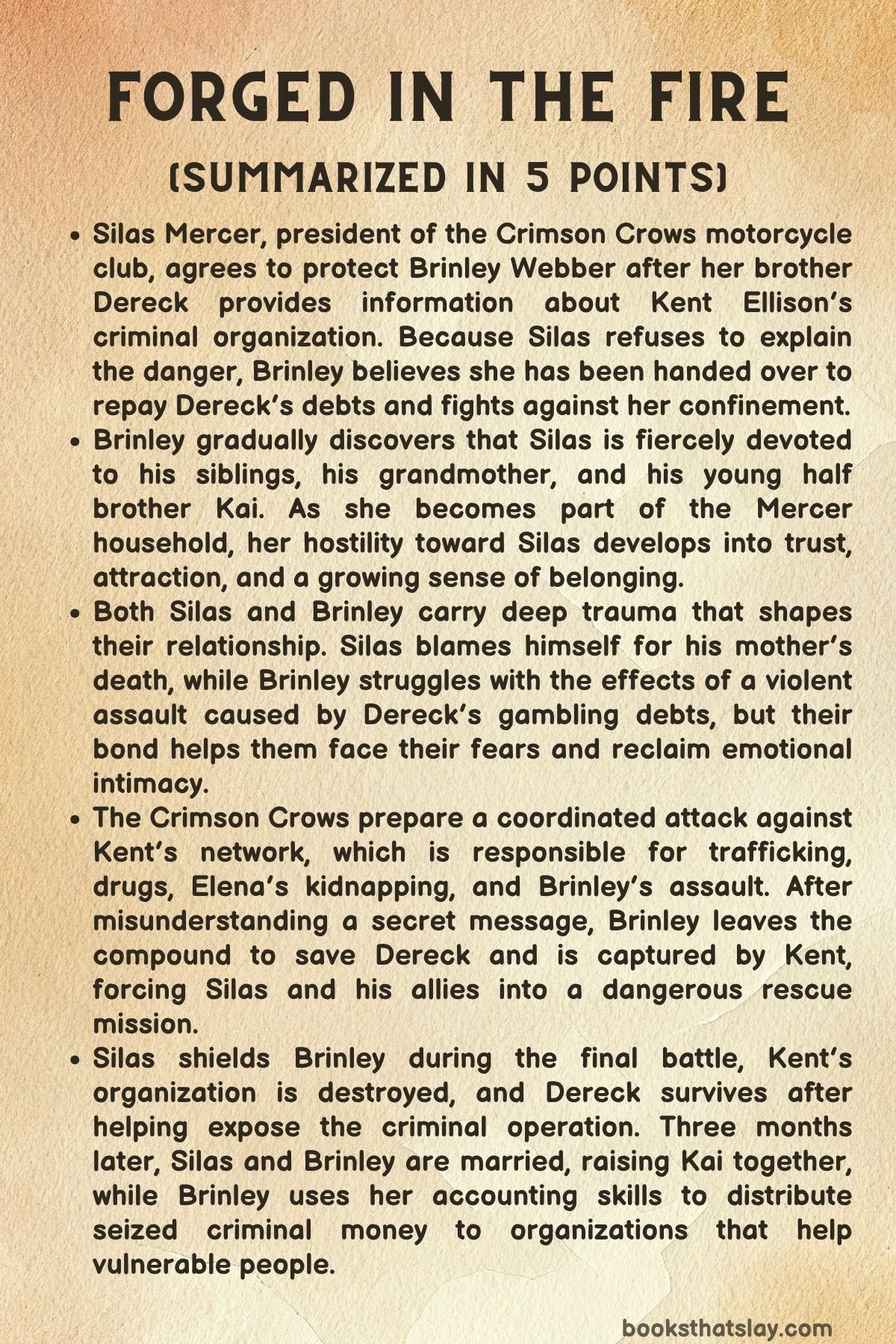
Summary
Silas Mercer waits at the Crimson Crows’ fortified compound for Brinley Webber, the sister of an unreliable informant named Dereck. Dereck has provided information that may help the club destroy Kent Ellison’s criminal organization, but his cooperation places both him and Brinley in serious danger.
Although Silas intends to protect Brinley, he refuses to explain the threat because the planned operation depends on secrecy. Instead, he allows her to believe that Dereck has handed her over to repay a debt, hoping fear will keep her inside the compound and prevent her from interfering.
Brinley arrives furious, frightened, and convinced that Silas is a dangerous criminal who may harm her brother. She has spent most of her life repairing Dereck’s mistakes, and her loyalty to him was formed by a promise she made to their dying mother when she was still a teenager.
Silas places her in a room above the clubhouse and orders her to work in the office of the club’s autobody shop. His threats are deliberately harsh, but his attraction to her makes it increasingly difficult for him to maintain the intimidating role he has created.
Brinley refuses to remain obedient. She investigates the compound, attends club gatherings, enters restricted areas, and overhears conversations she does not understand, causing her to believe that the Crows intend to kill Dereck.
Her assumptions begin to weaken when she witnesses Silas with his family. The man who terrifies club members becomes gentle around his sister Elena, his grandmother Meems, his brother Brody, and the young child Kai.
Brinley initially assumes Elena and Kai are Silas’s partner and son. She soon learns that Elena is his sister and that Kai is his much younger half brother, whom Silas rescued after years of neglect by their abusive father, PJ.
The Mercer household welcomes Brinley with warmth that contrasts sharply with the violence associated with the club. Elena becomes her friend, Meems treats her like family, and Kai quickly forms an attachment to her.
Silas’s protectiveness grows after he notices a possible member of Kent’s organization watching them during a trip into town. He rushes Brinley back to the compound and moves her into the family house, insisting that she sleep in his room so he can guard her personally.
Their physical closeness intensifies an attraction that neither can deny. Silas wants Brinley but fears that acting on his desire would exploit her dependence, while Brinley is disturbed by how safe she feels with a man she originally considered her captor.
Flashbacks reveal the origin of Silas’s need for control. His childhood was dominated by PJ’s violence, his mother’s efforts to protect the children, and Silas’s growing belief that he was responsible for keeping the family safe.
As a teenager, Silas accepted money from PJ and began transporting illegal packages for Kent’s network. He justified the work as a way to support his struggling family, but his mother discovered the truth and confronted him.
Armed men arrived during that confrontation, and Silas’s mother was shot. PJ abandoned them, leaving Silas injured beside her as she died, and Silas spent the following years blaming himself for bringing criminal violence into her life.
In the present, the threat against Brinley becomes immediate when one of Kent’s men enters the autobody office and holds a knife to her throat. The Crows rescue her, but the attack confirms that Kent’s organization has located the people Silas is protecting.
The incident also reveals to Silas that Brinley’s fear is connected to an earlier trauma. After an intimate encounter built around her consent and control, Brinley finally tells him what happened five years before.
Dereck’s gambling debts had led three men to lure Brinley into a house by using his phone. They sexually assaulted her and intended to kill her, but unknown gunmen interrupted the attack, allowing emergency services to reach her.
Dereck later begged Brinley not to identify the attackers because he feared they would kill him. Bound by her promise to protect him, she withheld information and carried the physical and emotional consequences alone.
Silas is horrified by her account and apologizes for using threats when she first arrived. He explains that Dereck brought her to the compound to keep her safe and that the current danger is connected to the organization responsible for Elena’s abduction.
Brinley’s trust changes their relationship. She becomes more confident in reclaiming her independence, while Silas begins to understand that protection cannot mean controlling every decision she makes.
Their emotional and physical connection develops into love. Brinley becomes part of the Mercer household, caring for Kai, supporting Elena, helping in the shop, and imagining a future within the family.
Silas nevertheless believes his violent life makes him unworthy of her. He decides that after the operation against Kent, he will return her to Dereck and remove himself from her future.
Brinley refuses to let him make that choice for her. She tells him that she understands the risks and is choosing him freely, forcing Silas to recognize that abandoning her in the name of safety would be another attempt to deny her autonomy.
Silas finally accepts her choice, and they fully commit to one another. Their intimacy becomes an important step in Brinley’s recovery because it is based on love, communication, and her ability to determine what happens to her body.
Silas publicly introduces Brinley to the club as the woman who belongs beside him. The declaration shows that he is no longer hiding his emotional vulnerability, though Phoenix worries that Brinley has become a weakness that could compromise the coming mission.
On the morning of the attack, Brinley discovers hidden club records. She sees evidence of unsolved killings and large sums of money, along with messages declaring that someone identified as “D” is a liar who must be eliminated.
Believing the messages refer to Dereck, Brinley concludes that Silas has betrayed his promise. She finds an address connected to the operation, escapes the compound, and heads there alone to save her brother.
Silas discovers that Phoenix wrote the message because he believed Dereck was leading the club into an ambush. Phoenix had acted without authorization, but Brinley’s disappearance leaves no time for punishment.
A revelation then connects Silas and Brinley’s histories. Five years earlier, Silas and Phoenix had followed Kent’s men to the house where Brinley was being assaulted.
Silas abandoned his chance to attack Kent and opened fire to save the unidentified woman. He was shot, but the interruption forced her attackers to flee and gave the police time to reach her.
Brinley arrives at Kent’s compound and is captured alongside Dereck. Kent reveals that he led the men who assaulted her and that he has discovered Dereck’s efforts to provide information to the Crows.
Dereck’s cooperation was partly an attempt to avenge what happened to Brinley. Although his mistakes placed her in danger, he had become trapped within Kent’s organization and was trying to help destroy it from inside.
The Crows and their allies launch coordinated attacks on Kent’s locations. Silas leads a rescue team into the main compound, where he finds Brinley and Dereck restrained while Kent and PJ wait with armed men.
PJ has betrayed Silas again, expecting financial reward from Kent. Kent considers him useless and kills him, ending the abusive father’s life without granting Silas the revenge he once imagined taking himself.
A gunfight follows. Silas reaches Brinley and throws himself over her, taking three bullets in the back as he shields her from Kent.
Brinley believes Silas has died until he speaks to her and reveals that his body armor stopped the bullets. The Crows defeat Kent’s remaining men, rescue Dereck, and complete the destruction of the criminal network.
Afterward, Silas tells Brinley the full truth about his mother, the club, and the attack from five years earlier. He explains that the Crows seize wealth from criminal organizations and secretly redirect it to programs that assist victims.
They return home knowing the victory has carried a cost. Two Crows have been killed, several others are wounded, and Silas must accept that protecting people does not allow him to prevent every loss.
Three months later, Silas and Brinley are married. Dereck has recovered and joined the club as a prospect, Brody has earned his full patch, and Elena has begun pursuing greater independence.
Brinley uses her accounting ability to manage the money seized during club operations and distribute it anonymously to worthy organizations. Her work allows her to fulfill her old dream of using numbers to help people create safer and more stable lives.
Kai now calls Silas and Brinley Daddy and Mommy. Silas has transformed the fortified refuge he once controlled through fear into a genuine home where love, choice, responsibility, and hope can exist beside the scars of the past.
Characters
Silas Mercer
In Forged in the Fire, Silas Mercer is presented as both a feared motorcycle-club president and a deeply wounded protector whose entire identity has been shaped by responsibility. He commands the Crimson Crows with authority, plans violent operations, and kills those he considers a threat, yet his brutality is directed toward criminal groups that exploit vulnerable people.
Silas’s greatest strength is his willingness to place himself between danger and the people he loves. His mother’s death, Elena’s kidnapping, Kai’s neglect, and Brinley’s victimization have convinced him that his value depends on preventing further harm.
That conviction becomes his central flaw because he confuses protection with control. He confines Brinley, limits Elena’s independence, withholds information, and makes decisions for others because he believes fear gives him the right to determine what is safest.
Silas’s emotional growth depends on accepting that love requires trust. Brinley forces him to see that protecting someone does not mean denying that person a voice, and his decision to accept her choice represents a major change in his understanding of partnership.
His relationship with Kai reveals the tenderness beneath his public image. By becoming the child’s father in every meaningful sense, Silas proves that he can create the loving home his own father denied him.
Brinley Webber
Forged in the Fire presents Brinley as a survivor whose independence developed from necessity rather than personal preference. From adolescence onward, she manages money, cares for her dying mother, protects Dereck, and sacrifices her own ambitions because no dependable adult is available to carry those responsibilities.
Her loyalty is both admirable and destructive. She refuses to abandon Dereck even after his gambling debt leads to her assault, showing enormous compassion but also a damaging belief that his survival must always come before her well-being.
Brinley’s anger toward Silas is a form of resistance against losing control again. His secrecy and confinement resemble the powerlessness she has already experienced, so her defiance is essential to preserving her identity.
Her relationship with Silas becomes meaningful because she gradually chooses trust rather than being forced into it. She reclaims physical intimacy on her own terms, speaks openly about her trauma, confronts the place where she was attacked, and insists on deciding whether Silas’s dangerous world is acceptable to her.
Brinley’s final role in the club also completes her personal journey. She uses her financial skills to redirect stolen criminal wealth toward people in need, fulfilling the dream she had before trauma and obligation interrupted her plans.
Dereck Webber
Dereck is one of the story’s most morally conflicted characters. His gambling, drinking, instability, and criminal associations repeatedly force Brinley to rescue him, making him the clearest example of how love can become unhealthy when responsibility is never shared equally.
His actions contribute directly to Brinley’s assault, even though he does not knowingly send her to the attackers. His later request that she remain silent protects him at the cost of justice and leaves her to carry the trauma without accountability.
Dereck is not portrayed as entirely selfish or incapable of remorse. His cooperation with Silas is partly motivated by a desire to protect Brinley and destroy the organization that harmed her.
His position inside Kent’s network also shows the consequences of making repeated compromises. He becomes trapped among violent men and can only escape by risking his life as an informant.
By joining the Crimson Crows as a prospect, Dereck begins a path toward responsibility rather than receiving immediate forgiveness. His future depends on proving that he can contribute to a family without expecting Brinley to absorb every consequence of his choices.
Elena Mercer
Elena represents both the reason for Silas’s strict protection and the cost of that protection. Her abduction has intensified his fear, but surviving the ordeal has also made her determined to reclaim an independent life.
She is warm, sociable, and quick to welcome Brinley. Their friendship helps Brinley feel accepted, while Brinley’s courage encourages Elena to challenge the restrictions that have defined her life since returning home.
Elena understands her brother’s motives but refuses to treat good intentions as an excuse for confinement. She repeatedly reminds Silas that people cannot develop confidence if every difficult choice is made for them.
Her desire to open a business and live independently symbolizes her movement from protected victim to self-directed adult. The plan also forces Silas to practice the trust he has learned through Brinley.
Elena’s attraction to Trevan adds emotional tension to her struggle. His protective presence may offer security, but any future between them will require both men to recognize that she is capable of deciding what she wants.
Kai Mercer
Kai is Silas’s young half brother and one of the strongest symbols of innocence in the story. He has experienced neglect and instability under PJ, leaving him with nightmares, abandonment fears, and a need for constant reassurance.
Silas’s care for Kai reveals the depth of his paternal instincts. He wants the child to grow up surrounded by safety, affection, and dependable adults rather than learning that fear is a normal part of family life.
Kai’s immediate attachment to Brinley helps unite her with the Mercers. When he accepts her comfort and later calls her Mommy, the relationship confirms that family has been formed through daily commitment rather than biology alone.
The child also gives Silas and Brinley a shared purpose beyond their romantic attraction. Their ability to comfort, protect, and raise him shows that their relationship can support a stable home rather than merely survive danger.
Meems
Meems is the moral center of the Mercer family. She combines gentleness with strength, offering food, advice, affection, and practical support while remaining fully prepared to defend the household with a weapon when danger approaches.
She understands Silas’s guilt better than most people because she witnessed the abuse and loss that shaped him. Instead of dismissing his fear, she challenges the conclusions he has drawn from it.
Meems repeatedly reminds Silas that responsibility does not require him to carry every burden alone. She also recognizes that treating Brinley as a prisoner is incompatible with the values Silas claims to defend.
Her acceptance gives Brinley a maternal presence she has lacked since her own mother’s death. Through Meems, the household becomes a place where Brinley can receive care without having to earn it by solving someone else’s problems.
Trevan
Trevan is Silas’s oldest friend and the vice president of the Crimson Crows. His loyalty is based on history, shared purpose, and a willingness to challenge Silas when emotion begins to affect his judgment.
He frequently uses humor to expose Silas’s growing feelings for Brinley. Beneath the teasing, Trevan understands that their president’s isolation is unhealthy and that Brinley may offer him a future beyond revenge.
Trevan’s feelings for Elena are visible through his protectiveness and emotional restraint. His conflict lies in wanting her while respecting Silas’s authority and recognizing Elena’s vulnerability after her abduction.
His role within the club makes him both Silas’s supporter and a necessary counterbalance. He follows Silas into dangerous operations, but his loyalty does not prevent him from recognizing when the president is acting from fear rather than reason.
Phoenix
Phoenix is one of the most disciplined and severe members of the Crimson Crows. He places the club’s survival above personal attachments and believes that hesitation can result in the deaths of innocent people and fellow members.
His suspicion of Dereck is understandable because the informant’s behavior and information contain inconsistencies. However, Phoenix’s decision to order Dereck’s elimination without consulting Silas demonstrates the danger of treating efficiency as more important than transparency.
The secret instruction causes Brinley to believe Silas has betrayed her and sends her directly into Kent’s trap. Phoenix must therefore confront the fact that an action intended to protect the club has placed its president’s partner in greater danger.
His apology reveals that he is capable of humility and loyalty rather than simple coldness. He admits his mistake and joins the rescue without attempting to excuse the damage he caused.
Brody Mercer
Brody is Silas’s younger brother and one of the more energetic members of the Mercer family. His teasing, charm, and reckless humor offer relief within a household shaped by fear and responsibility.
He enjoys provoking Silas by showing Brinley attention, but his behavior is not intended to undermine their relationship. He recognizes his brother’s feelings and uses humor to force Silas to acknowledge what everyone else can already see.
Brody also proves that he is more than the carefree younger sibling Silas wants to protect. During the final operation, he insists that Brinley and the family are his responsibility as well, then demonstrates courage in battle.
Earning his full patch confirms his movement into adult membership within the club. His growth suggests that Silas must begin trusting his siblings to share risks rather than treating them as permanent dependents.
PJ Mercer
PJ is the principal source of violence within Silas’s childhood. He abuses Silas’s mother, manipulates his children, abandons them in moments of danger, and treats family relationships as opportunities for profit and control.
His influence extends beyond physical abuse. He convinces Silas that criminal activity is a test of masculinity and exploits the teenager’s desire to provide for the family.
PJ’s abandonment during the shooting that kills Silas’s mother becomes one of the defining betrayals of Silas’s life. It confirms that PJ values his own survival above every parental responsibility.
His later attempts to reclaim Kai show that he continues to view children as possessions. His alliance with Kent completes his moral collapse because he knowingly joins the man responsible for devastating his family.
Kent’s decision to kill PJ denies him both profit and power. His death also prevents Silas from defining himself through revenge against his father, forcing him to build a future based on the people he loves instead.
Kent Ellison
Kent Ellison is the central external antagonist and the figure connecting the major traumas experienced by Silas, Brinley, Elena, and Dereck. His organization profits from drugs, trafficking, exploitation, intimidation, and the calculated destruction of vulnerable people.
Kent’s cruelty is not impulsive. He treats violence as a tool for enforcing obedience, punishing debtors, and demonstrating power.
His role in Brinley’s assault reveals his desire to turn human suffering into a message for someone else. She is not viewed as a person but as an object through which Dereck can be controlled.
Kent also represents the criminal world Silas entered as a teenager. By destroying Kent’s organization, Silas confronts both the man responsible for his losses and the larger structure that allowed those losses to continue.
His defeat is meaningful because the Crows do more than kill him. They dismantle the network, redirect its resources, and prevent the organization from simply replacing one leader with another.
Silas’s Mother
Silas’s mother establishes the moral principles that continue guiding him after her death. She teaches him that love, effort, identity, and family come from the heart rather than from fear, blood, or social status.
Her strength is expressed through endurance and protection. Even while living with abuse, she tries to preserve warmth for her children and prevent PJ’s cruelty from defining them.
She recognizes that Silas’s desire to provide can be manipulated. Her warnings about criminal money show that she understands how quickly good intentions can be used to justify harmful choices.
Her death becomes Silas’s deepest source of guilt, but her lessons also prevent him from becoming entirely consumed by revenge. The Crimson Crows’ mission to protect victims and redistribute criminal wealth can be understood as Silas’s violent attempt to continue the values she gave him.
Brinley and Dereck’s Mother
Brinley’s mother shapes her daughter’s identity through the promise she requests before dying. She asks Brinley to care for Dereck while also pursuing a future of her own.
The request is loving but places an enormous emotional burden on a teenager who is already functioning as the family’s primary caregiver. Brinley remembers the duty to protect Dereck more strongly than the instruction to build her own life.
Her influence therefore has two sides. She gives Brinley purpose, resilience, and faith in her abilities, but the promise also contributes to Brinley’s belief that abandoning Dereck would be a betrayal.
Brinley’s eventual career allows her to honor the complete message rather than only its sacrificial part. She supports her brother while finally developing a future that uses her intelligence and serves her own values.
Cash Cunningham
Cash Cunningham is the leader of Sovereign Sanctum and an essential strategic ally of the Crimson Crows. His technical skills allow the groups to verify Dereck’s intelligence, coordinate simultaneous attacks, manage communications, and trace Kent’s extensive organization.
Cash represents a more analytical form of power than Silas’s direct physical force. He works through digital information, logistics, financial systems, and careful planning.
His contribution becomes especially important after the mission is exposed as a likely ambush. Instead of abandoning the operation, Cash helps restructure the assault so the allied groups can rescue Brinley while still destroying the wider network.
He later works with Brinley to clean and distribute seized criminal funds. Their partnership turns the club’s violence into practical assistance for organizations serving vulnerable communities.
Trent Lawson
Trent Lawson appears during a crucial period in Silas’s development. He provides the information that identifies Kent Ellison as the man connected to the criminal activity in Crimson Creek and therefore gives Silas’s anger a specific target.
He also recognizes Silas’s dissatisfaction with criminal organizations that harm ordinary people. By suggesting that another kind of club could exist, Trent helps create the foundation for the Crimson Crows.
His role demonstrates that Silas does not build his later mission entirely alone. The club emerges through alliances with people who share his belief that strength can be redirected against those who exploit others.
Cliff and Jupe
Cliff and Jupe are members of the Crimson Crows who die during the coordinated attack on Kent’s organization. Although the story provides limited individual detail about them, their deaths prevent the victory from feeling effortless or without consequence.
Their loss demonstrates that the Crows’ loyalty involves genuine sacrifice. The members accept missions knowing that their shared purpose may demand their lives.
Silas carries responsibility for their deaths alongside his relief that Brinley and the family are safe. Their absence becomes part of the emotional cost of the justice he pursues.
Themes
Protection, Control, and Personal Freedom
Forged in the Fire repeatedly questions when protection becomes another form of confinement. Silas believes that loving someone gives him a responsibility to eliminate every possible danger, but this belief leads him to control Brinley’s movements, limit Elena’s independence, and hide information from the people most affected by his decisions.
His behavior comes from real trauma rather than a desire for simple domination. He has watched his mother die, Elena be abducted, and Kai suffer neglect, so uncertainty feels like an invitation for catastrophe.
Brinley challenges the idea that safety is more important than autonomy. After surviving an assault in which all control was taken from her, she cannot accept a relationship where another person decides where she may go, what she may know, or what risks she may take.
Her decision to return to the shop after the knife attack shows that healing cannot be achieved through avoidance alone. She needs the freedom to face frightening places and make informed choices about her own life.
Silas’s growth occurs when he learns that protection should support another person’s agency rather than replace it. Accepting Brinley’s choice, allowing Elena to pursue a business, and sharing responsibility with his siblings all show him moving from control toward trust.
Trauma, Trust, and Reclaiming Intimacy
Both Silas and Brinley organize their lives around wounds they have never fully processed. Silas responds to trauma by becoming stronger, more violent, and more controlling, while Brinley responds by becoming independent, emotionally guarded, and unwilling to depend on anyone.
Their defenses allow them to survive but prevent them from experiencing peace. Silas believes closeness will expose others to danger, and Brinley believes trust will make abandonment or betrayal more devastating.
Physical intimacy becomes important because it reflects Brinley’s recovery of choice. Her relationship with Silas is only healing when he pays attention to her reactions, respects hesitation, and allows her to determine how far each encounter will go.
The story does not suggest that romance erases trauma. Brinley still remembers the assault, and Silas continues carrying guilt over his mother’s death and the people lost under his leadership.
What changes is their willingness to stop facing those memories alone. Brinley tells Silas what happened instead of minimizing it, while Silas reveals the fear beneath his control and accepts that vulnerability does not make him weak.
Their trust is finally restored through full disclosure after the battle. Honest knowledge, rather than secrecy or possession, becomes the foundation of their partnership.
Family Defined Through Love and Choice
Biological relationships in the story are not automatically safe or meaningful. PJ is Silas’s father, yet he abuses, exploits, and abandons his children, while Dereck’s relationship with Brinley repeatedly places her in danger despite their genuine love for one another.
In contrast, the Mercer household and the Crimson Crows create families through loyalty, responsibility, and shared action. Meems, Elena, Brody, Trevan, Phoenix, and the other members remain connected because they repeatedly choose to protect and support one another.
Kai’s story offers the clearest expression of this theme. PJ is his biological father, but Silas and Brinley become his parents by comforting him, providing stability, and making him feel wanted every day.
Brinley also finds a new family without abandoning Dereck. Her bond with the Mercers allows her to recognize that love does not have to consist entirely of sacrifice, guilt, and emergency.
Silas’s mother teaches him that family comes from the heart, and his adult life gradually proves the truth of her lesson. His marriage, his fatherhood of Kai, and his leadership of the Crows are all relationships created through deliberate commitment.
The chosen family does not erase conflict or loss. Its strength comes from allowing damaged people to remain connected while learning healthier ways to love.
Guilt, Redemption, and the Use of Violence
Silas believes his involvement in criminal work caused his mother’s death, and he spends years treating loneliness, danger, and revenge as the punishment he deserves. His guilt gives him purpose, but it also prevents him from imagining that he could build a life beyond correcting the past.
The Crimson Crows represent his attempt to transform guilt into action. They adopt the appearance and methods of criminals while directing their violence toward traffickers, exploiters, drug organizations, and people who harm vulnerable victims.
The moral position of the club remains complicated because its members kill, conceal evidence, and operate outside the law. Their good intentions do not make their actions innocent, and the deaths of Cliff and Jupe show that violent judgment produces consequences even when the targets are cruel.
The redistribution of criminal wealth adds another dimension to Silas’s idea of justice. Destroying offenders is not enough; resources taken through exploitation are returned to programs that help people rebuild their lives.
Brinley becomes central to Silas’s redemption because she refuses to define him only by the blood on his hands. She recognizes his capacity for tenderness, responsibility, and love without pretending his violence does not exist.
Silas’s redemption does not come from becoming harmless. It comes from accepting accountability, sharing power, allowing others to choose their paths, and believing that his future can contain more than punishment.