Finger Lickin’ Fifteen Summary, Characters and Themes
Finger Lickin’ Fifteen by Janet Evanovich is a fast, comic mystery in the Stephanie Plum series (15th in the series), built around murder, bounty hunting, bad cooking, and romantic confusion. Stephanie is once again caught between danger and absurdity, working skips for the bonds office while helping Lula chase a million-dollar reward after witnessing a brutal killing.
Alongside the murder case, Stephanie is drawn into Ranger’s world when a series of security breaches threatens his company. The book mixes crime, slapstick, jealousy, family chaos, and Stephanie’s familiar struggle between Morelli’s steadiness and Ranger’s dangerous pull.
Summary
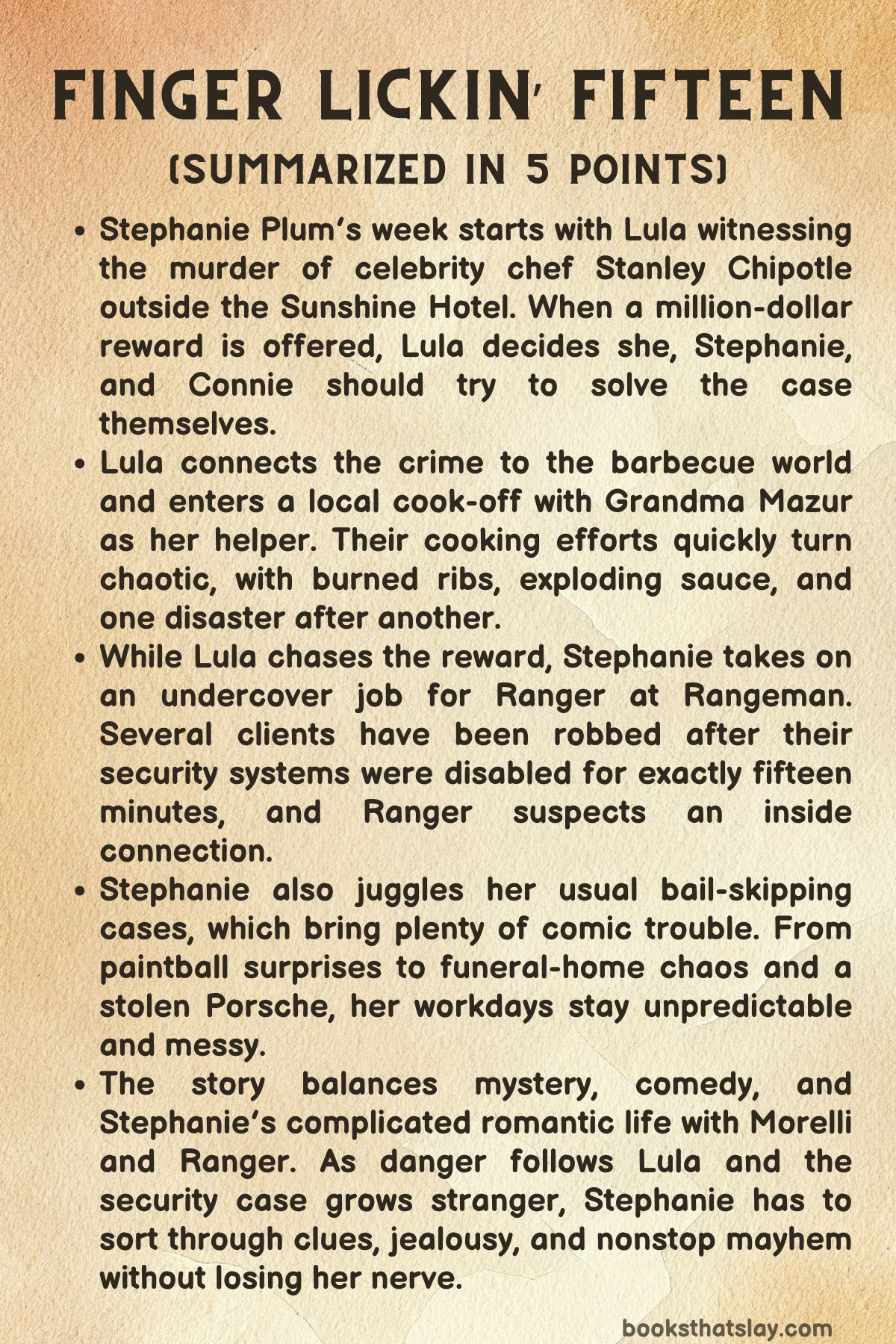
Stephanie Plum’s week starts with Lula storming into the bail bonds office in full panic. Lula claims she has just seen two men murder celebrity chef Stanley Chipotle outside the Sunshine Hotel.
The killing is shocking and theatrical: Chipotle has been decapitated. Lula is loud, frightened, and certain of what she saw, though everyone around her needs a moment to process the story.
Morelli is called in, the police inspect the scene, and the evidence confirms that Lula is not exaggerating. Later, Chipotle’s head is found near a television station, making the case even stranger and more public.
The murder quickly becomes more than a police matter when a barbecue sauce company offers a million-dollar reward for information leading to the killers. Lula sees this as her chance to become rich.
Since she was the witness, she decides she is uniquely qualified to solve the crime. She pulls Stephanie and Connie into her plan, insisting that the killing must have something to do with Chipotle’s career as a famous barbecue personality.
Lula’s reasoning leads her to enter a local barbecue cook-off, even though she cannot cook. Grandma Mazur joins as her assistant, which makes the plan even more chaotic rather than more practical.
While Lula chases the reward, Stephanie is pulled into another investigation through Ranger. Rangeman clients are being robbed after their security systems shut down for exactly fifteen minutes and then come back online.
The timing suggests inside knowledge, and Ranger fears someone connected to his company may be responsible. He asks Stephanie to work undercover in the office.
She takes a temporary desk job, observes employees, reviews files, and tries to spot unusual behavior. She focuses on people who have access to the security-code computer, but none of them clearly fits the pattern.
The burglaries continue while Stephanie is at Rangeman. One high-profile theft involves valuable Fabergé eggs, increasing the pressure on Ranger and his company.
Stephanie keeps searching for a connection inside the office but slowly begins to think the answer may lie somewhere else. The thief seems to know Rangeman’s routines, yet the clues do not quite point to a staff member.
Her work at Rangeman also keeps her close to Ranger, which complicates her already messy personal life.
Stephanie still has her regular bail enforcement work, and that brings its own disasters. With Ranger’s help, she catches Kenny “Marbles” Hatcher after walking into a strange paintball setup.
She also goes after Junior Turley, an exhibitionist who runs through a funeral home and turns the arrest attempt into a public mess. Lula uses a stun gun, but Junior still manages to get away.
Stephanie later deals with Ernie Dell, an arsonist who steals and burns Ranger’s Porsche Cayenne before Ranger catches him. Another skip, Cameron Manfred, is finally taken in after more comic trouble involving flour.
None of Stephanie’s cases goes smoothly, but she keeps going.
Lula’s situation grows more dangerous because she can identify Chipotle’s killers. The men come after her with a meat cleaver, shoot at her car, fire into the bonds office, and eventually blow up her Firebird.
Lula is scared, but she is also stubborn. One of the killers is identified as Marco “the Maniac,” a mob-connected criminal.
The other man is Zito Dudley. Lula refuses to disappear or let the police handle everything.
She remains fixed on the reward and on proving herself by winning the cook-off, even though every attempt at cooking ends badly.
Her barbecue preparation is a disaster from the beginning. Ribs burn beyond use.
Sauce explodes in Stephanie’s kitchen. A grill fire at Stephanie’s parents’ house burns up a tree.
Lula treats each failure as a temporary setback rather than evidence that she has no idea what she is doing. Grandma Mazur encourages the madness, and Connie becomes part of the search for the killers.
Stephanie is left trying to keep everyone alive while also preventing Lula’s cooking experiments from causing more property damage.
Stephanie’s romantic life is just as unsettled. Since her own living situation has been disrupted, she stays for a time at Ranger’s apartment.
The attraction between them is strong, and Ranger’s calm confidence makes it difficult for Stephanie to keep distance. At the same time, she remains emotionally tied to Morelli.
She notices Joyce Barnhardt around him and becomes jealous, while Morelli is annoyed by Stephanie’s closeness to Ranger. Stephanie and Morelli argue, flirt, push each other away, and drift back together.
Neither relationship is simple, and Stephanie avoids making a clean decision.
The barbecue cook-off becomes the main stage for the murder investigation. Lula, Grandma Mazur, Connie, and Stephanie attend while pretending to compete.
Stephanie ends up wearing a hot dog costume because the sparerib costume is not available, adding another layer of embarrassment. Lula is focused on spotting the killers, selling her terrible barbecue, and claiming the reward.
The event is crowded, ridiculous, and tense because everyone knows the killers may appear.
Lula eventually sees Marco at the cook-off. Marco tries to run and later attempts to reach the airport, but he is caught.
Once captured, he identifies Zito Dudley as his partner. Dudley then appears at the cook-off and takes Joyce Barnhardt hostage.
His motive becomes clear: Stanley Chipotle had refused to sign a new contract with Fire in the Hole barbecue sauce. Chipotle’s refusal threatened the company’s profits, and Dudley wanted the problem removed.
He hired Marco to help, but the crime fell apart because Lula witnessed the murder.
Dudley is arrested, and Joyce survives the hostage situation. Lula’s dream of becoming a barbecue champion collapses when her grill fails and the food burns.
The murder case is solved, but not in the glamorous way Lula imagined. She does not become a great cook, and the cook-off mostly proves that enthusiasm cannot replace skill.
Still, her stubbornness and eyewitness account help expose the people behind Chipotle’s death.
The Rangeman burglary case is solved soon after. Stephanie recognizes a man from Ranger’s surveillance footage when she sees him at Starbucks playing one of the stolen handheld games.
She follows him to an office, where Ranger discovers the stolen goods. The thieves turn out to be two young men who figured out how to beat the system by placing lookalike devices near Rangeman sensors and taking advantage of security routines.
The shutdowns were not caused by a Rangeman employee after all. The fifteen-minute gaps were part of a clever outside scheme.
With both major cases wrapped up, Stephanie leaves Ranger’s apartment and takes Rex with her. She goes to Morelli’s place to watch hockey.
The tension between them softens, and their relationship shifts back toward being active again. The ending leaves Stephanie in familiar territory: surrounded by danger, comedy, unfinished feelings, and the ongoing pull between the two men in her life.
Characters
Stephanie Plum
Stephanie Plum is the central character in Finger Lickin’ Fifteen, and she brings together the book’s mystery, comedy, romance, and chaos. She is not a polished detective or a traditional action heroine; her strength comes from persistence, instinct, and an ability to survive situations that repeatedly spiral out of control.
In this story, Stephanie is pulled between two investigations: Lula’s determination to solve Stanley Chipotle’s murder and Ranger’s request that she work undercover at Rangeman. Her role shows her flexibility, because she moves from bail enforcement to office surveillance to street-level detective work, often without much preparation but with a sharp sense of when something does not feel right.
Stephanie’s character is defined by her ordinary reactions to extraordinary situations. She gets scared, annoyed, jealous, embarrassed, and confused, which makes her feel human inside the book’s exaggerated events.
Her work with Ranger places her in a more controlled, professional environment, while her work with Lula throws her into disorder, danger, and slapstick comedy. This contrast highlights Stephanie’s unusual position: she is capable enough to help solve serious crimes, but she is also surrounded by disasters involving costumes, exploding sauce, burning cars, and chaotic captures.
Her investigation into the Rangeman burglaries also shows that she is more observant than people sometimes assume. She may not always solve problems elegantly, but she notices patterns and eventually helps uncover the truth.
Her personal life adds emotional tension to her character. Stephanie is caught between Morelli’s familiarity and Ranger’s danger, and the story uses this tension to show her divided desires.
With Morelli, she has history, comfort, irritation, and a relationship that keeps pulling them back together. With Ranger, she has attraction, mystery, and the appeal of someone who seems powerful and controlled.
Stephanie’s temporary stay at Ranger’s apartment intensifies this conflict, but the ending suggests that her emotional center still leans toward Morelli. Her character remains appealing because she does not fully master her life; she stumbles, argues, makes mistakes, and still keeps going.
Lula
Lula is one of the loudest, boldest, and most entertaining figures in the book. Her role begins dramatically when she witnesses Stanley Chipotle’s murder, and from that point onward she becomes both a witness in danger and an enthusiastic amateur investigator.
Lula’s personality is driven by confidence, appetite, stubbornness, and theatrical energy. She does not respond to trauma by hiding quietly; instead, she decides that the murder is her ticket to a million-dollar reward and throws herself into solving the case with wild determination.
Lula’s entry into the barbecue cook-off reveals her comic self-belief. She has no real cooking skill, yet she acts as though confidence alone can make her a barbecue champion.
Her burned ribs, exploding sauce, failed grill, and disastrous preparation show the gap between her ambition and her actual ability. This makes her funny, but it also makes her strangely admirable.
Lula refuses to let fear, danger, or incompetence stop her. Even after being attacked, shot at, and targeted by killers, she continues pushing forward.
Her courage is reckless, but it is courage all the same.
Lula also brings emotional warmth to the story. Her friendship with Stephanie, Connie, and Grandma Mazur turns the murder investigation into a chaotic group effort.
She can be selfish and impulsive, especially when the reward money is involved, but she is never dull or passive. Her personality transforms danger into spectacle.
In many ways, Lula embodies the comic spirit of the novel: danger is real, but it is filtered through outrageous behavior, exaggerated confidence, and an unwillingness to behave sensibly.
Joe Morelli
Joe Morelli represents stability, law enforcement, and Stephanie’s complicated romantic past. As a police officer, he is connected to the official investigation into Stanley Chipotle’s murder, and his presence gives the story a grounding force.
Morelli is practical, skeptical, and often irritated by the chaos surrounding Stephanie and Lula. He understands danger more seriously than Lula does, and he tends to view Stephanie’s risky choices with concern mixed with frustration.
Morelli’s relationship with Stephanie is one of the book’s main emotional threads. Their bond is familiar and physical, but it is also full of jealousy, arguments, and unresolved tension.
Morelli is bothered by Stephanie’s closeness to Ranger, while Stephanie reacts strongly when Joyce Barnhardt appears around him. These moments show that their relationship is not calm or simple.
They care about each other, but they also know exactly how to provoke each other. Morelli’s irritation is partly possessive, but it also comes from knowing Stephanie well enough to worry when she gets pulled into danger.
By the end of the story, Morelli’s role becomes softer. Stephanie leaves Ranger’s apartment and goes to Morelli to watch hockey, suggesting that their connection has survived the jealousy and conflict.
Morelli is not presented as a perfect romantic answer, but he is a familiar emotional anchor. His character balances Stephanie’s unpredictable life with a sense of home, even when that home is full of arguments.
Ranger
Ranger is one of the most controlled and powerful characters in the story. He is calm, disciplined, physically capable, and professionally intimidating.
His company, Rangeman, becomes the center of the burglary investigation, and his decision to ask Stephanie for help shows that he trusts her instincts even though her methods are unconventional. Ranger’s world is sleek, secure, and organized, which contrasts sharply with Stephanie’s usual chaos.
Ranger’s character is built around mystery and control. He rarely reveals too much emotionally, but his actions show concern for Stephanie.
He gives her a place to stay, helps her capture skips, tracks down problems efficiently, and remains composed even when situations become absurd. When Ernie Dell steals and burns his Porsche Cayenne, Ranger’s response is not panic but focused pursuit.
This reinforces his image as someone who can absorb chaos without being ruled by it.
His relationship with Stephanie carries strong romantic tension. Ranger is tempting because he represents danger, competence, and escape from Stephanie’s messy everyday life.
At the same time, he is difficult to fully know. Unlike Morelli, who is familiar and emotionally reactive, Ranger remains controlled and elusive.
His role in Finger Lickin’ Fifteen deepens Stephanie’s romantic conflict because he offers protection and excitement, but not necessarily the ordinary emotional life that Morelli represents.
Connie Rosolli
Connie Rosolli is a supporting character who provides loyalty, practicality, and comic partnership. As part of the bail bonds office, she belongs to Stephanie’s everyday working world, and she helps connect the murder investigation to the familiar environment of the bonds office.
Connie does not dominate the action, but she is important because she participates in Lula’s plans and supports the group’s efforts.
Connie’s character often works as a stabilizing presence beside Lula’s outrageous behavior. She is not as reckless as Lula, but she is willing to be drawn into the group’s schemes.
Her involvement in the barbecue contest and the search for the killers shows her loyalty to her friends and her willingness to step outside normal office duties when danger becomes personal. She helps create the sense that Stephanie’s world is not made up of isolated individuals but of a messy, loyal community.
Connie also adds to the humor by reacting to absurd situations with a mixture of competence and resignation. She is part of the bonds office’s chaotic rhythm, where murder investigations, bail skips, gunfire, and wild plans can all become part of the workday.
Her character may be less flamboyant than Lula or Grandma Mazur, but she strengthens the group dynamic and gives Stephanie another dependable ally.
Grandma Mazur
Grandma Mazur is a comic force whose enthusiasm often exceeds her good judgment. In this story, she becomes Lula’s assistant in the barbecue cook-off, even though neither of them has the cooking skill needed to compete seriously.
Her presence turns the contest into a farce, but it also shows her adventurous spirit. Grandma Mazur likes excitement, and she is drawn to situations that promise drama, spectacle, or danger.
Her character reflects a refusal to be limited by age or expectations. She does not behave like a quiet background family member; she throws herself into the action with curiosity and energy.
As Lula’s assistant, she adds another layer of chaos to an already hopeless cooking venture. Her involvement in the barbecue disaster shows her comic fearlessness and her willingness to participate in schemes that most people would avoid.
Grandma Mazur also adds warmth to the book’s family-centered humor. She is ridiculous, but she is not empty comedy.
Her boldness and curiosity make her a lively part of Stephanie’s world. She helps show that chaos in Stephanie’s life is not limited to criminals and investigations; it also comes from family, friends, and the people who love being near trouble.
Stanley Chipotle
Stanley Chipotle is the murder victim whose death drives the main mystery. Although he is not alive for much of the action, his importance is felt throughout the story.
As a celebrity chef connected to the barbecue world, he represents fame, business pressure, and the commercial value of food culture. His murder is shocking not only because it is violent, but because it happens in a public and bizarre way that immediately pulls Lula into danger.
Chipotle’s role becomes clearer as the motive is revealed. His refusal to sign a new contract with Fire in the Hole barbecue sauce threatens the company’s profits, making him more than just a famous chef; he becomes a financial obstacle.
This gives his character symbolic weight. He represents the point where celebrity, branding, and corporate greed collide.
His death shows how business interests can become deadly when money and reputation are at stake.
Even though he is mostly seen through the consequences of his murder, Chipotle shapes the actions of nearly every major character. Lula wants the reward connected to his killers, Stephanie gets pulled into the investigation, and Dudley’s crime is eventually exposed because the murder cannot be contained.
Chipotle’s character functions as the center of the mystery, and his death exposes the selfish motives of those around him.
Marco “the Maniac”
Marco “the Maniac” is one of the killers involved in Stanley Chipotle’s murder, and his character brings direct physical danger into the story. He is mob-connected, violent, and threatening, making him more dangerous than many of the comic criminals Stephanie usually encounters.
His nickname suggests instability and brutality, and his actions support that reputation. He attacks Lula, shoots at her, and tries to eliminate the witness who can identify him.
Marco’s character is important because he turns Lula’s reward-driven adventure into a real threat. Lula may treat the investigation with exaggerated confidence, but Marco reminds the reader that the murder is not just a comic setup.
He is willing to use violence repeatedly, and his pursuit of Lula raises the stakes. The attacks on her home, car, and workplace show how far he is prepared to go.
At the same time, Marco is not the mastermind. His eventual capture and confession reveal that he is part of a larger scheme connected to Zito Dudley and Fire in the Hole barbecue sauce.
This makes him a hired instrument of violence rather than the source of the motive. He represents the criminal muscle behind the crime, while Dudley represents the greed and planning that caused it.
Zito Dudley
Zito Dudley is the true planner behind the murder, and his character gives the mystery its business motive. He is connected to Fire in the Hole barbecue sauce and wants Stanley Chipotle’s contract problem solved because Chipotle’s refusal threatens the company’s profits.
Dudley’s villainy is rooted not in passion or accident but in greed and calculation. He treats murder as a way to protect business interests.
Dudley becomes especially dangerous because he hides behind a practical motive. He is not introduced as a wild killer in the same way Marco is; instead, he represents the respectable or corporate side of crime.
This makes him morally cold. He hires Marco to deal with the problem, but the plan collapses because Lula witnesses the murder.
His later decision to take Joyce Barnhardt hostage shows that he becomes more desperate as control slips away.
His capture at the cook-off is fitting because the barbecue contest is tied to the world that motivated the crime in the first place. Dudley’s exposure brings the murder plot full circle.
His character shows that the most absurd parts of the story, including the cook-off and sauce promotion, are connected to a serious motive: profit protected at any cost.
Joyce Barnhardt
Joyce Barnhardt functions as both a romantic irritant and an unexpected hostage in the story’s climax. Her presence around Morelli provokes Stephanie’s jealousy, making her important to the romantic tension between Stephanie and Morelli.
Joyce is not just another background character; she represents Stephanie’s insecurity and the fear that Morelli’s attention may shift elsewhere.
Joyce’s character often brings out Stephanie’s sharper emotional reactions. When Stephanie sees her near Morelli, the situation intensifies the already unstable balance between Stephanie, Morelli, and Ranger.
Joyce therefore helps reveal Stephanie’s possessiveness and uncertainty. Her role is less about deep personal transformation and more about creating pressure in Stephanie’s emotional life.
At the cook-off, Joyce becomes part of the crime plot when Dudley takes her hostage. This shifts her from romantic nuisance to endangered victim.
The moment also adds urgency to the climax and connects Stephanie’s personal jealousy with the main criminal investigation. Joyce survives, and her role shows how characters who begin as comic or romantic complications can suddenly become part of the book’s danger.
Kenny “Marbles” Hatcher
Kenny “Marbles” Hatcher is one of the bail skips Stephanie has to capture, and his role adds to the book’s episodic comedy. As a drug dealer connected to a bizarre paintball operation, he brings Stephanie and Ranger into one of the story’s stranger side adventures.
His character is not central to the murder or burglary plots, but he helps maintain the rhythm of Stephanie’s work as a bounty hunter.
Marbles represents the kind of criminal Stephanie regularly encounters: troublesome, odd, and difficult to capture cleanly. His situation allows the story to mix danger with absurdity.
The paintball setting turns a criminal capture into something visually ridiculous and chaotic, which fits the tone of Stephanie’s world. Even when the stakes are real, the circumstances often become comic.
His role also shows Ranger and Stephanie working together outside the Rangeman investigation. Ranger’s help makes the capture more efficient, while Stephanie’s presence keeps the scene unpredictable.
Marbles therefore contributes to the action-comedy structure of the book and reinforces the idea that Stephanie’s professional life is never routine.
Junior Turley
Junior Turley is another bail skip, and his character is mainly used for comic disorder. As an exhibitionist who runs through a funeral home, he creates one of the story’s most absurd chase sequences.
His behavior is embarrassing, inappropriate, and disruptive, which makes him a perfect example of the strange offenders Stephanie often has to deal with.
Junior’s role emphasizes Stephanie’s lack of glamorous detective work. Her job does not involve elegant interrogations or perfectly planned arrests; it often involves chasing ridiculous people through inappropriate places.
The funeral home setting heightens the comedy because it places his outrageous behavior in a space associated with solemnity and respect. Lula stunning him only for him to escape adds to the sense that even simple captures can become disasters.
Junior is not a deeply developed character, but he is useful to the book’s tone. He adds slapstick movement, public embarrassment, and frustration for Stephanie.
Through him, the story reminds readers that Stephanie’s work is unpredictable not only because criminals are dangerous, but because they are often absurd.
Ernie Dell
Ernie Dell is a bail skip whose main significance comes from stealing and burning Ranger’s Porsche Cayenne. As an arsonist, he brings property destruction and reckless behavior into the story.
His actions are serious, but the fact that he targets Ranger’s expensive vehicle gives the episode a sharp comic edge.
Ernie’s character matters because he disrupts Ranger’s controlled world. Ranger is usually composed, prepared, and difficult to shake, but the burning of his Porsche is a direct attack on his property and image.
Ernie therefore creates a moment where Stephanie’s chaotic bail enforcement work collides with Ranger’s polished lifestyle. Ranger’s ability to track him down reinforces Ranger’s competence and shows that even when criminals cause damage, they are rarely beyond his reach.
Ernie is another example of how the book uses side criminals to build momentum. He does not shape the central mystery, but he adds action, damage, and comedy.
His role keeps Stephanie’s working life active while the larger murder and burglary cases unfold.
Cameron Manfred
Cameron Manfred is a bail skip whose capture involves more slapstick trouble, especially the chaos connected to flour. His character fits the pattern of minor offenders who create oversized complications for Stephanie.
He is not a mastermind or major threat, but his capture adds to the comic burden of Stephanie’s week.
Manfred’s role shows how even smaller assignments become messy in Stephanie’s life. The flour-related trouble turns the capture into physical comedy, reinforcing the book’s pattern of making law enforcement work awkward, messy, and unpredictable.
Stephanie rarely gets to complete a task with dignity intact, and Manfred’s episode contributes to that running joke.
Although Manfred is not emotionally complex, he serves an important structural purpose. He keeps the bail bonds side of the story alive while the murder and Rangeman burglary plots develop.
His presence reminds readers that Stephanie is still juggling ordinary work responsibilities even while surrounded by murderers, corporate thieves, romantic confusion, and Lula’s barbecue disaster.
Rex
Rex, Stephanie’s hamster, is a small but meaningful part of her life. He represents continuity, comfort, and home in the middle of Stephanie’s unstable world.
While people, cars, apartments, and relationships around her are constantly disrupted, Rex remains a quiet personal attachment.
Stephanie taking Rex when she leaves Ranger’s apartment is a simple but important detail. It signals her return to her own life and her movement back toward Morelli.
Rex does not influence the plot in an active way, but he helps humanize Stephanie. He is part of the ordinary domestic world she keeps trying to preserve despite the constant chaos around her.
Rex’s role is gentle compared with the louder characters in the story. He offers a reminder that Stephanie’s life is not only about criminals and romantic tension.
It also includes small routines and attachments that make her feel grounded, even when everything else is unstable.
Themes
Chaos as a Form of Survival
Stephanie’s world is full of disorder, but the humor comes from the way she keeps functioning inside it rather than escaping it. In Finger Lickin’ Fifteen, crime scenes, exploding sauces, burning cars, failed disguises, unstable witnesses, and ruined plans all become part of ordinary life.
This theme shows that chaos is not just a background for comedy; it is the condition Stephanie has learned to survive. She rarely has complete control over events, and her investigations often move forward through accidents, interruptions, and strange coincidences.
Yet she does not collapse under the pressure. Her strength lies in persistence, quick recovery, and the ability to keep going after embarrassment or danger.
Lula’s wild behavior, Grandma Mazur’s enthusiasm, and Ranger’s controlled professionalism all make Stephanie’s messy life seem even more extreme. The novel suggests that survival is not always graceful.
Sometimes it means showing up again after disaster, accepting confusion, and finding a way to laugh while still doing the job.
Friendship, Loyalty, and Shared Madness
The relationships around Stephanie create a sense of loyalty that is loud, imperfect, and often ridiculous. Lula, Connie, Grandma Mazur, Ranger, Morelli, and Stephanie’s family all pull her in different directions, but they also keep her grounded.
Lula’s determination to solve Stanley Chipotle’s murder is reckless, but Stephanie still supports her because friendship in this story often means standing beside someone even when their plan makes no sense. Grandma Mazur’s involvement in the barbecue contest adds comic energy, yet it also reflects the way the people in Stephanie’s life join her problems instead of watching from a safe distance.
Loyalty here is not calm or sentimental. It comes through shared danger, arguments, favors, bad decisions, and repeated rescues.
Even when characters annoy one another, they remain connected. The book presents friendship as a messy support system, where people may increase the trouble but also make the trouble easier to face.
Identity, Performance, and Reinvention
Many characters spend the story acting out roles that are larger, stranger, or more dramatic than their ordinary selves. Lula turns herself into a barbecue detective and contest hopeful, even though she has no real cooking ability.
Stephanie works undercover at Rangeman, trying to appear professional while feeling uncertain about what she is supposed to find. The killers hide behind business motives and hired violence, while the thieves use false devices and careful timing to create an illusion of normal security.
Even Stephanie’s hot dog costume becomes part of this theme, showing how identity in the novel is often comic, temporary, and uncomfortable. These performances reveal both weakness and ambition.
Lula wants importance, Stephanie wants competence, Ranger’s employees want trust, and criminals want invisibility. Finger Lickin’ Fifteen uses disguise and role-playing to show that people often try to control how others see them, but their real nature usually comes out under pressure.
Desire, Independence, and Emotional Uncertainty
Stephanie’s personal life reflects a constant struggle between attraction, comfort, independence, and confusion. Her connection with Ranger represents danger, control, elegance, and temptation, especially while she stays in his apartment and becomes involved in his investigation.
Morelli represents familiarity, emotional history, jealousy, and a relationship that keeps returning even after conflict. Stephanie’s uncertainty is not treated as a simple romantic problem; it connects to her larger difficulty in choosing stability when her life is built around instability.
She wants safety, but she is drawn to risk. She wants independence, but she repeatedly depends on others for help, housing, protection, and emotional support.
Her jealousy over Joyce and Morelli’s irritation about Ranger show that desire in the novel is mixed with pride and insecurity. By the end, Stephanie moves back toward Morelli, but the tension is not fully resolved.
The theme remains open because Stephanie herself remains undecided about what kind of life she truly wants.