Fire by Kristin Cashore Summary, Characters and Themes
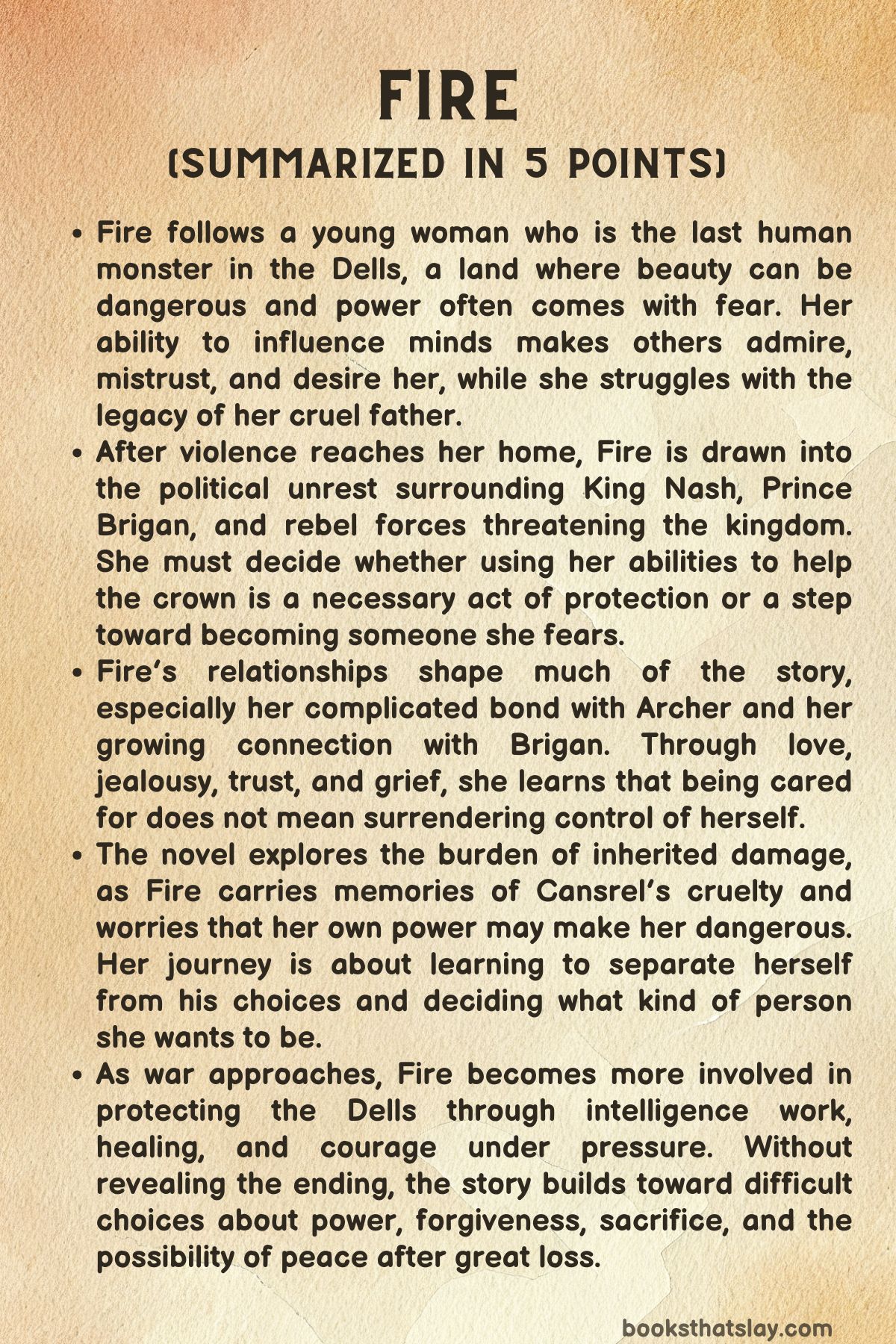
Fire by Kristin Cashore is a fantasy novel set in the Dells, a kingdom threatened by political unrest, war, and strange creatures known as monsters. At its center is Fire, the last human monster, whose beauty and mind-reading power make her both admired and feared.
The novel follows her struggle to decide how to use abilities inherited from a cruel father without becoming like him. It is a story about power, guilt, choice, love, and self-forgiveness, shaped by danger from within the court, enemies at the borders, and a hidden threat from another land. It’s the 2nd book of the Graceling Realm series.
Summary
Fire begins with Larch, a game warden in Monsea, raising his son Immiker after his wife dies in childbirth. Immiker is not an ordinary child.
He is unnaturally clever, persuasive, and difficult to resist. When his eyes become two different colors, Larch realizes his son is a Graceling and fears the king will take him away.
Immiker’s influence over Larch grows stronger, and Larch leaves his home with him. Their journey through the mountains is brutal.
Hunger, wild animals, and exhaustion wear them down until they fall through a crack in the mountain and reach the Dells, a land filled with bright, dangerous monster creatures.
As Immiker grows, Larch becomes more confused and more trapped by his son’s words. He slowly understands that Immiker’s Grace lets him control people through speech.
When Larch begins to suspect the truth, Immiker stabs him, burns their house, and disappears under a new name: Leck.
A year later, Fire, the last human monster in the Dells, is shot by a poacher who mistakes her for an animal. Fire’s monster beauty affects people and animals intensely, and her mind has the power to influence others.
She forces the poacher to bring her home to Archer, her closest friend and lover. Archer imprisons the poacher, but the man is murdered before Fire can learn much from him.
His death suggests that strangers are moving through Archer’s lands, possibly connected to rebel lords who threaten the kingdom.
Fire’s past explains why she fears her own abilities. Her father, Cansrel, was a beautiful and cruel human monster who used his power to control people, including the former king, Nax.
Cansrel raised Fire apart from the capital, taught her mind control, and left her with guilt and dread. Fire eventually helped arrange his death by allowing a monster leopard to kill him.
Though she believes the act protected others, she is haunted by it.
After more bodies are found, Archer travels with Fire to Queen Roen’s fortress to ask for help. On the way, they see the damage caused by war and encounter King Nash and his brother, Prince Brigan.
Fire notices Brigan’s open distrust. At the fortress, Roen warns Fire that Nash may be dangerously drawn to her, while Brigan will probably resent her because of Cansrel’s history.
Nash soon proves unstable around Fire and tries to force his attention on her, while Brigan threatens to kill her if she manipulates the king.
When Gray Haven comes under attack, Nash and Brigan leave the fortress with a small force, but monster raptors swarm outside. Fire rides out on her horse, Small, and uses herself as bait to draw the monsters away, saving the soldiers at great cost to herself.
Her courage changes how some people see her, though suspicion remains. Soon after, more strange men with foggy minds appear, and unseen archers kill them before Fire can question them.
Brigan arrives with soldiers and orders Fire to King’s City, where Nash wants her to examine a prisoner found in his rooms. Archer reacts with jealousy and anger, but Fire goes.
During the journey with Brigan’s First Branch, Fire sees the discipline of Brigan’s army and begins to understand his responsibility. Her presence causes fights and obsession among some soldiers, but Brigan protects her.
When a hateful soldier destroys her beloved fiddle, Brigan quietly ensures that she and her horse are cared for, and another soldier lends her an instrument. Fire and Brigan begin to speak during sleepless nights, and their guarded conversations soften the fear and distrust between them.
King’s City overwhelms Fire with its beauty, crowds, and attention. People chant her name, but palace life is dangerous.
Nash again tries to kiss her, and Brigan intervenes. Fire examines the palace prisoner but refuses Nash’s demand that she take over the man’s mind and force answers from him.
Nash strikes her in anger, then later apologizes and even asks her to marry him. Fire refuses to be controlled by his need.
In the palace, Fire meets Princess Clara and Prince Garan, who help manage spies and court intelligence. She also meets Hanna, Brigan’s hidden daughter, whose existence was concealed because Cansrel once targeted anyone Brigan loved.
Fire spends time teaching children how to guard their minds against monster animals, but the royal family continues pressing her to use her power for the kingdom. At first, Fire resists because she fears becoming like Cansrel.
Brigan eventually tells her the choice must be hers. Fire realizes that refusing to use her abilities may also cause harm, so she chooses to help.
Fire begins working with Garan and Clara, reading prisoners and informants to expose smuggling, plots, and alliances. The work is painful, but it proves useful.
She learns that someone has been altering minds, leaving a strange fog behind. Archer comes to court, and Fire is glad to see him, but his jealousy quickly damages their bond.
She ends their romantic relationship, knowing his possessiveness hurts her even though she still loves him as a friend.
Fire also notices a strange boy with one red eye and one gray eye. His mind feels confusing and foggy, and he seems connected to animal traders and to the mysterious archer who has been killing witnesses.
Eventually, Fire learns the archer’s name is Jod. Meanwhile, Archer discovers evidence that Captain Hart, a man believed loyal to the crown, is tied to the rebels.
Fire helps question Hart and uncovers a plan: Gentian and Gunner will attend the January gala, pretend peace, then assassinate Nash and Brigan. Murgda, Mydogg’s sister, will also attend.
As the gala nears, Fire learns that Clara is pregnant by Archer. Soon after, she discovers that Mila, one of her guards, is also pregnant by him.
Fire helps Mila while facing her own painful choice never to have children, fearing what her monster nature might pass on. She takes medicine to permanently prevent pregnancy.
Archer later cruelly reveals before the royal siblings that Fire helped cause Cansrel’s death. Fire is shaken, but Brigan’s letter tells her he already knew and still trusts her.
Tess, Brigan’s housekeeper, then reveals that she is Fire’s grandmother through Fire’s mother, Jessa.
At the gala, Fire monitors the palace from above. She discovers that Mydogg and Gentian have secretly allied against Nash and that Murgda wants to capture Fire as a weapon.
Fire tricks Gentian and Gunner into believing she may defect, leading them away while the king’s soldiers capture their followers. In the confrontation that follows, Fire learns that Mydogg has thousands of soldiers hidden on ships and plans to attack King’s City after a signal fire.
Gunner attacks her, but Brigan arrives and kills him. Gentian is also killed.
Brigan must leave immediately for Fort Flood, and Fire promises to care for Hanna if he dies.
Before Fire can recover, she is shot and kidnapped. She wakes on a boat with the strange red-eyed boy, Jod, and controlled men.
She learns the boy is Leck, a Graceling from another land whose power works through his voice. He can control minds but cannot read them.
At Cutter’s fortress, Fire realizes Archer has been killed. She poisons Leck, takes control of the people around her, finds Archer’s body, and burns Cutter’s house and stables in grief, releasing or killing the trapped animals so they do not suffer.
Fire escapes into the mountains, freezing and nearly dead. Leck follows and tries to persuade her to join him, revealing his ambition to control the Dells.
Fire refuses. When he prepares to shoot her, her mare attacks him and sends him into a deep crevice.
Fire is later rescued by underground people and returned to her allies.
At Fort Flood, Fire learns that Archer is dead, Murgda escaped, and the war continues. Her frostbitten hands are badly injured, and she may lose fingers.
Brigan visits before leaving for the northern front. Fire, overwhelmed by grief and fear, tries to push him away, but he tells her he loves her and asks her to keep living.
Fire begins helping in the healing rooms, easing pain and helping dying soldiers. She grieves Archer with Clara and learns that Jod may have been Archer’s biological father.
Brocker, Roen, and Mila arrive, and Fire also discovers that Brocker is Brigan’s true father. Though the truth angers her, she eventually writes to Brigan.
The war turns when Brigan’s plans help the King’s Army gain the advantage. Fire travels north with reinforcements and reunites with him.
Mydogg calls for a meeting, but it is a trap, and Nash is shot. Fire holds Nash’s mind steady and refuses to let him die while Brigan leads the battle.
The King’s Army wins, Mydogg and his ally die, and Murgda is captured.
After the war, Nash recovers and Fire continues her hospital work. She loses two fingers but slowly learns to play the fiddle again.
Mila gives birth to Archer’s daughter, Liv, and Clara gives birth to Archer’s son, Aran. In the end, Fire gathers with the people who loved Archer for his memorial.
She places his bows and part of her ruined fiddle on the pyre, finally begins to forgive herself for Cansrel’s death, and plays a mourning song as the ashes rise.
Characters
Fire
Fire is the central character of Fire, and she is written as a deeply conflicted young woman whose beauty and mental power make her both powerful and vulnerable. As the last human monster in the Dells, she lives with the burden of being desired, feared, hunted, and misunderstood.
Her monster nature gives her the ability to enter and influence minds, but the book makes it clear that her real struggle is not simply with power itself, but with how power should be used. Because her father, Cansrel, used his beauty and mental control cruelly, Fire grows up terrified of resembling him.
This fear shapes many of her decisions, especially her refusal to control prisoners or manipulate people unless she believes there is no other choice.
Fire’s character is also defined by guilt. She carries guilt over Cansrel’s death, over the harm caused by her beauty, over Archer’s pain, and later over Archer’s death.
Yet the story gradually shows that Fire’s guilt is not always fair to herself. She often accepts responsibility for things that were caused by other people’s cruelty, weakness, or obsession.
Her emotional journey is therefore one of learning the difference between accountability and self-punishment. She does not become morally careless; instead, she becomes more honest about the fact that refusing to act can also have consequences.
Fire’s compassion is one of her strongest traits. She helps wounded soldiers, comforts Hanna, protects Mila, teaches children how to guard their minds, and uses her abilities to ease suffering.
Even when she begins using her power for the royal family’s intelligence work, she remains troubled by the ethical cost of entering other people’s minds. This makes her a morally serious character rather than a simple heroic figure.
Her strength comes not from certainty, but from her willingness to keep questioning herself while still acting when the kingdom needs her.
Her relationships also reveal her growth. With Archer, Fire is affectionate but increasingly aware that love without respect becomes possession.
With Brigan, she experiences a slower, steadier bond built on trust, restraint, and mutual understanding. By the end of the story, Fire has not escaped grief or trauma, but she has gained a clearer sense of herself.
She learns to live without being ruled by Cansrel’s memory, to use her gifts without becoming him, and to accept love without surrendering her independence.
Prince Brigan
Brigan is one of the most disciplined and emotionally guarded characters in the book. As commander of the King’s Army, he is practical, controlled, and deeply devoted to protecting the Dells.
At first, his coldness toward Fire seems harsh, but it comes from political memory and personal fear. He knows how Cansrel controlled King Nax, and he worries that Fire could become the same kind of danger to Nash.
His suspicion is not baseless cruelty; it is the response of a soldier who has seen how beauty, power, and royal weakness can destroy a kingdom.
As the story develops, Brigan becomes more complex. His strength is not merely military skill, but emotional discipline.
He does not easily expose his feelings, and he often expresses care through action rather than speech. He protects Fire on the journey to King’s City, ensures her comfort after her fiddle is destroyed, trusts her judgment in dangerous political matters, and later supports her through grief without trying to control her.
His love for Fire is powerful precisely because it is patient. Unlike Archer, Brigan does not try to possess her or make her emotions serve his needs.
Brigan’s hidden fatherhood also adds tenderness to his character. His daughter Hanna reveals a private side of him that contrasts with his public role as commander.
He loves Hanna fiercely but has had to keep her hidden because of Cansrel’s threats. This secrecy shows the sacrifices demanded by his position and by the violent politics of the Dells.
His bond with Hanna also helps Fire see him as more than a stern soldier; he becomes a man shaped by loss, protection, duty, and quiet devotion.
By the end of the story, Brigan stands as a figure of steadiness. He is not perfect, and his early distrust wounds Fire, but he changes as he learns who she truly is.
His ability to revise his judgment is important. He begins by seeing Fire through the shadow of Cansrel, but eventually sees her as herself.
His love does not weaken his duty, and his duty does not erase his tenderness. This balance makes him one of the most mature emotional presences in the story.
Archer
Archer is Fire’s closest childhood companion, former lover, and one of the most emotionally complicated figures in the story. He is charming, brave, affectionate, and loyal in many ways, but he is also possessive, jealous, and careless with the feelings of others.
His relationship with Fire is rooted in years of intimacy and shared history, which makes their bond tender but also painful. Archer loves Fire deeply, yet he often treats that love as a claim.
He struggles to accept that Fire’s body, choices, and emotional life belong to her.
Archer’s jealousy becomes one of his defining weaknesses. He is threatened by Brigan, angered by Fire’s independence, and unable to fully separate friendship from romantic possession.
This makes him hurtful even when he is not intentionally cruel. His public revelation that Fire arranged Cansrel’s death is one of his most damaging actions, because it exposes a painful secret in a moment of anger.
That scene shows how Archer’s love, when mixed with jealousy, can become destructive.
At the same time, Archer is not presented as a simple villain. He is brave, skilled, and capable of tenderness.
He risks himself, investigates dangers, and remains emotionally important to Fire even after their romance ends. His flaws are tied to immaturity, entitlement, and emotional insecurity rather than pure malice.
His relationships with Clara and Mila also reveal his irresponsibility. He fathers children without fully facing the consequences, leaving others to manage the emotional and social weight of his choices.
Archer’s death is devastating because it cuts off the possibility of fuller growth. Fire grieves not only the person he was, but also the unresolved nature of their bond.
His memorial becomes a moment of release for her, allowing her to honor what was loving between them while also letting go of the guilt and pain attached to their past. Archer remains important because he represents Fire’s childhood, her first love, and the painful lesson that affection alone is not enough to make a relationship healthy.
King Nash
Nash is a weak but not hopeless king. His central struggle is self-control.
Like his father Nax, he is vulnerable to the influence of beauty and desire, and Fire’s presence exposes this weakness immediately. His attempts to kiss Fire, his emotional pressure on her, and his violent outburst when she refuses to control a prisoner show how dangerous a ruler can be when personal longing overrides judgment.
Nash is not evil, but his lack of discipline makes him unsafe.
His character is important because he represents the political danger Fire fears most: a powerful man who can be manipulated or who might use power selfishly. Nash’s attraction to Fire is not just romantic; it becomes a test of whether he can rule responsibly.
His apology after striking her shows that he is capable of remorse, but remorse alone does not erase the harm he causes. The story treats him with nuance by allowing him shame and improvement without pretending his actions are harmless.
Nash’s dependence on Brigan, Clara, Garan, Roen, and eventually Fire reveals both his weakness and his potential. He is not the strongest strategist, but he is surrounded by people who are more disciplined than he is.
Over time, he becomes more willing to accept help, correction, and restraint. His survival after being shot also gives Fire one of her most intense moments of mental strength, as she holds his mind and refuses to let him die.
By the end of the book, Nash is still a flawed man, but he is not the same reckless figure he was at the beginning. His recovery suggests the possibility of better kingship, especially if he continues to accept the guidance of those around him.
He functions as a reminder that leadership requires more than birthright. It requires humility, self-command, and the willingness to be corrected.
Cansrel
Cansrel is Fire’s father and the dark moral shadow over the entire story. As a human monster, he possessed beauty and mental power similar to Fire’s, but he used those gifts almost entirely for selfish pleasure, manipulation, and cruelty.
His relationship with King Nax helped damage the kingdom, and his private life was marked by emotional abuse, domination, and moral emptiness. He is important not only because of what he did, but because of what Fire fears he proves about her own nature.
Cansrel’s most disturbing trait is his lack of conscience. He teaches Fire how to use her power, but his lessons are poisoned by his own worldview.
To him, minds are tools, people are playthings, and beauty is a weapon. His influence leaves Fire with deep trauma.
Even after his death, he continues to shape her choices because she measures herself against him constantly. Her refusal to misuse her power is partly a rejection of him.
His death is one of the most morally complex events in Fire’s life. Fire’s role in arranging it burdens her with guilt for years, even though Cansrel was dangerous and destructive.
This guilt shows how different she is from him. Cansrel could harm others without remorse; Fire is nearly crushed by the knowledge that she helped cause one death, even the death of a man who had caused enormous suffering.
Cansrel’s function in the book is therefore both personal and political. Personally, he is Fire’s abuser, teacher, and nightmare.
Politically, he is a symbol of what happens when beauty and influence are joined to selfishness and royal weakness. Fire’s journey is meaningful because she does not simply inherit his power; she transforms the meaning of that power by using it with conscience.
Leck / Immiker
Leck, born Immiker, is one of the most chilling characters in the story because his evil appears early and develops with frightening calm. As a child, he is unnaturally persuasive, emotionally detached, and increasingly dominant over his father, Larch.
His Grace allows him to control minds through speech, and what makes him especially dangerous is that his victims often do not understand what is happening to them. He does not need beauty like Fire’s; his weapon is language itself.
Leck’s relationship with Larch reveals his cruelty at its earliest stage. Larch loves and protects him, but Leck gradually bends that love into obedience.
When Larch begins to suspect the truth, Leck murders him and erases his old life. This act establishes Leck as a character almost entirely without attachment.
He uses people until they become inconvenient, then discards them.
In the Dells, Leck becomes a different kind of threat from Cansrel. Cansrel can read and manipulate minds, while Leck controls through voice and spreads influence through others.
His fogging of minds makes him difficult to detect and even harder to resist. His interest in Fire is also deeply disturbing.
He sees her not as a person, but as a rare and useful being who could help him dominate the Dells. His desire to keep her is part fascination, part ownership, and part strategy.
Leck’s defeat by the gray mare is symbolically fitting because it interrupts his fantasy of control. He believes he can talk, threaten, and command his way into power, but he is finally stopped by something outside his control.
His presence expands the world of the story beyond the Dells and shows that monstrous power takes different forms. He is terrifying because he proves that the mind can be invaded not only through beauty or direct force, but through words.
Larch
Larch is a tragic figure whose story opens the larger danger surrounding Leck. As a game warden in Monsea, he begins as an ordinary grieving father trying to raise his son after Mikra dies in childbirth.
His love for Immiker is sincere, and this love makes him vulnerable. When he realizes that his son is a Graceling and may be taken by the king, he flees with him.
This decision comes from parental devotion, but it also leads him into isolation, fear, and eventual destruction.
Larch’s tragedy lies in the slow erosion of his own mind. He does not immediately understand that Immiker is controlling him.
Instead, he becomes increasingly confused, dependent, and trapped by his son’s words. His parental love is twisted into obedience, and his attempts to protect Immiker only give Leck more opportunity to dominate him.
The horror of Larch’s story comes from the fact that he is betrayed by the child he sacrifices everything to save.
He also serves as an early moral contrast to Leck. Larch is flawed and frightened, but he is capable of love, loyalty, and concern.
Leck, even as a child, treats those qualities as weaknesses to exploit. Larch’s death is not just a murder; it is the destruction of the last person who knew Immiker before he became Leck.
Once Larch is gone, Leck is free to rename himself and reinvent his identity without accountability.
Mikra
Mikra appears only briefly through her death, but her absence shapes Larch and Immiker’s early lives. She dies in childbirth, leaving Larch to raise their son alone.
Because of this, Larch’s love for Immiker is mixed with grief, responsibility, and perhaps a desperate need to preserve what remains of his family. Mikra’s death creates the emotional condition that makes Larch so devoted to the child who will later destroy him.
Although Mikra is not developed through direct action, her role matters because she represents the ordinary human life that Leck never truly belongs to. She is connected to family, birth, and vulnerability, while Leck grows into secrecy, manipulation, and violence.
Her absence also adds loneliness to Larch’s story. Without her, he has no partner to help him question what is happening to their son.
Brocker
Brocker is one of the book’s strongest figures of wisdom and moral steadiness. As Archer’s father and later revealed as Brigan’s true father, he is connected to several central characters through bonds of care, secrecy, and responsibility.
He is physically limited, but his influence is emotional and ethical rather than military. Fire’s memories of him show that he offered kindness and stability when Cansrel’s world was dangerous and corrupt.
Brocker’s importance to Fire lies in the fact that he helps her understand that not all authority is abusive. Unlike Cansrel, he does not use knowledge or power to dominate.
He listens, advises, and protects where he can. His estate becomes a place tied to memory, grief, and eventual healing.
At Archer’s memorial, Brocker’s presence reinforces the importance of chosen family and shared mourning.
His hidden connection to Brigan complicates him. The revelation that he is Brigan’s father angers Fire because it shows that even wise and loving people can carry secrets that affect others deeply.
Yet this secret does not erase Brocker’s goodness. Instead, it makes him more human.
He is a character shaped by past choices, private grief, and enduring care.
Queen Roen
Queen Roen is a politically sharp and emotionally intelligent figure. She understands the instability of the kingdom and sees clearly how dangerous both Nash’s weakness and Brigan’s suspicion can be.
Her early conversations with Fire show that she is practical, observant, and willing to speak plainly. She does not romanticize Fire’s presence; she recognizes both the danger Fire represents to others and the danger others represent to Fire.
Roen’s strength lies in her ability to balance compassion with political realism. She thanks Fire after Fire risks herself to save soldiers from raptor monsters, but she also makes it clear that the kingdom needs Fire’s abilities.
Roen does not treat Fire as merely decorative or monstrous. She sees her as a person whose power could be crucial in a collapsing political situation.
Her later gift of the green house to Fire is meaningful because it gives Fire a place of belonging. Roen’s role is maternal without being sentimental.
She guides, warns, supports, and makes difficult judgments. In a story full of unstable rulers and dangerous desire, Roen represents experienced leadership and clear sight.
Princess Clara
Clara is intelligent, capable, and politically useful in ways that are not always immediately visible. As Nash and Brigan’s sister, she operates within the palace but is far more than a royal ornament.
She helps manage spies with Garan, guides Fire through King’s City, and repeatedly pushes Fire to consider using her abilities for the kingdom. Clara understands court politics and intelligence work, and she is willing to make uncomfortable arguments when the stakes are high.
Her relationship with Fire is significant because it combines friendship, pressure, and mutual respect. Clara does not always make Fire comfortable, especially when she urges her toward mind-reading work, but she does take Fire seriously.
She sees Fire as someone capable of choice and responsibility. Their bond becomes especially important after Archer’s death, because Clara also carries grief connected to Archer.
Clara’s pregnancy by Archer adds emotional complexity to her character. She is not simply a strategist or princess; she is also a woman facing personal consequences in the middle of political crisis.
Her child, Aran, becomes part of Archer’s legacy. Clara’s strength is shown in her ability to continue functioning despite private pain, public danger, and emotional uncertainty.
Garan
Garan is cautious, suspicious, and intellectually sharp. As Nash and Brigan’s brother, he plays an important role in the kingdom’s intelligence network.
He is not as visibly commanding as Brigan or as emotionally exposed as Nash, but his guarded nature makes sense in a palace full of spies, divided loyalties, and political threats. He is careful because carelessness could cost lives.
His suspicion of Fire reflects the larger fear surrounding her power. Like Brigan, Garan understands the historical damage caused by Cansrel and Nax, and he is not quick to trust another human monster.
Yet his willingness to work with Fire shows that he can adapt when evidence changes. He values usefulness, truth, and strategy over personal comfort.
Garan also helps reveal Hanna’s background, which makes him important to Fire’s understanding of Brigan. Through him, Fire learns about Rose, Hanna’s mother, and the danger Cansrel posed to anyone Brigan loved.
This information shifts Fire’s view of Brigan and deepens the emotional structure of the royal family. Garan’s role is therefore both practical and explanatory: he helps protect the kingdom while revealing hidden histories.
Hanna
Hanna is Brigan’s secret daughter, and her presence brings innocence, vulnerability, and tenderness into a violent political world. She has grown up partly hidden because Cansrel once threatened anything Brigan loved.
This background gives her childhood a shadow of fear and secrecy, even though she herself is lively and emotionally direct. Her existence shows the personal cost of political violence.
Hanna’s relationship with Fire is one of the gentlest parts of the story. Fire finds her injured after fights with other children and comforts her with real tenderness.
In caring for Hanna, Fire reveals her own longing for motherhood and family, even as she chooses never to have children because of the danger of passing on her monster nature. Hanna therefore becomes emotionally significant not only to Brigan, but also to Fire’s understanding of love, loss, and sacrifice.
Hanna also humanizes Brigan. Through her, readers see him not only as a commander, but as a father who loves deeply and fears deeply.
Fire’s promise to care for Hanna if Brigan dies during the war shows how fully Hanna has become part of Fire’s emotional world. She represents the future that the adults are fighting to protect.
Tess
Tess is Brigan’s housekeeper and later revealed to be Fire’s grandmother through Jessa. Her character brings warmth, family history, and healing into Fire’s life.
Before the revelation, Tess already offers practical care and emotional steadiness. After Fire confesses the truth about Cansrel’s death, Tess becomes one of the people who receives that truth without abandoning her.
The discovery that Tess is Fire’s grandmother is deeply important because it gives Fire a blood connection not defined by Cansrel. For much of her life, Fire’s parentage is dominated by the horror of her father.
Tess gives her another lineage, one connected to ordinary care, grief, and family. This helps Fire see that she is not only Cansrel’s daughter.
She is also Jessa’s daughter and Tess’s granddaughter.
Tess’s role is quiet but emotionally powerful. She does not change the course of battles, but she helps change Fire’s understanding of herself.
In a story where inheritance is often frightening, Tess represents the possibility of inheritance as comfort rather than curse.
Jessa
Jessa, Fire’s mother, is mostly present through memory and other people’s accounts, but she remains important because Fire’s identity is incomplete without her. Brigan’s memory of Jessa and Tess’s later revelation help restore her place in Fire’s life.
Jessa represents the part of Fire’s origin that is not Cansrel’s cruelty.
Because Fire has been so shaped by fear of becoming her father, learning more about her mother matters emotionally. Jessa becomes a reminder that Fire’s humanity is not accidental.
She came from someone loved, remembered, and mourned. Even though Jessa is absent from the present action, her memory helps loosen Cansrel’s hold over Fire’s sense of self.
Liddy
Liddy is a maid who gives Fire comfort during one of the darkest periods of her life, when Fire is secretly planning Cansrel’s death while training his mind. Liddy’s importance comes from the tenderness and refuge she offers.
In Cansrel’s household, where power is abusive and affection is unsafe, Liddy represents a brief but meaningful form of kindness.
Cansrel’s decision to send Liddy away shows his cruelty and his desire to control Fire’s emotional attachments. He recognizes comfort as something that might strengthen Fire against him, so he removes it.
Liddy’s role is therefore small in terms of plot but significant in terms of Fire’s emotional history. She is one of the people who helped Fire survive before Fire had the freedom to define her own life.
Mydogg
Mydogg is one of the major rebel threats to Nash’s rule. He is ambitious, strategic, and willing to use deception on a large scale.
His secret alliance with Gentian shows that he is not merely a brute force enemy but a calculated political actor. He understands that the kingdom’s instability creates opportunity, and he is willing to exploit that weakness through hidden troops, false information, and coordinated violence.
His interest in Fire is especially dangerous because he sees her as a weapon. Through Murgda and the rebel plans, it becomes clear that Fire’s power is valuable not just to the royal family but to anyone seeking control.
Mydogg’s threat therefore reinforces one of the central political questions of the book: what happens when a person with extraordinary power becomes an object of military desire?
Mydogg’s downfall during the war marks the collapse of one major rebellion, but his character remains important because he reveals how fragile the Dells has become. His plans nearly succeed because the kingdom is divided, intelligence is unreliable, and trust is scarce.
He is dangerous because he knows how to turn disorder into strategy.
Gentian
Gentian is another rebel lord whose role depends heavily on deception. He pretends at reconciliation while secretly planning assassination and military attack.
His willingness to attend the gala under false intentions shows his political boldness and his confidence in layered plots. He is not simply rebelling from a distance; he is willing to enter the heart of royal power and strike from within.
Gentian’s alliance with Mydogg reveals the depth of the threat against Nash. By feeding false information even to their own people, Gentian and Mydogg make Fire’s intelligence work more difficult and demonstrate a sophisticated understanding of espionage.
Gentian’s danger lies in his ability to make truth uncertain.
When Fire lures Gentian and Gunner away at the gala, his role becomes crucial to the turning point of the conflict. Through him, Fire uncovers the hidden soldiers on Pikkian ships and the plan to attack King’s City.
Gentian’s defeat prevents a much larger disaster. His character represents political treachery, false peace, and the danger of underestimating enemies who can lie convincingly.
Murgda
Murgda, Mydogg’s sister, is a dangerous and calculating figure whose interest in Fire is deeply exploitative. She recognizes Fire’s value as a weapon and wants to capture her for rebel use.
This makes her one of the clearest examples of how others reduce Fire to power, beauty, and usefulness rather than seeing her as a person.
Murgda’s presence at the gala adds menace because her purpose is not fully obvious at first. She moves within the social and political performance of the event while carrying violent intentions beneath the surface.
Her escape after the palace conflict allows the danger to continue beyond the immediate defeat of Gentian and Gunner.
Her eventual capture after the war helps close one of the rebellion’s remaining threats. Murgda’s character is important because she shows that women in the story are not automatically nurturing or morally safer than men.
Like the male rebels, she is ambitious, ruthless, and willing to treat Fire’s mind and body as resources to be seized.
Gunner
Gunner is Gentian’s son and part of the assassination plot at the gala. He is less politically developed than Gentian, but he is dangerous because of his direct violence.
His attack on Fire during the questioning scene shows how quickly political strategy can become physical threat. He represents the younger generation of rebellion, inheriting and participating in his father’s treachery.
Gunner’s death at Brigan’s hands is one of the most immediate turning points during the gala conflict. His violence forces Brigan to act, and the scene reveals both Fire’s vulnerability and Brigan’s fierce protectiveness.
Gunner’s role is brief but intense, serving as the physical edge of Gentian’s conspiracy.
Jod
Jod is one of the most sinister secondary characters because he operates from hiddenness. As the mysterious archer with a fogged mind, he kills witnesses before Fire can question them and repeatedly prevents the truth from emerging.
His blankness makes him frightening because Fire, who can usually sense minds, cannot easily understand or anticipate him.
His connection to Leck’s influence explains much of his strangeness. Jod is not merely secretive; his mind has been altered.
Yet he still causes immense harm, including the murder of Archer. This makes him a painful figure for Fire, because he is both a weapon used by another power and the direct cause of personal devastation.
The suggestion that Jod may have been Archer’s biological father adds another layer of tragedy. If true, it links Archer’s death to a hidden family history he never fully knew.
Jod’s character therefore combines mystery, violence, manipulation, and grief. He shows how Leck’s control spreads damage through people who become instruments of his will.
Cutter
Cutter is an animal trader and one of the most openly exploitative figures in the story. He deals in living beings as commodities, and his attitude toward Fire is horrifying because he speaks of selling or breeding her.
Unlike characters who fear Fire or desire her romantically, Cutter sees her in brutally commercial terms. To him, her rarity makes her valuable property.
His fortress is a place of captivity, cruelty, and dehumanization. Fire’s response to him after Archer’s death is one of the most intense moments of rage in the book.
She forces the truth from him, destroys his house, releases the animals she can, and burns what must be burned. This destruction is not merely revenge; it is also a rejection of the system of cages and ownership that Cutter represents.
Cutter’s character matters because he shows another form of monstrosity. He does not need supernatural beauty or Grace to be cruel.
His evil is practical, greedy, and ordinary. He treats suffering as business, which makes him deeply repellent.
Captain Hart
Captain Hart is a traitor hidden within the structures of loyalty. His possession of Mydogg’s rare frozen-grape wine exposes his secret connection to the rebels, and his capture allows Fire and the royal intelligence network to uncover key information.
Hart’s importance lies in the way he shows that danger is not only outside the kingdom’s walls; it can exist within trusted ranks.
Fire’s method of breaking through Hart’s defenses is morally complicated. She makes his prison comfortable and uses his attraction to her to gain information.
This scene reflects Fire’s broader ethical conflict: she is using her power and beauty for a necessary purpose, but the act still troubles her. Hart therefore becomes a test case in the uneasy relationship between intelligence work and manipulation.
Through Hart, the royal family learns about the planned assassination and the attack on Fort Flood. His betrayal is dangerous, but his interrogation becomes useful.
He represents corruption within military loyalty and the difficulty of knowing whom to trust during civil conflict.
Musa
Musa is the leader of Brigan’s guard assigned to protect Fire, and she stands out as disciplined, competent, and loyal. Her presence helps create a protective structure around Fire during the journey to King’s City and afterward.
Unlike many people affected by Fire’s beauty, Musa is steady and professional, which makes her especially valuable.
Musa’s role also shows Brigan’s thoughtfulness as a commander. He chooses guards who can withstand the complications Fire brings, and Musa’s leadership helps make that possible.
She is not merely a background protector; she is part of the circle of people who allow Fire to function safely in a world where her presence can provoke obsession, violence, and fear.
After Fire’s kidnapping and escape, Musa’s arrival is emotionally important. She helps bring Fire back to safety, reinforcing the idea that Fire is no longer isolated.
Musa represents loyal service, practical courage, and the quiet strength of those who protect without demanding attention.
Mila
Mila is one of Fire’s guards, and her pregnancy by Archer places her in a vulnerable emotional position. She is frightened, uncertain, and caught in the consequences of Archer’s carelessness.
Fire’s response to Mila shows Fire’s compassion and maturity. Even though Fire has complicated feelings about Archer and her own choice not to have children, she helps Mila rather than resenting her.
Mila’s character brings attention to the ordinary human consequences of romantic irresponsibility. Archer’s charm and desire leave lasting effects on women who must carry more of the burden than he does.
Mila’s fear is not treated lightly. Her situation deepens Fire’s grief over her own infertility decision and her complicated attachment to Archer.
Later, Mila’s daughter Liv becomes part of Archer’s continuing legacy. Mila’s possible future with Nash also suggests renewal after fear and uncertainty.
She is a quieter character, but her arc contributes to the book’s exploration of motherhood, responsibility, and the aftermath of love.
Small
Small, Fire’s horse, is more than an animal companion. He is a steady source of loyalty, comfort, and survival.
Fire’s bond with Small shows her gentleness with animals and her need for trust that is not complicated by politics, desire, or fear. When Fire rides out to draw the raptor monsters away, Small shares the danger and is badly wounded alongside her.
Small’s return to Fire after Archer’s death is emotionally healing. Seeing him helps her begin to release some of her guilt, as if his survival gives her one living connection to courage, loyalty, and home.
In a story filled with mental invasion and human betrayal, Small represents simple faithfulness.
Blotchy
Blotchy is one of the animals connected to Fire’s world and becomes especially important during the chaos around Hanna’s danger. Fire hears Blotchy injured below before finding Hanna threatened near the green house.
Although Blotchy is not developed like the human characters, the moment matters because it heightens the danger and shows how violence spreads through both people and animals.
Blotchy’s presence also reflects Fire’s sensitivity to living creatures. Animals in the story are not decorative; they are part of the emotional and physical landscape of the Dells.
Fire’s awareness of them reinforces her connection to the natural world, including its beauty, danger, and suffering.
Edler
Edler is one of Brigan’s guards whose mind is affected by the strange fog connected to Leck’s influence. Fire’s ability to clear his mind becomes an important discovery because it proves that someone else has been altering people mentally.
Edler’s condition helps shift the story from political rebellion alone toward a deeper supernatural threat.
His role is important because he becomes evidence. Through him, Fire realizes that the mental disturbances are not random and not the same as ordinary fear or confusion.
Edler’s altered mind helps reveal the presence of another kind of power in the Dells, one that Fire does not immediately understand.
Quislam
Quislam is Gentian’s ally, and his rooms become important during the confusion of the gala. When Fire accidentally leads Gentian and Gunner toward Quislam’s area, the mistake shows how difficult and dangerous the palace operation is.
Even with Fire’s abilities, the plan is fragile, and one wrong turn can expose her to deadly risk.
Quislam’s role is mostly political. He represents the hidden network of rebel support within spaces that should be loyal or controlled.
His presence reinforces the idea that the conflict is not a simple battlefield struggle. It is also a war of rooms, secrets, alliances, and concealed loyalties.
Rose
Rose is Hanna’s mother and the stable girl Brigan loved. Though she is absent from the present action because she died in childbirth, she is emotionally important to both Brigan and Hanna’s history.
Her relationship with Brigan reveals that his private life has been marked by love and loss long before Fire truly knows him.
Rose’s death also parallels other maternal losses in the story, including Mikra’s death after giving birth to Immiker. These deaths shape the lives of children and fathers left behind.
In Rose’s case, her absence leads to Hanna being raised under secrecy and protection. Rose represents a lost tenderness in Brigan’s life and helps explain the depth of his protectiveness.
Liv
Liv is Mila and Archer’s daughter, and her birth after Archer’s death gives his legacy a living future. She represents continuity after grief.
For Fire, Liv is emotionally complicated because she is connected to Archer, to Mila’s fear, and to Fire’s own decision never to bear children. Yet Liv’s existence is not treated as a source of bitterness.
Instead, she becomes part of the wider circle of family and recovery after war.
Liv’s importance is symbolic rather than active. She shows that life continues after destruction, and that Archer’s story does not end only with his mistakes or his death.
Through Liv, the book allows grief to coexist with renewal.
Aran
Aran is Clara and Archer’s son, another child born from Archer’s complicated relationships. Like Liv, he represents the future that remains after war and personal loss.
His birth connects Clara’s private life to Archer’s memory and expands the family circle that gathers after the conflict.
Aran’s role is small, but he matters because the ending of Fire is not only about victory in war. It is also about what survives afterward: children, memory, mourning, and the possibility of gentler lives.
Aran, like Liv and Hanna, belongs to that future.
Themes
Power, Control, and Moral Responsibility
Fire’s ability to enter minds places her in a constant moral struggle because her power can protect people, but it can also violate them. Her fear does not come simply from having power; it comes from knowing how easily power can become cruelty when used without restraint.
Cansrel’s life shows the worst version of influence: he uses beauty, fear, and mental force to bend others to his will, leaving Fire terrified that she may repeat his harm. This fear explains why she first refuses to help Nash’s court, even when the kingdom is close to collapse.
Yet the story does not present complete refusal as innocence. Fire slowly learns that choosing not to act can also have consequences, especially when her abilities could save lives.
Her growth lies in creating limits for herself. She decides when to enter minds, why she is doing it, and how far she will go.
In Fire, moral responsibility is not about having no power, but about using power with self-awareness, compassion, and restraint.
Identity, Beauty, and Being Seen as Human
Fire’s monster beauty shapes nearly every interaction she has, often preventing others from seeing her as a full person. People stare at her, desire her, fear her, or want to use her, and these reactions trap her inside an identity she did not choose.
Her appearance gives her influence, but it also makes her vulnerable to attack, obsession, and political exploitation. The word “monster” becomes painful because it describes not only her physical nature but also the way others reduce her to something strange and dangerous.
Fire’s deepest conflict is that she fears there may be truth in the label because of her father’s legacy and her own abilities. Yet her choices repeatedly prove that humanity is defined by action, not appearance.
She protects soldiers, comforts children, supports the wounded, and refuses to treat people as tools. Brigan’s growing trust matters because he learns to see beyond both her beauty and her ancestry.
Her identity becomes something she builds through courage, care, and self-command, rather than something decided by blood, beauty, or public fear.
Grief, Guilt, and the Work of Healing
Loss in Fire is not treated as a single moment of sadness but as a long process that changes how a person understands herself. Fire carries guilt for Cansrel’s death, for the harm caused by her beauty, for the danger she brings to others, and later for Archer’s death, even when she is not truly responsible for all of it.
Her grief is complicated because love and pain are often mixed together. Archer has been her closest companion, yet his jealousy and possessiveness wound her deeply.
Cansrel was her father, yet he was also a source of fear and moral damage. Because of this, healing requires more than mourning; it requires Fire to judge the past honestly without letting it define her entirely.
Her work in the healing rooms becomes important because it shifts her attention from self-punishment to service. She cannot undo death, but she can ease suffering and help others live.
By the end, her mourning becomes an act of release, allowing memory, forgiveness, and survival to exist together.
Love, Trust, and Emotional Freedom
The relationships in the story show that love becomes destructive when it turns into possession, fear, or control. Archer loves Fire, but his love often demands access to her choices, her body, and her emotional life.
His jealousy reveals how affection can become harmful when it refuses to respect another person’s freedom. Nash’s desire for Fire also shows the danger of confusing attraction with entitlement, especially when power and kingship are involved.
In contrast, Brigan’s relationship with Fire develops through caution, honesty, and earned trust. He begins by fearing what she might do, but he changes as he watches her choices and listens to her pain.
Their bond grows because he does not ask her to become harmless, powerless, or less herself. He trusts her judgment even when her abilities frighten him, and she learns to trust that he sees her as a person rather than a weapon.
This contrast makes emotional freedom central to the theme of love: true love does not claim ownership, but gives space for dignity, choice, and truth.