Florescentia Summary, Characters and Themes
Florescentia by I.V. Ophelia is a dark speculative fantasy centered on Lucia Collesano-Fairfax, an inventor whose scientific curiosity leads her beyond the limits of the physical world.
Living in the star-obsessed city of Astraea, Lucia secretly interacts with supernatural creatures called Peculiars and has learned to exchange emotional energy for extraordinary luck. What begins as calculated experimentation becomes a confrontation with grief, mortality, family secrets, personal freedom, and an ancient bargain made before her birth. The novel combines supernatural fantasy with scientific investigation while asking whether knowledge remains valuable when gaining it threatens a person’s identity, relationships, and right to choose. It’s the 1st book of the Luminary series.
Summary
Lucia Collesano-Fairfax lives in Astraea with her husband, Dorian, while secretly pursuing experiments that most of society would consider impossible. She can perceive creatures called Peculiars, including two familiar shadows she names Absinthe and Tonic, and she has discovered that by opening a passage to the mysterious Otherside and offering intense emotional energy, she can receive supernatural luck in return.
Lucia has spent years convincing herself that the practice is controlled and scientific rather than mystical. Her confidence comes partly from past successes, including obtaining professional recognition despite discrimination against female inventors and helping Dorian return safely after his military unit disappeared.
Her newest scientific project is pneuma-type photography, a process capable of recording the energy surrounding living bodies. Lucia hopes the invention will provide measurable evidence for phenomena traditionally interpreted as spiritual, although her brother Maxim warns that Astraea’s religious establishment may react badly to the idea.
At the same time, several pressures begin converging. Dorian leaves to interview for an astronomical engineering position, Lucia’s father Salvatore suffers increasingly serious memory loss, and her own photographs begin showing unexplained changes in her aura.
Wanting greater control over events, Lucia performs another supernatural ritual even though she knows that opening passages too frequently is dangerous. Absinthe and Tonic resist her commands, an ominous Everie reading warns of failed ambition and conflict between physical and metaphysical forces, and the ritual collapses violently.
The word Obscuria appears carved into the floor, indicating that something has deliberately closed the passage from the other side. For the first time, Lucia faces evidence that the realm she has treated as a resource possesses intentions independent of her own.
Her situation worsens quickly. A patent official dismisses her work, she secretly removes a mysterious grimoire from the Treasury, and a visit to her parents forces her to confront how little control she possesses over aging and illness.
Salvatore gives Lucia an old leather journal during a rare moment of clarity. Soon afterward, an unseen influence alters Lucia’s perception while she crosses a busy road, nearly causing her death, and the grimoire begins displaying clearly supernatural behavior.
Then Lucia receives devastating news: Dorian has died in a traffic collision. At the morgue, she struggles even to acknowledge that the damaged body before her belongs to the husband who had been her closest friend, intellectual partner, and emotional foundation.
Grief transforms Lucia’s curiosity into obsession. She begins searching for a method of reversing death and forces another portal open despite the resistance of Absinthe and Tonic.
This attempt allows a vast supernatural entity to enter her world. Unlike the smaller Peculiars, the creature is ancient, intelligent, immensely powerful, and capable of building a human appearance for itself.
The entity has waited for someone like Lucia because repeated openings have weakened the boundary between worlds. It also knows something Lucia does not: the star-shaped markings across her body are evidence of a supernatural contract connected to her birth.
The creature gradually adopts a masculine human body whose appearance initially contains disturbing echoes of Dorian. Lucia mistrusts him, but her desire for knowledge is stronger than her instinct to retreat.
She eventually proposes an exchange. The being will teach her about the Otherside while she teaches him how to experience human society, physical life, and ordinary relationships.
Through an Everie reading, the entity selects the name Altair. As Lucia introduces him to food, public spaces, language, customs, and bodily sensation, he becomes increasingly individual in her mind rather than simply another supernatural predator.
Their relationship deepens when Altair explains that physical desire is less valuable to beings like him than genuine vulnerability. Lucia tells him about Dorian, their friendship, their marriage, and the miracle that once returned him from military service, revealing why she became convinced that supernatural exchanges could defeat impossible circumstances.
Meanwhile, Salvatore’s journal provides evidence that Lucia’s family has a much older connection to the Otherside. It contains ritual commands, trapping symbols, information about water as a supernatural doorway, and warnings about a powerful solitary deceiver.
Altair reacts fearfully when he realizes Lucia possesses the journal. His response confirms that Salvatore knew about him long before Lucia opened her own portals.
Further investigation strengthens the connection. Salvatore recognizes supernatural shadows, has a trapping sigil beneath his chair, and reacts to Altair with unmistakable terror.
When Altair is eventually left alone with him, the truth becomes harder to conceal. Salvatore speaks of an old bargain and asks whether Altair has come to collect what he is owed.
Lucia continues experimenting rather than abandoning the supernatural. She enters the Otherside partially and discovers a realm governed less by stable physical laws than by perception, emotion, thought, and expectation.
Her curiosity places her in immediate danger when she interacts recklessly with an unfamiliar organism. Altair rescues her, demonstrating both the hazards of the realm and Lucia’s growing dependence on him.
At the same time, Lucia continues mourning Dorian. Maxim secretly helps her remove Dorian’s coffin so his body can be given to the sea according to his actual wishes rather than the religious expectations imposed upon him.
Lucia briefly considers following Dorian into the water but decides she is not ready to die. Her decision to continue living, however, remains tied to the hope that she may someday reach him through the Otherside.
Lucia’s relationship with Altair becomes increasingly intimate. Their exchanges of supernatural energy blur the boundary between experimentation, attraction, grief, and desire, while Altair begins developing emotions he once regarded as distinctly human.
His private thoughts reveal that Lucia is not entirely of Earth. Previous attempts had been made to create someone capable of forming a stable bridge between realms, but Lucia is the first strong enough to survive the process.
Her markings function as both map and seal, and one mark directly corresponds to Altair. What Lucia interprets as an accidental relationship is therefore the result of a design that began before she was born.
Lucia eventually brings Altair to her parents’ home. Salvatore recognizes him and confirms that Lucia herself is connected to the price of an old agreement.
Feeling betrayed, Lucia becomes increasingly suspicious of Altair, yet their emotional attachment continues growing. His behavior complicates her view of him because he manipulates her and conceals vital information while simultaneously protecting and comforting her.
This contradiction becomes especially clear when Lucia, overwhelmed by grief during a visit to Wildwood, walks into the sea and stops resisting death. Altair rescues her even though allowing her to die might have simplified his plans.
Afterward, he reveals that his original ambition was to become mortal. Existing for an immeasurable length of time has deprived experience of urgency, novelty, and meaning, and he wants to become human enough eventually to die.
Lucia and Altair grow physically and emotionally closer, but Lucia never abandons her desire to contact Dorian. Research at the Treasury finally reveals a ritual that can communicate with dead individuals who remain temporarily within the transitional Otherside.
Using the sentient grimoire, personal objects, supernatural energy, and collected names, Lucia successfully contacts a dead woman named Allison Thomas and helps her move onward. Encouraged, Lucia attempts the same process with Dorian.
Dorian does not respond. Instead, Lucia’s ritual attracts an enormous predatory Peculiar that forces its way through the opening.
When Altair refuses to rescue her, hoping she will finally understand the danger of treating supernatural beings as tools, Lucia does something neither of them expects. Realizing that the predator itself came from the Otherside, she deliberately allows it to swallow her and uses the creature as a passage.
Lucia awakens inside the Otherside. Her camera becomes essential because its lens reveals the supernatural nature of apparently harmless organisms, but she soon realizes that reaching the realm was much easier than understanding or escaping it.
Altair privately hopes Lucia will decide to remain there with him. His attachment to her is genuine, yet he continues manipulating the conditions around her because he believes he understands what her future should be.
Eventually he reveals the most painful truth: Dorian has already passed completely beyond the transitional realm. His individual consciousness no longer exists in a form Lucia can retrieve.
Lucia is furious because Altair knew this while allowing her to continue believing that reaching Dorian was possible. His technical avoidance of direct lies no longer matters to her because he deliberately used her hope to guide her toward the outcome he wanted.
The grimoire then reveals Salvatore’s past. Lucia witnesses her younger father during wartime bargaining with Altair and promising that his firstborn child would carry the debt created by the agreement.
At first Lucia believes Salvatore sacrificed her selfishly. A later memory changes her understanding by showing Nina terribly injured during the fighting and Salvatore desperately trying to save the woman he already loved.
His request had not been for Nina’s affection but for their survival together. The bargain remains morally terrible because Lucia became its price, yet she finally understands that her father acted from desperation rather than calculated ambition.
Lucia eventually witnesses Salvatore reunited with Nina in the Otherside and realizes that her mother has also died during her absence. She chooses not to interfere with their departure, allowing them to move onward together.
The experience gives Lucia the acceptance she had repeatedly refused. Dorian, Nina, and Salvatore are no longer people waiting to be recovered; death has changed their relationship to existence in ways she cannot reverse through engineering, ritual, desire, or determination.
Altair finally reveals the complete design behind Lucia’s birth. Across centuries, he made repeated bargains intended to produce a successor capable of taking his place in the Otherside so that he could cross permanently into Earth, become mortal, and eventually die.
Lucia is the first successful result. Altair’s feelings have altered what he wants emotionally, but he still hopes she will remain with him rather than return to human life.
He offers endless knowledge, supernatural experiences, pleasure, and companionship. Lucia is tempted because these promises appeal directly to her deepest curiosity and because her feelings for Altair are real.
Yet she recognizes the decisive issue: none of those possibilities matter if the choice is not genuinely hers. Altair has guided, concealed, manipulated, and tempted because he cannot simply force her to surrender herself.
Lucia ultimately refuses to become the solution to a bargain she never made. After a final kiss, she speaks Obscuria and rejects the role constructed for her before birth.
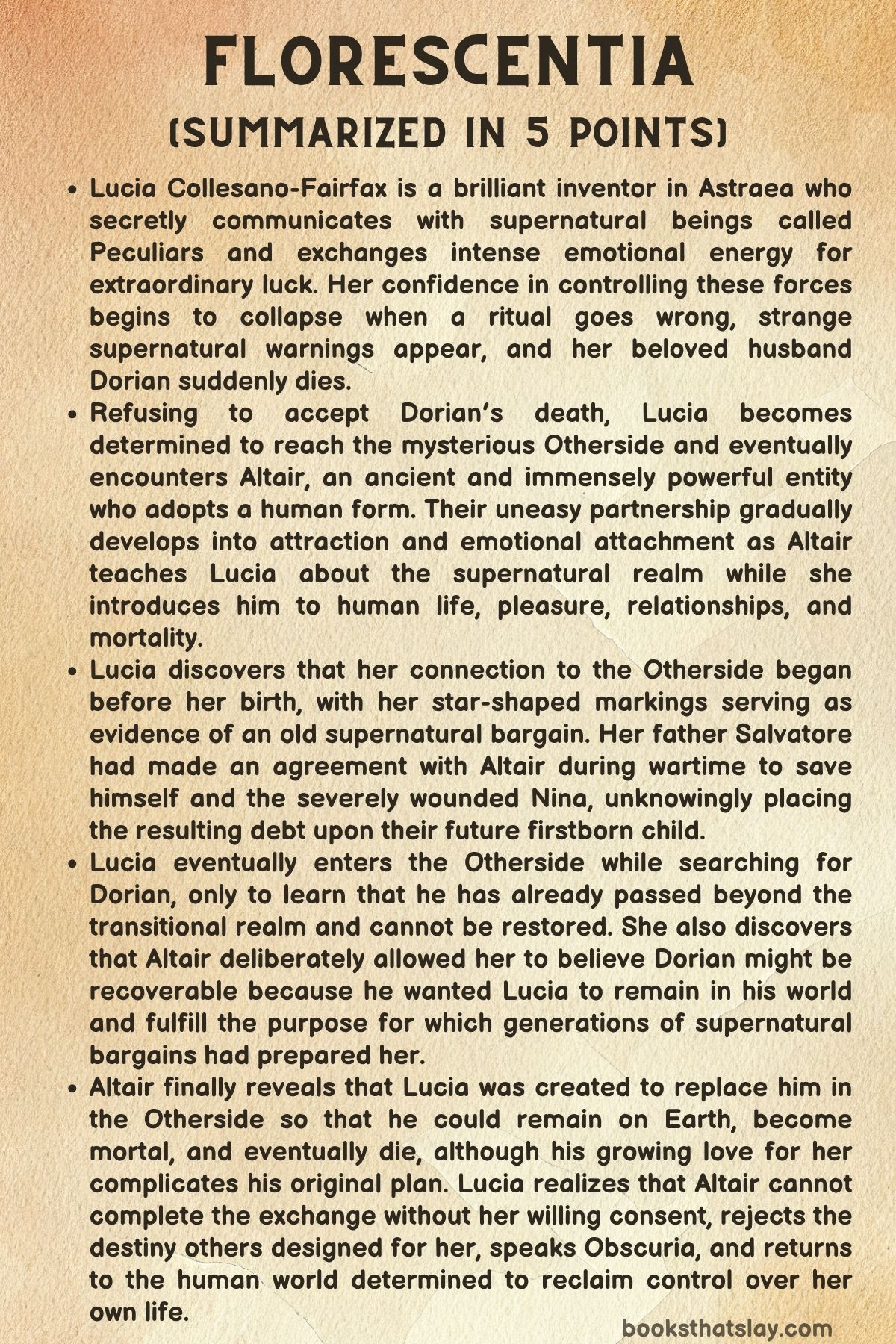
She awakens in her own world inside a safety coffin and desperately rings its emergency bell until people begin digging her out. The ending returns Lucia to humanity not because she has defeated death, solved every mystery, or destroyed Altair, but because she has reclaimed the authority to decide where she belongs and what her life will mean.
Characters
Lucia Collesano-Fairfax
Lucia is the central force of Florescentia, defined by extraordinary intelligence, relentless curiosity, emotional stubbornness, and a dangerous need to transform uncertainty into something she can understand. She approaches supernatural phenomena with the mentality of an inventor, treating rituals, Peculiars, portals, and emotional exchanges as systems that can be observed and eventually controlled.
Her confidence is both her greatest strength and one of her central weaknesses. Lucia has experienced enough successful supernatural interventions to believe that risk can always be reduced through knowledge, so warnings often make her more determined rather than more cautious.
Dorian’s death destroys the emotional structure supporting that confidence. Instead of accepting grief as something beyond correction, Lucia initially treats death as another problem requiring the correct experiment, ritual, or doorway.
Her growth comes from discovering the difference between persistence and control. By the end of her journey, she remains curious and defiant, but she understands that knowledge cannot justify surrendering personal freedom and that love cannot make another person’s choices on their behalf.
Altair
Altair begins Florescentia as something closer to an ancient force than a recognizable human personality. He is immensely knowledgeable, capable of manipulating supernatural energy, and initially interested in Lucia because she represents the successful conclusion of a plan extending across generations.
His relationship with Lucia gradually changes him. Food, touch, jealousy, humor, fear, tenderness, physical limitation, and companionship give him experiences that endless existence in the Otherside could not provide.
That transformation does not make Altair harmless. He repeatedly withholds essential information, directs Lucia toward outcomes she has not chosen, exploits her desire for knowledge, and assumes that his affection gives him some authority over her future.
His tragedy lies in the conflict between learning to love Lucia and failing to understand that genuine love requires respecting a decision he dislikes. By the end, his emotions have become recognizably human, but his methods still reveal the possessiveness and certainty of a being accustomed to manipulating reality itself.
Dorian
Although Dorian dies relatively early, his presence remains central throughout Florescentia because Lucia’s memories, ambitions, grief, and supernatural decisions continually return to him. He is presented as Lucia’s closest companion before he is presented simply as her romantic partner.
Dorian respects Lucia’s intellect and helps transform her unconventional ideas into practical inventions. Their marriage develops from friendship, necessity, shared work, and eventually deep attachment, making his death feel like the destruction of an entire way of living rather than only the loss of a spouse.
He also represents an ethical counterweight to Lucia’s obsession with supernatural luck. Lucia eventually acknowledges that Dorian would probably have questioned the methods she uses to manipulate outcomes, suggesting that part of her journey requires separating what she wants from what he would actually have wanted.
His final importance comes through absence. Lucia cannot truly continue living until she stops treating Dorian as someone temporarily misplaced and accepts that remembering him does not require recovering him.
Maxim Collesano-Fairfax
Maxim is Lucia’s younger brother and one of the strongest representatives of practical loyalty in the novel. As First Keeper of the Treasury archives, he shares Lucia’s intellectual world while remaining considerably more sensitive to social convention, religious consequences, and ordinary human limits.
He repeatedly tries to protect Lucia without attempting to dominate her. He warns her about the possible consequences of her inventions, pushes her to visit their failing father, handles difficult funeral responsibilities, and becomes increasingly worried when Lucia’s grief begins affecting her behavior.
His most significant act is secretly arranging for Dorian’s body to be given to the sea according to Dorian’s actual wishes. The decision demonstrates that Maxim is willing to violate law and custom when compassion requires it.
Maxim therefore offers a quieter contrast to Lucia. Where she often responds to love by trying to defeat reality, he responds by helping people preserve dignity within realities they cannot change.
Salvatore Collesano
Salvatore is one of the most morally complicated figures in Florescentia because Lucia’s entire supernatural existence originates in a decision he made before her birth. His deteriorating memory initially makes him seem primarily vulnerable, but scattered remarks, his journal, ritual knowledge, and his fear of Altair gradually reveal a hidden history.
The truth of his bargain changes meaning as Lucia learns more. She initially believes he sacrificed his future child for selfish personal desire, only to discover that Nina was already his wife and that he was desperately trying to keep them both alive during wartime.
His motives make his choice understandable without making its consequences fair. Salvatore purchased survival by allowing another person—his unborn child—to inherit a debt she never agreed to carry.
His mental decline also suggests the cost of prolonged contact with the boundary between worlds. By the time Lucia understands him fully, he has lost much of the ability to explain himself, leaving her to reconstruct the fear, love, guilt, and desperation behind his actions.
Nina Collesano
Nina provides an important human center within a story dominated by supernatural secrets. Her mechanical arm, created with help from Lucia and Dorian, connects her personal history of survival with Lucia’s identity as an inventor.
For much of the novel, Lucia does not understand the violent circumstances that led to Nina losing her arm. The later vision of Nina’s wartime injury reveals that her survival was directly connected to Salvatore’s bargain and therefore indirectly to Lucia’s supernatural inheritance.
Nina also represents forms of love that exist outside Lucia’s desire for control. Her relationship with Salvatore predates the supernatural agreement, disproving Lucia’s fear that Altair manufactured their bond.
Her eventual appearance beside Salvatore in the Otherside gives Lucia one of her clearest lessons in letting go. Rather than interrupt their departure for her own emotional needs, Lucia allows her parents to continue onward together.
Absinthe and Tonic
Absinthe and Tonic initially appear in Florescentia as familiar supernatural assistants whose behavior Lucia believes she understands. Because they are smaller Peculiars and regularly participate in her rituals, Lucia treats their cooperation almost like a dependable scientific mechanism.
Their resistance becomes one of the earliest signs that Lucia has misunderstood the supernatural hierarchy surrounding her. They refuse to cooperate because repeated portals are attracting entities far more dangerous than anything Lucia has previously encountered.
This changes the moral meaning of Lucia’s experiments. What she considers disciplined control often involves forcing sentient beings to perform actions they recognize as dangerous.
Absinthe and Tonic therefore function as both companions and warnings. Their behavior quietly challenges Lucia’s assumption that intelligence belongs only to creatures capable of communicating in recognizable human ways.
Calum
Calum serves as a useful connection between Lucia and the older knowledge preserved within the Treasury. He helps her locate information concerning ancient Astrian rituals, banishment, and eventually communication with the dead.
Unlike Altair, Calum does not possess hidden supernatural authority over Lucia. His role is comparatively ordinary, but that normality becomes important because it reminds the reader that Lucia can pursue knowledge through cooperation rather than manipulation or dangerous bargains.
Altair’s jealousy toward Calum also reveals how emotionally human the ancient entity has become. Calum therefore affects the story not through dramatic supernatural action but through the reactions his presence produces in Lucia and Altair.
Ava
Ava appears briefly but contributes to the novel’s treatment of Lucia’s appearance and self-acceptance. Her fearful reaction to Lucia’s vitiligo reflects the assumptions people can attach to visible difference before understanding it.
Lucia refuses to treat her markings as something shameful and instead argues that uniqueness may itself possess value. The later revelation that those same markings have a supernatural origin complicates the moment without invalidating Lucia’s response.
Ava’s reaction allows Lucia to state an important principle before she knows its full significance. Her body belongs to her, regardless of what other people—or supernatural beings—believe its markings mean.
Allison Thomas
Allison Thomas is a deceased woman whom Lucia contacts while testing the ritual intended for Dorian. Her appearance proves that the ritual genuinely reaches consciousnesses temporarily remaining within the transitional region of the Otherside.
Lucia does not exploit Allison merely as experimental evidence. Instead, she and Altair help the frightened woman understand that she must confront the door she has been avoiding so that she can continue onward.
Allison’s passage quietly anticipates the lesson Lucia herself will eventually face. The dead cannot always be brought backward, and sometimes compassion requires helping someone leave rather than trying to preserve them indefinitely.
Dorian’s Mother
Dorian’s mother represents the social expectations surrounding mourning, family identity, inheritance, and widowhood. Her interactions with Lucia remind the protagonist that Dorian’s death belongs not only to Lucia’s private grief but also to a larger network of family customs and obligations.
The tension surrounding Dorian’s funeral traditions further emphasizes the difference between how a person actually lived and how surviving relatives may wish to remember them. Through these conflicts, the novel questions whether honoring the dead means obeying convention or respecting the individual they truly were.
Themes
Grief, Loss, and the Limits of Recovery
Grief in Florescentia is presented less as passive sadness than as a force that alters judgment, ambition, and identity. Lucia cannot initially accept Dorian’s death because her entire intellectual history has taught her that apparently impossible outcomes can sometimes be changed through persistence, invention, supernatural luck, or sufficient personal sacrifice.
That belief makes mourning especially difficult because accepting Dorian’s absence feels to Lucia like intellectual surrender. Instead of asking how she can live after his death, she asks which rule, ritual, entity, or doorway must be defeated to reverse it.
The Otherside eventually forces Lucia to recognize the distinction between someone being absent and someone being gone. Allison can still be reached because she remains temporarily suspended between states, but Dorian has already passed beyond the form of existence Lucia can contact.
The deaths of Salvatore and Nina reinforce this lesson from another direction. Lucia sees them together and chooses not to interrupt their departure, demonstrating that love can sometimes require refusing to pull another person back toward oneself.
Her final acceptance does not erase grief or make loss desirable. Instead, it transforms memory from a reason to resist reality into a way of carrying relationships forward without denying that they have ended.
Science, Knowledge, and the Desire for Control
Lucia approaches both technology and supernatural phenomena through experimentation. Pneuma-type photography, portal rituals, Everie readings, the sentient grimoire, and her observations of Peculiars all become parts of an expanding effort to understand realities that other people explain through religion or superstition.
The novel respects this curiosity while repeatedly showing how easily investigation becomes entitlement. Lucia assumes that because something can be tested, measured, summoned, photographed, or commanded, she has the right to use it.
Absinthe and Tonic challenge that assumption by resisting her rituals, while Altair repeatedly demonstrates that supernatural beings possess motives inaccessible to Lucia’s preferred methods of classification. The Otherside itself creates an even larger problem because observation changes experience there and expectation can influence physical reality.
Knowledge therefore becomes valuable but morally incomplete. Lucia survives because she remains curious enough to question the choices Altair presents, yet many of her worst dangers arise because she mistakes partial understanding for mastery.
Her development does not require abandoning science. Instead, she learns that responsible knowledge depends on recognizing uncertainty, respecting other forms of agency, and accepting that understanding a mechanism does not automatically justify controlling it.
Choice, Consent, and Personal Autonomy
Choice becomes increasingly important as Lucia discovers how many of the circumstances defining her life were decided before she could consent to them. Salvatore’s bargain places a supernatural obligation upon his unborn first child, while Altair spends centuries waiting for someone capable of completing the agreement.
Lucia therefore discovers that her unusual body, attraction to the Otherside, supernatural abilities, and connection to Altair are not entirely accidental. Other people have treated aspects of her future as property that can be promised, planned, or exchanged.
Altair repeats this pattern even after developing genuine affection for her. He does not simply explain the truth and permit Lucia to decide; he withholds information, appeals to her curiosity, creates seductive environments, and tries to make remaining with him seem preferable to every alternative.
The decisive fact is that he ultimately requires her willing surrender. That limitation gives Lucia the power to reject the entire structure imposed upon her.
Her use of Obscuria becomes more than a supernatural command. It becomes an assertion that neither inherited obligation, romantic attachment, parental desperation, nor cosmic design has greater authority over her future than her own consent.
Mortality, Meaning, and the Value of an Ending
Mortality is treated in Florescentia not simply as something frightening but as one of the conditions that gives experience significance. Lucia initially experiences death as an intolerable failure because it permanently removes people she loves from the world she can reach.
Altair approaches mortality from the opposite direction. His existence has lasted so long, and his access to experience is so vast, that endless continuation has become exhausting rather than comforting.
His desire to become mortal suggests that limitation can create value. Food matters because hunger returns, companionship matters because separation is possible, and a lifetime gains urgency because its opportunities cannot continue indefinitely.
Lucia gradually reaches a related understanding without embracing Altair’s desire for death. Her encounters with Dorian’s absence, her parents’ departure, extinct animals, fading memories, and transitional souls show her that preserving everything forever would not necessarily honor what once existed.
The final conflict therefore concerns two people approaching mortality from opposite directions. Altair wants an ending because endless existence has emptied experience of consequence, while Lucia chooses continued human life after learning that accepting endings does not require seeking one prematurely.
Her return to Earth affirms temporary existence rather than supernatural permanence. Life matters not because every loss can be reversed, but because limited time makes freedom, curiosity, love, responsibility, and choice matter while they are still possible.