Free Falling Summary, Characters and Themes
Free Falling by Lyla Sage is a small-town romance built around two people who have spent years protecting themselves in very different ways.
Clarke Cartwright tries to control every part of her life while concealing her ability to communicate with ghosts, whereas Leith Wilkes carries unresolved grief and a fierce responsibility toward his family farm. Their fake relationship begins as a practical bargain involving an inheritance deadline and repairs to Clarke’s family antiques shop, but the arrangement gradually exposes feelings that neither can dismiss. Alongside the romance, the novel examines family legacy, community responsibility, emotional exhaustion, grief, and the difficulty of accepting help. It’s the 2nd book of the Sweetwater Peak series.
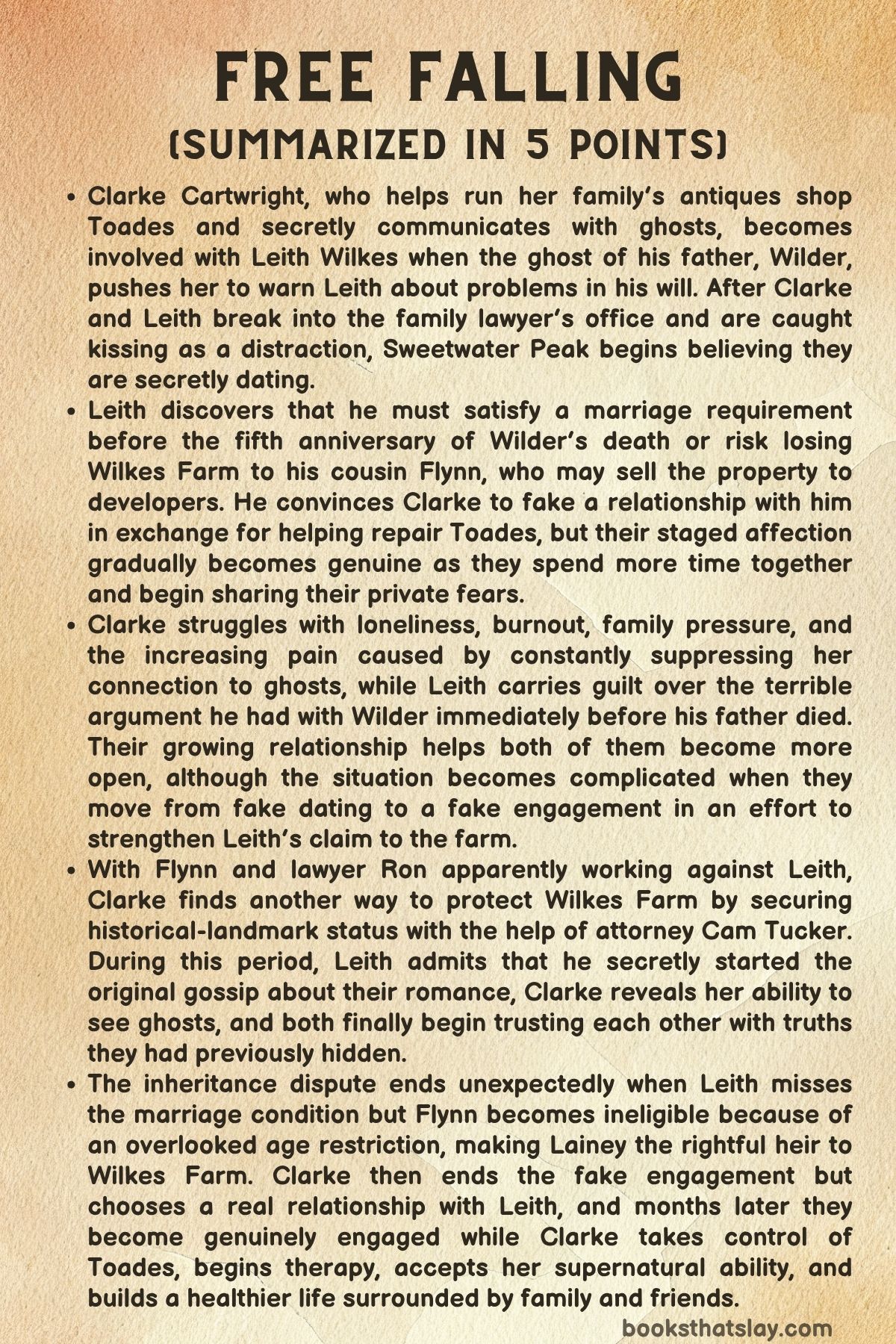
Summary
Clarke Cartwright spends most of her life trying to keep Toades, her family’s antiques store in Sweetwater Peak, running smoothly. A storm has damaged the roof, money is tight, and Clarke desperately wants to prove that she is capable of eventually taking over the business, but she is also struggling privately with the supernatural ability she shares with her twin sister, Collins: Clarke can see and hear ghosts, yet unlike Collins, she finds their presence exhausting and constantly tries to shut them out.
Her carefully controlled routine changes when Leith Wilkes appears at her home accompanied by the ghost of his late father, Wilder. Wilder has spent months urging Clarke to warn Leith about his will, and although Clarke refuses to become a regular messenger between the living and the dead, she has already broken that rule once by telling Leith to examine the fine print in the estate documents.
Leith has his own reasons for seeking Clarke. Since Wilder’s death, strange reminders of his father have appeared around him, while family lawyer Ron Rummager repeatedly avoids providing a full copy of the will and has still not transferred Wilkes Farm into Leith’s name after nearly five years. Clarke and Leith eventually break into Ron’s office through adjoining businesses, where they locate Wilder’s documents, but Ron returns unexpectedly and Clarke kisses Leith to make their presence look like a secret romantic encounter rather than a burglary.
Their improvised excuse works almost too well. Ron believes Clarke and Leith are secretly involved, and the story quickly reaches Sweetwater Peak’s gossip network, where their single kiss becomes evidence of a hidden romance.
The stolen documents reveal the true danger: Leith can inherit Wilkes Farm only if he meets a marriage requirement before the fifth anniversary of Wilder’s death. If he does not, the property passes to the next eligible relative, Flynn Wilkes, Leith’s older cousin and Lainey’s biological father, a man both Clarke and Leith distrust.
With only a few months remaining, Leith proposes turning the town’s misunderstanding into a strategy. Clarke will pretend to be his girlfriend so that Ron believes Leith is rapidly moving toward marriage, while Leith will supply labor and favors to help repair Toades; Clarke initially rejects the idea but changes her mind after acknowledging that she cannot save her family business entirely by herself.
They create detailed rules for their arrangement and deliberately use Sweetwater Peak’s love of gossip to establish a believable romantic history. Public dates, hand-holding, thoughtful gifts, affectionate gestures, and appearances around town convince everyone else, but the larger problem is that Clarke and Leith already share a long history and genuine attraction, so pretending begins to feel natural almost immediately.
As Leith works on Toades, he begins seeing how overwhelmed Clarke truly is. The ghosts have become increasingly loud around her, and one intense episode leaves Clarke pale and nearly unable to function; Leith takes her to the cemetery, one of the few places where she experiences supernatural silence, and gently challenges her habit of handling every problem alone.
Their emotional closeness grows alongside the attraction. Leith remembers details about Clarke that she never realized he noticed, encourages her to enjoy herself without constantly thinking about how other people see her, and eventually reveals the guilt he has carried since Wilder’s death: their final conversation was a terrible argument in which Leith threatened to let the farm fail, and Wilder died unexpectedly the following day.
Clarke becomes one of the few people with whom Leith can speak openly about the complicated mixture of love, anger, resentment, and grief he feels toward his father. At the same time, the boundaries of their fake relationship collapse when Clarke and Leith begin becoming physically intimate in private, where there is no audience to convince and therefore no practical reason to behave like lovers.
The inheritance problem also becomes more dangerous. Leith finds Flynn meeting with Ron and a man apparently connected to development interests, which makes him suspect that Flynn plans to acquire Wilkes Farm and sell it, while Ron’s repeated delays may be deliberate rather than careless; the possibility of an active plan against the farm pushes Clarke and Leith from fake dating into a fake engagement.
Leith gives Clarke a ruby ring from Toades and promises that even though the engagement itself is false, his commitment to treating her carefully is genuine. They stage the engagement around Lainey’s prom, but by then their relationship has become emotionally complicated enough that both are privately acting on feelings far beyond the original agreement.
Collins soon discovers the truth and recognizes that Clarke has real feelings for Leith. More importantly, she realizes how severely Clarke has been suppressing both her supernatural ability and her own needs, so the sisters investigate the ghosts at an abandoned car wash, where Clarke learns that spirits have been trying to communicate significant information for months but cannot reach her because she refuses to listen.
The pressure becomes overwhelming and Clarke collapses. Leith immediately goes to her, revealing through his actions how deeply involved he has become in her life, while Collins explains that Clarke has rarely believed she can safely depend on another person; during the same night, Leith admits to Collins that he secretly created the original gossip post about himself and Clarke to pressure the fake-dating plan forward.
Afterward, Collins confronts Clarke about the larger emotional problem. Clarke has withdrawn from the people she loves, buried herself in responsibility, and convinced herself that constant exhaustion is simply the price of being dependable, while Collins pushes her toward confidence, pleasure, connection, and acceptance of the parts of herself she has spent years rejecting.
A possible solution to the farm crisis finally emerges when Clarke realizes that Wilkes Farm may qualify for historical protection. She and Leith contact Cam Tucker, the lawyer who previously helped her family, and spend the following weeks securing landmark protections that would severely restrict Flynn or any developer from altering or exploiting the property.
Before confronting Ron, Clarke and Leith finally remove the major secrets between them. Leith confesses that he started the gossip that helped push Clarke into the arrangement, while Clarke tells him that she sees ghosts and explains that Wilder originally directed her toward the will; rather than rejecting her, Leith accepts the truth and begins understanding the source of the pain she has been experiencing.
At Ron’s office, Cam presents the completed historic protections, effectively destroying Flynn’s plan to profit by developing the farm. Ron then announces that according to his records, Wilder’s fifth death anniversary has already arrived and Leith has missed the marriage deadline, but an obscure clause produces an unexpected reversal: Flynn has turned sixty-five and is no longer eligible to inherit either.
The next eligible heir is Delainey Dawn Wilkes. Lainey becomes the owner of Wilkes Farm, allowing the property to remain with someone who loves it while freeing Leith from the administrative ownership he never truly wanted; Leith fires Ron, Flynn leaves defeated, and the farm’s future is finally secured.
With the practical crisis over, Clarke turns toward the emotional problems she has avoided. She reconciles with Joanie, admits the truth about the fake romance to her family, and later meets Leith, who has already openly declared his love for her; Clarke removes the ruby ring, not because she wants to leave him, but because she wants their real relationship to begin without inheritance conditions, deadlines, or deception.
Months later, Clarke and Leith are genuinely engaged after allowing themselves time to date normally. Clarke takes control of Toades, begins therapy for the depression and burnout she has been experiencing, becomes more accepting of her supernatural ability, and remains rooted in Sweetwater Peak with the people she loves, finally understanding that dependence, joy, imperfection, and belonging do not make her weak.
Characters
Clarke Cartwright
Clarke is the emotional center of Free Falling, and much of her development comes from the conflict between the competent person she presents to the world and the exhausted woman she hides underneath. She is intelligent, responsible, socially attentive, devoted to Toades, and deeply invested in becoming someone her family can trust with its future.
Her strongest quality is also one of her greatest weaknesses: Clarke believes that loving people means becoming useful to them without creating needs of her own. She remembers details about customers, worries about the store, manages problems before anyone else notices them, and tries to remain pleasant even when she is overwhelmed.
This habit extends to her supernatural ability. While Collins accepts communication with ghosts, Clarke treats the dead as invasive noise and attempts to suppress them, but the harder she fights that part of herself, the more physically and emotionally painful the experience becomes.
Her relationship with Leith challenges the structure she has built around herself. He notices when she is unwell, remembers details from her childhood, shows up when she collapses, and repeatedly demonstrates that being cared for does not require her to first prove that she deserves it.
Clarke’s romantic journey therefore reflects her broader emotional recovery. She begins by treating intimacy as something she can manage under rules, but eventually recognizes that genuine love requires uncertainty, openness, and the willingness to depend on another person.
Her reconciliation with Joanie is equally important because it forces her to acknowledge how much fear and resentment have shaped her behavior around Toades. By the end, she is not suddenly free of difficulty, but she has begun therapy, accepted help, taken responsibility for the store, and stopped treating every imperfect part of herself as something that must be hidden.
Leith Wilkes
Leith begins Free Falling as someone who appears relaxed, humorous, and socially confident, but much of that ease exists beside a deep fear of failing the people who depend on him. He loves Wilkes Farm as a place of work, community, food production, family history, and personal identity, even though he does not actually enjoy the managerial authority attached to owning it.
His relationship with Wilder created much of his emotional burden. Leith’s final argument with his father left him believing that he must save the farm partly to prove that Wilder was wrong about him, and partly to compensate for words he can never take back.
That guilt explains why Leith sometimes makes questionable choices. Creating the gossip post to pressure Clarke toward fake dating is manipulative, but his eventual confession demonstrates that he understands love cannot survive if he continues controlling circumstances from the shadows.
Leith’s strongest trait is his willingness to show up. He repairs Toades, cares for Clarke during her supernatural episodes, protects Lainey from Flynn, supports his mother, works the farm, and responds to emotional crises through action rather than distance.
His relationship with Clarke also reveals considerable tenderness beneath his teasing personality. He wants her to enjoy herself, encourages her to see her own attractiveness and worth, and eventually becomes less interested in obtaining marriage as a legal solution because he wants any future marriage to be genuinely chosen.
Losing ownership of Wilkes Farm ultimately frees Leith from an identity he thought he was required to assume. Lainey’s inheritance allows him to remain a farmer, teacher, protector, and family member without forcing him into the administrative position Wilder once expected him to fill.
Collins Cartwright
Collins acts as Clarke’s strongest mirror in Free Falling because the twins possess similar supernatural abilities but respond to them in nearly opposite ways. Collins approaches ghosts with curiosity and acceptance, while Clarke experiences them as a burden she would rather eliminate from her life.
Because Collins understands the supernatural problem better than anyone else, she is also uniquely able to recognize the damage Clarke causes by constantly suppressing herself. Their conflict at the abandoned car wash becomes painful because Collins is not simply talking about ghosts; she is accusing Clarke of treating pleasure, identity, desire, and personal need as things that should always come second to responsibility.
Collins can be forceful and even insensitive when frightened for her sister. Her harshness contributes to Clarke becoming overwhelmed during the investigation, but she immediately abandons the argument once Clarke collapses and focuses on protecting her.
She also plays an important role in Clarke’s developing relationship with Leith. Collins recognizes that Leith has become emotionally significant before Clarke is willing to say it directly, challenges both of them when necessary, and pushes Clarke toward seeing herself with greater confidence through the photography session.
Ultimately, Collins represents acceptance rather than perfection. She encourages Clarke to stop separating herself into acceptable and unacceptable pieces and instead live as a whole person.
Delainey “Lainey” Wilkes
Lainey becomes one of the most important symbols of the future in Free Falling. Although Flynn is her biological father, he has never provided the consistent care or emotional security that Leith gives her, and Lainey clearly understands the difference between biological connection and genuine family.
Her relationship with Leith is built on trust. She depends on him, respects him, worries about the farm with him, and eventually makes clear that he matters more to her than either Flynn or Wilder ever did.
Lainey also forms an easy relationship with Clarke. Their conversations about books, business, family expectations, and the future allow Clarke to see how naturally she could belong within Leith’s family even before the romance becomes genuine.
Her inheritance resolves the estate conflict in a way that is both legally surprising and emotionally appropriate. The farm does not go to the man obsessed with controlling it, nor to the man who intended to sell it, but to the young woman who sincerely wants to become a farmer.
Lainey therefore represents continuity without repetition. She can preserve Wilkes Farm without becoming another Wilder, and Leith can support her without recreating the demanding father-son dynamic that damaged him.
Wilder Wilkes
Wilder remains a powerful presence throughout Free Falling despite being dead before the central action begins. His ghost is responsible for pushing Clarke toward Leith and the will, making him one of the major forces behind the inheritance investigation.
As a father, Wilder left Leith with unresolved anger as well as love. He valued the farm intensely and apparently doubted Leith’s readiness to manage it, leaving their relationship fractured by a final argument that Leith spends years regretting.
His actions after death complicate his character further. Wilder clearly wants to prevent Flynn from obtaining the farm and attempts to reach his son through Clarke, suggesting concern and regret that he failed to communicate effectively while alive.
Yet the novel does not excuse him simply because he is dead. When Leith is hurt by the idea that Wilder only began reaching toward him after death, Clarke allows him to feel that anger instead of transforming Wilder into an idealized father.
Joanie Cartwright
Joanie is Clarke’s mother and one of the central figures in Clarke’s conflict over Toades. She loves the store and her daughter, but financial problems, storm damage, and questions about succession cause ordinary disagreements to become emotionally loaded.
Clarke interprets Joanie’s concerns as evidence that her mother does not trust her to run the business. Joanie, meanwhile, experiences Clarke’s criticism of insurance decisions and emergency planning as a judgment on the way she and Dex managed the store.
Their conflict reflects a familiar family problem: both people care deeply about the same thing but allow fear to shape how they communicate. Their eventual reconciliation matters because both admit responsibility instead of demanding that one person accept all the blame.
Joanie’s decision to hand control of Toades to Clarke confirms the trust Clarke spent much of the story fearing she would never receive. It also allows their relationship to return to being primarily mother and daughter rather than two people competing over the meaning of a family business.
Dex Cartwright
Dex is Clarke and Collins’s father, whose work as a trucker keeps him periodically away from home. He is affectionate toward his family and proud of Toades, but his questions about the repaired roof unintentionally force Clarke deeper into the lies surrounding her arrangement with Leith.
Compared with the tension between Clarke and Joanie, Dex often represents a steadier parental presence. His retirement at the end suggests a broader transition within the Cartwright family as the parents step away from old responsibilities and Clarke assumes control of the shop.
His remarriage to Joanie at the renovated Toades also reinforces the story’s interest in relationships that can be renewed after difficulty. Rather than presenting family stability as something automatic, the novel shows the Cartwrights consciously choosing one another again.
Flynn Wilkes
Flynn is the principal human antagonist in the inheritance conflict. As Leith’s older cousin and Lainey’s biological father, he has family connections to the farm but demonstrates little of the care, responsibility, or emotional loyalty that would justify control of it.
His attempts to charge purchases to Wilkes Farm and his confidence around Ron suggest that he sees Leith’s approaching deadline as an opportunity. His apparent connection to development interests makes his possible inheritance dangerous not just for Leith but for Sweetwater Peak as a whole.
Flynn’s treatment of Lainey also exposes his priorities. He has failed to function as her father for most of her life yet invokes that relationship when power over the farm becomes relevant.
His defeat is therefore especially fitting. He loses eligibility through the same obscure succession agreement he hoped to exploit, while the daughter he neglected becomes the person who inherits the property.
Ron Rummager
Ron is the family lawyer whose evasiveness drives much of the mystery surrounding Wilder’s estate. His repeated refusal to provide documents and complete the farm transfer initially looks like incompetence but gradually appears increasingly suspicious.
His association with Flynn and his possible financial vulnerability make Leith suspect deliberate interference. Whether motivated by personal weakness, outside pressure, or self-interest, Ron repeatedly fails the basic responsibility of protecting the interests he was supposed to administer.
The confrontation with Cam exposes how badly Ron has handled the estate. Leith’s decision to fire him is therefore not merely an angry reaction but an acknowledgment that family loyalty and local familiarity are no substitute for professional trustworthiness.
Earnest
Earnest is one of the few ghosts Clarke permits herself to know personally. His attachment to an old record console and his love for Adeline make him more than supernatural background; he becomes evidence that the dead retain longing, personality, affection, and unfinished emotional needs.
He also understands Clarke’s condition better than many living people. Earnest notices when other spirits overwhelm her and later challenges her belief that constantly shutting them out is the best way to protect herself.
His relationship with Adeline quietly parallels Clarke’s developing understanding of love. Earnest knows that contact may be brief and imperfect, yet he still values every opportunity for connection.
Adeline
Adeline appears primarily through Clarke’s decision to reunite her briefly with Earnest. Although her role is small, the reunion has an important effect on Clarke because witnessing their companionship forces her to recognize her own loneliness.
Adeline also contributes to the novel’s treatment of love as something valuable even when circumstances prevent permanence. Her appearances with Earnest give the supernatural material emotional significance beyond mystery or danger.
Alison “Ali”
Ali initially exists in Clarke’s mind as a possible romantic obstacle because of her long on-and-off history with Leith. Instead, Ali refuses the expected rivalry and makes clear that her relationship with Leith was already emotionally finished before Clarke became involved.
Her decision to speak directly with Clarke is generous and mature. She dislikes the town gossip turning two women into competitors and deliberately removes herself from that narrative.
Ali also helps Clarke recognize how convincing her connection with Leith has become. When Ali says they appear good together, the comment is uncomfortable precisely because Clarke knows the relationship contains far more truth than she is admitting.
Trudy Wilkes
Trudy is Leith’s mother and provides a sense of warmth within the Wilkes household. Her interest in Clarke and willingness to invite her into family evenings show how quickly Clarke begins becoming part of Leith’s personal world.
She also helps demonstrate that the Wilkes family cannot be reduced to the difficult relationship between Wilder and Leith. There is affection, domestic comfort, and continuity beyond the father-son conflict.
Sadie
Sadie is Clarke’s best friend and an important measure of how withdrawn Clarke has become. Although she spends much of the central action away, her concern becomes clear when she contacts Collins because Clarke’s isolation has grown serious enough to alarm her.
The fact that Clarke has distanced herself even from Sadie supports Collins’s argument that the problem is larger than ordinary work stress. Sadie represents one of the relationships Clarke already possesses but has stopped allowing herself to use for support.
Cam Tucker
Cam is the competent outside lawyer Clarke contacts once the group realizes local legal channels cannot be trusted. His earlier experience helping the Cartwright family against Sullivan Industries makes him especially useful once the farm appears threatened by similar development interests.
He helps transform Clarke’s historical-landmark idea into an effective legal defense. His preparation and professionalism also provide a direct contrast with Ron’s evasive handling of the estate.
Cam’s role demonstrates that saving the farm does not depend only on romance or luck. Research, legal knowledge, historical protection, and strategic action all contribute to preventing Flynn from exploiting the property.
Boone
Boone provides a place of safety after Clarke collapses during the ghost investigation. His home becomes the setting for one of Clarke’s most peaceful mornings, surrounded by Collins, Brady, Leith, dogs, food, and ordinary conversation.
That moment matters because Clarke is not responsible for managing anyone else. Boone’s household temporarily gives her something she rarely permits herself to experience: belonging without performance.
Brady
Brady is connected to Collins and participates in the warm breakfast gathering after Clarke’s collapse. His presence contributes to the sense that Clarke is surrounded by a larger network of people who can help carry difficult moments.
His upholstery shop also indirectly becomes part of Clarke and Leith’s route into Ron’s office earlier in the story. Although he is not central to the romance, he belongs to the interconnected Sweetwater Peak community that makes the setting feel socially close.
Ryne
Ryne assists Leith in inspecting the damaged roof at Toades. His practical role emphasizes that Leith’s promise to help Clarke is backed by real labor rather than empty reassurance.
He also happens to be present when Clarke’s supernatural distress becomes severe, though Leith sends him away so he can care for Clarke privately. Ryne therefore appears at an important moment when Clarke’s carefully controlled public image begins failing.
Pearl
Pearl, Clarke’s older dog, is an important source of companionship. Clarke remembers that adopting her changed the experience of coming home because Pearl ensured that even during lonely periods, the house was never completely empty.
Leith’s immediate affection toward Pearl also softens Clarke’s feelings toward him. Pearl quietly represents the comfort of dependable presence, something Clarke gradually learns to accept from people as well.
Gary
Gary appears briefly at the hardware store but provides Leith with important information when he reveals that Flynn has attempted to charge purchases to Wilkes Farm. That warning helps confirm that Flynn is already behaving as though control of the property is within reach.
His role reflects the way information travels through Sweetwater Peak. Even minor interactions within the community can affect the central conflict.
Ed
Ed is the man Leith finds meeting with Flynn and Ron. His apparent connection to development interests increases Leith’s suspicion that Flynn intends to acquire the farm for financial gain rather than preserve it.
Although Ed remains a minor figure, his presence shifts the estate problem from a private family dispute toward a broader threat involving outside commercial interests.
Principal Kirk
Principal Kirk appears during Lainey’s prom, where Clarke and Leith serve as chaperones. His need to remind Leith to reduce the public displays of affection adds humor while also showing that the supposedly staged romance has become difficult for Leith to control.
His brief appearance emphasizes how completely the couple’s performance has convinced the town. By this stage, their real problem is no longer making the relationship believable but admitting how much of it is genuine.
Emmy
Emmy arrives with Cam when he returns to Sweetwater Peak to help prepare the legal defense surrounding Wilkes Farm. Her role is minor, but her presence places her among the people contributing to the final effort against Flynn and Ron.
She belongs to the widening circle of allies who demonstrate that neither Clarke nor Leith ultimately has to solve every crisis alone.
Themes
The Difference Between Independence and Isolation
Clarke’s determination to remain independent gradually becomes a form of isolation. In Free Falling, she has convinced herself that being dependable means preventing other people from ever having to carry her problems, so she manages Toades, worries about money, handles family tension, hides her supernatural suffering, and maintains a socially capable exterior even when she is increasingly unhappy.
The danger in this mindset is that Clarke interprets needing help as evidence of personal failure. She believes people appreciate her because she is useful and easy to rely on, which creates the frightening possibility that their affection might disappear if she becomes the person who needs care instead.
Leith challenges this assumption through repeated action. He does not merely tell Clarke that people would come if she called; he takes her somewhere safe during a severe episode, remains beside her when she is vulnerable, repairs Toades, responds immediately when Collins calls about her collapse, and demonstrates that concern is not a debt Clarke must repay with perfect behavior.
Collins approaches the same issue more aggressively by showing Clarke how much she has withdrawn from Sadie, family, pleasure, the supernatural part of herself, and ordinary social life. Clarke’s eventual progress comes from recognizing that independence should mean possessing the freedom to make choices, not forcing herself to endure every difficulty privately.
By the ending, accepting therapy, family support, love, and her own limitations does not make Clarke less capable. It allows her competence to exist without requiring constant self-denial.
Family Legacy and the Burden of Inheritance
Both Clarke and Leith build large parts of their identities around something inherited from their families. Clarke wants Toades because the shop represents history, community, her parents’ work, and the future she has imagined for herself, while Leith feels responsible for Wilkes Farm because generations of his family have depended on it and because it remains essential to Sweetwater Peak.
The problem is that inheritance carries expectations as well as meaning. Clarke believes she must demonstrate exceptional competence before Joanie can safely trust her with Toades, while Leith believes saving Wilkes Farm is tied to proving Wilder wrong after their final argument.
Their journeys gradually separate love for a legacy from obedience to the exact form previous generations expected. Clarke can become the owner of Toades without running it according to every decision her parents made, and Leith can remain devoted to the farm without becoming the legal owner or administrator Wilder imagined.
Lainey’s inheritance makes this distinction especially clear. The farm remains in the family, but control passes to someone young enough to shape its next era rather than simply copying the past.
The story ultimately presents legacy as something living. Preserving a family institution does not require preserving every old conflict, role, assumption, or rule attached to it; genuine continuity can involve letting the next generation decide what deserves to remain and what needs to change.
Acceptance of the Self
Clarke’s supernatural ability provides one of the clearest expressions of self-rejection in Free Falling. She and Collins share the ability to perceive ghosts, but Clarke has spent years treating that part of herself as unwanted interference, forcing spirits away until the effort itself becomes increasingly painful.
The physical consequences mirror her emotional habits. Clarke does not only suppress ghosts; she suppresses loneliness, resentment, exhaustion, fear, attraction, sadness, and the desire to be cared for, attempting to maintain control by refusing experiences that might make her feel exposed.
Collins eventually identifies the pattern. Her accusation that Clarke continually makes herself smaller connects the supernatural conflict with the rest of Clarke’s life, showing that she has mistaken restriction for safety.
Leith contributes to this process of acceptance by responding calmly when Clarke finally tells him the truth about the ghosts. His willingness to believe her removes one of the fears that has kept the ability hidden and demonstrates that intimacy does not require presenting a carefully edited version of herself.
The ending avoids suggesting that acceptance instantly removes the difficulty. Clarke begins therapy, her recovery remains uneven, and the ghosts do not disappear, but their presence becomes easier to tolerate once she stops treating her own nature as an enemy.
Self-acceptance therefore becomes an active practice rather than a single revelation. Clarke learns that a meaningful life does not require eliminating every inconvenient or painful part of herself before she deserves joy.
Love as a Choice Rather Than an Obligation
The central romance begins with almost everything except free romantic choice. Clarke agrees to fake-date Leith because Toades needs repairs and Wilkes Farm needs protection, their fake engagement exists because the inheritance threat grows more serious, and marriage itself eventually appears as a possible legal requirement rather than a natural expression of commitment.
This structure creates the story’s central romantic question: if two people behave like partners because circumstances require it, how can they know when the relationship has become real? The answer gradually appears in moments that have nothing to do with deceiving Ron or satisfying the town—Leith caring for Clarke when she is ill, Clarke listening to his guilt about Wilder, their private intimacy, his connection with Pearl, her bond with Lainey, and their willingness to reveal truths that could change how the other sees them.
The ruby engagement ring becomes an especially important symbol of this distinction. Leith first gives it to Clarke during a false engagement, but the promise to treat her carefully is sincere even when the public meaning of the ring is not.
After the inheritance crisis ends, Clarke returning the ring is therefore an act of commitment rather than rejection. She refuses to let their future remain attached to a deadline, a will, a threatened farm, or the expectations of Sweetwater Peak.
When they later become genuinely engaged, the same ring carries a different meaning because they have chosen it without external pressure. Love becomes valuable not because circumstances forced them together, but because once those circumstances disappeared, they deliberately chose to remain.