Freeing the Wild Summary, Characters and Themes
Freeing the Wild by Paisley Hope is a contemporary romance set against the wide-open spaces of rural Kentucky and the high-pressure world of modern country music.
The novel follows Cassie Spencer, a rising singer caught between image-driven fame and a longing for something steadier, and Haden Westbrook, a ranch hand whose life revolves around hard work, horses, and loyalty to his community. When their lives cross at Silver Pines Ranch, a reckless first meeting leads to consequences neither expects. The story traces how chance encounters, personal loss, and the search for home reshape two guarded people.
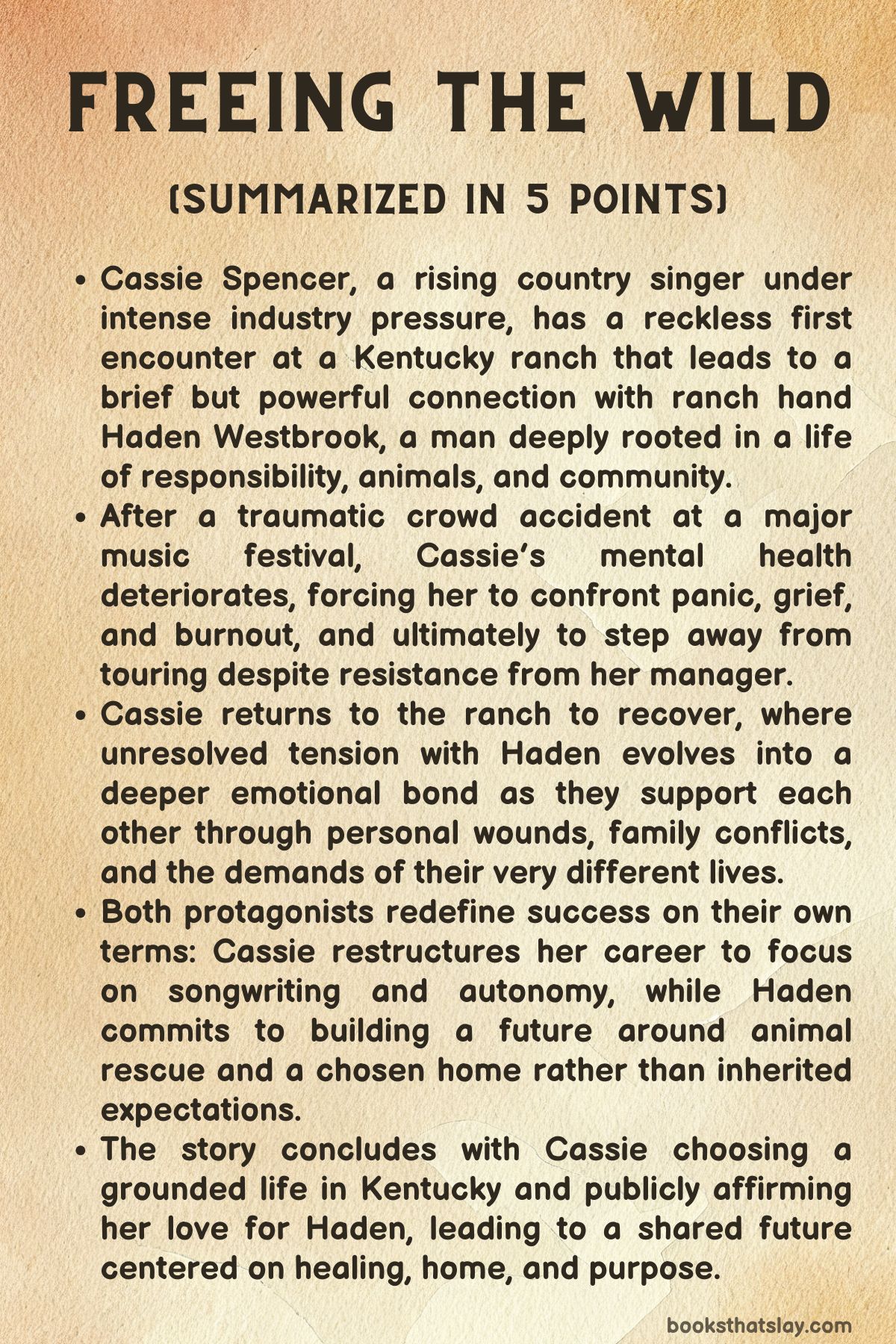
Summary
Cassie Spencer arrives at Silver Pines Ranch near Laurel Creek, Kentucky, hoping to film a short social media video that will sell her brand as “authentic” country. Though she grew up around horses, years on the road have dulled her skills. At the barn, she flirts with Dusty, a young ranch hand, and pushes him to saddle a striking but unpredictable horse named Outlaw instead of the calm beginner mount he recommends.
Despite warnings that Outlaw is not fully trained, Cassie insists on riding. The horse bolts, and the situation turns dangerous. Haden Westbrook, the ranch’s most capable hand, rushes in, too late to stop Cassie from being thrown. She escapes serious injury, but the incident leaves Haden furious at the recklessness that put both rider and horse at risk.
Haden tends Cassie’s scrapes with blunt concern and a sharp tongue, calling out her treatment of the horses as props for content. Cassie bristles at his manner but also recognizes she crossed a line. Dusty accepts responsibility for letting his attraction cloud his judgment, and Haden makes it clear that safety comes first on the ranch. Cassie returns to her sister Ivy’s cabin embarrassed and shaken.
Ivy and Wade, the ranch owner, check on her and remind her that her choices ripple outward. Cassie salvages a short clip from the failed shoot, even as her manager, Dax, presses her to keep promoting an upcoming festival and manage band changes caused by a member entering rehab.
That evening, Cassie heads to the Horse and Barrel to meet Darcy, a temporary bassist. The bar is a local hub where Haden relaxes after long days at Silver Pines and volunteer work at Penny Lane Rescue Ranch, where he helps an older veterinarian rehabilitate neglected horses.
In the crowded bar, Cassie notices how different Haden seems off the clock—easy with friends, respected by staff. When a stranger pushes for Cassie’s attention, Haden steps in, and their earlier sparring turns playful. A wager over a pool game leads to dancing, laughter, and an attraction neither tries to hide. The night moves fast, and they share an intense, impulsive encounter in Haden’s truck.
Afterward, the mood shifts. Cassie draws a line, asking that they treat the night as a one-time thing and avoid personal details.
She slips away without saying goodbye. Haden, unsettled by how quickly the connection formed and how abruptly it ended, can’t shake the feeling that something real passed between them. The next day, he learns through a livestream that Cassie is a rising country singer—and Ivy’s sister. The realization stings. He worries about the fallout of crossing a line with his boss’s family and tells himself he is better off keeping his distance.
Five months later, Cassie’s career is soaring. A song inspired by her night in Kentucky becomes a breakout hit, but the success comes with relentless schedules, online scrutiny, and mounting anxiety. During a festival in California, a crowd surge collapses a barricade near the stage.
Cassie is trapped in the chaos and witnesses a woman die in the crush. The experience leaves her shaken and haunted. Attempts to return to performing trigger panic attacks, and she collapses backstage at another show. Against her manager’s pressure to push through, Cassie decides to take a break and returns to Kentucky to recover with Ivy and Wade.
Back at Silver Pines, Cassie is assigned a cabin next to Haden’s. The reunion is tense. He confronts her about hiding who she was and about the song tied to their night. She apologizes for the secrecy but insists they were both adults who made a choice. Despite their words, neither is untouched by what they shared.
At a family gathering, the warmth of the ranch community contrasts with Cassie’s fragility; Haden notices how much the past months have worn her down. When Ivy suggests that time with the horses might help Cassie find steadiness, Haden agrees to guide her under strict rules.
A snowstorm settles over the ranch, and sleepless nights bring small, human moments. Cassie and Haden talk late into the night about their lives: his strained relationship with a father who still defines him by a lost football career, her complicated ties to a manager who treats her as a product.
Therapy sessions force Cassie to face the trauma of the concert tragedy, while messages from Dax reveal how little space he gives her to heal. When the power fails during the storm, Haden checks on Cassie and brings her to his cabin for warmth. They share food, stories, and games by firelight, slowly allowing trust back in. What begins as guarded companionship grows into renewed closeness, marked by honesty about fears and hopes.
Their fragile calm is tested when the storm damages Penny Lane Rescue Ranch. Haden mobilizes help to save trapped horses, and Cassie insists on pitching in despite the danger.
The loss at the rescue ranch underscores how much the work there matters to Haden and how deeply he cares for the animals and people in his orbit. Cassie sees a side of him defined by responsibility rather than bravado. Their bond deepens through shared effort and grief, even as Haden struggles with jealousy and the fear of being left behind again.
As Cassie regains footing, she begins to reshape her career. With the help of Fiona, a manager who prioritizes her well-being, she lets her old contract lapse and signs an agreement that leaves her room to walk away if the work no longer fits her life. Haden, meanwhile, secures a loan to buy Penny Lane, committing to the rescue ranch’s future and honoring the woman who built it.
A confrontation with his father forces long-buried resentments into the open. Haden draws boundaries and claims ownership of the life he wants, choosing the ranch over old expectations.
Cassie makes a final break from her touring band and fires Dax, publicly framing the split with grace while privately reclaiming control. She returns to Kentucky for a benefit concert supporting Penny Lane.
Onstage, she speaks candidly about therapy, the toll of fame, and the person who helped her find steady ground. She names Haden as part of the home she has chosen and sings a song about finding peace in Kentucky. The gesture is public and brave, a reversal of the secrecy that marked their first encounter.
Backstage, Cassie and Haden reunite with clarity. She explains her plans to focus on songwriting and build a life that leaves room for quiet. He shares his commitment to Penny Lane and the community that shaped him.
They choose to move forward together, aware of the work it will take to balance two demanding worlds.
Years later, their shared life reflects that choice. Penny Lane grows into a thriving rescue ranch, and Cassie’s songwriting earns industry recognition without trapping her on the road. They build a family rooted in the land and the people who supported them.
On their wedding day beneath an old oak, with children, friends, and horses nearby, Cassie walks toward the life she once only brushed against in a reckless moment—now steady, chosen, and shared.
Characters
Cassie Spencer
Cassie is the emotional and narrative center of Freeing the Wild, a young country singer whose public success masks a private struggle with pressure, grief, and self-doubt. She is ambitious and driven, shaped by a manager who prioritizes image and output over her well-being, which teaches her to perform authenticity even when she feels disconnected from herself.
Cassie’s recklessness with the horse at Silver Pines reflects a pattern of pushing past limits to meet expectations, while her later collapse and trauma after the festival tragedy expose the cost of that pattern.
Across the story, she grows into someone who learns to set boundaries, reclaim agency over her career, and choose a life aligned with her values. Her return to Kentucky marks a shift from living for an audience to living for herself, with songwriting becoming a way to process pain rather than a tool for validation.
Haden Westbrook
Haden represents steadiness, labor, and care rooted in place. He is grounded in the daily work of the ranch and in his commitment to animal welfare, particularly through his volunteer work at the rescue ranch, which shows a capacity for patience and long-term responsibility. His bluntness and initial anger toward Cassie’s behavior stem from a deep respect for safety and for the animals he tends, but beneath that firmness is a guarded tenderness shaped by family disappointment and the loss of a different future after his injury. Haden’s strained relationship with his father reveals how deeply he has internalized the pressure to become someone else’s version of success. Over time, he claims his own definition of a good life, choosing purpose and community over inherited expectations. His connection with Cassie draws out vulnerability he rarely shows, and his arc centers on learning to trust that intimacy does not have to threaten his hard-won sense of self.
Ivy Spencer
Ivy functions as Cassie’s emotional anchor and reality check. As Cassie’s older sister, she understands the cost of the music industry from close range and is unafraid to call out Cassie’s impulsiveness when it puts others at risk.
Ivy’s life at Silver Pines, grounded in family and routine, offers a contrast to Cassie’s unstable world of touring and promotion. Her role as a mother adds another layer to her perspective, as she consistently frames choices in terms of long-term impact rather than short-term gain.
Ivy’s support is steady rather than indulgent; she provides a safe place for Cassie to land while still holding her accountable, which helps Cassie move toward a more balanced understanding of responsibility and care.
Wade Ashby
Wade, as the owner of Silver Pines Ranch and Ivy’s partner, embodies quiet leadership and a protective sense of stewardship over both land and people. He balances authority with empathy, addressing safety issues firmly without humiliating those involved. Wade’s presence reinforces the ranch as a community built on trust, where mistakes are addressed but not weaponized.
His acceptance of Cassie after her accident and later during her return signals the openness of the space he cultivates. Wade’s role is less about personal transformation and more about maintaining a stable environment in which others can change, making him a structural pillar of the story’s setting.
Dusty
Dusty is a young ranch hand whose eagerness to please and susceptibility to charm lead to a lapse in judgment that triggers the opening conflict. His mistake is not born of malice but of inexperience and a desire to be liked, which places him in contrast to Haden’s stricter standards.
Dusty’s immediate remorse and willingness to accept consequences show a character still learning the weight of responsibility. Through Dusty, the story illustrates how boundaries and mentorship shape growth, and how accountability can be corrective rather than purely punitive.
Dax
Dax represents the most corrosive aspects of the music industry’s machinery. As Cassie’s manager, he views her primarily as a product, measuring success through visibility, output, and marketability while dismissing her emotional and physical limits.
His pressure to perform after trauma and resistance to her need for rest expose a worldview in which personal well-being is secondary to profit and momentum. Dax’s presence clarifies the conflict between Cassie’s inner needs and the external demands placed upon her, making him a catalyst for her eventual decision to reclaim control over her career and identity.
Fiona
Fiona offers a counterpoint to Dax’s management style, prioritizing Cassie’s autonomy and long-term sustainability over short-term gain. She approaches Cassie as a creative partner rather than a commodity, creating space for her to step back, heal, and redefine what success looks like.
Fiona’s role is quietly transformative, providing structural support for Cassie’s shift from performance-driven validation to authorship and choice. Through Fiona, the story presents a healthier model of professional partnership grounded in trust and mutual respect.
Penny
Penny, the older veterinarian who runs the rescue ranch, embodies compassion rooted in endurance. Her life’s work with neglected horses reflects a commitment to care that extends beyond profit or recognition, and her mentorship of Haden shows how values are passed through lived example rather than instruction alone.
Penny’s vulnerability during the storm damage reveals the emotional cost of such devotion, while her willingness to entrust the ranch to Haden underscores her belief in continuity and shared purpose. She functions as a moral touchstone for the story’s themes of healing, stewardship, and chosen family.
Cole Ashby
Cole, Wade’s brother, brings warmth and continuity to the ranch’s extended family. His engagement and eventual marriage introduce moments of communal joy that balance the heavier emotional arcs elsewhere in the story.
Cole’s easy presence highlights the possibility of stable partnership within the same environment that hosts conflict and change, offering Cassie and Haden a living example of commitment grounded in everyday life rather than spectacle.
Ginger
Ginger, Cole’s partner, represents an outsider who becomes woven into the ranch family through choice rather than blood.
Her integration into the community reflects the openness of the space Silver Pines provides, where belonging is built through shared presence and care. Ginger’s role, though quieter, reinforces the theme that family is shaped by intentional bonds as much as by lineage.
Darcy
Darcy, the stand-in bassist, provides a grounded perspective on balancing music with personal life. As a married parent who participates in Cassie’s career temporarily, Darcy models a version of musicianship that does not require total self-erasure.
Her normalcy and warmth subtly challenge Cassie’s assumption that success must come at the cost of stability, offering an alternative narrative of how creative work can coexist with rooted personal commitments.
Themes
Healing After Trauma and the Body’s Memory
Cassie’s experience with public tragedy reshapes how she moves through the world, and the novel treats trauma as something carried in the body as much as in the mind. After the concert incident, her panic attacks, insomnia, and physical collapse show how survival does not end when danger passes; it continues through involuntary reactions that interrupt daily life.
The story places her recovery in ordinary settings rather than dramatic epiphanies: therapy sessions that leave her exhausted, long silences in a quiet cabin, small routines like cooking dinner or stepping outside into falling snow. These moments suggest that healing happens through repetition and safety, not through a single breakthrough.
The ranch becomes a stabilizing environment because its rhythms are predictable and grounded in care for living beings, offering Cassie a way to re-enter her body without performance. Her relationship with Haden further supports this process, not as a cure but as a context in which she is allowed to be frightened, withdrawn, or uncertain without being treated as broken.
The narrative resists quick resolution by showing that progress includes setbacks and discomfort, and that choosing rest in a culture that rewards relentless output is itself a form of courage. Through Cassie’s slow reclamation of agency, the novel frames healing as the work of building conditions that make safety possible again.
Authenticity Versus Performance
From the opening incident with the horse, the pressure to present a marketable version of self shapes Cassie’s decisions. Her manager’s insistence on curated authenticity exposes a contradiction at the heart of public image: the demand to appear genuine while behaving according to branding strategy.
This tension plays out in Cassie’s internal conflict between writing music that reflects her real experiences and performing songs selected to maximize reach. The consequences of treating life as content become clear when her desire for the right image overrides safety and respect for the animals and people around her. As the story progresses, Cassie’s exhaustion with being constantly visible pushes her toward choices that reduce exposure rather than expand it, including stepping back from touring and restructuring her professional relationships.
The ranch, by contrast, values competence, consistency, and mutual accountability, none of which are optimized for display. Haden’s world operates on practical truths: a horse’s temperament, the weight of snow on a roof, the limits of a body after injury. Placing Cassie within that environment highlights how performance loses meaning when faced with consequences that cannot be edited away.
The arc toward choosing songwriting and a quieter life reflects a refusal to let identity be dictated by audience metrics. The novel presents authenticity not as a brand but as alignment between inner needs and outward choices, even when that alignment costs visibility or approval.
Place as Home and Moral Grounding
The Kentucky ranch is not merely a backdrop but a system of values that shapes the characters’ ethical decisions.
Daily labor, care for animals, and communal response to crises establish a framework in which worth is measured by responsibility rather than acclaim. Haden’s sense of self is rooted in this place, and his attachment to the land represents a commitment to continuity and stewardship. For Cassie, whose life has been structured by travel and temporary accommodations, the ranch introduces a different relationship to space: one that allows routines to form and relationships to deepen over time.
The environment teaches through constraint; storms demand preparation, injuries demand patience, and animals demand attention that cannot be rushed. These demands encourage a slower pace that counters the extractive tempo of the music industry. The rescue ranch, in particular, extends the theme of place as moral grounding by framing care as an ongoing practice rather than a symbolic gesture.
Choosing to invest in land and community becomes an ethical stance, signaling a belief that value lies in sustaining what already exists. The novel suggests that home is not defined by nostalgia but by participation in a shared responsibility, and that rootedness can offer a counterweight to lives organized around mobility and consumption.
Reclaiming Agency from Inherited Expectations
Both Cassie and Haden navigate expectations imposed by powerful figures, and their arcs run parallel in the effort to redefine success on their own terms.
Cassie’s professional life has been shaped by managerial authority that equates worth with productivity and exposure, leaving little room for rest or refusal. Her decision to renegotiate contracts and step away from touring marks a shift from compliance to authorship, where she determines the conditions under which her work exists. Haden’s conflict with his father reflects a different inheritance: a future imagined through the lens of athletic success that ended with injury.
The lingering judgment he faces reveals how easily personal worth becomes tethered to abandoned paths, even when those paths were never freely chosen. His choice to invest in the rescue ranch represents a declaration of values that depart from his father’s measure of achievement. In both cases, agency is reclaimed not through confrontation alone but through sustained commitment to alternative ways of living.
The novel treats agency as something practiced over time, through repeated decisions that prioritize well-being and purpose over approval. By aligning their lives with values they have chosen rather than inherited, the characters demonstrate that adulthood involves revising the scripts handed down by industry, family, and circumstance.