Fruit Fly Summary, Characters and Themes | Josh Silver
Fruit Fly by Josh Silver is a dark contemporary novel about two people whose lives collide across a vast social divide.
Mallory Maddox is a once-successful novelist desperate to recover her creative identity, while Leo is a homeless young man living with severe addiction, exploitation, and instability. Their relationship begins when Mallory rescues Leo from violence and soon turns into a morally complicated exchange in which each uses the other for personal survival. Through alternating perspectives, poetry, publishing satire, addiction, sexuality, mental health, and troubled relationships, the novel questions whether observing another person’s suffering can ever be separated from exploiting it.
Summary
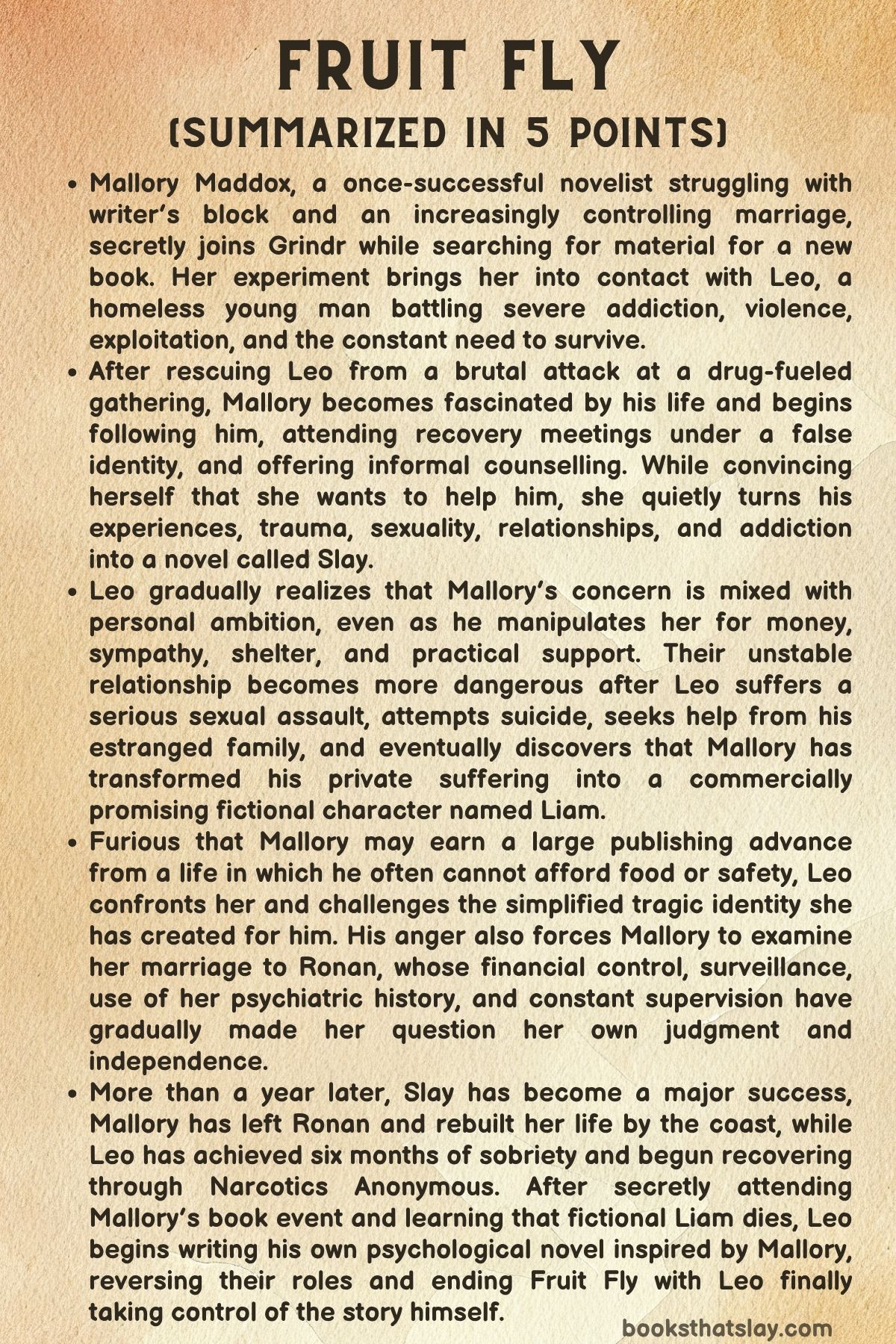
Mallory Maddox appears to have everything that should make her happy. She lives in an expensive North London home with her successful husband Ronan, once wrote a bestselling novel called Shallow Embers, and moves among people whose careers and lifestyles suggest security, yet she feels increasingly detached from the life she has built.
Seven years have passed since her literary success, and Mallory has been unable to complete another book. Her agent has left her, another project was cancelled, she has spent time in psychiatric care, and she now presents herself as a therapist despite having only limited counselling training.
Ronan’s career has continued rising while hers has stalled. His professional confidence, financial control, and plans for them to have a child make Mallory feel that her identity is being reduced to that of a dependent wife who should be grateful for stability.
One evening, while searching online for ideas that might revive her career, Mallory encounters cynical advice suggesting that dark stories involving marginalized people are especially marketable. Thinking about her late gay brother Nick and the kind of material publishers might want, she begins imagining a novel centered on queer suffering.
Her curiosity leads her to Grindr. To create a convincing profile, she secretly photographs Ronan’s naked body while he sleeps and uses cropped images of him without his consent.
Mallory initially believes she is conducting harmless research. She contacts a man named Sam, known online as Daddy, and misunderstands his invitation to a “T-party,” imagining something far more innocent than the drug-centered sexual gathering he actually means.
Meanwhile, Leo is living inside a relentless cycle of addiction. He steals, deals drugs, sleeps in unstable places, owes money to dangerous people, and repeatedly uses substances because intoxication provides the temporary silence and relief he cannot find while sober.
Leo attends Sam’s gathering carrying drugs and stolen funeral flowers. The men there challenge him over money and the quality of substances he has previously supplied, and what begins as hostility quickly becomes a violent attack.
Mallory arrives outside the house and finally understands what kind of event she has entered. When she sees Leo being brutally beaten, her fantasy of daring literary research gives way to genuine horror, and she intervenes by getting him into her car and driving him away.
Leo refuses hospital treatment and is deeply suspicious of Mallory’s concern. He has learned that respectable people often turn vulnerable strangers into stories about their own kindness, so he assumes that her interest cannot be entirely selfless.
That suspicion is justified almost immediately. After returning home, Mallory begins writing, using the violence, atmosphere, and details of Leo’s life as material, and her long-standing creative block suddenly disappears.
Her fascination with Leo grows quickly. She begins following him, attending a recovery meeting under the false name Mandy, observing his behavior, and presenting herself as someone who understands addiction despite having no legitimate reason to be there.
Leo is equally skilled at performance. At the meeting he exaggerates certain parts of his suffering to provoke sympathy, while Mallory creates a false recovery history from pieces of her genuine emotional distress.
Their relationship develops because each believes the other can provide something necessary. Mallory wants access to Leo’s experiences so that she can write an authentic novel, while Leo sees Mallory as a possible source of money, shelter, attention, and practical help.
Mallory reconnects with literary agent Stanley Maier and begins developing a manuscript called Slay. Leo becomes the fictional Liam, while Mallory transforms herself into Mandy and adapts people around Leo into characters whose behavior can strengthen the novel.
Stanley responds positively but wants more specificity, emotional depth, and personal justification for Mallory’s authority to tell the story. Mallory therefore connects Liam to Nick, using her deceased brother’s sexuality and suffering as a bridge between herself and the material.
Leo eventually meets Mallory in a café. He invents a dramatic story about nearly being murdered in a canal because he hopes that frightening her will persuade her to bring him home, where he imagines stealing expensive belongings.
What Mallory does not realize is that Leo has discovered that Mandy is actually Mallory Maddox, a novelist. He chooses not to reveal what he knows because he wants to discover what she wants from him.
Their sessions become increasingly disturbing. Mallory asks about Leo’s childhood, addiction, education, relationships, and trauma while filling notebooks with details that will later become Liam’s history.
Leo reveals that he was once academically promising and loved writing. He also speaks about a sexual relationship with a teacher from his school years, forcing Mallory to confront the fact that she is hearing about abuse she is professionally unqualified to address.
When Mallory attempts to stop the discussion, Leo experiences her withdrawal as rejection. He demands money, leaves angrily, and soon steals an elderly woman’s handbag, knocking her to the pavement.
Mallory remains behind with her friend Joanie but lies about who Leo is and avoids involving the police. Once home, she again turns the frightening encounter into fiction, demonstrating how automatically she converts real harm into useful narrative material.
Leo feels guilt over the robbery but responds by taking more drugs. His addiction remains tied to his desire to erase fear, shame, memory, and physical discomfort as rapidly as possible.
He later tells Mallory more about his early life. Alcohol and drugs entered his world at a young age, and intoxication gradually became his most reliable method for escaping thoughts and emotions he could not manage.
At the same time, the novel reveals more about Mallory’s marriage. Ronan controls finances, monitors her phone and movements, repeatedly invokes her previous psychiatric hospitalization, and assumes that decisions about children and domestic life should proceed according to his expectations.
Mallory increasingly hides both Leo and Slay from him. Her creative revival becomes linked to secrecy because writing offers her an identity outside the version of herself Ronan supervises.
Leo’s life becomes even more dangerous when he visits Mo, a man connected to the chemsex world. After consuming a mixture of substances, Leo becomes incapacitated and is sexually assaulted by several men.
Traumatized, bleeding, intoxicated, and desperate, he goes directly to Mallory’s house. He demands shelter and accuses her of claiming that she wants to help while refusing to provide the safety he actually needs.
Mallory hesitates because allowing Leo inside would expose everything she has hidden from Ronan. Their argument wakes Ronan, who arrives carrying Mallory’s phone and discovers Grindr, the photographs Mallory secretly took of him, and evidence of her double life.
Leo flees. Overwhelmed by addiction, homelessness, assault, shame, and hopelessness, he enters a canal intending to die.
He survives and eventually decides that he wants to live. Believing his parents might help him recover, Leo returns home, only to find that years of broken promises and damage have exhausted their willingness to trust him.
His father refuses to finance another attempt at recovery, and Leo leaves. With nowhere else to go, he secretly enters Mallory’s garden and begins sleeping in her shed.
Mallory, meanwhile, is placed under even closer supervision by Ronan. Her mother Stacey comes to stay, supporting Ronan’s interpretation that Mallory is unstable, dramatic, and in need of control rather than autonomy.
Mallory outwardly obeys them while secretly continuing Slay. The publisher wants a stronger ending, and she becomes increasingly desperate because she believes the novel represents her only route back to professional and personal independence.
While hiding in the house, Leo discovers that Ronan is secretly taking explicit photographs of himself and sending them to someone. The discovery makes Ronan’s outrage over Mallory’s behavior appear hypocritical and gives Leo evidence that the marriage is far more complicated than Ronan presents.
Leo also discovers Mallory’s laptop and reads Slay. He recognizes himself immediately in Liam and realizes that Mallory has turned his addiction, sexuality, abuse, crimes, vulnerabilities, and suffering into fiction.
The discovery confirms one of Leo’s deepest fears. People do not merely look at him with disgust or pity; they also find his destruction interesting enough to inspect, package, and consume.
Mallory eventually learns that Mo has died and that police are looking for a young man connected to him. Before she can process what that might mean, Leo confronts her inside the house while carrying the laptop and a knife.
He has also discovered that Mallory has been offered a large advance for Slay. The financial difference between them intensifies his fury because Mallory may earn a fortune from experiences drawn partly from a man who frequently cannot afford food.
Leo refuses to accept her claim that she only wanted to help. He points out that while he lies and manipulates because he is trying to survive, Mallory entered his world from a position of safety and continued because his pain restored her career.
He also objects to the way Liam has been simplified. Leo reminds Mallory that he studied English at university, loved literature, writes poetry, thinks critically, and possesses a full inner life beyond drugs, sex, victimhood, and violence.
Ronan and Stacey are drawn into the confrontation. Leo argues that Mallory and he are more alike than she wants to admit because both are seeking warmth, safety, recognition, and escape from identities imposed upon them.
Leo then turns the knife toward himself. His question is not merely whether he will survive but whether Mallory believes someone like him is narratively destined to die because tragedy makes the story more powerful.
Mallory later transforms this confrontation into the ending of Slay. In her fictional version, Liam is attacked by Mandy’s abusive husband and dies, allowing Mallory to shape chaos into a dramatic ending that the publishing industry accepts.
More than a year later, Slay has become an enormous success. Mallory is separated from Ronan, living on the coast, receiving proper therapy, and presenting a public version of herself as a survivor who rebuilt her life through writing.
The publishing industry turns her transformation into another product. Interviews, publicity, social media, branding, and carefully staged vulnerability create a polished public identity around a novel supposedly concerned with authenticity.
Leo, however, is alive. He has been sober for six months, attends Narcotics Anonymous, has a sponsor named Debbie, and is slowly learning that painful emotions do not have to be immediately erased through substances.
He secretly attends one of Mallory’s major book events. From the audience, he hears Mallory claim that Liam was inspired by Nick rather than acknowledging that a living person supplied much of the material.
Outside, Leo learns from publishing professionals that Liam dies in the published version. The discovery hurts because Mallory has given the fictional version of him the tragic ending he feared she had always expected.
Yet Leo also learns something useful from the industry conversations surrounding Slay. Publishers are searching for dark, marketable stories, and he begins recognizing that the same machinery that used his life might also be something he can use.
Mallory continues her new life by the sea, hoping Leo survived and found a future beyond what happened between them. She cannot entirely separate herself from him because his presence continues to influence the way she understands writing, pain, morality, and survival.
Leo begins spending his days in a library writing his own novel under the name Luke. He submits The Poet Acts, a psychological horror story about a man abandoned by his therapist who follows her, enters her home, frightens her, and makes her question her own mind.
Stanley responds enthusiastically and encourages him to make the story darker. Leo then stands outside Mallory’s coastal home, looking through the window at the woman who once turned him into her protagonist.
The relationship between author and subject has reversed. Mallory once believed she controlled Leo by deciding how Liam’s story should end, but Leo now possesses the ability to transform Mallory into fiction and decide what kind of story she will inhabit.
The novel closes without resolving whether Leo intends revenge, artistic reclamation, manipulation, or some unstable combination of all three. What is certain is that he has recovered the power to write himself rather than existing only as material inside somebody else’s narrative.
Characters
Mallory Maddox
Mallory is one of the two central figures in Fruit Fly, and much of her characterization depends upon the gap between how she sees herself and how her actions appear from outside. She thinks of herself as intelligent, progressive, compassionate, creative, and capable of recognizing suffering, yet her obsession with becoming a successful writer again repeatedly causes her to cross ethical boundaries.
Her writer’s block has become inseparable from her identity crisis. Losing literary success has left her feeling that the most important version of herself disappeared years earlier, so the sudden return of creativity after meeting Leo feels almost like recovering a missing part of her personality.
That excitement makes her increasingly willing to justify intrusion. She photographs Ronan without consent, creates a fake Grindr account, enters a recovery meeting dishonestly, follows Leo, investigates people around him, and records intensely private disclosures while telling herself that artistic research and therapeutic concern make her behavior acceptable.
Mallory is not emotionally indifferent to Leo. She worries about him, rescues him from violence, fears that he may have died, and eventually recognizes that she has reduced a living person into a character whose pain can be arranged for maximum effect.
Her marriage further complicates her morality because Mallory is also living under control. Ronan supervises finances, monitors her phone, interprets her actions through her previous psychiatric hospitalization, and gradually makes her doubt whether she is capable of trusting her own judgment.
Mallory therefore occupies the uncomfortable position of being both exploited and exploitative. Her eventual separation from Ronan gives her greater independence, but the success of Slay ensures that she cannot simply erase the moral cost of the process that restored her career.
Leo
Leo is the emotional and moral counterweight to Mallory in Fruit Fly. He is homeless, addicted, sexually exploited, financially desperate, frequently dishonest, sometimes violent, and capable of harming innocent people, yet the novel repeatedly refuses to let these behaviors become a complete definition of who he is.
His manipulation is usually conscious. He invents stories, exaggerates danger, performs vulnerability, reads other people quickly, and uses sympathy because experience has taught him that straightforward requests for help rarely produce what he needs.
At the same time, the things he manipulates people with are often rooted in genuine pain. He really is homeless, traumatized, hungry, addicted, frightened, lonely, and repeatedly exposed to people who treat his body or suffering as something they can use.
Leo’s poetry reveals the part of him that other characters repeatedly overlook. Beneath the defensive humor and destructive behavior is an intelligent young man who once loved literature, attended university, and possesses a strong ability to observe both himself and the hypocrisy of others.
His addiction is presented as an attempt to silence an unbearable internal noise. Drugs provide warmth, quiet, detachment, and relief, which explains why sobriety requires more than simply deciding that substances are harmful.
His recovery becomes meaningful because he gradually learns to experience pain without immediately destroying consciousness. By the end, Leo is writing again, and authorship becomes a form of reclaimed power because he can finally create a narrative rather than merely appearing inside someone else’s.
Ronan
Ronan occupies one of the most morally complicated positions in Fruit Fly because his controlling behavior often appears in the language of responsibility. He is professionally successful, socially charming, materially generous, and skilled at convincing other people that his management of Mallory is necessary because she has previously experienced serious psychological instability.
His power is rarely presented through obvious cruelty at first. Instead, it appears through finances, phone access, location monitoring, decisions about treatment, reproductive expectations, and repeated reminders that Mallory has made irrational choices before.
This method gradually weakens Mallory’s confidence in her own perceptions. Ronan becomes the person who defines whether she is healthy, reasonable, safe, responsible, or unstable, making resistance difficult because disagreement can itself be presented as proof that she needs supervision.
The discovery that Ronan privately sends explicit photographs of himself complicates the moral authority he claims after finding Mallory’s Grindr profile. His secrecy demonstrates that he also maintains a hidden self while insisting that Mallory surrender hers.
Ronan may believe that some of his behavior is protective, but intention does not erase its effect. By the time Mallory leaves the marriage, she has begun distinguishing care that supports another person from care that makes independence increasingly difficult.
Stacey
Stacey, Mallory’s mother, represents the social history that helped shape Mallory long before Ronan entered her life. She has worked hard to escape financial insecurity and social stigma, so she values respectability, stability, appearance, and material security with an intensity that Mallory experiences as emotionally restrictive.
Her reaction to Mallory’s marriage is strongly influenced by this background. Ronan appears to offer exactly the secure middle-class life Stacey spent years trying to achieve, making it difficult for her to recognize why Mallory might feel imprisoned inside something Stacey considers successful.
Stacey also distrusts Mallory’s tendency to construct dramatic explanations for her unhappiness. She interprets Mallory’s behavior as immaturity and believes gratitude, marriage, motherhood, and routine would provide the stability her daughter needs.
This attitude makes Stacey an ally of Ronan during Mallory’s crisis. However, her behavior is not based simply on cruelty; it emerges from a worldview in which survival depends upon suppressing disorder and protecting whatever security has already been obtained.
Her limitations help explain Mallory’s lifelong hunger for emotional recognition. The daughter who repeatedly seeks validation through writing, romance, and rescue has grown from a family environment where practical survival often mattered more than openly expressing fear or vulnerability.
Nick
Nick is dead before the events of Fruit Fly, but he remains central to Mallory’s understanding of herself. As her gay brother, he becomes associated in her memory with childhood comfort, sexuality, marginalization, grief, and the emotional intimacy she feels she lost after his death.
Mallory initially uses Nick partly as moral justification for Slay. When Stanley wants a stronger personal connection between her and Liam, Nick allows Mallory to position herself as someone whose relationship with queer suffering gives her a legitimate reason to write Leo’s story.
Yet Nick also exposes the weakness in Mallory’s thinking. She believes she understands her brother because she loved him, but love does not grant complete access to another person’s private experience.
Stacey challenges Mallory’s preferred account of the family past, forcing her to recognize that memory is shaped by need, grief, and interpretation. Mallory eventually understands that she can no longer ask Nick what he actually felt, just as she has been inventing inner motives for Leo rather than respecting the limits of what she knows.
Nick therefore becomes more than backstory. His absence demonstrates the danger of assuming that affection automatically gives someone ownership over another person’s pain.
Joanie
Joanie represents Mallory’s connection to the person she was before marriage, professional disappointment, and psychological crisis reshaped her life. Their old friendship contains memories of recklessness and intimacy, but the present relationship has become guarded and uncertain.
When Joanie sees Mallory with Leo after the handbag robbery, her reaction exposes how difficult Mallory’s behavior has become to defend. She recognizes immediate danger where Mallory keeps constructing elaborate explanations about therapy, confidentiality, responsibility, and rescue.
Joanie also functions as a reminder that Mallory’s isolation is not entirely imposed upon her. Mallory has allowed secrecy and shame to create distance between herself and people who might challenge her more honestly than Ronan does.
Their interactions show how friendship can erode when one person becomes invested in maintaining a hidden identity. Mallory wants Joanie’s understanding but does not want the scrutiny that genuine closeness would require.
Stanley Maier
Stanley is Mallory’s literary agent and one of the clearest representatives of the publishing industry inside Fruit Fly. He recognizes commercial potential in Slay and encourages Mallory to make Liam more specific, emotionally complex, personally connected to her, and narratively compelling.
Stanley is not portrayed as uniquely malicious. His suggestions follow recognizable professional logic: characters need depth, manuscripts need clear emotional stakes, and publishers need stories that can be positioned successfully.
The ethical problem emerges because those ordinary editorial demands are being applied to material taken from a vulnerable real person. Every request for greater authenticity encourages Mallory to gather more of Leo’s life while every demand for stronger drama increases the temptation to exaggerate or reshape what she discovers.
Stanley later responds positively to Leo’s writing under the name Luke, again encouraging darkness and stronger threat. This parallel suggests that the industry itself is less concerned with moral purity than with whether pain has been transformed into a form readers will buy.
Sam
Sam, who uses the name Daddy online, belongs to the drug-centered sexual environment through which Mallory first encounters Leo. His relationship with Leo is based on drugs, debt, power, access, and conditional usefulness rather than security.
Leo understands that Sam can provide temporary belonging while also recognizing that he has little protection within Sam’s world. When violence erupts, the people surrounding Leo are far more interested in debts and substances than in his safety.
Sam therefore represents one of the environments in which Leo has learned that intimacy is transactional. Attention can disappear instantly when he ceases to provide what other people want.
Mo
Mo embodies some of the most dangerous aspects of Leo’s social world. Mallory investigates him through Grindr and quickly turns what she learns into material for the villain in Slay, but Leo’s direct experience of Mo becomes far more serious than anything Mallory can safely observe.
The assault at Mo’s home marks one of Leo’s lowest points. Drugs destroy his ability to meaningfully resist, multiple men use his incapacitation against him, and the event leaves him physically injured and psychologically shattered.
Mo’s later death adds another layer of uncertainty. Leo becomes connected to police suspicion, while Mallory immediately begins wondering whether he may have been responsible.
The character also demonstrates the difference between writing danger and living inside it. For Mallory, Mo can become an antagonist whose function is controlled by narrative structure; for Leo, men like Mo are unpredictable realities whose actions can permanently alter his life.
Kerry
Kerry works in Leo’s supported accommodation and represents institutional care at its most frustrating and necessary. She recognizes his injuries, knows his medical history, understands the dangers surrounding his substance use, and attempts to set boundaries intended to keep him alive.
Leo experiences those same actions as judgment and intrusion. His shame and fear make ordinary questions feel accusatory, particularly when Kerry raises drug use, sexual health, treatment, and responsibility.
Their conflict demonstrates why support systems cannot succeed through availability alone. Leo must also be psychologically able to tolerate structure, accountability, and concern, which are precisely the things his experiences have trained him to distrust.
Debbie
Debbie becomes Leo’s sponsor during the recovery period near the end of Fruit Fly. Her importance comes from the fact that she refuses the fantasy of rescue that has shaped so many of Leo’s previous relationships.
She does not promise that another person will arrive and fix his life. Instead, she gives him ordinary responsibilities: stay sober, make the bed, accept difficult feelings, follow basic routines, and recognize that building a different life requires repeated action.
Her bluntness contrasts with Mallory’s grander desire to save Leo. Debbie offers something less dramatic but more sustainable because her support does not require Leo to become a fascinating character, a grateful victim, or proof of someone else’s goodness.
Through Debbie, recovery becomes practical rather than theatrical. Leo begins learning that survival can consist of small choices repeated long enough for a different identity to form.
Brick
Brick is one of Leo’s dealers and contributes to the threatening network of obligation surrounding his addiction. Leo owes him money and treats every interaction as a calculation involving danger, humiliation, substances, and escape.
Their scenes emphasize how addiction creates dependency not only on chemicals but also on people who control access to them. Leo’s sharp internal mockery of Brick gives him a temporary sense of superiority, but materially he remains dependent upon someone he dislikes and fears.
Brick therefore helps establish the structure from which Leo must eventually escape. The drug itself is only one part of that structure; debt, criminal exposure, unstable relationships, and constant threat are equally important.
Tommy
Tommy is another dealer Leo turns to when guilt and anxiety become overwhelming. His role is smaller than Brick’s, but he appears at a moment when Leo is deliberately seeking extreme intoxication rather than simple relief.
After the handbag robbery, Leo wants several substances at once so that he can disappear completely from his own consciousness. Tommy provides access to that possibility.
His presence reinforces the ease with which Leo can move from emotional crisis to chemical self-erasure. The network is always available when Leo is most vulnerable, which makes sobriety a battle against both internal craving and an external environment organized around immediate access.
Brenda
Brenda is the elderly woman whose handbag Leo steals. She has little direct narrative space, yet her presence is essential because she forces the story to acknowledge that Leo’s suffering does not make him incapable of harming other vulnerable people.
Leo initially reduces the robbery to survival logic. He needs money, older people may carry cash, and therefore Brenda becomes a target rather than a person.
His later concern about whether she has died shows that his conscience has not disappeared. Brenda therefore prevents Leo from becoming a simplified victim by demonstrating that damaged people can also cause damage, even when the causes of their behavior remain understandable.
Meghan
Meghan is Mallory’s young publicist and initially appears to embody the artificial language of contemporary literary promotion. She carefully manages photographs, audience expectations, emotional presentation, and Mallory’s public image, even instructing her to appear nervous because vulnerability suits the brand being created around her.
Later, however, Meghan reveals that she survived an emotionally abusive relationship and found genuine meaning in Slay. The disclosure forces Mallory to recognize a person beneath the professional persona.
That moment complicates the novel’s criticism of publishing. Manufactured publicity can be artificial while the responses readers and workers have to stories can still be real, private, and meaningful.
P.K. Anderson
P.K. Anderson is the enormously successful writer Mallory once envied and later appears as the interviewer at her major public event. P.K.’s presence symbolizes the level of literary recognition Mallory spent years believing she had lost permanently.
During the interview, P.K. asks about Liam’s inspiration. Mallory responds by emphasizing Nick rather than Leo, protecting the public narrative surrounding the book while continuing to hide the living person whose experiences contributed heavily to it.
P.K. therefore becomes an unwitting participant in the process through which a messy reality is turned into a clean literary story. The polished conversation onstage contrasts sharply with Leo’s anonymous presence at the back of the room.
Julian
Julian is a publishing editor Leo meets outside Mallory’s event. Their conversation gives Leo an accidental education in how Slay has been marketed, discussed, and converted into industry success.
Julian casually reveals that Liam dies in the published novel, information that deeply affects Leo because it confirms his fear that Mallory ultimately imagined his life through a tragic ending. He also talks openly about publishing trends and what kinds of darkness the market may want next.
Without realizing it, Julian helps Leo understand how to enter the same system that profited from a fictional version of him. The conversation contributes directly to Leo’s decision to reshape his own experience into material that Stanley might want.
Themes
Storytelling, Ownership, and the Ethics of Using Another Person
The central moral conflict in Fruit Fly concerns who has the right to turn lived experience into narrative. Mallory believes that fiction transforms reality enough to make her use of Leo’s experiences defensible, yet the closer she moves toward authenticity, the more aggressively she invades his privacy.
Her research gradually becomes a form of possession. She watches Leo, follows him, questions him, records details about his trauma, investigates his contacts, and changes pieces of his identity whenever Stanley suggests that Liam needs stronger characterization.
The ethical issue becomes sharper because Mallory profits from experiences Leo can barely survive. A large publishing advance is offered for a story based partly on a man who often lacks food or secure shelter, creating a disturbing contrast between literary value and material poverty.
Leo’s anger therefore concerns more than factual accuracy. What hurts him is the discovery that Mallory has decided which parts of his life matter, which wounds define him, what motives he possesses, and whether the fictional version of him deserves to live.
The ending reverses this relationship when Leo begins writing about Mallory. The shift does not necessarily make his intentions morally cleaner, but it demonstrates how authorship can function as power: the person controlling the narrative can decide what another life means.
Addiction, Escape, and Learning to Endure Pain
Leo’s substance use is repeatedly presented as an attempt to escape consciousness rather than a simple desire for pleasure. Drugs provide warmth, silence, beauty, detachment, and temporary freedom from the relentless mental noise that has troubled him since childhood.
His poetry about waves makes this connection especially clear. Even before severe addiction, Leo longed for sensations powerful enough to drown out the internal hum he found exhausting.
As his life becomes more traumatic, substances become more necessary to him because every new humiliation creates another emotion he does not know how to tolerate. Violence produces craving, guilt produces craving, sexual assault produces craving, rejection produces craving, and even attempts at recovery produce discomfort that tempts him back toward chemical relief.
Recovery therefore cannot be reduced to abstaining from drugs. Leo must learn an entirely different relationship with distress.
Debbie’s guidance becomes important because she teaches him that painful feelings can exist without requiring immediate annihilation. Crying, craving, resentment, loneliness, and grief remain present, but Leo slowly discovers that surviving an emotion is different from eliminating it.
His six months of sobriety do not create a perfect new life. They show instead that recovery begins when pain is no longer automatically treated as something that must be erased before the next moment can be endured.
Safety, Control, and the Desire to Be Seen
Both central characters spend much of Fruit Fly searching for safety, although their material circumstances are radically different. Leo wants food, shelter, physical protection, sobriety, kindness, and relief from people who treat his body as something available for use.
Mallory possesses material security but lacks emotional independence. Her beautiful home gradually feels like a controlled environment in which Ronan manages money, communication, movement, reproduction, and even the interpretation of her own mental state.
This contrast allows the story to distinguish security from safety. A person can live in luxury and still feel psychologically trapped, while another person can have almost nothing and still recognize moments of safety through kindness, warmth, poetry, or genuine connection.
Leo eventually tells Mallory that the two of them want similar things. Beneath their performances, both are frightened people trying to find someone or somewhere that allows them to stop defending themselves.
Their methods are often destructive because each confuses safety with control. Mallory attempts to control Leo through understanding and narration, Leo manipulates people to secure resources, and Ronan maintains control over Mallory while describing his behavior as protection.
The novel ultimately suggests that genuine safety cannot depend upon reducing another person’s autonomy. Recognition, boundaries, honesty, and the ability to exist without constant performance provide something neither surveillance nor rescue can create.
Pain, Authenticity, and the Marketplace
Pain becomes a form of currency throughout the novel. Publishers want emotional intensity, social relevance, darkness, authenticity, and characters whose suffering can be converted into experiences powerful enough to attract readers.
Mallory gradually recognizes that the literary world organizes human pain into marketable categories. Addiction, sexuality, abuse, trauma, mental illness, poverty, relationships, identity, and recovery all become material that can be packaged, branded, promoted, photographed, and sold.
Her public image becomes part of the same process. Once Slay succeeds, Mallory herself is transformed into a story about survival, courage, vulnerability, and artistic rebirth.
Even apparent authenticity becomes managed. Meghan tells Mallory how to look in photographs because nervousness fits her brand, while interviews turn complex personal history into clean explanations that audiences can understand quickly.
Leo recognizes the same mechanism from the opposite position. His raw life initially becomes profitable only after Mallory rearranges it into Liam’s tragedy, but he later studies what the industry wants and begins adapting his own fiction accordingly.
The theme is not simply that commercial storytelling is dishonest. Readers can genuinely recognize themselves in fictional pain, as Meghan does, but the novel remains suspicious of systems that reward suffering most generously after it has been shaped into something emotionally satisfying, narratively controlled, and easy to consume.