Gingerbread Bones Summary, Characters and Themes
Gingerbread Bones by Lindsay Lovise is a young-adult survival horror novel that combines reality television, family betrayal, supernatural terror, and the consequences of adults exploiting vulnerable teenagers.
Sixteen-year-old Georgie Leider enters the Maine wilderness expecting an unpleasant reality-show experience engineered by her image-conscious stepmother, Ashley, only to discover that the abandoned camp chosen for filming carries a violent past. As adults disappear, bodies begin turning up, and a mysterious woman stalks the teenagers, Georgie must depend on her brother Hamish and a group of troubled strangers. The deeper danger ultimately reaches into Georgie’s own family history, transforming the wilderness ordeal into a confrontation with guilt, abuse, identity, and survival.
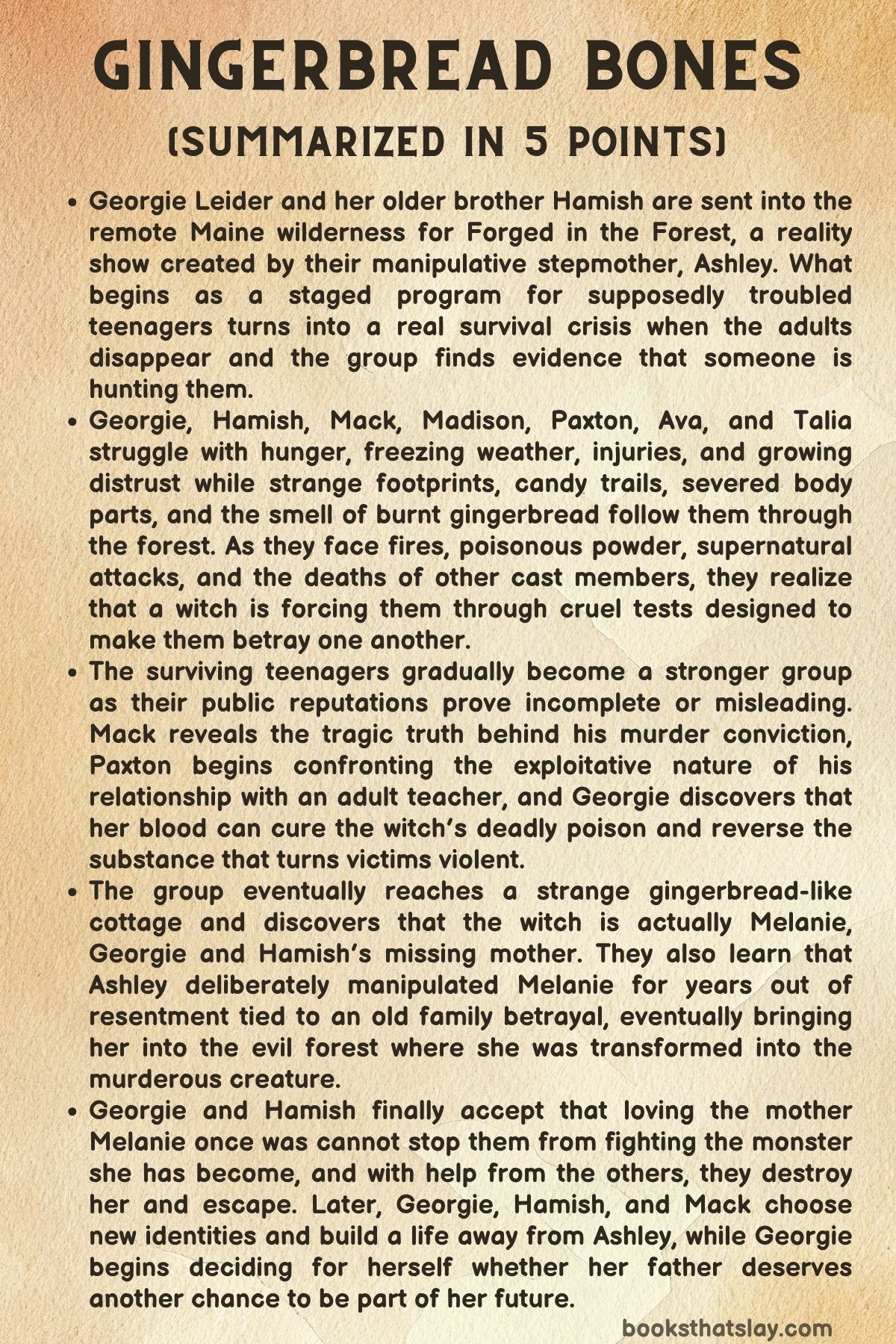
Summary
Sixteen-year-old Georgie Leider travels into northern Maine with her older brother Hamish to participate in Forged in the Forest, a reality program created by their stepmother Ashley. The show supposedly intends to reform teenagers with behavioral problems, but Georgie immediately suspects that Ashley cares far more about ratings, public attention, and humiliating her stepchildren than about helping them.
Georgie already distrusts Ashley because the woman was once the best friend of Georgie’s mother, Melanie, before Melanie mysteriously disappeared. Ashley later married Georgie’s father and cultivated a wholesome parenting persona online, while privately treating Georgie and Hamish with hostility and manipulation.
At the wilderness staging point, Georgie and Hamish meet the adults responsible for the production and the other teenage participants. The cast includes the arrogant Paxton, brilliant hacker Madison, gentle Ava, volatile Talia, mysterious Mack Gray, and several others whose personal scandals have been turned into marketable identities by FilmStream.
After a difficult three-day hike, the group reaches an abandoned location once known as Camp Recovery. The former institution had supposedly been designed to reform troubled teenagers, but its counselors used cruel psychological methods until several young people died, leaving behind stories about an evil influence in the surrounding forest.
The adults soon begin disappearing. Survival specialist Rick and psychologist Mazie vanish first, their tents apparently torn apart, and several teenagers leave camp with cameraman Walker in hopes of finding civilization.
Georgie remains with Hamish, Mack, Madison, Paxton, Ava, Talia, and cameraman Evan. Their situation becomes more frightening when they discover that Evan has been manufacturing scares for the program, confirming that the production team is willing to traumatize the cast for dramatic footage.
Evan then disappears for real. While searching for water and trying to navigate the increasingly silent forest, the teenagers find his severed hand, still wearing his expensive watch.
Mack examines the injury and determines that the hand almost certainly belonged to Evan while he was alive rather than being a television prop. The discovery forces the group to accept that an actual attacker may be hunting them, even though no one yet understands whether the threat is human or supernatural.
As food runs out, the teenagers begin adapting to genuine survival. Hamish becomes a natural leader, Mack proves unexpectedly capable in dangerous situations, Madison applies her intelligence to navigation and strategy, and Ava contributes knowledge of plants and basic care.
Georgie gradually becomes closer to the others, particularly Mack. His intimidating appearance and murder conviction initially make her suspicious, yet his actions repeatedly show restraint, loyalty, and concern for the group.
Signs of a stalker become impossible to ignore. Small square-heeled footprints appear around their campsites, candy is deliberately left behind, and Evan’s buried hand is dug up and placed near the sleeping teenagers.
The group eventually discovers running water, but their route is suddenly blocked by a massive forest fire. They flee through the smoke toward a stream, where Hamish helps Georgie overcome her fear of deep water and reach the opposite bank.
Across the river, Georgie and Hamish see a dark-haired woman standing calmly before the flames. The impossible figure disappears soon afterward, but the smell of burnt gingerbread remains, connecting her with the strange signs that have followed the teenagers through the forest.
That night, the woman attacks Georgie directly and drags her into the woods with unnatural strength. Georgie manages to injure her with sharpened wood, establishing that the creature can be physically harmed even though she is clearly not an ordinary person.
Soon afterward Alicia, one of the teenagers who left the original camp, returns badly wounded. She explains that the mysterious woman hunted the others before an unnatural infection spreads through Alicia’s body and kills her in front of the group.
The teenagers increasingly understand that they are being forced through a deliberate series of tests. White powder placed along their route can turn victims violent, and both Talia and Georgie temporarily lose control after exposure to it.
They later reach a chasm equipped with a mechanical crossing system apparently designed to force one person to remain behind. Mack volunteers to operate it for everyone else and then risks his life crossing without assistance, allowing the group to defeat a challenge intended to make them sacrifice one another.
The enraged witch retaliates with supernatural poison. Madison is wounded, and black veins begin spreading through her body in the same manner that killed Alicia.
Desperate for a cure, Madison theorizes that Georgie and Hamish may possess some unusual resistance because both have survived direct contact with the witch. Georgie allows Madison to drink some of her blood, and after a frightening reaction, the black infection disappears completely.
During a later night watch, Mack finally explains the truth behind his murder conviction. He had an identical twin named Mason whose cruelty escalated from torturing animals to threatening people, and Mack ultimately killed him while trying to stop him from causing further harm.
Georgie recognizes that Mack, like her, has allowed guilt to define much of his identity. Their growing attraction becomes more emotionally significant because each understands what it means to be judged by a simplified story while carrying a far more complicated history.
The witch continues trying to turn the teenagers against one another. Mack and Paxton inhale more of the controlling powder and become violent, but Georgie discovers that her blood can also neutralize this poison, restoring both boys.
Repeated attempts to divide the survivors instead strengthen their loyalty. Even Paxton, who once appeared selfish and dismissive, begins acting as part of the group rather than treating everyone else as expendable.
Following another trail of candy and the increasingly powerful smell of gingerbread, the survivors finally reach an impossible cottage resembling the gingerbread house from a fairy tale. Through a window they see Talia, and Georgie decides they cannot leave her behind.
Inside, they discover that Talia has already been killed and butchered. The witch captures Georgie and Hamish, but her appearance and familiar behavior awaken Georgie’s childhood memories.
The monster is their missing mother, Melanie.
Melanie has not aged normally and has become the creature responsible for poisoning, hunting, killing, and consuming people in the forest. Her recognition of Georgie and Hamish also explains their unusual resistance to her supernatural powers and the healing properties of their blood.
The truth about Ashley then becomes clear. Years earlier, Georgie’s grandfather had an affair with Ashley’s mother, contributing to the collapse of Ashley’s family and leaving Ashley with a deep resentment toward Melanie, who continued enjoying the stable family life Ashley believed had been stolen from her.
Ashley deliberately befriended Melanie and spent years attacking her confidence. She encouraged Melanie’s fears about her marriage, appearance, parenting, and personal worth before eventually bringing her into the same forest associated with Camp Recovery.
The evil present there exploited Melanie’s vulnerabilities and transformed her into the witch. Ashley then stepped into the family Melanie left behind, marrying her husband and becoming stepmother to her children.
For Georgie, the revelation destroys the belief that she caused her mother to abandon the family. Her childhood guilt was based on a false assumption, because Ashley had systematically created the conditions that led to Melanie’s disappearance.
Yet learning that Melanie was manipulated cannot erase what she has become. The remaining fragments of maternal love inside the witch coexist with murderous hunger, and Georgie realizes that surviving requires separating the memory of her mother from the creature now wearing her face.
Melanie forces Georgie and Hamish into a deadly version of twenty questions during a grotesque family dinner. The siblings correctly determine that her favorite food is lamb, but the witch refuses to honor her promise of freedom and attacks them anyway.
Georgie fights back with a hidden knife as Hamish and eventually the other survivors join her. Paxton returns to help despite having a chance to flee, demonstrating how completely the ordeal has changed the relationships among the teenagers.
Together they trap the witch inside the burning cottage. Melanie’s supernatural form is destroyed as the gingerbread house collapses, and the oppressive presence that dominated the forest finally disappears.
The survivors are eventually found by a logging truck. Madison, Ava, and Paxton continue toward medical help, while Georgie, Hamish, and Mack persuade the driver to leave them at a remote gas station so they can disappear rather than return to Ashley, authorities, and relentless media attention.
The group agrees to claim that wolves caused the deaths because they assume no one would believe the truth about the witch. Madison later targets Ashley from a distance by leaking documents exposing unethical business relationships and signaling that she knows much more about Ashley’s past.
Two years later, Georgie, Hamish, and Mack have established new identities and begun rebuilding their lives. Hamish studies political science, Georgie continues her education, and her relationship with Mack has become part of the new family they created together.
Georgie’s father eventually finds her and admits that he failed both children by ignoring Ashley’s treatment of them and leaving Hamish to shoulder responsibilities that belonged to a parent. Georgie accepts his phone number without promising forgiveness, understanding that any future relationship will develop according to her own boundaries rather than someone else’s demands.
Characters
Georgie Leider
Georgie is the central character of Gingerbread Bones, and much of her development concerns the difference between being labeled difficult and actually being damaged by the environment around her. Her stealing, aggression, distrust of authority, and tendency to become “Full Georgie” initially appear to justify the image Ashley and FilmStream create for her, but the story gradually shows that those behaviors developed through grief, neglect, anger, and years of feeling powerless.
Her strongest relationship is with Hamish, whose protection has given Georgie a stability that their father failed to provide. Yet Georgie also carries intense guilt because she believes she somehow caused Melanie to disappear, and that false belief has influenced how she views herself for years.
The wilderness forces Georgie to reconsider the identities assigned to both herself and everyone around her. She learns that anger can be destructive, but she also discovers that refusing to suppress it entirely allows her to confront people who depend on her silence and fear.
Her relationship with Mack further changes how she understands judgment. By recognizing that his conviction does not explain his entire character, Georgie begins questioning whether her own mistakes should define her permanently.
The discovery that Melanie was manipulated rather than driven away by Georgie finally removes one of the deepest sources of her shame. By the end, Georgie is not transformed into a completely different person; instead, she becomes someone more capable of deciding which parts of herself deserve acceptance and which patterns she wants to change.
Hamish Leider
Hamish functions as Georgie’s protector, substitute parent, and most reliable emotional anchor throughout Gingerbread Bones. Although the reality program categorizes him as a violent teenager because of his history of fighting, his behavior in the wilderness reveals that much of his aggression is connected to years of protecting Georgie and managing responsibilities their father neglected.
He repeatedly places the group’s survival above his own comfort. He organizes shelter, helps prepare food, carries leadership responsibilities, assists Georgie through the river despite her fear of drowning, and consistently returns for people he could more easily abandon.
His protectiveness is admirable but also exposes how much childhood he has lost. Hamish has become accustomed to behaving like an adult because the actual adults in his family failed to create a secure home.
His relationship with Ava shows another side of him, especially when he responds to her scars with concern rather than judgment. His sensitivity toward her demonstrates that his physical toughness does not prevent him from being patient or compassionate.
When Melanie is revealed as the witch, Hamish suffers the same emotional shock as Georgie but quickly understands that their mother’s remaining affection can be used strategically. His ability to confront both love and horror at once makes him crucial to the final confrontation.
Mack Gray
Mack is initially one of the most threatening-looking participants in Gingerbread Bones, largely because the others know he has been convicted of killing someone. His silence, physical strength, experience with death, and reluctance to discuss his past encourage both the cast and the reader to wonder whether he is dangerous.
His behavior steadily challenges that assumption. Mack protects weaker members of the group, assists Hamish with difficult survival tasks, volunteers to risk his life at the chasm, and repeatedly places himself between Georgie and danger.
The revelation about Mason explains the guilt behind Mack’s withdrawn personality. Killing his identical twin was an act with terrible consequences, but it occurred after years of watching Mason’s cruelty grow and believing that no adult would intervene effectively.
Mack does not excuse what he did, which is important to his characterization. His struggle comes from accepting that an action can be both devastating and connected to an attempt to prevent something worse.
His relationship with Georgie develops because each recognizes shame in the other. Their attraction eventually becomes trust, and that trust allows Mack to imagine a future in which his worst moment does not automatically determine every remaining part of his life.
Madison
Madison is one of the most intellectually important characters in the novel. Her technological knowledge, analytical thinking, competitive personality, and willingness to question appearances repeatedly help the group distinguish genuine danger from manipulation.
FilmStream presents her as a troubled gaming addict and criminal hacker, but her actual history is more complicated. She used illegal technological methods to redirect money toward charitable causes, making her actions unlawful without making her motivations purely selfish.
Madison often approaches supernatural events like problems that can be studied. She analyzes trails, identifies patterns in the witch’s behavior, proposes theories about Georgie and Hamish’s resistance, and eventually risks drinking Georgie’s blood because the alternative is almost certain death.
Her courage is therefore intellectual as well as physical. She continues thinking even while poisoned and dying, demonstrating that knowledge becomes one of the group’s most effective survival tools.
After escaping, Madison remains active rather than simply disappearing into safety. Her exposure of Ashley’s unethical dealings shows that technology, previously treated as evidence of her delinquency, can also become a weapon against powerful adults who believe they can control public narratives.
Paxton
Paxton initially appears arrogant, self-centered, argumentative, and concerned primarily with preserving his own survival. In Gingerbread Bones, however, his defensive behavior is gradually connected to the public scandal involving his relationship with an adult teacher.
Paxton has internalized the idea that he participated in the relationship on equal terms and often presents himself as experienced or desirable. Georgie challenges this interpretation by forcing him to acknowledge that the adult had greater responsibility and power.
His selfishness remains real, particularly during the early survival conflicts and his secret decision to help Talia cross the chasm. Even so, the wilderness gradually pushes him toward responsibility for people beyond himself.
His return during the final confrontation is especially important because he could have escaped. By choosing to help Georgie and Hamish fight Melanie, Paxton rejects the purely self-protective identity he has displayed throughout much of the story.
He survives as a more complicated person than either the show’s scandal-driven version or his own confident performance suggests. His development reinforces the book’s larger argument that teenagers can make serious mistakes while still being shaped, exploited, or failed by adults.
Ava
Ava is quieter than several members of the group, but her compassion and practical knowledge make her increasingly valuable. Her familiarity with plants, injuries, and basic care allows her to support the survivors when professional medical help is completely unavailable.
Her severe scars reveal that she has experienced major trauma before entering the forest. She is initially uncomfortable exposing them, suggesting that survival involves not only physical danger but also the fear of being observed and judged.
Hamish’s respectful treatment of her becomes meaningful because he does not demand explanations or react with disgust. Their growing connection gives Ava an emotional relationship within the group that is based on care rather than spectacle.
Ava’s attempts to help Alicia and Madison also show the limits of compassion. She cannot save everyone, but she continues trying even after witnessing terrible deaths, which makes her emotional endurance as significant as her practical abilities.
Talia
Talia is one of the youngest participants and becomes increasingly unstable as the group’s circumstances worsen. Her irritability and difficult behavior initially cause frustration, but her age and fear make it clear that she is poorly equipped for the danger into which the adults have placed her.
Her exposure to the witch’s powder demonstrates how easily existing fear can be turned into violence. Once poisoned, she attacks the group and becomes evidence that the witch’s strategy involves encouraging the teenagers to destroy one another.
Talia later crosses the chasm with Paxton’s help because she is desperate to get away. That decision isolates her from the protection of the group and ultimately leads to her death.
Finding her butchered inside the cottage gives the final confrontation its most brutal evidence of the witch’s cannibalism. Talia therefore represents the catastrophic consequences of leaving frightened children to manage dangers created by adults.
Ashley Ouellette
Ashley is the principal human antagonist behind the events of Gingerbread Bones, even though she spends much of the wilderness narrative physically absent. Her public identity is built around parenting advice, image management, family values, and carefully controlled online presentation, while her private behavior toward Georgie and Hamish is manipulative and cruel.
Her connection to Camp Recovery reveals that her decision to use the location was personal rather than accidental. The discovery of her family history shows how resentment toward Melanie developed from the affair involving Georgie’s grandfather and Ashley’s mother.
Ashley responds to childhood pain by reproducing harm rather than confronting it. She deliberately enters Melanie’s life, attacks her confidence, manipulates her insecurities, and eventually brings her to the forest where Melanie is transformed.
Her later marriage to Melanie’s husband gives her revenge a particularly disturbing quality because she effectively occupies the family position from which Melanie has been removed. Ashley’s greatest power comes from controlling appearances, which is why Madison’s later attack on her public reputation is so fitting.
Melanie Leider
Melanie occupies the most tragic role in Gingerbread Bones because she exists simultaneously as Georgie and Hamish’s lost mother and as the supernatural creature hunting them. Her transformation forces the siblings to confront the painful difference between remembering who someone once was and accepting what that person has become.
Before her disappearance, Melanie was systematically weakened by Ashley’s manipulation. Ashley encouraged insecurity about her body, marriage, motherhood, and personal value until Melanie became vulnerable to the evil connected to the forest.
Fragments of her former identity remain after the transformation. Songs, memories, maternal affection, and hesitation around her children show that Melanie has not vanished completely, and this surviving attachment explains why Georgie and Hamish possess unusual resistance to her power.
Those remnants do not erase her murders or cannibalism. Georgie and Hamish ultimately understand that loving the person Melanie once was cannot require surrendering themselves to the monster she has become.
Her death therefore involves grief as well as survival. Killing her ends the supernatural threat while also forcing both siblings to accept that recovering the mother they remember is impossible.
Georgie and Hamish’s Father
Their father is defined largely by passivity. He allows Ashley to control the household, fails to notice or confront her treatment of his children, and leaves Hamish carrying responsibilities that should belong to a parent.
His failure is different from Ashley’s deliberate cruelty because he does not actively construct the abuse. However, his refusal to recognize what is happening still produces serious consequences.
When he finds Georgie two years later, he does not attempt to excuse himself. His admission that he failed both children gives Georgie the opportunity to decide whether any future relationship is possible.
Her decision to accept his number without promising forgiveness establishes an important boundary. Reconciliation becomes something he must earn rather than something Georgie owes him because he is her father.
BellaLeigh
BellaLeigh is Georgie and Hamish’s five-year-old half sister and remains outside the direct wilderness conflict. Her presence nevertheless emphasizes the complicated family structure Ashley has created after Melanie’s disappearance.
Hamish’s instinct to protect BellaLeigh as well as Georgie reinforces his tendency to assume responsibility for younger family members. She also represents an innocent connection to the household Georgie and Hamish eventually choose to leave behind.
Evan
Evan is a cameraman whose behavior exposes FilmStream’s willingness to manufacture emotional distress for entertainment. He deliberately provokes teenagers and plants a frightening sound device in the forest to produce stronger reactions on camera.
His disappearance marks the point where staged danger gives way to genuine horror. Finding his severed hand forces the teenagers to reconsider every assumption they have made about the production.
Evan is therefore both an exploiter and an early victim. His fate demonstrates that once the supernatural threat takes control, the adults who helped create the situation are no safer than the teenagers they intended to manipulate.
Walker
Walker is the second cameraman and follows Desiree’s group when they decide to leave the abandoned camp. His decision keeps the production element present even after the cast separates.
He later disappears along with most of that group. Although his role is less developed than Evan’s, his fate contributes to the growing realization that the forest is consuming everyone connected to the production.
Rick Detoy
Rick serves as the survival expert who should make the wilderness experience relatively controlled. His early disappearance removes one of the group’s most important sources of practical security.
After Rick vanishes, teenagers who were supposedly participating in a supervised television program must suddenly make genuine decisions about shelter, food, navigation, fire, and weather. His absence therefore helps expose how dangerously unprepared the production is once its planned structure collapses.
Mazie Hemsfield
Mazie is the psychologist attached to the reality program, but her interactions with Georgie suggest that her purpose is not purely therapeutic. She attempts to obtain emotionally revealing material from Georgie in ways that feel more connected to producing television than offering meaningful care.
Her disappearance removes the program’s supposed psychological authority. The teenagers are left without professional support precisely when the situation becomes most traumatic.
Jessica Vance
Jessica is the showrunner responsible for helping manage Forged in the Forest. She represents the production structure that turns troubled teenagers and their family crises into marketable entertainment.
Although she does not remain central once the cast enters the wilderness, her participation helps establish that the exploitation is institutional rather than the work of Ashley alone. FilmStream repeatedly values dramatic reactions over the emotional well-being of its teenage subjects.
Liam
Liam serves as one of the producers involved with the program. Like Jessica, his significance lies in the machinery surrounding the reality show rather than in a personal relationship with Georgie.
His presence reinforces the number of adults who participate in sending vulnerable teenagers into an unsafe environment. The later public scrutiny of FilmStream demonstrates that the disaster cannot be dismissed as a single individual’s mistake.
Desiree
Desiree is one of the teenagers who refuses to remain at the abandoned camp after the adults disappear. Her determination to leave reflects a reasonable fear, but it also divides the group at a moment when remaining together may have offered greater protection.
She later becomes one of the witch’s victims. The discovery of her finger in Melanie’s stew confirms the full extent of the creature’s cannibalism and eliminates any hope that the missing teenagers simply escaped elsewhere.
Alicia
Alicia originally joins the program after attacking her abusive stepfather while defending her mother. Her backstory therefore immediately complicates FilmStream’s portrayal of her as merely another violent problem teenager.
Her return from the forest is one of the story’s most disturbing moments because she provides direct evidence of what happened to the separated group. The black infection spreading from her mutilated ear eventually kills her despite Ava’s efforts to save her.
Alicia’s death also gives the survivors crucial information about the witch’s poisons. What happens to her later helps them recognize the danger when Madison is infected.
Devon
Devon joins Desiree’s group when they leave the original camp in search of safety. He disappears after the group encounters the witch.
Although the source provides limited individual development for him, his fate contributes to the scale of the disaster. His disappearance shows that leaving the camp does not offer protection from the creature controlling the forest.
Theo
Theo also departs with Desiree, Alicia, Devon, and Walker. Like Devon, he becomes one of the missing members whose presumed death demonstrates the consequences of the group’s early separation.
His limited characterization is itself consistent with the reality-show structure, where participants are initially reduced to cast members within a larger production. Once the supernatural crisis begins, those distinctions become horrifyingly literal as individuals disappear before the survivors can learn much about them.
Mason Gray
Mason is Mack’s identical twin brother and appears only through Mack’s memories, yet he is essential to understanding Mack’s character. From childhood, Mason displays increasingly severe cruelty, beginning with animals and eventually creating the fear that he will seriously harm another person.
His ability to manipulate situations is made more dangerous by his identical appearance to Mack. Mack’s difficulty convincing adults that Mason is dangerous leaves him feeling responsible for preventing whatever his brother might eventually do.
Mason’s death becomes the event that defines Mack publicly and psychologically. His role demonstrates how incomplete a criminal label can be when separated from the circumstances surrounding the act.
Georgie’s Grandfather
Georgie’s grandfather is largely a figure from the family’s past, but his affair with Ashley’s mother creates consequences that reach across generations. His actions contribute to the destruction of Ashley’s family and become part of the resentment Ashley later directs toward Melanie.
He is important because the conflict begins long before Georgie understands it. Choices made by one generation create emotional damage that later characters inherit without fully understanding its origin.
Ashley’s Mother
Ashley’s mother is another important figure whose influence exists mainly through backstory. Her relationship with Georgie’s grandfather contributes to the collapse of her marriage, and her later death by suicide becomes part of the traumatic childhood Ashley carries into adulthood.
Her suffering helps explain the origin of Ashley’s resentment without excusing Ashley’s later actions. The distinction is important because the novel repeatedly shows that being harmed does not automatically justify harming others.
Themes
Identity, Labels, and the Stories Others Create
The teenagers enter Gingerbread Bones carrying identities constructed by adults, media coverage, school discipline, criminal records, and family narratives. Georgie is the thief, Hamish is the fighter, Madison is the hacker, Paxton is the scandalous student, and Mack is the murderer, allowing FilmStream to market each person through a simplified description that generates conflict more easily than understanding.
The wilderness gradually exposes how inadequate those labels are. Georgie steals partly because she is angry and neglected but also because she wants scar treatment for Hamish, while Madison commits a serious crime for reasons that include helping others, and Mack’s murder conviction hides years of fear surrounding Mason’s escalating violence.
Paxton’s story similarly changes once Georgie challenges the way he describes his relationship with an adult teacher. What he initially treats as evidence of maturity begins to look like a situation in which an adult possessed greater power and responsibility than the teenager involved.
These complications do not erase wrongdoing. Instead, they demonstrate that an action and an identity are not identical, and understanding context is different from denying responsibility.
The reality show depends on denying such complexity because easily recognizable categories make better entertainment. Survival does the opposite, forcing the teenagers to judge one another according to behavior rather than reputation.
Guilt, Responsibility, and Forgiveness
Guilt shapes Georgie and Mack more powerfully than almost any external punishment. Georgie believes for years that she caused Melanie to leave, while Mack believes that killing Mason has permanently determined what kind of person he deserves to become.
Both characters eventually confront the difference between responsibility and self-destruction. Mack does not pretend that killing his brother was insignificant, but he begins accepting that the circumstances matter and that continuing to live does not mean celebrating what happened.
Georgie’s revelation is even more dramatic because the guilt controlling her life is based on something she did not cause. Ashley spent years manipulating Melanie, yet Georgie unconsciously accepted responsibility because children often interpret unexplained family breakdowns through their own behavior.
The novel also treats forgiveness carefully. Georgie’s father apologizes for his failures, but the apology does not automatically restore the relationship or entitle him to immediate closeness.
Accepting his phone number becomes an act of control rather than surrender. Georgie allows the possibility of future reconciliation while reserving the right to decide whether trust can actually be rebuilt.
In this way, forgiveness is separated from obligation. Healing does not require pretending that harmful choices never happened, and guilt becomes useful only when it leads toward honest responsibility rather than permanent self-punishment.
Exploitation by Adults and Failed Protection
Almost every major crisis begins with adults failing to protect young people. Ashley deliberately exploits Georgie and Hamish for revenge and attention, FilmStream converts teenage trauma into entertainment, and Camp Recovery represents an earlier system in which adults claimed to reform children while abusing them.
The reality program continues the same pattern in a newer form. Cameras, confessionals, staged scares, provocative questions, and sensational labels are presented as entertainment even though they depend on teenagers becoming frightened, humiliated, or emotionally exposed.
The adults repeatedly describe the young participants as problems while ignoring the conditions that shaped their behavior. Hamish fights after years of acting as Georgie’s protector, Alicia attacks an abusive stepfather while defending her mother, and Paxton is publicly defined by a relationship in which an adult teacher held greater authority.
Even Georgie and Hamish’s father fails through passivity. He does not engineer their suffering like Ashley, but he refuses to see enough of what happens inside his own home to protect them.
The teenagers survive only after adult authority effectively disappears. That reversal exposes the irony at the center of the story: the supposedly irresponsible children repeatedly demonstrate more loyalty, adaptability, courage, and accountability than the adults who claimed they needed correction.
Survival Through Solidarity Rather Than Sacrifice
The witch repeatedly tries to prove that fear will make people betray one another, and Gingerbread Bones answers that challenge through the survivors’ growing refusal to treat another person as expendable. The chasm mechanism makes this idea literal because it appears designed to demand that one teenager remain behind so everyone else can escape.
Mack’s willingness to take that position could have fulfilled the witch’s design, but the group finds a way for him to cross as well. Their success enrages the creature because they have rejected the assumption on which her game depends.
The poisoned powder serves a similar function by turning friends into attackers. Georgie’s blood becomes important not simply because it is supernatural but because she repeatedly uses it to restore Madison, Mack, and Paxton rather than abandoning them once they become dangerous.
Paxton’s return during the final battle completes his transformation. A boy who frequently argues for self-preservation voluntarily returns to help others when leaving would be safer.
Solidarity does not make the group harmonious. They fight, distrust one another, make selfish decisions, and sometimes cause real harm, but survival becomes possible because those failures do not permanently destroy cooperation.
The witch represents hunger without satisfaction, possession without love, and relationships based on consuming what another person can provide. The teenagers defeat that logic by creating a form of belonging in which survival is strengthened when people refuse to reduce one another to burdens, sacrifices, scandals, or labels.