Marion by Leah Rowan Summary, Characters and Themes
Marion by Leah Rowan is a psychological thriller that examines female fear, suppressed anger, abusive relationships, workplace exploitation, and the uncertain boundary between survival and revenge.
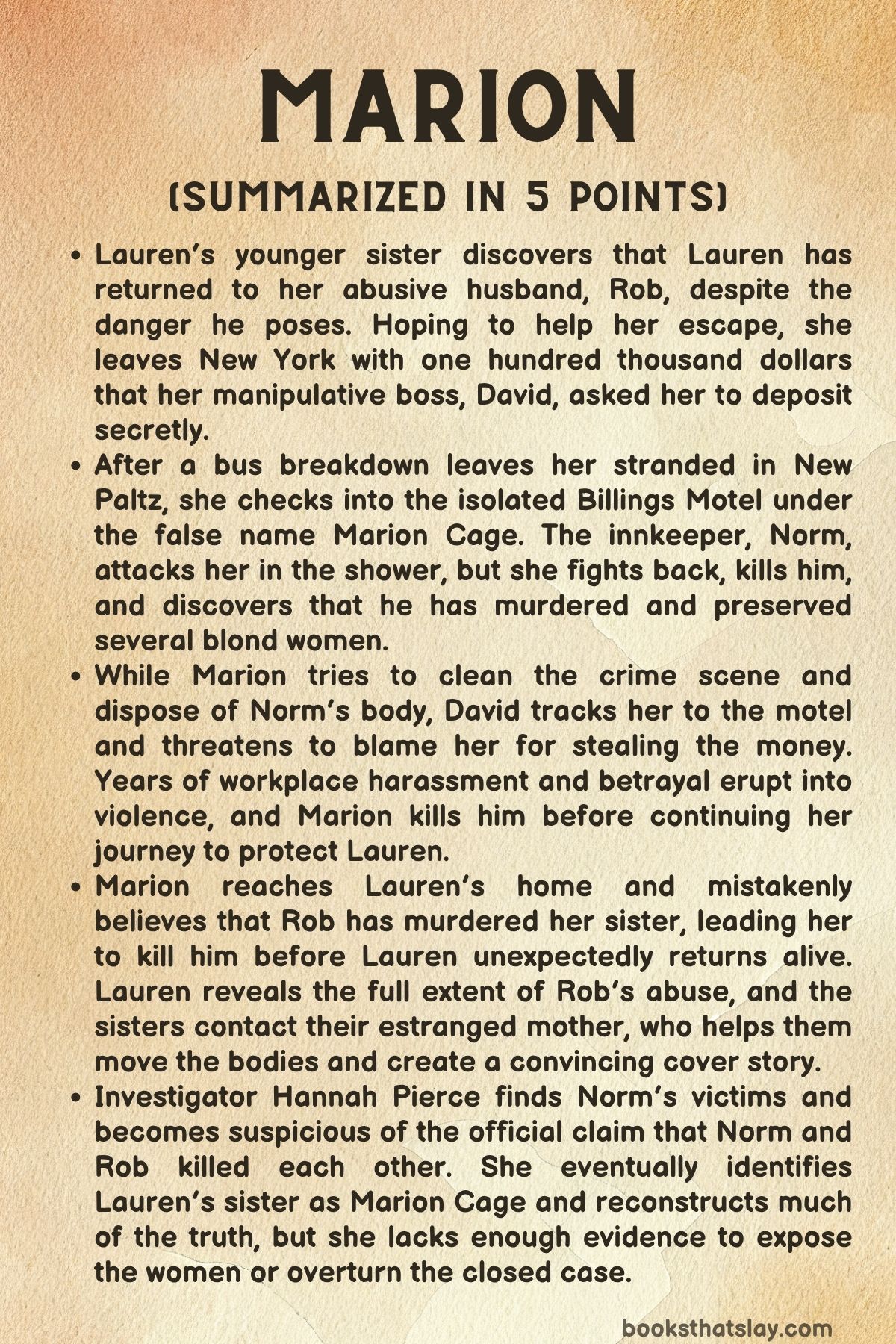
The story follows a woman who adopts the name Marion Cage after leaving New York with stolen money and checking into an isolated motel. When the innkeeper attacks her, she refuses to become the passive victim expected in a conventional horror story. Her act of self-defense begins a violent chain of events involving several deaths, an elaborate family cover-up, and a determined investigator who slowly reconstructs the truth. The novel repeatedly asks whether understanding violence is the same as excusing it.
Summary
On July 28, 2023, a young woman meets her older sister, Lauren, for lunch in Manhattan. Lauren has a bruise beneath her eye and a suitcase beside her, yet she announces that she intends to return to her husband, Rob.
Lauren had recently arrived at her sister’s apartment in tears and strongly suggested that Rob had hit her. His drinking, isolation, and temper have become increasingly dangerous, but Lauren refuses to describe the abuse fully and resents being treated like someone incapable of making her own decisions.
Leaving Rob would also involve serious financial losses. He owns half of Lauren’s interior-design business and shares ownership of the childhood home that contains the sisters’ memories of their deceased father and their estranged mother.
Lauren has secretly started saving money, but she believes she needs several years before she can escape without losing everything. Her sister warns that Rob may kill her before she becomes financially independent, and Lauren reluctantly agrees to stay in the city for another night while they form a plan.
Lauren’s sister returns to the advertising agency where she works and joins a meeting with her boss, David, and a skincare entrepreneur named Barry. David has repeatedly taken advantage of her professional talent while denying her the promotion she deserves.
David secretly plans to leave the agency and establish his own company. He promises to make her an associate creative director, double her salary, and hire their friend Rodrigo if she helps him deposit Barry’s one-hundred-thousand-dollar cash advance into his private account.
Although the arrangement appears illegal, she accepts because the higher salary could help Lauren escape Rob. The bank refuses the deposit because her name is not attached to David’s account, leaving her in possession of money that only David knows she carries.
When she returns home, Lauren is gone. A note claims that she has spoken to Rob, decided that the assault was an accident, and agreed to try therapy with him.
Convinced that Lauren is returning to serious danger, her sister packs clothing, documents, and the cash before leaving for Port Authority. She tells Rodrigo that she is travelling for a romantic encounter because she does not want to reveal Lauren’s abuse or the money in her bag.
She buys a bus ticket toward Saratoga Springs, intending to reach Lauren’s house. When the bus breaks down in New Paltz, she gives the last available room at an inn to a stranded mother and child and begins walking toward another motel.
A young police officer offers her a ride. Instead of taking her to the expected location, he drives her down a remote road to the Billings Motel, an isolated property operated by a handsome innkeeper named Norm.
Frightened that her real identity might create a trail, she invents the name Marion Cage. She pays in cash and becomes the motel’s only guest because Norm claims that renovations are about to begin.
Norm lives in a chalet above the cabins with his supposedly ill and bedridden mother. He invites Marion to dinner, prepares salmon and vegetables, and describes his life as a devoted caregiver who has sacrificed independence to remain beside his mother.
Marion is attracted to him, but she is disturbed by the noise, medical smells, and cold air coming from the locked downstairs bedroom. Norm becomes defensive whenever she approaches the room.
Later, Marion discovers that her garnet necklace is missing and returns to the chalet to search for it. She finds it near the mysterious bedroom, where Norm suddenly appears and reacts with anger before regaining his friendly manner.
Back in her cabin, Marion enters the shower. Norm pulls back the curtain while holding a knife, but she fights rather than freezing.
She injures him, takes the weapon, and stabs him repeatedly. Her fear changes into fury, and she continues attacking after he is no longer capable of harming her.
At the same time, twenty-four-year-old Hannah Pierce travels to New Paltz to investigate the disappearance of Emily Stockton, a young blond data engineer. Hannah works as a paralegal but hopes to prove that she deserves a permanent position as a private investigator.
Emily travelled from New York City to New Paltz and then vanished. Hannah questions local residents and learns that one blond woman was seen waiting nervously at a diner, while another short-haired blond woman later appeared carrying an old-fashioned motel key.
The key leads Hannah to the Billings Motel. She finds the property apparently deserted, with vehicles left outside, electricity still running, a hungry cat wandering the grounds, and one cabin key missing.
Meanwhile, Marion considers contacting the police after killing Norm. She decides that her false identity, stolen money, unexplained journey, and excessive use of violence would make her appear guilty.
She begins cleaning the cabin and discovers that Norm had installed hidden cameras. Recordings show him watching her undress and deliberately entering the bathroom with the knife, confirming that he intended to attack her.
Marion wraps Norm’s body in the shower curtain, places it in his Subaru, and plans to dump him in the Hudson River. Before leaving, she enters the downstairs bedroom because she fears that Norm’s helpless mother will die without care.
Inside, Marion finds the preserved body of a dead blond woman. Norm has shaved her head, applied cosmetics, surrounded her with medical equipment, and attempted to prevent her body from decaying.
Marion assumes that the woman is Norm’s mother and concludes that he may have intended to kill and preserve her as another helpless dependent. She drives away with Norm’s body but repeatedly returns to the property to remove evidence and retrieve the cash.
David tracks her through software installed on her work-connected phone and finds her in the cabin. He takes back the money and announces that he plans to blame Marion for stealing it because his scheme has been exposed.
David admits that he never intended to give her the promised promotion or salary. He says her appearance, rather than her talent, has carried her career and claims that she owes him sexual attention after years of working together.
The confrontation becomes physical. After David threatens to call the police, Marion strikes him with the landline telephone and strangles him with its cord.
Unlike Norm’s death, David’s killing cannot easily be described as self-defense. Marion is horrified because she knew him for years, yet she convinces herself that remaining free is necessary if she is going to save Lauren.
Hannah returns to the motel after following Myra, an older diner employee who reacted strangely when questioned about Norm. Myra enters the chalet, discovers the preserved woman, and reveals that she has keys to the property.
Hannah and Myra then find Norm and David decomposing inside the cabin. The bathroom has been cleaned, important items are missing, and the available evidence appears deliberately arranged.
Myra reveals that her full name is Myra Billings and that Norm is her estranged son. She is not the preserved woman in the chalet.
Hannah identifies the dead woman through her wallet and a heart tattoo. The victim is Emily Stockton, the woman Hannah was hired to find.
Police later discover another blond woman’s body in the cellar. Myra explains that Norm became obsessed with caring for her during two periods of cancer treatment.
After Myra recovered, Norm could not accept that she no longer needed him. He wanted her to remain in bed and dependent upon him, so she eventually left the motel and began travelling.
Hannah realizes that Norm selected blond women who resembled Myra. He killed, altered, and preserved them so that he could continue acting as an indispensable caregiver to women who could never recover or leave.
Marion reaches Lauren and Rob’s house after failing to contact her sister. Rob claims Lauren is shopping, but his evasiveness and the blood on his shirt make Marion believe he has killed her.
When Marion notices a rolled rug with what appears to be blond hair sticking from it, she assumes Lauren’s body is hidden inside. She attacks Rob with a geode, injures him, and strangles him with an electrical cord.
Lauren then walks through the door carrying groceries. The supposed hair is only the rug’s fringe, meaning Marion has killed Rob because of a mistaken assumption.
Instead of condemning her sister, Lauren thanks her. Rob had abused her for years, and she believed she might never escape him.
Marion confesses the deaths of Norm, David, and Rob. Lauren then reveals that their mother is not dead, as Marion told Norm, but has been estranged from them because of severe alcoholism.
Their mother arrives and listens without rejecting them. She explains that she knew Rob was abusing Lauren and once had him arrested, but Lauren refused to press charges and threatened to end contact if their mother involved her younger sister.
The three women create an elaborate cover-up. They return Rob’s body to the Billings Motel, place it beside Norm, and arrange the evidence to suggest that the two men killed each other.
David’s body is dumped in the Hudson River with cinder blocks. His wallet, phone, rental car, and the missing money are used to create the impression that he stole Barry’s payment and fled toward Canada.
Marion recreates the motel records so that Rob appears to have arrived after she left. She also visits the diner in a disguise, ensuring that witnesses remember the mysterious blond guest calmly leaving town.
The official theory becomes that Rob was connected to Emily and fought with Norm. Investigators accept that Norm stabbed Rob before being strangled, even though the room’s blood patterns, Rob’s unexplained head injuries, and the cleaned bathroom do not fit comfortably with that conclusion.
Hannah remains suspicious. She becomes a professional investigator after finding Emily, adopts Norm’s cat, and continues studying the evidence.
Months later, Marion has received the promotion David denied her. She lives with Lauren, their mother has agreed to enter rehabilitation, and the stolen money has helped the family rebuild.
Marion nevertheless suffers from nightmares and continues hearing the violent inner voice associated with her alias. She recognizes that this identity helped her survive and protect Lauren, but she fears it may emerge again.
Hannah eventually discovers Marion’s real identity through Lauren’s family connections, David’s disappearance, the bus breakdown, and witness descriptions of the short-haired blond guest. She confronts the sisters and accurately theorizes that Marion killed Norm and David before the women replaced David’s body with Rob’s.
Hannah lacks enough physical evidence to challenge the closed investigation. Marion dismisses the theory as an imaginative story, while Hannah promises to continue searching for proof.
The narrator ends by addressing the reader directly. She does not claim innocence, but she argues that female anger develops within a world where women constantly anticipate assault, harassment, abuse, and disbelief.
Marion represents the part of a woman that refuses to remain attractive, polite, compliant, or afraid. The narrator cannot promise that this violent identity has disappeared, leaving open the possibility that fear or injustice may awaken it again.
Characters
The Narrator and Her Alter Ego
The unnamed narrator begins the book as an intelligent and professionally capable woman who has learned to suppress anger in order to survive. She tolerates David’s harassment, accepts repeated career disappointments, conceals Lauren’s crisis, and follows social expectations that encourage women to remain calm even when they feel threatened.
Her transformation begins when she invents the identity of Marion Cage. The alias initially provides privacy, but it gradually develops into a separate emotional force representing courage, rage, self-protection, and freedom from social restraint.
Norm’s attack gives this hidden identity a legitimate reason to emerge. The narrator fights for her life, yet her decision to continue stabbing him after the danger has passed reveals that her violence is also connected to years of accumulated fear and resentment.
David’s death marks a serious moral change because the threat he presents is less immediate. Although he attacks, betrays, harasses, and threatens her, strangling him becomes an act shaped by revenge and self-preservation rather than a clear struggle for survival.
Rob’s death exposes the danger of allowing instinctive fear to replace evidence. The narrator sees signs that appear to confirm her worst expectations and acts before checking whether Lauren is truly dead.
As the central figure of Marion, she is neither presented as innocent nor reduced to a simple villain. Her actions are understandable within the circumstances that formed her, but understanding those circumstances does not erase the lives she takes or the choices she makes afterward.
Her final condition is deeply unstable. She has gained professional authority, financial freedom, and a restored relationship with her family, but these improvements exist beside guilt, trauma, deception, and the continuing attraction of violent power.
Lauren
Lauren is both a victim of domestic abuse and a woman determined to preserve control over the way her situation is handled. Her refusal to leave Rob immediately frustrates her sister, but it reflects the financial, emotional, and psychological traps that often keep abused partners inside dangerous relationships.
Rob owns part of Lauren’s business and childhood home, allowing him to control her future as well as her present. Leaving him could mean surrendering her career, financial security, family memories, and the life she spent years building.
Lauren also protects Rob’s secret by minimizing his violence and preventing her mother and sister from intervening. Her choices are painful and sometimes damaging, but they grow from fear, shame, dependency, and the belief that she must solve the situation herself.
Her response to Rob’s death is morally complicated. She is horrified by the killing, yet her whispered gratitude reveals the depth of her desperation and the extent to which she believed ordinary escape was impossible.
Lauren becomes an active participant in the cover-up rather than remaining someone others must rescue. She helps organize the evidence, protect her sister, and reconstruct their family, showing that survival has required her to become deceptive and pragmatic.
Hannah Pierce
Hannah is ambitious, observant, persistent, and willing to challenge official assumptions. She begins her investigation partly to help Emily’s family and partly to prove that she deserves professional recognition.
Her approach combines empathy with determination. She understands how missing women are often blamed for travelling alone, meeting strangers, or keeping parts of their lives private, so she refuses to dismiss Emily as someone who voluntarily disappeared.
Hannah’s greatest strength is her ability to revise her conclusions. When Officer McMillian explains that the woman he transported was not Emily, Hannah abandons her preferred theory instead of forcing the facts to support it.
Within Marion, Hannah functions as a moral and intellectual counterweight to the narrator. Both women are ambitious and angry about injustice, but Hannah seeks truth through investigation while the narrator increasingly relies on force, concealment, and personal judgment.
Hannah is not perfectly ethical. She enters crime scenes, handles evidence, hides details from the police, follows Myra without permission, and uses professional connections to obtain confidential reports.
These violations show that she shares some of the narrator’s belief that rules may be broken when institutions are ineffective. The difference is that Hannah remains committed to uncovering what happened, even when the truth may damage people she understands.
Norm Billings
Norm initially appears gentle, attractive, lonely, and devoted to his sick mother. His knowledge of plants, careful cooking, and apparently selfless caregiving allow him to present himself as a sensitive man trapped by family responsibility.
His history reveals that caregiving became central to his identity after his father abandoned the family and Myra developed cancer. Norm found meaning in being needed, particularly when his mother’s illness made him responsible for her survival.
The problem begins when Myra recovers. Norm cannot accept her independence because her helplessness has given him purpose, authority, and emotional security.
After Myra leaves, he creates replacements who resemble her. His victims are shaved, dressed, preserved, and placed in a hospital room where they can never reject his care or recover from their dependence.
Norm’s crimes expose the destructive side of devotion when care becomes possession. He does not simply want companionship; he wants total control over women who are physically incapable of leaving him.
His attack on the narrator confirms that his politeness is part of a predatory performance. He chooses isolated blond women, watches them secretly, and prepares to transform them into objects that satisfy his emotional needs.
Myra Billings
Myra carries enormous grief, confusion, and misplaced guilt after discovering what her son became. She remembers Norm as a gentle child and devoted caregiver, making it difficult for her to reconcile that image with the preserved bodies at the motel.
Her illness creates the conditions under which Norm develops his obsession, but she is not responsible for his crimes. Hannah correctly challenges the belief that a mother should be blamed for an adult son’s violence.
Myra’s decision to leave the motel is an act of self-preservation. Norm continues treating her as helpless after her recovery, and remaining with him would require her to surrender her independence permanently.
She also represents a mother who cannot fully know or control her child. Her love does not provide access to Norm’s hidden thoughts, and her absence does not cause his decision to murder women.
Myra’s reaction to Norm’s body shows that parental love can survive even after terrible knowledge. She mourns the son she remembers while confronting evidence that the man he became destroyed several lives.
The Sisters’ Mother
The sisters’ mother is introduced through conflicting memories of strength, grief, alcoholism, and failure. She once taught her daughters that women must be prepared to defend themselves because nobody else can always be trusted to protect them.
After her husband’s death, she becomes consumed by grief and alcohol. Her daughters attempt interventions and eventually treat her as though she has died because maintaining contact has become unbearable.
Her history with Rob reveals that she recognized Lauren’s abuse long before the narrator understood its extent. She physically confronted Rob, involved the police, and tried to protect Lauren, but Lauren’s refusal to cooperate left her powerless.
Her drinking is partly connected to guilt over failing to save both her husband and daughter. This does not excuse the harm she causes, but it explains why she retreats from motherhood when her daughters need her.
When called after Rob’s death, she responds with immediate loyalty and practical intelligence. She organizes the body exchange, false trail, altered records, and disappearance of David with remarkable calm.
Her assistance fulfils the old promise that she would help her daughters bury a body. It also allows her to re-enter the family through criminal protection rather than through ordinary reconciliation.
Rob Trent
Rob represents domestic abuse hidden behind respectability, shared property, and marital intimacy. He once appeared gentle and dependable, making his later violence difficult for Lauren and others to reconcile with the man they believed they knew.
His control is not limited to physical assault. By owning part of Lauren’s company and childhood home, he makes separation financially threatening and emotionally devastating.
Rob also depends on Lauren’s silence. Her refusal to press charges, her explanations for injuries, and her efforts to keep relatives away protect him from consequences while increasing his power.
The narrator kills him because she misinterprets several details as proof that Lauren has been murdered. His death is therefore not presented as a direct act of rescue, even though Lauren experiences it as release from years of fear.
Rob’s documented abuse later makes him a convenient figure in the cover-up. Investigators and the public are willing to accept that a violent husband may have become involved in another deadly confrontation.
David
David is a workplace predator who disguises exploitation as mentorship and friendship. He recognizes the narrator’s talent, depends on her labour, and allows her to perform responsibilities beyond her title while repeatedly preventing her advancement.
His plan to establish a new agency depends on her willingness to accept legal and professional risk. He uses promises of promotion, increased salary, loyalty, and support for Rodrigo to persuade her to carry Barry’s cash.
When the plan begins collapsing, David immediately decides to blame her. His betrayal confirms that the professional trust between them has always been conditional upon his own interests.
David’s harassment has also continued for years through touching, suggestive behaviour, and the expectation of eventual sexual access. He interprets her tolerance as encouragement rather than recognizing that she feared damaging her career.
His death differs from Norm’s because he does not arrive intending to murder her. Nevertheless, his attempt to sacrifice her freedom and reputation causes years of suppressed resentment to become physical violence.
Emily Stockton
Emily is absent as a living character for most of the story, yet her disappearance drives Hannah’s investigation. The limited facts about her reveal a dependable, socially connected young professional whose private romantic decisions are used by others to speculate about her behaviour.
Her journey to New Paltz exposes the danger of assuming that a missing woman chose to disappear. Hannah’s refusal to accept that explanation preserves Emily’s importance as a person rather than treating her as an irresponsible stranger.
Emily becomes one of Norm’s preserved replacements for Myra. Her altered body shows how completely he attempts to erase his victims’ identities and convert them into figures serving his private fantasy.
Hannah’s discovery of Emily’s tattoo restores part of that identity. The tattoo provides proof that the preserved woman was not merely an anonymous body but the daughter Rachel Stockton had been waiting to find.
Rodrigo
Rodrigo is the narrator’s closest friend at work and one of the few men who consistently shows concern without demanding control. He worries when she claims to be travelling for a romantic meeting and offers companionship because he fears for her safety.
Unlike David, Rodrigo respects her professional ability. After David disappears, he openly recognizes how much work she performed and supports her advancement.
Rodrigo also becomes an unknowing participant in the cover story. His conversations with Hannah eventually help connect the narrator to David’s missing money and the events surrounding Rob’s disappearance.
His role demonstrates that concern from men is not automatically predatory or controlling. His friendship offers a contrast to the entitlement represented by David, Rob, and Norm.
Jenna
Jenna recognizes Hannah’s investigative ability before Hannah has an official title. She gives her small assignments and notices her attention to detail, photography skills, and persistence.
Although Jenna initially withholds the Emily case until proper authorization arrives, Hannah’s success convinces her that the risk was worthwhile. She protects Hannah by agreeing to ignore the irregular way the investigation began.
Jenna’s support helps Hannah obtain the position she has been trying to earn. She represents professional mentorship based on demonstrated ability rather than manipulation or personal entitlement.
Detective Prior
Detective Prior is practical, experienced, and more receptive to Hannah than some of the other officers. She listens to theories about Norm’s victims and recognizes that Hannah’s independent work led directly to Emily.
Prior nevertheless accepts the convenient official explanation for Norm and Rob’s deaths. Decomposition, contamination, limited resources, and the low social value assigned to the dead men reduce the incentive for a more expensive investigation.
Her later conversations with Hannah show that she shares some doubts about the case. However, suspicion without evidence is insufficient to reopen an investigation that authorities consider resolved.
Prior therefore represents the limits of institutional justice. She is not deliberately corrupt, but she works within a system that must decide which unanswered questions are worth time and money.
Detective Campbell
Detective Campbell responds to Myra with immediate suspicion. He focuses on her retained keys, estrangement from Norm, and decision to visit the motel rather than first considering the emotional shock she has experienced.
His questioning illustrates the tendency of investigations to view unusual behaviour as evidence of guilt. Myra’s complicated relationship with Norm makes her vulnerable to assumptions even though she had no part in his crimes.
Campbell’s presence also allows Hannah to become Myra’s defender. By controlling parts of her own account, Hannah protects Myra from being misinterpreted by investigators searching for a simple explanation.
Officer McMillian
Officer McMillian transports the narrator to the Billings Motel after finding her walking alone. His decision appears helpful, although the narrator’s fear of him reflects the uncertainty women may feel even during encounters with apparently well-intentioned men.
His detailed memory later becomes essential to Hannah’s reconstruction. He clearly distinguishes the short-haired motel guest from Emily instead of confirming Hannah’s assumption merely because the women share similar features.
McMillian’s honesty prevents the investigation from settling prematurely on an incorrect timeline. His testimony ultimately helps Hannah identify Lauren’s sister as Marion Cage.
Bri
Bri is cautious about Hannah’s questioning and protective of Myra. Her suspicion is understandable because Hannah initially pretends to be Emily’s friend rather than admitting that she is conducting an investigation.
She remembers the disguised blond woman carrying a motel key and waiting for a telephone call. This detail provides the first significant connection between the mysterious traveller and the Billings property.
Bri also challenges Hannah’s assumptions about whether witnesses saw Emily or another woman. Her observations contribute to the realization that multiple blond women are connected to Norm.
Barry and Gustaf
Barry initiates the workplace crisis by bringing a large cash payment to the agency. His casual participation in a sexist discussion about ideal female models establishes the professional culture in which the narrator is expected to be attractive, agreeable, and emotionally controlled.
Gustaf repeatedly fails to recognize the narrator’s value until David disappears. His eventual decision to promote her confirms that she had already been performing work above her official position.
Neither man understands how their choices contribute to the violence that follows. Their importance lies in the environment they maintain, where women’s labour can be overlooked while male ambition and authority remain protected.
Rachel Stockton
Rachel Stockton is Emily’s mother and the person waiting for certainty about her missing daughter. Although she appears briefly, her grief gives Hannah’s investigation its human purpose.
Finding Emily cannot restore her life, but it ends the uncertainty that prevents mourning. Hannah’s decision to contact Rachel personally shows that investigative success includes responsibility for the emotional consequences of the truth.
Denny Billings
Denny’s abandonment of Myra and Norm becomes a major event in Norm’s development. By leaving the family for a wealthy guest when Norm is seventeen, he creates a combination of rejection, insecurity, and fear of further loss.
His departure does not excuse Norm’s later violence. It does, however, help explain why Norm becomes obsessed with making himself indispensable to his mother.
Denny represents the absent parent whose decisions continue shaping the family long after he has left. His refusal of responsibility contributes to a situation that Myra and Norm are forced to manage alone.
The Sisters’ Father
The sisters’ father appears through memory as a stabilizing influence whose death damages the entire family. He teaches his daughters to surrender possessions rather than risk injury, offering a philosophy of safety based on avoiding unnecessary confrontation.
His approach contrasts with his wife’s belief that women must sometimes fight because help may not arrive. The narrator’s actions repeatedly move between these two inherited lessons.
His death also contributes to the mother’s alcoholism and the sisters’ emotional isolation. The family’s later crimes occur partly within the absence of the security and balance he once provided.
Themes
Female Anger and the Demand for Self-Protection
Women throughout the story are expected to remain calm, attractive, reasonable, and accommodating even when they face danger. The narrator tolerates workplace harassment, Lauren minimizes domestic abuse, Myra questions whether she caused her son’s violence, and missing women risk being blamed for their own disappearances.
In Marion, suppressed anger becomes both protection and threat. The narrator survives Norm because she refuses to behave like the frightened victim he expects, but the same refusal later contributes to the deaths of David and Rob.
Her violent alter ego represents emotions that have been denied expression for years. It allows her to reject politeness, professional submission, sexual entitlement, and the belief that women must wait for others to protect them.
The problem is that anger does not automatically distinguish between immediate danger, possible danger, humiliation, and misunderstanding. Once the narrator begins trusting rage more than evidence, every threatening man can appear to deserve punishment.
Rob’s death demonstrates the consequences of this change. The narrator acts upon a terrifying interpretation that proves false, even though her fear is rooted in Rob’s real history of violence.
The theme therefore resists a simple celebration of female retaliation. Anger can break the paralysis created by fear, but when it becomes a complete moral system, it can reproduce the same disregard for life that originally made it necessary.
Violence, Victimhood, and Moral Responsibility
The story repeatedly complicates the distinction between victim and aggressor. The narrator is unquestionably Norm’s intended victim, yet the number of stab wounds and her emotional satisfaction raise questions about when self-defense becomes excessive.
David has exploited and harassed her, but his death cannot be justified as clearly as Norm’s. Rob is an abusive husband, yet he is killed during a mistaken belief that he has murdered Lauren.
These differences matter because suffering does not give a person unlimited authority to punish others. The narrator’s history explains her choices, but the novel refuses to claim that explanation removes responsibility.
The cover-up makes the moral situation even less stable. Lauren and their mother act from love and fear, but they also move bodies, destroy evidence, deceive investigators, and deny other families the complete truth.
Hannah’s pursuit of the case introduces the competing demand for accountability. She recognizes the failures of official systems, yet she believes Myra and the dead men’s families still deserve to know what happened.
The official investigation closes partly because Norm is a serial killer and Rob is an abuser. Their wrongdoing makes authorities less interested in determining the precise circumstances of their deaths, showing how easily justice can become dependent upon whether a victim is considered worthy of effort.
Caregiving, Dependency, and Control
Care appears in several forms, ranging from genuine protection to destructive possession. The narrator wants to rescue Lauren, the mother tries to protect both daughters, Hannah seeks answers for Emily’s family, and Norm builds his entire identity around caring for Myra.
Norm’s devotion becomes dangerous because he does not value Myra’s recovery. Her illness makes him necessary, while her health threatens the role that gives his life meaning.
When Myra becomes independent, Norm experiences her freedom as rejection. He replaces her with murdered women whose bodies can never recover, disagree, leave, or ask him to stop.
His hospital room transforms care into total control. The medical equipment, cosmetics, wigs, cold temperature, and preservation methods imitate tenderness while denying the victims every part of their humanity.
The narrator’s protection of Lauren contains a less extreme version of the same danger. She loves her sister, but she repeatedly assumes that she knows what Lauren needs and acts without allowing Lauren to decide.
Her decision to confront Rob ultimately results in a killing based on an incorrect conclusion. The desire to save someone has become powerful enough to silence the person being saved.
The theme shows that care remains ethical only when it respects independence. Once another person’s vulnerability becomes the source of identity, authority, or purpose, protection can become another form of possession.
Sisterhood, Motherhood, and Compromised Loyalty
The relationship between the narrator, Lauren, and their mother is shaped by love that repeatedly fails to produce safety. Each woman wants to protect the others, yet secrecy, fear, addiction, and guilt prevent them from acting together until several people are dead.
Lauren hides Rob’s abuse because she wants control over her life and fears losing her business and home. Her silence prevents her sister from understanding the full danger and prevents their mother from intervening effectively.
The mother withdraws into alcohol after losing her husband and failing to free Lauren. Her absence forces the sisters to depend on each other, but it also leaves them without guidance during the years when Rob and David gain power over them.
The criminal crisis reunites the family. Their mother becomes focused and capable, Lauren stops concealing the abuse, and the narrator finally reveals the fear and violence she has been carrying alone.
Their loyalty saves the narrator from prison and allows Lauren to escape Rob. It also requires them to deceive Emily’s investigators, manipulate Myra’s grief, and construct a false account of three deaths.
Family devotion is therefore presented as both restorative and morally compromising. The women rebuild their relationships by protecting one another, but the foundation of that recovery is a shared secret that could destroy them if Hannah ever proves the truth.