Man of My Dreams Summary, Characters and Themes
Man of My Dreams by Olivia Worley is a psychological thriller that uses the familiar structure of a romantic fantasy to examine identity, memory, deception, and revenge.
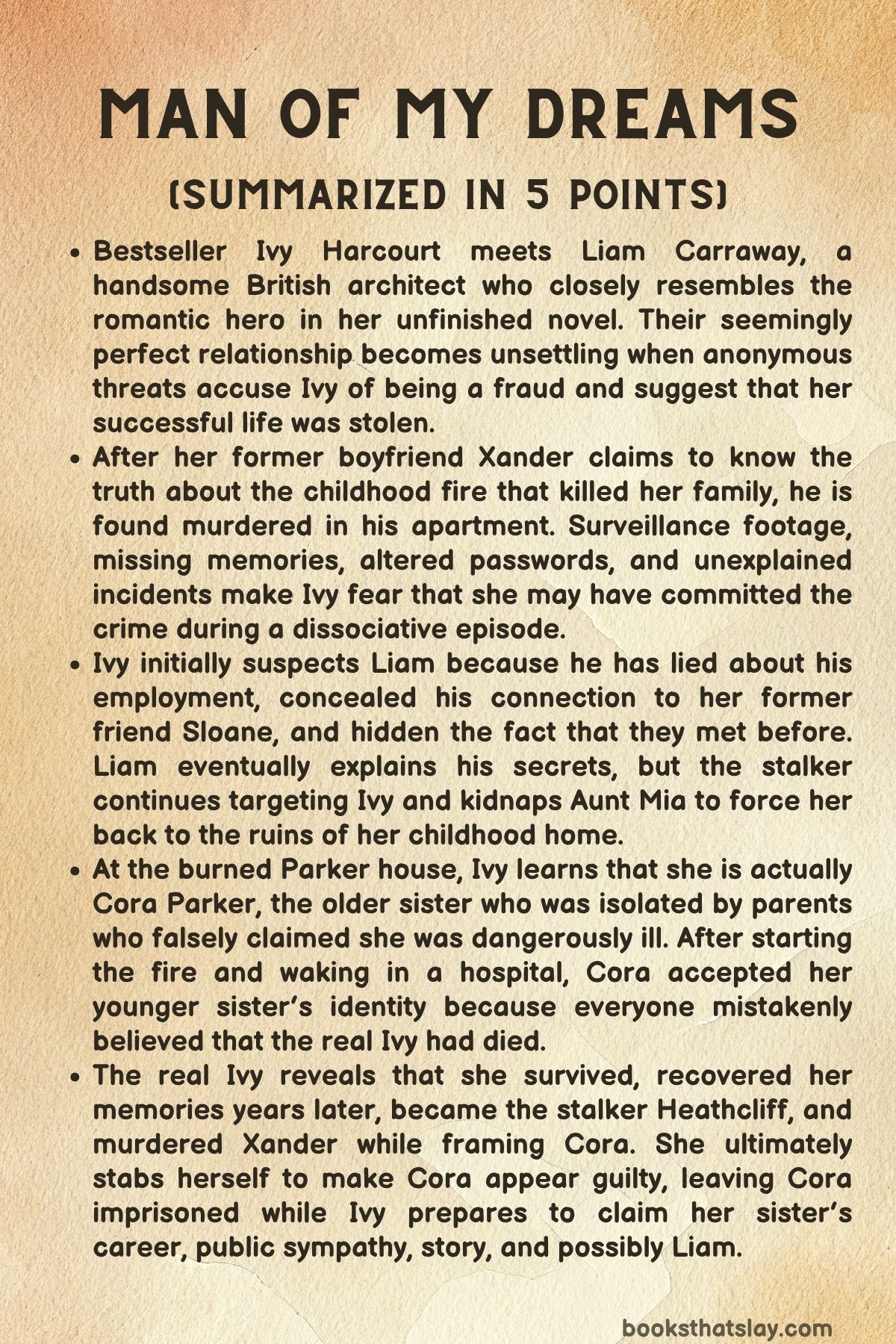
Ivy Harcourt appears to have achieved everything she once wanted: a bestselling novel, public recognition, and an attractive man who resembles the hero she created. Her success, however, rests on a past she refuses to confront. Anonymous threats, unexplained memory gaps, and a murder gradually expose the instability beneath her carefully constructed life. The book combines a dangerous romance, an unreliable protagonist, a family mystery, and a conflict between two sisters whose identities were permanently altered by a devastating fire.
Summary
Ivy Harcourt has recently become a bestselling romance author after the success of her debut novel, Haunt Me Then. Although her professional life appears ideal, she is struggling to complete her second book and is still recovering from Xander, her unfaithful former boyfriend.
At a bookstore, Ivy briefly imagines having a romantic encounter with an attractive reader, only to discover that he is purchasing her novel for his girlfriend. The embarrassing incident highlights how strongly Ivy wants her own life to resemble the love stories she writes.
Soon afterward, Ivy saves a runaway dog named Frank in Washington Square Park. Frank’s owner is a handsome British architect named Liam Carraway, whose name, profession, education, appearance, and personality are almost identical to those of the romantic hero in Ivy’s unfinished manuscript.
Liam recognizes Ivy as the author of Haunt Me Then and asks for her number. Their immediate attraction seems like an extraordinary coincidence, and Ivy begins to believe that the fictional man she created may have entered her real life.
Their first date is intensely romantic. Liam takes Ivy to the High Line, speaks passionately about architecture, and later brings her to the elegant brownstone he inherited from his grandmother.
The two begin a physical relationship, but several details trouble Ivy. Liam knows about her severe strawberry allergy without her remembering that she told him, and his reason for bringing Frank to Washington Square Park does not make sense because he lives far uptown.
At the same time, Ivy begins receiving hostile messages from an anonymous account called Heathcliff. The stalker calls her a fraud, burns a copy of her novel on video, and sends a vandalized copy to her apartment with accusations that she stole someone else’s happy ending.
The threats awaken memories of the fire that destroyed Ivy’s childhood home when she was fifteen. Her parents and older sister, Cora, were reported dead, while Ivy survived and later moved to Los Angeles with Aunt Mia.
Ivy has never revealed the full truth about the fire. Since adolescence, she has also experienced sleepwalking, blackouts, dissociation, and periods during which she performed complicated actions without retaining any memory of them.
Her growing fear is mixed with professional pressure. After finally completing her second manuscript, Ivy discovers that someone has entered her email account and sent her agent a message claiming that she is withdrawing from her publishing contract because she is not the author she pretends to be.
Unable to cope, Ivy reconnects with Sloane, a volatile former coworker associated with her old drinking habits. She becomes heavily intoxicated and later remembers almost nothing about the night, reinforcing her fear that her own mind may be responsible for the unexplained events.
Liam remains affectionate and supportive. He asks Ivy to become his girlfriend and offers to accompany her to Dani’s wedding in place of Xander, making Ivy feel that she may finally have found the secure relationship she has always wanted.
The sense of security disappears when Ivy and Liam return to her apartment and discover a candle burning dangerously. Ivy cannot remember leaving it lit, and the recording password for her newly installed doorbell camera has been changed.
At a bookstore event, Xander unexpectedly appears with bruises around his neck. He tells Ivy that she must ask someone about the fire and claims to know what truly happened, but Liam violently removes him before he can finish explaining.
Ivy is disturbed that Xander knows about her hidden past. She is also frightened by Liam’s strength and wonders whether he caused the bruises already visible on Xander’s neck.
Later that night, a disguised person enters Xander’s apartment. The following morning, Ivy receives threatening messages from him and secretly leaves Liam’s home to confront her former boyfriend.
When she reaches Xander’s apartment, Ivy finds him murdered. His neck has been injured, and the back of his head has been crushed.
Recognizing that his messages could incriminate her, Ivy deletes their conversation from his phone before calling the police. Detectives Kelleher and Lopez question her, and Ivy admits that Liam recently attacked Xander but conceals her own fears about the fire and her memory gaps.
After returning home, Ivy discovers the name CORA written repeatedly across her bathroom mirror in red lipstick. She finally tells Liam that Cora was her older sister and that someone has been stalking her, but she still does not explain her own role in the family tragedy.
The narrative gradually reveals Cora’s childhood. Cora was told that she had survived leukemia and remained dangerously immunocompromised, so her parents kept her isolated inside their large Victorian home.
Cora was homeschooled, denied ordinary friendships, and forced to watch the outside world from behind windows. Her younger sister, Ivy, was permitted far more freedom, creating both longing and resentment.
A neighborhood girl named Gabby eventually befriended Cora. Their secret friendship gave Cora her first experience of companionship, affection, and independence, but Cora remained terrified that her parents would discover them.
In the present, Dani investigates Liam and discovers that his supposed employer has no record of him. Ivy also notices muddy boots in Liam’s home after the stormy night during which Xander was killed.
Ivy follows Liam and sees him meeting secretly with Sloane. She then confirms that he does not work at Meyer and Green Architects, leading her to believe that he may have studied her manuscript and deliberately transformed himself into her fictional hero.
Searching Xander’s apartment, Ivy finds articles about the Parker house fire, a photograph of Cora, and a flash drive containing years of research. She realizes that Xander connected her present identity to the fire before his death.
The police then reveal security footage showing a masked woman entering Xander’s building shortly before his murder. The woman is wearing Ivy’s raincoat, boots, and distinctive umbrella.
Because Ivy cannot trust her own memory, she begins to believe that she may have killed Xander during a dissociative episode. She confesses this possibility to Liam while also confronting him about his false employment, muddy boots, and connection to Sloane.
Liam finally explains that Sloane is his former girlfriend. He also reveals that he met Ivy eighteen months earlier while she was intoxicated and working as a server.
During that meeting, Ivy described the architect she planned to include in her romance novel and joked that Liam resembled the character. Liam later ended his relationship with Sloane partly because he remained fascinated by Ivy.
When Liam encountered her again in Washington Square Park, he assumed she remembered him. He hid the truth after realizing that she had forgotten their first meeting, while his false employment story resulted from being dismissed from Meyer and Green and feeling ashamed to admit it.
The explanations restore Ivy’s faith in Liam, but they do not identify Xander’s killer or the stalker. Her fears intensify when Heathcliff sends a photograph proving that someone entered her apartment and obtained information about Dani’s wedding.
The historical narrative reveals that Cora eventually learned that she had never suffered from leukemia or an immune disorder. Her parents had fabricated the illness to keep her hidden from schools, doctors, authorities, and other outsiders.
Cora also discovered that Melanie and Arthur Parker were not her biological parents. They claimed to have found her as a neglected toddler and concealed her because they believed returning her to her original family would place her in danger.
Instead of seeking legal help, they forged records, created a false medical history, and imprisoned Cora within their home. When she rejected their explanations and attempted to escape, Arthur dragged her back and locked her in the cellar.
At Dani’s wedding, Ivy notices a mysterious blond woman dressed like one of the bridesmaids. The stranger disappears, and Ivy later learns that Aunt Mia has been abducted.
Heathcliff sends Ivy a photograph of Mia bound inside a car trunk and orders her to return alone to the ruins of the Parker house. Ivy leaves the wedding and drives to Tarrytown, where her memories of the fire begin returning.
Years earlier, Cora escaped from the cellar, collected gasoline, and prepared to burn the house. She intended to destroy the place where she had been imprisoned and punish the parents who had stolen her childhood.
Cora initially locked Ivy in the cellar but returned to release her, believing that her younger sister also deserved freedom. Ivy refused to abandon Melanie and Arthur and attempted to warn them about the gasoline.
Cora dropped a match, and the fire spread rapidly. As the sisters tried to escape, Ivy ran back toward the room where their parents were trapped.
Cora grabbed her, but Ivy fell down the stairs and struck her head. Believing her sister was dead, Cora carried the unconscious girl outside before collapsing near the road while seeking help.
In the present, Ivy enters the ruined cellar and meets the blond woman from the wedding. The stranger calls her “Cora,” revealing that the successful novelist known as Ivy Harcourt is actually Cora Parker.
After the fire, Cora had awakened in a hospital carrying Ivy’s personalized copy of Wuthering Heights. Because the sisters resembled each other and she had no identification, hospital staff assumed she was Ivy.
When Cora was informed that her parents and sister had died, she accepted the mistake. Living as Ivy gave her the freedom she had always been denied, and she eventually convinced herself that the stolen identity truly belonged to her.
The woman confronting her is the real Ivy. After Cora left her on the lawn, Ivy regained consciousness and told Gabby that Cora might still be inside the burning house.
Gabby entered the building and died, and her remains were mistaken for Cora’s. Ivy later attempted to seek help but was struck by a vehicle, spent six months in a coma, and awakened without her memories.
She lived for years under the name Catherine. When she saw Cora promoting Haunt Me Then, her memories returned, and she realized that her sister had survived by taking her name and building a successful life from it.
The real Ivy created the Heathcliff accounts and began stalking Cora. She also became Cat, the woman with whom Xander had cheated.
Xander was actually Alexander, Gabby’s younger brother. He had spent years investigating his sister’s disappearance and eventually connected Catherine, Cora, and the Parker fire.
When Xander discovered the truth, Ivy attacked him. After he survived the initial assault and threatened to contact the police, she returned to his apartment, murdered him, and wore Cora’s clothes to frame her.
Ivy admits that she hacked the email, entered the apartment, lit the candle, left the threatening book, and wrote Cora’s name on the mirror. She also reveals that she had secretly poisoned Cora with strawberry extract during childhood, helping their parents maintain the illusion that Cora was dangerously ill.
Ivy attacks Cora with a knife but changes her strategy when Liam arrives. She stabs herself and makes it appear that Cora was responsible.
One month later, Cora is awaiting trial for the fire, Gabby’s death, Xander’s murder, and Ivy’s stabbing. The real Ivy survives and publicly presents herself as the victim whose identity and life were stolen.
She approaches Liam and asks him to help her write a memoir. Ivy now intends to claim Cora’s career, public sympathy, personal history, and perhaps even her relationship, demonstrating that the struggle between the sisters has shifted from physical survival to control of the story itself.
Characters
The characters in Man of My Dreams are shaped by concealed histories, mistaken identities, damaged memories, and conflicting versions of the past. Their relationships repeatedly force the reader to question whether love, protection, and loyalty are genuine or simply methods of control.
Cora Parker, Known as Ivy Harcourt
Cora is the central character and the person readers initially know as Ivy Harcourt. Her identity is built on a misunderstanding that she consciously accepted after awakening in the hospital following the fire.
As a child, Cora endured severe psychological imprisonment. Melanie and Arthur convinced her that she had survived leukemia and remained medically fragile, making her believe that ordinary contact with the outside world could kill her.
Her isolation produced intense loneliness, limited social development, and a distorted understanding of danger. Because every desire for independence was treated as evidence of recklessness, she learned to distrust her own instincts.
Discovering that her illness was fabricated destroys the foundation of her childhood. The revelation does not merely expose her parents as liars; it forces her to recognize that nearly every rule governing her life was designed to prevent others from discovering who she was.
Cora’s decision to burn the house develops from both desperation and rage. She wants freedom, but she also wants the people who controlled her to experience the destruction they inflicted upon her life.
Her attempt to rescue Ivy shows that she is not completely consumed by revenge. Even while resenting her sister’s greater freedom, she recognizes that Ivy has also been shaped by their parents and deserves a chance to escape.
After the fire, Cora accepts Ivy’s identity because it provides an immediate path away from captivity. That decision can be understood as an act of survival, but it also becomes a moral failure once she continues the deception for eleven years.
Her later success as a romance novelist allows her to create the loving relationships and happy conclusions absent from her childhood. Writing gives her control over reality, yet it also helps her avoid confronting the life she appropriated.
Cora’s memory problems make her vulnerable to manipulation. Because she has previously acted while dissociated or intoxicated, she can be persuaded that she may have hacked her email, lit the candle, visited Xander, or committed murder.
Her relationship with Liam represents a longing to be chosen freely and loved without conditions. However, her attraction to his resemblance to a fictional hero demonstrates how strongly she relies on constructed stories when interpreting real people.
Cora is neither entirely innocent nor equivalent to the sister who frames her. She caused the fire, accepted a stolen identity, and concealed the truth, but she did not murder Xander or deliberately create the long campaign of psychological terror directed against her.
Within Man of My Dreams, Cora represents the uncertainty between becoming someone new and erasing responsibility for the person one used to be. Her tragedy is that the identity which once allowed her to survive eventually becomes the evidence used to destroy her.
Ivy Parker, Also Known as Catherine, Cat, and Heathcliff
The real Ivy begins as Cora’s younger sister, a child who appears to enjoy greater freedom within the Parker household. Although she is not imprisoned as completely as Cora, she is still raised by manipulative parents who normalize secrecy and teach her that obedience is necessary for family survival.
Ivy’s childhood behavior reveals disturbing moral complexity. She secretly uses strawberry extract to create reactions in Cora, helping Melanie and Arthur preserve the fiction that Cora is seriously ill.
This act shows that Ivy is not merely an innocent child confused by adults. She becomes an active participant in her sister’s captivity, whether from jealousy, loyalty to her parents, a desire for approval, or a mixture of all three.
During the fire, Ivy runs toward Melanie and Arthur instead of escaping with Cora. Her decision demonstrates how deeply she remains attached to the parents who controlled the family, even after learning that they kidnapped Cora and fabricated her illness.
Ivy’s suffering after the fire is genuine. She loses her home, parents, identity, memory, and access to anyone who might explain who she is.
Her years as Catherine create another form of stolen existence, though unlike Cora, Ivy does not initially choose the new identity. Her memory returns only after she sees Cora publicly living under her name.
Ivy’s anger is therefore understandable. She sees her sister enjoying professional success, romantic possibility, social recognition, and a secure identity while she has spent years disconnected from her own history.
Nevertheless, Ivy transforms legitimate pain into calculated cruelty. She stalks Cora, invades her home, alters her communications, triggers her trauma, exploits her memory problems, and builds evidence intended to make her doubt her own sanity.
Her relationship with Xander is especially manipulative. She uses his grief over Gabby and his connection to Cora while presenting herself as Cat, then kills him once he understands the truth.
Ivy’s final scheme shows that she does not simply want her original name restored. She wants Cora to experience total erasure and plans to take her career, public reputation, romantic partner, and authority over the family story.
Her willingness to stab herself and frame Cora demonstrates exceptional self-control and strategic thinking. She knows that public sympathy will favor the apparent victim and that a convincing story can outweigh uncertain evidence.
Ivy becomes a dark reflection of Cora. Both sisters live under identities that are not originally theirs, but Ivy ultimately chooses violence, manipulation, and narrative conquest as methods of reclaiming what she believes she is owed.
Liam Carraway
Liam initially appears to be the perfect romantic hero brought to life. He is handsome, British, educated as an architect, devoted to his dog, emotionally attentive, and remarkably similar to the man Cora created for her unfinished novel.
His apparent perfection makes him both desirable and suspicious. Each coincidence encourages Cora’s romantic hopes while also suggesting that he may have studied her private writing and deliberately designed himself to gain her trust.
Liam contributes to this uncertainty through his dishonesty. He does not tell Cora that they met eighteen months earlier, that Sloane is his former girlfriend, or that he has been dismissed from Meyer and Green.
These lies arise primarily from embarrassment and emotional confusion rather than a plan to harm her. Even so, his decision to maintain the illusion of a new meeting allows Cora to build a relationship on false assumptions.
Liam’s protective behavior is similarly complicated. He supports Cora after Xander’s murder and considers the possibility that someone is framing her, but his violent confrontation with Xander demonstrates that tenderness and aggression can exist together.
His attachment to Cora began before her literary success and before their official relationship, which makes his interest more sincere than she initially believes. He is attracted to her imagination, ambition, humor, and emotional vulnerability rather than merely to her public identity.
Liam also functions as a contrast to the fictional hero Cora wants him to be. He is loving but imperfect, supportive but secretive, and confident in appearance while privately ashamed of unemployment and rejection.
At the conclusion, Liam remains suspicious of the real Ivy’s story, suggesting that he has not completely abandoned Cora. However, Ivy’s attempt to involve him in her memoir places him at the center of the next stage of her manipulation.
Dani
Dani is Cora’s closest and most dependable friend. Their relationship began during adolescence, when Dani responded calmly to Cora’s sleepwalking rather than treating her as dangerous or abnormal.
As an adult, Dani continues to provide stability, rational judgment, and emotional loyalty. She celebrates Cora’s literary success while remaining willing to question decisions that appear unsafe.
Dani’s investigation of Liam demonstrates both intelligence and protectiveness. When she discovers inconsistencies in his professional identity, she shares them even though she knows Cora may react defensively.
Their argument shows Cora’s fear that concern will become another form of control. Because Cora spent her childhood being told that restrictions were imposed for her own safety, she sometimes interprets reasonable warnings as attempts to deny her independence.
Dani does not punish her for this reaction. At the wedding rehearsal, she welcomes Cora without demanding an apology, proving that her friendship is based on acceptance rather than power.
Her wedding also represents the ordinary future Cora desires. Watching Dani marry Jeremy helps Cora believe that commitment, stability, and family might still be possible for her.
Dani is not simply a supportive friend placed outside the central mystery. Her wedding becomes the location from which Mia is abducted, turning Dani’s happiest day into another stage for Ivy’s revenge.
Aunt Mia
Mia becomes Cora’s guardian after the fire, believing that she is Ivy Parker. She provides the secure home and adult protection Cora had never previously experienced.
Her concern about whether strange events are “starting again” shows that she witnessed Cora’s sleepwalking, identity confusion, and trauma-related behavior during adolescence. However, she never knew enough about the Parker family to recognize that the girl in her care was actually Cora.
Mia’s limited knowledge protects Cora’s secret while also leaving her emotionally isolated. Cora cannot explain the full truth without risking the life and relationship she gained after the fire.
Although Mia is initially suspicious of Liam’s wealth and polished manner, she warms to him quickly. Her response reflects a protective instinct without the controlling behavior that characterized Melanie.
Ivy abducts Mia because she understands her emotional importance. Threatening Mia forces Cora to return to the burned house and proves that Ivy is prepared to harm an innocent person in order to control her sister.
Xander, Also Known as Alexander
Xander initially appears to be an unfaithful former boyfriend whose betrayal left Cora emotionally wounded. His relationship with Cat seems to confirm that he is selfish and dishonest.
The revelation that he is Gabby’s younger brother gives his behavior a more complicated purpose. As Alexander, he has spent years investigating his sister’s disappearance and trying to understand what happened at the Parker house.
His romantic relationship with Cora may have included genuine affection, but his collection of documents shows that he was also researching her identity. This secrecy makes it difficult to separate his personal feelings from his search for the truth.
Xander’s affair with Cat places him unknowingly between the two sisters. The woman he believes is merely another romantic partner is actually the real Ivy, who is using his grief and investigation for her own purposes.
His appearance at the bookstore event suggests that he has finally connected Cora to the fire. The bruises on his neck reveal that he has already survived an attack, but he fails to communicate the truth before being forced away.
Xander’s murder serves several purposes in Ivy’s plan. It silences someone who understands the sisters’ identities, creates evidence against Cora, and allows Ivy to punish the brother of the girl whose death remains connected to the fire.
Gabby
Gabby is the first outsider to treat Cora as a full person rather than a patient, prisoner, or neighborhood legend. Instead of mocking the mysterious girl behind the window, she approaches her with curiosity and compassion.
Their friendship gives Cora access to ordinary conversation, affection, photography, books, and the possibility of a future beyond the Parker house. Gabby validates feelings that Cora has been taught to suppress.
Their kiss deepens the relationship and demonstrates that Cora’s connection to Gabby is both emotional and romantic. For Cora, this affection represents a life in which she can choose whom to trust and love.
Gabby also helps expose the medical deception by taking Cora to the hospital. Without her intervention, Cora might have continued believing that she was physically fragile and dependent upon her parents.
Her death is one of the book’s cruelest consequences. After Ivy tells her that Cora may still be inside the burning house, Gabby enters to rescue her and is killed.
Because Gabby’s body is mistaken for Cora’s, she is erased twice: first through death and then through an incorrect identification. Xander’s investigation becomes an attempt to restore the truth of what happened to her.
Melanie Parker
Melanie is Cora’s adoptive mother and the principal architect of her captivity. She claims that she rescued Cora from abuse, but her later decisions replace one alleged danger with systematic psychological control.
By inventing leukemia, a stem-cell transplant, and severe immunodeficiency, Melanie creates a convincing justification for keeping Cora away from schools, doctors, authorities, and friends. She transforms medical language into an instrument of imprisonment.
Melanie’s manipulation is especially effective because it makes Cora participate in her own confinement. Cora believes that disobedience may result in illness or death, so fear performs much of the work that physical locks would otherwise require.
She also presents herself as a loving and protective mother. This makes her abuse difficult for Cora to identify because every restriction is described as a sacrifice made for the child’s safety.
When Gabby enters the family’s world, Melanie quickly identifies her vulnerabilities. By referring to Gabby’s mother’s addiction, she shows that she is willing to use private pain and social authority to frighten outsiders into silence.
Melanie may believe that her original decision was morally justified, but her refusal to seek legal help reveals a desire for ownership rather than protection. She wants Cora to remain dependent, grateful, and invisible.
Arthur Parker
Arthur appears less openly manipulative than Melanie, but he is essential to maintaining Cora’s imprisonment. His quieter manner does not reduce his responsibility.
He cooperates in the forged adoption, fabricated medical history, homeschooling arrangement, and isolation of Cora. His participation gives Melanie’s decisions practical force and presents a united parental authority that Cora cannot easily challenge.
Arthur’s most revealing action occurs when Cora attempts to flee. He catches her, apologizes as though he has no choice, drags her back to the house, and locks her in the cellar.
The apology demonstrates his moral weakness. He recognizes that he is causing harm but prefers obedience to Melanie and preservation of the family secret over Cora’s freedom.
Arthur represents the danger of passive complicity. He may not originate every lie, yet his cooperation allows the abuse to continue for years.
Sloane
Sloane is connected to Cora’s former life of drinking, blackouts, and unstable behavior. Her presence recalls a period Cora would rather leave behind.
Her friendship with Cora is inconsistent, but she demonstrates genuine concern when she prevents Cora from accepting a drink from a stranger. She understands that Cora’s intoxication and memory problems make her vulnerable.
The revelation that Sloane is Liam’s former girlfriend explains her strange reaction to Cora’s voicemail. She believes that Liam may be exploiting someone who does not remember meeting him before.
Sloane’s anger is partly motivated by jealousy and unresolved feelings, but it also raises a legitimate ethical concern. Liam’s silence allows Cora to believe that their meeting is entirely new, even though he knows her memory is unreliable.
Her secret meeting with Liam appears threatening when viewed from Cora’s perspective. Once explained, it becomes another example of how incomplete information can make ordinary actions resemble betrayal.
Detectives Kelleher and Lopez
Kelleher and Lopez represent two different approaches to investigating Cora. Kelleher’s warmer manner encourages conversation, while Lopez’s visible suspicion places Cora under immediate pressure.
Their discovery of the surveillance footage transforms Cora from a distressed witness into a potential suspect. The clothing worn by the masked woman makes the accusation difficult to dismiss.
Neither detective fully understands Cora’s history, which allows Ivy’s manufactured evidence to appear convincing. From their perspective, Cora has motive, opportunity, memory gaps, deleted messages, and a history connected to the fire.
Their investigation demonstrates how psychological manipulation can influence legal reality. Ivy does not need to prove that Cora is guilty; she only needs to produce enough suspicious details for authorities to construct a plausible case.
Laura and Selene
Laura, Cora’s agent, and Selene, her editor, represent the professional life she has built under Ivy’s identity. Their expectations create pressure, but they also confirm that her literary career is real and earned through her own work.
The hacked withdrawal email attacks more than Cora’s contract. It threatens the identity she created through writing and suggests that she has no right to claim authorship.
Laura’s immediate contact gives Cora an opportunity to correct the message, but the incident proves that the stalker can reach beyond her private life. Her career, reputation, and public identity are all vulnerable.
Jeremy
Jeremy is Dani’s fiancé and later husband. He remains outside most of the central conflict, but his relationship with Dani provides an important image of mutual commitment.
His wedding to Dani allows Cora to imagine a stable future with Liam. It also creates the celebratory setting that Ivy violates by kidnapping Mia.
Jeremy’s connection to an uncle at Meyer and Green indirectly helps expose Liam’s false employment claim. That discovery intensifies Cora’s suspicion even though Liam’s deception has a less dangerous explanation.
Frank
Frank is Liam’s dog and the immediate reason Cora and Liam meet again in Washington Square Park. By running toward traffic, he creates the rescue that Cora interprets as a romantic accident.
Frank also makes Liam appear warmer and more trustworthy. His presence softens tense situations and helps Mia become comfortable in Liam’s home.
At the same time, details involving Frank create suspicion. Liam’s decision to take him far downtown and his claim that he walked him during a storm both seem inconsistent, making the dog part of the uncertainty surrounding Liam.
Themes
Identity, Memory, and Self-Invention
In Man of My Dreams, identity is presented as something shaped by names, memories, documents, relationships, and the stories other people accept. Cora becomes Ivy because hospital workers misidentify her, but the mistake becomes permanent only when she chooses not to correct it.
Her new identity allows her to escape the medical fiction and confinement imposed by Melanie and Arthur. It gives her education, friendship, professional achievement, and the chance to create an adult life unrelated to the house in which she was imprisoned.
That freedom carries an unresolved moral cost. Cora is not merely using a false name; she is occupying the social and familial position of a sister she believes to be dead.
The real Ivy experiences the opposite form of loss. After awakening without memory, she receives an identity that has no connection to her past and spends years as Catherine without understanding what has been taken from her.
Memory is therefore both evidence and vulnerability. Cora’s blackouts prevent her from trusting herself, while Ivy’s recovered memories provide the motive for revenge.
Neither sister can return to a simple original self. Cora’s years as Ivy have produced real relationships and accomplishments, while the real Ivy’s years as Catherine have shaped the person she has become.
The book ultimately questions whether identity belongs to biology, memory, public recognition, legal records, personal choice, or moral conduct. Its ending suggests that whoever controls the accepted version of events may possess greater power than whoever remembers the truth.
Protection as a Form of Imprisonment
Melanie and Arthur describe their treatment of Cora as protection, turning abuse into an apparent expression of parental devotion. By claiming that she is medically fragile, they make isolation seem necessary rather than cruel.
The fabricated illness controls Cora more effectively than constant physical force. She avoids people, obeys restrictions, and fears independence because she believes ordinary contact may kill her.
This form of control damages her ability to evaluate risk. When her body reacts after she argues with Melanie, Cora interprets the incident as confirmation that resistance is physically dangerous.
The discovery that she was always healthy reveals how thoroughly authority shaped her understanding of reality. Her body was not the prison; the story told about her body was.
Melanie’s original claim that she rescued Cora from neglect further complicates the idea of protection. Even if she believed the child was endangered, her decision to hide Cora rather than contact authorities transformed rescue into possession.
Arthur’s participation shows that abuse does not require equal enthusiasm from every adult involved. His apologies and hesitation do not free Cora or reduce the damage caused by his actions.
The theme continues in Cora’s adult relationships. Dani’s warnings and Liam’s protectiveness sometimes frighten her because they resemble the language once used to deny her choices.
The book distinguishes care from control through the presence of freedom. Dani and Gabby express concern while respecting Cora’s personhood, whereas Melanie defines safety as obedience, secrecy, dependence, and permanent separation from the outside world.
Love, Trust, and the Fantasy of a Perfect Romance
Cora writes romance because fiction allows her to create dependable affection, clear motives, and satisfying conclusions. Her unfinished hero represents the kind of man she wants: intelligent, attractive, emotionally available, and apparently designed for her.
When Liam resembles that character, she interprets coincidence as destiny. His arrival offers the possibility that the world might finally reward her after years of loneliness and trauma.
The resemblance also exposes the danger of viewing a real person through a fictional pattern. Cora initially overlooks suspicious details because she wants Liam to complete the romantic story she has imagined.
Later, every unexplained action becomes evidence that he may be dangerous. Her feelings move between idealization and fear because she struggles to accept that a person can be loving while also flawed, ashamed, or dishonest.
Liam’s secrecy damages trust even though his motives are not murderous. By concealing their earlier meeting, his relationship with Sloane, and his unemployment, he allows Cora to fall in love with an edited version of him.
Cora behaves similarly by withholding her identity, responsibility for the fire, dissociative history, and knowledge of Cora Parker. Both partners therefore seek emotional intimacy while protecting central truths about themselves.
Dani and Gabby offer more grounded forms of love. They recognize danger, challenge deception, and remain supportive without demanding that Cora become a fantasy.
The romantic element ultimately becomes inseparable from authorship. Cora imagines Liam, Ivy attempts to claim him, and Liam must decide whether he loves a name, a public identity, a personal history, or the individual he has actually known.
Revenge, Guilt, and Control of the Narrative
The conflict between the sisters is driven by injuries for which neither has fully accepted responsibility. Cora feels guilt for starting the fire, leaving Gabby behind unknowingly, and living under Ivy’s identity.
The real Ivy carries anger over her lost name, stolen adulthood, family deaths, physical injuries, and years without memory. She sees Cora’s success as evidence that her sister benefited from the disaster while she absorbed its consequences.
Ivy’s revenge is designed to reverse their positions. Cora once escaped under Ivy’s name, so Ivy constructs a plan that will place Cora in prison while allowing herself to inherit the identity, career, and relationships Cora built.
Her campaign is psychological before it becomes physical. The hacked email, candle, vandalized book, mirror message, stolen clothing, and surveillance footage are meant to make Cora accuse herself.
Guilt becomes the weapon that makes the framing effective. Because Cora already believes she deserves punishment for the fire and identity theft, she is prepared to accept responsibility for actions she did not commit.
Storytelling becomes more powerful than direct violence. Ivy understands that the public is likely to believe a surviving sister who claims that her life was stolen, especially when Cora already appears secretive and unstable.
The planned memoir represents the final stage of revenge. By writing the accepted account, Ivy can transform herself into the sole victim and Cora into the sole villain.
The unresolved ending emphasizes that truth does not automatically defeat a persuasive narrative. Evidence, sympathy, authorship, and public attention may determine which sister is remembered as the injured survivor and which one is condemned as the monster.