God’s Country Summary, Characters and Themes
God’s Country by William Kent Krueger is a wilderness thriller centered on Cork O’Connor, an aging former sheriff whose family’s ominous visions lead him toward a confrontation with violence, greed, and the darker side of his own nature.
Set largely in Minnesota’s Boundary Waters, the novel combines survival, crime, family loyalty, Ojibwe spirituality, and moral conflict as Cork tries to rescue an old friend from dangerous criminals while confronting the possibility that the greatest threat may be the hatred growing inside himself. It’s the 21st book of the Cork O’Connor series.
Summary
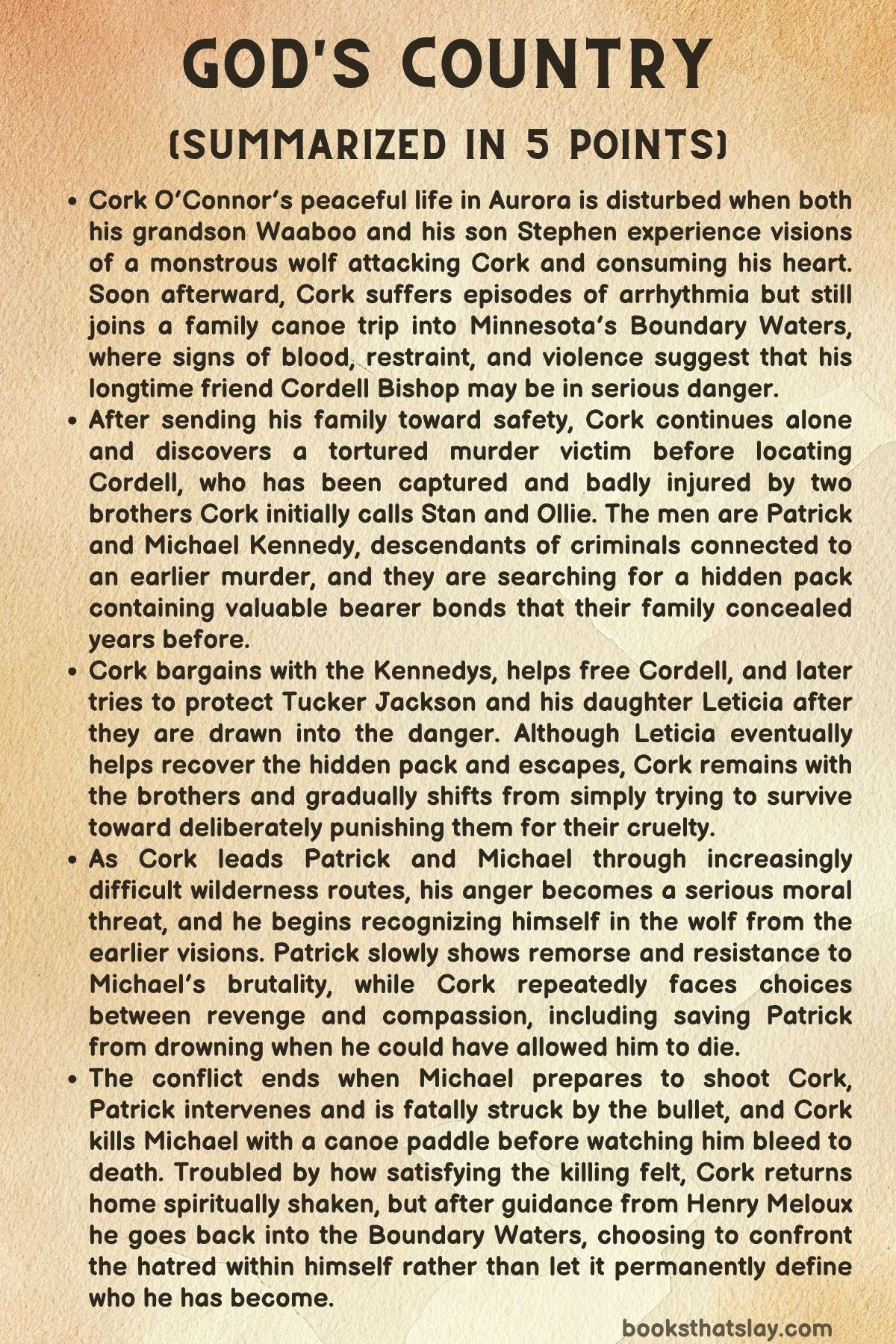
Cork O’Connor lives in Aurora, Minnesota, surrounded by the family he loves and the wilderness that has shaped much of his life. His sense of security is disturbed when his eight-year-old grandson, Waaboo, describes a terrifying vision in which a monstrous wolf stands over Cork, tears open his chest, and consumes his heart.
The vision becomes harder to dismiss when Cork’s son Stephen reveals that he has experienced almost exactly the same image. Both possess a spiritual sensitivity connected to their Ojibwe heritage, so the coincidence suggests something more serious than an ordinary nightmare.
At roughly the same time, Cork experiences disturbing heart irregularities. Although medical tests show no major damage, the episodes make the image of his heart being destroyed feel increasingly ominous.
Cork consults Henry Meloux, an elderly Ojibwe spiritual guide who has long played an important role in his life. Henry does not tell Cork that some external wolf is pursuing him; instead, he suggests that Cork himself might be the wolf.
The idea troubles Cork deeply. Rainy, Cork’s wife, interprets it as a possible warning about his habit of punishing himself emotionally, but Cork does not yet understand how literal the spiritual warning will become.
Despite his family’s concerns, Cork refuses to cancel a planned canoe trip into the Boundary Waters with Stephen, Daniel, Mal, Waaboo, and Luke. The expedition matters to him partly because he is growing older and fears that his years of physical adventure may be slipping away.
Once the group enters the wilderness, they discover troubling signs almost immediately. Litter has been left along the route, and Cork suspects that it may have come from a group being guided by his longtime friend Cordell Bishop.
At Shrike Lake, Cork and Stephen discover rope marks, blood, damaged bark, and signs that someone has been tied to a tree and abused. Cork contacts Sheriff Marsha Dross by satellite phone and learns that the men traveling with Cordell provided false identities and fraudulent payment information.
The situation becomes even more disturbing when Marsha connects the expedition to an old murder involving Dillon and Declan Kennedy. Fifteen years earlier, the Kennedy brothers tortured and murdered a man named Wollersheim and then used Cordell as a guide while attempting to escape toward Canada.
After the satellite phone is accidentally destroyed, Cork and his family become isolated. During the night Cork hears a disturbing cry that seems almost human, followed later by what may be a gunshot.
Knowing that Waaboo and Luke are in danger, Cork decides the others must leave the wilderness and seek help. He remains behind alone because he cannot accept the possibility that Cordell may be suffering somewhere nearby.
Cork soon discovers an abandoned campsite and the body of a brutally tortured and murdered man. The victim has been beaten, burned with cigars, and shot through the forehead, convincing Cork that Cordell’s companions are far more dangerous than he originally feared.
The murder also reminds Cork of a disturbing event from his youth. During a sweat ceremony overseen by Henry Meloux, Cordell once experienced a vision in which he and Cork were pursued by the Windigo, a cannibalistic being associated with greed, corruption, and destructive hunger.
Cork eventually reaches Devil’s End, where he secretly observes Cordell tied to a tree and badly injured. Two captors remain with him, a huge, aggressive man Cork mentally calls Ollie and a smaller, more calculating brother he calls Stan.
Cork waits until the men temporarily leave before freeing Cordell. He learns that the murdered man was Crispin, the captors’ half brother, and that all three men belong to the Kennedy family.
Their father was Declan Kennedy, while Dillon Kennedy was their uncle. Years earlier, one of the older Kennedys hid a valuable pack somewhere near Devil’s End during the failed escape to Canada, and the younger generation has returned to recover it.
Crispin apparently knew crucial information about the pack but refused to cooperate fully. Ollie tortured and killed him, demonstrating how little family connection means when greed and violence take control.
Cork cannot move the severely injured Cordell far enough to escape. His attempt to ambush the Kennedy brothers also fails, forcing him to bargain for his own survival.
He convinces the brothers that he may be able to locate the hidden pack and guide them toward Canada. In exchange, he persuades them to release Cordell, who begins the painful journey toward safety.
Cork later deliberately overturns a canoe while traveling with Stan, hoping to escape. Stan cannot swim, but before he can drown, Tucker Jackson and his fifteen-year-old daughter Leticia arrive and unknowingly become involved.
Ollie shoots Tucker in the leg and takes both father and daughter hostage. Cork’s heart begins racing violently again, but he suppresses his fear and concentrates on keeping everyone alive.
Cork determines that the hidden pack is probably lodged in an opening high on the cliffs of Devil’s Bottom. Because Leticia has climbing experience, he suggests that she retrieve it, hoping to turn the Kennedys’ greed into another opportunity to negotiate freedom for a hostage.
Leticia bargains for Tucker’s release before attempting the climb. Her first effort ends with a dangerous fall, though she survives after landing on Ollie and worsening his already painful back injury.
Cork then arranges for Leticia to be lowered from above. Once she reaches the pack, he secretly allows the rope to run until she reaches the ground and orders her to flee.
Leticia escapes despite Ollie firing after her, while Stan recovers the pack. Inside are bearer bonds eventually revealed to be worth ten million dollars.
After Leticia’s escape, Ollie savagely beats Cork. The abuse awakens something in Cork that gradually becomes more dangerous than his desire merely to survive.
Rather than seeking the fastest escape, Cork begins deliberately leading the brothers along difficult routes. He makes them work harder, prolongs their discomfort, and quietly takes satisfaction in their suffering.
When a bear destroys most of their food, Cork becomes even more valuable because only he knows how to obtain food from the wilderness. Eventually he manages to seize the Glock from Stan, giving him physical control over the brothers.
Yet Cork does not immediately escape. He tells himself that remaining with them prevents them from hurting others, but another motive is becoming impossible to ignore: he wants to punish them.
His growing attraction to vengeance becomes more disturbing after he dreams of himself as a predatory wolf hunting and consuming a human victim. The violence is horrifying, but within the dream it is also satisfying.
Cork continues tormenting Ollie in smaller ways, including secretly feeding him uncooked morels that cause severe gastrointestinal illness. He also tells the brothers stories of the Windigo, using the legend of endless hunger and moral corruption to frighten them while failing to recognize fully how closely his own behavior is beginning to resemble the warning.
The balance shifts again when Ollie attacks Cork with a skillet and recovers the gun. Shortly afterward, a lone canoeist arrives.
The stranger offers food and assistance without hesitation. Ollie murders him anyway, shooting him twice after deciding he has outlived his usefulness.
The killing devastates Cork because he had stayed partly to prevent precisely such an event. The victim, later identified as minister Blake Carver, becomes proof that Cork’s private campaign against the brothers has produced consequences for someone completely innocent.
Cork promises himself that no other innocent person will die. During another dangerous river passage, however, Stan nearly drowns, and Cork experiences a powerful temptation simply to let the current take him.
He ultimately rescues Stan. That choice begins changing their relationship because Stan increasingly questions both his brother and himself.
The difference between the Kennedy brothers becomes clearest when Ollie sees two women camping nearby and speaks about pursuing them for sexual violence. Stan refuses to cooperate, preventing another potential atrocity.
That night, Cork and Stan see a gray wolf enter the firelight. Cork, whose Ojibwe ancestry connects him to the Wolf Clan, views the animal not as an enemy but as a relative.
The sight of the wolf and the northern lights has a profound effect on Stan. He begins discussing his children, his brother, his failures, and the possibility that he might still make different moral choices.
Cork also remembers Henry Meloux’s teaching about two wolves existing within the human heart, one representing hatred and the other love. He finally recognizes how deliberately he has been feeding his own hatred.
When Cork later frees himself from his restraints, he stands over the sleeping Kennedy brothers with a hatchet. He seriously considers murdering both men in their sleep.
Instead, he takes the canoe and escapes. He reaches the campsite of Lou and Johanna, two women celebrating their wedding anniversary, and tells them what has happened.
Cork could leave with them, but he remains behind because he fears the stranded brothers may kill another traveler. When another father and son approach the Kennedys, Cork successfully intercepts them and sends them away.
Later, Stan attempts to cross the rough lake and steal Cork’s canoe. When Stan becomes trapped in dangerous water, Cork once again faces a choice between vengeance and mercy.
Cork saves him. Stan cannot understand why a man he helped torment would risk his life to rescue him, and their conversation afterward forces both men to confront what hatred has made of them.
Stan eventually returns to Ollie, not because he fully rejects his emerging conscience but because he cannot abandon his brother. Soon pilot Adam Beyer arrives searching for survivors and lands near them.
Ollie immediately takes Adam hostage and believes the plane provides their escape route. He orders Adam to fly them toward Canada and prepares to kill Cork before departing.
Stan finally chooses openly between his brother and Cork. When Ollie aims the Glock directly at Cork’s heart, Stan swings the valuable pack at him.
The gun fires and the bullet strikes Stan in the heart. Cork attacks Ollie with a canoe paddle, cutting deeply into his neck and severing an artery.
Ollie dies while Cork watches. The most disturbing part for Cork is not simply that he killed him, but that the act felt satisfying.
Stan dies as well, but his final moments reveal the moral change that has occurred within him. He asks Cork to tell his sons that he was not entirely a bad man, and Cork promises to tell them that their father saved his life.
Authorities eventually arrive, and Cordell, Tucker, and Leticia are confirmed alive. Cork returns home physically safe but spiritually disturbed by what happened.
He tells Henry that he feels changed beyond repair. Cork wants a ceremony that can cleanse him and restore the person he once was, but Henry explains that no ritual can simply return him to an earlier version of himself.
Henry tells Cork that he lost part of himself in the wilderness and must return there to find it. Cork initially rejects the idea, terrified that the Boundary Waters now contain the part of himself he most fears.
Rose later helps him remember that even damaged people can still choose what they give to others. Cork also decides to honor his promise to Stan by contacting his family and telling his children that their father died saving another person.
The ten million dollars in bearer bonds explain the Kennedys’ crimes across two generations. Yet the fortune ultimately matters less than the moral hunger it represents.
Cork finally understands the Windigo lesson: destroying a monster may require entering the monster’s world, but the greater danger is remaining monstrous after the threat is gone. He returns alone to the Boundary Waters, accepting that the wilderness itself never became evil.
The change occurred inside him. As Cork pushes his canoe onto the water and again calls the place God’s country, he chooses not certainty but trust, entering the wilderness in the hope that love can still melt the part of his heart hardened by hatred.
Characters
Cork O’Connor
Cork O’Connor is the central character of God’s Country, and his physical journey through the Boundary Waters becomes inseparable from a moral confrontation with himself. He begins as an experienced outdoorsman, former lawman, husband, father, grandfather, and protector whose confidence comes from decades of surviving danger and understanding the wilderness.
His decision to remain behind and search for Cordell demonstrates loyalty and courage, but those virtues gradually become entangled with pride and anger. Cork repeatedly convinces himself that he is acting to protect others even when he increasingly stays with the Kennedy brothers because he wants to punish them.
The wolf vision therefore becomes important not because it predicts an ordinary attack but because it exposes Cork’s capacity for hatred. By the time he secretly poisons Ollie with raw morels, engineers unnecessary hardship, and considers allowing Stan to drown, he has moved dangerously close to the cruelty he condemns.
His eventual decisions to rescue Stan, spare the sleeping brothers, and return to the wilderness show that the darker part of his nature has not erased his capacity for mercy. Cork finishes the book without a simple sense of purification, which makes his development convincing: he accepts that moral recovery is an ongoing choice rather than a single act of forgiveness.
Rainy
Rainy provides one of the clearest emotional anchors in God’s Country because she understands both Cork’s physical vulnerability and the spiritual implications of the visions surrounding him. As a public health nurse and Ojibwe healer, she approaches his heart episodes from both medical and cultural perspectives without treating either as meaningless.
Her concern about the Boundary Waters trip is practical rather than controlling. She knows Cork is aging, recognizes the possibility of genuine medical danger, and also understands that preventing him from going would mean asking him to surrender an important part of his identity.
Rainy also interprets Henry Meloux’s warning more perceptively than Cork initially does. Her suggestion that the wolf may represent Cork’s tendency to punish himself anticipates the larger struggle between self-condemnation, anger, and forgiveness that eventually defines his ordeal.
Although she is physically absent from most of the wilderness conflict, her relationship with Cork represents the home, love, and stability toward which he might return. Her role becomes especially important because the novel contrasts this kind of sustained love with the Kennedy family’s cycle of abuse and resentment.
Stephen O’Connor
Stephen represents one of the strongest spiritual connections in God’s Country. His vision mirrors Waaboo’s warning about Cork, confirming that the image of the wolf cannot easily be dismissed as an ordinary childhood nightmare.
Stephen combines respect for his father with increasing willingness to challenge him. When Cork intends to remain behind and search for Cordell, Stephen argues that Cork’s responsibility should be to his family, especially after receiving such an unmistakable warning.
His protective instinct toward Cork reverses the usual parent-child relationship and reflects the aging of both men. Cork still thinks of himself as the person responsible for protecting everyone else, while Stephen has reached a stage where he is capable of protecting his father.
Stephen also serves as evidence that Ojibwe spiritual traditions continue through generations rather than ending with elders such as Henry. His sensitivity, knowledge, and concern make him part of the moral framework that Cork carries into the wilderness even after they separate.
Waaboo
Waaboo is young, but his role in God’s Country is far greater than his age might suggest. His frightening vision provides the first warning that Cork’s upcoming journey will involve danger connected specifically to the heart and the wolf.
His innocence makes the warning more unsettling. Waaboo does not possess the adult language necessary to interpret what he sees, so his description arrives without an attempt to rationalize or reshape it.
His fear of losing Cork also gives the vision an emotional dimension beyond prophecy. He loves his grandfather and understands death enough to recognize what the image might mean, even if he cannot comprehend its symbolic complexity.
Near the end, his statement that Cork is “not you” becomes one of the strongest judgments Cork receives after returning home. Waaboo recognizes that the man who came back from the wilderness is physically his grandfather but spiritually altered, forcing Cork to acknowledge how visible his inner damage has become.
Cordell Bishop
Cordell is Cork’s old friend and one of the people whose suffering drives the central action of God’s Country. His connection with Cork reaches back to adolescence, including the sweat ceremony in which Cordell sees the Windigo following both of them.
His kidnapping gives Cork a concrete reason to move deeper into danger after the rest of the family leaves. Because Cordell has been tortured, shot, and humiliated, Cork’s loyalty to him initially appears entirely honorable.
Cordell also embodies endurance. Despite serious injuries, he tries to protect Cork, returns toward danger rather than leaving him to fight alone, and later makes the painful journey toward help.
His old Windigo vision becomes far more meaningful in retrospect. Cordell and Cork were warned decades earlier that they might one day face something shaped by greed and moral corruption, and Cordell’s ordeal becomes the event that brings that forgotten warning into reality.
Patrick “Stan” Kennedy
Patrick Kennedy, known to Cork for much of the novel as Stan, is the most morally conflicted member of the Kennedy family in God’s Country. He participates in kidnapping, violence, and the hunt for stolen wealth, which means the novel never treats him as innocent simply because he is less cruel than his brother.
Yet Patrick repeatedly demonstrates limits that Michael does not possess. He restrains unnecessary violence, preserves Cork’s usefulness by destroying the map, prevents his brother from pursuing two women, expresses remorse after Blake Carver’s murder, and speaks honestly about wanting his sons to become better men.
His relationship with Cork gradually becomes the clearest example of moral change in the story. Cork saves Patrick from drowning twice, even though allowing him to die would remove an enemy and appear to offer a form of justice.
Patrick ultimately confirms that this mercy mattered. When Michael prepares to shoot Cork, Patrick physically intervenes and takes the bullet himself, dying while saving the man he previously helped imprison.
His final concern is how his sons will remember him. Cork’s promise to tell them that their father saved his life gives Patrick neither complete absolution nor condemnation, but acknowledges that a person who has done serious wrong can still make a meaningful final choice.
Michael “Ollie” Kennedy
Michael Kennedy, whom Cork initially calls Ollie, represents violence without meaningful self-restraint. He enjoys physical domination, racial humiliation, intimidation, and killing, and he repeatedly treats other people as obstacles or objects rather than as human beings.
Unlike Patrick, Michael rarely demonstrates reflection about his actions. He tortures Crispin, abuses Cordell, wounds Tucker, fires at Leticia, murders Blake Carver, threatens sexual violence against women he has never met, and eventually prepares to murder Cork even when doing so is unnecessary.
His physical size initially reinforces his role as an intimidating force, but the wilderness gradually exposes his weaknesses. His injured back, poor conditioning, inability to live comfortably outdoors, insect bites, digestive illness, and fear of the unknown reduce the power he believes brutality guarantees him.
Michael also resembles the Windigo more closely than any other character because nothing satisfies him. Money, control, violence, food, revenge, and domination only create further appetite.
His death at Cork’s hands completes the central moral problem rather than solving it. Cork kills a dangerous man, but the pleasure he experiences while doing so leaves him wondering whether defeating a monster has required him to become too much like one.
Henry Meloux
Henry Meloux functions as Cork’s spiritual guide and moral interpreter. He understands that visions rarely provide simple predictions and immediately complicates Cork’s assumption that the wolf must represent an external attacker.
His suggestion that Cork may be the wolf becomes the central interpretive key to the story. Henry recognizes that the most dangerous consequence of confronting evil may be the transformation of the person fighting it.
Henry refuses to give Cork easy reassurance either before or after the wilderness ordeal. When asked whether Cork will be safe, he offers no promise, and when Cork later asks for purification, Henry refuses to present ceremony as an instant cure.
His teaching about the two wolves inside the heart places responsibility on Cork. Hatred and love are both possible, and the person Cork becomes depends on which one he continues to nourish.
Tucker Jackson
Tucker Jackson enters the story as a protective father who is trying to share the Boundary Waters with his daughter. His background as a St. Paul police officer gives him courage and practical instincts, but those abilities cannot prevent the Kennedy brothers from taking him hostage.
His defining characteristic is devotion to Leticia. Even after being shot, he resists leaving her behind and accepts freedom only when he realizes that reaching help may offer her the best chance of survival.
Tucker also provides a parallel to Cork. Both men instinctively place themselves between danger and younger family members, making Cork immediately understand why Tucker struggles to abandon his daughter.
His survival ensures that Leticia’s courage does not end in permanent family loss. Together, father and daughter also demonstrate how innocent people are repeatedly pulled into violence created by the Kennedys’ greed.
Leticia Jackson
Leticia initially appears as a teenager on an outdoor trip with her father, but she quickly proves exceptionally composed under pressure. Even after witnessing Tucker being shot and being taken hostage, she remains capable of negotiating with armed criminals.
Her insistence that Tucker be released if she retrieves the hidden pack shows how quickly she understands Cork’s bargaining strategy. She does not simply wait for Cork to protect her but participates actively in creating a chance for her father to escape.
Her climbing ability also makes her essential to the Kennedys’ search. The danger of the task exposes their willingness to risk a teenager’s life for money, particularly when Ollie pressures her to continue beyond what is safe.
Leticia’s successful escape after Cork lowers her from the cliff becomes one of the most important victories during his captivity. Her survival confirms that Cork’s protective instincts remain active even while his desire for vengeance is becoming stronger.
Rose Thorne
Rose is one of the most emotionally perceptive members of Cork’s extended family. Her late-night conversations with him before and after the wilderness ordeal show that she understands how to approach emotional pain without demanding immediate confession.
Before the trip, Rose expresses fear rooted in the losses the family has already endured. Having lived through the deaths of Jo and Annie, she cannot treat Cork’s dangerous journey as an abstract adventure.
After Cork returns, Rose again recognizes that he cannot be forced into healing. Her playful conversation with the Ernie cookie jar allows her to speak indirectly about emptiness, giving Cork enough emotional space to admit that he fears he has lost something essential.
She therefore becomes a quiet counterforce to Cork’s isolation. Where Henry offers spiritual challenge, Rose offers ordinary family love and reminds Cork that giving care to others remains part of who he is.
Mal Thorne
Mal combines spiritual history, family commitment, and practical courage. A former Catholic priest who left the priesthood and married Rose, he understands both institutional religion and the difficult choices involved in reshaping a life around personal conviction.
During the canoe trip, Mal functions as one of the responsible adults protecting Waaboo and Luke. Once the danger becomes clear, his priority is getting the boys safely out rather than proving courage by pursuing the threat.
His conversations with Cork and the others about evil, free will, and forgiveness give moral language to questions that later become intensely personal for Cork. The contrast between discussing evil around a campfire and actually confronting it becomes one of the novel’s significant transitions.
Daniel
Daniel initially approaches Waaboo’s vision more skeptically than Jenny does, wondering whether it could simply be a nightmare. His reaction provides a practical counterpoint to the spiritual certainty surrounding Stephen and Waaboo.
As events develop, Daniel does not cling stubbornly to that skepticism. Evidence of physical danger matters more than his original interpretation, and he becomes focused on protecting the children once the group discovers signs of torture and possible violence.
His role on the journey is less psychologically central than Cork’s or Stephen’s, but he helps establish the family structure around Waaboo. Daniel represents the ordinary parental responsibility against which Cork’s increasingly dangerous choices can be measured.
Jenny O’Connor
Jenny takes Waaboo’s vision seriously from the beginning. Her response reflects both her knowledge of her family’s history and her willingness to accept that her son may perceive things other people cannot easily explain.
She is also part of the protective pressure placed on Cork before the trip. Jenny knows that a warning involving her father’s death cannot simply be dismissed because Cork dislikes feeling vulnerable.
Although she does not accompany the expedition, her connection to both Cork and Waaboo strengthens the generational structure of the story. Spiritual sensitivity, fear of loss, and family responsibility all move through multiple generations of the O’Connor family.
Luke
Luke represents childhood excitement about the Boundary Waters before violence changes the emotional atmosphere of the trip. He enters the wilderness expecting fishing, camping, and time with older relatives rather than danger.
Stephen’s account of the Seven Fires prophecies gives Luke a wider perspective on history, destruction, renewal, and humanity’s choices. That conversation quietly introduces the idea that people continually face decisions between destructive and constructive paths.
His presence also affects the adults’ decisions. Once the evidence of violence becomes undeniable, protecting Luke and Waaboo takes priority over curiosity or investigation, helping force Cork to separate from the rest of his family.
Sheriff Marsha Dross
Marsha Dross represents the lawful system Cork once belonged to more directly. As Cork’s former deputy and the current sheriff, she trusts his judgment enough to investigate the suspicious evidence he reports from the wilderness.
Her research uncovers the false identities of Cordell’s clients and the connection to the earlier Kennedy crimes. This information turns Cork’s vague concern into a recognizable criminal threat.
After the ordeal, Marsha also helps restore factual order. She supplies the real identities of Patrick and Michael Kennedy, reports the survival of the hostages, identifies the likely murdered canoeist, and explains the bearer bonds that motivated the crimes.
Her presence contrasts with Cork’s private revenge campaign. Marsha represents investigation, evidence, and legal accountability, while Cork increasingly risks substituting personal punishment for justice.
Lou and Johanna
Lou and Johanna provide Cork with safety at a crucial moment after his escape. Their initial suspicion of him is sensible because a battered stranger appearing unexpectedly in remote wilderness could represent danger.
Once convinced that Cork is telling the truth, they offer food, shelter, equipment, and help. Their cooperation shows a form of human trust very different from the fear and manipulation dominating Cork’s experience with the Kennedys.
Their relationship also quietly reinforces the novel’s emphasis on companionship. They are celebrating the anniversary of a relationship that began in the very wilderness Cork now associates with violence, reminding him that the Boundary Waters also contain memories of love and connection.
Adam Beyer
Adam Beyer enters near the end as a pilot participating in the search effort. His arrival seems at first to promise rescue, but it unintentionally gives Michael Kennedy a possible route of escape.
Adam’s willingness to land demonstrates the same basic human instinct that led Blake Carver into danger: he sees someone apparently needing help and responds. Michael immediately exploits that generosity by taking him hostage.
Adam survives largely because the final confrontation occurs before Michael can carry out further violence. He later flies Cork home, helping move him physically out of the wilderness even though Cork’s emotional return will take much longer.
Crispin Kennedy
Crispin is dead before Cork fully understands the Kennedy family conflict, but his murder exposes the brutality operating within that family. He is the half brother of Patrick and Michael and apparently possesses information about the hidden pack.
Michael tortures Crispin despite their blood relationship. His death demonstrates that greed has erased even the limited loyalty that might ordinarily exist between brothers.
Crispin also appears to have been favored by their father, creating resentment that predates the treasure hunt. His murder therefore emerges from a mixture of greed, jealousy, inherited family dysfunction, and Michael’s willingness to use cruelty whenever frustrated.
Declan and Dillon Kennedy
Declan and Dillon create the violent inheritance that shapes the younger Kennedys. Their torture and murder of Wollersheim establish the original crime connected to the bearer bonds and the earlier attempt to escape through the Boundary Waters.
Declan’s abusive parenting also helps explain the hostility among his sons. Patrick later describes a household shaped by fear, favoritism, and emotional cruelty.
The novel does not present that upbringing as an excuse for murder. Instead, the older Kennedys show how violence and greed can become a family inheritance when no one decisively rejects them.
Jeanette
Jeanette, Patrick’s former wife, exists mainly outside the wilderness conflict but becomes important to understanding Patrick’s final motivations. She waits near Canada believing Patrick and Michael are taking a reconciliation trip and apparently knows nothing about their criminal purpose.
Her existence also connects Patrick to a life beyond his brother. Through Jeanette and their sons, the reader can imagine responsibilities and relationships Patrick has neglected while following Michael into crime.
Cork’s decision to contact her after Patrick’s death completes his promise. Rather than allowing Patrick to be remembered only as a criminal, Cork intends to tell his family about the moment when he finally resisted Michael and sacrificed himself.
Jo and Annie
Jo, Cork’s first wife, and Annie, his daughter, are already dead before the story begins, yet their absence continues shaping the O’Connor family. Memorial Day visits to their graves show that grief remains part of the family’s shared life.
Their deaths explain why Rose and others react so strongly to Cork’s willingness to take risks. The possibility of losing him does not exist in isolation; it threatens a family that already understands how permanent sudden loss can be.
They also contribute to Cork’s longstanding habit of self-judgment. His history is filled with people he could not save, making his determination to rescue Cordell and protect strangers easier to understand.
Blake Carver
Blake Carver is the innocent canoeist murdered after offering assistance to the stranded group. His death becomes one of the most important moral turning points for Cork because Blake approaches them out of kindness rather than suspicion.
Cork had remained with the Kennedys partly because he believed he could prevent them from harming others. Blake’s death proves that Cork overestimated his ability to control the situation.
Learning that Blake was a minister on a spiritual retreat makes the killing even more painful for Cork. Blake becomes the clearest example of innocent goodness destroyed by violence, and Cork carries personal guilt for failing to protect him.
Sam Winter Moon and Nels Jensen
Sam Winter Moon belongs to Cork’s earlier life and functions as a father figure after Cork loses his own father. His presence during the old sweat ceremony connects Cork’s youth, Ojibwe spirituality, and his long relationship with Cordell.
Nels Jensen appears in Cork’s memory of nearly drowning as a teenager. When another boy panics and pulls Cork underwater, Nels can save only Cork, while the other boy dies.
That experience becomes important because Cork believes he saw his eventual death during the incident. The memory explains part of his strange confidence that his heart problems and later wilderness dangers will not kill him.
Babs Bishop
Babs Bishop provides the first important information suggesting something is unusual about Cordell’s latest guiding job. She explains that three inexperienced men specifically requested Cordell and behaved in a way that made her uncomfortable.
Her instincts prove correct. The apparently ordinary commercial expedition becomes the beginning of kidnapping, torture, murder, and the attempt to recover the bearer bonds.
Although her role is brief, she helps establish that warning signs existed before Cork entered the Boundary Waters. Like many warnings in the story, however, their significance becomes clear only after danger is already underway.
Themes
The Battle Between Hatred and Love
The central moral conflict concerns what happens when justified anger begins transforming into hatred. God’s Country does not suggest that Cork is wrong to oppose the Kennedy brothers; they torture, murder, threaten children, and repeatedly exploit innocent people, giving Cork every reason to resist them.
The danger comes when stopping them is no longer enough. Cork begins enjoying their suffering, deliberately prolongs their hardship, poisons Michael with raw mushrooms, contemplates allowing Patrick to drown, and eventually thinks seriously about killing both brothers while they sleep.
Henry Meloux’s teaching about two wolves inside the heart gives this struggle a spiritual form. One wolf is fed by hatred, while the other is sustained by love, mercy, and connection.
Cork’s most important victories are therefore not physical defeats of his enemies. They occur when he rescues Patrick from drowning, refuses to murder the sleeping brothers, helps strangers avoid danger, and finally returns to the wilderness instead of surrendering the place permanently to his fear.
Patrick experiences a similar conflict on a different scale. His final decision to stand between Michael and Cork demonstrates that even after serious wrongdoing, a person can still choose which part of himself receives strength.
Greed and the Windigo
The legend of the Windigo transforms greed from a simple desire for money into a condition of endless appetite. A Windigo can never be satisfied because every act of consumption only increases its hunger, making the creature an effective symbol for the Kennedy family’s destructive obsession.
The bearer bonds are worth ten million dollars, but the fortune itself does not create the Kennedys’ moral collapse. Instead, it reveals how thoroughly money has already replaced family loyalty, human dignity, and ordinary restraint.
Declan and Dillon murder Wollersheim for the bonds, and years later the next generation repeats the same pattern. Michael tortures and kills his own half brother, threatens strangers, and risks a teenager’s life because possession of the hidden wealth matters more to him than any human relationship.
Cork also begins showing Windigo-like characteristics when vengeance becomes something he cannot easily satisfy. Every punishment inflicted on the brothers creates a desire for another, until the distinction between opposing cruelty and enjoying cruelty becomes dangerously thin.
The myth therefore applies beyond the obvious criminals. Anyone can become controlled by an appetite that promises satisfaction but instead demands more, whether that appetite is for money, domination, revenge, or punishment.
Family, Inheritance, and Moral Choice
Families in the novel pass down both love and damage. Cork’s family transmits spiritual sensitivity, protective instincts, cultural memory, and a strong expectation that people care for one another, while the Kennedy family passes down abuse, resentment, greed, and violence.
Yet inheritance never becomes destiny. Stephen and Waaboo inherit unusual spiritual perception without simply becoming copies of Cork, while Patrick grows up under an abusive father and violent family influence but remains capable of making choices Michael refuses to make.
The contrast between the two families becomes especially clear through fatherhood. Cork repeatedly risks himself for children and friends, Tucker refuses to abandon Leticia, and Patrick speaks with genuine concern about his sons becoming better men than he has been.
Declan Kennedy represents the opposite model. His abuse, favoritism, and emotional cruelty help establish conditions in which his sons grow into adults filled with resentment and insecurity.
The story therefore acknowledges the power of upbringing without allowing it to erase responsibility. Patrick and Michael come from the same destructive family system, yet their decisions increasingly separate them.
Patrick’s final act matters precisely because he chooses against the pattern he inherited. By saving Cork, he leaves his sons one final story about their father that is not defined entirely by greed, criminality, or submission to Michael.
Wilderness, Spiritual Identity, and Renewal
The Boundary Waters function as more than the physical setting of God’s Country. For Cork, the wilderness has always represented beauty, identity, ancestry, memory, family, and a connection to something spiritually larger than himself.
The Kennedy brothers bring torture, murder, greed, and exploitation into that environment, making Cork feel that something sacred has been violated. His response becomes complicated because his attempt to defend the wilderness eventually turns it into the setting for his own acts of revenge.
Nature itself remains morally neutral. Bears search for food, storms arrive, currents become dangerous, wolves move through the forest, and northern lights appear regardless of human conflict.
This distinction becomes essential after Cork returns home. He initially wants nothing more to do with the Boundary Waters because he associates the place with Michael’s death and with the violent part of himself that emerged there.
Henry refuses to allow that interpretation to stand. Cork did not lose himself because the wilderness became corrupted; he lost himself while responding to events within it.
Returning therefore becomes an act of spiritual responsibility rather than simple adventure. Cork enters the canoe again without knowing whether he can forgive himself or recover completely, but he refuses to let fear and hatred define his relationship with a place that once gave his life meaning.
His final journey suggests that renewal does not require becoming the person he was before. It requires accepting what he has learned about himself and continuing to choose love, responsibility, and connection even after discovering that violence also exists within his own heart.