Girl, Forgotten Summary, Characters and Themes
Girl, Forgotten by Karin Slaughter is the second novel in the Andrea Oliver series (following Pieces of Her). It is a dual-timeline thriller that alternates between 1982 and the present day, blending a cold-case murder with personal trauma, small-town secrets, and the lingering impact of sexual violence and cover-ups.
Set in the small town of Longbill Beach, the book follows the haunting story of Emily Vaughn, a high school senior whose life takes a tragic turn when she becomes pregnant under mysterious circumstances, only to be found dead soon after. Decades later, Andrea Oliver, a U.S. Marshal, is drawn into the investigation of Emily’s death, uncovering buried secrets and confronting painful memories. As Andrea delves into the case, she is forced to reconcile her personal connection to the past with her duty to seek justice for Emily.
Summary
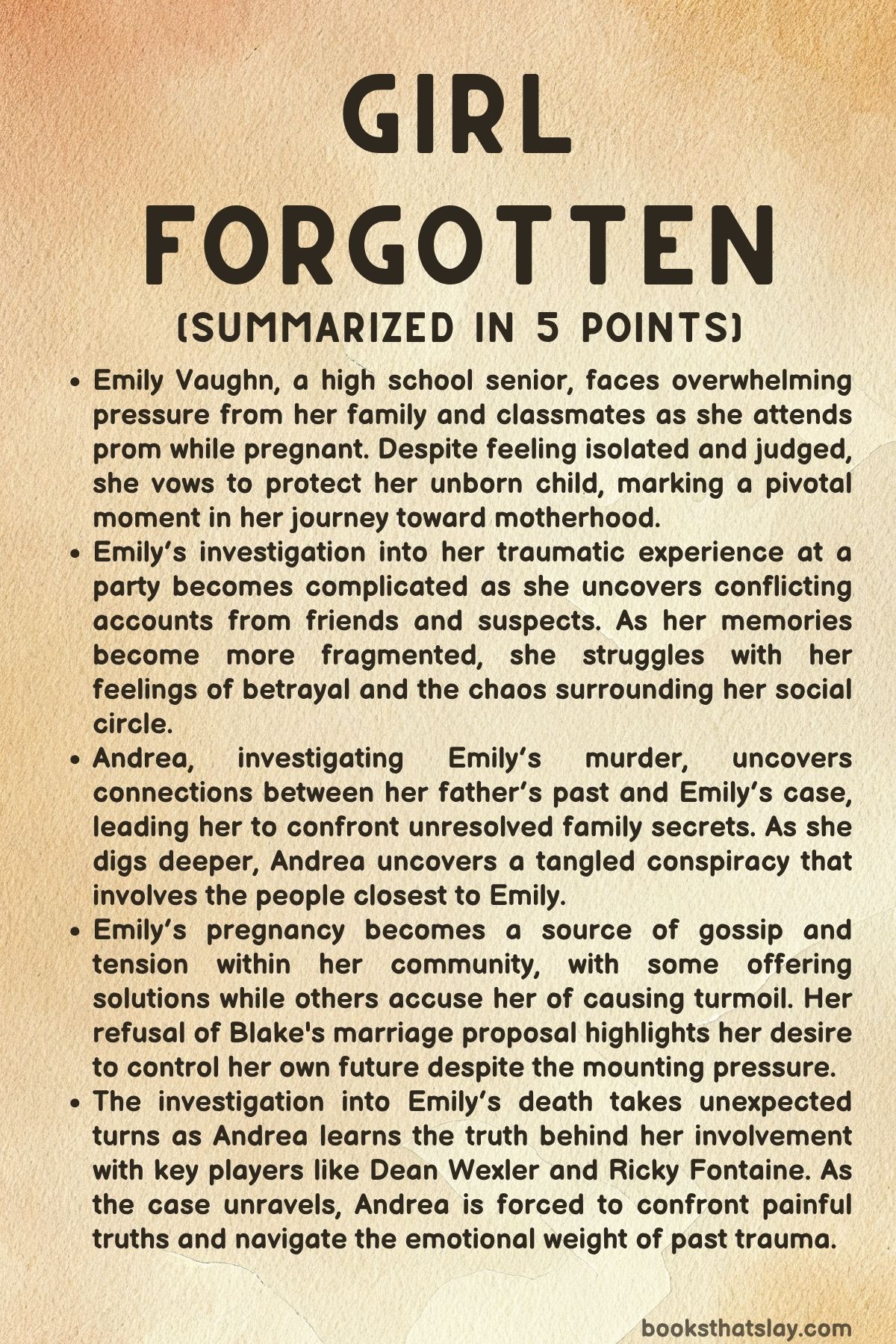
In Longbill Beach, Delaware—a small, affluent beach town—Emily Vaughn is a bright, athletic, well-liked high school senior just weeks from graduation and prom. She comes from a prominent family: her mother, Esther Vaughn, is a respected (and ambitious) judge on the verge of a major federal appointment under President Reagan. Emily’s life shatters when she discovers she is pregnant. She has no clear memory of the conception. The only thing she knows is that it happened after a party with her close-knit group of friends, where she was likely drugged and assaulted.
Emily’s “clique” includes:
- Clayton Morrow (who will later become known as Nick Harp, Andrea’s father)
- Bernard “Nardo” Fontaine
- Dean Wexler (a teacher at the school with questionable boundaries)
- Erica “Ricky” Fontaine (Nardo’s twin sister and Emily’s former close friend)
As word of the pregnancy spreads, Emily faces brutal ostracism. Her peers slut-shame her mercilessly.
Her parents, especially her mother Esther, react with cold fury and disappointment—the scandal threatens Esther’s judicial ambitions. Emily is pressured to give up her dreams of college and independence. Instead of support, she encounters judgment, even from medical professionals who treat her with contempt.
Determined to uncover the truth about what happened the night she was assaulted and who fathered her child, Emily begins her own quiet investigation. She confronts members of her old friend group and pieces together fragmented memories.
On prom night, she attends despite the hostility, hoping for some normalcy or answers. That night ends in violence: Emily is savagely beaten and left for dead. She is discovered in a dumpster, clinging to life but with catastrophic brain injuries.
Doctors keep her on life support long enough for her to deliver a healthy baby girl, whom her grandparents (Esther and her husband) raise as their own—naming her Judith. Emily dies shortly afterward. The murder investigation stalls quickly. Her friends close ranks, providing alibis and vague statements. Her wealthy family withdraws into grief and silence.
The case goes cold, and the town moves on. Emily becomes, quite literally, the “girl forgotten.”
Nearly forty years later, Andrea Oliver—now a newly minted U.S. Marshal in her early thirties—arrives in Longbill Beach on her first official assignment.
Officially, she is there to protect Judge Esther Vaughn, who has been receiving credible death threats. Andrea’s experienced partner is Marshal Leonard “Bible” Bible (often called Catfish), a wry, no-nonsense mentor who helps ground her.
Unofficially, Andrea has a personal agenda. She has been haunted by Emily Vaughn’s unsolved murder ever since she first learned of it a year earlier.
The case has eerie connections to her own troubled family history. Andrea’s biological father is Clayton Morrow (aka Nick Harp), the charismatic, violent cult leader from Pieces of Her. He was part of Emily’s 1982 clique and has long been a suspect in the murder.
With Clayton up for parole soon, Andrea (with some behind-the-scenes help from her uncle, Senator Jasper Queller) sees this assignment as a chance to dig into the cold case and potentially find new evidence that could keep her father locked up.
As Andrea settles into the protection detail, she begins quietly re-examining Emily’s file. She interviews surviving witnesses and old friends still living in or near Longbill Beach, including Dean Wexler and the Fontaine twins. The town has changed little in its insularity. Secrets fester beneath the surface.
Andrea soon discovers a disturbing modern parallel: Dean Wexler and Nardo Fontaine run a “farm” (actually a compound) growing fava beans, where they exploit vulnerable young women in what amounts to a cult-like setup. The women are controlled through rigid diets, isolation, and psychological manipulation.
This operation has ties to the Vaughn family—Nardo and Dean have been blackmailing Judge Esther and her husband for years, using old secrets to secure land and silence. Esther, it turns out, has even been sending some of the death threats to herself as a way to secure federal protection and potentially neutralize the blackmailers.
The investigation intensifies when Andrea uncovers more about the night of Emily’s attack. DNA and old witness statements point to multiple possible fathers, but the truth is uglier: Nardo admits (in a later confrontation) that he repeatedly raped Emily while she was intoxicated or unconscious. He claims paternity but denies the murder.
Tensions peak in a chaotic scene at a local diner. A drunk and furious local police chief, Jack “Cheese” Stilton (son of the original 1982 police chief and someone who had his own complicated feelings toward Emily), confronts Nardo.
Nardo arrogantly confesses to the rapes but insists he did not kill Emily. In a fit of rage, Stilton shoots and kills Nardo on the spot.
With Nardo dead, Andrea turns her focus to Ricky Fontaine. She accompanies a distraught Ricky home, where she finds old notes Emily had made during her own amateur investigation (nicknamed her “Columbo” notes).
Confronted with the evidence and her overwhelming guilt, Ricky finally confesses: she murdered Emily in a jealous rage on prom night. Ricky had been in love with Nardo and was devastated that Emily was carrying his child. She rented a black tuxedo to blend in at the prom, attacked Emily, and—with help from her twin brother—hid the body.
Ricky’s confession brings some closure to Emily’s murder, but justice remains imperfect. Nardo dies without facing trial for the rapes. Dean Wexler is arrested for his role in the blackmail and the exploitative “farm”/cult.
The young women there receive temporary support and housing. Judge Esther Vaughn’s complicity in the cover-up and blackmail scheme is exposed in layers, though her exact legal consequences are complicated by her status and age.
Throughout the novel, Andrea grapples with her own identity, her complicated feelings toward her mother Laura (who survived Clayton’s cult), and the shadow of her father’s legacy. Working with Bible helps her grow more confident as a Marshal. She learns to trust her instincts while confronting how trauma and secrets echo across generations.
The book closes on a note of partial resolution mixed with unease. Andrea has solved Emily’s murder and helped dismantle the modern cult operation.
Yet true redemption feels elusive—some perpetrators escape full accountability, and the emotional scars remain deep. In the final pages, Andrea receives a phone call from her imprisoned father, Clayton Morrow. He claims to have information about her uncle Jasper that she would find interesting, hinting at more secrets and potential future conflicts.
Characters
Andrea Oliver
Andrea stands at the center of the story as both investigator and inheritor of other people’s damage. She enters Longbill Beach in an official role, but her purpose is never purely professional.
Her interest in Emily’s death is shaped by her own family history, especially the fact that Clayton Morrow is her biological father. That connection gives her the emotional intensity of someone hunting for truth not only for a victim, but also against the fear that violence and moral corruption may be part of her inheritance. Her character is defined by this tension between duty and private obsession.
What makes Andrea compelling is that she is not a polished or detached investigator. She is still learning how to function as a U.S. Marshal, and that relative inexperience matters because it keeps her vulnerable, impulsive, and human.
She wants justice, but she also wants personal clarity, and those motives do not always sit comfortably together. Her growth comes from learning how to turn emotional urgency into disciplined action.
She begins as someone pushed by unresolved pain and suspicion, but she gradually becomes someone capable of seeing the larger system around the crime.
Andrea also represents the possibility of interrupting cycles that seemed destined to repeat. She comes from a legacy of manipulation, secrecy, and violence, yet she refuses to accept that bloodline as destiny. By pursuing the truth, protecting the vulnerable, and refusing to look away from ugly facts, she defines herself against her father rather than through him.
In that sense, her character arc is not only about solving a murder. It is about constructing an identity that is ethical, self-aware, and independent of the men whose actions shaped her life before she had any say in it.
Emily Vaughn
Emily is the emotional and moral core of the narrative, even though much of her story unfolds through memory, reconstruction, and aftermath. She begins as a girl who appears to possess every advantage: intelligence, athletic ability, beauty, social standing, and a future that seems clear.
Yet that appearance is quickly exposed as fragile, because her town’s approval depends entirely on her ability to remain legible within its narrow expectations. Once she becomes pregnant, she is no longer treated as a full person with trauma, fear, and uncertainty. She becomes a scandal for others to manage.
Her tragedy lies not only in the assault and murder, but in the way the people around her fail to recognize her humanity when she most needs compassion. She is judged by her peers, controlled by her family, and dismissed by authority figures who should have protected her.
Still, she is not written as passive. She tries to recover fragments of the truth and make sense of what happened to her. Her private search for answers shows courage, intelligence, and a refusal to surrender completely to shame. That stubbornness gives her real agency, even as the world around her closes in.
Emily also functions as a measure of the town’s moral collapse.
The treatment she receives exposes how quickly privilege, status, and respectability can be used to erase a victim. She becomes “forgotten” not because her life lacked value, but because too many people benefited from silence. Her death haunts the entire story because it is never just about one lost girl. It is about how a community decided her suffering was less important than its own self-protection.
Esther Vaughn
Esther is one of the most complex figures because she embodies authority, ambition, maternal failure, and self-justification all at once.
As a judge on the edge of greater political advancement, she is deeply invested in image, control, and public standing. Her daughter’s pregnancy is therefore not treated first as a crisis of violence or vulnerability, but as a threat to a career she values intensely.
This response reveals a woman who has trained herself to interpret the world through power and consequence rather than through emotional truth.
Her coldness toward Emily is especially disturbing because it comes from someone who should have offered protection. Esther’s failure is not mere harshness; it is a profound moral blindness shaped by class pride and institutional thinking.
She can identify risk, calculate outcomes, and manage appearances, but she cannot respond to suffering without filtering it through status.
That inability makes her both formidable and tragic. She is not a caricature of maternal cruelty. She is a woman who has so fully internalized public ambition that private love becomes conditional.
Later revelations deepen her character by showing that she is willing to manipulate systems for self-preservation. Her involvement in concealment and blackmail-related dynamics shows how far she has drifted from any claim to justice. Yet she is not emotionally simple.
There is grief in her, guilt in her, and a long history of choices she cannot undo. She becomes an image of what happens when respectability is valued more than truth: a person may retain social authority while losing moral authority completely.
Clayton Morrow / Nick Harp
Clayton is a looming presence whose direct role in the present is limited, yet whose influence shapes the narrative powerfully.
As a member of Emily’s social circle in 1982 and later as Andrea’s imprisoned father, he represents charisma fused with menace. His dual identity underscores one of the book’s central ideas: dangerous men often survive by reinventing themselves while keeping their essential cruelty intact. He moves through other people’s lives as a source of distortion, making trust difficult and truth unstable.
His significance lies partly in uncertainty.
For much of the story, he exists as a possible answer to several mysteries, which mirrors Andrea’s emotional experience of him. He is both concrete and symbolic: a real man with a record of harm, and also a shadow that stretches across generations.
Andrea cannot think about Emily’s case without also thinking about what kind of man her father is, what he may have done, and what it means to be connected to him by blood.
Clayton’s narrative function also extends beyond guilt or innocence in a single crime. He stands for the enduring afterlife of male violence. Even from prison, he remains capable of intrusion, manipulation, and psychological disruption.
His final contact with Andrea makes clear that he still sees knowledge as a weapon and intimacy as leverage. He matters because he reminds both Andrea and the reader that some forms of danger do not end when a man is incarcerated. They persist through memory, influence, and the secrets he still controls.
Leonard “Bible” Bible
Bible serves as a stabilizing force in a story filled with unstable loyalties and suppressed violence. As Andrea’s partner and mentor, he offers experience, skepticism, and practical intelligence.
He is not sentimental, and that quality is important because it prevents him from becoming a simple emotional support figure. Instead, he grounds Andrea by insisting on method, caution, and perspective. His value lies in the fact that he sees clearly without becoming cynical to the point of paralysis.
His relationship with Andrea gives shape to her development. He recognizes both her strengths and her vulnerabilities, and he often functions as a counterweight to her impulsive, personally driven approach.
Through him, the narrative explores what professionalism can look like in contrast to obsession. He does not erase Andrea’s instincts; he helps refine them. That dynamic allows their partnership to feel earned rather than decorative.
Bible also carries thematic weight because he represents a healthier model of male authority. In a world crowded with predatory, weak, corrupt, or self-serving men, he is competent without being domineering and protective without being possessive. That distinction matters.
He helps create a space in which Andrea can grow into her role rather than be controlled by it. His presence suggests that institutional power is not inherently corrupt, though it becomes meaningful only when exercised with integrity and restraint.
Bernard “Nardo” Fontaine
Nardo is one of the story’s clearest embodiments of entitlement without conscience. In youth, he is part of the privileged social circle around Emily, and in adulthood he remains a man who believes access to other people’s bodies and lives is his natural right.
His later admission that he repeatedly raped Emily while she was incapacitated strips away any ambiguity about his moral nature. He is not simply a suspect in a murder investigation. He is a predator whose violence has long been protected by silence, wealth, and social familiarity.
What makes Nardo particularly disturbing is the banality of his evil. He is not defined by dramatic self-awareness or tortured psychology. He is sustained by the ordinary arrogance of a man who has rarely been challenged in any meaningful way. That makes him more realistic and more chilling.
His brutality exists alongside routines, business arrangements, and the casual performance of local influence. He does not need to appear monstrous at every moment because the system around him has helped normalize his conduct.
His role in the present-day “farm” operation extends his earlier violations into a larger pattern of exploitation. He is someone who repeatedly seeks out women made vulnerable by circumstance and then builds structures that preserve his control over them.
Even his death does not feel like justice in any complete sense, because it removes him from legal accountability.
That incompleteness is central to his character. He is one of the figures through whom the narrative shows how often predatory men escape proportionate consequences.
Erica “Ricky” Fontaine
Ricky is a deeply unstable and tragic figure whose outward toughness conceals fixation, jealousy, and long-buried guilt. In the past, she is part of Emily’s close social circle, yet that intimacy contains resentment and emotional distortion.
Her love for her brother and her obsession with possession create a warped emotional world in which Emily’s pregnancy becomes intolerable. She does not see Emily as a person suffering violence; she sees her as a rival, an intrusion, and a threat to a bond Ricky cannot relinquish in any healthy way.
Her eventual confession reshapes the novel’s emotional logic because it reveals that the murder was driven not by a grand criminal scheme, but by personal pathology intensified by secrecy and denial.
Ricky’s violence is shocking, yet it grows from years of emotional damage, repression, and misdirected devotion. That does not excuse what she did, but it explains why she has lived as a haunted person rather than a triumphant one. Guilt has not redeemed her, but it has corroded her from within.
Ricky also shows how women can become participants in patriarchal harm rather than only its victims. She does not protect Emily from the men around them; she turns against her.
Her character therefore complicates any easy gender division between victim and oppressor. She is herself shaped by a toxic environment, yet she chooses brutality. Her confession offers truth, but it does not restore what was destroyed.
It instead reveals how jealousy and denial can become deadly when a culture already teaches women to direct rage at each other instead of at the systems and men that harm them.
Dean Wexler
Dean represents institutional corruption at its most insidious because he occupies the role of educator, a position associated with trust, formation, and safety. His questionable boundaries in the past already suggest moral rot, but the present-day revelations about his involvement in exploitation confirm that he has always used authority as a cover for predation.
He is the kind of figure who thrives in environments where respectability protects men from scrutiny.
What distinguishes Dean from more visibly violent characters is his method. He does not rely primarily on force in the obvious sense. He relies on grooming, manipulation, intimidation, and the strategic use of dependency.
The “farm” operation reveals his preference for systems that make coercion look orderly or even benevolent from the outside. That makes him particularly dangerous because he weaponizes structure, routine, and ideology in order to control vulnerable women.
Dean’s character broadens the novel’s critique of abuse by showing that harm is not always chaotic or impulsive. It can be organized, rationalized, and maintained through institutions that appear legitimate.
His downfall matters because it exposes the machinery behind exploitation rather than focusing only on individual acts of cruelty. He is less emotionally dramatic than some other characters, but his presence is essential because he represents the predatory intelligence that turns private wrongdoing into a sustained social arrangement.
Jack “Cheese” Stilton
Stilton is a volatile character shaped by the inheritance of local power, masculine resentment, and unresolved history. As police chief and son of the original 1982 police chief, he carries both personal and institutional baggage. He is not a steady guardian of law. Instead, he reflects a policing culture burdened by ego, memory, and compromised judgment.
His complicated feelings toward Emily and the old case make him less an impartial officer than a damaged participant in the town’s long denial.
His killing of Nardo is a moment of explosive rage rather than measured justice. That action is significant because it captures the failure of men and institutions to respond properly even when confronted with truth. Stilton recognizes horror, but he processes it through wounded masculinity and impulsive violence. He does not restore order; he adds another act of lawless force to a story already saturated with male aggression.
At the same time, he is not emotionally empty.
His anger suggests that the town’s buried crimes have deformed him too. He appears as someone who has lived in proximity to corruption for so long that he can no longer distinguish justice from vengeance. In this way, he becomes another example of the damage caused by silence. Even those who are not the original perpetrators are changed by a culture that suppresses truth for decades.
Judith
Judith occupies a quieter but symbolically important place in the story. Raised by Emily’s parents as their own child after Emily’s death, she embodies the layered consequences of violence, concealment, and substitution.
Her existence is living proof that the past has never been contained. She is the child born from assault, but she is also a person shaped by a family arrangement built on silence and reinvention. That gives her character an unsettling symbolic weight even when she is not always the dominant presence in the action.
She represents what survives after catastrophe, though survival here is ethically complicated. Her life is possible because Emily was kept alive long enough to give birth, a fact that carries both tenderness and horror.
Judith’s upbringing under Esther’s roof raises difficult questions about love, possession, guilt, and compensation. Was she cherished as a child, used as a replacement, or both? The emotional ambiguity around her makes her role more powerful.
Judith also shows that the past is never truly buried when it continues in human form. She is not just evidence or consequence. She is a person whose identity is shaped by truths others tried to hide. Through her, the story suggests that even when a town suppresses a crime, the results remain present in family structures, emotional histories, and the lives of children who inherit secrets they did not create.
Themes
Trauma, Memory, and the Fragility of Truth
Trauma shapes how people remember, misremember, and conceal what happened to them. Emily cannot fully recall the circumstances of her assault, and that damaged memory becomes part of her isolation because uncertainty is used against her instead of being recognized as evidence of violation.
The same pattern continues decades later as Andrea tries to reconstruct a crime buried under lies, fear, and selective recollection.
Truth does not appear as something cleanly recoverable; it must be assembled from fragments left behind by people who are ashamed, self-protective, or psychologically broken. In Girl, Forgotten, this makes investigation feel less like solving a puzzle and more like confronting the limits of what damaged minds and dishonest communities are willing to reveal.
The theme also extends to inherited trauma. Andrea is not only investigating an old murder; she is living with the emotional consequences of a violent family history that affects how she sees herself and others. Memory in this story is therefore not simply a storehouse of facts. It is unstable, painful, and often shaped by power. The search for truth becomes meaningful precisely because trauma has made truth so difficult to hold onto.
Sexual Violence and the Social Punishment of Victims
The response to Emily’s pregnancy reveals a culture that would rather discipline a girl than confront the men who harmed her. She is shamed by classmates, judged by adults, and treated as though the visible evidence of assault has made her morally suspect.
The social reaction matters as much as the crime itself because it shows how communities protect predatory behavior through humiliation, disbelief, and strategic silence. Emily is not only attacked physically. She is stripped of dignity by a system that interprets female suffering as contamination. That same pattern continues in the exploitation of vulnerable young women at the compound run by Dean and Nardo. Abuse is shown not as a single event but as a recurring structure sustained by entitlement and indifference.
The novel argues that sexual violence survives most easily where institutions, families, and peer groups treat women’s pain as inconvenient. The victim is expected to absorb shame, while the perpetrators are granted complexity, delay, and cover. By exposing this imbalance, the story becomes an indictment of the social habits that make abuse easier to commit and harder to punish.
Power, Respectability, and Corruption
Public prestige repeatedly masks private failure. Esther’s judicial authority, the town’s polished affluence, the school environment, and local law enforcement all project order, yet each contains compromise or decay. Respectability functions as protection for the people most invested in avoiding scandal.
Once image becomes more valuable than justice, institutions stop serving the vulnerable and begin managing appearances instead. Esther’s reaction to Emily makes this especially clear. Her concern is filtered through ambition and reputation, which reveals how power can turn empathy into a liability. Dean’s conduct adds another dimension by showing how authority figures use trusted roles to gain access and avoid scrutiny.
Even policing is contaminated by inherited loyalties and emotional distortions. The story’s critique is not limited to one villain or one bad decision. It suggests that corruption flourishes when class privilege, professional status, and social familiarity combine to make certain people seem unquestionable.
In that environment, truth becomes dangerous because it threatens structures that benefit the powerful. Justice is delayed not only by fear, but by the fact that too many influential people need the lie to survive.
Inheritance, Identity, and the Refusal to Repeat the Past
Andrea’s story is shaped by a fear that family history may define who she is. Having Clayton as a father forces her to confront the possibility that violence, manipulation, and moral damage are not distant facts but intimate origins. The emotional force of her investigation comes partly from that anxiety.
She wants to solve Emily’s murder, but she also wants proof that she can stand apart from the legacy that produced her. This theme gives the narrative a generational depth. The past is not closed; it presses into the present through bloodlines, secrets, reputations, and long-guarded resentments.
Judith also reflects this theme as a child whose existence is born from violence and then shaped by concealment. Yet the story does not argue that inheritance is destiny. Andrea’s growth depends on making choices that oppose the patterns embodied by her father and by the town’s old culture of silence.
Identity emerges not from origin alone, but from what one chooses to confront, protect, and reject. The narrative’s measure of hope lies in this possibility: a person may come from damaged histories without becoming their continuation.