Good Joy, Bad Joy Summary, Characters and Themes
Good Joy, Bad Joy by Mikki Brammer is a warm, reflective novel about friendship, aging, grief and the freedom that can come from questioning the rules that have governed an entire life.
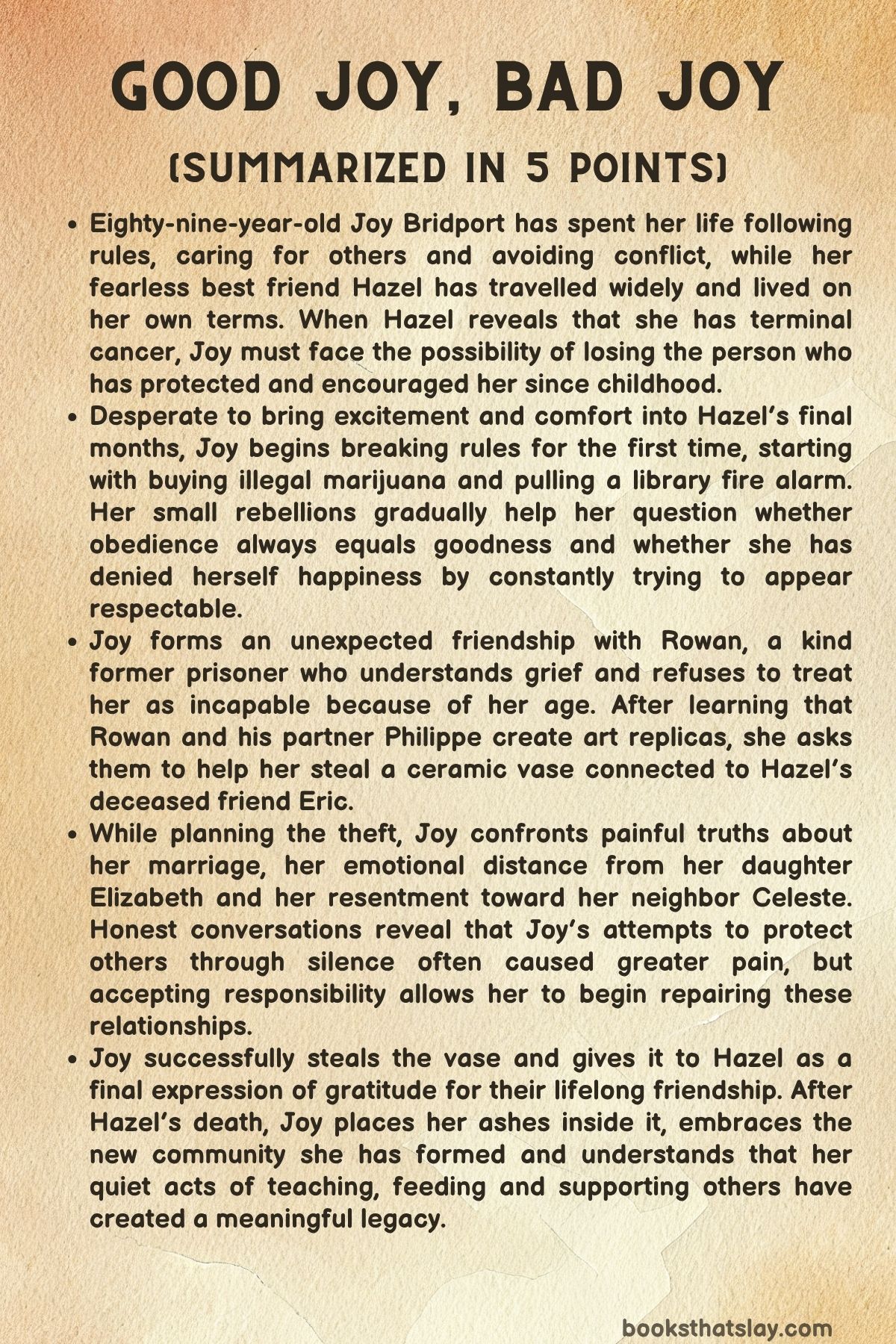
At eighty-nine, Joy Bridport has spent decades trying to be dependable, generous and morally correct, yet the approaching death of her closest friend forces her to reconsider what goodness truly means. Through acts of rebellion, unexpected friendships and painful family conversations, Joy discovers that a quiet life can leave a powerful legacy. The book also celebrates friendship as a form of lasting love capable of surviving distance, disagreement, regret and loss.
Summary
Eighty-nine-year-old Joy Bridport begins each morning by feeling grateful that she is still alive. She has outlived her husband, Thom, and most members of her generation, leaving her childhood friend Hazel as the only person who fully remembers the long history they share.
Joy lives alone in the Beacon house she has occupied for more than sixty years. She finds pleasure in her garden, birdsong, sunlight, baking and the daily messages Hazel sends to confirm that she is still alive, yet these comforting routines also remind her of the people who are no longer present.
Her limited savings require careful budgeting, so Joy grows vegetables, preserves food and repairs possessions rather than replacing them. She has also started giving away household objects because she does not want her daughter Elizabeth and grandson Finn to face an overwhelming task after her death.
During a family dinner, Joy notices that Hazel is unusually tired and subdued. After Elizabeth and Finn leave, Hazel reveals that she has terminal cancer, has refused aggressive treatment and expects to live only a few more months.
Joy is devastated because she always assumed she would die before Hazel. Hazel has protected her since childhood, beginning when the confident young girl defended the shy newcomer from schoolyard cruelty and immediately claimed Joy as her friend.
Their personalities have always been different. Hazel is bold, fashionable, adventurous and willing to challenge anyone, while Joy has spent her life avoiding conflict, following rules and trying to remain useful without becoming a burden.
Hazel’s illness therefore forces Joy to imagine living without the person who has repeatedly guided her through loss. Hazel supported her after her mother died, encouraged her through marriage and motherhood, and returned from Egypt to help her learn basic financial and household skills after Thom’s death.
Joy’s childhood explains much of her cautious personality. Her stern father demanded perfect behavior, while her dying mother taught her that a respectable woman should remain composed, choose security over passion and never trouble other people with private suffering.
Joy followed those instructions faithfully. She married Thom because he appeared dependable and orderly, believing affection would grow within a stable marriage, but she later discovered that security could exist alongside emotional distance, control and repeated betrayal.
Thom managed the money, made many household decisions and had affairs that Joy refused to confront. She remained married partly because she believed divorce would harm Elizabeth, only to learn much later that her daughter had always understood what was happening and had suffered from the family’s silence.
Hazel chose a very different life. She moved to New York, travelled widely, created a successful textile business and supported artisans around the world, yet her independence also involved mistakes, broken relationships and private regrets.
One of Hazel’s greatest regrets concerns Eric, an artist who created a striking ceramic vase. Eric loved Hazel, but when he confessed his feelings, she reacted with surprised laughter and humiliated him; before they could repair the damage, he died from an overdose.
The vase eventually came into the possession of Seth, a former gallery owner who blamed Hazel for discouraging Eric from accepting professional representation. Seth refuses to sell it because keeping it allows him to continue punishing Hazel for a decades-old grievance.
As Joy struggles to accept Hazel’s diagnosis, she begins questioning whether her own carefully controlled life has been meaningful. A kitchen accident, social invisibility and patronizing treatment from younger people make her feel vulnerable, while comparisons with Hazel’s achievements leave her wondering whether she has lived too cautiously.
Her first unexpected rebellion occurs at the library. After seeing a reserved romance novel she wants, Joy slips it into her bag and escapes because the librarian trusts her too much to suspect theft.
On a train to Manhattan, Joy meets Rowan, the tattooed newcomer whom neighborhood gossip identifies as a former prisoner. Rowan behaves with warmth and sensitivity, speaks openly about losing his mother to cancer and introduces Joy to Philippe, his partner of twenty years.
The conversation challenges Joy’s assumptions about love, criminality and appearances. It also gives her the courage to navigate the subway alone, something Hazel has always handled for her.
At Hazel’s loft, Joy sees how severely cancer has weakened her friend. Hazel reluctantly accepts food and companionship, then asks Joy to purchase marijuana from her regular dealer because it controls her pain better than the legal medication she has received.
Joy is terrified but agrees. The dealer turns out to be a polite young man who delivers the order in a coffee-shop bag, includes a gift for Hazel and expresses genuine concern about her illness.
The successful transaction gives Joy an exhilarating sense of freedom. She realizes that breaking a law in order to relieve Hazel’s suffering does not feel cruel or immoral, which leads her to question whether goodness can always be measured by obedience.
Wanting to experience that excitement again, Joy pulls a fire alarm at the library and joins the evacuation. Nobody suspects her because an elderly woman with decades of respectable behavior does not fit anyone’s idea of a reckless offender.
When Joy tells Hazel about the incident, Hazel is delighted. For once, Joy becomes the adventurous storyteller, and her confession briefly restores Hazel’s humor and energy.
Joy begins committing additional acts of mischief, including speeding, shoplifting and knocking over a supermarket display. Some actions feel liberating, but others expose the dangers of allowing long-suppressed anger to guide her behavior.
Her resentment is especially strong toward Celeste, a neighbor Joy believes had an affair with Thom. After seeing Celeste at a supermarket, Joy allows a shopping cart to strike her car, taking satisfaction in revenge despite never having asked Celeste what truly happened.
At the same time, Joy’s friendship with Rowan deepens. He admits that he spent eight years in prison after becoming involved with a fraudulent wine business and refusing to testify against the wealthy employer who shifted most of the blame onto him.
Joy recognizes the unfairness of a society that permanently labels Rowan while allowing her own offenses to go unnoticed. Her age, race, reputation and years of community service protect her, whereas Rowan continues to be judged according to the worst period of his youth.
Rowan later reveals that he and Philippe still participate in crime. Philippe creates expert replicas of valuable art, while Rowan uses his work as a piano tuner to identify objects they can replace and steal for a private collector.
Their activities trouble Joy, but the revelation also gives her an idea. She decides that the greatest final gift she can offer Hazel is Eric’s original vase.
Joy asks Rowan and Philippe to create a replica so she can switch it with the authentic piece in Seth’s store. Rowan warns that planned theft carries serious consequences, but Joy insists that a reproduction cannot provide Hazel with the genuine connection to Eric that she deserves.
Before the plan moves forward, Joy’s family relationships become increasingly strained. She delays telling Elizabeth about Hazel’s illness because she believes she is protecting her exhausted daughter, but Elizabeth is furious that Joy has taken away precious time she could have spent with Hazel.
The conflict worsens after Elizabeth reveals that Joy has never allowed difficult emotions to exist without immediately trying to replace them with gratitude, food, cleaning or advice. She explains that she needed her mother to listen rather than constantly attempting to make painful feelings disappear.
Elizabeth also says that watching Joy tolerate Thom’s affairs was more damaging than divorce would have been. Joy’s supposed sacrifice taught her daughter that stability mattered more than dignity, honesty or emotional safety.
The conversation forces Joy to reconsider the parenting principles she inherited from her mother. She realizes that she gave Elizabeth the childhood she herself had wanted without asking what her daughter actually needed.
Joy also remembers Percy, a gentle widower she met while volunteering. Percy treated her domestic work and piano teaching as meaningful, made her laugh and offered her the experience of being valued for herself rather than for the role she performed.
When Percy confessed his love, Joy ended the friendship because she refused to betray her marriage, although she loved him. Years later, after his death, she understood the depth of what she had sacrificed in order to preserve her identity as a good wife.
As Hazel becomes weaker, Rowan advises Joy to stop treating her as someone she is waiting to lose. He encourages her to respect Hazel’s choices, remain present and express her feelings in a letter that Hazel can read privately.
Joy struggles to summarize more than eighty years of friendship, eventually writing ninety cherished memories. She mails the letter on the morning of the planned theft, along with instructions for Elizabeth in case she is arrested.
Disguising herself as a confused and fragile old woman, Joy enters Seth’s store carrying Philippe’s replica. While Philippe distracts Seth, she switches the vases and hides the original inside her shopping caddy.
The plan nearly fails when Seth returns sooner than expected, but he pays little attention to Joy. The invisibility that once made her feel irrelevant now becomes the quality that allows her to succeed.
When Joy returns home, she sees a police car outside Rowan’s house and immediately confesses in order to protect him. The officer is actually investigating an unrelated complaint and turns out to be Charles, one of Joy’s former piano students.
Charles explains that Joy’s lessons, meals, clothing and encouragement provided stability during a neglected childhood. He believes her kindness helped save his life and tells her that she probably changed many other children without ever knowing it.
The encounter transforms Joy’s understanding of her legacy. Her contributions may not be publicly celebrated, but decades of teaching, feeding and supporting children have influenced lives across generations.
Joy presents the stolen vase to Hazel and explains the entire operation. Hazel is shocked by the danger Joy accepted, but she is deeply moved that her friend risked so much to give her a final connection to Eric.
Hazel asks Joy to place her ashes inside the vase after her death and keep it nearby. Joy agrees, finally understanding that goodness and badness cannot be separated into permanent identities based on individual actions.
Her moral awakening also gives her the courage to confront Celeste. When Joy publicly accuses her of kissing Thom, Celeste explains that Thom grabbed her without consent and that she pushed him away.
Joy realizes she blamed another victim for more than forty years. After apologizing and confessing that she damaged Celeste’s car, she discovers that honesty can repair relationships that silence allowed resentment to destroy.
Joy then visits Elizabeth and apologizes without defending herself. She admits that she dismissed her daughter’s emotions, encouraged her to remain with an unfaithful husband and confused practical caretaking with emotional understanding.
Elizabeth reveals that Jack also cheated on her and that she divorced him because she refused to repeat Joy’s choices. She has struggled financially, borrowed money from Hazel and begun dating a kind artist whose lack of financial security would once have alarmed Joy.
Instead of advising caution, Joy tells Elizabeth to pursue happiness. Their honest conversation allows them to acknowledge their jealousy, disappointment and love, beginning a more equal relationship.
During Hazel’s final months, Joy moves into the Brooklyn loft and cares for her without trying to control her. She provides food, medicine, companionship and familiar pleasures while accepting that love cannot prevent death.
Hazel tells Joy that although she experienced many passionate romances, Joy has been the true love of her life. She leaves the loft to Joy and creates a scholarship for electric pianos so that Joy’s teaching can continue.
After Hazel dies, Joy holds a dinner attended by Elizabeth, Finn, Celeste, Rowan and Philippe. Hazel’s ashes rest inside Eric’s vase at the head of the table, placing her symbolically within the new community Joy has built.
Joy removes her wedding ring and releases the idea that Thom’s expectations must continue directing her life. At ninety, she plans to divide her time between Beacon and Brooklyn, teach more children and remain open to friendship, adventure and change.
Characters
Joy Bridport
Joy Bridport is the emotional center of Good Joy, Bad Joy, and her transformation gives the novel its central movement. At eighty-nine, she appears gentle, disciplined and generous, but her identity has been shaped by decades of emotional suppression and obedience.
Her mother taught her to remain cheerful, avoid burdening others and choose stability instead of passion. Joy turns these instructions into permanent moral rules, judging herself according to how effectively she can serve people without demanding care in return.
Her kindness is genuine rather than performative. She teaches free piano lessons, feeds hungry children, shares produce, tends forgotten graves and notices practical needs that others overlook.
However, Joy often uses service to avoid emotional exposure. She feels safer baking, cleaning or solving problems than listening to anger, grief or disappointment that she cannot remove.
This limitation damages her relationship with Elizabeth. Joy believes she is protecting her daughter, yet she repeatedly withholds information, minimizes distress and offers advice based on her own fears rather than Elizabeth’s actual needs.
Hazel’s illness forces Joy to confront the difference between goodness and obedience. Her crimes become experiments through which she discovers agency, anger, pleasure and the ability to make choices based on personal conviction.
Not all of Joy’s rebellions are admirable. The damage to Celeste’s car and the supermarket disturbance show that liberation without reflection can become selfish or harmful.
Her greatest growth comes when she accepts responsibility rather than merely enjoying escape. She apologizes to Celeste, listens to Elizabeth without defending herself and cares for Hazel according to Hazel’s wishes rather than her own need for control.
Joy also learns that her quiet life has mattered. Charles’s gratitude helps her understand that teaching and practical generosity created a lasting influence, even though she never received public recognition.
By the end, Joy has not replaced her generous nature with recklessness. She has expanded her identity so that kindness can coexist with desire, anger, courage, uncertainty and personal freedom.
Hazel
Hazel is Joy’s lifelong friend, protector and emotional opposite. Within Good Joy, Bad Joy, she represents the possibilities Joy denied herself, although the novel gradually reveals that Hazel’s apparent fearlessness has always contained regret and vulnerability.
As a child, Hazel immediately defends Joy from bullying. This establishes the pattern of their friendship, with Hazel challenging the world while Joy provides steadiness and care.
Hazel builds a successful business, travels internationally and refuses traditional expectations surrounding marriage and motherhood. Her choices give her independence, but they also leave her with relatively few lasting relationships near the end of her life.
She does not regret refusing motherhood, yet she recognizes that freedom without sustained commitment can produce loneliness. Her illness strips away the dramatic appearance through which she has always projected confidence.
Hazel’s relationship with Eric reveals her capacity for carelessness. Her laughter at his declaration of love wounds him deeply, and his death prevents her from repairing the relationship or apologizing.
Her desire for Eric’s vase is therefore connected to remorse rather than simple possession. It represents unfinished love, guilt and the wish to preserve something created by a person she failed to understand in time.
Hazel often rejects assistance because she associates dependence with defeat. Hiring a death doula allows her to discuss mortality without feeling responsible for managing Joy’s grief.
Her decision to accept Joy’s care becomes one of her final acts of trust. She allows Joy to see the frightened and exhausted person beneath the bold identity she has maintained for decades.
Hazel’s description of herself as a kite and Joy as the string corrects Joy’s belief that their friendship has been unequal. Hazel needed Joy’s constancy as much as Joy needed Hazel’s courage.
Her declaration that Joy is the true love of her life gives the friendship the emotional status usually reserved for romance. Hazel’s final gifts ensure that Joy’s future will include both personal freedom and continued service to others.
Elizabeth
Elizabeth is Joy’s daughter and one of the clearest witnesses to the consequences of Joy’s emotional habits. She is hardworking, responsible and loving, but her exhaustion and guarded behavior reveal years of unresolved resentment.
Joy interprets Elizabeth’s distance as rejection. Elizabeth, however, experiences her mother as someone who responds to pain by offering food, optimism or instructions instead of emotional attention.
As a child, Elizabeth understood more about Thom’s affairs than Joy realized. Watching her mother tolerate betrayal taught her that maintaining appearances mattered more than acknowledging harm.
Joy encourages Elizabeth to remain with dependable Jack because she repeats the advice inherited from her own mother. Elizabeth eventually discovers Jack’s infidelity and chooses divorce rather than copying Joy’s silence.
Her closeness with Hazel reflects her need for an adult model who values independence and self-expression. Hazel gives Elizabeth permission to question expectations, attend protests, alter her appearance and imagine a life beyond conventional security.
Elizabeth’s decision to borrow money from Hazel is not intended to humiliate Joy. She knows her mother is struggling and refuses to let Joy sacrifice basic necessities while pretending everything is manageable.
Her confrontation with Joy is harsh because it contains decades of unspoken pain. She needs her mother to understand that good intentions do not automatically erase damaging consequences.
Elizabeth also accepts responsibility for her own choices. She admits that pride may influence her handling of Jack, that she has financial difficulties and that she has concealed parts of her personal life.
Their reconciliation becomes possible when Joy finally listens. Elizabeth is then able to express both anger and affection without being corrected, reassured or told to feel grateful.
Finn
Finn is Joy’s grandson and a source of warmth, humor and emotional honesty. He is affectionate, observant and comfortable showing vulnerability in ways that earlier generations of the family often resisted.
His classmates mock him for dancing with his mother, lacking interest in football and appearing too emotionally close to Elizabeth. Their cruelty demonstrates how rigid expectations of masculinity can punish kindness, sensitivity and family affection.
Finn also suffers from Jack’s unreliability. His father cancels plans without taking responsibility for the emotional effect, leaving Joy and Elizabeth to help Finn process rejection.
Unlike the adults around him, Finn often responds naturally to distress. When Elizabeth breaks down after learning about Hazel’s cancer, he comforts her physically without trying to explain the pain away.
His leadership assignment introduces the idea that nobody is entirely good or bad. This observation helps Joy understand that morality involves choices, motives and consequences rather than permanent labels.
Finn also supports Joy’s growth in practical ways. He guides her while she drives on the freeway and celebrates her success rather than treating her age as proof of incapacity.
His presence connects the family’s past and future. Through him, Joy sees the possibility of a generation that can value security without demanding emotional silence.
Thom Bridport
Thom is Joy’s late husband and the person around whom she organized most of her adult identity. He initially appears safe, respectable and dependable, making him the ideal partner according to her mother’s standards.
Their marriage contains genuine companionship, family rituals and shared enjoyment. Board games and domestic routines allow Joy and Thom to create real moments of affection despite the emotional limitations surrounding them.
Thom nevertheless exercises extensive control. He manages the finances, influences Joy’s appearance, makes decisions on her behalf and encourages her dependence by assuming responsibility for tasks she is capable of learning.
His affairs reveal a pattern of entitlement and dishonesty. He expects Joy to maintain the home and family while he violates the stability he claims to represent.
Thom’s treatment of Celeste is especially disturbing because Joy initially assumes their kiss was consensual. Celeste later explains that he grabbed her, showing that his behavior harmed women beyond his wife.
Joy’s loyalty allows Thom’s influence to continue after his death. She remains uncertain about money, driving, household repairs and personal decision-making because he trained her to see these matters as his responsibilities.
The novel does not erase the family and memories created during their marriage. Instead, Joy learns to acknowledge the good without allowing it to excuse betrayal, control or emotional neglect.
Removing her wedding ring represents neither hatred nor denial. It marks her decision to stop defining herself according to the role Thom assigned her.
Rowan
Rowan is Joy’s neighbor, friend and unexpected guide into moral uncertainty. His tattoos, criminal history and reserved manner initially make him the object of neighborhood suspicion.
His kindness quickly challenges Joy’s assumptions. He speaks honestly about grief, respects Hazel’s independence, repairs Joy’s car and treats her as a capable adult rather than a fragile elderly woman.
Rowan’s prison history demonstrates how wealth and social reputation influence punishment. As a young employee, he became involved in fraud, but his employer’s resources allowed the more powerful man to shift responsibility onto him.
His refusal to testify may reflect loyalty, fear, pride or immaturity. The consequences, however, follow him long after his sentence ends, limiting society’s willingness to recognize his growth.
Rowan’s continuing participation in art theft prevents him from becoming a simple victim. He knowingly breaks the law and justifies his actions by claiming that the collector appreciates the objects more than their wealthy owners.
His moral arguments attract Joy because they reject simplistic divisions between criminals and respectable people. At the same time, his activities remind readers that sympathy for a person does not require approving every decision.
Rowan understands Joy’s struggle with Hazel because he cared for his own dying mother. His advice helps Joy replace control with companionship and express gratitude through writing.
Most importantly, Rowan becomes evidence that new friendship remains possible in old age. His presence does not replace Hazel, but it helps Joy imagine a future that is not defined entirely by absence.
Philippe
Philippe is Rowan’s longtime partner and the skilled creator of replicas used in their thefts. Although he appears less frequently, his work is essential to Joy’s plan.
His relationship with Rowan provides Joy with a model of love that differs from her conventional marriage. They maintain separate homes, respect each other’s preferences and create closeness without demanding identical lifestyles.
Philippe’s artistry raises questions about authenticity and ownership. He can reproduce the appearance of valuable objects, but Hazel’s desire for Eric’s vase proves that emotional history cannot be copied.
His participation in the heist also reflects loyalty. He accepts personal risk because Rowan values Joy and because the purpose of the theft carries emotional significance.
Philippe enters Joy’s developing community without judgment or condescension. His presence at the final dinner confirms that her new life includes relationships once excluded by the narrow social expectations of her youth.
Celeste Hobart
Celeste is Joy’s longtime neighbor and the target of decades of resentment. Joy believes she willingly participated in Thom’s infidelity after seeing him kiss her at a party.
Because Joy refuses confrontation, she never asks Celeste for an explanation. Silence allows jealousy, shame and suspicion to harden into a fixed story.
Celeste carries her own shame. She believes she may somehow have encouraged Thom even though he grabbed her without consent, showing how women are often taught to blame themselves for men’s actions.
Joy’s hostility deprives both women of a potentially valuable friendship. Each assumes that the other has rejected or judged her.
Their confrontation finally corrects the misunderstanding. Celeste’s willingness to accept Joy’s apology and laugh about the damaged car reveals generosity beneath her polished social image.
She also complicates Joy’s belief that professional success automatically creates confidence. Although Celeste appears accomplished, she has spent decades carrying private discomfort and longing for reconciliation.
Rita
Rita is the neighborhood gossip who spreads information about Rowan’s criminal record and repeatedly attempts to manage Joy’s social life. Her intrusive behavior makes her irritating, but she also performs an important social function.
She notices isolation and invites Joy into a circle of older women. Although the gathering initially makes Joy feel inadequate, Rita’s invitation forces her to recognize that she cannot complain about loneliness while rejecting every available connection.
Rita’s suspicion of Rowan exposes how communities can turn private history into permanent identity. She believes she is protecting the neighborhood, yet her gossip encourages surveillance and prejudice.
Her comments about Ramona’s husband having an affair also reveal a tendency to blame women for male betrayal. This conversation finally provokes Joy into speaking publicly about Thom and Celeste.
Rita is not presented as purely malicious. She is socially active, persistent and capable of creating community, but her curiosity becomes harmful when it lacks empathy or restraint.
Percy Strahan
Percy represents the love Joy might have chosen if she had trusted her own desires. He is gentle, curious and attentive, finding genuine value in the domestic and volunteer work Joy dismisses as ordinary.
Unlike Thom, Percy does not define Joy by what she can provide. He notices her humor, intelligence and individuality, and he gathers unusual facts because he enjoys making her laugh.
Their relationship grows through conversation and companionship rather than dramatic passion. This quiet connection feels deeper to Joy because she can be herself rather than performing the role of an ideal wife.
Percy’s confession forces Joy to choose between personal happiness and the moral identity she has protected for decades. She ends the friendship even though she loves him.
His final message after death shows that his feelings never disappeared. The loss becomes proof that following rules can carry its own moral and emotional cost.
Percy’s importance lies not in suggesting that Joy should necessarily have begun an affair. He reveals how fear, duty and virtue can become difficult to separate when a person has never been taught to consider her own happiness legitimate.
Seth
Seth owns the secondhand store containing Eric’s vase. His refusal to sell it is driven by resentment rather than artistic appreciation.
He treats the vase as proof that he defeated Hazel, allowing a professional disagreement to become a private campaign of punishment. His behavior shows how objects can be used to preserve anger long after the original conflict has lost practical importance.
Seth believes Hazel harmed Eric’s career. Even if this concern once contained truth, his pleasure in denying her the vase reveals that the conflict has become centered on his own pride.
His inability to recognize Joy helps make the theft possible. Like many people, he overlooks an elderly woman because he assumes she cannot be important, dangerous or unpredictable.
Eric
Eric is physically absent from the present story, yet his memory shapes Hazel’s final wishes. He is a talented ceramic artist whose love for Hazel remained unreturned.
His declaration of love exposes him emotionally, but Hazel’s surprised laughter humiliates him. His later overdose leaves her uncertain about how much her rejection contributed to his suffering.
The book does not claim that Hazel caused his death. Instead, her guilt reflects the painful human tendency to revisit unfinished conversations after loss and imagine a different outcome.
Eric’s vase becomes more than an artwork. It carries his creativity, Hazel’s remorse and the friendship’s willingness to risk consequences in order to honor emotional truth.
Jack
Jack is Elizabeth’s former husband and Finn’s father. He initially represents the dependable partner Joy believes her daughter should choose.
His predictability appears reassuring because it resembles the stability Joy once sought in Thom. However, stability without faithfulness becomes another version of the same family pattern.
Jack cheats on Elizabeth and proves unreliable as a father. Canceling time with Finn without arranging an alternative causes emotional pain that other family members must address.
Elizabeth’s decision to divorce him demonstrates her refusal to repeat Joy’s marriage. Nevertheless, her later uncertainty about reconciliation and child support shows that leaving an unhealthy relationship does not automatically resolve every practical or emotional consequence.
Joy’s Mother
Joy’s mother is loving, refined and deeply influential. Facing illness and early death, she attempts to prepare her daughter for adulthood by passing down the rules that helped her survive her own limited world.
Her lessons emphasize hospitality, appearance, emotional restraint and the importance of choosing a dependable husband. They arise from concern but become restrictive when Joy treats them as timeless moral laws.
The instruction never to become an imposition is especially damaging. Joy learns to hide distress, anticipate other people’s needs and believe that receiving care is morally suspect.
Her mother’s influence demonstrates how harmful patterns can be transmitted through love rather than cruelty. Joy must eventually separate gratitude for her mother from unquestioning obedience to her advice.
Joy’s Father
Joy’s father is stern, emotionally distant and controlling. He expects perfect behavior because he believes Joy represents the family’s status and reputation.
During his wife’s illness, he restricts Joy’s visits under the claim that conversation is exhausting. His control deprives mother and daughter of time together and leaves Joy absent when her mother dies.
His response to death is cold and practical. At the funeral, he cannot offer the physical comfort Joy seeks, allowing Hazel to become the person who holds her hand.
He teaches Joy that authority should not be questioned and that emotion must remain private. Even decades after his death, she continues seeking the approval she rarely received from him.
Charles Launceston
Charles, once known as Chuck, is a former piano student who becomes a police officer. His return gives Joy direct evidence of the influence she has had on other lives.
As a neglected child, he received food, clothing, encouragement and stability through Joy’s lessons. She offered these things quietly, protecting his dignity by presenting assistance as ordinary generosity.
Charles remembers her care as one of the strongest supports of his childhood. His survival and professional life challenge Joy’s belief that her achievements were insignificant.
His appearance also creates a moral irony. The officer who could expose her crimes instead reveals that the trust protecting her was built through decades of service.
Sunny, Lincoln and Freya
Sunny, Lincoln and Freya represent the many children Joy teaches and supports. Each child has practical or emotional needs that Joy notices even when those needs are not directly expressed.
Sunny practises on a cardboard keyboard because her family cannot afford a piano. Her eagerness to share a cookie with her mother reminds Joy that generosity begins with noticing circumstances rather than assuming everyone has enough.
Lincoln is shy, and Joy allows him to approach the instrument without pressure. Her patience demonstrates an understanding of children’s emotions that she has difficulty applying within her relationship with Elizabeth.
Freya arrives hungry because her overwhelmed mother forgot to prepare lunch. Joy immediately places nourishment before achievement, showing that her lessons have always involved far more than music.
Together, these students embody Joy’s hidden legacy. Her influence exists not through fame but through repeated acts that give children confidence, safety and opportunity.
Themes
The Unstable Boundary Between Good and Bad
Moral identity is presented as a collection of choices rather than a permanent condition. Good Joy, Bad Joy challenges the assumption that obedience automatically produces virtue or that breaking a rule permanently makes someone immoral.
Joy has always considered herself good because she follows rules, serves others and suppresses selfish desires. Yet some of her most obedient decisions, including remaining silent about Thom and withholding difficult information from Elizabeth, cause lasting harm.
Her illegal purchase of marijuana is technically criminal but motivated by compassion. By contrast, damaging Celeste’s car feels personally satisfying while being driven by resentment and misinformation.
Rowan further complicates the distinction. He is capable of kindness, loyalty and emotional wisdom, yet he also continues participating in theft and rationalizes taking objects from people he considers undeserving.
The novel therefore refuses to judge characters according to isolated actions. Intentions matter, but consequences also matter, and good motives cannot erase every form of harm.
Joy’s growth depends on accepting contradiction. She can be kind and angry, generous and selfish, law-abiding and rebellious without allowing any one quality to define her completely.
True moral development occurs when she reflects on her behavior, accepts responsibility and makes amends. Goodness becomes an active practice of attention, honesty and correction rather than a flawless reputation.
Friendship as Lifelong Love
Joy and Hazel’s friendship functions as the book’s central love story. Their bond survives childhood, marriage, travel, motherhood, conflict, jealousy and the changing expectations of different periods.
Hazel protects Joy during moments of fear and grief. Joy, in return, provides stability, remembrance and a dependable emotional home that allows Hazel to live adventurously without feeling entirely untethered.
Their friendship is not idealized as perfectly harmonious. Hazel’s abortion causes Joy pain during her struggle with infertility, while Joy sometimes resents Hazel’s closeness with Elizabeth and compares her own quiet life unfavorably with Hazel’s achievements.
Hazel’s illness changes the balance between them. Joy must become the protector and learn that caring for someone does not mean controlling her decisions or denying the reality of death.
The theft of Eric’s vase becomes an extreme expression of gratitude. Joy cannot save Hazel, but she can recognize the emotional history her friend carries and offer a final act that proves how deeply she has been understood.
Hazel’s declaration that Joy is the true love of her life expands the meaning of romantic language. It suggests that devotion, memory, loyalty and shared experience can create a love as significant as marriage or passion.
After Hazel’s death, the friendship continues through Joy’s choices. The loft, scholarship, vase and memories do not prevent grief, but they allow love to become part of Joy’s future rather than only evidence of what she has lost.
Aging, Invisibility and Continuing Growth
Old age exposes Joy to loss, physical vulnerability and social disregard. People speak over her, underestimate her abilities and assume that her age has removed her capacity for desire, danger, intelligence or change.
This invisibility causes pain because Joy feels that her personhood is gradually disappearing. At the same time, it becomes a strange form of power when people fail to suspect her thefts or recognize her deliberate actions.
The story rejects the belief that identity becomes fixed in later life. Joy learns to drive on freeways, navigate New York independently, form new friendships, confront old conflicts and reconsider moral rules she has followed for more than eighty years.
Her development does not depend on becoming youthful. She remains aware of financial limits, physical risks, memory, death and the responsibilities created by a long life.
Instead, aging gives her an unusually broad perspective. She can review the consequences of decisions made across decades and recognize patterns that were invisible while she was living through them.
Joy also discovers that new relationships do not betray those who have died. Rowan, Philippe, Celeste and the crafting group cannot replace Hazel, but they can prevent grief from becoming permanent isolation.
The final image of blooming in different seasons affirms that growth has no fixed deadline. Joy’s late transformation is not an exception to life but a continuation of it.
Silence, Emotional Honesty and Repair
Silence initially appears to Joy as a form of kindness. She believes that withholding pain, controlling emotion and preserving appearances protect other people from unnecessary distress.
Her mother teaches her not to become a burden, and Joy applies this instruction throughout adulthood. She conceals her marriage problems, delays telling Elizabeth about Hazel and avoids asking Celeste what happened with Thom.
These silences do not remove suffering. They prevent people from making informed choices, create false stories and allow resentment to survive for decades.
Elizabeth’s anger shows how optimism can become dismissive when it denies emotional reality. She does not need Joy to make every painful feeling disappear; she needs permission to express anger and disappointment without correction.
The confrontation with Celeste demonstrates the destructive power of untested assumptions. One honest conversation reveals that both women spent years blaming themselves for Thom’s actions.
Joy’s letter to Hazel offers another form of emotional truth. Writing allows her to communicate gratitude without forcing Hazel to respond immediately or manage Joy’s feelings.
Repair becomes possible when Joy stops defending her intentions and listens to consequences. Her apologies do not erase the past, but they create relationships based on fuller knowledge.
The novel ultimately presents honesty as a form of care. Difficult truth may cause immediate discomfort, yet it gives people the freedom to understand one another, accept responsibility and choose what happens next.