Girls Our Age Summary, Characters and Themes
Girls Our Age by Phoebe Thompson is a contemporary novel about three women attempting to preserve the friendship that shaped their early adulthood while their lives move in sharply different directions.
Ana seeks security through a wealthy longtime partner, Margot measures herself through professional achievement, and Lily prepares for marriage while quietly losing her sense of purpose. Their reunion for Lily’s bachelorette weekend exposes resentments, inequalities, and private struggles that have gone unspoken for years. The novel examines female intimacy without presenting friendship as effortless, showing that lasting closeness requires honesty, attention, accountability, and the courage to be known beyond success, romance, or appearance.
Summary
Ana, Lily, and Margot meet during their first year at Hawthorne College, where sharing a cramped dorm room creates an intimacy none of them expects. They borrow clothes, discuss marriage, imagine their futures, and promise that romantic relationships will never replace the friendship forming between them.
Years later, the women remain close in theory, but their adult lives have separated them geographically and emotionally. Lily is preparing to marry Jack, Ana is living with her longtime boyfriend Silas in San Francisco, and Margot is pursuing a career-defining advertising account in Chicago.
Ana teaches fourth grade at Horizon Academy, an elite private school filled with wealthy families whose influence shapes the institution. She has recently moved into an expensive apartment with Silas, and its impressive view and luxurious features appear to prove that her life is progressing successfully.
Yet Ana contributes little financially to their lifestyle, and Silas’s family connections helped her obtain her position at Horizon. She tries to interpret these advantages as evidence of security, but she increasingly senses that her relationship depends on Silas controlling the money, opportunities, and decisions.
When Silas invites her to Paris, Ana assumes he intends to propose. Marriage would confirm that she permanently belongs in the affluent world she entered through him, but his refusal to discuss their future directly leaves her waiting for a commitment he may not intend to make.
At Horizon, Ana becomes concerned about Hadley, a scholarship student from a less privileged school. Hadley is accused of copying a wealthy classmate’s work even though she is clearly the stronger student, and Principal Beth protects the accusing family because of its influence and financial support.
Ana recognizes that the school’s language about inclusion hides a system designed to satisfy wealthy parents. Her discomfort grows when the administration expects her to investigate Hadley rather than question the accusations made against her.
Silas repeatedly minimizes Ana’s concerns. He treats teaching as optional, reminds her that his connections secured her job, and suggests that she stop working because he can support them.
Lily has moved from New York to Boston so Jack can attend Harvard Law School. She left behind a promising publishing career, familiar routines, and the friends who supported her recovery from anorexia.
Although she tells herself that wedding planning keeps her busy, unemployment leaves her isolated and uncertain. A premarital counseling session reveals that Jack imagines her returning to meaningful work, while Lily has assumed she may stay home and prepare for motherhood.
Jack worries that Lily’s lack of structure may threaten her recovery. Lily feels exposed and betrayed when he raises the concern, yet his observation is accurate: old habits involving calories, control, and body criticism have begun returning.
Her mother, Gina, intensifies these pressures without fully recognizing the damage she causes. Gina constantly comments on weight, exercise, aging, food, and wedding appearances while treating her involvement as an expression of love.
During a cake tasting, Lily hears the forceful return of the internal voice that calculates calories and demands restriction. She recognizes the danger but hides it from Jack, Ana, Margot, and Gina because she does not want to disrupt the wedding or become a source of worry.
Margot has constructed her entire identity around professional achievement. At the advertising agency McQueen O’Doul, she believes winning the Infinity hotel account will bring her an early promotion and confirm that her relentless effort has been worthwhile.
She works longer hours than her colleagues, postpones personal obligations, and treats emotional uncertainty as a distraction. Even Lily’s carefully prepared bachelorette package remains unopened while Margot concentrates on presentations, strategy, and office politics.
Margot’s certainty is disrupted when she meets Alix, a confident woman who asks for her number. Margot has occasionally questioned her sexuality, but work has always given her a reason to avoid examining the subject seriously.
Her attraction to Alix quickly becomes impossible to dismiss. For the first time, Margot begins imagining a future shaped by desire and personal connection rather than promotions and recognition.
The three friends travel to Miami for Lily’s bachelorette celebration, but Jack’s bachelor party unexpectedly relocates there as well. Lily agrees to combine the gatherings even though she wanted private time with Ana and Margot, once again surrendering her wishes to avoid disappointing others.
Margot resents having to reorganize the carefully arranged weekend. Ana tries to keep the peace, while Lily hides how little she is eating and waits for a moment when she can tell her friends that she may be relapsing.
Each woman arrives in Miami carrying a private crisis. Ana is upset about Hadley, the school’s prejudice, her mother’s unexplained dizzy spells, and Silas’s dismissive behavior.
Margot remains focused on the Infinity account and her new feelings for Alix. Lily feels increasingly trapped by food calculations, unemployment, wedding pressure, and the expectation that she must ensure everyone else has a good time.
The weekend exposes how poorly the women now understand one another. Ana feels Margot and Lily dismiss her workplace concerns, Margot believes Ana refuses to take responsibility for her relationship, and Lily feels invisible beneath her role as the cheerful bride.
Ana becomes drawn to Alistair, one of Jack’s friends, because he listens seriously to her opinions. His attention makes her feel intelligent and visible, qualities she no longer experiences in her relationship with Silas.
Margot confronts Ana about using Alistair’s interest to avoid deciding whether she wants to remain with Silas. Ana responds by accusing Margot of treating career achievement as the only meaningful form of adulthood.
During the same evening, a man named Keith casually uses homophobic language and asks Margot whether she is gay. Margot unexpectedly says yes, making the admission before she has even spoken openly to her closest friends.
Margot later notices Lily’s distress and takes her to the bathroom. Lily finally admits that she is worried about relapsing, expecting Margot to comfort her and help create a plan.
Before Margot can respond, Jenny calls with an emergency involving the Infinity account. Margot leaves the bathroom to take the call and agrees to fly to New York the next morning, abandoning Lily at the moment she has finally asked for help.
Lily interprets Margot’s departure as proof that professional problems matter more than her illness. Her pain deepens when Ana makes a drunken comment suggesting Lily cannot understand financial or professional anxiety because she comes from money and is marrying into wealth.
Margot leaves Miami early, convincing herself she can repair the friendships after securing Infinity. Ana returns home unsure what happened with Alistair, while Lily carries resentment toward both friends.
In Boston, Jack discovers Lily standing on a hidden scale. Her attempt to conceal the number and her body collapses into sobbing, and she finally admits that her distress involves far more than weight.
She feels purposeless, lonely, controlled by the wedding, frightened about motherhood, and uncertain about the person she is becoming. Jack encourages her to seek treatment, offering steady support without pretending he can solve everything himself.
Margot’s professional efforts soon produce disaster. Infinity rejects McQueen, and Margot accidentally copies a major gas client on an email recommending that the agency drop the company.
The insult causes McQueen to lose another valuable account. Margot is suspended for a month without pay, leaving her without the work structure that has defined her entire adult identity.
Ana’s relationship also reaches a breaking point. After hiking with Alistair and hiding the meeting, she argues with Silas about her job, his financial power, and the influence he has exercised over her choices.
Silas tells her to leave the apartment. Ana stays with her colleague Bryn, who tells her that uncertainty is survivable and that she does not need Silas’s approval to make adult decisions.
Bryn’s directness helps Ana understand that she has mistaken dependence for safety. She begins questioning whether she wants Horizon, San Francisco, Silas, or the prestigious life attached to him.
Lily meets with a therapist named Barri and enters an outpatient eating-disorder program. Therapy helps her recognize that her illness is connected to her refusal to express anger, disappointment, and need.
She has spent years arranging herself around the happiness of Jack, Gina, and her friends. Recovery requires her to speak even when honesty may make others uncomfortable.
Ana travels to Wisconsin when her mother is hospitalized. Returning home forces her to confront the shame she developed after entering the wealthy social world of Hawthorne and Silas.
She sees that she distanced herself from her mother not because they lacked love, but because Ana feared her background would expose her as less sophisticated. Her mother’s illness reminds her that belonging cannot be measured through money, property, or powerful connections.
Margot reacts to her suspension by drinking, sleeping, and isolating herself. Without achievements to pursue, she becomes depressed and briefly experiences frightening thoughts about disappearing.
A chance encounter with Alix offers another possibility. Alix has left Google because her own work obsession became emotionally destructive, and she shows Margot that uncertainty does not automatically equal failure.
Margot tells Alix that she is not straight. Their growing connection encourages her to consider an identity beyond professional competence, though Alix insists that Margot approach the relationship thoughtfully rather than impulsively.
Lily begins speaking honestly in treatment. She tells Ana about the relapse and explains how hurt she felt in Miami, while Ana apologizes and reveals that her mother has been hospitalized.
Lily also confronts Gina about the lifelong effect of her comments concerning food, weight, aging, and appearance. Gina does not respond perfectly, but she listens and accepts that Lily needs stronger boundaries.
Ana eventually ends her relationship with Silas. She understands that she spent years believing she was not good enough for him when he was the one who repeatedly treated her choices, work, and background as inferior.
Shortly before Lily’s wedding, Ana, Lily, and Margot reunite at Gina’s house. Their interactions remain strained until Lily’s wedding dress no longer fits her treatment-restored body.
Rather than allow the crisis to destroy the day, Margot locates Siobhan, a designer who stocks inclusive formalwear. Lily chooses a pale-blue dress and begins seeing her body with the kindness she would offer another person.
During the drive back, the women revive their old game of Confessions. Margot tells them about Alix, her sexuality, the failed Infinity account, her suspension, and the depression that followed.
Ana admits that she has left Silas and does not know where she will live or work. She also acknowledges that Alistair’s attention was not an answer but a reminder that she wanted to feel respected.
Lily reveals the full extent of her relapse and confronts both friends about Miami. Margot apologizes for leaving during Lily’s confession, while Ana apologizes for directing her anger about class and dependence toward Lily.
Their reconciliation does not erase the years of distance or solve their problems. Instead, it restores honesty, allowing the friendship to exist without each woman pretending to be successful, certain, or emotionally self-sufficient.
Lily proceeds with the wedding because marrying Jack remains her own choice, not because the celebration proves her life is perfect. She removes the professional makeup, wears the blue dress, eats despite fear, and allows herself to experience the day fully.
Ana walks beside Alistair during the ceremony but focuses on Lily rather than imagining a new relationship. Margot attends without knowing what will happen to her career, and Lily marries while accepting that recovery will continue after the wedding.
After the ceremony, Lily suggests jumping into the cold Atlantic. Ana and Margot follow, recreating the spontaneity of their younger years without pretending they are still the same women.
Their friendship has survived not because it remained unchanged, but because they finally chose to reveal the lives hidden behind their performances. Girls Our Age ends with the three women separate in identity and circumstance yet still willing to move together into uncertainty.
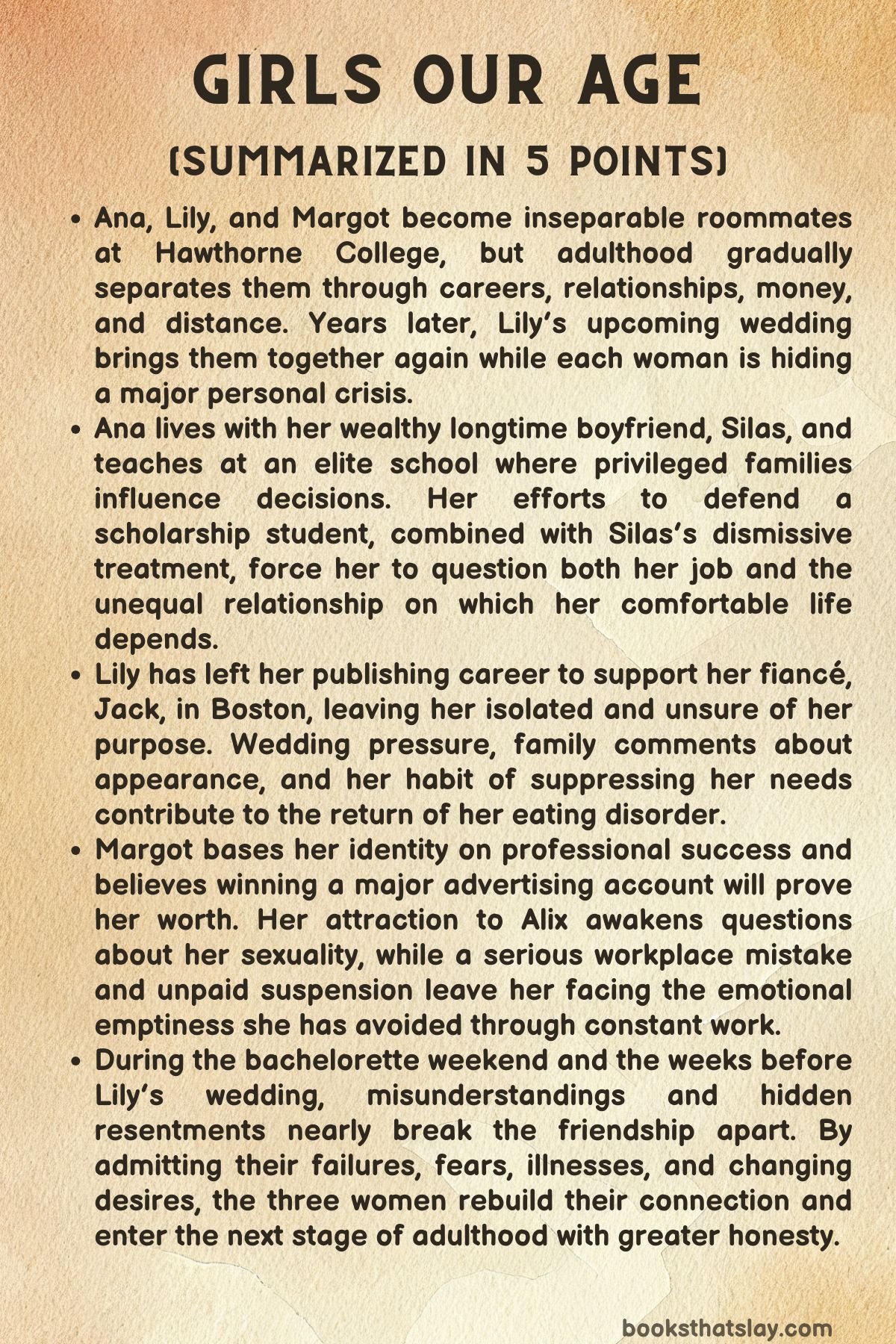
Characters
Ana
Ana is one of the three central women in Girls Our Age, and her development centers on the difference between being cared for and being controlled. She initially believes Silas’s wealth, confidence, and social knowledge compensate for qualities she lacks, so she treats dependence on him as evidence that she has achieved a secure adulthood.
Her modest Wisconsin upbringing leaves her highly conscious of class differences. At Hawthorne, she learns to associate money and sophistication with personal worth, eventually distancing herself from her mother and judging the home that once made her feel safe.
Ana is compassionate and professionally committed, particularly in her defense of Hadley. Her response to the false cheating accusation shows that she understands how institutions protect privilege while demanding gratitude and obedience from those they claim to include.
At the same time, Ana struggles to defend herself as strongly as she defends her student. She recognizes injustice at Horizon but initially accepts Silas’s dismissal of her work, his control over their finances, and his belief that his choices are more rational than hers.
Her attraction to Alistair is less about romance than recognition. He listens to her ideas, asks serious questions, and reflects an image of Ana as thoughtful and capable, reminding her of parts of herself that have weakened during her years with Silas.
Ana’s final decision to leave Silas marks a recovery of self-trust rather than a simple romantic separation. By reconnecting with her mother and accepting that uncertainty is ordinary, she begins building an identity based on her own values instead of wealth, approval, or borrowed status.
Lily
Lily is generous, socially skilled, and deeply attentive to other people’s needs. She sends elaborate bridesmaid packages, manages the feelings of family members, adjusts plans for Jack, and tries to ensure that every person involved in her wedding feels valued.
This generosity is sincere, but it also functions as a form of control. By anticipating everyone’s needs, Lily avoids stating her own preferences and protects herself from anger, conflict, or the possibility that someone might consider her difficult.
Her history of anorexia shapes the way she responds to uncertainty. Restriction originally gave her a sense of order, and the disorder returns when she loses her career, moves away from her support system, and faces pressure to define herself through marriage.
Lily’s relapse is not caused by vanity alone. It reflects loneliness, purposelessness, fear of dependence, family pressure, body criticism, and her inability to express resentment before it becomes emotionally overwhelming.
Her relationship with Ana and Margot is central to her identity because they knew her before marriage became the organizing structure of her life. She expects them to notice her decline without requiring her to risk a direct request for help, then feels abandoned when they fail to interpret the signs correctly.
Treatment teaches Lily that intimacy requires disclosure rather than silent testing. Her decision to confront Gina, Ana, and Margot allows her to recover a voice that had been hidden beneath politeness, competence, and the desire to appear easy to love.
Margot
Margot defines herself through effort, speed, and professional usefulness. She believes achievement provides objective proof of her value, making work safer than relationships because success appears measurable and controllable.
Her ambition is rooted partly in her upbringing. She has been trained to treat every present choice as an investment in future success, so relaxation, emotional uncertainty, and unstructured time feel irresponsible.
Margot’s work ethic makes her resourceful and capable. She organizes Lily’s bachelorette plans, performs well under pressure, and solves the wedding-dress emergency with the same decisiveness she brings to advertising campaigns.
However, those strengths become destructive when she assumes that every crisis should be treated as a problem to solve quickly. She abandons Lily during a vulnerable confession because the Infinity account offers a clearer challenge with a recognizable reward.
Her attraction to Alix forces her to examine the self she has neglected. Sexuality becomes part of a broader awakening in which Margot begins asking what she wants when professional success is no longer available to answer the question for her.
The failed account and suspension expose the fragility of an identity built on constant accomplishment. Within Girls Our Age, Margot’s most meaningful progress occurs when she admits failure, depression, loneliness, and desire without converting those experiences into a list of tasks.
Silas
Silas initially appears dependable, intelligent, and generous. His confidence helps Ana navigate college, and his financial resources provide the comfort and security she once lacked.
His kindness, however, is tied to a belief that he understands the world better than Ana. He repeatedly presents his opinions as objective truth, whether discussing schools, careers, money, domestic responsibilities, or the proper direction of their relationship.
Silas uses financial support as both a gift and a source of authority. He tells Ana that she does not need to work, reminds her that his connections secured her Horizon position, and treats the apartment as evidence of what he provides rather than as a shared home.
He does not need to issue explicit commands because his certainty encourages Ana to doubt herself. His influence is strongest when Ana begins anticipating his judgments and adjusting her behavior before he speaks.
Silas is not portrayed as a simple villain. He may genuinely believe he is helping Ana, but his inability to respect her judgment makes equality impossible.
Jack
Jack is a stabilizing figure in Lily’s life and one of the few people who recognizes the seriousness of her changing behavior. His concern about her unemployment and lack of structure proves justified, even though raising it during counseling initially feels like a betrayal to Lily.
He is caring without being entirely perceptive. His decision to move the bachelor party to Miami overlooks Lily’s desire for private time with her friends, showing that even supportive partners can make assumptions when needs are not clearly expressed.
When Jack discovers the scale, he does not shame Lily or reduce the crisis to appearance. He understands that professional support is necessary and encourages treatment while continuing to offer emotional consistency.
His suitability as Lily’s husband lies in his willingness to remain present during uncertainty. He does not require her to complete recovery before the wedding or pretend that marriage will cure her.
Gina
Gina loves Lily intensely, but her love often takes the form of management. She involves herself in the wedding, arranges appointments, searches for dresses, and offers immediate solutions whenever Lily expresses difficulty.
Her comments about calories, aging, exercise, weight, and appearance reveal a deeply internalized culture of body surveillance. Gina may not intend to harm Lily, yet her casual observations reinforce the exact fears that sustain Lily’s disorder.
She also treats Lily’s history of anorexia as evidence that her daughter requires constant supervision. This prevents Lily from feeling trusted as an adult and encourages her to hide struggles until they become impossible to conceal.
Gina’s response to Lily’s confrontation shows that she is capable of listening. She does not instantly transform, but she accepts Lily’s boundaries more calmly than Lily expects, suggesting that their relationship can change when Lily stops protecting her from uncomfortable truths.
Alix
Alix represents an alternative to Margot’s achievement-centered model of adulthood. She is confident, direct, and willing to admit that leaving a prestigious company has left her uncertain about what comes next.
Her attraction to Margot is clear, but she refuses to become another impulsive project. By delaying their first kiss until Margot has had time to think, Alix establishes a boundary that encourages honesty rather than urgency.
Alix’s departure from Google also mirrors Margot’s professional crisis. Unlike Margot, she chooses to leave before work completely destroys her well-being, demonstrating that stepping away from status can be an act of self-preservation.
She helps Margot imagine that a meaningful life may include experimentation, rest, pleasure, and uncertainty. Her role is important because she offers companionship without demanding that Margot arrive with a fully defined identity.
Alistair
Alistair functions primarily as a catalyst in Ana’s development. He listens to her concerns about Horizon and recognizes the conflict between the work that reflects her values and the prestigious life she believes she should want.
His attention makes Ana feel respected, but the novel avoids presenting him as a replacement for Silas. Ana eventually understands that choosing Alistair immediately would allow romantic validation to substitute for genuine independence.
Alistair’s observation that Oakbrook represents Ana’s authentic values helps her question the standards she has adopted from Silas. He reminds her that another way of living is possible, but Ana must decide what that life looks like for herself.
Bryn
Bryn is Ana’s colleague and one of the most direct characters in the novel. She recognizes the corruption within Horizon but remains there because financial obligations limit her choices.
Her honesty prevents Ana from romanticizing indecision. Bryn tells her that she can leave Silas, remain with him, return to Oakbrook, pursue Alistair, or face rejection, but she cannot continue pretending she has no agency.
By giving Ana a place to stay, Bryn combines blunt advice with practical care. Her warm, imperfect home contrasts with Ana’s expensive apartment and helps redefine what security can mean.
Hadley
Hadley is a talented scholarship student whose treatment reveals the hidden power structure at Horizon. She is academically capable, diligent, and affectionate, yet her background makes her more vulnerable to suspicion than wealthier classmates.
The accusation against her is insignificant in academic terms but serious in social meaning. It demonstrates how privileged families can define a problem, while students without comparable influence are expected to defend their right to belong.
Hadley also reflects Ana’s younger self. Ana recognizes the fear of entering a world designed for wealthier people, which makes her determination to protect Hadley both professional and personal.
Beth
Beth presents herself as a progressive educator, but her decisions consistently protect donors, board members, and well-connected families. She uses language about adjustment, culture, and restorative practices to disguise unequal treatment.
Her request that Hadley publicly apologize despite the absence of evidence exposes the school’s priorities. Beth is less concerned with truth than with preserving the confidence of powerful parents.
She represents institutional hypocrisy rather than openly declared prejudice. Her behavior is dangerous precisely because exclusion is described as care, inclusion, or community harmony.
Ana’s Mother
Ana’s mother represents the life and background Ana attempted to reject. Her modest home, familiar possessions, and emotional openness once embarrassed Ana because they reminded her of the class identity she wanted to escape.
Her illness forces Ana to reconsider that shame. The home Ana once considered unsophisticated becomes a place of sincerity, memory, and belonging.
She does not pressure Ana to explain her problems with Silas. Her patient willingness to listen contrasts with Silas’s certainty and allows Ana to reconnect without being directed.
Barri
Barri helps Lily understand that her relapse cannot be separated from her communication patterns. Rather than focusing only on food, she asks why Lily refuses to say no, express anger, or admit disappointment.
The role-playing exercise involving Gina gives Lily permission to articulate years of accumulated resentment. Barri’s approach shows that recovery requires more than restoring physical health; it demands a different relationship with emotion and conflict.
Her recommendation of outpatient treatment gives Lily necessary structure. At the same time, she makes clear that adult recovery depends on Lily choosing to participate rather than submitting passively to authority.
Bruce
Bruce challenges Lily’s belief that her friends should have recognized the relapse without being told. He identifies the hidden expectation beneath her resentment: Lily wants intimacy without exposing herself to possible rejection.
His guidance encourages her to call Ana and describe the hurt directly. By pushing Lily toward honest communication, Bruce helps transform treatment into a change in relationships rather than merely a change in eating behavior.
Jenny
Jenny is Margot’s manager and initially encourages her ambition because Margot’s energy benefits the agency. She relies on Margot’s personal connection with Infinity and admits that she may not be able to secure the account without her.
However, Jenny also understands institutional limits more clearly than Margot. During the Infinity meeting, she tries to prevent Margot from making promises beyond her authority.
When the email error costs McQueen another client, Jenny refuses to minimize the consequences. Her response teaches Margot that talent and effort do not remove the need for judgment, accountability, and restraint.
Warner
Warner represents the professional validation Margot desires. His praise makes her believe that her personal talent can overcome conflicts between Infinity’s environmental identity and McQueen’s other clients.
Although he genuinely respects Margot, his admiration cannot guarantee the account. His decision demonstrates that professional relationships remain subject to financial, ethical, and institutional realities.
Jason
Jason, the agency owner, responds angrily when Margot’s email causes People’s Gas to leave McQueen. His decision to suspend her reflects the seriousness of the damage rather than a rejection of her entire career.
He represents the authority Margot forgets exists when she begins treating the agency’s accounts as if they are hers to rearrange. His reaction forces her to confront consequences that confidence cannot immediately repair.
Claire
Claire is a junior employee who receives Margot’s reckless email. Her position highlights the hierarchy Margot has worked hard to climb and the authority she now assumes over those below her.
Margot directs Claire efficiently, but she rarely considers how her urgency affects less powerful colleagues. Claire’s involvement in the email mistake also shows how rapidly careless instructions can spread within a professional system.
Amelia
Amelia is the agency receptionist who hopes to become an art director. Her openness about attraction and ambition contrasts with Margot’s controlled professional image.
She admires Margot and views her as an example of success. That admiration makes Margot’s later collapse more significant, since the identity Margot presents to younger colleagues hides exhaustion, fear, and emotional avoidance.
Sabrina
Sabrina is Margot’s roommate and part of the ordinary personal life Margot repeatedly places beneath work. She provides company and celebration, but Margot does not reveal the full extent of her emotional uncertainty.
Her limited role reflects Margot’s broader isolation. Margot may live with another person, but professional ambition still occupies most of her attention and emotional energy.
Cooper and His Parents
Cooper becomes the center of the cheating accusation despite being less academically capable than Hadley. His claim gains authority because his family possesses wealth, influence, and a long relationship with Horizon.
His parents frame the issue as a matter of integrity while ignoring the possibility that their son is mistaken. Their confidence demonstrates how privilege allows personal assumptions to become institutional concerns.
Cooper’s mother later attacks Ana’s credentials in a private parent group. Her behavior shows how wealthy families can threaten teachers as well as scholarship students when those teachers refuse to support their preferred narrative.
Scott
Scott, Cooper’s father, is an influential technology investor whom Silas recognizes. His social standing helps explain why Horizon treats the family’s complaint with exaggerated seriousness.
His presence also connects Ana’s professional conflict to Silas’s world. The same networks that granted Ana access to Horizon now protect the people whose behavior she finds unjust.
Keith
Keith is a member of Jack’s bachelor group whose careless homophobic remark prompts Margot’s first open declaration that she is gay. He does not understand the importance of the moment, making the disclosure both accidental and anticlimactic.
His behavior illustrates the casual social pressure that can force someone to define an identity before they are prepared. At the same time, his question pushes Margot to speak a truth she has avoided.
Emily
Emily is one of Lily’s bridesmaids and contributes practical support during the wedding preparations. She repairs Ana’s makeup and responds casually when Ana reveals that she and Silas have separated.
Her admission that she never liked Silas confirms that Ana’s friends saw problems Ana had normalized. Emily’s straightforward response helps turn the breakup from a private failure into an understandable decision.
Annette
Annette, Jack’s mother, participates in wedding preparations and dress shopping. Unlike Gina, she offers broad praise rather than direct criticism, but her involvement still adds pressure to Lily’s sense that she must satisfy two families.
She is not intentionally harmful, yet her presence contributes to the crowded emotional environment surrounding the wedding. Lily’s preferences become harder to identify when every decision appears connected to someone else’s expectations.
Siobhan
Siobhan provides Lily with a replacement wedding dress after the original no longer fits. Her shop offers multiple sizes without humiliating customers, presenting a direct alternative to fashion environments built around exclusion and body judgment.
Her own history with an eating disorder gives the moment additional significance. She does not treat Lily’s changed body as a problem that must be corrected, allowing Lily to choose clothing that fits her rather than punish herself for failing to fit the clothing.
Max
Max shares his home with Bryn and welcomes Ana during her separation from Silas. His presence helps create the comfortable domestic environment that contrasts with Ana’s luxurious but emotionally empty apartment.
Although he has a minor role, the hospitality he and Bryn provide shows Ana that care can be ordinary, generous, and free from control. Their home becomes evidence that emotional safety does not require wealth.
Aunt Kate
Aunt Kate joins Ana and her mother in Wisconsin and speaks plainly about Ana’s professional choices. She questions why Ana remains at Horizon when the job pays less and offers less satisfaction than her previous work.
Her practical perspective cuts through the prestige surrounding Horizon. Along with Ana’s mother, she reconnects Ana to a family culture in which work is evaluated by usefulness and dignity rather than status.
Harper
Harper, Silas’s sister, excludes Ana from her wedding party because she is uncertain Ana will remain part of the family. The decision intensifies Ana’s desire for a proposal and her need to prove that her relationship is permanent.
Although she appears mainly through memory, Harper represents the conditional acceptance Ana experiences within Silas’s affluent family. Ana is welcomed, but she is never allowed to forget that her place may depend on Silas’s continuing approval.
Rachel
Rachel is a substitute teacher who receives classroom opportunities through her relationship with Beth. Her advancement is described through progressive language about supporting women in science, but Ana recognizes another example of insider privilege.
Rachel’s role reinforces Ana’s conclusion that Horizon distributes opportunity through private networks while presenting the results as merit or social progress. She becomes one final reason for Ana to reconsider remaining at the school.
Themes
Female Friendship and the Work of Remaining Close
The friendship at the center of Girls Our Age begins in a dorm room where Ana, Lily, and Margot can speak with the confidence of young women who believe emotional closeness will naturally survive every future change. Their college intimacy depends on physical proximity, shared routines, and the ability to observe one another before distress needs to be explained.
Adulthood removes those conditions. Careers, relationships, financial differences, family responsibilities, and geographic distance mean that each woman sees only the version of the others that can be communicated through messages, visits, and carefully managed celebrations.
Their Miami reunion proves that affection alone cannot preserve closeness. Ana expects understanding without fully describing her dependence on Silas, Lily expects her relapse to be noticed while actively hiding it, and Margot expects her friends to respect her ambition without explaining the fear driving it.
The friendship begins recovering when the women stop treating familiarity as a substitute for communication. Confessions restores intimacy not because they repeat a college ritual, but because they finally speak about failure, resentment, illness, sexuality, and dependence.
Their bond survives by changing its terms. They cannot return to the effortless closeness of eighteen, but they can build an adult friendship based on attention, apology, boundaries, and the willingness to reveal experiences that may be misunderstood.
Achievement, Purpose, and Personal Worth
Work gives Ana, Lily, and Margot very different relationships with self-worth. Margot believes professional success is the clearest evidence that she deserves respect, Ana wants work that reflects her values but doubts her ability to choose it independently, and Lily discovers how quickly losing a career can weaken her sense of identity.
Margot’s crisis offers the most extreme example of achievement becoming emotional protection. Constant work prevents her from confronting loneliness, sexuality, uncertainty, and exhaustion, so the suspension leaves her without the structure that previously kept those feelings contained.
Lily’s unemployment produces a quieter but equally serious loss. She initially treats wedding planning and future motherhood as sufficient purpose, yet the absence of independent work makes her days feel empty and increases her dependence on Jack, Gina, and the wedding.
Ana’s struggle shows that employment can also become disconnected from purpose when status replaces conviction. Horizon appears prestigious, but its treatment of Hadley violates the reasons Ana became a teacher.
The novel does not argue that ambition is harmful or that domestic life is inferior. Instead, it questions any identity that relies on a single role to prove worth.
Purpose becomes healthier when it remains chosen, flexible, and connected to personal values. Margot must become more than an employee, Lily must define herself beyond bride or future mother, and Ana must trust that meaningful work does not require elite approval.
Class, Privilege, and Dependence
Economic inequality shapes the women’s friendship even when they avoid discussing it. Ana experiences Lily’s expensive gifts and Silas’s luxurious lifestyle as reminders that adulthood operates differently for people with wealth, family connections, and financial protection.
Her resentment is understandable but sometimes misdirected. Lily’s money gives her access to treatment, elaborate celebrations, and freedom from immediate financial danger, yet it does not protect her from illness, loneliness, family pressure, or fear about dependence.
Silas demonstrates how financial support can become relational authority. He pays for the apartment, influences Ana’s employment, and treats his contributions as evidence that his priorities deserve greater weight.
Horizon extends this pattern into an institution. Wealthy parents influence administrative decisions, donor status strengthens accusations, and scholarship students are expected to adapt to a culture that claims to welcome them while protecting those already powerful.
Ana’s return to Wisconsin challenges her belief that expensive surroundings represent a superior life. Her mother’s modest home offers emotional continuity and belonging that the San Francisco apartment never provides.
The novel treats privilege as both material and psychological. Money changes available choices, but it also shapes whose opinions are believed, whose mistakes are forgiven, and who is expected to feel grateful.
Honest friendship becomes possible only when the women acknowledge these inequalities without reducing one another entirely to them.
Control, the Body, and the Right to Express Need
Lily’s eating disorder provides the clearest exploration of control, but the same pattern appears throughout the three women’s lives. Each attempts to manage uncertainty by controlling a specific area: Lily manages food and other people’s emotions, Margot manages work, and Ana allows Silas’s certainty to manage decisions she fears making herself.
Lily’s relapse intensifies when she loses professional structure and becomes surrounded by wedding expectations. Calorie counting offers a false sense of order at a moment when her future, body, career, family relationships, and friendships all feel unstable.
Her silence strengthens the disorder. Because she believes anger and need will burden others, she conceals symptoms, agrees to unwanted plans, and waits for people to notice what she refuses to say.
Recovery requires more than eating prescribed meals. Lily must tolerate discomfort, disappoint Gina, confront Ana and Margot, and accept that love does not depend on being endlessly agreeable.
The replacement wedding dress becomes a powerful symbol of this change. Instead of forcing her recovering body into a garment chosen before treatment, Lily selects a dress that fits the person she is on the wedding day.
Ana and Margot face related choices. Ana stops surrendering authority to Silas, while Margot allows uncertainty and emotional vulnerability to exist without immediately converting them into professional action.
Across the story, control weakens when the women speak directly. Their bodies, choices, and needs become their own only when they stop treating discomfort as evidence that they have failed.