Fury Bound Summary, Characters and Themes
Fury Bound by Sable Sorensen is a dark romantic fantasy about a young queen struggling to reclaim a stolen kingdom while resisting political manipulation, supernatural enslavement, and the violent legacy of those who ruled before her. Meryn Sturmfrost inherits immense power, but her greatest challenge is deciding how that power should be used.
Surrounded by rebels, Siphons, direwolves, rival monarchs, and divine relics, Meryn must distinguish loyalty from control and protection from possession. Her developing relationship with the dangerous but devoted Stark offers both emotional refuge and a demanding test of trust, equality, and personal freedom. It’s the 2nd book of the Wolves of Ruin series.
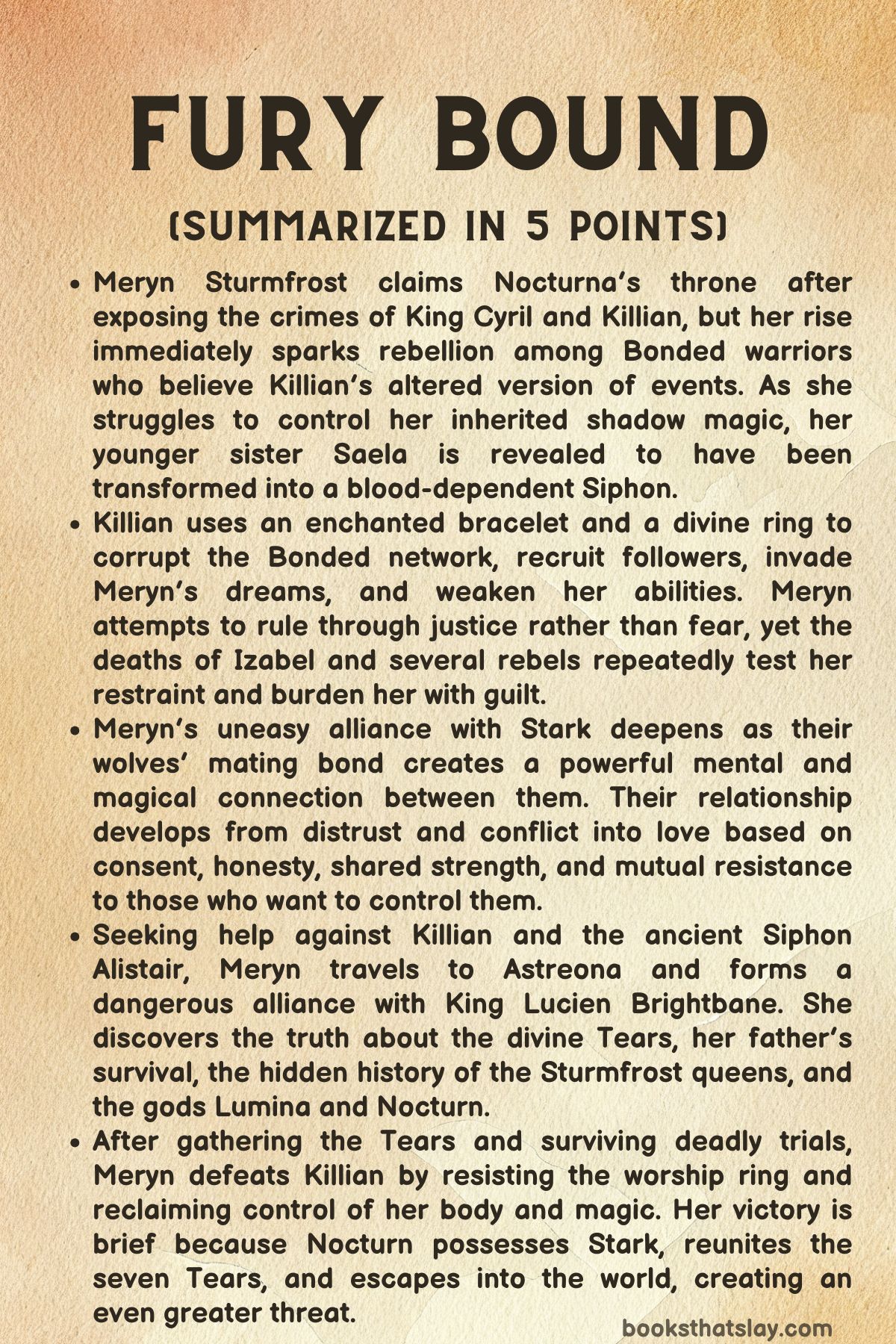
Summary
Meryn’s reunion with her kidnapped younger sister, Saela, turns horrifying when the child attacks Helene and reveals that she has been transformed into a blood-dependent Siphon. Saela is temporarily unable to recognize her family, forcing Meryn, Stark, Anassa, and Cratos to hide her in a dungeon while they search for a way to control her hunger.
Meryn learns that her family descends from Nocturna’s original Sturmfrost queens and that the royal bloodline was deliberately erased from history. She also discovers that Cyril and Killian belonged to a Siphon lineage connected to the ancient tyrant Alistair Brightbane.
Killian uses the enchanted bracelet attached to Meryn’s wrist to enter the Bonded communication network. He broadcasts altered memories that show Meryn killing King Cyril and threatening him, presenting himself as an innocent victim while declaring her an unstable commoner who stole the throne.
Meryn answers with her own kingdom-wide transmission. She admits that she killed Cyril but reveals his imprisonment of children, Killian’s Siphon nature, the Valtiere family’s service to Alistair, and the curse that removed the Sturmfrost queens from recorded history.
She identifies herself publicly as Meryn Sturmfrost and promises to reform the deadly Bonding Trials and rule with greater fairness. Sovereign Alpha Siegrid, Leader Aldrich, Meryn’s friends, and many Bonded warriors kneel to her, but Jonah rejects her claim and incites a violent rebellion.
During the fighting, Meryn uses the ancient Dire Blade to command the wolves to stop. The bracelet corrupts the weapon, causing it to shatter, and when Meryn places the recovered Sturmfrost crown on her head, uncontrolled shadows erupt and kill several rebels.
Horrified by the deaths, Meryn allows the surviving attackers to escape. She later punishes herself by striking the stone floor until Stark intervenes, forcing her to confront her despair rather than continue hurting herself.
As preparations for her coronation begin, Meryn repairs her damaged relationship with Anassa. The ancient direwolf explains that she waited centuries for Meryn’s arrival and withdrew only because Meryn’s rejection of their bond caused pain severe enough to make Anassa fear losing control.
Meryn also learns that Anassa and Cratos are mates, creating a secondary connection between her and Stark. Through this link, they can deliberately communicate and sometimes sense each other’s strongest emotions.
Killian begins pulling Meryn into a shadow realm during sleep. He claims that he is also Alistair’s victim and urges her to return to him, but his possessiveness soon exposes his true intentions.
He redirects Meryn’s own shadows, grips her, and insists that she belongs to him. She escapes, but the recurring encounters leave her exhausted and frightened, especially because she does not understand the bracelet or the mysterious presence within the shadow realm.
Saela eventually regains awareness and is horrified by what she has become. Meryn promises to search for a cure, while their mother’s opal necklace unexpectedly protects Saela from outside Siphon influence.
Siegrid treats Saela as a political danger and privately orders Stark to marry Meryn, control her rule, and produce a Sturmfrost heir. Stark refuses to manipulate Meryn and begins recognizing that loyalty to the Sturmfrost line may require opposing his own mother.
Meryn’s political education continues as she learns royal abilities such as mental shielding, distant communication, rifting, compulsion, and foresight. Her shadow power remains unstable, however, and Killian’s bracelet continues to steal, block, or corrupt her magic.
Before Stark leaves to secure noble attendance for the coronation, he tattoos twelve marks along Meryn’s ribs for the lives she took during the rebellion. Their physical closeness exposes a growing attraction, but Stark withdraws before they kiss.
While traveling with Noemi, Stark uses deadly force against a noble family that humiliates her. Meryn condemns his methods, insisting that legitimacy cannot rest entirely on terror, while Stark argues that Nocturna’s ruling class understands only fear.
At the coronation, Meryn refuses the Mother Priestess’s humiliating traditions and forces the ritual to proceed according to her decisions. The ceremony becomes even more meaningful when dozens of riderless direwolves enter the hall, bow to her, and recognize her as their queen.
The celebration ends in tragedy when Izabel drinks poisoned wine intended for Meryn. She dies almost immediately, and Meryn’s grief causes her shadows to kill Councilor Gerhold and his family after his involvement in the conspiracy is exposed.
Meryn later admits that not every person she executed may have been guilty. Her determination to accept responsibility separates her from advisers such as Siegrid, who regard fear and collective punishment as useful political instruments.
Soon afterward, Killian corrupts the Phylax pack’s bond and compels many of its riders to defect. Their departure leaves Weisenstat, Nocturna’s main grain-producing region, exposed to an Astreonan invasion.
Meryn travels there with Stark, Saela, Venna, Noemi, and their wolves. Along the way, rebels capture Saela, and the resulting battle leaves the ground covered with blood, causing Saela to lose control and feed from a corpse in front of Venna and Noemi.
The secret damages Meryn’s relationship with Venna, who feels betrayed after being allowed to tutor Saela without knowing the danger. Meryn recognizes that protecting her sister cannot justify withholding information from those whose lives may be affected.
At Weisenstat, every conventional strategy Meryn sees through foresight ends in devastation. The only possible path requires her and Stark to infiltrate the Astreonan camp and use their shadow powers together.
Inside the enemy camp, Meryn stops imitating other Bonded abilities and embraces her anger in its natural form. Stark reaches her through their unusual connection, and their minds merge closely enough for her to share control of the shadows with him.
Their combined power forces the Astreonan army to retreat. General Ruby Navarro then offers a ceasefire on behalf of King Lucien Brightbane, claiming that both kingdoms face a greater enemy in Alistair.
Ruby also reveals that Meryn’s father, Fredrich Cooper, is alive. He was transformed into a Siphon after being mortally wounded, remained in Astreona out of fear, and eventually became Ruby’s partner.
Meryn cannot forgive him for leaving his family to suffer. Her mother became violent under the pressure of grief and poverty, and Meryn was forced to raise Saela without the father she believed had died honorably.
After confronting Fredrich, Meryn releases her rage through a fierce sparring match with Stark. Their magical connection opens completely, allowing them to sense each other’s thoughts, physical responses, attraction, and fears.
Stark admits through the link that he fears becoming another controlling man in Meryn’s life. Meryn insists that their connection makes them equals, and their long-denied attraction finally leads to a kiss and a more intimate relationship grounded in her freedom to choose.
Meryn accepts Lucien’s invitation to visit Astreona because Nocturna cannot survive without military assistance. Crossing the border reveals that Astreona is not a barren wasteland but a fertile kingdom hidden behind an enormous magical illusion.
Humans and Siphons live together there, blood is regulated, and transforming children is illegal. Yet Meryn also witnesses desperate humans being exploited through debt, feeding arrangements, and legal systems that favor powerful Siphons.
At Lucien’s court, she learns that Alistair is Lucien’s older brother. Alistair created forbidden thrall bracelets that use blood magic to control victims remotely, and Meryn’s bracelet is one of these ancient devices.
Meryn realizes that Killian gathered her blood while pretending to care for her injuries. He used her trust to create the bracelet and disguised the instrument of enslavement as a symbol of romantic commitment.
Lucien proposes an alliance and later attempts to strengthen his position by asking Meryn to marry him. Meryn avoids giving an immediate answer, knowing that she needs his forces but refusing to trade one form of control for another.
Noemi attempts to poison Lucien after his public feeding reminds her of the sexual exploitation she endured under King Cyril. Meryn requires a political apology but refuses to dismiss Noemi’s trauma or treat her pain as disloyalty.
While Meryn remains in Astreona, the corrupted Phylax pack attacks Nocturna’s command position. Siegrid is killed, and her authority passes to Stark, making him the new Sovereign Alpha.
Meryn learns that Killian possesses the Mother Priestess’s opal ring, a divine Tear that inspires worship. Its power explains why many Bonded warriors followed him even when their former loyalty and judgment should have resisted.
Research suggests that seven Tears exist and that another is hidden within a tower on a concealed island. Meryn, Stark, Venna, and Noemi represent the four Bonded packs required to enter, while Lucien accompanies them to prevent Meryn from collecting unchecked divine power.
The tower tests the true meaning of each pack. Venna guides the group through darkness using intelligence, Stark proves that genuine strength comes from freely offered loyalty, and Noemi learns that protection does not require preventing every possible wound.
In the Strategos trial, poisonous gas fills a chamber while a riddle appears to demand one person’s entire lifeblood. Refusing to order someone else to die, Meryn drives a dagger into her own chest.
The tower restores her to life and reveals a Tear of creation. Stark is devastated by her sacrifice, forcing Meryn to recognize that even necessary risks inflict emotional consequences on those who love her.
Visions produced by the Tears reveal the gods Lumina, Nocturn, and Astreon. Lumina’s daughter founded the Sturmfrost line, while Nocturn’s possessive treatment of Lumina mirrors the controlling relationships that have shaped Meryn’s life.
Meryn identifies the final Tear, representing destruction, inside a goddess statue in Linsfall. The Mother Priestess breaks the statue while attempting to claim the relic for Killian, causing the city to split apart.
Meryn and Stark use their shared shadows to save civilians, but Jonah later attacks their retreating group and mortally wounds Venna’s direwolf, Skaia. To prevent Venna from dying through the Bonded connection, Lucien transforms her into a Siphon.
Meryn decides to confront Killian before he destroys Blumenfall. Lucien returns to Astreona with Venna but entrusts Meryn with his own crown and necklace, allowing her to carry all six recovered Tears.
Meryn enters the shadow realm and pretends that Killian has finally broken her. She claims to have abandoned Stark and agrees to bring him as a prisoner, relying on Killian’s arrogance and his conviction that she secretly wants to submit.
The final plan nearly fails when Tormun traps Stark and the worship ring compels Noemi and Meryn to obey Killian. Killian wounds Anassa and forces Meryn toward complete surrender.
Stark reaches Meryn through their private connection, which the ring cannot fully control. Remembering her identity, Meryn cuts off Killian’s ring hand and beheads him after Noemi joins the attack.
Alistair escapes Killian’s dead body as blue smoke, leaving his ultimate fate uncertain. The thrall bracelet falls from Meryn’s wrist, restoring complete ownership of her body and magic.
Meryn offers mercy to those who were compelled to fight her and promises to rebuild Nocturna rather than govern through revenge. Saela begins thriving in Astreona, while Meryn and Stark briefly enjoy the freedom they have fought to secure.
Their victory proves temporary. Nocturn possesses Stark, reforges the Dire Blade, gathers all seven Tears, and uses their combined power to escape his imprisonment.
Stark regains control only after reality has fractured and the sky has changed. He confesses that the Therion family’s ancient oath was never ultimately to the Sturmfrost queens but to Nocturn, whose return creates a threat greater than the war Meryn has just survived.
Characters
Meryn Sturmfrost
Meryn is the central character of Fury Bound, and her development is shaped by the conflict between possessing extraordinary power and fearing what that power might make her. She begins her rule without preparation, political experience, or confidence that hereditary blood gives her any moral right to govern.
Her strongest quality is her willingness to examine her own actions. When her shadows kill people, she does not hide behind necessity, and when she executes Gerhold’s family, she later admits that grief may have caused her to punish innocent people.
Meryn’s compassion does not make her passive. She confronts nobles, rejects humiliating traditions, attacks enemies, and ultimately kills Killian, yet she continually questions whether violence is protecting others or merely satisfying anger.
Her relationship with Saela exposes both the generosity and danger within her protective instincts. Meryn loves her sister fiercely, but she sometimes makes decisions for Saela and conceals information from others because she assumes that love gives her the authority to control every risk.
The novel repeatedly tests Meryn’s understanding of sacrifice. Her willingness to stab herself during the Strategos trial proves her refusal to treat followers as expendable, but it also reveals how easily she accepts personal destruction as a leadership duty.
Her emotional growth is closely connected to recovering ownership of herself after Killian’s abuse. By rejecting the bracelet, the worship ring, Lucien’s marriage proposal, and every attempt to reduce her to a political vessel, she defines queenship as the right to choose rather than the power to command.
Stark Therion
Stark is one of the most morally conflicted figures in Fury Bound, combining brutality, discipline, devotion, trauma, and a genuine desire to become better. He has been trained to function as a weapon, and much of his identity initially depends on believing that violence is the only reliable form of usefulness.
His upbringing under Siegrid taught him to obey authority, suppress vulnerability, and treat fear as a political instrument. The scars across his body demonstrate that this training was not merely harsh but abusive, leaving him convinced that pain and control are unavoidable features of loyalty.
Stark’s attachment to Meryn forces him to question these beliefs. He begins by protecting her because of family duty and the mating bond between their wolves, but he eventually chooses her because he believes in the future she represents.
His greatest fear is not that Meryn will reject him but that he will become another Killian. Stark knows that he is possessive, commanding, and capable of extreme violence, so he repeatedly withdraws because he worries that desire will become domination.
What separates him from Killian is his respect for Meryn’s choices. Even during their most intimate encounters, Stark makes her authority over her own body explicit, allowing dominance to exist without removing consent.
His inheritance of the Sovereign Alpha’s power expands his responsibilities while exposing the hidden corruption within his family’s history. The final possession by Nocturn is especially tragic because Stark has spent the entire story resisting control, only to become the instrument through which a god escapes.
Killian Valtiere
Killian is Meryn’s former lover and the human vessel through which Alistair operates. His danger comes not only from his supernatural power but from his ability to transform intimacy, trust, and remembered affection into tools of psychological control.
He repeatedly claims that he wants equality with Meryn, yet his actions reveal that equality means her voluntary submission to him. He restricts her magic, manipulates public memories, invades her dreams, and treats her refusal as temporary confusion rather than a valid decision.
Killian understands Meryn’s compassion well enough to exploit it. He knows that she fears becoming cruel, feels responsible for every death around her, and longs to protect Saela, so he uses these vulnerabilities to weaken her confidence.
His relationship with Alistair is also built upon domination. Although Killian sometimes presents himself as Alistair’s victim, he remains willing to benefit from the power, authority, and violence that their connection provides.
His final defeat is psychological as well as physical. Meryn kills him without giving him the emotional surrender he believes he deserves, destroying the fantasy that abuse can eventually force love to return.
Saela Cooper
Saela is Meryn’s younger sister and one of the clearest representations of identity transformed by forces outside personal control. Her conversion into a Siphon leaves her frightened of her own body and convinced that death may be preferable to becoming dangerous.
Her early desire to be killed comes from guilt rather than cruelty. She understands that her hunger can overpower recognition and affection, and she fears that the people she loves will become victims of instincts she cannot yet manage.
Meryn initially approaches Saela’s condition as an illness that must be cured. Saela’s time in Astreona gradually challenges this assumption by showing that a Siphon can build relationships, control feeding, and remain morally responsible without returning to a human body.
Saela’s decision to remain with Fredrich is an important act of independence. She does not reject Meryn, but she chooses an environment where her new identity is understood and where she can discover who she is beyond her sister’s protection.
Her connection to the protective Tear also makes her essential to the political and divine conflict. More importantly, it demonstrates that safety should create room for growth rather than become a permanent enclosure.
Anassa
Anassa is Meryn’s direwolf, protector, adviser, and magical counterpart. Her centuries-long wait for a Sturmfrost heir gives her deep knowledge, but it also leaves her emotionally isolated and afraid of losing the purpose around which she has built her existence.
Her early withdrawal from Meryn is caused by pain rather than indifference. When Meryn resists their bond, Anassa fears that instinct and anguish may cause her to attack the person she has waited so long to serve.
Their reconciliation depends on honest communication. Once both acknowledge their stubbornness, the bond becomes a source of partnership rather than an inherited obligation that neither understands.
Anassa frequently balances Meryn’s impulsiveness with practical advice. She encourages Meryn to stop imitating other Bonded powers and use her shadows according to her own emotional nature.
Her mating bond with Cratos creates the connection between Meryn and Stark. Yet Anassa never treats that connection as proof that the humans must become lovers, preserving the distinction between magical influence and personal choice.
Cratos
Cratos is Stark’s direwolf and Anassa’s mate. His massive strength and aggressive protectiveness reflect Stark’s own tendencies, but he also possesses a direct emotional loyalty that is less complicated by human politics.
He reacts immediately when Siegrid threatens Meryn or Saela, showing that his allegiance is not automatically governed by Stark’s family hierarchy. His loyalty follows the emotional and moral bonds he has formed rather than the commands of a political superior.
Cratos’s relationship with Anassa makes him a bridge between Stark and Meryn. Through the wolves, he helps create the private channel that eventually allows the two humans to combine their magic and resist the worship Tear.
His rescue of Noemi during the swim to the tower is especially significant. He abandons the narrow assumption that protecting Meryn is the only priority and recognizes that the survival of the group depends on protecting every member.
Siegrid Therion
Siegrid is the Sovereign Alpha, Stark’s mother, and the embodiment of duty corrupted by control. She sees herself as the guardian of order, yet her understanding of order allows manipulation, forced marriage, political breeding, and calculated sacrifice.
Her loyalty is directed toward the Sturmfrost institution rather than Meryn as an individual. She is prepared to remove Meryn once a more controllable heir exists, revealing that her devotion to the bloodline does not include respect for the person carrying it.
Siegrid’s treatment of Stark is equally damaging. She trains him through pain, scars him physically and emotionally, and regards his eventual defiance with pride because she interprets ruthlessness as strength.
She is not entirely without strategic value. Her knowledge of royal abilities, pack structures, and military threats helps Meryn survive, but her refusal to recognize consent or emotional consequence prevents her from becoming a trustworthy mentor.
Her death leaves Stark grieving a relationship that never became what it could have been. He mourns both the mother who died and the possibility of a mother who might have loved him without turning him into a weapon.
Lucien Brightbane
Lucien is the ancient Siphon king of Astreona and one of the story’s most ambiguous political figures. He is charming, intelligent, historically informed, and genuinely opposed to Alistair, but he remains comfortable using pressure, spectacle, and unequal power.
He reveals essential truths about the thrall bracelets, the Tears, Alistair’s history, and the survival of Meryn’s father. Without his knowledge and military resources, Meryn would have little chance of understanding the larger conflict.
Lucien nevertheless treats human suffering with a detachment shaped by immortality and privilege. His court normalizes public feeding, debtor exploitation, and violent entertainment, exposing the limits of Astreona’s claim that humans and Siphons coexist fairly.
His marriage proposal to Meryn combines strategy with coercion. He does not threaten her as crudely as Killian, but he uses Nocturna’s military desperation to make refusal politically costly.
His actions toward Venna reveal a more compassionate capacity. He saves her through transformation, shows concern for her survival, and later gives Meryn his own Tears, accepting genuine personal vulnerability for the sake of defeating Killian.
Venna
Venna is a Kryptos warrior, scholar, friend, and eventually a transformed Siphon. Her intelligence is practical rather than merely academic, allowing her to interpret magical objects, memorize unfamiliar buildings, uncover hidden information, and guide the group through danger.
Her reaction to Saela’s secret demonstrates the importance of trust. Venna does not reject Saela for being a Siphon, but she correctly challenges Meryn for exposing her to danger without giving her the knowledge necessary to consent.
The death of her twin, Izabel, leaves Venna struggling to preserve an identity separate from the sister with whom she shared nearly everything. Remaining on the Council becomes a method of surviving grief rather than escaping it.
During the tower trial, Venna proves that Kryptos strength lies in perception, adaptation, and communication. She turns a power associated with concealment into a source of light, demonstrating that inherited abilities need not be limited by tradition.
Skaia’s death destroys the Bonded identity around which Venna has built her life. Choosing transformation allows her to survive, but it forces her to enter the same condition she once feared in Saela and begin constructing an entirely new future.
Noemi Eisenfall
Noemi is a Phylax warrior whose hard exterior conceals severe trauma, rejection, and guilt. She was raised to believe that her body could advance her family’s political ambitions, and her father delivered her into King Cyril’s exploitation.
Her bond with Stark is familial rather than romantic. Both were raised by Gertie after suffering abuse, and Stark’s fierce protectiveness comes from knowing what Noemi endured and believing that he failed to save her.
Noemi’s attempted assassination of Lucien is reckless, but it emerges from a traumatic response rather than political calculation. His public feeding recreates the helplessness and disgust associated with Cyril, causing her to act before considering the consequences.
Her Phylax trial teaches her that protection does not mean preventing every injury or saving everyone. She succeeds by continuing to hold the bridge even while frightened, exhausted, and aware that failure remains possible.
Her later control by the worship Tear reinforces the difference between action and consent. Meryn’s refusal to blame her demonstrates the compassionate justice Noemi was denied by both her family and her former king.
Fredrich Cooper
Fredrich is Meryn and Saela’s father, long believed to have died in battle. His survival as a Siphon destroys the heroic memory Meryn carried and replaces it with the more painful truth that he chose not to return.
His fear is understandable. Nocturna would probably have executed him, and his transformation created an attachment to Ruby that complicated any attempt to leave Astreona.
However, fear does not erase the consequences of his absence. Fredrich assumed that his family would survive without verifying their safety, leaving Meryn to endure poverty, their mother’s violence, and responsibility for Saela.
His desire to know his daughters appears genuine, but the book does not offer him immediate forgiveness. He must prove himself through continued action, especially by giving Saela the care, education, and acceptance he failed to provide earlier.
Ruby Navarro
Ruby is an Astreonan general, Fredrich’s partner, and an important diplomatic connection between the kingdoms. She first appears as a military opponent but quickly proves willing to negotiate when continued war would only strengthen Alistair.
Her decision to transform Fredrich saved his life, though it also contributed to the separation of his family. She does not appear to have understood the full consequences of that choice for Meryn and Saela.
Ruby is direct about the limits of Astreona’s mercy. Her ceasefire offer contains a genuine opportunity for cooperation, but she also warns that refusal will lead to military destruction.
Her later concern for Saela and proposal for a school for young Siphons show a more constructive use of authority. She offers Saela not merely survival but education, community, and a future beyond secrecy.
Izabel
Izabel is one of Meryn’s closest friends and a source of humor, loyalty, and emotional normality during the early stages of Meryn’s reign. Her developing affection for Tomison gives her a personal future beyond war and royal politics.
Her death is especially devastating because it results from a playful, ordinary gesture. By drinking from Meryn’s cup, she becomes the unintended victim of an assassination attempt aimed at the queen.
Izabel’s death changes the emotional direction of Meryn’s rule. It exposes the danger faced by anyone close to the throne and triggers one of Meryn’s most morally troubling uses of shadow power.
Venna’s funeral speech ensures that Izabel is remembered as a complete individual rather than merely a twin, friend, or victim. Her courage, wit, affection, and loyalty remain important even after her death.
Tomison
Tomison is a Bonded warrior whose romance with Izabel offers warmth before becoming a source of overwhelming grief. Her death destroys the future he expected and leaves him unable to separate Meryn from the circumstances surrounding the poisoning.
His attack on Meryn is driven by anguish rather than political rebellion. Meryn’s decision to remove him from service without further punishment shows her ability to recognize pain even when it is directed violently against her.
Tomison’s response also prevents Izabel’s death from becoming meaningful only through Meryn’s guilt. His suffering reminds the court that every political assassination creates private devastation extending far beyond the intended target.
Aldrich
Leader Aldrich functions as a researcher, historian, and early supporter of Meryn’s claim. He helps confirm the truth about the Sturmfrost bloodline and provides essential information about Siphons, blood requirements, and sire bonds.
His loyalty is based on evidence rather than unquestioning devotion. This makes him an important contrast to followers influenced by Killian’s worship ring or nobles who support whichever ruler appears strongest.
Aldrich’s limitations are also important. He cannot solve the bracelet, repair the Dire Blade, or offer Saela a cure, reminding Meryn that knowledge does not always produce immediate rescue.
The Mother Priestess
The Mother Priestess represents religion used to protect hierarchy rather than truth. She is fascinated by the opal Tears, yet she hides their history while demanding that Meryn submit to traditions designed to humiliate and control queens.
Her loyalty to Killian is not entirely the result of magical compulsion. She willingly interprets his authority as sacred because his rule preserves the patriarchal religious structure Meryn threatens.
Her destruction of Lumina’s statue captures her hypocrisy. She physically breaks the image of the goddess she claims to serve in order to place divine power in the hands of a controlling man.
Meryn eventually executes her after the destruction of Linsfall. The death removes an immediate threat but also adds another deliberate killing to the moral burden Meryn carries.
Jonah
Jonah is one of Killian’s most visible supporters and a representative of the prejudice that strengthens the rebellion. He rejects Meryn’s evidence because accepting her claim would require recognizing the legitimacy of a common-born woman.
His language is openly misogynistic, reducing political disagreement to accusations about Meryn’s character, ambition, and gender. He gives Killian’s supernatural manipulation a social foundation by voicing beliefs many nobles and warriors already hold.
Jonah repeatedly uses the consequences of rebellion as proof that Meryn is dangerous, even when he helped create the violence. His death beneath the destructive Tear ends his military role but does not erase the attitudes that allowed his movement to grow.
Alistair Brightbane
Alistair is an ancient Siphon who treats bodies, blood, magic, and political institutions as extensions of his personal will. His creation of the thrall bracelets reveals a desire for control so complete that consent becomes an obstacle to eliminate.
His conflict with Lucien begins as a struggle over inheritance but develops into centuries of possession, warfare, and manipulation. He refuses to accept exclusion from power and repeatedly uses other people as vessels through which he can continue his ambitions.
His relationship with Killian is unstable because both men desire authority. Meryn exploits this tension by reminding Killian that Alistair controls him, encouraging the conflict that prevents them from functioning as a completely unified enemy.
Alistair’s escape after Killian’s death leaves the threat unresolved. Destroying his vessel interrupts his plans but does not guarantee that the ancient consciousness controlling events has truly been defeated.
Lumina
Lumina is the radiant goddess whose tears become the divine opals at the center of the conflict. She is also the mother of the human daughter from whom the Sturmfrost queens descend.
Her history has been distorted until Nocturna remembers her only as the Faceless Goddess. This erasure removes her identity, relationships, suffering, and creative power while allowing religious authorities to speak in her name.
Lumina’s tears are created through grief, protection, confinement, creation, and destruction. Their emotional origins show that divine power is not separate from pain but formed through responses to it.
Her imprisonment by Nocturn repeats the book’s central pattern of possessive love. Even a goddess can be confined by someone who claims that desire gives him ownership over her freedom.
Nocturn
Nocturn is the dark god connected to the direwolves, the Therion bloodline, and the shadow realm. He initially appears as a mysterious voice, but later revelations establish him as the source of a much older system of power.
His love for Lumina is possessive and imprisoning. Like Killian, he interprets closeness as ownership and reacts to separation by removing the other person’s freedom.
The Therion family’s secret oath allows him to influence Stark. By possessing the new Sovereign Alpha, Nocturn turns Stark’s inherited power into a route back into the physical world.
His escape changes the scale of the story. The political struggle for Nocturna becomes part of a divine conflict involving imprisonment, erased history, inherited obedience, and the dangerous reunion of the seven Tears.
Themes
Consent, Possession, and Personal Freedom
Control repeatedly disguises itself as love, duty, protection, religion, or political necessity. Killian claims to love Meryn while attaching a blood-magic bracelet that restricts her power, invades her dreams, and allows him to treat every refusal as temporary resistance.
Siegrid uses duty in a similar way when she orders Stark to marry Meryn, produce an heir, and govern through her. Lucien’s marriage proposal is more diplomatic, but it still places the survival of Nocturna behind a demand that Meryn surrender part of her personal freedom.
Fury Bound contrasts these relationships with the bond between Meryn and Stark. Stark is possessive and commanding, yet he fears becoming controlling and repeatedly emphasizes that Meryn must choose what happens between them.
Consent also shapes Meryn’s leadership. She wants loyalty offered freely rather than obedience produced through compulsion, which is why the Daemos tower trial identifies an open hand offering a crown as the true symbol of strength.
The theme extends beyond romance. Saela must be allowed to choose Astreona, Venna has the right to know when she is being exposed to danger, and magically controlled warriors cannot be judged as though their actions were freely chosen.
Freedom therefore becomes more than escape from captivity. It is the continuing right to make informed choices, even when those choices frighten the people who claim to be offering protection.
Power, Accountability, and the Burden of Rule
Meryn inherits power before she has learned how to control either its magical or political consequences. Her shadows can stop armies, destroy cities, protect civilians, and kill people before she has decided whether death is justified.
Her defining quality is not perfect restraint but her refusal to declare herself innocent merely because she is queen. She carries marks for those killed in the arena and later questions whether Gerhold’s entire family deserved execution.
This willingness to accept responsibility separates her from Cyril, Killian, Siegrid, and the Mother Priestess. Each of them treats authority as proof that their decisions are correct, whereas Meryn understands that authority makes honest self-examination more necessary.
The Strategos trial presents the most extreme form of this responsibility. When a life appears necessary to save the group, Meryn refuses to choose a follower and offers herself instead.
However, the reaction of Stark, Venna, and Noemi complicates the apparent nobility of her sacrifice. Leadership cannot mean treating one’s own life as worthless, because self-destruction also harms the people who depend upon and love the leader.
The novel therefore rejects both selfish rule and careless martyrdom. Ethical power requires action, restraint, accountability, and recognition that even necessary decisions create consequences that cannot be erased by good intentions.
Trauma, Healing, and Reclaimed Identity
Many characters have been shaped by abuse that taught them to confuse survival with obedience. Meryn carries the effects of Killian’s manipulation, Stark bears physical and emotional scars from Siegrid’s training, and Noemi has been treated as a political object by both her father and Cyril.
Healing does not occur through forgetting these experiences. Meryn must repeatedly confront the ways Killian altered her understanding of affection, vulnerability, and desire.
Her relationship with Stark becomes restorative because it allows her to experience intensity without surrendering control. She closes their magical connection to confirm that her attraction is genuinely her own and later uses consensual intimacy to separate present desire from Killian’s coercion.
Stark’s recovery is less complete. He recognizes that violence was forced into the center of his identity, but he continues to believe that brutality is what makes him valuable.
Noemi’s failed assassination shows that trauma can return through sensory and emotional triggers even after the original abuser is gone. Meryn acknowledges the reason for Noemi’s actions without pretending that pain eliminates responsibility for dangerous choices.
Saela and Venna face a different form of reclaimed identity after becoming Siphons. Their futures depend not on returning to what they were but on discovering how to remain themselves within bodies and communities permanently altered by violence.
History, Religion, and the Manipulation of Truth
Nocturna’s political order depends upon stories that have been repeated until they appear unquestionable. The Sturmfrost queens have been erased, Astreona has been depicted as a barren land of monsters, and Lumina has been reduced to a nameless, faceless religious symbol.
Killian uses the same process on a smaller scale when he broadcasts selected memories of Cyril’s death. He does not need to invent every event; he only removes the context that would allow people to interpret Meryn’s actions fairly.
The official history of Astreona also proves incomplete. The kingdom is not the lifeless enemy state Nocturnans imagine, but its prosperity does not erase the exploitation of human debtors or the privilege enjoyed by ancient Siphons.
Religion becomes another instrument of selective memory. The Mother Priestess protects traditions that conceal Lumina’s identity and uses sacred authority to defend male control over queens and divine relics.
Recovering the past therefore requires more than finding hidden facts. Meryn must compare memories, journals, songs, magical visions, political testimony, and lived experience while recognizing that every source may contain bias.
The revelation of Nocturn’s role shows that even the newly recovered history remains incomplete. Truth is not a single object waiting to be uncovered but a continuing struggle against institutions and individuals who gain power by deciding what others are permitted to remember.