Greedy by Callie Kazumi Summary, Characters and Themes
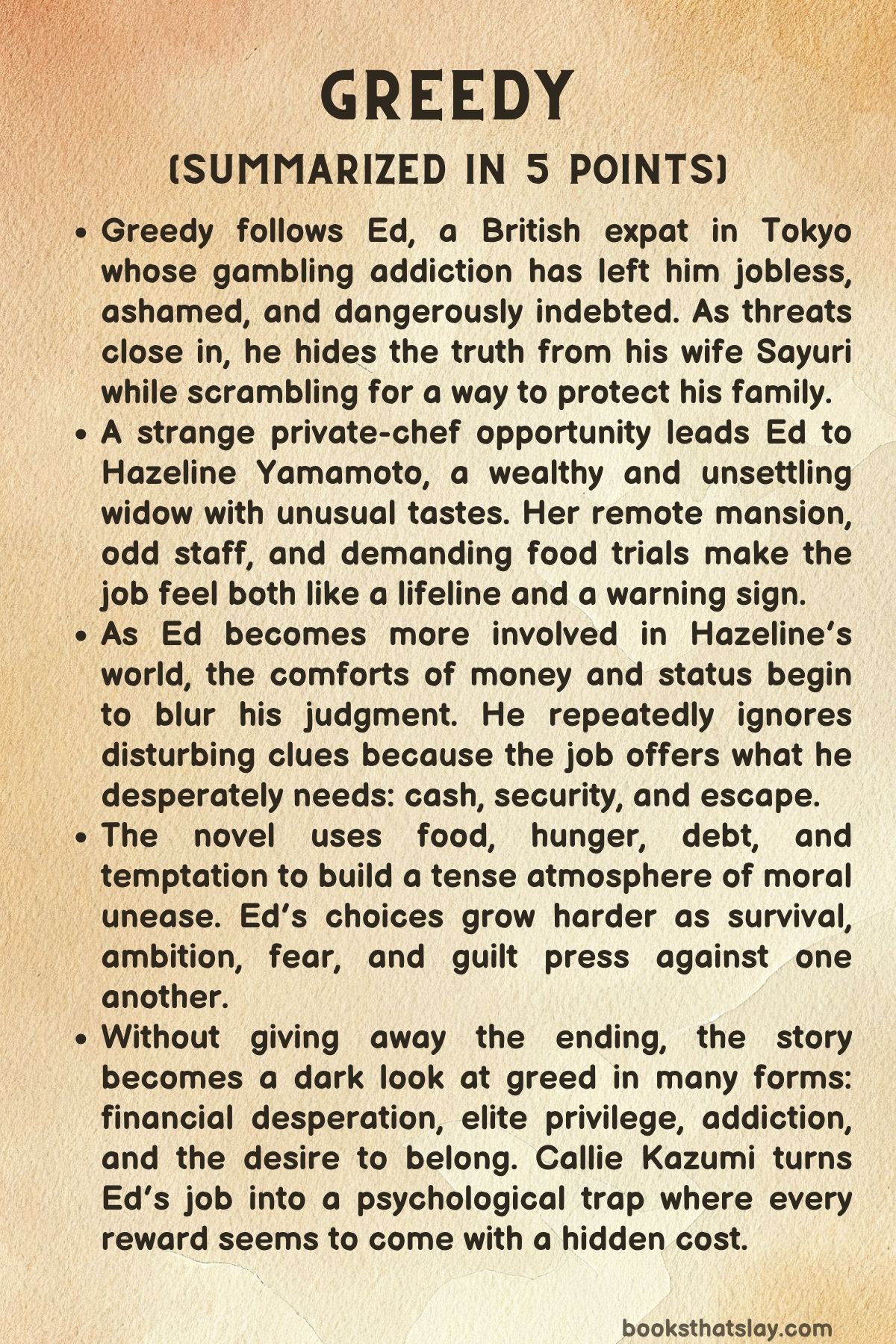
Greedy by Callie Kazumi is a dark psychological horror story about hunger in its many forms: hunger for money, status, safety, control, and escape. Set between Tokyo, Yamanashi, and the hidden spaces of extreme wealth, the novel follows Ed, a desperate British expat whose gambling addiction leaves him trapped between violent creditors and a marriage under strain.
What begins as a strange job opportunity becomes a moral trap, drawing him into the world of Hazeline Yamamoto, a rich and frightening woman whose appetite is far more dangerous than it first appears.
Summary
Ed is a British man living in Tokyo with his Japanese wife, Sayuri, and their young daughter, Kaori. His life is falling apart.
After losing his recruitment job, he has fallen into a severe gambling addiction that has swallowed his savings, damaged his marriage, and placed his family in danger. He spends his time and money on pachinko, horse racing, online casinos, and illegal gambling run by the Yakuza.
His debts are no longer numbers on paper. They have become physical threats.
The man he owes money to is Isamu Ikagi, a gangster with a brutal reputation. Ed is beaten in an alley and warned that if he fails to repay what he owes, Ikagi’s men will start by taking one of his fingers.
After that, the danger may reach his wife and daughter. Ed returns home bruised and frightened, but he hides the truth from Sayuri.
She already knows something is wrong. She sees his unemployment, his secrecy, and his evasions, but Ed keeps lying because he cannot bear to admit how badly he has failed.
With eviction notices and bank statements piling up, Ed becomes desperate. He finds a strange newspaper advertisement seeking an “innovative and unusual” private chef for a wealthy businesswoman.
The offer includes a two-day paid trial worth two million yen. Ed is not a trained chef, but he has worked in chain kitchens in Britain and knows enough to fake confidence.
He lies on his CV and applies.
The job leads him to Hazeline Yamamoto, the reclusive widow of the rich Yamamoto family. Ed travels to her isolated mansion in Yamanashi, a glass-and-wood estate surrounded by forest.
There he meets Rodrick Bauer, Hazeline’s unsettling German housekeeper. The house feels wrong from the start.
Ed hears a scream outside, but Rodrick dismisses it as a fox. Hazeline herself is theatrical, rich, unpredictable, and obsessed with food.
She interviews Ed while holding her dog, Momo, and makes it clear that she wants more than ordinary cooking. She wants surprise, obedience, and satisfaction.
Ed cooks for her during the trial. His first dish, duck with ume jam, roasted potatoes, and asparagus, is good enough to keep him in the running, though Momo refuses it.
His next dish, a light crab salad with mango, cucumber, carrots, panko, and dressing inspired by Sayuri’s cooking, pleases Hazeline more. Ed begins to imagine the job saving him.
The mansion, the money, and the comfort seem like a doorway out of fear.
Then Hazeline changes the final test. Instead of making breakfast, Ed must kill a live chicken humanely.
He is horrified, but his need for money is stronger than his disgust. He forces himself to do it.
The act marks a shift in his character. He has crossed a line, but he tells himself he had no choice.
Back in Tokyo, Ed gives Sayuri the trial money. She is cold and suspicious, but the cash matters.
Soon afterward, Ed receives an email offering him the job. Hazeline invites him to celebrate at Untamed Teppanyaki, an exclusive restaurant serving rare and exotic meats.
Ed is picked up in a limousine and joins Hazeline and Rodrick for a luxurious meal that includes beef, lobster, and python. The evening makes him feel important.
On his way home, he resists the urge to enter a pachinko parlor, buys gifts for Sayuri and Kaori, and briefly believes he can repair his life.
But the Yakuza soon learn about his new employer and demand faster repayment. After another threatening encounter, Hazeline’s chauffeur, Nakamura, notices Ed’s injuries.
Nakamura reveals that he works for Hazeline because she houses his sick wife, Suki, and pays for her medical care. His warning is quiet but serious: Ed should be careful about getting too close to Hazeline.
Ed asks Hazeline for an advance, lying that he needs money for boiler repairs. She agrees, deepening his dependence on her.
At the mansion, Ed receives a cooking lesson from celebrity Chef Chungpu, who teaches him Hazeline’s beloved lamb shank recipe. It is a dish tied to her childhood and carries emotional weight for her.
Ed enjoys the lesson, but later finds what appear to be teeth in the bin. Chungpu claims they are fish bones.
Ed accepts the explanation because denial is easier than investigation.
That night, Ed discovers Nakamura’s annex and Suki’s medical room, then is warned not to snoop. Later, he wakes at 2 a.m.
and sees Hazeline and Rodrick naked in bed, devouring leftover lamb shanks with their hands in a wild, animal-like manner. By morning, Ed convinces himself it was probably a dream.
Hazeline’s behavior grows more disturbing. During a brunch with her old school friend Octavia, Ed overhears them discuss a coded business deal involving “American” cargo, “cattle,” “calves,” and a desperate seller who needs money for medical care.
The language suggests illegal trafficking, but Ed chooses not to dig deeper. His survival depends on not knowing too much.
At home, Ed briefly returns to gambling and loses money on a horse race. The relapse frightens him because he sees how easily he can destroy any chance of recovery.
He talks with Sayuri about Kaori growing up mixed-race in Japan, and Sayuri reassures him, though the trust between them remains fragile.
Hazeline later hosts a wilderness charity event for five children: Daiki, Koji, Asuka, Hana, and Aiko. Ed prepares food while Hazeline and Rodrick lead survival activities.
When a trapped pheasant upsets Aiko, the children protest until Hazeline agrees to release it. Around the campfire, the children call Hazeline “Yama Uba,” referring to a mountain spirit who may protect children in some stories but eat them in darker ones.
Hazeline then tells them about human sacrifice and cannibalism, leaving Ed disturbed by how casually she brings horror into a children’s event.
As Ed continues working for Hazeline, he manages to pay another Yakuza installment. For an important guest, he is sent to buy unusual meat and chooses suzume, whole sparrows from Kyoto.
He is disgusted by their tiny bodies, beaks, and bones, but buys them anyway with Hazeline’s unlimited credit card. At the market, he defends the butcher from a drunken man using an old discriminatory insult, showing that his moral instincts still exist, even as he keeps compromising elsewhere.
The guest is Ellie, an American teenager from Mississippi supposedly visiting for work experience. She is rude, unimpressed, and clearly uncomfortable.
Ed prepares the sparrows whole, and Hazeline is delighted by their grotesque appearance. At dinner, Ellie refuses to eat.
Hazeline responds with cruelty, insulting her and mentioning that Ellie’s parents needed money for her mother’s medical care. She sends Ellie away hungry, then orders Ed to eat Ellie’s untouched sparrow.
Ed obeys and is horrified to find it tastes good.
That night, Ed hears beeping from the basement. With Ellie’s brief help, he finds that a freezer has malfunctioned, partially defrosting packages of strange meat.
One dark red cut looks unlike beef or pork. When Ed tells Hazeline the next morning, she is devastated.
Rodrick explains the meat was being saved for an important annual dinner party. Hazeline sends Ed to a carcass auction as backup.
At the auction, Ed buys a prized pig carcass for Hazeline. Afterward, in a private members’ room, he unexpectedly encounters Ikagi.
The gangster is furious because Ed has outbid him for the pig. He punches Ed, fracturing his eye socket.
Ed is also given a wet blue package for Hazeline containing more strange meat.
Hazeline later gives Ed her private recipe book and asks him to prepare “Special Liver” for a dinner. Ed serves the dish to Hazeline’s powerful guests.
When Hazeline reveals the liver came from Mississippi, Ed understands the truth: he has cooked Ellie’s liver. The horror is complete, but Ed is already trapped.
Hazeline pays off his Yakuza debts, transferring his obligation from Ikagi to herself.
Ed finally confesses his gambling addiction and debts to Sayuri. She is furious, but she agrees to help by controlling their finances and urging him to seek professional support.
Hazeline then invades Ed’s home life, visiting his cramped apartment, giving Kaori gifts, and presenting herself as a powerful benefactor.
She later takes Ed to her charity headquarters, a luxury penthouse where children and teenagers are raised in comfort. Hazeline explains that she buys children from poor single mothers, gives them rich lives, and eventually sends them into a supposed internship.
Under pressure, she admits the truth: the young adults are killed painlessly and served as “special meat” at her annual supper club. Ellie was killed early because the freezer stock spoiled.
Hazeline justifies everything as charity. She also threatens Ed into silence by reminding him of his debts, his Yakuza ties, and his role in cooking Ellie.
Forced to cater the annual dinner, Ed prepares human meat for wealthy, famous, and powerful guests. Hazeline pulls him into their circle and presents him with a special dish made by Chef Chungpu: Ikagi’s tattooed hand.
Ed resists, but Hazeline pressures him with promises of status, safety, and belonging. He eats it, then vomits in horror.
The guests then gather outside in robes and feast savagely on the main course. Afterward, Hazeline announces a new ritual.
Since future replacement meat is uncertain, one guest must become next year’s sacrifice. A bone will be spun to choose the victim.
The guests object, but Hazeline condemns their greed and orders Rodrick to spin it.
The final twist reveals that Sayuri knew more than Ed realized. She already knew he was gambling and had secretly helped him get Hazeline’s job through Honami.
She had heard rumors about Hazeline as “Yama Uba” but accepted the risk. In Sayuri’s calculation, Ed would either become successful and save the family, or disappear and leave her and Kaori financially protected.
Greedy ends by showing that Ed is not the only one shaped by hunger, fear, and self-preservation.
Characters
Edward Cook (Ed)
Ed is the central figure of Greedy, and his character is built around desperation, weakness, shame, and moral collapse. At the beginning of the book, he is a British expat in Tokyo who has lost his job and fallen into a severe gambling addiction.
His life is already unstable before Hazeline enters it: he is unemployed, drowning in debt, hiding the truth from his wife, and terrified of the Yakuza. What makes Ed compelling is that he is not presented as simply evil or innocent.
He is a man who repeatedly makes selfish and cowardly choices, yet many of those choices come from fear. His love for Sayuri and Kaori seems real, but it is constantly weakened by his lies, addiction, and refusal to face consequences honestly.
Ed’s journey in the book is a gradual descent from ordinary dishonesty into participation in horror. At first, lying on his CV seems like a desperate but understandable act.
Killing the chicken is disturbing, but he convinces himself it is necessary. Eating strange meats, accepting Hazeline’s money, and ignoring signs of danger all become steps in his moral compromise.
His greatest flaw is not just greed for money, but his ability to look away when truth becomes inconvenient. He hears suspicious conversations, sees unsettling evidence, witnesses Hazeline’s cruelty, and repeatedly chooses survival over conscience.
By the time he realizes he has cooked Ellie’s liver, his earlier small compromises have trapped him inside something monstrous.
Ed is also a character defined by envy. When he enters Hazeline’s world of wealth, luxury, and power, he begins to imagine himself as someone who could belong there.
His wish for Hazeline’s life while breaking the sparrow wishbone reveals that his desire is not only to escape debt, but to possess comfort, status, and freedom from humiliation. This envy makes him vulnerable to Hazeline’s manipulation.
She understands that Ed wants rescue, but she also sees that he wants elevation. His tragedy is that he does not merely become her victim; he becomes useful to her because part of him is tempted by what she represents.
By the end of the story, Ed is morally shattered. He confesses to Sayuri, tries briefly to regain honesty, and is horrified by the truth of Hazeline’s charity, but his horror does not fully free him.
He has already cooked human meat, accepted protection from Hazeline, and eaten Ikagi’s hand under pressure. Ed’s character shows how a person can become complicit not through one grand evil decision, but through a long series of frightened, selfish, and avoidant choices.
He is pitiable, but not absolved. The book uses him to explore how desperation can make someone easier to control, and how greed can disguise itself as survival.
Sayuri
Sayuri is one of the most quietly complex characters in the novel. At first, she appears to be the exhausted wife of a failing husband: practical, suspicious, angry, and emotionally distant.
Her coldness toward Ed’s money is understandable because she senses that something about him is wrong. She is not naïve, and her patience has clearly been worn down by months of unemployment, deception, and financial instability.
Sayuri’s role as a mother also shapes her character deeply. Her concern is not only for herself, but for Kaori’s safety, future, and social position in Japan as a mixed-race child.
Sayuri’s conversations with Ed reveal that she understands the pressures of family life more clearly than he does. While Ed hides in gambling, lies, and fantasies of sudden rescue, Sayuri thinks in terms of survival, responsibility, and long-term security.
When Ed finally confesses his gambling addiction and debts, her fury is not melodramatic; it is the response of someone who has already carried too much emotional and practical burden. Yet she does not simply abandon him.
She insists on taking control of the finances and urges him to seek help, showing that she is capable of discipline and care at the same time.
The final revelation changes how Sayuri must be understood. She already knew Ed was gambling and secretly helped him get Hazeline’s job through Honami.
This reveals a harder, more strategic side to her character. Sayuri is not merely a victim of Ed’s secrecy; she has been making hidden calculations of her own.
Her decision suggests that she sees Ed both as a husband and as a liability. If he succeeds, the family benefits.
If he disappears, she and Kaori may still be protected financially. This does not make Sayuri heartless in a simple way, but it makes her morally ambiguous.
Like Ed, she is shaped by desperation, but unlike him, her desperation is colder and more controlled.
Sayuri’s character adds a sharp final twist to the book’s moral world. She is not greedy in the same obvious way as Hazeline or the supper-club guests, and she is not weak in the same way as Ed.
Her greed, if it can be called that, is tied to security, protection, and escape from a collapsing domestic life. She understands danger and chooses to gamble with Ed himself.
That choice makes her both frightening and understandable. She becomes a mirror to Ed: both of them take risks with human lives to secure a future, but Sayuri does it with clearer eyes.
Kaori
Kaori is a small child, but her presence is deeply important because she represents what Ed claims to be fighting for. She is not developed through adult decisions or long dialogue, but through what she means to the people around her.
For Ed, Kaori is the emotional justification for many of his actions. He wants to provide for her, protect her, and give her a stable life, yet his choices repeatedly endanger her.
This contradiction makes Kaori central to understanding Ed’s hypocrisy. He loves his daughter, but his addiction and lies create the very threats he claims he is trying to escape.
Kaori also represents innocence inside a book filled with appetite, exploitation, and moral consumption. While adults gamble, lie, manipulate, buy children, and turn bodies into luxury food, Kaori remains unaware of the horrors circling her family.
Hazeline’s visit to Ed’s cramped home becomes especially unsettling because Kaori is brought into Hazeline’s orbit. The gifts Hazeline gives her are not innocent gestures; they feel like a display of power.
Hazeline is showing Ed that she can reach his family, charm his child, and cross the boundary between work and home.
Through Kaori, the story also raises questions about inheritance and consequence. Ed’s debts are not only his own problem; they threaten to pass danger onto his wife and daughter.
Sayuri’s final calculation is also centered on Kaori’s future. This makes Kaori the emotional core of the family’s moral crisis.
She does not choose anything, but almost every adult choice affects her. Her innocence makes the surrounding corruption feel more disturbing.
Hazeline Yamamoto
Hazeline Yamamoto is the most dominant and terrifying figure in the story. She is eccentric, wealthy, theatrical, and predatory, but her danger lies in how charming and persuasive she can be.
When Ed first meets her, she appears strange rather than openly monstrous. Her obsession with food, her morbid humor, her reclusive mansion, and her appetite all create an atmosphere of unease.
She is clearly powerful, but she presents herself as playful and unconventional. This makes her manipulation of Ed more effective because she offers him exactly what he needs: money, employment, protection, and the possibility of belonging to a world above ordinary struggle.
Hazeline’s character is built around appetite in its widest sense. She hungers for food, control, admiration, novelty, and moral superiority.
Her cannibalism is not merely a shocking habit; it is the ultimate expression of her belief that wealth gives her the right to consume others. She turns human beings into delicacies, but she also turns suffering into a business model.
Her so-called charity is especially horrifying because she frames exploitation as kindness. By buying children from poor mothers, raising them in luxury, and later killing them for elite diners, she creates a system where generosity and cruelty become inseparable.
She does not see herself as a villain. She believes she is more honest, more refined, and perhaps even more merciful than ordinary society.
Her relationship with Ed is one of calculated possession. She recognizes his desperation immediately and draws him closer step by step.
She pays him, tests him, rewards him, frightens him, and eventually makes him complicit. Once he has cooked Ellie’s liver, she has power over him that money alone could not create.
Her payment of his Yakuza debts seems like rescue, but it is actually a transfer of ownership. Ed stops owing Ikagi and starts owing Hazeline.
This is one of her defining methods: she saves people in ways that make them belong to her.
Hazeline is also linked to myth through the children calling her “Yama Uba.” This comparison captures her dual nature. She can appear protective, generous, and maternal, but beneath that image is a devouring monster.
Her beauty, wealth, and social polish disguise a fairy-tale predator. Yet she is not chaotic.
She has rules, rituals, networks, and a philosophy. Her final decision to choose a future sacrifice from among her own greedy guests reveals that she sees herself as judge as well as consumer.
In Greedy, Hazeline becomes the embodiment of elite appetite: elegant, rationalized, and endlessly hungry.
Rodrick Bauer
Rodrick Bauer is Hazeline’s eerie German housekeeper and one of the clearest signs that her household operates according to unnatural rules. From his first appearance, he feels controlled, secretive, and threatening.
He dismisses Ed’s concerns, guards the boundaries of the mansion, and helps maintain the strange order of Hazeline’s world. His role is not simply domestic.
He is servant, enforcer, accomplice, and ritual assistant. The more Ed discovers, the clearer it becomes that Rodrick knows exactly what Hazeline is and has chosen to serve her.
Rodrick’s loyalty to Hazeline is disturbing because it appears intimate as well as professional. The scene in which Ed sees Hazeline and Rodrick naked in bed, devouring lamb shanks animalistically, reveals the private savagery beneath the mansion’s refined surface.
Rodrick shares Hazeline’s appetite, or at least submits fully to it. He is not shocked by her rituals, her cruelty, or her cannibalism.
Instead, he helps protect and organize them. His calmness makes him frightening because he treats horror as routine.
Rodrick also functions as a gatekeeper. He warns Ed not to snoop, controls access to hidden areas, and participates in the final ritual where a bone is spun to select the next sacrifice.
This makes him a figure of enforcement rather than temptation. Hazeline seduces and manipulates; Rodrick watches, blocks, and acts.
His presence reminds the reader that Hazeline’s power is not only personal charisma but an organized structure supported by loyal agents.
Momo
Momo, Hazeline’s dog, may seem minor, but the dog plays an important symbolic role in the story. Hazeline holds Momo during Ed’s interview, making the animal part of her performance of eccentric wealth and intimacy.
Momo’s rejection of Ed’s duck is also significant because Hazeline values appetite and taste so intensely. The dog’s response becomes a strange judgment on Ed’s cooking, almost as if even the pet participates in Hazeline’s world of consumption.
Momo also highlights Hazeline’s warped emotional priorities. She can show affection toward a dog while arranging the death and consumption of human beings.
This contrast makes her more unsettling. Her tenderness is selective and does not translate into compassion.
In a household where human life is treated as meat, the presence of a pampered pet sharpens the moral grotesqueness of Hazeline’s character.
Nakamura
Nakamura is Hazeline’s chauffeur, but he is more than a background servant. He represents another form of entrapment within Hazeline’s system.
Unlike Ed, Nakamura appears more aware of the danger from the beginning. He warns Ed to be careful, and his connection to Hazeline is rooted in his wife Suki’s illness.
Hazeline provides housing and medical care for Suki, which means Nakamura’s loyalty is tied to gratitude, fear, and necessity. He is not simply employed; he is bound.
Nakamura’s character shows how Hazeline collects vulnerable people by solving their problems in ways that make escape difficult. His situation parallels Ed’s, though Nakamura seems more resigned and less self-deceived.
He knows Hazeline is dangerous, but he remains because his wife depends on her resources. His warnings to Ed suggest that he still has a conscience, but that conscience is limited by helplessness.
He can hint, caution, and observe, but he does not openly rebel.
Through Nakamura, the story expands its moral world beyond Ed’s individual weakness. Hazeline’s power depends on people who need her too much to resist her.
Nakamura is not as visibly corrupted as the supper-club guests, but his silence still supports the system. He is a tragic figure because his love for Suki makes him vulnerable to complicity.
Suki
Suki appears mostly through her illness and dependence, but she is important because she explains Nakamura’s obedience to Hazeline. Her medical room in the annex reveals that Hazeline’s mansion contains not only luxury and horror, but also private forms of dependency.
Suki’s condition makes Hazeline seem generous on the surface, yet that generosity is another form of control. By caring for Suki, Hazeline secures Nakamura’s service.
Suki’s role also reflects one of the story’s major patterns: people in need become bargaining chips. Ellie’s mother’s medical treatment is used to justify Ellie’s sale.
Nakamura works for Hazeline because of Suki’s medical needs. Ed lies about repairs and accepts advances because of his debts.
Again and again, illness, poverty, and desperation allow the powerful to buy obedience. Suki is not morally responsible for Nakamura’s choices, but her vulnerability reveals how Hazeline turns care into leverage.
Isamu Ikagi
Isamu Ikagi is the Yakuza creditor who represents the first visible threat in Ed’s life. Before Hazeline’s true nature is revealed, Ikagi seems like the main danger.
He is violent, direct, and terrifying. His threats against Ed’s body and family make the debt crisis immediate and physical.
Unlike Hazeline, Ikagi does not hide his brutality behind elegance or charity. He uses fear openly.
Ikagi’s role changes as the story progresses. At first, he is the monster Ed must escape.
Later, when Hazeline pays Ed’s debts, Ikagi is displaced as Ed’s owner. This shift is important because it shows that Hazeline’s world is even more frightening than organized crime.
Ikagi may break bones and demand payment, but Hazeline absorbs that threat and turns it into part of her own power. When Ed is later presented with Ikagi’s tattooed hand, the reversal is complete.
The man who once threatened to take Ed’s finger has himself been reduced to meat.
Ikagi’s fate also exposes Hazeline’s dominance over other forms of violence. The Yakuza creditor, once powerful, becomes an ingredient in her ritual of control.
For Ed, eating Ikagi’s hand is psychologically devastating because it forces him to consume both his former fear and his own humiliation. Ikagi is therefore not only a villain; he becomes a symbol of how Hazeline devours even the predators around her.
Ellie
Ellie is one of the most tragic characters in the book. She is introduced as a rude and unimpressed teenager from Mississippi, supposedly visiting for work experience, but her unpleasantness should not distract from her vulnerability.
Her behavior reads like the defensiveness of someone displaced, frightened, and trapped in a situation she does not fully control. She has been brought into Hazeline’s world because her parents needed money for her mother’s medical care.
That detail makes her fate especially horrifying because she is not merely a victim of violence; she is a victim of poverty being exploited by wealth.
Ellie’s refusal to eat the sparrow is one of her most important moments. In a household where appetite is treated as sophistication, her refusal becomes an act of resistance, even if she does not understand the full stakes.
Hazeline’s vicious response reveals how much she hates being denied. Ellie’s hunger after being sent away also foreshadows the cruelty of a system that feeds the powerful by starving and consuming the powerless.
The revelation that Ed has cooked Ellie’s liver is one of the story’s most devastating moral turning points. Ellie becomes the human reality behind all the coded language, strange meat, and suspicious rituals.
Until then, Ed has been able to dismiss or avoid what he sees. Ellie’s death makes avoidance impossible.
She is no longer an abstract warning; she is a murdered teenager whose body has passed through Ed’s hands. Her character gives the horror its emotional weight because she represents the children and young adults who are transformed from people into luxury commodities.
Chef Chungpu
Chef Chungpu is a celebrity chef who teaches Ed Hazeline’s beloved lamb shank recipe. His presence broadens the world of the story by suggesting that Hazeline’s appetite is connected to culinary prestige, not just private madness.
He is professional, skilled, and associated with refinement. His lesson gives Ed a taste of legitimate culinary ambition, allowing Ed to feel that he is improving and entering a higher world.
This makes Chungpu’s role seductive because he helps disguise the monstrous environment as one of artistry and opportunity.
At the same time, Chungpu is deeply suspicious. The teeth-like objects Ed sees in the bin, which Chungpu dismisses as fish bones, create one of the story’s early hints that the kitchen hides something worse than exotic cuisine.
Whether he is fully aware of Hazeline’s cannibalistic practices or simply part of the outer circle of secrecy, he contributes to the atmosphere of denial. His calm explanation allows Ed to keep doubting himself, which is exactly how the mansion’s horror survives.
Chungpu’s later preparation of Ikagi’s hand makes him appear openly complicit. By transforming a human body part into a special dish, he becomes an artist of atrocity.
He represents the corruption of culinary skill when technique is separated from morality. In the world of Greedy, fine dining becomes a language through which violence is beautified, and Chungpu is one of the figures who makes that beautification possible.
Octavia
Octavia is Hazeline’s old school friend and serves as a glimpse into the social network surrounding Hazeline’s crimes. Her conversation with Hazeline about “American” cargo, “cattle,” “calves,” and a desperate seller suggests that the cannibalistic system is not an isolated secret known only within the mansion.
Octavia’s coded language implies familiarity with trafficking, purchase, and human commodification. She understands enough to speak indirectly, which makes her disturbing.
Octavia’s importance lies in how casual she makes evil sound. The conversation Ed overhears is horrifying precisely because it resembles a business discussion.
People are disguised as cargo and cattle; desperation becomes a market condition; children become calves. Octavia helps reveal that Hazeline’s world is supported by polite, wealthy, socially connected people who know how to hide brutality behind euphemism.
She is not as dramatically monstrous as Hazeline, but her normality makes her dangerous.
Daiki
Daiki is one of the children at Hazeline’s wilderness charity gathering. As part of the group, he helps show the contrast between Hazeline’s public image and her hidden appetite.
The event appears to be charitable, educational, and adventurous, but the atmosphere is filled with darker implications. Daiki’s presence contributes to the unsettling question of whether Hazeline sees children as people to protect, people to train, or future prey.
Although Daiki is not individually developed in great detail, he matters as part of the group that responds to Hazeline’s wilderness activities. The children’s reactions to fear, animals, and stories reveal their innocence.
Their presence makes Hazeline’s performance of benevolence more disturbing because the reader understands that her interest in children may never be innocent. Daiki helps build the sense that Hazeline’s charity is a mask for possession.
Koji
Koji is another child in the wilderness gathering, and his role is tied to the group’s collective innocence. He participates in an event that seems designed to teach survival, courage, and connection with nature, but Hazeline’s involvement gives every activity a sinister edge.
The trapped pheasant, the campfire story, and the nickname “Yama Uba” all place Koji and the other children near symbolic danger.
Koji’s character is important less because of individual action and more because of what he represents: the vulnerability of children placed under the care of powerful adults. In ordinary circumstances, a wealthy patron hosting a charity event might seem generous.
In this story, Koji’s presence forces the reader to question the motives behind that generosity. He helps show how easily care can become control when the caregiver is someone like Hazeline.
Asuka
Asuka belongs to the group of children who attend Hazeline’s charity gathering, and her presence helps strengthen the book’s focus on childhood as both innocence and commodity. The gathering initially appears to be a wholesome wilderness experience, but Hazeline’s personality turns it into something more threatening.
Asuka is one of the children exposed to Hazeline’s unsettling mixture of nurture, spectacle, and cruelty.
The importance of Asuka’s role lies in the way the children collectively react to the trapped pheasant and to Hazeline’s frightening story. They are still capable of empathy, protest, and fear.
In contrast to the adults who rationalize consumption and violence, the children instinctively recognize suffering. Asuka’s presence helps make that moral contrast clear.
The children may not understand Hazeline’s true nature, but their reactions show a natural compassion that the adult world has lost.
Hana
Hana is part of the charity gathering and contributes to the story’s symbolic use of children. Like the others, she is placed in a setting where Hazeline performs care and authority.
The wilderness event presents Hazeline as a guide, protector, and benefactor, but the darker associations surrounding her make this role feel dangerous. Hana’s presence helps create the uneasy feeling that the children are being watched, tested, and emotionally shaped by someone whose kindness cannot be trusted.
Hana also helps emphasize the theme of stories and myths. When the children call Hazeline “Yama Uba,” they connect her to a figure who can be protective in some versions and monstrous in others.
Hana, as part of that child group, participates in naming the truth before the adults fully admit it. The children sense something mythic and frightening about Hazeline.
Their nickname captures her better than polite adult language does.
Aiko
Aiko stands out among the children because of her scream over the trapped pheasant. This moment is important because it reveals her sensitivity to suffering.
While Hazeline may view trapped or killed creatures through the lens of appetite, lesson, or spectacle, Aiko reacts with immediate distress. Her response helps draw a moral line between innocent empathy and adult cruelty.
Aiko’s protest, along with the other children’s support, causes Hazeline to release the pheasant. This is a rare moment where Hazeline appears to yield to compassion, but even that moment is ambiguous.
She may be indulging the children, performing kindness, or enjoying the drama of control. Aiko’s role therefore highlights both the children’s moral clarity and Hazeline’s ability to manipulate appearances.
Aiko is small in the plot, but she carries an important emotional function: she shows that the natural response to suffering is horror, not appetite.
Honami
Honami is important because of the final revelation that Sayuri secretly used her to help Ed get Hazeline’s job. Although Honami does not dominate the visible action, her role changes the meaning of the story’s setup.
Ed believes he has found the job through desperate chance, but the truth suggests that other people have been moving him toward Hazeline. Honami therefore becomes part of the hidden machinery behind Ed’s fate.
Her character also deepens Sayuri’s complexity. Through Honami, Sayuri is able to act indirectly, arranging an opportunity while keeping Ed unaware.
Honami’s involvement suggests that rumors about Hazeline and “Yama Uba” were not completely hidden. People knew enough to treat Hazeline’s world as dangerous, yet Sayuri still allowed Ed to enter it.
Honami therefore functions as a quiet link between domestic desperation and the monstrous world of Hazeline.
Themes
Greed as Moral Hunger
Greed in Greedy is shown as more than the desire for money; it becomes a hunger that changes what people are willing to accept. Ed’s first greed is tied to survival, debt, shame, and the wish to restore his family’s security.
Yet his need for money slowly trains him to ignore warnings, lie, obey cruel instructions, and accept situations that should have made him run. Hazeline represents a more extreme form of greed: she already has wealth, power, servants, and influence, yet she still wants rare experiences, forbidden meals, obedience, admiration, and control over life itself.
Her guests are even worse because their greed is polished by status. They hide behind fine dining, charity, and privilege, but their appetite depends on the suffering of the powerless.
The theme becomes disturbing because greed is not presented as sudden evil. It grows through small compromises.
Ed kills a chicken, eats the sparrow, accepts Hazeline’s money, serves the special liver, and finally becomes part of the feast. Each step makes the next horror easier to justify.
Debt, Control, and Entrapment
Debt acts like a cage, but the story shows that the cage changes shape depending on who holds the power. At first, Ed is trapped by gambling losses and the Yakuza.
Their threats are direct, physical, and brutal, making debt feel like a visible danger. Once Hazeline pays what he owes, however, the danger becomes quieter and more psychological.
She saves him from one predator only to make herself his new owner. This shift is important because it shows that rescue can also be control.
Hazeline understands Ed’s fear, guilt, criminal involvement, and family weakness, and she uses all of it to keep him obedient. His choices become less free each time he accepts money, lies to Sayuri, or participates in her world.
Even comfort becomes a trap: the mansion, the expensive food, the limousine, and the promise of status all make captivity feel desirable. By the time Ed understands the truth, he is already tied to Hazeline through debt, secrecy, and guilt.
The theme suggests that desperation makes people vulnerable not only to violence, but also to help that comes with hidden ownership.
Complicity and Self-Deception
Ed’s decline depends heavily on his ability to lie to himself. He repeatedly sees signs that something is wrong, but he chooses the explanation that allows him to keep earning money.
The scream in the woods, the strange meat, the coded conversation, the medical room, Hazeline’s cruel treatment of Ellie, and the freezer incident all create chances for him to stop. Instead, he treats each warning as something unclear, exaggerated, or none of his business.
This self-deception is not simple stupidity; it is a survival method. Ed knows that the truth would demand action, and action would threaten his money, his family, and possibly his life.
The horror of Greedy comes from watching him move from ignorance to suspicion to knowledge, while still continuing. Once he cooks Ellie’s liver and later prepares human meat, his guilt can no longer be avoided.
The theme shows that complicity often begins before a person fully understands the crime. By refusing to question what benefits him, Ed becomes useful to evil long before he admits what he is helping to do.
Family, Betrayal, and Protection
Family is presented as both Ed’s excuse and his weakness. He tells himself that every compromise is for Sayuri and Kaori, yet his secrecy places them in greater danger.
His desire to be a provider is mixed with pride, shame, and avoidance. Instead of trusting Sayuri with the truth, he hides debts, injuries, eviction threats, and the nature of Hazeline’s work.
This makes his love flawed because he wants to protect his family without allowing them honesty or choice. Sayuri’s final revelation complicates the theme further.
She is not simply the betrayed wife waiting at home; she has also been watching, calculating, and making her own dangerous decision. Her secret role in helping Ed get the job shows that protection can become morally cold when survival is at stake.
She is willing to risk Ed because his success could save the family, while his disappearance could still leave her and Kaori financially secure. The theme refuses to present family loyalty as purely innocent.
Love exists, but it is shaped by fear, resentment, money, and the harsh question of who must be sacrificed so others can survive.