Half City Summary, Characters and Themes | Kate Golden
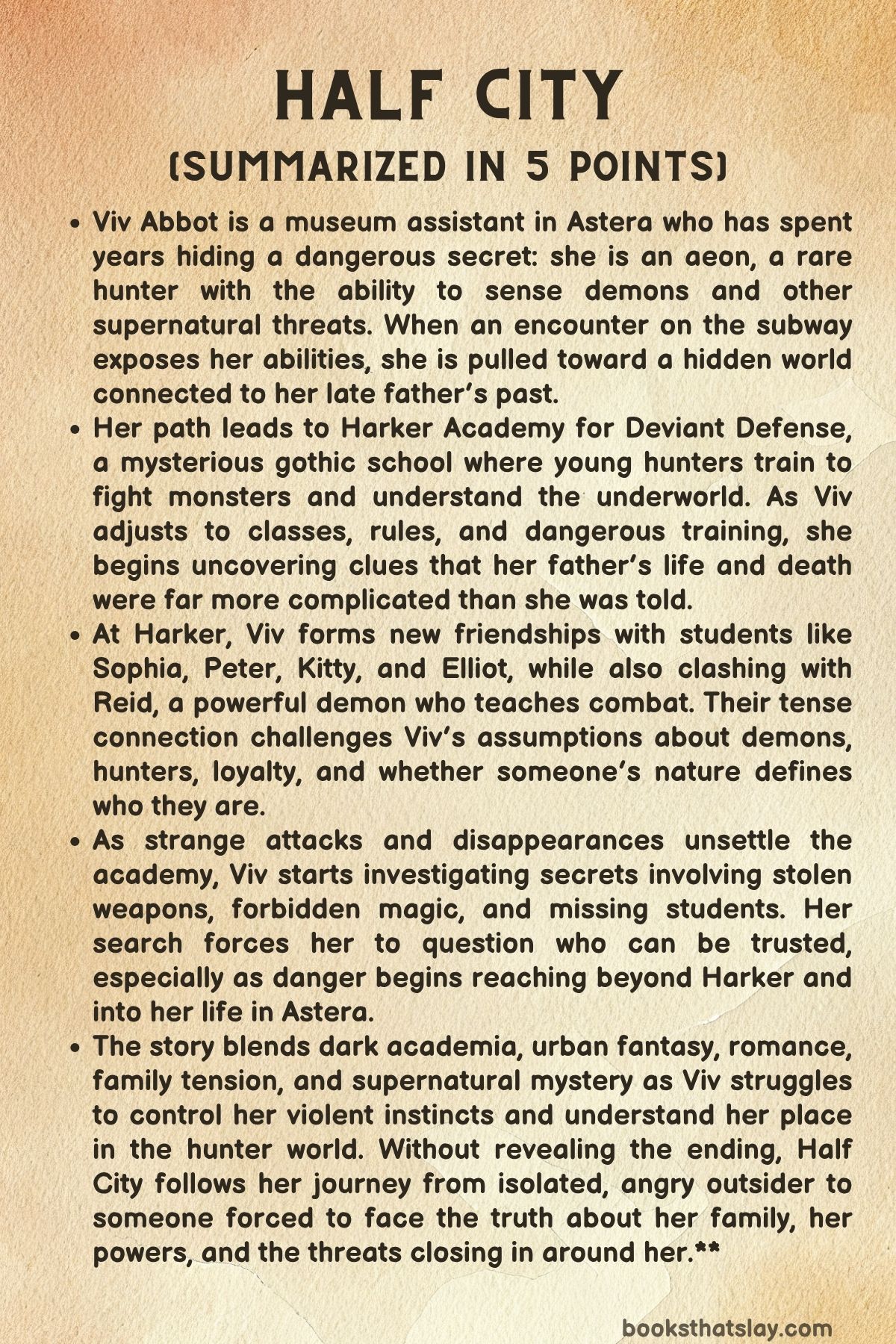
Half City by Kate Golden is a dark fantasy story about Viv Abbot, a young museum assistant in the divided city of Astera, whose ordinary life hides a dangerous inheritance. Viv is an aeon, a rare kind of hunter with the ability to sense and kill supernatural creatures, but her gift comes with violent urges she fears and does not understand.
When she discovers Harker Academy, a secret school for hunters, she begins uncovering the truth about her dead father, her family’s lies, and a plot that threatens both the mortal world and the hidden realm of deviants. This is the 1st book in the Harker Academy series.
Summary
Viv Abbot is twenty-one, works as a museum assistant at the Windsor in Astera, and lives with her best friend Penny above a bar called Cobwebs. Her life looks ordinary from the outside, but Viv has always carried something frightening inside her.
As a child, she crushed a beetle and felt fascination instead of guilt. That disturbing reaction never left her.
She has spent years trying to control a violent hunger that rises in her whenever she senses something inhuman.
Viv’s mother, Beatrice, is Astera’s district attorney and has recently sent Viv a box of belongings that belonged to Viv’s late father. Their relationship is strained.
Beatrice criticizes Viv’s neighborhood, questions her choices, and keeps pushing her toward James Pine, Viv’s wealthy and devoted boyfriend. Viv knows James is kind, but she cannot make herself feel what everyone expects her to feel.
While rushing to Penny’s birthday dinner, Viv notices a man harassing a tired mother with two babies on the subway. Her instincts tell her he is a demon.
Viv is secretly an aeon, a rare hunter who can sense deviants and feels a powerful drive to destroy them. She attacks the demon with her father’s silver daggers, injures herself, breaks one blade, and finally kills him.
As the body turns to ash, Viv notices a shadowy figure watching her.
That figure later confronts her. He is Reid, a handsome Brood demon who claims to be an instructor at Harker Academy for Deviant Defense, a hidden college for hunters.
Instead of killing Viv, he gives her an ancient coin and tells her how to reach Harker through a broken ticket machine at the Windsor. Viv doubts him until she finds a locket among her father’s things that proves he once had a connection to Harker.
At the museum, Viv follows Reid’s instructions and is transported to the academy. Harker is a gothic campus hidden in another plane, filled with hunter students, strict rules, and dangerous secrets.
Viv learns that students are forbidden from hunting in Astera without faculty supervision, which infuriates her. She meets Kitty Briggs, Peter Roydon, Elliot Thompson, and her bold new roommate, Sophia Valentine.
She also learns that her father attended Harker under the name David Cadell, not David Abbot, meaning he had hidden part of his past.
Viv begins classes in underworld history, monster identification, and combat. She learns about demons, vampires, wraiths, werewolves, lymantrians, and other deviants.
Reid teaches combat, and their relationship quickly becomes charged with anger, mistrust, attraction, and challenge. Viv resents being told she is reckless, but Reid sees that her strength is dangerous because she lacks discipline.
Outside Harker, Viv continues struggling with her family. At a dinner hosted by the Pines, Beatrice announces that Caspar Harlock will support her planned mayoral campaign.
Viv feels trapped among wealthy people who judge her, and tensions with her mother and sister Nora worsen. When Viv loses control and crushes a wineglass in her hand, it becomes another sign that she does not fit into the life her mother wants for her.
Back at Harker, danger reaches the school. Wraiths invade Viv’s dorm and attack students.
Viv fights them but learns silver cannot kill them. Sophia helps save her with salt, and Reid destroys the remaining wraiths.
Soon after, Kitty disappears. Her roommates claim she left school voluntarily, but Viv, Sophia, Elliot, and Peter doubt the note she supposedly left.
They begin to suspect someone is covering up something.
During a field investigation at an asylum, Viv senses a vampire and chases it alone, abandoning Sophia. She kills it but is drugged in the process.
Before Reid rescues her, an elderly patient warns her that “Thane” is coming for “the last of ’em.” Under the effects of the drug, Viv tells Reid that the Brood killed her father and that her mother seems to blame her for his death. Sophia later confronts Viv for leaving her behind and reveals that she knows Viv is an aeon.
Instead of betraying her, Sophia promises to stand by her.
More attacks follow. Zombies rise from Harker’s cemetery because of a spell, and two students die.
Viv and Sophia help stop the dead while Dean Driscoll destroys the source of the magic. Afterward, Viv’s daggers burn strangely, suggesting they are connected to another lost weapon.
Peter helps Viv research dark magic and explains syrabraxas, spells powerful enough to strip abilities or damage planes of existence. Viv wonders whether such a spell could remove her aeon nature.
The group discovers that Viv’s daggers are part of a three-blade aeon set. The missing blade was checked out under Kitty’s name on the night of the cemetery spell, even though Kitty was already gone.
Viv, Sophia, Elliot, and Peter break into the archives using a key card Viv stole from Reid. There they learn that melted aeon dagger alloy is one ingredient in a syrabraxa, along with celestial bloom, a conjuring witch’s eye, and aeon blood.
They realize someone may be collecting these ingredients.
Viv also digs deeper into her father’s past. She learns he was David Cadell at Harker, and that his records stop after Viv’s birth, even though he lived for ten more years.
Reid catches her in the archives but lets her go. He later allows her into field training.
During a patrol in Astera, Viv disobeys orders to chase a strzyga into a restaurant. She clears the building, traps the monster with Reid, and kills it by igniting spilled alcohol, though both she and Reid are burned.
Afterward, Viv tells Reid what she and her friends have found: Kitty’s disappearance, the stolen dagger, the hidden asphodel garden, and the possible syrabraxa. Reid agrees to help.
Their growing connection is complicated when James sees them together and acts possessive. Viv later realizes she no longer wants to be with James and breaks up with him on Halloween night.
She and Reid share a more honest bond, though both are haunted by their pasts.
Viv’s feelings for Reid deepen after he treats an injury he accidentally gives her during combat training. He tells her about his brutal father, the Brood, his brother, and the life he escaped with Dean Driscoll’s help.
They kiss, but their relationship remains fragile. Together, they later find the hidden asphodel garden inside the planetarium and discover flowers have been stolen.
They also find poppy marked with white antlers. Soon after, Lyra Roth disappears, and Viv connects the white antler symbol to a club called Fever Dream.
Viv suspects the missing girls are tied to the stolen ingredients and may have been taken because someone thinks they have aeon blood. Reid warns her not to go to Fever Dream, whose owner is known as the White Stag, but Viv ignores him.
She brings Sophia and Penny to the club. Inside, she follows a suspicious man and finds the White Stag, a powerful demon named Deacon.
Viv attacks him, believing he may be responsible, but he overwhelms her. Reid arrives and orders Deacon to release her.
Viv learns Deacon is Reid’s brother, not the High Thane.
The revelation damages Viv’s trust in Reid. She feels he hid too much from her.
At the same time, her ordinary life collapses. She misses the Windsor’s Chasm exhibit opening, Fiona fires her, and Beatrice leaves a cruel voicemail.
When Viv goes to collect her things, she finally confronts her mother about years of coldness and grief. Their argument is interrupted by an alarm.
Viv discovers the Brood inside the museum’s Chasm exhibit, led by the real High Thane, who steals an artifact called the censer. Reid arrives, and they fight.
Professor Lisette appears and saves Viv, then reveals she is actually Fiona in another form: a dichotomous shifter who lives as mortal Fiona and hunter Gemeline Lisette. Fiona explains that the censer can protect demons from the madness caused by casting a syrabraxa.
Viv connects a clue from her father’s death to Dean Driscoll. Her father carved the number twenty-six into his hand before dying, and Viv remembers that Driscoll wore that number in an old Harker lacrosse photo.
She realizes Driscoll killed her father, joined the Brood, staged attacks, stole spell ingredients, covered up the missing girls, and framed Deacon.
Before Viv can act, she hears Penny through a protective charm Reid gave her, which Viv had passed to Penny. Penny has been kidnapped and taken to the docks, where Viv’s father died.
Viv and Reid rush there. Reid distracts the Brood while Viv rescues Penny from a shipping container, then takes Penny’s place to keep her safe.
Driscoll reveals he has spent years searching for the last aeon bloodline. Kitty and Lyra were taken because they resembled Viv and might have been aeons.
Driscoll prepares Viv for the syrabraxa, and the High Thane’s son Finn reveals the larger plan: Viv’s death will help break open the Chasm and release deviants into the mortal world. Driscoll completes the spell, binding it painfully into Viv’s spine.
Reid bursts in and fights to give Viv a chance to escape. Viv runs to save Penny and finds Driscoll about to kill her.
She kills him, even though he may have been the only person who could remove the spell from her. Viv gets Penny to safety near a police station, then realizes she has no safe place left and Reid has probably been captured.
Injured, desperate, and marked by the syrabraxa, she goes to Fever Dream and begs Deacon for help. When she shows him the spell mark and tells him it concerns his brother, Deacon pulls her inside.
Characters
Viv Abbot
Viv Abbot is the central character of Half City, and her personality is shaped by a constant struggle between control and violence. At twenty-one, she appears to be a young museum assistant trying to manage work, family pressure, friendship, and romance, but beneath that ordinary surface she carries the instincts of an aeon, a rare hunter driven by an almost consuming need to sense and kill deviants.
Her childhood memory of crushing a beetle and feeling fascination rather than guilt reveals the earliest sign of this frightening inner nature. Viv is not simply violent, however; she is deeply afraid of what that violence means.
Much of her character is built around the tension between her moral awareness and her dangerous cravings.
Viv’s emotional life is marked by abandonment, grief, and secrecy. Her father’s death has left a wound that never fully healed, especially because her mother seems to blame her for it or at least treats her as a reminder of loss.
This makes Viv defensive and restless. She often expects criticism before it is spoken, especially from Beatrice, Nora, Fiona, and the wealthy social world surrounding James.
Her sense of not belonging is one of her strongest traits. South of the Chasm, at Harker, in Astera’s elite circles, and even in her own family, Viv often feels like someone standing outside a closed door.
Harker begins to change that because it gives her a language for what she is, but it also exposes how much has been hidden from her.
Viv’s bravery is undeniable, but it often borders on recklessness. She repeatedly runs toward danger before fully understanding it, whether she is fighting a demon on the subway, chasing a vampire alone, confronting Deacon at Fever Dream, or taking Penny’s place at the docks.
Her courage comes from loyalty and instinct, but also from anger and self-punishment. Viv does not always value her own safety, and that makes her both heroic and vulnerable.
She wants to save others, yet she also wants to test herself against monsters because violence temporarily quiets the chaos inside her. This makes her one of the most morally complicated figures in the book.
Her relationships reveal different sides of her. With Penny, Viv is protective and loving, but also dishonest, hiding the most important parts of her life.
With James, she is guilty because he represents the safe, socially approved future everyone wants for her, even though she cannot return his feelings. With Sophia, Peter, Kitty, and Elliot, she begins to experience friendship without the same suffocating expectations.
With Reid, she finds someone who recognizes both her danger and her pain. Their connection is intense because he does not ask her to pretend to be harmless, but he also challenges her when her impulses put people at risk.
By the end of the given story, Viv has changed from a secretive, isolated hunter into someone who understands that her identity is tied to a much larger history. Learning that her father was David Cadell, uncovering the truth about Driscoll, and discovering that she is part of the last aeon bloodline force her to confront the fact that her life has been shaped by secrets she did not choose.
Her decision to kill Driscoll, even though he may be the only one who can remove the syrabraxa from her, shows both her tragic decisiveness and her refusal to let survival come before protecting someone she loves. Viv is fierce, wounded, impulsive, loyal, and deeply human precisely because she is always fighting the monster she fears she might become.
Reid
Reid is one of the most intriguing characters in Half City because he exists between enemy and protector, monster and teacher, temptation and warning. As a Brood demon working as an instructor at Harker Academy, he immediately complicates the simple hunter-versus-demon worldview that Viv has grown up with.
His first appearance is threatening because he watches Viv kill a demon and then confronts her, but instead of harming her, he guides her toward Harker. This establishes his role as someone who knows more than he initially reveals and whose motives are difficult to read.
Reid’s personality is controlled, sharp, and often infuriatingly calm. In training, he is demanding and unsentimental, especially with students who are arrogant or careless.
His humiliation of Matt Peverell reveals his intolerance for cruelty disguised as skill, while his refusal to let Viv enter Field Training at first shows that he sees the danger in her recklessness clearly. Reid is not gentle in the ordinary sense, but he is attentive.
He notices Viv’s injuries, gives practical advice, protects students during attacks, and repeatedly intervenes when danger becomes overwhelming. His care is often hidden behind sarcasm, discipline, or restraint.
His demonic past gives him emotional depth. Reid has suffered under a brutal father, endured the violence of the Brood, loved and lost, and lived with a brother who embodies many of the things he is trying to escape.
Dean Driscoll’s decision to give him a chance at Harker is crucial to his identity because it allows him to believe that a person, or even a demon, can become something other than what they were made to be. This makes Reid a mirror to Viv.
Both characters fear their own violent nature, and both are trying to decide whether instinct defines destiny.
Reid’s relationship with Viv develops through conflict, attraction, and reluctant trust. He challenges her because he understands how easily courage can turn into self-destruction.
She challenges him because she refuses to accept secrets and half-truths. Their romantic tension grows from the fact that they see each other too clearly.
The planetarium scene, the lure bracelet, and the intimacy of him tending her wound reveal his longing for an ordinary life, one not ruled by bloodlines, hunting, and demons. Yet Reid’s secrecy about Deacon damages Viv’s trust, proving that his protective instincts can become controlling when he withholds the truth.
Reid is ultimately a character defined by restraint. He restrains his demonic nature, his attraction to Viv, his anger toward Deacon, and his fear that Viv will be destroyed by the world he knows too well.
His tragedy lies in the fact that he is trying to protect Viv from dangers that secrecy only makes worse. Still, his loyalty is clear when he comes for her again and again, even when doing so means facing his brother, the Brood, and the High Thane’s forces.
Penny
Penny is Viv’s best friend and one of the book’s strongest emotional anchors. Unlike the hunters and demons around Viv, Penny belongs to the ordinary world, which makes her presence especially important.
She represents warmth, familiarity, humor, and the life Viv might have had if she were not trapped between family trauma and supernatural violence. Her birthday dinner at Cobwebs shows her as loving and forgiving, but her comment that she did not expect Viv to show up also reveals the damage Viv’s secrecy and unreliability have caused.
Penny’s character is full of openness. She loves intensely, celebrates loudly, and feels heartbreak deeply.
Her pain after Claude leaves her for someone in Paris shows that she is vulnerable in a direct, unguarded way. Unlike Viv, Penny does not hide behind anger or danger.
She feels things plainly, which makes her both emotionally brave and easy to wound. Her friendship with Viv is built on loyalty, but it is also strained by the fact that Viv keeps disappearing, lying, and returning injured without explanation.
Penny’s importance grows when she becomes connected to Viv’s hidden world. The lure bracelet, which Viv gives her for protection, becomes a symbol of how Viv’s supernatural life can no longer be kept separate from her ordinary relationships.
Penny’s kidnapping is not just a plot event; it is the emotional consequence of Viv’s secrets finally reaching the person she most wanted to protect. When Penny becomes suspicious after Fever Dream, her hurt is justified.
She senses that Viv and Sophia have lied to her, and that realization places pressure on the friendship.
Penny’s role in the story is not that of a fighter, but she is not insignificant. She reminds Viv what is at stake beyond hunter politics and magical bloodlines.
Saving Penny forces Viv to make one of her most defining choices: taking her friend’s place even though it means walking directly into Driscoll’s trap. Through Penny, the book shows that ordinary love can be just as powerful a motivation as vengeance, destiny, or supernatural instinct.
Beatrice Abbot
Beatrice Abbot, Viv’s mother and Astera’s district attorney, is a cold, ambitious, and emotionally complicated figure. She is not presented as simply cruel, but her cruelty is unmistakable in the way she speaks to Viv.
Her criticism of Viv’s neighborhood, career, clothing, relationship, and choices reveals a mother who communicates through judgment rather than tenderness. Beatrice’s emotional distance has shaped Viv’s insecurity and anger, making their relationship one of the most painful in the story.
Beatrice’s grief over David’s death appears to have hardened into control. Instead of openly mourning him with Viv, she seems to have built a life around public achievement, political ambition, and social respectability.
Her decision to send Viv a box of her father’s belongings feels less like a loving gesture and more like an attempt to clear space, emotionally and physically. This deeply hurts Viv because it suggests that Beatrice wants to remove David from her home and, by extension, from the family’s living memory.
Her support of James as a suitable partner for Viv shows her desire to place Viv into a stable, respectable future that fits Beatrice’s worldview. Yet this support is not truly about Viv’s happiness.
It is about image, safety, status, and control. Beatrice seems to believe that if Viv can be shaped into the right kind of daughter, then the messiness of grief and danger can be contained.
Her mayoral ambitions intensify this quality, especially when Caspar’s backing turns family gatherings into political arrangements.
The confrontation at the Windsor is important because it brings years of buried resentment into the open. Viv’s question about why Beatrice hates her exposes the emotional core of their relationship.
Beatrice may not actually hate Viv, but her inability to process David’s death has made Viv feel blamed and unloved. Beatrice is therefore a tragic parental figure: powerful in public, but emotionally inadequate in private.
Her failure is not a lack of intelligence or strength, but a lack of tenderness when Viv most needed it.
David Abbot / David Cadell
David Abbot, whose original name was David Cadell, is physically absent for most of the story but emotionally present everywhere. He is the lost father whose death defines Viv’s childhood, family tension, and hidden heritage.
The discovery that he attended Harker and changed his name suggests that he lived under threat and carried secrets into his family life. His silence about Harker, hunting, and Viv’s aeon nature becomes one of the central mysteries surrounding him.
David represents both love and concealment. Viv clearly remembers him as someone important and beloved, but the more she learns, the more she realizes how much he withheld.
His hidden connection to Harker, his old locket, his appearance in lacrosse photographs, and his records under another name all show that he had a past he tried to bury. This does not make him uncaring; rather, it suggests he may have been trying to protect his family from the danger attached to the Cadell name and the aeon bloodline.
His death becomes more meaningful when Viv learns that he carved the number twenty-six into his hand before dying. This final act shows that even in death, he was trying to leave a clue.
He knew or suspected that Edgar Driscoll was responsible, and his last effort was to point Viv toward the truth. That detail transforms him from a passive victim of the Brood into someone who resisted until the end.
David’s character is important because he gives Viv a history larger than her pain. He is not merely the father she lost; he is part of the aeon legacy Driscoll has been hunting.
Through him, Viv discovers that her life has been shaped by fear, protection, and betrayal long before she understood any of it. His absence creates grief, but his hidden past gives Viv the key to understanding herself.
James Pine
James Pine represents the safe, socially approved life that Viv is expected to want but cannot truly accept. He is kind, devoted, and protective in many ways, especially when he worries about Viv and Penny living in a dangerous neighborhood.
However, his concern often carries an assumption that he knows what is best for Viv. This makes him a complicated character rather than a simple good boyfriend.
James’s relationship with Viv is built on imbalance. He loves her more clearly than she loves him, and Viv feels guilty because she knows she cannot return his feelings with the same certainty.
To Beatrice and the Pine family, James appears to be the ideal partner: wealthy, stable, respectable, and connected to the kind of future they want Viv to inhabit. For Viv, however, that future feels suffocating.
Her inability to love James becomes another way she disappoints the people around her.
His possessiveness becomes more visible when he encounters Viv with Reid. His attempt to pay Reid for discretion is revealing because it shows how quickly James falls back on class privilege and control.
He misunderstands Viv’s autonomy and treats the situation as something that can be managed through money and social power. This moment strips away some of his earlier gentleness and reveals the entitlement beneath his polished exterior.
James is not evil, but he is wrong for Viv. His final insult after their breakup, especially the revelation that Beatrice once said he could do better, confirms that he has absorbed the same judgmental view of Viv that has wounded her for years.
He represents a version of love that is conditional on Viv becoming easier, safer, and more acceptable. Viv’s choice to end the relationship is therefore an important act of self-honesty.
Fiona / Professor Gemeline Lisette
Fiona is one of the most surprising characters because she exists in two forms: the mortal Fiona, Viv’s sister-in-law and supervisor at the Windsor, and Professor Gemeline Lisette, a hunter and Harker teacher. This dual identity makes her a literal and symbolic figure of divided existence.
She embodies secrecy more completely than almost anyone else in the story, moving between the ordinary world and Harker while keeping both lives carefully separated.
As Fiona, she appears responsible, controlled, and often critical of Viv. Her lectures about responsibility frustrate Viv because they echo the judgment she receives from her mother and sister.
Yet Fiona’s criticism is not empty cruelty. She values consequences, discipline, and reliability, and from her perspective Viv repeatedly fails to meet her obligations.
Her decision to fire Viv after the missed Chasm exhibit opening is painful but consistent with her belief that actions matter.
As Professor Lisette, she becomes more mysterious, authoritative, and watchful. She teaches Underworld Studies, warns Viv away from trouble, and appears to possess a deeper understanding of Harker’s dangers than she initially reveals.
Her presence in the academy gives Viv access to knowledge, but also reinforces the feeling that adults around Viv are hiding essential truths. Lisette’s mention of asphodels helps Viv make a crucial connection, even though the full truth remains concealed until later.
Her revelation as a dichotomous shifter changes the reader’s understanding of her completely. Fiona has been living with the same kind of divided identity that Viv experiences emotionally.
She is mortal in one form and hunter in another, which allows her to exist in both Viv’s everyday world and the hidden world of Harker. This makes her secrecy more understandable, though not painless.
Fiona is stern, guarded, and sometimes hurtful, but she is also brave, knowledgeable, and ultimately aligned against the true threat.
Nora
Nora, Viv’s sister, functions as part of the family structure that makes Viv feel judged and alienated. She appears most strongly in moments where family tension rises, especially during the uncomfortable dinner at the Pine house and the confrontation at the Windsor.
Nora’s presence intensifies Viv’s sense that she is the difficult daughter, the unstable sister, and the one who never quite fits the family’s expectations.
Nora seems to occupy a more acceptable place in the family than Viv does. This contrast matters because Viv experiences her not just as a sibling but as another standard she fails to meet.
Their tensions suggest years of unresolved resentment, comparison, and misunderstanding. Nora may not be as openly cutting as Beatrice, but she participates in the emotional environment that leaves Viv feeling cornered.
At the Windsor, Nora’s presence during Viv’s confrontation with Beatrice makes the scene more painful. Viv is not merely arguing with her mother in private; she is exposing family wounds in front of people who have long been part of the same pattern.
Nora represents the family’s inability to speak honestly until crisis forces the truth into the open.
Nora is not developed as deeply as Viv or Beatrice, but her role is important because she helps show how isolated Viv is within her own family. She is part of the ordinary world Viv is supposed to belong to, yet that world feels almost as hostile to Viv as the supernatural one.
Sophia Valentine
Sophia Valentine is bold, glamorous, perceptive, and fiercely loyal. As Viv’s roommate at Harker, she quickly becomes one of the most important friendships in the book.
Her confidence stands out immediately. She helps Viv navigate the academy, registers for classes with her, and brings style, humor, and social ease into Viv’s increasingly dangerous life.
Sophia is the kind of character who appears dazzling at first, but her true value lies in her steadiness.
Sophia’s bravery is repeatedly proven. During the wraith attack, she appears with a crossbow and saves Viv, showing that her glamour is not superficial.
In Field Training, she faces real danger and becomes understandably furious when Viv abandons her to chase the vampire alone. This confrontation is important because Sophia refuses to be treated as disposable.
She cares about Viv, but she also demands accountability. Her friendship is not blind approval; it is honest loyalty.
Her realization that Viv is an aeon shows her intelligence and emotional sensitivity. Instead of exposing Viv, Sophia promises to keep her secret and support her.
This moment strengthens their bond because Viv is terrified of being known, while Sophia responds not with fear but with acceptance. Sophia gives Viv something she rarely receives: the chance to be seen without being condemned.
Sophia also has her own desires and vulnerabilities. Her attraction to Reid, though disappointing to her once Viv’s connection with him grows, makes her feel real rather than merely supportive.
She has humor, jealousy, courage, and pride. Her decision to go with Viv to Fever Dream, even when the plan is dangerous and forbidden, shows that Sophia is willing to risk herself for her friends.
She is one of the strongest examples of chosen family in the story.
Peter Roydon
Peter Roydon is intelligent, observant, and emotionally wounded. He serves as one of Viv’s most important sources of knowledge at Harker, explaining the academy’s structure, hunter history, syrabraxas, aeon weapons, and the significance of Viv’s daggers.
His role is partly scholarly, but he is not merely an information-giving character. His knowledge comes with personal grief and fear.
Peter’s past trauma is revealed when he admits that he watched his mother die to a Brood demon when he was eight. This experience connects him to Viv, whose life has also been shaped by the Brood’s violence.
Their conversation about guilt over their parents’ deaths shows Peter’s emotional depth. He understands the irrational burden of surviving when someone loved has died.
This makes him one of the few characters who can meet Viv’s grief without trying to correct it.
Peter is less physically aggressive than Viv, Sophia, or Reid, but his courage appears in quieter ways. He insists that Kitty would never abandon Harker, compares her note to her classwork, and helps investigate the stolen dagger and dark spell ingredients.
His persistence matters because he trusts emotional truth as much as evidence. When the official explanation feels wrong, Peter refuses to accept it simply because authority presents it.
His near-death encounter with the werewolf also reveals the danger of Harker’s training culture. Peter is chosen for a test that nearly kills him, and Viv’s intervention saves him.
This moment emphasizes his vulnerability, but it also reinforces his importance to the group. Peter is thoughtful, loyal, and morally grounded, and his presence helps balance Viv’s impulsiveness with research, memory, and caution.
Kitty Briggs
Kitty Briggs begins as one of the friendly students who helps introduce Viv to Harker, but her disappearance turns her into a central mystery. At first, she seems welcoming, knowledgeable, and fully committed to the academy.
This makes the claim that she simply left school immediately suspicious. Peter’s insistence that Kitty would not abandon Harker gives weight to her unseen character: even when absent, she is defined by loyalty and seriousness.
Kitty’s forged letter suggests that someone is manipulating the truth around her. Her name being used to check out the missing Aeon’s Dagger deepens the suspicion and makes her disappearance feel connected to a larger plot.
She becomes one of the first signs that the danger at Harker is not random. The attacks, stolen objects, missing students, and hidden ingredients all begin to form a pattern around her absence.
The later claim that Kitty is safe and hunting in Brazil briefly offers relief, but Viv’s continued suspicion proves justified. Kitty’s connection to the White Stag symbol and the missing ingredients suggests she has been caught in the scheme surrounding aeon blood and the syrabraxa.
Her importance lies partly in what others project onto her: the official story says she left, Peter says she would not, Reid’s information says she is safe, and Viv senses that the truth is darker.
Kitty is a character whose absence drives action. She represents the vulnerability of students within an institution that claims to protect them.
Her disappearance exposes Harker’s failures and leads Viv toward the truth about Driscoll’s betrayal.
Elliot Thompson
Elliot Thompson is part of Viv’s Harker friend group and helps create the sense of student life beyond training and danger. He is not as central as Sophia or Peter, but he contributes warmth, humor, and companionship.
His presence helps Viv begin to feel that Harker might be a place where she can belong.
Elliot’s involvement in Field Training and his lacrosse game places him within the ordinary rhythms of Harker student life, where school activities exist alongside supernatural threats. The zombie attack during his game shows how quickly the academy’s apparent normality can collapse.
Through Elliot, the story shows that Harker students are still young people trying to have friendships, sports, jokes, and ordinary experiences despite being trained for violence.
Elliot also serves as part of the group that helps Viv investigate. His willingness to enter dangerous situations, including the archive break-in and Field Training dangers, shows loyalty and courage.
He may not dominate the plot, but he helps form the emotional structure around Viv. She is no longer acting entirely alone, and Elliot is one of the people who makes that change possible.
His character matters because he broadens the world of Harker. Not every student is a rival, love interest, or secret villain.
Some are friends, teammates, and witnesses to the growing danger. Elliot helps make the academy feel like a lived-in community worth protecting.
Dean Edgar Driscoll
Dean Edgar Driscoll is one of the most significant antagonists because he hides betrayal beneath authority. As dean of Harker Academy, he initially appears to be a figure of order, discipline, and institutional protection.
He warns Viv, helps identify the origin object during the zombie attack, and speaks with the authority of someone responsible for student safety. This makes the later revelation of his guilt especially devastating.
Driscoll’s betrayal is personal, historical, and institutional. He knew Viv’s father, appears in the old lacrosse photo, and is identified through David’s final clue.
The number twenty-six connects him to David’s death, turning a long-buried mystery into a direct accusation. Driscoll did not simply betray Viv; he betrayed her father, Harker, the students under his care, and the entire purpose of the academy.
His manipulation is extensive. He steals spell ingredients, stages attacks, covers up disappearances, frames Deacon, and hunts the last aeon bloodline.
Kitty and Lyra are taken because they resemble Viv and might be possible aeons, which shows the horrifying breadth of his obsession. He is willing to sacrifice students to complete his goal, making him a predator hidden inside the institution meant to defend them.
Driscoll’s villainy is frightening because it comes from trusted power. He does not operate only from dark alleys or demon clubs; he acts from the center of Harker.
His role suggests that corruption is most dangerous when it wears the face of protection. Viv’s decision to kill him, even though he may be able to remove the syrabraxa, is one of her most consequential choices.
In that moment, justice and survival are in conflict, and Viv chooses to stop him.
Deacon
Deacon is Reid’s brother and the demon known as the White Stag, making him a dangerous and morally ambiguous figure. When Viv first confronts him at Fever Dream, he appears to be the likely villain behind the missing students.
His power, criminal influence, ability to intimidate, and history of taking hunter souls make him terrifying. He easily overpowers Viv, proving that her confidence and violence are not always enough.
Deacon’s presence reveals more about Reid’s past. The brothers clearly share a brutal history, and Deacon represents the demonic world Reid has tried to escape.
His cruelty and confidence contrast with Reid’s restraint. Where Reid is controlled, Deacon is predatory.
Where Reid resists his old nature, Deacon seems to have embraced power, fear, and manipulation. Their relationship carries the weight of family violence and unresolved loyalty.
Yet Deacon is not the High Thane, and this distinction complicates him. He is dangerous, but he is also used as a false target in Driscoll’s larger scheme.
His club, symbol, and reputation make him easy to blame. This does not make him innocent, but it means he is not the central architect of the disappearances.
The story uses Deacon to challenge Viv’s tendency to leap from suspicion to attack.
By the end of the provided events, Viv goes to Deacon for help because Reid may be captured and the syrabraxa mark connects her fate to demon politics. This choice shows how desperate she has become, but it also suggests that Deacon may serve a more complicated role moving forward.
He is cruel, powerful, and dangerous, yet his connection to Reid may make him an unwilling ally when the threat becomes large enough.
The High Thane
The High Thane is the larger demonic threat behind the catastrophic plan to break open the Chasm. Compared with Deacon or Driscoll, he functions as a more distant but immense source of danger.
His presence is associated with the Brood, stolen artifacts, dark magic, and the possibility of unleashing deviants into the mortal world. He represents not just personal evil but world-level destruction.
His plan involving the censer and syrabraxa reveals intelligence and ambition. The censer can protect demons from the consequences of certain spells, and the High Thane intends to use Viv’s death to break open the Chasm.
This makes him a figure who treats people as ingredients, tools, or sacrifices. Viv is valuable to him not as a person but as the last aeon bloodline needed for a magical catastrophe.
The High Thane’s brief appearance with Finn also suggests dynastic power. He is not merely a monster acting alone; he has heirs, followers, and a structure of command.
This makes the Brood feel like an organized force rather than a random collection of demons. His influence reaches through Driscoll, the attacks, the stolen artifact, and the dockside ritual.
As an antagonist, the High Thane embodies the external threat that parallels Viv’s internal one. Viv fears the violence in herself, but the High Thane shows violence without conscience, purpose without morality, and power without restraint.
He is the kind of being hunters exist to stop, but the book complicates that mission by showing that the human Driscoll may be just as monstrous.
Finn
Finn, the High Thane’s son, is a threatening figure because of what he represents more than how much time he occupies. His appearance during the ritual places him inside the Brood’s hierarchy and connects him directly to the plan involving Viv’s death and the Chasm.
He is part of the next generation of demonic power, suggesting that the High Thane’s ambitions are not temporary but dynastic.
Finn’s role in the scene with Viv and Reid is menacing. He helps reveal the true purpose of the spell and participates in the danger surrounding Viv’s capture.
His presence makes the ritual feel larger than Driscoll’s personal obsession. Driscoll may have hunted Viv’s bloodline for years, but Finn shows that the Brood has its own stake in using Viv.
As Reid fights Finn and the Brood, Finn becomes part of the immediate physical threat that separates Reid from Viv. He is not explored as deeply as Reid or Deacon, but his position makes him important.
He embodies inherited cruelty and allegiance to the High Thane’s destructive plan.
Finn’s character also sharpens the contrast between demon families. Reid and Deacon’s brotherhood is fractured by violence, escape, and resentment, while Finn appears aligned with the High Thane’s ambitions.
Through him, the story suggests that family can transmit power, brutality, and ideology just as surely as bloodlines transmit hunter abilities.
Caspar Harlock
Caspar Harlock is a figure of wealth, influence, and political calculation. His presence at the Pine dinner helps turn an already uncomfortable family gathering into a public announcement of ambition.
By financially backing Beatrice’s exploratory mayoral campaign, he becomes part of the network of power surrounding Viv’s mother.
Caspar’s importance lies in what he represents: the alliance between money, politics, and image. Beatrice’s campaign is not presented as a purely personal dream; it is tied to donors, social positioning, and carefully staged announcements.
Caspar’s support shows that Beatrice is moving further into a world where relationships are strategic and appearances matter deeply.
For Viv, Caspar’s presence contributes to her alienation. The dinner is already painful because of James, Beatrice, Nora, Fiona, and the wealthy guests.
Caspar’s announcement makes Viv feel even more blindsided and powerless. Her family’s future seems to be discussed and arranged in rooms where she has no real voice.
Caspar is not a central emotional character, but he helps define the social world pressing in on Viv. He belongs to the polished, influential side of Astera that expects composure, status, and obedience.
Against that world, Viv’s violence and instability appear scandalous, but the book also suggests that respectable power can be cold and controlling in its own way.
Lyra Roth
Lyra Roth is another missing Harker student whose disappearance deepens the central mystery. Like Kitty, she becomes evidence that the danger at the academy is organized and escalating.
Her absence causes panic across Harker because it proves Kitty’s disappearance was not isolated.
Lyra’s connection to the white antler symbol helps Viv identify Fever Dream as a possible link between the missing girls. Her disappearance also strengthens Viv’s suspicion that Kitty’s supposed safety was fabricated.
Through Lyra, the story shows Viv moving from personal curiosity to urgent investigation. The pattern becomes too strong to ignore.
Driscoll later reveals that Kitty and Lyra were taken because they resembled Viv and were mistaken as possible aeons. This makes Lyra’s role tragic.
She is victimized not because of her own choices but because she is caught in someone else’s hunt for bloodline power. Her disappearance exposes the cruelty of Driscoll’s obsession and the vulnerability of students under his authority.
Lyra may not be deeply developed on the page, but her function is emotionally significant. She represents the human cost of the conspiracy.
Every missing student turns the mystery from an intellectual puzzle into a moral emergency.
Professor Dawnmere
Professor Dawnmere, the fairy professor, adds danger and unpredictability to Harker’s academic world. Her terrifying loss of temper shows that even teachers who are not obvious villains can be frighteningly powerful.
She contributes to the sense that Harker is not a safe school with supernatural decoration, but a place where immense forces are barely contained.
Her character also broadens the range of beings and personalities at the academy. Harker’s faculty are not ordinary instructors.
They include hunters, fairies, demons, shifters, and other figures whose identities complicate simple categories of good and evil. Dawnmere’s temper reminds students that knowledge at Harker comes with danger.
Although she does not play as central a role as Reid or Lisette, Dawnmere helps establish the atmosphere of the academy. She makes the classroom feel like a place where one wrong move can reveal something ancient and terrifying.
Her presence supports the idea that Viv has entered a world far older and stranger than she imagined.
Professor Crowley
Professor Crowley teaches Monster Identification and represents the practical, classificatory side of Harker’s education. In a world where survival depends on recognizing threats quickly, his subject matter is essential.
He helps show that hunting is not only about violence but also about knowledge, preparation, and correct judgment.
Crowley’s role is important because Viv begins Harker with raw instinct but limited training. She can sense and fight deviants, but she does not yet understand the full hierarchy, weaknesses, or histories of the creatures she faces.
Classes like Crowley’s reveal the gap between natural ability and disciplined expertise.
He is less emotionally central than many other characters, but he contributes to Viv’s growth as a hunter. The more she learns, the clearer it becomes that her father kept enormous truths from her.
Crowley’s classroom is part of the world that gives Viv the tools to understand what she has been fighting blindly.
Matt Peverell
Matt Peverell is an arrogant student whose cruelty is exposed during Combat Training. When he injures his blindfolded partner, he shows that he values dominance over discipline.
His behavior contrasts sharply with the kind of hunter Reid wants students to become. Skill without honor, the book suggests, is dangerous.
Reid’s response to Matt is severe and public. By humiliating him in a blindfolded sparring match, Reid makes an example of him.
This moment reveals Matt’s weakness beneath his arrogance and also shows Reid’s teaching philosophy. Recklessness, bullying, and abuse of advantage have no place in real combat.
Matt’s character is minor but useful. He helps distinguish confidence from cruelty and bravery from ego.
In a school full of dangerous students, he shows that some threats come not from monsters but from undisciplined people who enjoy power over others.
Claude
Claude is important mainly through the emotional effect he has on Penny. His decision to leave her for someone in Paris breaks her heart and reveals how deeply Penny feels romantic loss.
Though he does not occupy much space in the story, his absence creates a vulnerable moment that draws Penny further into Viv and Sophia’s dangerous plans.
Claude’s role is also useful because it shows Penny’s ordinary life continuing alongside Viv’s supernatural crisis. While Viv is dealing with missing students, demons, and dark spells, Penny is suffering through a recognizable human heartbreak.
The contrast makes the story’s emotional world feel broader.
His abandonment of Penny also indirectly places her in danger. Sophia insists Penny come clubbing with them to distract her, which leads Penny to Fever Dream and eventually into the chain of events that results in her kidnapping.
Claude therefore has a small but meaningful influence on the plot.
Themes
Identity, Inheritance, and the Burden of Blood
Viv’s identity is shaped by secrets she did not choose and instincts she does not fully understand. Her aeon nature gives her power, but it also frightens her because it links violence with desire, making her question whether she is heroic, dangerous, or both.
The discovery that her father lived under another name deepens this crisis, because her family history becomes less like a memory and more like a mystery she must solve. In Half City, inheritance is not only about bloodlines; it is about hidden truths, unfinished conflicts, and the emotional weight passed from one generation to the next.
Viv’s father’s past, the missing aeon lineage, and Driscoll’s hunt for her blood all show how identity can become a target. Yet Viv’s journey also shows that inheritance does not control character.
She may carry a violent legacy, but her choices reveal compassion, loyalty, and moral judgment.
Control, Rebellion, and Personal Agency
Viv repeatedly resists people and institutions that try to control her life. Her mother wants her to become acceptable, polished, and useful to the family’s public image.
James wants to protect her, but his protection often becomes possessive. Harker tries to discipline her through rules, training limits, and authority figures who believe they know what she is ready for.
Viv’s rebellion is not simple immaturity; it comes from a deep need to act when danger is being ignored or hidden. At the same time, the story does not present recklessness as pure strength.
Viv’s choices often save lives, but they also endanger her friends and damage trust, especially when she lies or charges ahead alone. The theme becomes most powerful when agency is shown as something more mature than defiance.
Viv must learn that freedom is not just doing what she wants; it is choosing with awareness of consequences, accepting help, and taking responsibility for the people affected by her actions.
Family, Grief, and Emotional Distance
The family relationships in Half City are marked by grief that has never been properly faced. Viv’s mother does not simply disapprove of her; she seems unable to separate Viv from the pain of losing David.
Her criticism, coldness, and public ambition become ways of avoiding grief rather than healing from it. Viv, in turn, carries the belief that she is blamed for her father’s death, which makes her defensive, angry, and desperate for answers.
Nora and Fiona also stand inside this broken family structure, showing different ways of coping with duty, disappointment, and secrecy. The emotional distance between Viv and her mother matters because it explains why Viv often feels most at home among people she has only recently met.
Harker, despite its danger, offers partial honesty, while her actual home demands performance. The theme shows that silence within families can become as harmful as open cruelty, especially when love remains buried under resentment.
Trust, Secrecy, and Betrayal
Secrecy drives nearly every major conflict in the story. Viv hides Harker from Penny, her hunting from James, her aeon identity from classmates, and her investigations from authority figures.
Some secrets protect her, but others isolate her and cause the people closest to her to feel deceived. Reid’s secrecy works in a similar way.
His hidden connection to Deacon is understandable because of shame and danger, yet it still damages Viv’s trust because she has already been surrounded by lies from family, school, and history. The academy itself also depends on secrecy, keeping students away from truths about attacks, disappearances, and the larger threat.
Betrayal becomes painful because it often comes from people who believe they are acting for protection. The theme asks whether safety built on withheld truth can really be safety at all.
By the end, Viv is forced to rely on unlikely allies, proving that trust is not created by perfect honesty from the start, but by what people risk when truth finally matters.