Haven’t Killed in Years Summary, Characters and Themes
Haven’t Killed in Years by Amy K. Green is a psychological thriller that explores themes of identity, trauma, and the inescapable nature of one’s past. The novel follows Gwen Tanner, a woman who has spent most of her life running from the shadows of her family’s criminal legacy.
Her father, a notorious serial killer, and her mother, who aided in his crimes, have left Gwen with a complicated and painful history. Gwen’s attempts to lead a quiet life are shattered when she begins receiving mysterious packages containing severed body parts. As she delves deeper into the mystery, she is forced to confront the people and events tied to her father’s gruesome legacy, all while grappling with her own dark memories and the relentless pursuit of those who know too much about her past.
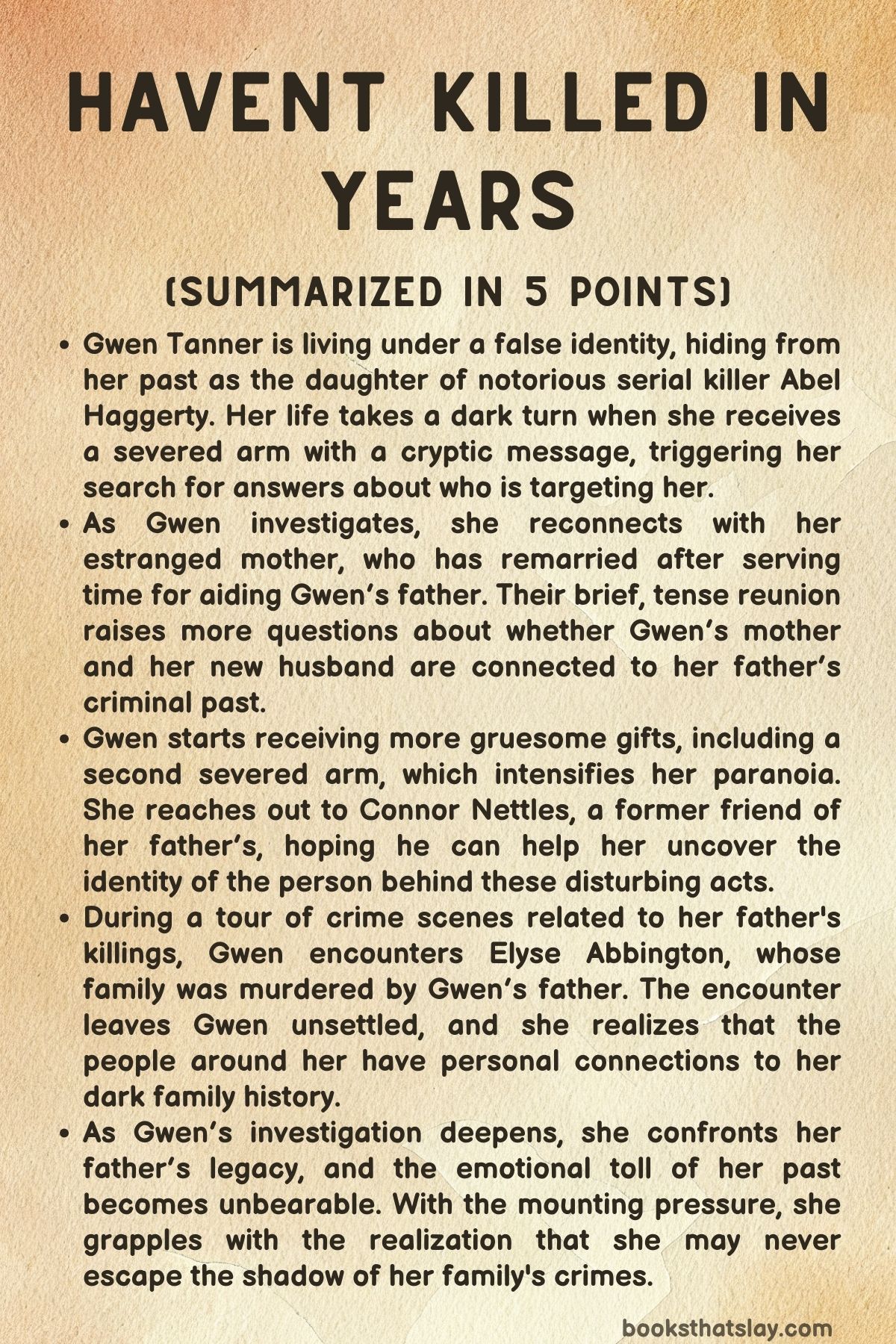
Summary
Gwen Tanner’s life has been defined by a past she can’t escape. Her father, Abel Haggerty, is a convicted serial killer serving a life sentence, and her mother, Reanne, aided in his crimes.
Gwen was taken from her family as a child and has since lived under an assumed name, Gwen Tanner, in an attempt to distance herself from the violence and tragedy of her early years. However, on the day of her mother’s release from prison, Gwen experiences a series of bizarre and unsettling events, including a series of clumsy mishaps and an odd encounter with her boyfriend, Brian.
As the day progresses, the tension mounts when Gwen discovers a disturbing package at her doorstep—a severed man’s arm accompanied by a note addressed to her by her birth name, Marin.
Confused and terrified, Gwen attempts to dispose of the arm, but the disturbing message it sends only heightens her fear that someone from her father’s past is targeting her. The realization that she is being manipulated and stalked by someone with knowledge of her family’s crimes becomes undeniable.
In her search for answers, Gwen reaches out to her mother, who is living quietly with her new husband. Their brief and awkward meeting only raises more questions, and Gwen is left with no choice but to dig deeper into the mystery surrounding her family’s criminal past.
Her investigation leads her to Connor Nettles, an inmate who had befriended her father while he was in prison. Through Connor, Gwen hopes to uncover the identity of the person sending her these disturbing gifts.
But as the gifts keep coming, each more gruesome than the last, Gwen’s sense of security begins to unravel. Another severed arm arrives, and Gwen starts to realize that this is no random act—it’s a calculated attempt to draw her back into the horrors of her past.
To distract herself from the escalating tension, Gwen visits a ceramics studio, Painting Pots, where she finds solace in pottery. But even here, the shadow of her past follows her.
Another arm is delivered, and Gwen is no longer able to ignore the fact that someone with intimate knowledge of her history is orchestrating these unsettling events. She feels trapped in a game she doesn’t fully understand, one that is pulling her deeper into the darkness of her family’s legacy.
As Gwen continues her search for answers, she decides to take a guided tour of crime scenes related to her father’s murders. The tour, led by Dominic, a man with an unhealthy obsession with Abel Haggerty, brings Gwen to locations that were once familiar to her—the homes where her family had lived before their arrests.
During the tour, Gwen meets Elyse Abbington, the only surviving member of a family her father had murdered. This meeting shakes Gwen to her core, and she is left questioning whether Elyse knows more about her past than she is letting on.
Things take a strange turn when Gwen learns that Elyse is involved with Dominic, the tour guide, and their connection to the past becomes even more complicated. The closer Gwen gets to the truth, the more she realizes that the people around her have their own twisted ties to her father’s crimes, and the web of manipulation and deceit is far more complex than she could have imagined.
As the story unfolds, Gwen’s paranoia grows, and she becomes increasingly aware that the people she encounters—Dominic, Elyse, and others—are not merely bystanders to her story. They are players in a game that is not over, a game that Gwen is struggling to control.
With each new revelation, she is forced to confront the painful truth about her family’s criminal history and the inescapable grip it has on her life.
Dominic, who seems to have his own reasons for investigating Abel Haggerty’s crimes, becomes more involved in Gwen’s search for answers. He shares his theory that Gwen’s true identity, Marin Haggerty, has been hidden, and he becomes obsessed with finding her.
As Gwen continues to explore her family’s dark past, she is confronted with the realization that the people around her, including Dominic, may be more connected to her father’s legacy than she thought. The deeper she digs, the more she uncovers, and the more she begins to question whether she will ever be able to escape the shadow of her family’s past.
The tension escalates as Gwen becomes entangled with a group of individuals whose motives are unclear, including a man named Jake, who has a disturbing connection to Abel Haggerty’s followers. Jake’s manipulation of Gwen and Elyse leads to a violent confrontation, and Gwen finds herself once again fighting for her life.
In a moment of self-preservation, Gwen manages to disable Jake and escape his clutches, but the damage has been done.
As the story progresses, Gwen’s sense of self becomes increasingly fragmented. She grapples with the violent history that defines her and the people who seem intent on resurrecting it.
With Jake arrested and his plans thwarted, Gwen is left to process the toll that the events have taken on her. She struggles to reclaim her identity as Gwen Tanner, not Marin Haggerty, but the haunting memories of her past continue to weigh heavily on her.
The novel concludes with Gwen attempting to move forward, but her past remains an ever-present force. She reconnects with Porter, a man who had once provided comfort, and tries to find some semblance of normalcy in a life that has been anything but.
However, she knows that the consequences of her past will continue to affect her, and the search for closure remains elusive. In the end, Gwen’s journey is one of self-discovery, as she comes to terms with the fact that she will never fully escape the legacy of her family’s crimes.
The story ends on a note of bittersweet acceptance, as Gwen realizes that moving forward is her only option, even if the past will always be a part of her.
Characters
Gwen Tanner
Gwen Tanner, the protagonist of Haven’t Killed In Years, is a woman struggling to escape a dark past that seems impossible to outrun. Raised as Marin Haggerty, the daughter of infamous serial killer Abel Haggerty, Gwen has spent years hiding under a new identity, attempting to lead a quiet, anonymous life.
However, her past relentlessly resurfaces when a series of gruesome and cryptic events—such as severed limbs being sent to her doorstep—reignite her connection to her father’s horrific legacy. Throughout the novel, Gwen’s internal conflict is central, as she is torn between confronting the past and maintaining her self-imposed distance from it.
She tries to suppress the weight of her upbringing, but the more she uncovers about her past, the more she realizes she cannot escape the legacy of her father’s crimes. Gwen’s character is complex, marked by her constant battle with guilt, fear, and the desire for closure.
She navigates a world where every encounter feels like a potential threat, yet she is determined to uncover the truth and reclaim control over her identity. Her emotional journey is one of discovery, resilience, and the harsh realization that some parts of the past cannot be buried so easily.
Elyse Abbington
Elyse Abbington’s character is deeply intertwined with Gwen’s tragic past. Elyse, a survivor of a brutal crime committed by Abel Haggerty, is haunted by the murder of her family, particularly her brother Cody, who was killed by Marin, Gwen’s birth name.
For years, Elyse has carried the burden of witnessing this murder but remained silent, unable to speak out due to fear. Her relationship with Gwen evolves from a shared recognition of trauma to a complex bond defined by revenge, guilt, and the quest for closure.
Elyse struggles with the temptation to seek vengeance against Gwen for the role her father played in destroying her family, yet she is conflicted about whether revenge would truly heal her. Elyse’s inner turmoil is evident as she grapples with unresolved anger, loss, and the search for justice, which never seems to be fully attainable.
Over time, she comes to realize that confronting her past, and perhaps confronting Gwen, may not bring the peace she desperately seeks. Elyse’s character is tragic in her inability to move on from her trauma, but also relatable in her desire for resolution.
Her journey is defined by a tension between her desire for justice and her fear of perpetuating the cycle of violence.
Dominic
Dominic is an enigmatic character whose obsession with Gwen’s father, Abel Haggerty, propels much of the narrative tension. As a tour guide specializing in the history of Abel’s crimes, Dominic initially appears to be a curious but benign figure.
However, his deep knowledge of Gwen’s past and his personal involvement in the investigation into Abel’s crimes suggest he is more connected to her history than he lets on. As the story unfolds, Dominic becomes a key figure in Gwen’s search for answers, although his motivations remain unclear.
His intense fixation on Marin, Gwen’s birth name, raises suspicions that he may be more than just an outsider obsessed with the past—he might be involved in manipulating the present to uncover long-buried secrets. Dominic’s attraction to Gwen is complicated by his role in the criminal investigation, which hints at a more personal stake in her family’s story.
He becomes both an ally and a potential threat to Gwen, forcing her to question the nature of their interactions and his true intentions. Dominic’s character represents the blurred lines between obsession, justice, and manipulation, as he struggles with his own dark impulses while attempting to solve the puzzle surrounding Gwen’s past.
Jake
Jake is a pivotal yet malevolent figure whose presence in Gwen’s life escalates the tension and danger she faces. He is initially introduced as a figure involved with Abel Haggerty’s followers, though his motivations and connection to Gwen are shrouded in mystery.
Jake’s obsession with revenge and his manipulative nature make him a formidable antagonist. As the story unfolds, his deepening involvement with the death of Gwen’s loved ones and his role in orchestrating some of the grisly events reveal his true nature.
His fixation on Gwen is unsettling, as he uses her emotions and vulnerabilities to further his twisted desires for vengeance. Jake’s actions drive much of the plot’s darker moments, particularly his violent confrontations with Gwen and Elyse.
His character reflects the devastating effects of revenge—how it can consume a person and make them willing to commit horrendous acts. Ultimately, Jake becomes a symbol of how the cycle of violence can perpetuate itself, drawing Gwen into a web of manipulation, violence, and deceit.
Natalie Shea
Natalie Shea is a character whose troubled past and violent tendencies add an additional layer of complexity to the narrative. Driven by an intense need to protect Gwen, Natalie struggles with controlling her impulses, particularly when it comes to the people she cares about.
Her obsession with Gwen, though rooted in a desire to keep her safe, becomes dangerously overwhelming. Natalie’s inability to manage her emotions leads her to stalk Gwen and make irrational decisions driven by fear and paranoia.
She is a character torn between her desire to help and her growing instability, making her an unpredictable and unsettling presence in Gwen’s life. As the story progresses, Natalie’s internal conflict grows, and her actions increasingly blur the lines between protection and harm.
Her obsessive fixation on Gwen is not only about safety but also a reflection of her own inability to confront her past or control the rage that lies beneath the surface. Natalie’s character is tragic, as she seeks love and connection but is ultimately consumed by her fear of losing control and her desire for revenge.
Her descent into emotional chaos exemplifies the destructive nature of unaddressed trauma and obsession.
Porter
Porter’s character is initially a source of comfort for Gwen, offering a semblance of normalcy amidst the chaos of her past. However, as the story progresses, Porter becomes entangled in the same dangerous web that surrounds Gwen.
Though he is not as directly involved in the dark history of Abel Haggerty, his relationship with Gwen leads him into the tumult of her past. Porter’s struggles with his own emotional battles mirror Gwen’s, but he lacks the deep understanding of the darkness she carries.
He serves as a foil to Gwen’s character, offering her a chance at a normal life, but also becoming a casualty of her past as their relationship strains under the weight of the secrets Gwen keeps. Porter is an innocent character in many ways, but his involvement with Gwen pulls him into a violent and unsettling world that he is ill-prepared to navigate.
His character arc is a reflection of the collateral damage that comes from being connected to someone with a tragic and violent history, as well as the emotional cost of being drawn into someone else’s turmoil.
Barbara
Barbara, Dominic’s mother, plays a subtle yet important role in unraveling the connections between Gwen and the events surrounding her family’s past. Through Gwen’s investigation into Dominic’s life, Barbara becomes a key figure in shedding light on the obscure ties that link her family to the world of crime.
Her past, particularly her association with Oswald Shields and his former partner, serves as a crucial piece in understanding Dominic’s obsession with Gwen. Barbara’s character, though not as overtly involved in the chaos as others, represents the silent generation of individuals who are indirectly complicit in the lives shaped by crime and violence.
Her interactions with Gwen help reveal the deeper layers of the story, adding a sense of historical continuity to the personal dramas unfolding. Barbara’s quiet presence in the background underscores the theme of how people are often unknowingly tied to dark legacies, even when they are not directly responsible for the actions of those who came before them.
Themes
Trauma and the Legacy of Violence
The pervasive theme of trauma and its lasting impact on individuals is central to Havent Killed In Years. Gwen Tanner, the protagonist, is living under a fabricated identity, hiding from her horrific past.
Her father’s legacy as a notorious serial killer and her mother’s involvement in aiding and abetting his crimes create a foundation of violence and loss that Gwen cannot escape. Throughout the book, she is constantly reminded of her traumatic history, not only by the eerie severed arms sent to her but also through her interactions with those who are similarly connected to her past.
These events serve as a stark reminder of how trauma continues to shape Gwen’s present, influencing her relationships, decisions, and mental state.
The trauma Gwen experiences is not just individual but is shared by those around her, such as Elyse Abbington, who witnessed the brutal murder of her brother by Gwen’s father. Elyse’s emotional turmoil, guilt, and anger are all rooted in the unresolved trauma of her past, much like Gwen’s.
The characters are all ensnared in the cycle of trauma, unable to move forward without confronting the past. The book paints a haunting picture of how trauma is inherited, passed down through generations, and remains a constant, defining factor in the lives of those affected by violence.
Gwen’s search for answers is a desperate attempt to come to terms with this trauma, but the deeper she goes, the more she realizes that the violence of her past cannot be undone, and its influence is far-reaching.
In addition, the trauma experienced by the survivors of Abel Haggerty’s crimes, like Elyse and Natalie Shea, adds layers of complexity to the narrative. Elyse’s desire for justice and Natalie’s obsessive need to protect Gwen stem from their own fractured emotional states, as they struggle to make sense of their painful histories.
The theme highlights that while trauma can shape who people are, it also challenges them to decide whether they will perpetuate the violence or break free from it. Ultimately, the novel suggests that healing from trauma is not a straightforward path, as the past continually haunts the characters, shaping their futures in ways they cannot control.
Identity and Self-Discovery
Throughout Havent Killed In Years, the search for identity is intricately tied to Gwen’s struggle to understand who she truly is. Having been taken from her family at a young age, Gwen’s sense of self has always been shaped by the shadows of her father’s crimes and the mysterious life of her mother.
Her decision to live under a different name, Gwen Tanner, reflects her attempt to escape the person she once was, or more accurately, the identity forced upon her by her association with Abel Haggerty’s notorious past. The severed arms, which appear to be deliberate messages, are not just physical threats but also challenges to Gwen’s constructed identity, constantly pulling her back to a history she wishes to forget.
The complexity of Gwen’s identity becomes more pronounced as she uncovers the hidden layers of her past. Her birth name, Marin, is revealed through the strange messages she receives, and with each disturbing clue, Gwen is forced to confront the parts of herself she has tried to bury.
Her interactions with people who are linked to her family’s criminal legacy, such as Dominic and Elyse, further complicate her sense of self, as they continuously remind her of the darker aspects of her identity. Gwen’s struggle is not just about solving the mystery of the arms or understanding her father’s crimes; it is about reconciling the person she has become with the person she was and is still perceived to be by others.
In addition, the theme of identity is explored through other characters like Dominic, who becomes obsessed with uncovering the truth about Gwen’s real identity. His quest for information about her is driven by his own twisted fascination with Abel Haggerty, but it also reveals how the identities of those involved in a violent history are continually molded by the actions of others.
Gwen’s journey towards self-discovery is not just about reclaiming her name, but also about understanding how her past influences her present choices. As the novel unfolds, Gwen realizes that while she cannot erase her past, she can choose how to move forward, ultimately taking ownership of her identity in a world that is constantly trying to define her.
Revenge and Justice
The theme of revenge and justice permeates the actions and motivations of several characters in Havent Killed In Years, especially Elyse and Gwen. Elyse, whose family was murdered by Abel Haggerty, has lived with the desire for revenge for years.
Her unresolved anger and the trauma of her brother’s death fuel her actions, and she wrestles with whether seeking justice through revenge will truly bring her peace. This internal conflict mirrors the broader question of what justice really means when it is intertwined with personal pain and loss.
For Elyse, justice seems incomplete without retribution, and the book explores the morally grey area between seeking justice and descending into revenge-fueled obsession.
Gwen, on the other hand, is caught in a web of vengeance tied to her father’s crimes. Although she did not commit the murders herself, she is constantly confronted with the fallout of her father’s actions.
The severed arms left at her doorstep serve as a reminder that her family’s violent legacy is still alive and that the pursuit of revenge is still very much part of the world she inhabits. Gwen’s search for answers, driven by a need to uncover the identity of those who are tormenting her, quickly becomes a pursuit of justice, though she remains wary of the consequences of this pursuit.
As Gwen’s story unfolds, she is forced to question whether justice is ever truly served when it is driven by vengeance and if her pursuit of the truth is merely a quest to right the wrongs of the past.
The novel complicates the concept of justice by suggesting that revenge, while often seen as a form of justice, only perpetuates the cycle of violence and trauma. The ultimate realization that revenge does not lead to closure forces the characters to confront the futility of their quests for vengeance.
Gwen’s ultimate decision to break free from the cycle of revenge reflects a shift towards understanding that justice cannot be served through violence alone. It is a sobering commentary on the emotional and moral costs of vengeance, illustrating how it can consume individuals and prevent them from moving forward.
Obsession and Control
Obsession, particularly in the form of control, is another recurring theme in Havent Killed In Years. Several characters exhibit obsessive behaviors that stem from their need to regain control over their lives or the past.
Dominic’s obsession with Gwen and her father’s crimes is a prime example of how obsession can manifest in unhealthy ways. His need to control the narrative surrounding Abel Haggerty’s legacy and his fixation on uncovering Gwen’s true identity create an undercurrent of tension that drives much of the plot.
Dominic’s obsession with the past not only affects him but also ensnares Gwen in a web of manipulation, as he attempts to use her to further his own goals.
Similarly, Natalie’s obsession with protecting Gwen reveals how the need for control can spiral into dangerous territory. Natalie’s overwhelming desire to protect Gwen, combined with her inability to manage her emotions, leads her to stalk and manipulate Gwen.
Her obsessive behavior stems from a deeper psychological need to control the events surrounding Gwen’s safety, even if it means resorting to extreme measures. This theme explores how obsession, particularly when linked to trauma or unresolved emotional issues, can distort an individual’s sense of reality and push them into actions that harm themselves and others.
The theme of obsession also extends to Gwen’s struggle with control over her own life. Throughout the story, she battles with the feeling of being powerless, whether in terms of her identity or in the actions of those around her.
As Gwen unravels the mystery of the severed arms and confronts her past, she realizes that control is an illusion—no matter how much she tries to hide from her father’s legacy or manipulate the people around her, she remains ensnared by the very forces she wishes to escape. The novel suggests that obsession with control can lead to a loss of autonomy, where individuals are driven by forces beyond their comprehension or ability to influence.