Heart Check by Emily Charlotte Summary, Characters and Themes
Heart Check by Emily Charlotte is a compelling story set in a small town where hockey reigns supreme, and the tensions between personal ambition and social responsibility collide. It follows Luke Dawson, a determined hockey player, who finds his future in jeopardy after his beloved coach is fired due to a scandal.
As he navigates the challenges of a new, unpredictable coach and his strained relationship with his teammates, Dawson’s life becomes further complicated by his growing feelings for Harper, a classmate who is vocal about her frustrations with the school’s prioritization of sports. The book explores themes of ambition, self-discovery, and the complexity of relationships, both on and off the rink.
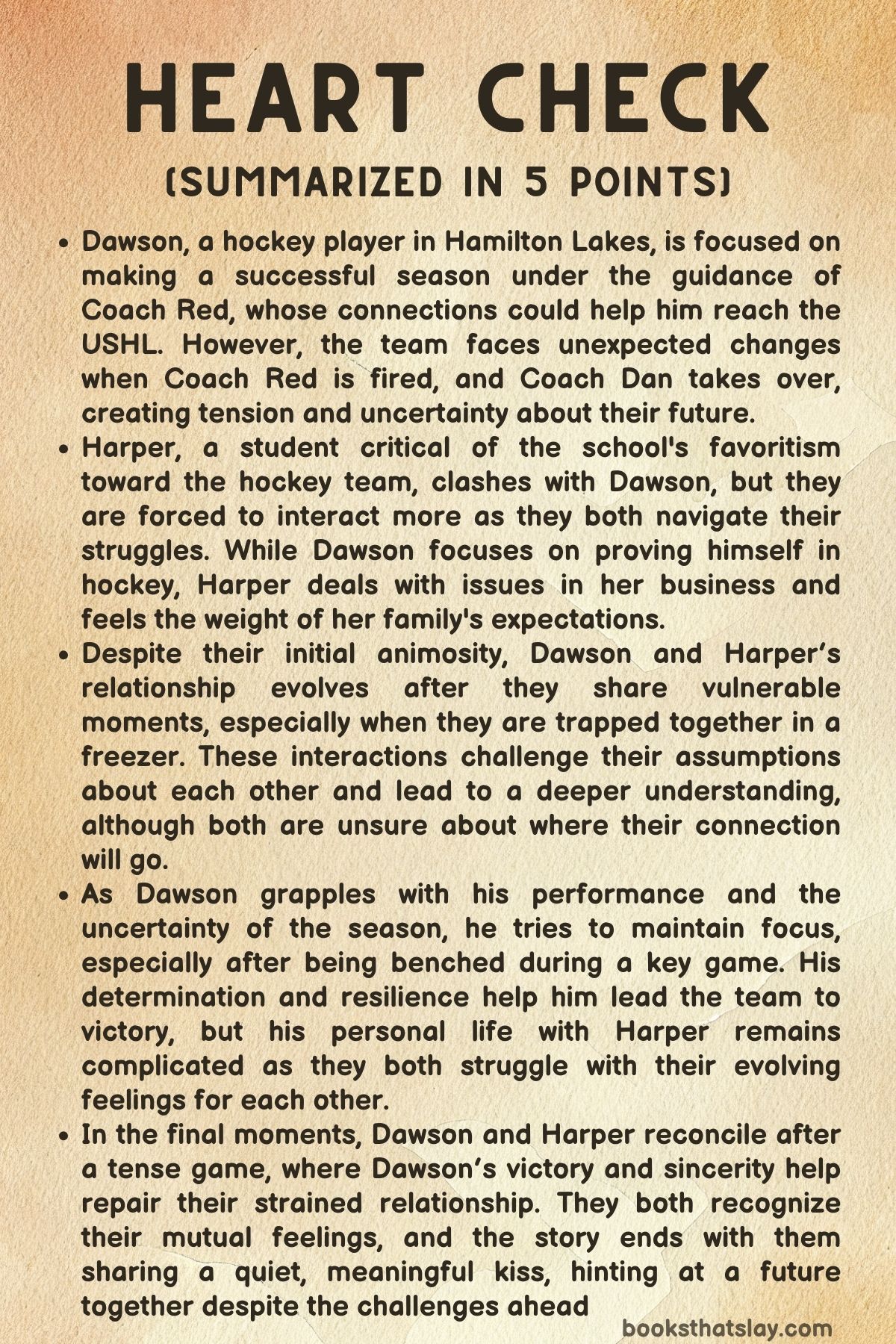
Summary
Luke Dawson is a dedicated hockey player at Hamilton Lakes, driven by his desire to secure a future in professional hockey. As the new season begins, he reflects on the opportunity ahead, particularly with Coach Red, who has helped many players get noticed by scouts.
Dawson is eager to impress, especially with a chance to move up in his career. His best friend, Alex, is still stuck on the junior varsity team and struggles to make the varsity squad.
Dawson offers Alex advice, hoping his friend will improve his game. Together, they prepare for the season’s challenges.
However, things take an unexpected turn when Coach Red is fired amid accusations of embezzling funds meant for the new rink. This news shocks the entire team, as Red had been a staple of their success.
Coach Dan, an assistant coach, is appointed to take over, but his unorthodox style creates uncertainty and frustration within the team. Dawson, who had been looking forward to impressing Coach Red’s connections, feels the weight of the situation and fears the loss of his future prospects.
At school, Dawson encounters Harper, a student who works at the local diner and is outspoken against the hockey team’s dominance. Harper is particularly upset about the amount of funding the school puts into the hockey program, at the expense of other programs like theater, which is struggling.
Her resentment toward the team clashes with Dawson’s focus on his career. They often argue, with Harper criticizing Dawson and the others for their privileged status.
Things grow more complicated when Dawson overhears gossip about Coach Red’s alleged misuse of funds. Harper’s perspective seems to align with the rumors, leading Dawson to confront her.
She denies involvement in the scandal but reveals that Coach Red had overlooked Dawson’s academic performance in the past, letting him play despite poor grades. This revelation makes Dawson question his priorities and the decisions he has made.
Despite their differences, Dawson and Harper continue to interact. Though there’s tension between them, an underlying respect begins to develop as they start to understand each other’s struggles.
Harper is grappling with her small business, which is struggling due to online sabotage, while Dawson is burdened by the weight of the season and his future. Both are at a crossroads, unsure of where their paths will lead.
As the season progresses, Dawson faces even more challenges. Coach Dan benches him for the first game, which only adds to his frustration.
He’s determined to prove himself, but his lack of focus and internal turmoil make it difficult to perform. Meanwhile, Harper deals with her own emotional turmoil, particularly with her complicated friendship with Marissa, who dislikes Dawson and the hockey team.
Despite these personal conflicts, Harper begins to realize that she has been too harsh on Dawson. She starts to see him in a new light and is willing to spend more time with him, even though she’s unsure about the direction of their relationship.
In an unexpected turn, Dawson and Harper are forced to work together when they get trapped in a walk-in freezer at the diner. This forced proximity leads to a moment of vulnerability and understanding between them.
Their animosity begins to dissolve as they share their concerns and fears. Harper, who has been holding onto her frustrations about the hockey team, starts to see Dawson as more than just a jock.
Dawson, on the other hand, begins to understand Harper’s perspective on the inequality in their school’s priorities.
Later, at a party, Dawson and Harper share a quiet conversation that deepens their connection. The awkwardness between them starts to fade, and they begin to understand that their initial assumptions about each other were wrong.
Dawson, still dealing with his pressure to perform in hockey, begins to open up to Harper, revealing his vulnerabilities. Harper, in turn, starts to reconsider her feelings toward him.
As the season continues, Dawson struggles with his performance on the ice. His lack of focus threatens his spot on the team, and Coach Dan warns him that if he doesn’t improve, he may be benched for the critical game against Northview.
At the same time, Harper is dealing with the tension between her loyalty to her best friend and her growing feelings for Dawson. She attends the Northview game, hoping to support Dawson while also trying to reconcile her emotions.
The game is intense, and Dawson’s team faces a tough challenge. In the first period, they are trailing, and tensions within the team rise.
A confrontation between Dawson and Noah, a teammate, results in Noah being benched. Dawson, now determined to redeem himself, takes the ice with a renewed focus.
He plays a crucial role in securing a goal for his team, and in overtime, he scores the winning goal, leading Hamilton Lakes to victory.
After the game, Dawson is unsure if Harper saw his performance and if their relationship has any future. Meanwhile, Harper is struggling with her own emotions.
She’s proud of Dawson’s achievement but unsure where they stand. Dawson finds her at the game and apologizes for the misunderstandings that have occurred.
He admits that he cares about her and wants to make things right. Harper, moved by his sincerity, realizes that she still has strong feelings for him.
The two of them share a meaningful kiss, marking a turning point in their relationship.
As Dawson and Harper reconcile, they acknowledge their mutual feelings and the challenges ahead. Dawson continues to focus on his hockey career, while Harper looks forward to growing her business.
Together, they realize that despite the obstacles in their way, they are ready to face the future, both in their personal lives and on their respective paths. Their bond, tested by personal and professional struggles, grows stronger, leaving room for a hopeful future together.
Characters
Luke Dawson
Luke Dawson is a dedicated and passionate hockey player who is determined to make his mark in the sport. Throughout the book, Heart Check, he faces various personal and professional challenges, notably dealing with the firing of his long-time coach, Red, and the arrival of the new coach, Dan, whose unconventional methods disrupt the team’s dynamic.
Dawson is deeply focused on his hockey career, knowing that this season is crucial for his future, particularly in gaining the attention of scouts. However, his journey is not without internal conflict.
While he strives to keep his emotions and distractions at bay, especially in his relationships with his teammates and with Harper, he also struggles with his own insecurities and pressure to live up to the expectations placed on him. Dawson’s growth is evident as he navigates the complexities of his role on the team, his fluctuating performance, and his developing feelings for Harper.
As he faces the tension of a new coach and team dynamics, Dawson learns to balance his ambitions with his personal struggles, evolving into a more self-aware and emotionally connected character.
Harper
Harper provides a strong counterpoint to Dawson’s ambitions in Heart Check. Initially introduced as someone with a critical perspective on the hockey team, especially regarding the allocation of funds for the new rink, Harper’s character is shaped by her frustrations with a system that favors sports at the expense of other school programs.
She works hard to support her small jewelry business, which is facing struggles due to sabotage and a lack of institutional support. Throughout the novel, Harper is portrayed as independent, strong-willed, and driven by her entrepreneurial goals.
Her tension with Dawson starts with their differing views, but over time, her interactions with him shift. While initially resentful of the hockey team and its privileges, Harper gradually begins to see Dawson in a new light, especially as she gets to know him beyond the surface-level stereotypes of athletes.
Her emotional journey mirrors the evolving relationship between her and Dawson, marked by moments of vulnerability, shared insecurities, and mutual understanding. Harper’s story explores themes of personal growth, balancing friendships, and learning to navigate complicated relationships, particularly with Dawson and her best friend, Marissa.
Coach Red
Coach Red plays a pivotal, though somewhat peripheral, role in the early part of Heart Check. As the team’s former coach, he represents a time of stability and success for Dawson and the rest of the team.
His departure after being accused of embezzling funds causes significant upheaval for Dawson and his teammates. Red’s character is portrayed as highly influential, not only as a coach who led the team to victory but also as someone with key connections to scouts and professional opportunities.
His reputation and the opportunities he provided were a driving force for Dawson’s aspirations. However, Red’s fall from grace forces Dawson to confront the reality of his career, and his absence leaves a leadership void that Coach Dan struggles to fill.
Despite his limited direct presence in the story, Coach Red’s impact is felt throughout the narrative, especially in Dawson’s journey to define his identity both on and off the ice.
Coach Dan
Coach Dan serves as a foil to Coach Red, offering a new, more unpredictable dynamic to Dawson’s team. In Heart Check, Coach Dan is introduced as the interim coach following Red’s dismissal, and his unorthodox methods and lack of clear communication with the team create significant tension.
Unlike Red, who had a strong rapport with his players and connections to help them advance, Dan’s approach is more about pushing players individually without the same level of personal connection. Dawson’s frustration with Coach Dan grows as he feels disconnected from the new leadership, especially when he is benched for the first game under Dan’s regime.
Coach Dan’s character highlights the theme of change and adaptation, as Dawson and his teammates struggle to adjust to a different coaching style, leading to a deeper exploration of their roles within the team.
Alex
Alex, Dawson’s best friend, plays an essential role in highlighting the camaraderie and pressures that exist within the sports world in Heart Check. Although Alex is not yet on the varsity team and is still stuck on the junior varsity squad, he remains a loyal and supportive friend to Dawson.
Throughout the story, Alex struggles with his own insecurities about not being good enough to make the varsity team, and Dawson offers him advice and reassurance. While Alex’s storyline is more secondary compared to Dawson’s, his character adds an element of friendship and mutual support.
His presence also highlights Dawson’s internal growth, as he begins to realize that his relationships off the ice are just as important as his success on the rink.
Noah
Noah, one of Dawson’s teammates, embodies the rivalry and tension that can arise within a competitive team in Heart Check. His relationship with Dawson is strained, particularly as Dawson starts to notice the friction between his team’s dynamics.
At one point, Noah’s actions even lead to a physical confrontation, which results in him being benched during a critical game. Noah’s behavior reveals the underlying pressures of the team’s competitive atmosphere, where individual egos often clash with the group’s goals.
Though Noah’s role is not as deeply explored as Dawson’s or Harper’s, his character serves as a catalyst for Dawson’s personal growth, especially when Dawson is forced to confront his own issues and rise above the team’s internal conflicts.
Marissa
Marissa is Harper’s best friend and a significant character in Heart Check, as her relationship with Harper is central to Harper’s emotional journey. Marissa’s dislike of Dawson and the hockey team creates a barrier between her and Harper, especially as Harper begins to form a closer bond with Dawson.
Throughout the novel, Marissa represents the contrasting perspective to Harper’s developing feelings for Dawson, forcing Harper to navigate the complexities of loyalty and personal growth. While Marissa’s character is not as prominent as some of the others, her influence on Harper’s decisions and emotions is undeniable, especially in moments when Harper feels torn between her friendship with Marissa and her budding relationship with Dawson.
Marissa’s role in the story serves to amplify Harper’s internal conflict and the challenges of balancing personal relationships with evolving emotions.
Themes
Ambition and Self-Discovery
In Heart Check, ambition emerges as a central theme, exploring the personal and professional goals of the characters, particularly Dawson. Dawson’s intense desire to succeed in hockey, which he views as his only path to a better future, reflects a common drive for achievement that many individuals face in their lives.
From the outset, Dawson is focused on proving himself to Coach Red and the scouts, determined to make his mark in the sport. His ambition, however, is complicated by the loss of Coach Red and the appointment of Coach Dan, whose unorthodox approach to coaching creates a volatile environment.
This shake-up forces Dawson to confront not only his athletic abilities but also his identity as a hockey player. As Dawson navigates the challenges on the ice, his journey is no longer just about scoring goals but also about learning to handle personal setbacks, relationship complexities, and the unpredictability of life.
His path to self-discovery is fraught with moments of self-doubt and frustration, especially when faced with new leadership and strained relationships with teammates. His relationship with Harper, initially antagonistic, becomes a pivotal part of his emotional growth.
The way Dawson learns to balance his ambitions with his personal relationships—particularly with Harper and his friend Alex—demonstrates how ambition is often intertwined with the need to understand oneself and others on a deeper level.
Conflict Between Personal Goals and Systemic Expectations
Another significant theme in Heart Check is the conflict between personal aspirations and the pressures imposed by external systems. Dawson is deeply immersed in the competitive world of high school hockey, where success is not just about personal effort but about aligning with the expectations of coaches, scouts, and the sports community.
Coach Red’s connections and methods symbolize the pressures of meeting external standards that are often beyond the control of individual players. When Red is unexpectedly fired, Dawson is thrust into a new reality where his individual goals seem less important than the team dynamics and the looming uncertainties about the team’s future.
The emergence of Coach Dan as the new leader exemplifies how the system can impose rigid expectations that leave little room for personal growth. Dawson’s struggle to stay focused and prove himself within the confines of this structure reveals how systems—whether they are sports teams, schools, or family expectations—can both nurture and stifle personal ambitions.
Harper’s perspective on the hockey team provides a contrasting lens, highlighting how funding and attention are disproportionately directed toward athletics while other programs suffer. This tension between the value placed on athletics versus other creative or academic pursuits illustrates the broader societal debate about how resources should be allocated and how individual aspirations are shaped by the systems around them.
Relationships and Emotional Growth
Throughout Heart Check, relationships play a crucial role in the characters’ emotional development, particularly the evolving dynamic between Dawson and Harper. Initially, they are at odds, with Harper harboring resentment toward the hockey team and Dawson’s privileged position within it.
Harper’s criticisms of Dawson’s world, and her personal struggles with her small business, create a significant rift between them. However, as the story progresses, their interactions reveal a deeper emotional complexity.
The shared moments of vulnerability, such as their time stuck together in the freezer, mark the beginning of a shift in their relationship. In those moments, both characters are stripped of their defenses, allowing them to see each other beyond the labels of “hockey player” and “opposer.” This emotional growth is also seen in Dawson, who learns to understand the value of supporting Harper’s business and respecting her independence, while Harper comes to realize that Dawson is not just a stereotypical athlete but a person with his own insecurities and pressures.
Their relationship becomes a reflection of how genuine emotional connections often require mutual understanding, growth, and an openness to seeing past surface-level judgments. By the end of the story, their bond represents not just romantic interest but a deeper recognition of each other’s aspirations, struggles, and emotional complexities.
The Burden of Perfection and Family Expectations
The theme of perfectionism is deeply embedded in Heart Check, particularly as it relates to Dawson’s relationship with his family and his pressure to succeed in hockey. Dawson’s identity as a hockey player is closely tied to his family’s expectations, particularly the unspoken assumption that his success in sports will secure his future.
This burden of perfection weighs heavily on Dawson throughout the story, as he is constantly aware of the stakes—his family’s hopes for him and the importance of his performance for college scouts. This pressure not only affects his performance on the ice but also his emotional state, as Dawson is unable to escape the constant drive to be the best.
The loss of Coach Red, a figure who had supported Dawson’s career, intensifies this pressure, leaving Dawson feeling uncertain and insecure. In his moments of doubt, he contemplates whether his passion for hockey is truly his own or if it is simply a reflection of his family’s ambitions for him.
The theme of perfectionism is further explored through Dawson’s interactions with Harper, who, in her own way, faces the pressures of perfectionism in her small business. Both characters grapple with the idea of fulfilling expectations—whether from family, friends, or society—and the toll this takes on their emotional well-being.
The narrative ultimately suggests that perfection, while a driving force for success, can be a double-edged sword, leading to internal conflict and personal dissatisfaction.
Social Critique and Class Divide
Heart Check also addresses the issue of social critique, particularly through Harper’s perspective on the inequities within the school system and the prioritization of sports over other important programs. Harper’s frustration with the lack of funding for the theater department, which she holds dear, juxtaposes the significant resources funneled into the hockey team.
This criticism of the school’s priorities highlights a deeper societal issue—the divide between athletic success and artistic or academic pursuits. Harper’s viewpoint challenges the reader to reflect on how systems often elevate one form of achievement over others, creating disparities that affect individuals like her, who are dedicated to the arts and business.
The tension between Dawson and Harper also mirrors this divide, as their initial animosity stems from their differing views on the value of hockey and other school programs. This social critique becomes more poignant as the story progresses, revealing how the characters’ lives are shaped by their respective positions in this system.
Harper’s struggle to gain recognition for her business, especially in a world that favors the athletic elite, adds another layer to the critique of how class and opportunity can shape one’s future. In contrast, Dawson’s realization that his world is not as perfect or as fair as he once believed helps him see the flaws in the system and reconsider his own place within it.