Heir of Prophecy Summary, Characters and Themes
Heir of Prophecy by Analeigh Sbrana is a fantasy novel centered on Audra Evers, a human-raised young woman who discovers that her life is tied to an ancient prophecy capable of changing the fate of several realms.
Against a world trapped in an unnatural winter, Audra is taken from her home and forced into a magical academy where survival, politics, religion, and prophecy are inseparable. Her awakening death magic places her between two rival civilizations, each hoping to use her power for its own survival. The story combines magical education, political conflict, friendship, grief, romance, personal autonomy, and the dangerous consequences of inherited systems of power. It’s the 1st book in the Clash of Prophecies series.
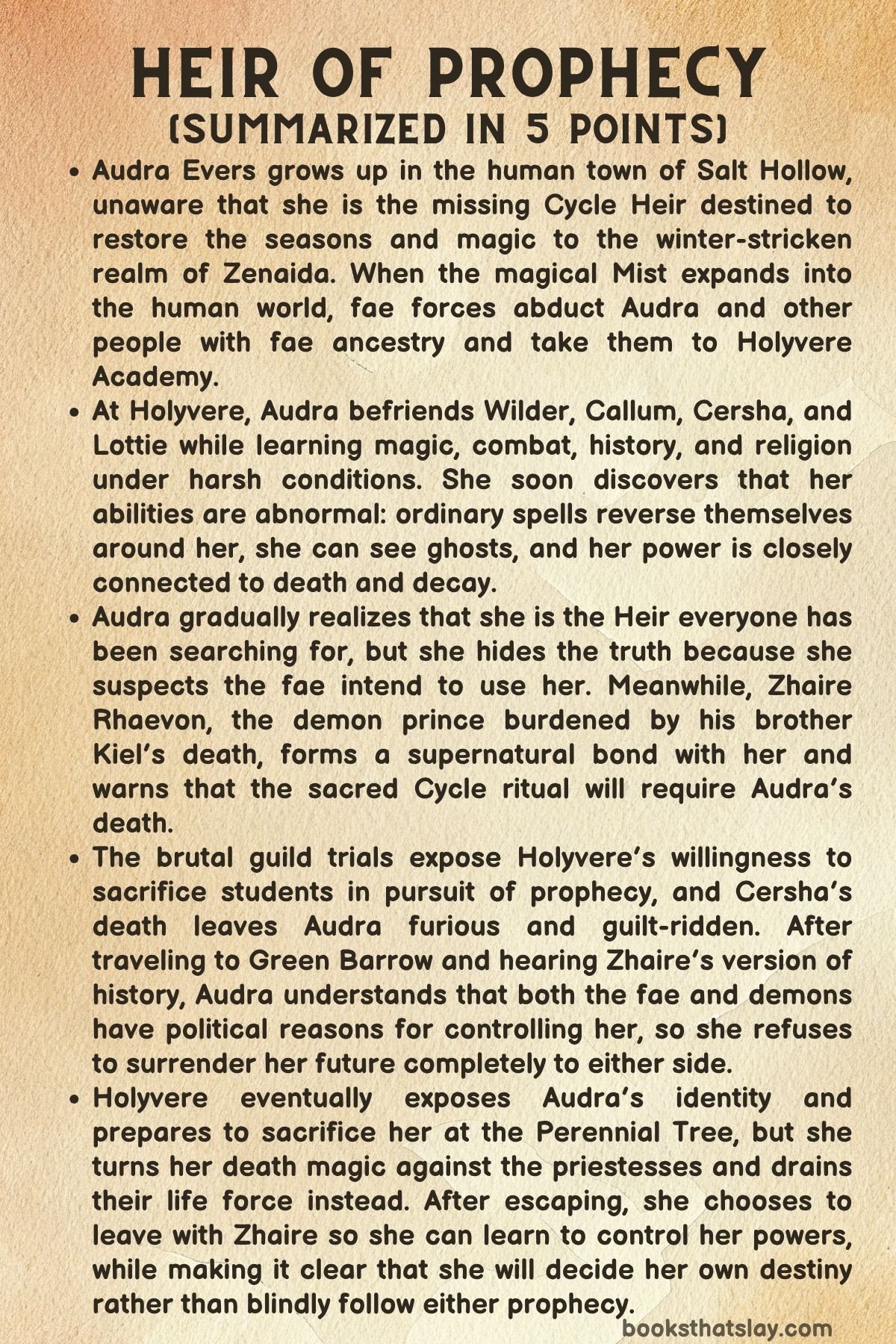
Summary
For more than twenty years, Zenaida has suffered beneath Desolate Winter. Magic has weakened, food has become scarce, and the Chorus of Echoes has maintained a sacred fast while waiting for the return of the missing Cycle Heir, whose existence is supposed to restore spring and restart the flow of magic.
When the third prophetic comet appears, the priestesses finally understand why they failed to locate the Heir after her birth. She was born in Khaveah, the human realm cut off from magic by the Mist, and therefore grew up without access to the death powers that normally identify the prophecy bearer.
That missing woman is Audra Evers, a twenty-three-year-old living in the struggling coastal town of Salt Hollow. Audra works at Fernwell Inn, the family establishment where she was raised by Kamari and Aisha after an unknown woman abandoned her there as an infant.
Her life has been shaped by responsibility. Aisha has recently died, Kamari is overwhelmed by grief, and Audra remains tied to the failing inn despite dreaming of education, travel, and a life far beyond Salt Hollow.
Audra also carries grief for her childhood friend Fiera, who was murdered years earlier. She maintains a complicated relationship with Shea Odie, a member of the Coastal Watch whom she understands more sympathetically than many others do, despite her hostility toward the institution he serves.
Everything changes when the ancient Mist separating Khaveah from the magical world suddenly expands across Salt Hollow. Audra risks her life entering the supernatural fog to rescue Emyre, the abused runaway boy whom her family has taken in.
Soon afterward, fae officials arrive at Fernwell. Scholar Khari, the brutal soldier Vrenn, Sight-Blessed priestesses, and armed guards have been authorized by the human king to search for people of the correct age who might possess fae ancestry.
When Kamari attempts to defend his household, Vrenn brutally strikes him down. Nyrah saves his life, but Audra is restrained, examined, drugged, and eventually transported away with numerous other human captives.
Aboard the ship carrying them toward Zenaida, Audra begins forming relationships that become essential to her survival. She befriends Wilder Demrah, a trained soldier; Callum, a large and kindhearted blacksmith; Callum’s younger sister Cersha; and later Lottie, whose painful history has not destroyed her capacity for warmth.
The captives soon learn how little control they possess. Margaryte, a woman devastated after being separated from her newborn child, is executed when the fae judge her too emotionally broken to continue.
The survivors are taken to Holyvere Academy of Arcane and Battle Arts. There they discover that each of them has fae ancestry and can access magic now that they have crossed into Zenaida.
One of them may also be the lost Cycle Heir. Those who excel can potentially become citizens, while those who fail are likely to be conscripted into the war against demons.
Audra therefore decides to succeed at any cost. She wants to survive, protect her new friends, and eventually return to Kamari and Emyre.
At Holyvere, however, unusual events quickly separate her from the other initiates. Ordinary magical glyphs do not behave correctly when she uses them. Growth magic causes decay, life can be drained rather than strengthened, and she begins seeing ghosts that remain invisible to everyone else.
Meanwhile, Zhaire Rhaevon, bastard son of the Demon King, becomes aware that the missing Heir has reached Zenaida. Zhaire was never expected to bear great political responsibility because his older brother Kiel had been raised for that purpose.
Kiel’s death has forced Zhaire into the position of Prince of Darkness and successor to the demon prophecy. Burdened by guilt over his brother’s death, he initially proposes simply killing the Heir so that winter will continue and demonkind will retain its advantage.
King Andreh rejects immediate assassination. Instead, he orders Zhaire to approach the Heir and convince her to join demonkind voluntarily.
A strange supernatural bond begins connecting Zhaire and Audra. He can sense the extraordinary intensity of her emotions, while she experiences visions of him, dreams of a dark temple, and an increasing sense that he is somehow linked to her destiny.
Audra continues researching previous Heirs while trying to hide her abnormal abilities. She discovers censored records, secretive religious practices, evidence that the Cycle ritual is more dangerous than the authorities admit, and ghosts who confirm that only the true Heir possesses abilities like hers.
Her fear increases when she secretly tests her magic and watches a healthy plant rot beneath her touch. Later, during another magical exercise, she realizes that her power could drain life from another person.
Zhaire eventually enters Holyvere through weaknesses in its magical defenses. He tells Audra that the fae are not preparing to honor her but to sacrifice her.
He offers another future among demons and claims she could possess enormous power there. Audra refuses because she recognizes that Zhaire also has political motives and because she cannot abandon her friends or risk bringing danger to her family.
The academy announces mandatory guild trials, giving Audra an opportunity to win temporary freedom outside Holyvere. She hopes to use the prize to visit Green Barrow and discover information that academy records conceal.
The trials demonstrate the cruelty of Holyvere more openly than anything before them. Children are deliberately poisoned during one test, combat competitors suffer severe injuries, and magical challenges are designed with little concern for whether participants survive.
Noel Carda repeatedly wins by exploiting every advantage available to him. Although Audra dislikes his arrogance, she recognizes that his victories demonstrate an important principle: Holyvere rewards results rather than fairness.
During the Arcane trial, Audra is transported into an artificial environment containing freezing water and lethal magical obstacles. She realizes that the challenge may have been designed specifically to force the hidden Heir into exposing distinctive powers.
Instead, Audra relies on her knowledge of glyphs and the unconventional methods she has developed. She nearly drowns but completes the trial first without openly revealing her death magic.
Victory brings little comfort. Several initiates die, including Cersha.
Cersha’s death devastates Callum and fills Audra with rage and guilt. She begins wondering whether revealing herself earlier might have prevented the trials, but she also knows that the institution itself chose to place innocent students in mortal danger.
Her reward allows her to travel to Green Barrow with Noel. There Zhaire confronts her again, accompanied by Rook, and finally explains the demon version of history.
According to him, the ancient fae separated the realms, altered the natural seasonal order, concentrated the world’s magic inside Zenaida, and condemned demonkind to the Veiled Realm. Every Heir who restores spring renews the same unequal system.
Most importantly, Zhaire says the Cycle ritual kills the Heir.
Audra refuses to accept either civilization’s story without question. Zhaire wants her to join demonkind, while Zenaida wants her power for its own survival. She increasingly understands that both sides are treating her existence as a resource.
After returning to Holyvere, Audra attempts to distance herself from Zhaire. Yet their emotional connection strengthens.
Inside their shared dream realm, the hostility between them gives way to vulnerability and desire. For the first time, they briefly encounter one another as two people burdened by unwanted duties rather than simply as representatives of rival prophecies.
Their moment of intimacy ends when Audra returns to waking life. At almost the same time, political pressure on Zhaire becomes far more dangerous.
King Andreh orders him to kill the Heiress.
Before Zhaire can decide how to respond, Holyvere makes its move. Archmagistra Syleste and the other authorities place Twyla in danger and force Audra to use magic before an assembled audience.
Audra can no longer hide what she is. Her power manifests as death magic, draining life instead of producing an ordinary spell.
The Chorus celebrates. After more than two decades, the lost Heir has finally been identified.
Audra is knocked unconscious and imprisoned within the temple. Nyrah visits her and presents sacrifice as a sacred honor necessary for restoring the seasons.
Audra rejects the argument completely. She refuses to accept that collective prosperity justifies murdering an unwilling person.
Nyrah eventually admits the truth: the Jelishaam ritual requires Audra’s death, and her consent does not matter.
Audra realizes that Zhaire was telling the truth about the sacrifice. She desperately tries to contact him, but temple wards cut off their supernatural bond.
Meanwhile, Zhaire senses Audra’s terror and the violent awakening of her power. He abandons his father’s assassination order and prepares to attack Holyvere, but their connection suddenly disappears.
He fears he has acted too late.
At the Perennial Tree, the priestesses bind Audra and prepare to sacrifice her. Rather than begging for mercy, Audra sings the protest song associated with the resistance and suffering she knew in Salt Hollow.
When the ritual begins, she finally stops suppressing her power.
Audra turns her death magic against the priestesses. She drains their life force, transferring their vitality into herself until the Echoes collapse as dried corpses.
The same power she was taught to fear becomes the means through which she refuses victimhood.
Afterward, Audra discovers that she can sense bones, command remains, perceive newly created spirits, and even destroy ghosts. She also realizes that her magic is dangerously hungry and that she needs instruction before she loses control of it.
Once she moves beyond the ritual site’s wards, she calls for Zhaire.
He immediately reaches her through a Veilway. Rather than accepting his prophecy or agreeing to become a tool of the demon realm, Audra establishes a condition: whatever happens next must be based on her own choice.
Zhaire accepts that demand and reveals that King Andreh ordered him to assassinate her. He admits that he could not do it and is willing to betray his father to keep her hidden.
Audra carries with her the bone of a previous dead Heiress, a physical reminder of the fate imposed upon those who came before her. She asks Zhaire to teach her how to understand and control her abilities.
He promises to teach her enough to command legions of the dead.
Together they enter the Veilway and leave the fae world behind. Audra has escaped the sacrifice, but she has not accepted the demon destiny in its place.
Her future remains uncertain, and that uncertainty becomes the first genuine freedom she has possessed: the possibility of deciding for herself what kind of Heir, ruler, weapon, or woman she intends to become.
Characters
Audra Evers
Audra is the central character of Heir of Prophecy, and nearly every major conflict develops from the struggle between what other people expect her to become and what she wants for herself. Raised as a human in Salt Hollow, she begins the story with no knowledge of her magical ancestry or prophetic importance.
Her strongest characteristic is loyalty. She repeatedly sacrifices opportunities for personal freedom because Kamari, Emyre, Fiera’s memory, and eventually Wilder, Callum, Cersha, and Lottie matter more to her than escape alone.
Audra is also highly observant and intellectually curious. Running Fernwell has taught her how to read dangerous people, bargain with difficult guests, recognize power imbalances, and survive situations in which direct confrontation would be reckless.
Those abilities become as important at Holyvere as magical talent. Instead of succeeding because prophecy automatically makes her superior, Audra studies, experiments, identifies conceptual opposites in incras, and finds indirect ways to use a form of magic that does not obey conventional rules.
Her death abilities frighten her because they challenge her moral understanding of herself. The moment she realizes that anger toward Noel could potentially turn into lethal magical hunger is especially important, because Audra immediately fears not only what others might do to her but what she might become if she stops controlling herself.
Her development reaches its decisive point during the attempted sacrifice. She refuses the idea that her life belongs to a kingdom merely because killing her would benefit millions of others.
By destroying the priestesses, Audra changes from someone constantly reacting to imposed duties into someone actively establishing the conditions of her own future. Even when she leaves with Zhaire, she refuses to exchange one prophecy for another, preserving choice as the principle around which her identity is forming.
Zhaire Rhaevon
Zhaire is Audra’s supernatural counterpart and the second major perspective character in Heir of Prophecy. As the bastard son of King Andreh, he once occupied a relatively secondary position because his older brother Kiel had been trained to fulfill demon prophecy and inherit political responsibility.
Kiel’s death changes Zhaire’s identity overnight. He is forced into a role for which he was never properly prepared, and his drinking, gambling, casual relationships, and deliberate avoidance of responsibility reflect grief as much as recklessness.
Guilt dominates his internal life. Zhaire believes his own choices contributed to Kiel’s death, making every new obligation feel like both punishment and replacement.
His original attitude toward Audra is therefore partly strategic. He considers killing her when continued winter seems advantageous to demonkind, then accepts the task of persuading her to join his people.
That position changes as their emotional bond develops. Because demons perceive and consume emotions, Zhaire experiences Audra’s fear, anger, love, curiosity, desire, and grief with unusual intimacy, making it increasingly difficult for him to reduce her to a political objective.
His relationship with her becomes an important test of whether he will continue obeying inherited expectations. When King Andreh orders him to kill Audra, Zhaire ultimately chooses her survival over royal command.
His willingness to confess the assassination order after rescuing her is equally significant. Rather than concealing an inconvenient truth to secure her loyalty, he gives Audra information that could cause her to reject him.
Zhaire remains politically compromised and far from completely trustworthy, but his final actions show movement toward a relationship based more on honesty and mutual choice than prophecy.
Wilder Demrah
Wilder becomes one of Audra’s earliest and most dependable allies in Heir of Prophecy. Her military background gives her practical abilities that distinguish her from many frightened captives, but her importance extends beyond combat experience.
She offers Audra companionship at a time when both women have been stripped of familiar identities and transported into an unknown society. Choosing the bunk near Audra and later sharing her Holyvere living space helps transform a survival alliance into a genuine friendship.
Wilder is disciplined, physically capable, and accustomed to danger. These traits allow her to perform strongly during combat training and the guild trials, yet even she is seriously injured by Holyvere’s tests.
Her injuries prove that competence offers only limited protection within an institution designed to accept casualties. Through Wilder, the story shows how systems of violence can threaten even people who appear well prepared to survive them.
She also functions as someone Audra wants to protect rather than merely someone capable of protecting Audra. This becomes especially important once Audra considers escaping with Zhaire.
The possibility of leaving friends such as Wilder behind prevents escape from becoming a simple solution. Wilder therefore represents one of the human bonds that keeps Audra morally connected to the people suffering alongside her.
Callum
Callum is physically imposing but emotionally gentle, creating one of the clearest contrasts between outward appearance and inner character in Heir of Prophecy. A skilled blacksmith, he initially becomes part of Audra’s group because of the shared need for survival.
His defining relationship is with his younger sister Cersha. Callum’s protectiveness toward her shapes almost every major decision he makes, and their sibling bond provides warmth in the otherwise coercive environment of Holyvere.
He also becomes a stabilizing presence within Audra’s group. His stories, practical skills, humor, and loyalty help maintain a sense of ordinary friendship even while the initiates are being prepared for competition and war.
The guild trials expose his vulnerability. Although he performs strongly, Noel defeats him by using magic to immobilize him, demonstrating that physical power and craftsmanship alone cannot guarantee success in a system that rewards ruthless adaptability.
Cersha’s death fundamentally changes him. His collapse in the music room strips away the image of the enormous protective brother and reveals someone completely devastated by the one loss he was most determined to prevent.
Through Callum, the story gives personal weight to Holyvere’s willingness to sacrifice students. Cersha does not become merely another casualty because Callum survives to carry the emotional consequences of her death.
Cersha
Cersha is one of the warmest members of Audra’s first circle of friends. Her relationship with Callum immediately establishes her vulnerability, but she is not simply a younger sister who needs protection.
She proves capable during the Echinacea trial, successfully treating Pia under extreme pressure and finishing behind Noel. Her performance demonstrates intelligence, medical knowledge, and emotional control.
Cersha also contributes small acts of care to the group, including preparing sleeping draughts for Audra. After her death, the remaining potion becomes emotionally valuable because it represents Cersha as a person rather than as a statistic within Holyvere’s trials.
Her death marks a major turning point. Before it, Audra is primarily focused on surviving the academy and protecting her secret; afterward, survival alone feels morally insufficient.
Cersha therefore becomes one of the strongest examples of the cost created by the search for the Heir. The institution accepts her death because eliminating another candidate serves its larger objective, while her friends understand that an irreplaceable individual has been lost.
Lottie
Lottie enters Audra’s life at Holyvere and quickly becomes one of her closest companions. Her history is exceptionally painful: her own family sold her into sex work, leaving her dependent upon communities similar to the Nightlys Audra knew in Salt Hollow.
That shared social connection creates immediate understanding between the women. Audra recognizes in Lottie someone who has experienced exploitation without allowing it to destroy her ability to trust or care for others.
Lottie’s optimism is not presented as ignorance. She understands cruelty because she has experienced it directly, making her continued kindness an active personal quality rather than evidence of a sheltered life.
Academically and magically, she is less naturally secure than some initiates. Audra worries about her performance because failure at Holyvere does not mean ordinary academic disappointment but possible conscription or death.
Lottie’s traumatic return from the Arcane trial, covered in blood and emotionally shaken, reinforces the brutality of an academy that treats terror as an educational instrument. Her survival matters to Audra because Lottie represents the possibility that people harmed by oppressive systems can still build compassionate relationships rather than reproducing the same cruelty.
Noel Carda
Noel initially appears to be an uncomplicated symbol of privilege. Wealthy, aristocratic, confident, and frequently arrogant, he assumes that social status and expensive training demonstrate natural superiority.
His repeated victories in the guild trials make him particularly irritating to Audra and her friends. Noel succeeds not by respecting the expected spirit of each competition but by exploiting rules, magical advantages, and strategic loopholes.
This behavior makes him unpleasant, but it also exposes the real values of Holyvere. The institution claims to measure specialized excellence while rewarding whoever can produce the desired result most efficiently.
Audra gradually recognizes that Noel understands this reality better than many others do. His refusal to limit himself teaches her something important about survival.
Their trip to Green Barrow adds complexity to him. Audra challenges his assumptions about inherited nobility, arguing that titles are social constructions used to preserve wealth and authority.
Noel is disturbed rather than simply dismissive, suggesting that his arrogance rests partly on beliefs he has never seriously examined. His willingness to help Audra return quickly to Holyvere without demanding explanations also shows that he is capable of basic loyalty and discretion.
Scholar Khari
Khari occupies a deliberately ambiguous position throughout the novel. He participates directly in the seizure of human captives, yet he also orders Nyrah to save Kamari after Vrenn nearly kills him.
This combination makes him difficult for Audra to classify. Individual kindness cannot erase his cooperation with an oppressive system, but cruelty alone does not completely explain his behavior either.
As Audra’s teacher, Khari recognizes her intelligence and gives her additional instruction. His guidance helps her understand advanced incras and develop methods for managing her unusual magical reversals.
There is genuine intellectual respect between them. Khari appreciates Audra’s creativity and willingness to challenge assumptions, making his eventual role in exposing her especially painful.
When Holyvere finally tests Audra publicly, Khari uses magic to transform her timepiece into restraints. The teacher who helped her gain control becomes one of the people preventing her escape.
Khari therefore embodies institutional complicity. A person can be educated, compassionate in isolated moments, and personally supportive while still helping maintain a system that commits profound injustice.
Priestess Nyrah Autumnborn
Nyrah has spent decades suffering through the Chorus of Echoes’ sacred fast while searching for the lost Heir. Her endurance demonstrates extraordinary religious commitment, but that devotion also narrows her moral perspective.
She can heal Kamari with considerable skill and appears capable of individual sympathy. Yet she drugs Audra during transport and later defends the ritual sacrifice as a sacred necessity.
Nyrah sincerely believes that killing the Heir is justified because the Cycle must restart. This makes her more disturbing than a character motivated purely by cruelty, because she treats violence as moral obligation.
Her conversation with imprisoned Audra exposes the distance between their ethical systems. Nyrah believes ancestry and prophecy create duties that Audra must accept, while Audra insists that no tradition has the right to transform an unwilling person into a sacrifice.
Nyrah ultimately becomes one of the priestesses destroyed by the very power they intended to use. Her fate reflects the consequences of assuming that prophetic importance removes another person’s right to consent.
Kamari Evers
Kamari is Audra’s adoptive father and one of the most important influences on her sense of loyalty. He and Aisha accepted an abandoned infant without knowing her origins and raised her completely as their daughter.
By the beginning of the story, Kamari is struggling with Aisha’s recent death. His grief contributes to the deterioration of Fernwell and leaves Audra carrying greater responsibility.
Despite this vulnerability, he reacts immediately when the fae threaten his household. Drawing a dagger against vastly stronger opponents is strategically hopeless, but the act demonstrates his instinct to defend Audra and those under his roof.
Vrenn’s attack on Kamari gives Audra an immediate personal reason to distrust the fae mission. Whatever larger justification they later offer cannot erase her first experience of their authority as violence against her father.
Kamari also represents the home Audra hopes to recover. Even after learning that her biological origins lie elsewhere, she never treats blood ancestry as more meaningful than the family that chose and raised her.
Emyre
Emyre is the abused runaway whom the Evers family effectively adopts. Audra sees him as a younger brother, and their relationship provides an early demonstration of how she defines family through protection and affection rather than biology.
When the Mist consumes Salt Hollow, Audra refuses to abandon him in the stables. She enters the supernatural fog despite not knowing whether she will survive.
The rescue establishes a pattern that continues throughout the novel. Audra repeatedly accepts personal danger when someone she loves might otherwise be harmed.
Emyre also strengthens Audra’s attachment to Khaveah. Her desire to survive Holyvere is not an abstract wish to escape captivity; it is connected to people such as Emyre who still expect her to come home.
Aisha Evers
Aisha is already dead when the central events begin, but her absence strongly affects both Audra and Kamari. She helped raise Audra after the abandoned infant arrived at Fernwell and therefore shaped the family identity Audra continues to defend.
Her death six months earlier leaves the inn emotionally and financially unstable. Kamari withdraws into grief while Audra assumes more responsibility.
Aisha also appears through memory when Audra first enters the Mist. The supernatural environment draws buried emotions toward the surface, showing how recently Audra has lost one of the central figures of her life.
Although absent physically, Aisha represents the ordinary love that formed Audra long before prophecy attempted to redefine her.
Fiera
Fiera is Audra’s murdered childhood friend. Her death occurred years before the main events, yet it remains central to Audra’s understanding of injustice.
Fiera was killed by a sailor, and the failure to obtain meaningful justice contributes to the protest culture surrounding Salt Hollow’s Nightlys. Through Fiera, Audra has already learned that institutions often value some lives less than others.
That lesson prepares her to recognize similar patterns in Zenaida. Margaryte, Cersha, the dead initiates, and the sacrificed Heirs all remind Audra of systems that explain away individual suffering when protecting powerful structures.
Fiera therefore continues influencing Audra despite never appearing alive in the main story.
Eilissa
Eilissa is Fiera’s grieving mother and a committed participant in protests demanding justice for murdered Nightlys. Her grief has become inseparable from political resistance.
Audra feels protective toward her because of their shared connection to Fiera. During the violence at the Salt Hollow protest, Audra focuses on getting Eilissa safely away from the Coastal Watch.
Eilissa also illustrates how grief can become a long-term social force. Rather than allowing Fiera’s death to disappear into official neglect, she continues insisting that the forgotten and marginalized deserve recognition.
Shea Odie
Shea is Audra’s longtime acquaintance and occasional lover. His position within the Coastal Watch creates tension because Audra strongly distrusts the institution and many people in her community consider his membership a betrayal.
Audra nevertheless understands why he joined. His family needed financial stability, creating a distinction between participation in a flawed institution and wholehearted identification with its values.
Shea helps Audra and Eilissa escape violence during the protest, demonstrating that his uniform does not completely define his loyalties.
His character also reflects the complexity Audra later encounters in people such as Khari. Individuals operating inside unjust systems can still make compassionate choices, though those choices do not automatically erase their institutional responsibility.
Margaryte
Margaryte represents one of the first devastating consequences of the fae selection process. Torn away from her newborn child, she becomes almost completely overwhelmed by grief.
Her captors interpret her emotional collapse as weakness rather than as a predictable consequence of their own violence. Instead of offering meaningful care, they execute her.
Her death becomes an early warning to Audra that Zenaidan promises about opportunity and belonging exist beside a ruthless willingness to eliminate anyone considered inconvenient.
Margaryte also anticipates Audra’s later rejection of sacrificial logic. Both women are expected to surrender their individuality to the supposed needs of a larger system.
Camyle
Camyle is Margaryte’s sister and attempts desperately to protect her after the abduction. Her helplessness during Margaryte’s execution reveals how completely the captives have been deprived of power.
After witnessing her sister’s death, Camyle becomes emotionally vacant. Her condition functions as another condemnation of the fae claim that only inherently weak people fail.
Camyle has been psychologically destroyed by an institution that first creates unbearable suffering and then blames victims for failing to endure it.
Vrenn
Vrenn is one of the most openly violent representatives of fae authority. His attack on Kamari immediately establishes him as someone who enjoys using supernatural physical superiority against humans.
At Holyvere, Vrenn continues embodying coercive discipline. He humiliates Audra, punishes mistakes, and treats physical suffering as a legitimate educational technique.
Unlike more complicated institutional figures, he rarely offers evidence of serious moral doubt. His presence gives the academy’s authority an overtly threatening face.
Scholar Haile
Haile teaches Zenaidan history and culture, providing the initiates with essential information about religion, magic, humanity, and the separated realms. Audra quickly recognizes that the lessons also function as ideological conditioning.
Haile presents information designed to encourage captives to identify with Zenaida and reinterpret human history through fae assumptions. Some students, especially those who suffered badly in Khaveah, find this new identity attractive.
Her classes demonstrate that control does not depend only on weapons. Education, historical framing, and selective truth can shape allegiance just as effectively.
Commander Renwick
Renwick oversees combat training and refuses to allow students to imagine military service as anything other than brutal warfare. His lessons on demon anatomy and lethal injury force initiates to confront what conscription would actually mean.
He emphasizes that war does not reward fairness. That principle later helps Audra understand Noel’s successful trial strategies.
Renwick is therefore both threatening and unexpectedly useful. His teaching prepares students for violence, but it also gives Audra a more realistic understanding of the environment in which she must survive.
Twyla
Twyla is the young acolyte assigned to Audra as an opinante. Her role gives Audra access to information about Zenaidan religion, although strict rules prevent Twyla from revealing the secrets of the Cycle ritual.
Twyla hopes her initiate will become the Heir because such an outcome could elevate her religious position. This desire shows how the sacrificial system distributes incentives among people who may not fully understand its consequences.
Eventually Holyvere deliberately places Twyla in danger to force Audra into revealing her magic. Twyla therefore becomes another young person whose safety the institution is willing to risk in pursuit of prophecy.
Archmagistra Syleste
Syleste leads Holyvere and publicly explains the academy’s purpose to the human initiates. She presents assimilation, education, military service, and the search for the Heir as parts of an organized social system.
Her authority gives institutional legitimacy to practices that repeatedly place students in mortal danger. The deadly guild trials occur under a structure she helps administer.
During Audra’s exposure, Syleste participates in the effort to force her magic into the open. Audra’s death power then turns toward her, symbolically directing the Heir’s anger at one of the principal representatives of the system that has confined her.
King Andreh
Andreh rules the demon realm and views the arrival of the Heir primarily through political and military strategy. He initially rejects Zhaire’s proposal to assassinate Audra because traditional prophecy still offers the possibility of winning her allegiance.
His willingness to change course later shows that Audra’s survival has always been conditional from his perspective. When persuasion becomes uncertain, he orders Zhaire to kill her.
Andreh therefore mirrors the fae authorities in an important respect. Although the two civilizations tell opposing historical stories, both initially treat Audra as a strategic object whose value depends on what she can provide to their people.
Kiel Rhaevon
Kiel never participates directly in the present-day events, but his death shapes Zhaire’s entire arc. He was raised from childhood to carry demon prophecy, approach the future Heir, lead his people, and eventually rule.
That upbringing deprived Kiel of many ordinary freedoms. Zhaire remembers moments when his brother wanted experiences outside the role created for him, making Kiel another example of prophecy restricting personal choice.
His death leaves Zhaire burdened by guilt and forces him into responsibilities he never expected to inherit.
Kiel and Audra therefore share an indirect connection: both have been assigned enormous historical roles without being allowed to choose whether they wanted them.
Rook
Rook is one of Zhaire’s closest companions and accompanies him to Green Barrow. His presence shows that Zhaire possesses relationships outside the royal hierarchy and is not completely isolated despite his self-destructive behavior.
He also provides practical support during Zhaire’s attempt to manage the crisis surrounding Audra. Through characters such as Rook, the demon realm appears as a society composed of actual relationships rather than simply the monstrous enemy presented in Holyvere lessons.
Ivara
Ivara is part of Zhaire’s trusted circle and directly challenges the order to assassinate Audra. She recognizes that Zhaire’s feelings have developed beyond political calculation.
Her willingness to question the king’s command provides an important contrast to institutions in which obedience is treated as sacred duty.
Ivara also helps force Zhaire to confront what he already knows: killing Audra is no longer something he can treat as a strategic possibility.
Daife
Daife serves as a military adviser within the demon court. When Zhaire initially suggests killing the Heir to preserve winter, Daife recognizes the strategic logic behind the idea.
His response reflects the military perspective surrounding the prophecy. From that viewpoint, Audra’s existence can be calculated in terms of seasons, magical advantage, territorial control, and casualties.
Daife therefore helps establish the political environment that Zhaire must eventually resist when his relationship with Audra becomes personal.
Jenella
Jenella is Cersha’s roommate and friend at Holyvere. After Cersha dies, she visits the grieving group and leaves alcohol for them.
The gesture is small but significant because the academy provides little meaningful space for mourning. Jenella participates in an informal community of grief that exists outside institutional recognition.
Her presence also confirms that Cersha formed relationships beyond Audra’s immediate circle, making the extent of her loss larger than the central group alone.
Pia
Pia is the young opinante assigned to Cersha during the Echinacea trial. The academy deliberately poisons her so Cersha can demonstrate medical skill.
Pia’s role exposes the moral distortion within Holyvere’s testing system. Children become instruments through which adults measure initiates, with danger justified by the assumption that healers can repair most consequences.
Cersha successfully saves Pia, making their interaction one of the final demonstrations of Cersha’s competence before her later death.
Nepthys
Nepthys appears prominently during the Sabre trial and quickly defeats Audra. Her combat superiority emphasizes how inexperienced Audra remains despite her extraordinary magical identity.
Audra wisely chooses not to treat every contest as something she must dominate. Her defeat by Nepthys demonstrates that being the Heir does not automatically make her the most capable person in every field.
Nepthys therefore contributes to keeping Audra’s development grounded in learned skill rather than effortless superiority.
Themes
Personal Choice Against Predetermined Destiny
The central conflict in Heir of Prophecy repeatedly asks whether destiny can create ownership over another person. Audra is supposedly born for a sacred purpose, yet she never agreed to that purpose, and almost everyone who discovers her identity assumes that prophecy gives them some legitimate claim over her future.
The fae insist that she must die so spring can return. The demons initially expect her either to join their cause or be eliminated before she can strengthen their enemies.
Even Zhaire begins by viewing her through this political framework. The conflict therefore is not simply between good prophecy and bad prophecy but between predetermined roles and individual consent.
Audra has already lived under obligations before discovering her magical identity. She remains at Fernwell because her family needs her, protects Emyre because she loves him, worries about Kamari, and continually delays her own ambitions.
These responsibilities differ from prophecy because they emerge from relationships she personally values. Holyvere removes even that distinction by declaring that ancestry itself creates obligation.
Her final rejection of the sacrifice becomes the clearest expression of self-determination. Audra does not argue that restoring spring is meaningless; she argues that an important outcome cannot automatically justify taking her life.
Leaving with Zhaire does not mean accepting demon destiny either. She explicitly refuses to trade one predetermined role for another, insisting that her future remain her own decision.
Sacrifice, Power, and the Value of an Individual Life
Systems throughout the novel repeatedly justify harm by claiming that larger benefits require individual suffering. Holyvere accepts dead initiates because identifying the Heir is considered more important than protecting every student.
Margaryte can be killed because her grief makes her inconvenient. Children can be poisoned because the Echinacea trial supposedly requires realistic stakes, and unsuccessful initiates can be sent to war because Zenaida needs soldiers.
The greatest example is the Cycle ritual. Zenaida has structured its prosperity around the repeated death of prophecy bearers, transforming murder into sacred tradition.
Nyrah’s reasoning demonstrates how thoroughly institutional language can normalize violence. She presents Audra’s death as an honor because accepting the victim’s humanity would force her to confront the moral cost of the system she serves.
Audra rejects this calculation because she has spent her life among people whose suffering was similarly dismissed. Fiera’s murder, the exploitation of Nightlys, Margaryte’s execution, and Cersha’s death have taught her that powerful institutions frequently describe vulnerable people as expendable.
The book therefore creates a conflict between collective survival and individual rights without pretending the larger crisis is imaginary. Winter genuinely threatens millions.
What Audra disputes is the assumption that necessity automatically grants others authority over her body. Her rebellion forces the question of whether a civilization can call itself righteous when its survival depends on victims who are never allowed to refuse.
Institutional Control and the Construction of Truth
Knowledge is constantly controlled, censored, or politically framed in Heir of Prophecy. Human history has been altered, information about previous Heirs is blacked out, the Jelishaam ritual is protected by religious secrecy, and both fae and demons present versions of the past that support their own claims to power.
Holyvere is particularly effective because coercion appears beside education, comfort, and opportunity. Students receive books, clothes, magical training, heated water, dormitories, specialized instruction, and the possibility of citizenship.
These benefits do not erase the reality that the initiates were abducted. Instead, they make control more sophisticated by encouraging captives to imagine that success within the institution proves the institution itself is legitimate.
Audra repeatedly resists this process by questioning how information is presented. She recognizes ideological assumptions in Haile’s history classes, challenges social hierarchy, investigates censored records, questions ghosts, searches forbidden spaces, and listens to Zhaire without automatically accepting his version either.
Her skepticism becomes one of her most important survival skills. Truth in the story is rarely available through a single authority.
The fae hide the lethal cost of the ritual, but the demons also possess strategic motives for exposing it. Audra therefore must construct understanding from conflicting evidence while remaining aware that every source may want something from her.
The theme turns knowledge into a form of resistance. Whoever controls history, education, religion, and access to information can shape what people believe they are obligated to do.
Grief, Attachment, and the Cost of Caring
Audra and Zhaire are both heavily shaped by grief, though they respond to it differently. Audra carries the deaths of Aisha, Fiera, Margaryte, and eventually Cersha, while Zhaire remains trapped in guilt over Kiel.
Neither character is allowed to experience loss privately. Their grief becomes connected to larger political systems that continue demanding action from them.
Audra’s attachments repeatedly make survival more difficult. Escaping alone would often be easier, but she refuses to abandon Emyre, worries about Kamari, protects her fellow captives, wants Lottie and Wilder to survive, and cannot imagine accepting Zhaire’s offer while leaving her friends behind.
The academy treats these bonds as weaknesses. Khari explicitly warns captives against allowing attachment to interfere with survival, yet the story repeatedly shows that Audra’s capacity to care is also what prevents her from becoming purely self-interested.
Zhaire initially takes the opposite path, using alcohol, sex, gambling, and avoidance to escape the pain of Kiel’s death. His connection with Audra gradually forces him to confront emotional responsibility again.
Their supernatural bond intensifies this process because emotion itself becomes something shared rather than hidden. Their attraction grows beside grief rather than replacing it.
By the end, caring has become dangerous for both of them. Zhaire risks treason because Audra matters to him, while Audra enters the Veilway trusting someone whose civilization may still seek to use her.
The story ultimately treats attachment as a source of vulnerability, obligation, courage, and resistance at the same time.