Hello Baby Summary, Characters and Themes
Hello Baby by Kim Eui-Kyung is a contemporary Korean novel centered on women whose lives are shaped by infertility, assisted reproduction, marriage, work, social expectations, and competing ideas of motherhood.
Through a group of women connected by the “Hello Baby” chat, the book shows how desperately wanting a child can affect identity, relationships, careers, finances, and mental well-being. Each woman approaches parenthood differently, ranging from repeated IVF and egg freezing to choosing a child-free future. Their separate experiences become connected by Kim Jeong-hyo, whose apparent miracle birth gradually reveals a devastating reality about longing pushed beyond the boundaries of reason.
Summary
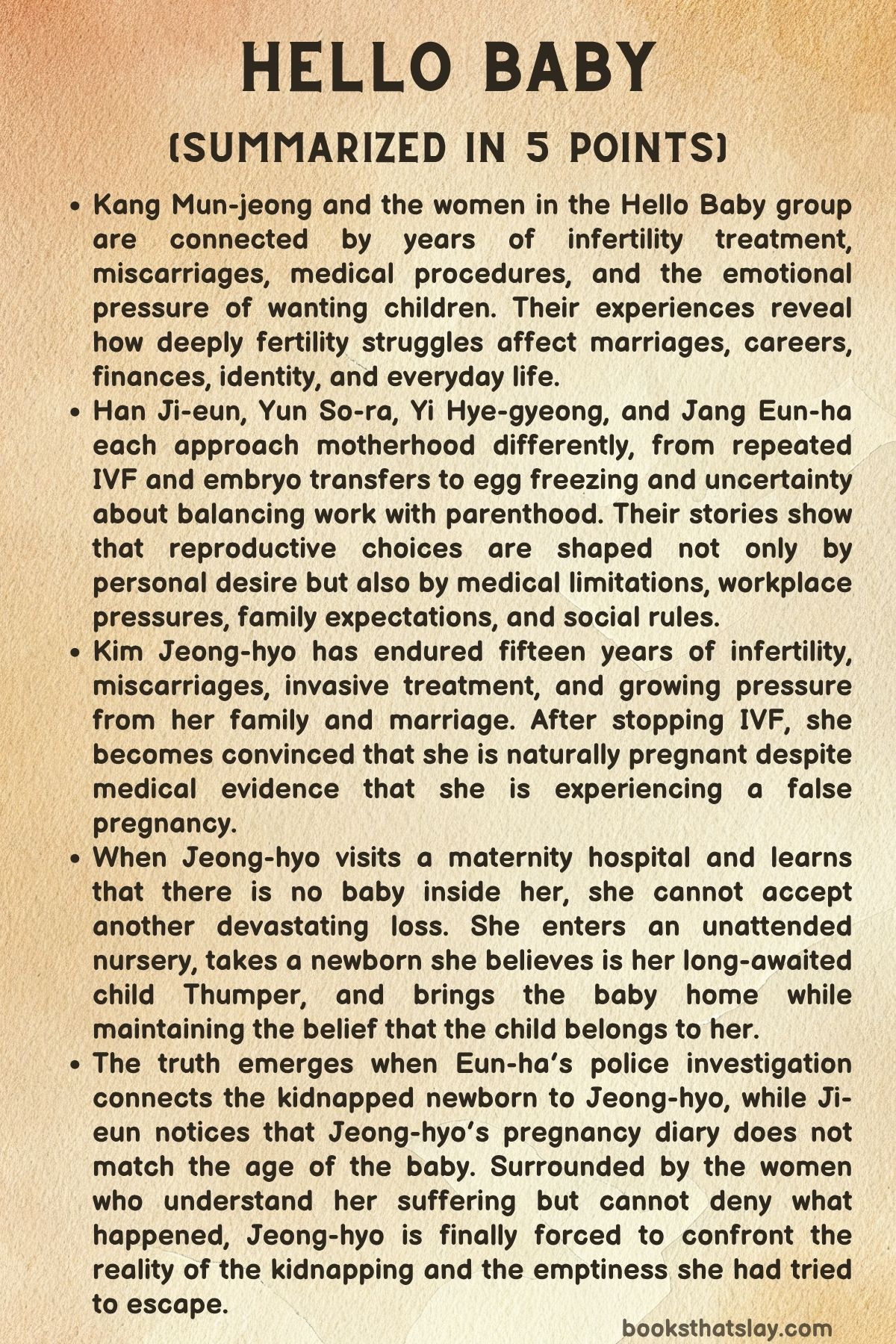
Kang Mun-jeong is forty-four and still undergoing fertility treatment after years of trying to become a mother. Her latest egg retrieval at Baby Angel Hospital has become another part of a familiar cycle of injections, anesthesia, uncertainty, physical exhaustion, and the fear that her declining ovarian reserve may soon leave her without another chance.
Her novelist husband still wants a child, but the daily burden of treatment rests largely on Mun-jeong. She remembers an earlier successful implantation that ended in miscarriage and the grief that followed, as well as the women she met while moving through fertility clinics and pregnancy loss.
Two of those women, Han Ji-eun and Kim Jeong-hyo, became especially important to her. Their shared experiences eventually encouraged Mun-jeong to create the Hello Baby group chat, where women facing similar difficulties could speak honestly about infertility without pretending that treatment was simple or emotionally manageable.
The group is suddenly shaken when Jeong-hyo, absent for nearly a year, announces that she has given birth. Her message produces a mixture of happiness, envy, astonishment, and hope, particularly because everyone knows how long she has struggled.
Han Ji-eun has her own painful history of infertility. She travels from Wonju to Seoul for treatment and learns that she has polycystic ovary syndrome, while her husband has obstructive azoospermia and must undergo sperm extraction.
Ji-eun’s husband supports her strongly, even defending her when his father assumes she is responsible for their childlessness. Yet the process still becomes physically, emotionally, and financially draining.
Ji-eun eventually leaves her office job because infertility treatment is nearly impossible to combine with a workplace that resents employees taking reproductive-health leave. After another embryo transfer, she imagines the two embryos as future children, affectionately naming them and dreaming of someday explaining how deeply they were wanted.
Yun So-ra represents a different path toward motherhood. A veterinarian in her late thirties, she is unmarried after ending a long-term relationship and does not believe marriage should determine whether she can eventually become a parent.
Rather than rushing into another relationship, So-ra freezes her eggs. Across repeated procedures, she stores fifty-two eggs, seeing them as a way to preserve possibilities while continuing to build her career.
She has even considered donor sperm and single motherhood, although legal and institutional barriers make those options difficult for unmarried women. Through Hello Baby, she becomes close to women with whom she can openly discuss fertility procedures, sex, relationships, husbands, social pressure, and the unequal physical burden placed on women.
Yi Hye-gyeong, a forty-four-year-old divorce lawyer, has endured numerous embryo transfers and egg retrievals. Doctors eventually discover multiple uterine fibroids that may be contributing to her repeated failures.
Her treatment has also exposed resentment within her marriage. She becomes furious when she realizes that her husband barely understands the fertility procedures she has endured despite years of watching her inject hormones, undergo anesthesia, recover from procedures, and cope with repeated disappointment.
Still, his presence during surgery shows that indifference is not the whole truth. He remains beside her while twelve fibroids are removed, and Hye-gyeong emerges with renewed hope that pregnancy might still be possible.
Police Sergeant Jang Eun-ha has a more conflicted relationship with motherhood. Her work exposes her to neglected and abused children, making her painfully aware that giving birth does not automatically make someone a capable parent.
At the same time, those cases strengthen her desire to create a stable family of her own. She values her police career and understands that pregnancy and childcare often affect women professionally far more severely than men.
Following an embryo transfer, Eun-ha begins monitoring her body for signs of implantation. Behaviors she once regarded as obsessive now make complete sense to her because she has become emotionally invested in every symptom and possibility.
Another perspective comes from Choi Seol-ju, Jeong-hyo’s upstairs neighbor and a mother of three. She once promised herself that motherhood would never consume her identity, but raising twins and a third child gradually reorganized her entire life.
Attempts to return to work fail because she cannot trust outside caregivers. Troubling experiences with nannies and stories about childcare abuse make her increasingly anxious until she eventually leaves her career to care for her children herself.
Seol-ju therefore represents a reality opposite to infertility. She has the children other women desperately want, yet motherhood has brought isolation, fear, professional sacrifice, and a sense that her identity has narrowed.
At the center of everything is Jeong-hyo. For fifteen years, she has undergone fertility treatment, miscarriages, invasive procedures, family pressure, and repeated disappointment.
She married young into a wealthy family and initially shared a close relationship with her mother-in-law. Over time, however, expectations that she should produce a grandchild transformed that relationship and made motherhood feel like both a personal dream and a duty she had failed to perform.
Her husband’s frequent absences deepen her loneliness. Jeong-hyo becomes convinced that a baby might restore closeness to their marriage and prove that all her suffering had meaning.
Eventually, after abandoning IVF, her menstrual cycle stops. A doctor identifies early menopause, but Jeong-hyo interprets physical symptoms such as nausea, frequent urination, and breast changes as evidence that she has conceived naturally.
She begins believing that she is pregnant and calls the imagined baby Thumper. Instead of sharing the supposed pregnancy with her husband, she keeps it secret and creates a private emotional world in which the child is unquestionably real.
Meanwhile, Mun-jeong interviews successful entrepreneur Bak So-yeong, who appears to possess an ideal life. Her thriving fashion business, famous husband, and polished confidence initially make her seem untouched by the struggles that define Mun-jeong’s existence.
When Mun-jeong accidentally reveals fertility medicine, however, So-yeong discloses that she also underwent IVF. Despite no obvious medical explanation for her infertility, she endured repeated unsuccessful attempts before deciding to stop.
So-yeong now considers herself happy without children. Her decision challenges the assumption that continuing fertility treatment indefinitely is always courageous while stopping necessarily represents defeat.
The encounter leads Mun-jeong to reconsider her own story and the broader contradictions surrounding reproduction in South Korea. Fertility clinics remain crowded with people spending enormous money, energy, and physical effort trying to conceive even as national concern focuses on a declining birth rate.
As the women prepare to celebrate Jeong-hyo’s newborn, inconsistencies begin appearing. Ji-eun checks Jeong-hyo’s old infertility blog, Until We Meet, and finds recently added pregnancy-diary entries.
The dates do not make sense. Jeong-hyo claims online to be only twenty-one weeks pregnant, yet she has suddenly announced the birth of a full-term infant.
At almost the same time, news spreads that a newborn has been kidnapped from Myeongseong Maternity Hospital. A masked person entered an inadequately secured nursery and disappeared with the child.
Ji-eun cannot immediately connect her friend to such a crime, but the timing disturbs her. The idea that someone traumatized by infertility might take another woman’s baby becomes impossible to dismiss entirely.
So-ra, unaware of the growing suspicion, buys a peach-colored onesie as a gift. Her memories of Jeong-hyo are affectionate because Jeong-hyo repeatedly cared for her during egg retrievals, bringing homemade food and offering companionship even after withdrawing from fertility treatment herself.
Hye-gyeong also heads toward the gathering, carrying yellow roses whose meanings of fulfillment and envy fit her conflicting emotions. She loves Jeong-hyo and is genuinely happy for her, yet the apparent miracle also represents everything Hye-gyeong has been unable to achieve.
Eun-ha’s police investigation soon leads to Jeong-hyo’s apartment complex. Knowing that Jeong-hyo has inexplicably produced a newborn on exactly the day a baby has disappeared, Eun-ha quietly asks So-ra for a photograph.
When she compares Jeong-hyo’s baby with the kidnapped infant’s photograph, the resemblance appears undeniable. Eun-ha realizes that professional duty has brought her directly into the private world of her closest fertility companions.
Seol-ju also becomes involved when she hears the newborn crying downstairs. Her experience as a mother tells her that the baby needs attention, and when the crying continues, concern overwhelms her reluctance to interfere.
She goes to Jeong-hyo’s apartment and finds police officers already there. The women, the authorities, Jeong-hyo, and the crying infant are finally brought into the same space.
The truth begins months earlier when Jeong-hyo, convinced she is twenty-one weeks pregnant, goes to Myeongseong Maternity Hospital because of severe morning sickness. An ultrasound reveals that there is no fetus.
A doctor gently explains that Jeong-hyo is experiencing a false pregnancy. After fifteen years of infertility, repeated miscarriages, social humiliation, and medical intervention, she cannot emotionally accept the diagnosis.
Disoriented, Jeong-hyo wanders into the maternity ward. Hearing a newborn crying from an unattended nursery, she enters and picks up the baby.
In her distorted state, she decides that the infant looks like both herself and her husband. Rather than seeing a stranger’s child, she sees Thumper, the baby she believes has been growing inside her.
She hides the newborn beneath her coat and leaves the hospital. By the time the Hello Baby women arrive to celebrate, Jeong-hyo has incorporated the stolen child completely into the imagined pregnancy she refuses to question.
When police arrive, the women do not immediately turn against her. Their years of shared suffering make condemnation difficult, and several instinctively try to protect her.
Mun-jeong and Ji-eun attempt to assume responsibility, while Hye-gyeong declares that she will act as Jeong-hyo’s lawyer. Seol-ju focuses on the infant’s immediate needs, and Eun-ha struggles with the tension between friendship and duty.
Ultimately, Ji-eun confronts Jeong-hyo with the contradiction that cannot be explained away. Her pregnancy diary states that she is twenty-one weeks pregnant, but the baby in front of them is clearly full-term.
A photograph of the biological mother destroys the remaining structure of Jeong-hyo’s imagined reality. Faced with evidence she can no longer reinterpret, she begins recognizing what she has actually done.
As the stolen baby cries nearby, Jeong-hyo touches her empty stomach. The moment strips away the fantasy that sustained her, leaving her face-to-face with both the childlessness she has resisted and the consequences of turning unbearable longing into a reality that never existed.
Characters
Kang Mun-jeong
Kang Mun-jeong functions as one of the principal connecting figures in Hello Baby, both because she creates the group chat and because her perspective captures many of the contradictions surrounding infertility. At forty-four, she has reached a stage where each treatment feels increasingly urgent, since age has turned time itself into another obstacle.
Her long experience with IVF has made medical routines ordinary without making them emotionally easier. Hormone injections, egg retrievals, embryo transfers, anesthesia, miscarriages, and disappointing results have become repetitive, yet every attempt still carries the possibility of life-changing success or failure.
Mun-jeong is also significant because she thinks critically about the culture surrounding fertility. As a journalist, she notices the contrast between public anxiety about declining birth rates and the private suffering of people spending enormous amounts of money and physical energy simply to conceive.
Her interview with Bak So-yeong broadens her outlook. So-yeong’s satisfaction after abandoning IVF forces Mun-jeong to consider whether stopping treatment may sometimes represent self-preservation rather than surrender.
Han Ji-eun
Han Ji-eun brings tenderness, optimism, and vulnerability into Hello Baby. Although infertility has caused her enormous pain, she continues imagining future motherhood with extraordinary emotional specificity, even giving affectionate names to embryos immediately after transfer.
Her marriage offers one of the book’s more supportive examples of partnership. Her husband undergoes painful sperm extraction, accepts responsibility when family members blame Ji-eun, and participates in treatment rather than treating infertility solely as a woman’s problem.
Yet Ji-eun still experiences structural pressures beyond her marriage. Her workplace effectively makes fertility treatment incompatible with employment, showing how supposedly available reproductive options can become inaccessible when professional systems do not accommodate them.
Ji-eun also becomes crucial during the final confrontation with Jeong-hyo. She approaches the truth carefully, using the contradiction in the pregnancy diary not simply to expose her friend but to bring her back toward reality.
Yun So-ra
Yun So-ra expands the book’s discussion of reproduction beyond conventional marriage. She wants the possibility of motherhood but refuses to treat finding a husband as the necessary first step.
After ending a long relationship, she chooses egg freezing and completes several retrievals. Her fifty-two stored eggs become a form of control over time, allowing her to continue building her veterinary career without feeling that biological pressure must immediately dictate her personal life.
Her willingness to consider donor sperm and single motherhood also exposes institutional inequalities. Reproductive technology may exist medically, but social rules still determine who can easily access it and under what family structure.
So-ra’s memories of Jeong-hyo reveal another important dimension of her character. Her loyalty grows from gratitude because Jeong-hyo cared for her during difficult procedures, making the later revelation especially painful.
Yi Hye-gyeong
Yi Hye-gyeong combines professional confidence with private frustration. As an accomplished divorce lawyer, she understands relationships, conflict, and legal responsibility intellectually, yet infertility exposes emotional vulnerabilities that professional competence cannot solve.
Her anger toward her husband comes largely from his failure to understand what she has physically endured. His ignorance symbolizes a broader gender imbalance in which men may want children while women carry most of the medical risk and bodily disruption.
The removal of twelve uterine fibroids gives Hye-gyeong another chance to hope. Her response shows how fertility treatment repeatedly renews optimism even after many failures, because each new doctor, procedure, or diagnosis can appear to offer the explanation that was previously missing.
In Hello Baby, her immediate decision to act as Jeong-hyo’s lawyer also shows how professional identity and friendship merge. She understands the seriousness of the situation but instinctively moves toward protection before judgment.
Jang Eun-ha
Jang Eun-ha occupies a particularly difficult position because she is both a woman undergoing fertility treatment and a police officer responsible for investigating the kidnapped newborn. These two identities collide at the climax.
Before IVF, Eun-ha privately judged women who studied every bodily sensation and became emotionally attached to embryo photographs. Her own treatment teaches her how quickly rational distance disappears when someone desperately wants a pregnancy to succeed.
Her police work complicates her desire for children in another way. She has repeatedly seen neglected, abused, or abandoned children, proving to her that biological parenthood alone says nothing about whether someone can provide love or safety.
When evidence leads toward Jeong-hyo, Eun-ha cannot avoid her duty. Her character therefore embodies the painful boundary between understanding why someone has suffered and excusing what that suffering eventually causes them to do.
Kim Jeong-hyo
Kim Jeong-hyo is the most psychologically complex character in Hello Baby. Fifteen years of infertility have transformed motherhood from a desire into the central organizing force of her emotional life.
Repeated miscarriages, invasive procedures, family expectations, a distant husband, and the gradual collapse of hope leave her increasingly unable to separate wanting a child from needing one in order to justify everything she has endured. Each failed pregnancy removes another source of stability.
Her false pregnancy develops within that context. When her period stops and she experiences physical symptoms, she interprets them according to the reality she needs rather than the diagnosis she receives.
The hospital revelation that she is not pregnant becomes psychologically intolerable. Instead of accepting another loss, she encounters a crying newborn and incorporates the child into the story she has already constructed around Thumper.
Her kidnapping of the baby is unquestionably harmful, but the novel builds enough background to show the emotional breakdown preceding it. Jeong-hyo is neither presented as simply malicious nor absolved because she has suffered.
Her final confrontation with the biological mother’s photograph is devastating because the external reality she has excluded finally becomes impossible to deny. Touching her empty stomach marks the collapse of the imagined motherhood that had briefly protected her from grief.
Choi Seol-ju
Choi Seol-ju provides a necessary counterpoint to the infertility experienced by the central women. She has three children, yet motherhood has not produced uncomplicated fulfillment.
Before becoming a parent, Seol-ju believed she would preserve a strong identity outside childcare. In practice, twins followed by another child leave her struggling to balance employment, safety, responsibility, and anxiety.
Her inability to trust caregivers eventually drives her from professional life. This decision is not presented as simple coercion by her husband or workplace but as the result of fear intensified by actual negative experiences and reports of childcare abuse.
In Hello Baby, Seol-ju reminds readers that obtaining the child others desperately want does not end every difficulty connected with motherhood. Her instinctive response to the stolen baby’s crying also demonstrates how deeply caregiving has become part of her awareness.
Bak So-yeong
Bak So-yeong initially appears to embody success without visible weakness. She runs a thriving business, has a high-profile husband, and seems completely comfortable with her life.
Her disclosure that she underwent several unsuccessful IVF cycles breaks the polished image Mun-jeong has been trying to understand. So-yeong has known the same uncertainty and disappointment that dominate the lives of the Hello Baby women.
What makes her distinctive is her decision to stop treatment. Instead of continuing indefinitely, she concludes that protecting the life she already possesses matters more than pursuing biological motherhood at any cost.
Her role therefore challenges an assumption that perseverance must always mean continuing treatment. She represents a legitimate future in which infertility remains part of someone’s history without defining the rest of her life.
Ji-eun’s Husband
Ji-eun’s husband offers a comparatively supportive model of masculinity within the fertility narrative. When his obstructive azoospermia contributes to the couple’s inability to conceive naturally, he does not hide behind shame or allow blame to fall entirely on Ji-eun.
He undergoes sperm extraction and openly acknowledges his own reproductive condition when his father criticizes his wife. That willingness to challenge family assumptions is especially important because infertility is frequently treated socially as a female problem even when male factors are involved.
His relationship with Ji-eun also demonstrates that mutual affection does not eliminate the hardships of infertility. Supportive marriages still face financial strain, medical pain, grief, and uncertainty, but shared responsibility can prevent those difficulties from becoming another form of isolation.
Hye-gyeong’s Husband
Hye-gyeong’s husband is more emotionally limited than Ji-eun’s, particularly in his poor understanding of the procedures his wife has endured. His ignorance becomes a symbol of how easy it is for the less physically affected partner to remain detached from the details.
His suggestion that fertility hormones may be making Hye-gyeong emotional understandably intensifies her anger. It reduces legitimate frustration to a medical side effect rather than acknowledging the imbalance in their experience.
Yet he is not completely uncaring. He accompanies her through surgery and remains close during moments of physical vulnerability, suggesting that affection exists even where communication has failed.
His legal view that reproduction is not the essential purpose of marriage also offers an important contrast to social pressure. Professionally, at least, he recognizes that marriage retains value regardless of whether a couple can have children.
Jeong-hyo’s Husband
Jeong-hyo’s husband is important largely through his emotional and physical absence. His frequent time away leaves Jeong-hyo increasingly alone with fertility treatment, family expectations, miscarriages, and the belief that a child might repair their relationship.
His absence does not by itself cause her psychological collapse, but it contributes to the isolation in which that collapse develops. The more she associates a baby with marital restoration, the more reproduction becomes tied to her entire sense of security.
He also represents the gendered imbalance surrounding prolonged infertility. Jeong-hyo’s body becomes the site of repeated treatment while she bears much of the emotional responsibility for fulfilling the family’s expectation of a grandchild.
Jeong-hyo’s Mother-in-Law
Jeong-hyo’s mother-in-law embodies the transformation of family affection under reproductive pressure. Their relationship begins warmly, helped by the security and privilege of the family Jeong-hyo marries into.
As years pass without a child, however, the expectation of producing a grandchild increasingly defines Jeong-hyo’s position. Even without constant explicit cruelty, this expectation turns fertility into a measure of belonging and success.
Her role shows how reproductive pressure can operate through families rather than solely through individual desire. A woman may genuinely want a child while simultaneously feeling that her value within marriage depends upon producing one.
Dr Sohn Yeong-su
Dr Sohn Yeong-su represents the medical system as a source of hope. His encouraging manner helps patients such as Ji-eun continue through demanding procedures that offer no certainty of success.
At the same time, his role exists within a broader medical environment where hope can become almost devotional. Patients move between doctors, treatments, tests, and specialists believing that the next intervention may finally solve the problem.
The doctor is not presented as manipulative; rather, the book shows how reproductive medicine naturally acquires enormous emotional significance because each procedure appears capable of changing the direction of an entire life.
Themes
The Cost of Reproductive Desire
Wanting a child becomes far more than a private wish for many women in Hello Baby. It shapes their bodies, marriages, finances, employment, schedules, friendships, and understanding of themselves.
Repeated fertility treatment places women inside a cycle governed by hormone injections, egg retrievals, embryo transfers, pregnancy tests, miscarriages, medical appointments, and waiting. Even when a procedure lasts only a short time, the emotional preparation and aftermath extend far beyond the clinic.
The novel is particularly attentive to the unequal physical burden of assisted reproduction. Men may be medically involved, but women repeatedly undergo invasive interventions and then monitor their bodies for signs of success or failure.
That imbalance also affects relationships. Hye-gyeong’s anger at her husband’s ignorance comes from realizing that years of bodily sacrifice can remain largely invisible even to the person who shares the same goal.
Jeong-hyo shows the most extreme consequence of desire becoming inseparable from identity. After fifteen years, motherhood no longer represents simply one possible future; it has become the imagined answer to marital loneliness, family expectations, lost pregnancies, wasted medical effort, and accumulated grief.
The story therefore treats reproductive desire with sympathy while also showing how damaging it can become when individuals are encouraged to keep pursuing the same goal regardless of emotional cost. So-yeong’s decision to stop IVF offers another possibility: a meaningful life can continue even when biological motherhood does not happen.
Motherhood, Identity, and Social Expectation
Motherhood appears throughout the novel as both a personal longing and a socially enforced identity. The women are not simply deciding whether they want children; they are negotiating expectations about what adulthood, marriage, femininity, and family are supposed to look like.
Jeong-hyo feels the weight of her wealthy in-laws’ desire for a grandchild, while Ji-eun encounters blame from her husband’s father despite infertility involving both partners. So-ra faces another form of restriction because her desire for motherhood does not fit neatly into marriage-centered reproductive rules.
Seol-ju reveals the opposite side of these expectations. She already has children, but motherhood gradually becomes so consuming that the independent self she once hoped to preserve becomes difficult to maintain.
Her story prevents parenthood from being presented as a simple solution to the pain experienced by infertile women. Having children brings love and meaning, but also anxiety, sacrifice, domestic labor, professional consequences, and responsibility.
Mun-jeong’s encounter with So-yeong adds another perspective by presenting a woman who ultimately rejects the idea that fulfillment requires motherhood. Her successful career and satisfying life undermine the assumption that a woman without children must necessarily remain incomplete.
Across these contrasting lives, the book treats motherhood as neither an automatic source of happiness nor something that can be dismissed as merely a social construction. It can be deeply desired while still being shaped by cultural expectations that make reproductive choices far more emotionally loaded than they might otherwise be.
Female Solidarity and the Limits of Loyalty
The Hello Baby group provides the women with a rare space where they can speak without filtering the realities of infertility. They discuss miscarriages, husbands, sex, injections, doctors, money, jealousy, failed transfers, and family expectations with people who understand the language and emotional rhythm of treatment.
This solidarity is practical as well as emotional. The women visit one another during procedures, bring food, share medical experiences, recommend doctors, celebrate possible successes, and remain present after disappointments.
Jeong-hyo’s past kindness to So-ra becomes particularly important because it explains why the women cannot instantly reduce her to the crime she commits. They remember someone who cared for them when they were frightened and physically vulnerable.
The final confrontation tests the boundaries of that loyalty. Mun-jeong and Ji-eun instinctively try to protect Jeong-hyo, while Hye-gyeong immediately assumes the role of legal defender.
Yet friendship cannot erase the existence of the kidnapped infant or the suffering of the biological mother. Eun-ha, because she is both friend and police officer, embodies this conflict most clearly.
Solidarity therefore becomes morally complicated rather than automatically virtuous. Compassion requires understanding Jeong-hyo’s suffering, but genuine care must eventually include helping her face reality rather than sustaining the fantasy that allowed her to take another woman’s child.
The group’s deepest act of friendship is ultimately not concealment but confrontation. Ji-eun’s gentle insistence on the impossible pregnancy timeline forces Jeong-hyo toward recognition when comforting lies can no longer protect anyone.
Reality, Grief, and Psychological Survival
The distinction between reality and emotionally necessary belief becomes central to Hello Baby through Jeong-hyo’s false pregnancy. Her body produces symptoms she interprets according to fifteen years of longing, creating a reality that feels more convincing to her than medical evidence.
Her response does not arise suddenly. Repeated miscarriages, fertility procedures, family pressure, marital loneliness, and the experience of being told again and again that a hoped-for child is absent gradually erode her ability to accept another definitive loss.
The imagined pregnancy therefore functions as a psychological defense. By believing in Thumper, Jeong-hyo temporarily transforms menopause and childlessness into a miraculous natural conception.
The danger emerges when private belief collides with external reality. At the maternity hospital, the newborn’s cries provide something tangible onto which Jeong-hyo can transfer the child she has imagined.
Once she decides the baby resembles herself and her husband, perception becomes organized around need rather than evidence. The infant ceases, in her mind, to belong to another mother and becomes proof that her pregnancy was real after all.
The final scene dismantles this constructed world through details that cannot coexist: the pregnancy diary says twenty-one weeks, the baby is full-term, and a photograph identifies another woman as the infant’s mother. Reality returns not as an abstract medical explanation but as an undeniable human claim.
Jeong-hyo touching her empty stomach captures the painful end of that defense. She must finally face both the original grief she escaped and the new harm created while escaping it.