Hocus Pocus Summary, Characters and Themes
Hocus Pocus by Brinda Charry is a historical novel set largely in Boston during the extraordinary cold year of 1816. It follows Samuel Thomas, an Indian-born magician whose pursuit of artistic recognition forces him to confront questions of race, performance, identity, ambition, freedom, and belonging.
Born Kumar Samee and later remade by colonial institutions and the entertainment world, Samuel repeatedly discovers that audiences prefer simplified versions of him to the complicated person he actually is. The book combines stage illusion, museum culture, racial politics, romance, grief, and the darker side of public spectacle while examining who has the right to define another person’s identity.
Summary
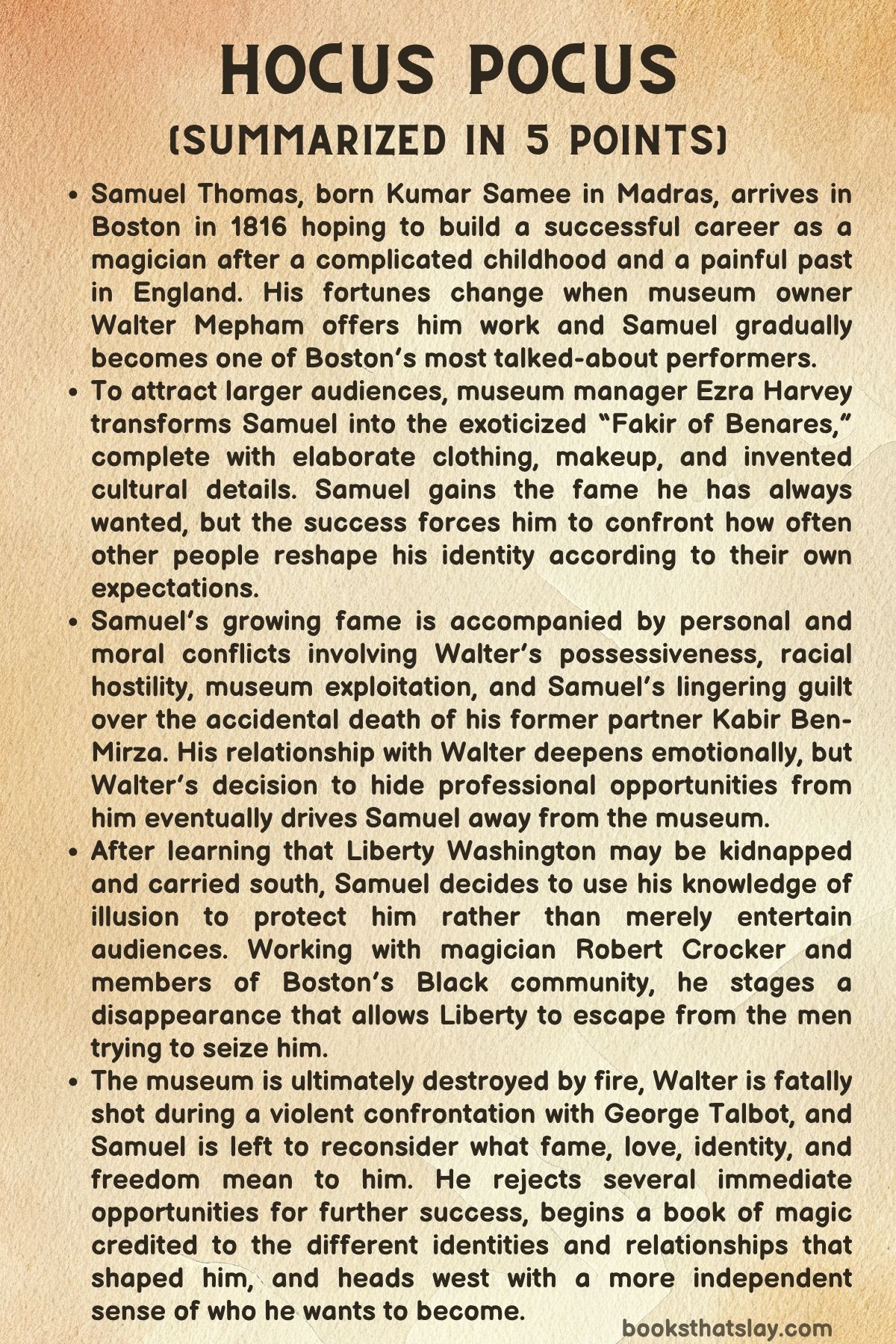
Samuel Thomas arrives in Boston during the bitter spring of 1816 determined to establish himself as a celebrated magician. Born Kumar Samee in Madras, he had been abandoned as an infant and raised by his blind grandparents among street performers, where his uncle taught him conjuring and insisted that apparent miracles came from knowledge, practice, and human ingenuity rather than supernatural powers.
His unusually light complexion eventually drew the attention of English officers, who removed him from his family and placed him in Pastor Burbank’s orphanage. There he was renamed Samuel Thomas, educated according to English expectations, and eventually sent to Britain after his talent attracted Major Lawrence’s attention.
Boston proves less welcoming than Samuel expects. His first performances draw indifferent crowds, and his position becomes desperate after Pierre Gagnon steals the bag containing his money and magical equipment.
Among those who notice him is Walter Mepham, the wealthy but financially reckless owner of the New Boston Museum. Walter is fascinated by Samuel’s appearance and skill and gradually begins regarding him with the same acquisitive fascination he brings to the unusual objects filling his museum.
Samuel initially resists Walter’s offer of employment because he wants to succeed independently. His declining finances, however, leave him with few practical alternatives, and he eventually agrees to become the museum’s resident magician.
Life at the museum introduces Samuel to the uneasy relationship between entertainment and exploitation. Walter believes deeply in Samuel’s talent, but manager Ezra Harvey thinks artistic excellence means little unless the public can be persuaded to buy tickets.
Samuel’s first museum performance demonstrates the problem. His illusions are polished, yet Boston audiences do not find him sufficiently unusual because his clothes, speech, and manners resemble those of an English gentleman.
Ezra therefore creates a new persona for him: the “Fakir of Benares.” Samuel is dressed in bright robes, jewelry, and a turban, his skin is darkened, and his supposedly Indian appearance is created according to American expectations rather than cultural accuracy.
Samuel understands immediately that the identity is artificial. Yet audiences respond enthusiastically, and his performances become enormously successful, especially after he reproduces the Mango Tree Trick that he remembers seeing his uncle perform.
The contradiction becomes impossible for him to ignore. In England, people had attempted to make him more English; in America, people now demand that he appear more Indian than he actually feels.
His success nevertheless gives him the applause he has long wanted. Moses Johnson, a talented Black fiddler of partly Indian ancestry, becomes his assistant, and Samuel encourages the younger man’s ambitions because he recognizes the same hunger for recognition in him.
Walter’s museum also expands around living curiosities and spectacular attractions. Walter purchases a Bengal tiger named Tipoo and an ingenious William Tell automaton while continuing to spend money despite severe debts.
Samuel increasingly recognizes that Walter’s enthusiasm for collecting extends beyond objects. Walter’s affection for Samuel is genuine, but it is repeatedly mixed with the desire to possess, protect, categorize, and control him.
The distinction becomes especially clear as Samuel receives invitations to perform in other cities. Afraid that Samuel will leave, Walter secretly hides letters offering him opportunities in New York and Philadelphia.
Samuel’s public identity causes another moral problem. Hannah Briggs, whose son William has disappeared, believes that the famous Fakir possesses actual supernatural powers and begs him to locate the boy.
Samuel cannot help her and feels ashamed that his manufactured persona has encouraged desperate people to believe his tricks are real magic. His insistence that illusion is technical rather than supernatural now conflicts directly with the reputation that has made him famous.
Danger around him grows. Samuel is attacked by men who associate his race, foreignness, and profession with witchcraft, and he survives an attempted sexual assault only after the strange prophet Amos interrupts his attackers.
Tipoo also becomes a victim of the world of spectacle. After escaping confinement, the frightened tiger is shot in the street, and Walter responds to its death by having the body preserved, attempting once again to transform loss into something permanent and collectible.
At the same time, Samuel’s past begins returning through Ezra’s investigation. Samuel had once performed in England under the name Augustus Armitage with Kabir Ben-Mirza, an exceptional magician who was also Samuel’s deeply loved professional and emotional partner.
Their act included the dangerous illusion of catching a fired bullet. During one performance, a real loaded weapon was used, and Samuel accidentally shot Kabir in front of the audience.
Although the official investigation declared the death accidental, Samuel fled Britain carrying enormous guilt. The fact that he and Kabir had argued shortly before the fatal performance makes the memory even more painful because reconciliation became impossible.
Walter and Samuel grow increasingly close, particularly during a journey away from Boston. Their relationship approaches physical intimacy, but Samuel withdraws because his unresolved attachment to Kabir prevents him from accepting another bond without fear and guilt.
The relationship fractures when Samuel learns that Walter has concealed professional invitations from him. Feeling betrayed by Walter’s attempt to control his career, Samuel leaves the museum and travels with Pépin and Breschard’s circus.
Distance forces Samuel to consider whether leaving the museum also means abandoning performance. Watching other entertainers accept danger because they cannot imagine lives without their craft helps him understand that magic remains essential to his identity even if he rejects the Fakir persona created for him.
Samuel eventually returns to Boston and confronts Walter. Walter admits learning the truth about Kabir but refuses to define Samuel solely by the accident, giving Samuel an opportunity to speak honestly about the guilt he has hidden for years.
A more immediate moral challenge emerges through Liberty Washington, a free Black man with vitiligo who has long feared being reduced to a curiosity because of his appearance. Men now intend to seize Liberty and transport him south under questionable legal claims.
Samuel refuses to remain passive. Earlier, he had allowed Ezra’s actions against rival magician Signor Ricci to benefit his own career without interfering, but Liberty’s danger pushes him toward a different choice.
He approaches Robert Crocker, a Black American magician whose performances emphasize science and rational explanation. Although Crocker could be considered Samuel’s professional rival, the two agree to combine their technical abilities to create an escape disguised as a magical disappearance.
Their plan depends on the cooperation of Boston’s Black community. During a major museum performance, Liberty appears disguised as an assistant, and Samuel and Crocker seemingly make him vanish.
The illusion has genuine consequences because the confusion allows Frank Hastings and others to move Liberty beyond the reach of the men trying to capture him. Magic, which Samuel has so often used to satisfy audiences or construct false identities, finally becomes a means of protecting another person’s actual freedom.
That same performance has been advertised as the occasion on which Samuel will demonstrate the legendary Great Indian Rope Trick. The audience expects the sensational version promoted through stories of mysterious Indian magic.
Samuel refuses to give them the fantasy they demand. Instead of making a rope rise into the air and climbing impossibly upward, he escapes from ropes binding his body, transforming the promised spectacle into a symbolic assertion of self-liberation.
The crowd reacts badly because it expected the legend rather than reality. Chaos follows, and a fire connected with Jason’s return as a fire-eater spreads through the museum, destroying the collection to which Walter has devoted his fortune and identity.
Walter’s personal world collapses as well. George Talbot, his hostile father-in-law, admits that he was responsible for intimidation directed at Samuel because he wanted to protect Sarah and separate Walter from him.
A violent confrontation follows in which George shoots Walter. Caesar Malcolm, an elderly Black man once enslaved by the Talbot family, kills George, and Caesar himself dies soon afterward.
Walter’s final thoughts turn not toward the thousands of possessions he accumulated but toward Samuel performing the Mango Tree Trick. His death leaves Samuel to confront the complicated truth that Walter loved him while also repeatedly confusing love with possession.
After the fire, Sarah inherits her father’s wealth and gains an independence she lacked within her troubled household. Liberty’s disappearance succeeds, and he considers continuing north toward Canada, beyond the immediate danger of capture.
Moses chooses the life of a traveling performer, while Nora Fowler prepares to move west. Samuel also decides against immediately pursuing the prestigious invitations that once would have seemed like proof of success.
Instead, he wants temporarily to stop being the object everyone watches. After years of being transformed into something for other people’s entertainment, he wishes to experience the world as an observer rather than an exhibit.
Samuel begins writing a handbook of magic and credits it to Kumar Samee, Samuel Thomas, and Kabir Ben-Mirza. By placing these names together, he begins accepting parts of himself that he had previously treated as separate and incompatible.
As he travels west, he watches a young girl practicing a coin trick. Her pleasure in discovering how the illusion works reminds him of what existed before ambition, exotic costumes, museums, grief, and fame: the simple delight of making the impossible appear possible.
Characters
Samuel Thomas / Kumar Samee / Augustus Armitage
Samuel is the central character of Hocus Pocus, and his multiple names express the central conflict of his life. Kumar Samee belongs to his childhood in Madras, Samuel Thomas is the identity imposed upon him through a British orphanage, and Augustus Armitage belongs to the English stage career he abandoned after Kabir’s death.
His desire to become a respected magician comes partly from artistic pride and partly from a powerful need to be seen. Having been raised by blind grandparents, Samuel associates attention with recognition, yet the attention he eventually receives is rarely directed toward his complete self.
Samuel is rational about magic. He rejects supernatural explanations and understands illusion as a combination of mechanics, discipline, misdirection, psychology, and skill, making the Fakir persona particularly uncomfortable because it depends on presenting these abilities as mysterious Eastern powers.
His ambition makes him ethically imperfect. He benefits from Ricci’s intimidation despite suspecting Ezra’s involvement, and for a time he accepts a false cultural performance because it gives him the success he desperately wants.
His development becomes clearest when Liberty is threatened. Samuel chooses to use his craft not simply to attract applause but to protect another person’s freedom, demonstrating that he has begun separating artistic achievement from public approval.
His unresolved grief over Kabir also shapes nearly every intimate relationship he forms. Accepting that Kabir’s death was a terrible accident rather than proof of his own permanent moral corruption is essential to Samuel’s eventual movement toward a more integrated identity.
Walter Mepham
Walter is one of the most complicated figures in Hocus Pocus because affection, curiosity, desire, generosity, selfishness, and possession coexist within him. His museum reflects the way he approaches the world: anything beautiful, unusual, distant, or fascinating creates an urge to acquire and preserve it.
That impulse extends to Samuel. Walter genuinely admires his talent and develops deep emotional and romantic feelings for him, yet he repeatedly treats Samuel as though loving him provides some claim over his career and future.
His decision to hide invitations from other cities becomes the clearest expression of this possessiveness. Walter wants Samuel to succeed, but only within the museum and within a relationship Walter can control.
Walter is also financially irresponsible. His continuing purchases of Tipoo, the automaton, and other curiosities show how collecting functions almost like an addiction, continuing even when his household and museum are endangered by debt.
His treatment of loss is similarly revealing. When Tipoo dies, Walter has the animal preserved, demonstrating his inability to accept that something valued can disappear rather than remain permanently available to him.
Walter’s death therefore carries bitter irony. His museum and collection are destroyed, and his final thoughts settle not on objects but on Samuel, leaving behind the question of whether he ever fully learned to love another person without also wanting possession.
Ezra Harvey
Ezra is the museum’s practical strategist, and his understanding of entertainment is far less romantic than Walter’s. He recognizes that audiences often respond more strongly to publicity, image, and expectation than to technical skill.
His creation of the Fakir of Benares proves commercially brilliant while remaining ethically disturbing. Ezra understands that American spectators want a recognizable fantasy of India, so he transforms Samuel into exactly the figure they expect rather than allowing Samuel’s complicated history to challenge their assumptions.
Ezra’s effectiveness makes him dangerous because he approaches human beings as components of a business strategy. His investigation into Samuel’s past, his role in Ricci’s disappearance from Boston’s magic scene, and his involvement in the threat against Liberty all show how readily managerial calculation can override moral restraint.
He is not simply interested in truth. Information gives him leverage, and spectacle gives him profit, which makes him one of the clearest representatives of institutional exploitation in the novel.
Kabir Ben-Mirza
Kabir is physically absent from most of Hocus Pocus, yet his influence over Samuel is enormous. He was Samuel’s magical partner in England, an artist of exceptional ability, and the person with whom Samuel shared his deepest professional and emotional bond.
His death during the bullet-catching illusion becomes the defining trauma of Samuel’s adult life. Because Samuel fired the fatal shot shortly after the two had argued, grief becomes inseparable from guilt, regret, and the knowledge that reconciliation can never occur.
Kabir consequently survives within Samuel as both memory and judgment. Samuel’s reluctance to become intimate with Walter comes partly from his inability to imagine loving someone else without betraying the relationship he lost.
By eventually placing Kabir’s name alongside his own identities in the handbook of magic, Samuel changes the meaning of the memory. Kabir is no longer only the source of an unbearable secret but becomes acknowledged as part of Samuel’s artistic history.
Liberty Washington
Liberty Washington embodies the struggle to preserve ownership of one’s body and identity. His vitiligo makes him visually unusual in a society eager to convert difference into public spectacle, yet he strongly resists allowing himself to become someone else’s attraction.
His suspicion of museums is therefore grounded in experience rather than cynicism. He understands earlier than Samuel that being paid to display oneself does not automatically eliminate the unequal power of the person deciding how that body will be presented.
Liberty’s danger becomes acute when men seek to seize him and transport him south. The threat exposes the fragile condition of Black freedom in a society that celebrates liberty while leaving free Black people vulnerable to kidnapping and racial violence.
Samuel’s decision to help him marks an important moral transition in the book. Liberty’s literal disappearance during the performance turns illusion into liberation and rejects the idea that another person’s body can legitimately be owned, displayed, or removed by force.
Moses Johnson
Moses is a young Black fiddler whose ambition closely parallels Samuel’s early dreams. He wants professional recognition, public performance, and the opportunity to turn talent into a life rather than restricting music to a private activity.
Samuel responds warmly to Moses because he recognizes this longing. Their relationship allows Samuel to occupy the role of mentor and gives him an opportunity to support another performer rather than viewing every talented person as a competitor.
Moses’s presence also complicates the book’s treatment of cultural identity. His family connection to India creates another reminder that ancestry, race, nationality, and belonging cannot always be organized into the simple categories demanded by audiences.
His eventual choice to travel with entertainers suggests a future shaped by movement and artistic possibility. Unlike Samuel, he begins that journey with the benefit of having seen both the excitement and the dangers associated with professional spectacle.
Nora Fowler
Nora offers Samuel a perspective that challenges his dependence on public recognition. She does not share his hunger to be watched, celebrated, or remembered by an audience, and her practical approach forces him to consider why applause matters so intensely to him.
Their conversations help Samuel articulate the emotional foundation beneath his ambition. His admission that being seen has always mattered, particularly after growing up with blind grandparents, turns his career from a simple desire for fame into something psychologically deeper.
Nora also represents mobility and independence outside Walter’s world of collecting. Her connection with the traveling circus demonstrates that performance does not have to mean remaining trapped within one institution or under one person’s control.
Robert Crocker
Robert Crocker operates as both professional contrast and eventual ally to Samuel in Hocus Pocus. A Black American magician who emphasizes science and natural philosophy, he publicly presents illusion in the rational terms Samuel himself has always preferred.
His appearance exposes the extent to which Samuel’s stage identity has drifted away from his own beliefs. While Samuel is advertised through exotic mystery, Crocker demonstrates that a performer can build a public identity around explanation, technical mastery, and reason.
Their collaboration to rescue Liberty is therefore especially significant. Instead of allowing professional rivalry to dominate their relationship, both men use their different reputations and shared knowledge of illusion for a purpose larger than individual fame.
Sarah Mepham
Sarah is frequently caught between men whose ambitions shape her life without sufficiently considering her needs. She is loyal to Walter and repeatedly tries to secure assistance from her wealthy father, George Talbot, even as their hostility places her in an increasingly painful position.
She is also perceptive about the museum. Her recognition that Samuel appears too ordinary to audiences helps identify the commercial problem that ultimately produces the Fakir persona.
Sarah’s situation exposes the personal cost of Walter’s financial irresponsibility. While he pursues acquisitions and Samuel’s company, she lives with uncertainty created by debts, family conflict, and emotional neglect.
The deaths of Walter and George leave her facing enormous loss, but they also produce an unexpected independence. Her inheritance gives her a future no longer governed by the conflict between husband and father.
George Talbot
George Talbot represents wealth, patriarchal authority, and the desire to control family relationships through financial power. He despises Walter’s museum and regards Walter’s spending as reckless, but his attempts to protect Sarah eventually become coercive and violent.
His decision to arrange intimidation against Samuel reveals that his idea of protection permits him to interfere secretly in other people’s lives. He assumes that removing Samuel will restore the household to an order he considers proper.
The final confrontation exposes the destructive consequences of that mentality. By shooting Walter, George transforms long-standing hostility into irreversible violence, only to be killed by Caesar Malcolm, a man once enslaved by the Talbot family.
Caesar Malcolm
Caesar is an elderly formerly enslaved man whose history connects the Talbot family’s present wealth and authority with an older system of exploitation. His repeated search for those who abandoned him after he became old exposes the cruelty of relationships built on ownership rather than genuine obligation.
He serves as a quiet parallel to several other characters. Samuel fears being treated as an exotic possession, Liberty faces the possibility of literal seizure, and Caesar has already lived through a system in which another person possessed legal control over his life.
His killing of George Talbot brings that history violently into the present. The act does not erase what Caesar suffered, but it ensures that the Talbot family’s legacy of domination cannot remain merely an abstract historical fact.
Pierre Gagnon
Pierre occupies the vulnerable margins of Boston society. He survives through theft, transactional sex, and unstable relationships, first entering Samuel’s story by stealing the magician’s money and equipment.
His connection with Walter reveals another side of Walter’s desires before Samuel becomes central to them. Walter exchanges money and laudanum for sexual access, reinforcing the novel’s repeated concern with relationships complicated by unequal power.
Pierre’s eventual death receives far less public importance than the losses of wealthier or more socially protected characters. His fate shows how easily those without security or status can disappear from the larger social record.
Signor Ricci
Ricci initially appears to be Samuel’s professional rival, an established magician who understands how theatrical foreignness can attract Boston audiences. His warning that the city cannot support both men reveals the insecurity beneath his confidence.
Samuel considers Ricci less technically refined than himself, yet Ricci succeeds because he understands presentation. In that sense, his career anticipates Ezra’s transformation of Samuel into the Fakir.
When Ricci is driven out through intimidation and sabotage, Samuel’s response becomes morally important. Although he suspects Ezra is responsible, Samuel accepts the advantage rather than challenging the wrongdoing, creating an earlier failure that contrasts sharply with his later decision to protect Liberty.
Hannah Briggs
Hannah Briggs reveals the painful consequences of Samuel’s invented supernatural reputation. Desperate to find her missing son William, she approaches the Fakir because she believes his stage powers may be genuine.
Her appeal forces Samuel to confront the difference between entertainment and deception. He has knowingly allowed audiences to interpret technical illusions as evidence of mysterious power, but Hannah’s desperation makes that misunderstanding suddenly consequential.
Through her, the story asks whether performers remain responsible for false beliefs encouraged by their own publicity. Samuel’s inability to give Hannah what she needs becomes a source of shame and contributes to his increasing dissatisfaction with the identity created around him.
Themes
Identity as Performance
Samuel’s life repeatedly demonstrates that identity can be shaped by institutions, audiences, and power rather than solely by personal choice. He begins as Kumar Samee, becomes Samuel Thomas through a British orphanage, performs as Augustus Armitage in England, and is eventually marketed as the Fakir of Benares in America.
Each identity contains something real, yet none is sufficient by itself. The problem is not simply that Samuel adopts different names; it is that other people repeatedly decide which version of him is acceptable.
British society tries to make him culturally English, while American audiences become fascinated only after Ezra exaggerates his Indianness. The contradiction shows how racial identity is often treated as something spectators believe they can recognize visually, even when their expectations are based on fantasy.
Hocus Pocus therefore presents performance as both opportunity and confinement. Samuel gains money and acclaim by playing the Fakir, but every successful performance strengthens a public image that feels increasingly unlike his private sense of self.
His final decision to credit a magical handbook to Kumar Samee, Samuel Thomas, and Kabir Ben-Mirza signals movement toward integration. Rather than choosing one supposedly authentic identity and discarding the others, he accepts that his past contains several selves, languages, relationships, and cultural influences.
The ending does not suggest that identity becomes simple. Instead, Samuel begins claiming authority over the complexity that others repeatedly tried to simplify for him.
Possession, Collecting, and Freedom
Walter’s museum turns the desire to possess into one of the story’s central moral problems. His collection begins with physical objects, but his habits of thought increasingly extend toward animals and people.
Tipoo is purchased because Walter imagines the tiger as an extraordinary museum attraction. After the animal dies, Walter has its body preserved, demonstrating how difficult he finds it to accept that something loved can exist beyond his control or disappear entirely.
His relationship with Samuel follows a similar pattern. Walter’s affection is sincere, yet he secretly intercepts professional invitations because he fears Samuel will leave him and the museum.
This conflict makes possession emotional as well as economic. Walter does not need to describe Samuel as property for his behavior to become controlling; the decisive issue is his belief that his own love and investment justify restricting Samuel’s choices.
Liberty Washington provides the harshest form of the same theme. The threat that he may be kidnapped and transported south shows that legal freedom remains fragile when racial power allows others to make claims over a Black person’s body.
Samuel’s role in making Liberty disappear reverses the logic of collecting. Instead of using spectacle to capture and display someone, illusion becomes a method for helping a person escape those who want to possess him.
The destruction of the museum completes this pattern symbolically. A building devoted to keeping the world contained, labeled, and preserved is finally consumed by fire, while the surviving characters move outward into uncertain but self-directed futures.
Spectacle, Race, and the Public Gaze
Entertainment in Hocus Pocus is inseparable from the assumptions audiences bring with them. Samuel initially fails because spectators do not consider his real personality sufficiently foreign, and he becomes successful only after Ezra manufactures a version of Indianness designed to match American fantasies.
The result exposes the unequal conditions under which Samuel performs. He is supposedly being celebrated for his difference, yet the particular form of difference being celebrated has largely been invented by others.
Walter’s museum makes this problem visible beyond Samuel’s career. Unusual animals, objects, physical features, foreign cultures, and human performers are all evaluated according to their ability to attract curiosity.
Liberty understands this danger immediately because his vitiligo makes his body vulnerable to exactly the kind of attention museums can commercialize. His refusal to become an exhibit is therefore also a refusal to let spectators determine the meaning of his body.
Racial violence shows the darker side of the same gaze. Samuel can be admired onstage as an exotic Fakir and attacked outside the museum for being foreign, racially ambiguous, and supposedly connected to witchcraft.
The contradiction reveals how fascination and hostility can arise from the same refusal to recognize another person’s full humanity. A society may consume cultural difference as entertainment while still punishing the people associated with that difference.
Samuel’s final Rope Trick challenges that relationship. When he refuses to perform the mythical version audiences demand, their anger shows that what they valued was not necessarily his skill but their own fantasy reflected back to them.
Magic, Truth, and Moral Responsibility
Samuel consistently insists that magic is created through human intelligence rather than supernatural power. Tricks require planning, physical control, mechanical understanding, misdirection, and the ability to anticipate what spectators will believe.
Yet the book complicates the boundary between illusion and dishonesty. Samuel knows that his Fakir persona encourages mystical interpretations, and those beliefs become disturbing when Hannah Briggs asks him to use supposed supernatural powers to find her missing son.
At that moment, theatrical exaggeration produces a real moral consequence. A grieving mother approaches him not for entertainment but because the public image surrounding him has taught her to expect impossible help.
Samuel’s earlier acceptance of Ricci’s intimidation creates another ethical failure. He may not have ordered Ezra’s actions, but he benefits from them and remains silent because removing a rival improves his own career.
His later involvement in Liberty’s escape demonstrates a different use of deception. The disappearance trick is still false as spectacle, yet the false appearance creates a truthful outcome: Liberty actually gains freedom.
The distinction suggests that illusion itself is morally neutral. What matters is the purpose it serves, the power relationship surrounding it, and whether it harms, exploits, protects, comforts, or liberates another person.
Samuel’s journey therefore changes the meaning of professional success. Magic begins as the instrument through which he hopes to become famous, becomes part of a false identity imposed upon him, and eventually becomes a skill he can choose to use according to his own ethical judgment.
By the end, the young girl’s pleasure in practicing a coin trick restores magic to its simplest form. Before publicity, racial fantasy, money, professional rivalry, and tragedy, there is curiosity—the pleasure of understanding how human hands can make reality briefly appear impossible.