How to Find Love in the Cereal Aisle Summary, Characters and Themes
How to Find Love in the Cereal Aisle by Alissa DeRogatis is a contemporary romance about heartbreak, creative uncertainty, friendship, and the difficult process of redefining what love means after a relationship ends.
At its center is romance novelist Ainsley Green, whose professional identity depends on writing optimistic love stories just as her own faith in lasting relationships collapses. Her attempts to manufacture charming encounters for inspiration gradually teach her that meaningful love is less about cinematic beginnings than consistency, honesty, and emotional safety. The book also follows Ainsley as she rebuilds her friendships, career, confidence, and sense of self after realizing that an ending does not erase the value of what came before.
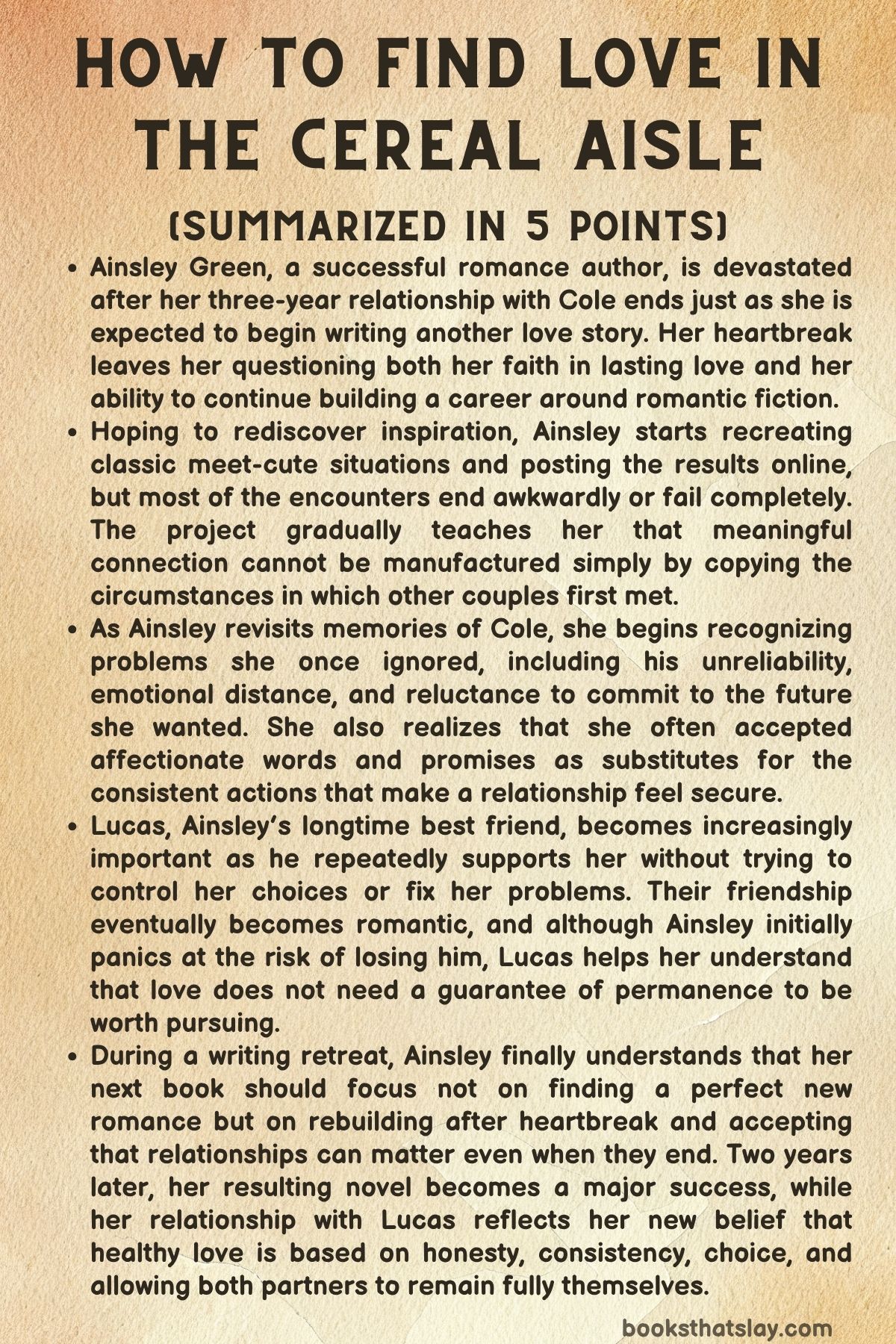
Summary
Ainsley Green begins the launch tour for her second romance novel while still struggling with the end of her three-year relationship with Cole. Although she is supposed to present herself as a confident romance author celebrating professional success, she feels increasingly disconnected from the hopeful ideas she writes about.
At a bookstore appearance in Raleigh, an audience member asks about Cole because he had been mentioned in the dedication of Ainsley’s earlier work. Ainsley unexpectedly admits that they have broken up and speaks openly about how devastated she feels, creating an uncomfortable moment for her publicist, Ross.
Instead of damaging her reputation, however, the confession makes readers respond warmly to her honesty. That public vulnerability becomes one of the first indications that the version of herself Ainsley is trying so hard to protect may be less useful than simply admitting that she does not have everything figured out.
Her professional uncertainty soon becomes almost as frightening as her heartbreak. Her original publishing contract has been completed, and her agent, Tess, wants to know what she intends to write next.
Ainsley has no idea. Her previous romances grew from exciting meet-cute concepts, but heartbreak has made it difficult for her to believe convincingly in the stories she once produced so naturally.
She begins revisiting memories of meeting Cole. Years earlier, shortly after graduating from college and moving into a Raleigh duplex with Grace and Savannah, she had met him while their friends were helping with the move.
Cole immediately caught her attention through his confidence, humor, and willingness to take her ambition to become a writer seriously. Their attraction developed through playful conversations and small gestures that Ainsley later remembered as signs that something important had begun.
As their relationship grew, Ainsley started collecting moments that resembled scenes from romance fiction. At the North Carolina State Fair, she imagined strangers falling in love while trapped together on a Ferris wheel, only for Cole to kiss her while their own Ferris wheel car was suspended above the fair.
The idea inspired her first published novel. From that point onward, Ainsley’s romantic relationship and creative identity became closely connected, making the eventual breakup especially damaging to both.
In the present, she spends increasing amounts of time with Lucas, her longtime best friend. Lucas has always been dependable, and their friendship allows Ainsley to speak more freely than she can in most other relationships.
After observing Lucas and his girlfriend Margo struggling with different expectations for their future, Ainsley starts thinking about how couples meet. Her parents met in a grocery store, people she knows met through school or friends, and she met Cole during an ordinary moving day.
She decides to create a project around deliberately recreating classic meet-cute situations. The idea serves two purposes: it may give her material for another book, and it may help her prove that romance still exists outside the relationship she lost.
The experiments rarely go as planned. At an airport, she flirts with an attractive stranger only to discover that he already has a girlfriend.
At a grocery store, she tries to recreate the accidental encounter through which her parents met, but the situation becomes awkward rather than romantic. Other attempts similarly reveal that copying the circumstances of someone else’s romance cannot reproduce the emotional connection that made the original encounter meaningful.
Meanwhile, Ainsley remains haunted by the apparent perfection of other people’s lives. Social media constantly presents successful authors announcing new projects, couples displaying happiness, and her older sister Elizabeth seeming to have reached every adult milestone effortlessly.
Ainsley responds by pretending that her own next book is further along than it actually is. That lie creates additional pressure because she now feels she must produce the project she has implied already exists.
Memories of Cole gradually reveal that their relationship had serious problems long before it ended. During a family gathering, Cole told Ainsley he loved her, strengthening her belief that she had found the person with whom she would build her future.
Yet later memories show that Cole frequently failed to prioritize her. Grace and Savannah noticed his unreliability and tried to express concerns, but Ainsley interpreted their criticism as disloyalty.
She valued Cole’s affectionate messages, romantic gestures, and verbal reassurances while overlooking his repeated failure to show up when she needed him. Even when she sensed that their expectations for the future were diverging, she accepted his promises because believing him was easier than acknowledging that the relationship might not be progressing toward the life she wanted.
The meet-cute project nevertheless becomes unexpectedly successful online. Ainsley’s failed attempts are funny, relatable, and popular with followers.
When she discovers that Cole has blocked her on social media, her pain temporarily becomes motivation. Rather than allowing herself to feel erased, she decides to become more committed to her work and to creating a career that belongs entirely to her.
At the same time, Lucas’s relationship with Margo ends because they acknowledge that their futures are moving in incompatible directions. His breakup is quieter than Ainsley’s, but his willingness to accept that love does not always mean forcing a relationship to continue gives Ainsley another model for understanding endings.
Lucas begins helping with her meet-cute experiments. They recreate situations, film embarrassing failures, drink together, and spend increasing amounts of time in the easy rhythm that has always characterized their friendship.
Ainsley also begins building new connections outside her old social circle. At a dog park, she meets Maddie, whose openness and humor quickly make friendship possible.
Maddie introduces her to new activities and eventually becomes someone with whom Ainsley can discuss both her breakup and her increasingly confusing feelings toward Lucas. Through Maddie, Ainsley realizes that rebuilding after heartbreak does not have to revolve entirely around finding another romantic partner.
Her memories of Cole continue revealing how much she had ignored. Even when Cole helped her settle into a new apartment and talked affectionately about their future, he resisted the greater commitment Ainsley wanted.
She repeatedly questioned whether they should live together or move toward marriage, while Cole responded with comforting words instead of concrete decisions. Ainsley increasingly recognizes that verbal reassurance kept her invested even when the relationship was no longer giving her the stability she needed.
Her experiments eventually produce what appears to be a genuine romantic possibility. At a Christmas tree farm, she meets Jack, a charming stranger who flirts with her naturally and asks for her number.
The encounter seems to be exactly what Ainsley had been trying to create. Yet when Lucas calls because his grandfather has died, she immediately abandons the romantic opportunity and goes to him.
During Lucas’s grief, Ainsley sees a deeper form of love expressed through simple presence. His family cares for one another by being available during pain rather than through dramatic declarations.
Lucas also talks about his grandparents’ marriage and the importance of repeatedly choosing a partner. When he holds Ainsley’s hand slightly longer than necessary, their relationship begins to feel different to her.
The change becomes harder to deny during later meet-cute outings. Ainsley notices that she pays more attention to Lucas than to the strangers she is supposedly trying to meet.
Followers watching her videos also begin commenting on the chemistry between them. Ainsley resists the possibility because Lucas is one of the most secure relationships in her life, and turning friendship into romance could mean losing him entirely if things go badly.
Her manuscript, meanwhile, continues developing in an unexpected direction. Rather than writing a conventional new romance, she keeps documenting her memories of Cole.
As she approaches the end of their story, she recognizes how emotionally absent he had become. Their shared routines continued, but intimacy had faded, communication had weakened, and Ainsley increasingly felt that she was fighting alone for a relationship Cole had already begun leaving emotionally.
Eventually the memory reaches their breakup. Ainsley had planned a romantic dinner in the hope that reconnecting with the early stages of their relationship might restore what they had lost.
Instead, Cole admitted that he no longer wanted to continue and that he had feelings for someone else. Ainsley’s imagined future collapsed immediately.
The breakup became even more painful when she learned that Grace and Savannah had known important details but had not told her. Feeling betrayed by both her boyfriend and her friends, she lost an entire social structure at once rather than simply losing one relationship.
In the present, Ainsley’s feelings for Lucas finally become impossible to suppress. Maddie encourages her to recognize that Lucas consistently gives her many of the things she once begged Cole to provide: attention, reliability, understanding, and presence.
Ainsley asks Lucas to come home with her, and he immediately understands the meaning behind the invitation. They sleep together, transforming years of friendship into something openly romantic.
At first, the intimacy feels safe because Lucas already knows her history and insecurities. That very safety soon frightens Ainsley, however.
Losing Cole had been devastating, but losing Lucas after a failed romance would mean losing both a partner and her closest friend. Fear causes her to withdraw just as the relationship begins.
Feeling emotionally overwhelmed and creatively uncertain, Ainsley accepts Ross’s suggestion that she attend a writing retreat on Martha’s Vineyard. She hopes that leaving Raleigh will give her enough distance from Cole, Lucas, social media, and professional expectations to determine what she actually wants.
At the retreat, conversations with other writers help Ainsley understand that uncertainty is not proof that she has failed professionally. She begins questioning whether she needs to remain confined to the conventional romance formula that established her career.
Maddie also helps her recognize that the emotional story Ainsley has been searching for has existed around her all along. Her heartbreak, lost friendships, new relationships, creative crisis, and reconstruction of her identity all contain material worth writing about.
Ainsley gradually realizes that closure does not require another explanation from Cole. She can stop waiting for the past to resolve itself perfectly and instead choose what meaning she gives to it.
Near the end of the retreat, Lucas unexpectedly arrives. Ainsley finally admits that she is avoiding him because she fears that a romantic relationship could destroy their friendship.
Lucas refuses to promise that they will stay together forever. Instead, he promises something more believable: he will continue showing up and choosing her as long as they are together.
That answer matters precisely because it avoids the kind of fantasy Ainsley once demanded from love. She decides that uncertainty does not automatically make a relationship unsafe and chooses to take the risk.
The next morning, a comment from Lucas helps unlock her new book. Ainsley realizes that relationships do not become meaningless simply because they end.
Her years with Cole mattered even though they were not permanent. Rather than writing a traditional story about finding the perfect romantic partner, she decides to write about what happens after heartbreak and how someone rebuilds a life after losing the future they expected.
Several weeks later, Ainsley is writing confidently again and openly dating Lucas. She ends her meet-cute video series by acknowledging that the meaningful relationship she had been searching for had existed beside her throughout the process.
Two years later, Ainsley’s new novel, If You Never Broke My Heart, becomes a major bestseller. During a television interview, she explains that her breakup forced her to reconsider both storytelling and love.
She no longer believes every worthwhile relationship must end in lifelong partnership. Sometimes happiness means recognizing when a relationship has stopped fitting, leaving it behind, rebuilding one’s identity, and becoming capable of recognizing healthier love.
Ainsley’s relationship with Lucas reflects that revised understanding. Rather than treating him as someone who completes her, she sees him as a partner who allows her to remain fully herself.
Her creative breakthrough and emotional recovery ultimately come from the same realization: love is not proven by a perfect beginning or guaranteed permanence. It becomes meaningful through honesty, consistency, choice, and the ability to grow without surrendering one’s identity.
Characters
Ainsley Green
Ainsley Green is the central character of How to Find Love in the Cereal Aisle, and nearly every major conflict in the book develops from the tension between the stories she believes about love and the reality she eventually learns to accept. At the beginning, she has built both her personal identity and professional success around the idea that romantic relationships should lead toward permanence.
Her breakup with Cole therefore damages much more than her confidence as a girlfriend. Because she writes romance professionally, losing faith in her own relationship also disrupts the assumptions that allowed her to create fiction, leaving her unable to separate personal disappointment from creative failure.
Ainsley initially treats the breakup almost as evidence that she misunderstood love itself. She repeatedly compares her life with her parents’ marriage, Elizabeth’s apparently secure adulthood, and the carefully presented happiness she sees online.
That habit makes her particularly vulnerable to shame because every person who appears settled becomes proof, in her mind, that she is falling behind. Her meet-cute project grows partly from this insecurity: if she can recreate a charming beginning, perhaps she can restore both romantic hope and professional productivity.
Her greatest development comes from learning to evaluate relationships through consistency rather than intensity. As she revisits memories of Cole, Ainsley recognizes how often she allowed dramatic affection, future promises, and occasional tenderness to excuse a persistent lack of reliability.
By contrast, Lucas rarely makes grand promises but repeatedly appears when she needs him. This forces Ainsley to change not only whom she loves but the standards by which she recognizes love.
Ainsley’s career arc mirrors this emotional development. She begins by trying to manufacture the kind of romantic premise she thinks readers expect, but her strongest writing emerges only when she stops avoiding painful experience.
By the conclusion of How to Find Love in the Cereal Aisle, she understands that creative authenticity does not require forcing her life into a predetermined genre. Her eventual success comes from accepting heartbreak as legitimate material and recognizing that an ending can produce growth rather than invalidate everything that preceded it.
Lucas
Lucas functions as Ainsley’s emotional constant long before either of them consciously considers romance. He is dependable without being controlling, supportive without pretending he can solve every problem, and comfortable enough with Ainsley to create a relationship based on familiarity rather than performance.
One of his most important qualities is his willingness to allow Ainsley to make her own decisions. Even when he sees problems in her relationship with Cole, he does not attempt to dictate what she should do.
His relationship with Margo also demonstrates Lucas’s ability to accept difficult truths. Their breakup is not caused by betrayal or cruelty but by the realization that their futures no longer align, and Lucas understands that affection alone cannot compensate for fundamentally different directions.
That experience makes him particularly suited to challenge Ainsley’s belief that every valuable relationship must last forever. He knows that something can matter deeply and still reach a natural ending.
Lucas’s behavior after his grandfather’s death further establishes his understanding of love. His reflections on his grandparents emphasize consistency and the repeated act of choosing another person rather than depending on constant excitement.
Those beliefs ultimately shape what he offers Ainsley when she becomes frightened by their romantic connection. Rather than promising marriage, permanence, or destiny, he promises continued effort and presence.
This moment makes Lucas especially significant within How to Find Love in the Cereal Aisle because he represents a form of love fundamentally different from the version Ainsley idealized with Cole. His appeal is not that he creates an extraordinary romantic fantasy but that he makes ordinary emotional reliability meaningful.
Lucas also respects Ainsley’s independence as a writer. When she finally discovers the project she wants to create, he does not demand attention or turn her breakthrough into a story about himself.
He asks what she needs and gives her the space to work. That response reinforces the central quality of his character: he supports Ainsley’s identity instead of requiring her identity to revolve around their relationship.
Cole
Cole is not presented simply as an obvious villain. The book makes clear that Ainsley’s relationship with him contained genuine affection, excitement, companionship, and moments that shaped both her adult identity and her career.
His early attentiveness helps Ainsley feel that her ambition to become a writer deserves to be taken seriously. Their Ferris wheel experience even becomes the inspiration for her first novel, making Cole permanently connected to an important stage in her development.
The problem emerges through the increasing difference between what Cole says and what he consistently does. He expresses love, discusses future possibilities, and reassures Ainsley whenever she questions the direction of their relationship.
Yet he frequently fails to prioritize her, avoids concrete steps toward the shared future she wants, and allows emotional distance to develop without confronting it honestly. Ainsley repeatedly accepts his words because they support the future she desperately wants to believe in.
Cole’s behavior near the breakup reveals the most damaging aspect of his character. By the time Ainsley recognizes how disconnected they have become, he has already developed feelings for someone else and emotionally withdrawn.
His failure is therefore not merely that he falls out of love. It is that he allows Ainsley to continue investing in a future after his own commitment has already weakened.
Within How to Find Love in the Cereal Aisle, Cole also serves an important thematic role because Ainsley eventually refuses to interpret the relationship as wasted time. Her growth depends on accepting that he once mattered without concluding that this means they should have remained together.
Cole becomes part of the life she has outgrown rather than proof that every memory associated with him was false. This more balanced interpretation allows Ainsley to release him without needing to rewrite their entire past as meaningless.
Maddie
Maddie enters Ainsley’s life at a point when much of her emotional attention is still directed toward romantic loss, making their friendship an important expansion of the book’s understanding of love. Their connection develops casually at the dog park, where Maddie treats Ainsley as an ordinary person rather than primarily as an author or newly single woman.
Her ease and humor give Ainsley access to a social relationship that is independent of Cole and the friend group connected to him. That independence matters because Ainsley has spent months feeling as though the breakup removed not only her boyfriend but much of her social identity.
Maddie’s interest in attachment styles makes her especially perceptive about Ainsley’s emotional behavior. She recognizes Ainsley’s feelings for Lucas before Ainsley is comfortable naming them and challenges the excuses Ainsley uses to dismiss those feelings.
At the same time, Maddie does not push Ainsley toward romance as though finding another boyfriend is the solution to heartbreak. She becomes proof that recovery can involve expanding one’s life through friendship, new communities, and experiences unrelated to dating.
Her role in How to Find Love in the Cereal Aisle becomes especially important during Ainsley’s retreat. Maddie helps her recognize that she has already been living through the material she keeps trying to locate somewhere else.
Her conversations with Ainsley support emotional clarity rather than offering simplistic instructions. She therefore functions as both a new friend and an outside observer capable of recognizing patterns that Ainsley cannot easily see from inside her own anxiety.
Elizabeth
Elizabeth initially exists in Ainsley’s mind as a standard against which she repeatedly judges herself. She appears to have achieved the orderly adult life Ainsley believes she should want: a stable marriage, a successful career, and a clear progression through conventional milestones.
Because Ainsley views Elizabeth through insecurity, she often interprets her sister’s apparent stability as evidence of her own failure. This comparison reveals more about Ainsley’s mindset than Elizabeth’s actual personality.
Elizabeth becomes considerably more important when Ainsley is struggling with Cole’s new relationship. Rather than offering polished or impersonal advice, Elizabeth directly challenges the idea that the other woman must possess some quality Ainsley lacks.
She reframes the question around Cole’s inability to make Ainsley feel securely chosen. That distinction is crucial because it moves Ainsley away from self-comparison and toward evaluating the actual quality of the relationship she lost.
Elizabeth also helps expose the danger of assuming that another person’s life is effortless simply because it appears stable from the outside. Ainsley’s habit of comparing herself with her sister is another version of the same behavior that causes her distress on social media.
Elizabeth ultimately becomes less of a symbol of perfection and more of a supportive family member whose perspective helps Ainsley develop healthier expectations.
Ross
Ross serves as Ainsley’s publicist, friend, and professional stabilizer throughout much of her crisis. He is present when her carefully controlled author image begins collapsing in public, particularly during the bookstore event where she unexpectedly admits the truth about her breakup.
Rather than treating her emotional honesty as a career disaster, Ross recognizes that readers respond positively because Ainsley finally appears genuine. This becomes an important lesson that extends beyond publicity and influences her eventual writing.
Ross also understands that Ainsley’s creative problems cannot be solved entirely through professional pressure. Although he wants her career to continue growing, he recognizes when her environment has become part of the problem.
His suggestion that she attend the Martha’s Vineyard retreat comes when Ainsley feels trapped by associations with Cole, Lucas, social media, and the expectations surrounding her next book. By encouraging physical and emotional distance, Ross helps create the conditions in which she can reconsider what kind of writer she wants to be.
His significance in How to Find Love in the Cereal Aisle therefore extends beyond his professional title. Ross represents supportive friendship within a career setting, showing that someone can care about Ainsley’s professional success without reducing her value to productivity.
Tess
Tess, Ainsley’s literary agent, embodies the professional expectations surrounding her creative crisis. Her inquiries about Ainsley’s next book are reasonable from a publishing perspective, but Ainsley’s emotional state causes her to interpret them as evidence that she is already failing.
Tess is important because she demonstrates how internal anxiety can distort neutral external pressure. She repeatedly gives Ainsley room to develop something honest, yet Ainsley hears deadlines and expectations even when Tess is deliberately trying to avoid creating panic.
Her presence also reinforces the distinction between commercial identity and creative identity. Ainsley has become known as a romance author, so producing another romance appears to be the obvious professional move.
Yet her eventual growth requires accepting that the next book may not conform neatly to the structure that previously made her successful. Tess’s willingness to let Ainsley discover that project helps make the transition possible.
Grace and Savannah
Grace and Savannah represent one of the more complicated losses connected to Ainsley’s breakup. They were important friends before the relationship with Cole deteriorated, but tensions develop when they begin criticizing Cole’s repeated failure to show up for Ainsley.
From their perspective, they are concerned because they see behavior Ainsley continually excuses. From Ainsley’s perspective, their private conversations feel judgmental and disloyal.
The conflict becomes more serious when Ainsley later discovers that they knew information surrounding the breakdown of her relationship without telling her. Their silence leaves her feeling that people she trusted allowed her to remain unaware of important truths about her own life.
Yet the situation is not presented as emotionally simple. Their loyalties are complicated by overlapping friendships and relationships, especially their connections to other people within the group.
Grace and Savannah therefore show how romantic breakups can damage entire communities rather than affecting only two partners. Ainsley’s pain comes partly from losing the version of adulthood she thought she was building with a group of friends who would remain permanently connected.
Jack
Jack appears relatively briefly but serves an important purpose in Ainsley’s emotional development. He represents the successful version of the meet-cute she has spent so much time trying to manufacture.
Their meeting at the Christmas tree farm is spontaneous, easy, attractive, and promising. He asks for her number, and for once Ainsley does not have to manipulate the situation into resembling romance.
The real significance of Jack becomes clear when Lucas calls after his grandfather’s death. Ainsley immediately leaves the romantic opportunity behind to support her friend.
Her decision demonstrates that she has already formed an emotional priority she has not yet consciously acknowledged. Jack therefore does not fail as a romantic possibility; rather, his presence helps reveal that Ainsley is searching externally for something that has already begun developing with Lucas.
Margo
Margo is important primarily because her relationship with Lucas provides a contrast to Ainsley and Cole. Margo and Lucas care about one another, but their professional and geographic goals increasingly point in different directions.
Instead of transforming that incompatibility into prolonged resentment, they eventually accept that the relationship is no longer moving toward a shared future. Their breakup is painful but comparatively mature.
For Ainsley, observing their relationship initially raises questions about whether apparently stable couples are actually secure. Later, Lucas’s explanation of the breakup helps her understand that love does not automatically require people to remain together when doing so would demand that one person abandon important parts of their life.
Margo consequently supports one of the novel’s central challenges to Ainsley’s earlier worldview: endings are not always evidence that the relationship was false or that someone failed.
Ainsley’s Parents
Ainsley’s parents strongly influence her original understanding of romance. Their story of meeting while reaching for the same box of Lucky Charms becomes almost mythic in Ainsley’s imagination and helps inspire her belief in accidental romantic beginnings.
Their long marriage also gives Ainsley a model of lasting love that she expects to reproduce in her own life. Because their relationship appears secure, she initially struggles to understand why her relationship with Cole cannot simply continue toward the same destination.
As she matures, however, Ainsley stops focusing solely on the charming circumstances of how her parents met. She becomes more aware that the meaningful part of their relationship is not the grocery-store story but everything they consistently built afterward.
This distinction reflects the central shift in her understanding of romance: the beginning may make a good story, but everyday commitment determines whether the relationship can endure.
Themes
The Difference Between Romantic Fantasy and Dependable Love
A central concern of How to Find Love in the Cereal Aisle is the difference between the memorable beginning of a romance and the ordinary behavior that sustains a relationship afterward. Ainsley initially gives enormous importance to meet-cutes because they correspond with both her profession and her personal mythology about love.
Her parents’ grocery-store meeting, her first encounter with Cole, and the Ferris wheel moment all seem to confirm that romantic significance can be recognized through striking beginnings. Consequently, after her breakup, she tries to reproduce those situations as though the correct setting might recreate the emotional certainty she has lost.
The experiment repeatedly fails because attraction cannot be engineered through circumstances alone. Even when she finally meets Jack in a way that resembles an ideal romantic premise, the encounter does not matter as much as her instinctive need to support Lucas during his grief.
Ainsley’s memories of Cole eventually reinforce the same lesson from another direction. Cole provided affection, romantic gestures, and future-oriented reassurance, but those expressions increasingly existed without the consistency Ainsley required.
Lucas offers something less dramatic but more substantial. He listens, notices, arrives, helps, gives her room to make decisions, and remains present even when her emotional state is difficult.
The book therefore shifts attention away from asking how love begins and toward asking what people repeatedly do after the exciting beginning is over. A successful relationship is not defined by having the perfect origin story but by whether both people continue making choices that create emotional security.
Heartbreak as Reconstruction Rather Than Simple Loss
Ainsley’s breakup initially appears to remove nearly everything that gave her adult life structure. She loses Cole, becomes estranged from important friends, doubts her identity as a romance writer, questions her judgment, and feels disconnected from the future she had imagined.
Because so many parts of her identity were organized around the relationship, recovery cannot simply mean waiting until she stops missing Cole. She has to determine who she is when the plans she built around him no longer exist.
The meet-cute project begins as an attempt to replace what was lost, but its greater value is that it pushes Ainsley into new experiences. She meets Maddie, reconnects more deeply with Lucas, engages with readers honestly, examines old memories, and slowly builds a social identity not inherited from her former relationship.
Her writing undergoes the same reconstruction. At first, she assumes professional recovery requires producing another familiar romance novel, and every failed idea therefore feels like evidence that heartbreak has damaged her creativity.
At the retreat, she realizes that the creative block is partly caused by trying to return to the person and writer she was before the breakup. Progress becomes possible when she accepts that the experience has changed what she wants to say.
By the conclusion, recovery is not presented as restoring the old Ainsley. She develops a new understanding of love, friendship, authorship, and independence that could not have existed without confronting the collapse of her previous expectations.
The Value of Relationships That Do Not Last Forever
How to Find Love in the Cereal Aisle challenges the assumption that permanence determines whether a relationship was worthwhile. Ainsley’s deepest early fear is that the end of her relationship with Cole proves she misunderstood everything that came before it.
If they were not going to remain together permanently, she wonders whether the years they shared were somehow wasted. This belief is closely connected to the romance narratives she has internalized, in which finding the correct partner appears to resolve emotional uncertainty permanently.
The book gradually offers more complicated examples. Lucas and Margo care for one another, yet they recognize that their future goals are incompatible.
Their decision to separate does not transform the entire relationship into a mistake. Instead, it demonstrates that honesty may require acknowledging when affection is no longer enough to create a sustainable shared life.
Ainsley eventually applies this idea to Cole. She recognizes his failures more clearly and understands that she deserved greater honesty and reliability, but she does not need to declare every positive memory false.
The relationship helped shape her, influenced her writing, gave her genuine happiness at certain points, and eventually taught her important lessons about what she needs from a partner. Its ending changes its place in her life without erasing its historical importance.
This realization also reduces Ainsley’s fear of Lucas. She cannot know whether their relationship will last forever, but she eventually understands that uncertainty alone does not make loving him a mistake.
Identity, Creativity, and Learning to Live Without Comparison
Ainsley’s creative crisis is deeply connected to her habit of measuring herself against external standards. She compares her romantic life with her parents’ marriage, her adulthood with Elizabeth’s, her career with other authors’ announcements, and her emotional recovery with the version of herself she thinks readers expect to see.
Social media intensifies this pattern because she encounters polished evidence of other people’s success while experiencing the most confused period of her own life. The result is a constant sense that everyone else possesses certainty while she alone has fallen behind.
Her meet-cute series initially continues this performance. Although it becomes enjoyable and professionally useful, it also turns recovery into content and creates another expectation that she should produce visible progress.
Eventually Ainsley becomes exhausted by treating healing as something that must be demonstrated publicly. Her retreat becomes valuable because it removes many of the comparisons that have prevented her from hearing her own creative instincts.
The writers she meets there also dismantle the fantasy that successful people always know what they are doing. Their unfinished projects, uncertainty, and rejection remind her that creative work does not proceed through constant confidence.
Ainsley’s breakthrough arrives when she stops asking what kind of book a romance novelist is expected to write and instead asks what she genuinely has to say. The same principle applies to her relationships.
She becomes healthier when she stops trying to reproduce her parents’ love story, match Elizabeth’s life, replace Cole immediately, or create a relationship worthy of social-media storytelling. Her eventual confidence comes from recognizing that adulthood is not a race toward identical milestones and that both love and creativity become more sustainable when they are allowed to reflect the person she has actually become.